Hubbry Logo
Polyphase systemPolyphase systemMain
Open search
Polyphase system
Community hub
Polyphase system
logo
8 pages, 0 posts
0 subscribers
Be the first to start a discussion here.
Polyphase system
Polyphase system
from Wikipedia
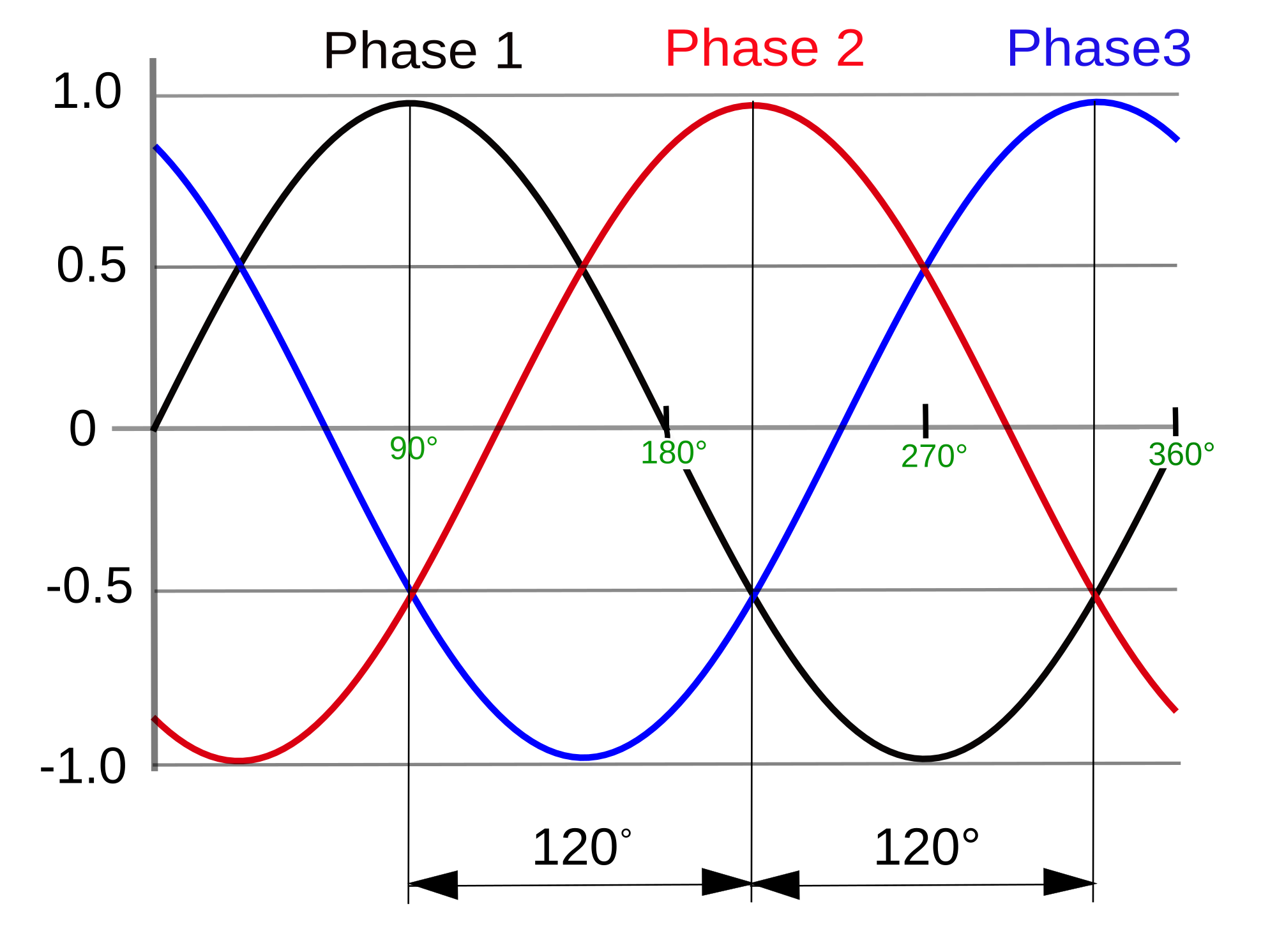
One voltage cycle of a three-phase system

A polyphase system (the term coined by Silvanus Thompson) is a means of distributing alternating-current (AC) electrical power that utilizes more than one AC phase, which refers to the phase offset value (in degrees) between AC in multiple conducting wires; phases may also refer to the corresponding terminals and conductors, as in color codes. Polyphase systems have two or more energized electrical conductors carrying alternating currents with a defined phase between the voltage waves in each conductor. Early systems used 4 wire two-phase with a 90° phase angle,[1] but modern systems almost universally use three-phase voltage, with a phase angle of 120° (or 2π/3 radians).

Polyphase systems are particularly useful for transmitting power to electric motors which rely on alternating current to rotate. Three-phase power is used for industrial applications and for power transmission. Compared to a single-phase, two-wire system, a three-phase three-wire system transmits three times as much power for the same conductor size and voltage, using only 1.5 times as many conductors, making it twice as efficient in conductor utilization.

Systems with more than three phases are often used for rectifier and power conversion systems, and have been studied for power transmission.

Number of phases

[edit]

In the very early days of commercial electric power, some installations used two-phase four-wire systems for motors. The chief advantage of these was that the winding configuration was the same as for a single-phase capacitor-start motor and, by using a four-wire system, conceptually the phases were independent and easy to analyse with mathematical tools available at the time.[2]

Two-phase systems can also be implemented using three wires (two "hot" plus a common neutral). However this introduces asymmetry; the voltage drop in the neutral makes the phases not exactly 90 degrees apart.

Two-phase systems have been replaced with three-phase systems. The move from two to three phases was originally motivated by making a more ideal rotating field for AC motors: Mikhail Dolivo-Dobrovolsky calculated that, for simple winding configurations of the time, the magnetic field fluctuation can be reduced from 40% to 15%[citation needed]. This is less important in modern machines that create a nearly ideal rotating field using sinusoidally distributed windings, but three-phase systems retain other advantages.

A two-phase supply with 90 degrees between phases can be derived from a three-phase system using a Scott-connected transformer, which can also produce three-phase power from a two-phase input.

A polyphase system must provide a defined direction of phase rotation, so mirror image voltages do not count towards the phase order. A 3-wire system with two phase conductors 180 degrees apart is still only single phase. Such systems are sometimes described as split-phase.

Motors

[edit]
Three-phase electric machine with rotating magnetic fields

Polyphase power is particularly useful in AC motors, such as the induction motor, where it generates a rotating magnetic field. When a three-or-more-phase supply completes one full cycle, the magnetic field of a two-poles-per-phase motor has rotated through 360° in physical space; motors with more than two poles per phase require more power supply cycles to complete one physical revolution of the magnetic field and so these motors run more slowly. Induction motors using a rotating magnetic field were independently invented by Galileo Ferraris and Nikola Tesla and developed in a three-phase form by Mikhail Dolivo-Dobrovolsky in 1889.[3] Previously all commercial motors were DC, with expensive commutators, high-maintenance brushes and characteristics unsuitable for operation on an alternating current network. Polyphase motors are simple to construct, are self-starting and have little vibration compared with single-phase motors.

Higher phase order

[edit]

Once polyphase power is available, it may be converted to any desired number of phases with a suitable arrangement of transformers. Thus, the need for more than three phases is unusual, but higher phase numbers than three have been used.

High-phase-order (HPO) power transmission has been frequently proposed as a way to increase transmission capacity within a limited-width right of way.[4] Transmitted power is proportional to the square of the phase-to-ground voltage drop, but transmission lines require conductors spaced adequately distant to prevent both phase-to-ground and phase-to-phase electrical arcs. For three-phase power, the phase-to-phase voltage, which is 3≈1.7 times the phase-to-ground voltage, dominates. Higher-phase systems at the same phase-to-ground voltage have less voltage difference between adjacent phases, allowing a tighter conductor spacing. For six- and higher-phase power systems, the dominant effect becomes the phase-to-ground voltage instead.[5]

Six-phase operation thus lets an existing double-circuit transmission line carry more power without requiring additional conductor cable. However, it requires the capital expense and impedance losses of new phase-converting transformers to interface with the conventional three-phase grid.[4] They are particularly economical when the alternative is upgrading an existing extra high voltage (EHV, more than 345 kV phase-to-phase) transmission line to ultra-high voltage (UHV, more than 800 kV) standards.

Between 1992 and 1995, New York State Electric & Gas operated a 1.5 mile 93kV 6-phase transmission line converted from a double-circuit 3-phase 115kV transmission line. The primary result was that it is economically favorable to operate an existing double-circuit 115kV 3-phase line as a 6-phase line for distances greater than 23–28 miles.[6]: xvii–xviii 

Three-phase power lines rely on transposition to equalize across all phases transmission losses due to slight deviations from ideal geometry. This is not possible with higher-phase lines, because a transposition can only swap adjacent phases, and the dihedral group on n elements coincides with the full symmetric group only for n≤3. Full application of even that limited transposition scheme is necessary to properly protect against ground faults.[6]: 45–52 

Multi-phase power generation designs with 5, 7, 9, 12, and 15 phases in conjunction with multi-phase induction generators (MPIGs) driven by wind turbines have been proposed. An induction generator produces electrical power when its rotor is turned faster than the synchronous speed. A multi-phase induction generator has more poles, and therefore a lower synchronous speed. Since the rotation speed of a wind turbine may be too slow for a substantial portion of its operation to generate single-phase or even three-phase AC power, higher phase orders allow the system to capture a larger portion of the rotational energy as electric power.[dubiousdiscuss][citation needed]

See also

[edit]

References

[edit]

Further reading

[edit]
Revisions and contributorsEdit on WikipediaRead on Wikipedia
from Grokipedia
A polyphase system is an electrical power distribution method that employs multiple alternating currents or voltages of the same frequency but with defined phase differences between them, enabling more efficient transmission and utilization of compared to single-phase systems. The most common configuration is the three-phase system, where three sinusoidal waveforms are offset by 120 degrees, providing balanced power delivery and constant instantaneous power in ideal conditions. Independently developed by Nikola Tesla and Galileo Ferraris in the late 1880s, polyphase systems revolutionized electrical engineering by facilitating long-distance AC power transmission and powering rotating machinery through induction motors without the need for mechanical commutation. Tesla's polyphase alternating current inventions, patented and acquired by George Westinghouse in 1888, overcame limitations of direct current systems and single-phase AC, leading to their widespread adoption in modern power grids. Key advantages include reduced conductor material requirements—typically 25% less copper than single-phase for equivalent power—smoother torque in motors, and minimized power fluctuations, making them ideal for industrial applications. In practice, polyphase systems are configured in wye (star) or delta connections, with line voltages and currents related by factors of √3 in balanced three-phase setups, and they form the backbone of global , transmission, and distribution for loads exceeding a few kilowatts. While three-phase dominates due to its balance of efficiency and simplicity, variants like two-phase (90-degree offset) appear in specialized servomechanisms, and six-phase systems support high-power rectification in applications such as aluminum production. Today, these systems underpin nearly all large-scale electrical , including utility-scale generators, charging, and integration.

Fundamentals

Definition

A polyphase system is an (AC) electrical system that employs multiple waveforms of the same but with fixed phase offsets between them, enabling efficient power distribution and utilization in applications. These systems typically involve two or more energized conductors carrying currents that are symmetrically staggered in time, with common configurations using offsets such as 120° in three-phase setups to achieve balanced operation. The term "polyphase" appears in Silvanus P. Thompson's 1895 publication Polyphase Electric Currents and Alternate-Current Motors, where it described multi-phase AC systems for and motor operation. At its core, a polyphase system operates on the principle of coordinating multiple phase currents to produce a in devices like motors or to ensure balanced and constant over lines, minimizing fluctuations inherent in simpler AC setups. Compared to single-phase AC systems, polyphase configurations transmit greater power capacity using fewer conductors per phase, as the interleaved phases allow for smoother delivery and reduced material requirements in wiring.

Historical Development

The development of polyphase systems began in the mid-1880s with pioneering experiments in (AC) motors that leveraged multiple phases to generate s. In 1885, Italian physicist and engineer independently conceived and demonstrated the first polyphase , using two out-of-phase AC currents to produce a continuous without the need for a , laying the foundational principle for self-starting AC motors. Two years later, in late 1887 and early 1888, filed a series of U.S. patents for his polyphase AC system, including motors and transmission methods that employed multiphase currents to achieve efficient production and power distribution. These innovations marked the shift from single-phase AC limitations toward more practical multiphase configurations for industrial applications. Parallel advancements occurred in , where Russian engineer , working for the German firm AEG, refined the three-phase variant in 1888–1889 by developing the first practical three-phase generator, transformer, and , optimizing it for balanced power delivery. The system's potential was proven in 1891 during the International Electrotechnical Exhibition in , , where Dolivo-Dobrovolsky's design transmitted 25 horsepower of three-phase over 175 kilometers from the Lauffen hydroelectric plant to the exhibition hall—the world's first long-distance high-voltage AC transmission—demonstrating its feasibility for widespread electrification. This breakthrough accelerated the transition from two-phase to three-phase systems as the preferred standard, owing to three-phase's greater efficiency in transmission, which required only three wires instead of four or more while delivering constant power and minimizing losses over distance, as evidenced by the 1891 Lauffen-Frankfurt line. In the United States, polyphase AC triumphed during the (late 1880s–early 1890s), a rivalry between Thomas Edison's (DC) and George Westinghouse's adoption of Tesla's polyphase patents; Westinghouse secured key contracts, including the 1893 Chicago World's Fair illumination and the 1895 hydroelectric project, which powered Buffalo 32 kilometers away and solidified AC's superiority for long-distance distribution. Standardization efforts in the early further entrenched three-phase polyphase systems globally. The (IEC), established in 1906 following the 1904 International Electrical Congress, focused on unifying electrical terminology, measurements, and ratings, including those for polyphase AC systems, to resolve inconsistencies in voltages, frequencies, and configurations across nations and enable interoperable infrastructure. By the and , IEC publications and related bodies like the had formalized guidelines for three-phase wiring, earthing, and neutral configurations, cementing its role as the backbone of modern power grids.

Configurations

Two-Phase Systems

A two-phase electrical system consists of two waveforms displaced by 90 degrees (π/2 radians) in phase, typically requiring four wires for independent delivery of each phase or three wires when using a common neutral conductor. This configuration, independently developed by in 1885 and patented by in his 1888 patent for an electro-magnetic motor (US 381,968), where two generator coils positioned at right angles produced the phase shift, connecting to motor windings via separate circuits to generate a . The phase offset enables a circular , facilitating smoother production than single-phase alternatives. Historically, two-phase systems were used in some early power distribution and before , particularly in applications like the Tesla polyphase motor designs that powered initial AC efforts. They found use in some power installations and rotary converters, which transformed frequencies or converted between AC and DC by leveraging the rotating field for mechanical rotation. Tesla's patents, including US381968, exemplified this by integrating generator and motor elements to transmit power efficiently in early industrial settings. One key advantage of two-phase systems was their ability to produce a more uniform in motors compared to single-phase systems, enabling self-starting operation without additional mechanisms and providing constant power delivery to balanced loads. This simplicity made them suitable for early AC motors and converters, reducing pulsations in power output that plagued single-phase setups. However, two-phase systems required more conductors—typically four—for equivalent compared to three-phase configurations, increasing material costs and complexity in wiring. This inefficiency contributed to their obsolescence by the early , as three-phase systems became the standard for their superior economy and reduced copper usage. Today, two-phase systems are rare in general power distribution but persist in specialized applications, such as low-power servo motors for control systems in and positioning devices. Legacy equipment in some older industrial sites or niche rotary applications also retains two-phase elements, though they are largely phased out in favor of more efficient polyphase alternatives.

Three-Phase Systems

The three-phase system consists of three sinusoidal voltage waveforms displaced by 120 degrees (or 2π/32\pi/3 radians) from one another, providing a balanced and efficient means of (AC) power delivery. This configuration typically employs either three wires for delta-connected systems or four wires—including a neutral—for star (wye)-connected systems, allowing for both three-phase and single-phase loads. In the star connection, the three phase windings are connected at a common point called the neutral, with the other ends linked to the load or supply lines, enabling the provision of both line-to-line and line-to-neutral voltages for balanced loads. The , by contrast, links the windings in a closed triangular loop without a neutral, suitable for purely three-phase balanced loads and offering higher line voltages equal to the phase voltage. Both configurations ensure symmetrical current distribution when loads are equal across phases, minimizing losses and maintaining system stability. In a wye setup, the line-to-line voltage is 3\sqrt{3}
Add your contribution
Related Hubs
User Avatar
No comments yet.