



Community hub
Recent from talks
Contribute something
Nothing was collected or created yet.
Polytope model
View on WikipediaThe polyhedral model (also called the polytope method) is a mathematical framework for programs that perform large numbers of operations -- too large to be explicitly enumerated -- thereby requiring a compact representation. Nested loop programs are the typical, but not the only example, and the most common use of the model is for loop nest optimization in program optimization. The polyhedral method treats each loop iteration within nested loops as lattice points inside mathematical objects called polyhedra, performs affine transformations or more general non-affine transformations such as tiling on the polytopes, and then converts the transformed polytopes into equivalent, but optimized (depending on targeted optimization goal), loop nests through polyhedra scanning.
Simple example
[edit]Consider the following example written in C:
const int n = 100;
int i, j;
int a[n][n] = {{0,1}};

for (i = 1; i < n; i++) {
  for (j = 1; j < (i + 2) && j < n; j++) {
    a[i][j] = a[i - 1][j] + a[i][j - 1];
  }
}

for (i = 0; i < n; i++) {
  for (j = 0; j < n; ++j) {
    printf("%4d ", a[i][j]);
  }
  puts("");
}
The essential problem with this code is that each iteration of the inner loop on a[i][j] requires that the previous iteration's result, a[i][j - 1], be available already. Therefore, this code cannot be parallelized or pipelined as it is currently written.
An application of the polytope model, with the affine transformation and the appropriate change in the boundaries, will transform the nested loops above into:

a[i - j][j] = a[i - j - 1][j] + a[i - j][j - 1];
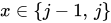
In this case, no iteration of the inner loop depends on the previous iteration's results; the entire inner loop can be executed in parallel. Indeed, given a(i, j) = a[i-j][j] then a(i, j) only depends on a(i - 1, x), with . (However, each iteration of the outer loop does depend on previous iterations.)
Detailed example
[edit]
src, before loop skewing. The red dot corresponds to src[1][0]; the pink dot corresponds to src[2][2].The following C code implements a form of error-distribution dithering similar to Floyd–Steinberg dithering, but modified for pedagogical reasons. The two-dimensional array src contains h rows of w pixels, each pixel having a grayscale value between 0 and 255 inclusive. After the routine has finished, the output array dst will contain only pixels with value 0 or value 255. During the computation, each pixel's dithering error is collected by adding it back into the src array. (Notice that src and dst are both read and written during the computation; src is not read-only, and dst is not write-only.)
Each iteration of the inner loop modifies the values in src[i][j] based on the values of src[i-1][j], src[i][j-1], and src[i+1][j-1]. (The same dependencies apply to dst[i][j]. For the purposes of loop skewing, we can think of src[i][j] and dst[i][j] as the same element.) We can illustrate the dependencies of src[i][j] graphically, as in the diagram on the right.
#define ERR(x, y) (dst[x][y] - src[x][y])

void dither(unsigned char** src, unsigned char** dst, int w, int h)
{
    int i, j;
    for (j = 0; j < h; ++j) {
        for (i = 0; i < w; ++i) {
            int v = src[i][j];
            if (i > 0)
                v -= ERR(i - 1, j) / 2;
            if (j > 0) {
                v -= ERR(i, j - 1) / 4;
                if (i < w - 1)
                    v -= ERR(i + 1, j - 1) / 4;
            }
            dst[i][j] = (v < 128) ? 0 : 255;
            src[i][j] = (v < 0) ? 0 : (v < 255) ? v : 255;
        }
    }
}
|

src, after loop skewing. The array elements will be processed in the order gray, red, green, blue, yellow...Performing the affine transformation on the original dependency diagram gives us a new diagram, which is shown in the next image. We can then rewrite the code to loop on p and t instead of i and j, obtaining the following "skewed" routine.

 void dither_skewed(unsigned char **src, unsigned char **dst, int w, int h)
 {
     int t, p;
     for (t = 0; t < (w + (2 * h)); ++t) {
         int pmin = max(t % 2, t - (2 * h) + 2);
         int pmax = min(t, w - 1);
         for (p = pmin; p <= pmax; p += 2) {
             int i = p;
             int j = (t - p) / 2;
             int v = src[i][j];
             if (i > 0)
               v -= ERR(i - 1, j) / 2;
             if (j > 0)
               v -= ERR(i, j - 1) / 4;
             if (j > 0 && i < w - 1)
               v -= ERR(i + 1, j - 1) / 4;
             dst[i][j] = (v < 128) ? 0 : 255;
             src[i][j] = (v < 0) ? 0 : (v < 255) ? v : 255;
         }
     }
 }
|
See also
[edit]External links and references
[edit]- "The basic polytope method", tutorial by Martin Griebl containing diagrams of the pseudocode example above
- "Code Generation in the Polytope Model" (1998). Martin Griebl, Christian Lengauer, and Sabine Wetzel
- "The CLooG Polyhedral Code Generator"
- "CodeGen+: Z-polyhedra scanning"[permanent dead link]
- PoCC: the Polyhedral Compiler Collection
- PLUTO - An automatic parallelizer and locality optimizer for affine loop nests
- Bondhugula, Uday; Hartono, Albert; Ramanujam, J.; Sadayappan, P. (2008-01-01). "A practical automatic polyhedral parallelizer and locality optimizer". Proceedings of the 29th ACM SIGPLAN Conference on Programming Language Design and Implementation. PLDI '08. New York, NY, USA: ACM. pp. 101–113. doi:10.1145/1375581.1375595. ISBN 9781595938602. S2CID 7086982.
- polyhedral.info - A website that collect information about polyhedral compilation
- Polly - LLVM Framework for High-Level Loop and Data-Locality Optimizations
- The MIT Tiramisu Polyhedral Framework.
Polytope model
View on GrokipediaBackground
Polyhedral Theory Basics
A polytope is a bounded polyhedron in -dimensional Euclidean space, generalizing the concept of a convex polyhedron from three dimensions to arbitrary dimensions. It consists of vertices (0-dimensional faces), edges (1-dimensional faces connecting vertices), and facets ((n-1)-dimensional faces bounding the polytope), with its combinatorial structure described by the face lattice that encodes inclusion relations among these elements.[5][6][7] Key properties of a convex polytope include its convexity, ensuring that the line segment between any two points in the polytope lies entirely within it, and its representation as the intersection of finitely many closed half-spaces. This half-space intersection yields the H-representation, formally denoted as , where is an constraint matrix and is an -dimensional bound vector defining the inequalities. Alternatively, the V-representation expresses the polytope as the convex hull of its finite set of vertices, capturing the extreme points that generate the entire shape.[5][8] Basic operations on polytopes include the Minkowski sum , which combines two polytopes by vector addition of their points, yielding another polytope whose facets are derived from the supporting hyperplanes of the operands. The intersection forms a polytope as the common region satisfying both sets of half-space constraints, potentially reducing dimensionality if empty. Projection onto a lower-dimensional subspace maps the polytope affinely, preserving convexity and resulting in another polytope.[9][6][5] The theory of convex polytopes originated in the 18th century with Leonhard Euler's 1758 formulation of the polyhedron formula , relating the numbers of vertices (), edges (), and faces () for convex polyhedra, which laid foundational insights into their combinatorial structure. This was expanded in the 19th century through studies of higher-dimensional generalizations and geometric properties by mathematicians such as August Ferdinand Möbius and Ludwig Schläfli.[10][11]Loop Nests and Parallel Computing
In imperative programming languages such as Fortran and C, loop nests consist of multiple nested loops where each loop iterates over a range of integer indices to perform computations on arrays or other data structures.[12] These structures are common in scientific and numerical applications, enabling systematic traversal of multi-dimensional data spaces.[12] Affine loop nests represent a subclass where loop bounds are affine functions—linear combinations of outer loop indices plus constants—and array access indices are affine expressions of the loop iterators.[13] Parallel computing introduces significant challenges when optimizing sequential loop nests, primarily due to data dependences that constrain the order of iterations, potentially leading to incorrect results if executed concurrently. Load balancing becomes critical to distribute work evenly across processors, avoiding idle cores and maximizing utilization in multi-core systems.[14] Locality issues arise from poor memory access patterns in sequential code, causing cache misses and increased latency on hierarchical memory architectures like those in multi-core CPUs and GPUs.[15] The primary goals of program optimization for loop nests in parallel environments are to reduce execution time by exploiting parallelism on hardware such as multi-core processors and GPUs, where thousands of threads can process independent iterations simultaneously.[16] Additionally, optimizations aim to enhance cache efficiency by improving data reuse and minimizing transfers between slow and fast memory levels, thereby addressing the memory wall in modern architectures.[15] Early efforts in loop optimization during the 1970s and 1980s focused on vectorization and parallelization of Fortran DO loops to leverage emerging vector processors and multiprocessors.[17] Seminal work by Lamport in 1974 introduced methods for parallel execution of DO loop iterations while respecting dependences.[17] Allen and Cocke's 1976 data flow analysis provided foundational techniques for detecting dependences in loops, enabling safe transformations for vectorization and parallelism. These advancements laid the groundwork for compiler-based optimizations in the 1980s, targeting supercomputers like the Cray-1.[12] The polytope model requires affine forms as prerequisites because only programs with constant or affine loop bounds and linear index expressions in iterators can be precisely represented as integer points within polytopes, allowing geometric analysis of iterations.[18] Non-affine elements, such as indirect accesses or variable bounds, prevent such exact modeling and necessitate approximations or exclusions.[19]Core Concepts
Iteration Domains as Polytopes
In the polyhedral model, the iteration domain of a statement within a static control loop nest is defined as the set of all integer points, known as lattice points, that satisfy the bounds and conditions of the surrounding loops, represented geometrically as a polytope in the multidimensional index space.[20] This polytope encapsulates the feasible executions of the statement, where each dimension corresponds to a loop index variable, enabling geometric analysis of the computation structure.[20] The vertices of the polytope are integer-valued, forming a Z-polyhedron that precisely bounds the discrete iterations.[20] The geometric representation of code in the polyhedral model treats the iteration space—the set of all possible executions of a loop body—as a convex polyhedron in multi-dimensional space. Loop bounds and strides are mapped to linear inequalities, defining the polytope that bounds the valid iterations. Each valid execution corresponds to an integer point within this polytope, providing a precise mathematical object for analyzing program behavior.[21] The construction of the iteration domain polytope proceeds by translating the syntactic elements of the loop nest—such as lower and upper bounds, step sizes (typically unity), and conditional guards—into a conjunction of linear inequalities in the iteration variables and parameters. This formulation relies on Presburger arithmetic, the first-order theory of the integers with addition, equality, and order, which serves as the logical framework for reasoning about sets of integer points in the model.[22] For a basic two-dimensional example with loopsfor i = 1 to N and for j = 1 to M, the domain is the rational polytope given by
which can be expressed in matrix form as , where is the iteration vector, are parameters, and encode the inequalities.[20] More intricate bounds, such as i + j <= N + 2, add further affine constraints like , tightening the polytope while preserving its convex nature.[20] This process ensures the polytope is parametric, accommodating symbolic sizes like and for generality across program instances.[20]
Array accesses and computations involving affine expressions, such as indexing A[i + 2*j], are incorporated by applying linear transformations to the iteration vector , mapping the domain to the data space via matrices that represent the affine mapping . These transformations allow the model to relate iteration points to memory locations without altering the core polytope definition, facilitating subsequent analyses like dependence capture.
Although the polytope is a continuous geometric object, the actual iteration domain consists of its integer lattice points, requiring discretization to enumerate or count feasible executions.[23] For parametric polytopes, the number of lattice points is approximated and exactly computed using Ehrhart polynomials, which provide a quasi-polynomial expression valid over specific parameter domains, where is the dimension and are periodic functions often involving fractional parts like .[23] For instance, in a triangular domain like , the Ehrhart polynomial yields points, precisely counting the iterations.[23]
Visualization aids understanding: in two dimensions, a rectangular loop nest forms a axis-aligned box polytope, while a triangular one appears as a right-angled shape with vertices at (1,1), (N,1), and (N,N); in three dimensions, nested loops might yield a cubic prism or irregular convex hull, highlighting the geometric intuition for higher-dimensional computations.[20]
Mathematical Transformations for Optimization
Mathematical transformations in the polyhedral model manipulate the geometric representation of iteration domains to improve performance while preserving program semantics. Affine transformations, which involve linear algebra operations such as matrix multiplications applied to the polyhedron, enable reordering of iterations to enhance parallelism and locality.[24] Specific techniques include loop tiling or blocking, which partitions a large polytope into smaller sub-polytopes to improve data locality by fitting data into CPU cache. Loop skewing and interchange alter the shape of the iteration space, exposing hidden parallelism by changing the order of loop execution. These transformations are applied through affine mappings and are verified for legality using dependence analysis to ensure correctness.[25]Dependence Analysis
In the polyhedral model, data dependences between statements in a loop nest are classified into three types: flow dependences, where one statement produces a value used by another; anti-dependences, where a statement reads a value later overwritten by another; and output dependences, where multiple statements write to the same memory location.[26] These dependences are modeled as vectors , such that there is a dependence from the source instance to the sink instance , capturing the displacement in the iteration space between dependent executions.[27] The analysis ensures the legality of transformations by mathematically proving that they produce the same numerical results as the original code, addressing hazards such as Read-After-Write dependencies.[26] Dependences are represented in the polyhedral model using dependence polyhedra, which define the set of all possible dependence vectors satisfying the program's constraints. Formally, for statements and with iteration domains defined by and , the dependence polyhedron is given by where is the source iteration vector and is the sink iteration vector.[26][27] This representation allows exact analysis of affine dependences, where the dependence vectors are affine functions of the iteration indices.[26][27] For uniform dependences, where the dependence vector is constant, Z-polyhedra provide an exact enumeration of integer points within the polyhedral constraints, ensuring precise modeling of discrete iteration points.[26][28] In contrast, full dependence polyhedra handle non-uniform cases, where varies affinely with the source index , capturing more complex relations through piecewise affine approximations over the polyhedron.[26] To determine the feasibility or existence of dependences, integer linear programming (ILP) is employed to check whether the dependence polyhedron contains any integer points; if empty, no dependence exists between the statements. This test is performed by solving the system of inequalities defining and verifying integrality at the polyhedron's vertices.[26][29] The affine dependence analysis underlying these representations was introduced by Paul Feautrier in 1992, building on earlier dataflow techniques to enable precise polyhedral scheduling.[29]Program Representation
Static Control Regions
Static control regions, also known as Static Control Parts (SCoPs), represent subsets of program code that can be precisely modeled within the polyhedral framework. These regions consist of consecutive statements embedded in loop nests where loop bounds are affine functions of surrounding lexical scope variables, loop parameters, and constants, ensuring no data-dependent bounds or while loops are present. Additionally, any conditional statements within SCoPs must feature affine conditions with respect to iteration variables and parameters, allowing the control flow to be statically analyzable. Straight-line code dominates, modulo these affine if-statements, enabling the entire region to be abstracted as a geometric structure suitable for optimization.[30][31][32] The extraction of SCoPs from source code involves parsing the program's abstract syntax tree or control flow graph to identify maximal regions satisfying the affine constraints. This process typically scans for nested for-loops with affine bounds and flags non-conforming elements like indirect accesses or non-affine expressions for exclusion. Conditional branches with affine guards are incorporated by partitioning the iteration space into unions of polyhedra, where each sub-region corresponds to a feasible execution path under the condition. Tools automate this by traversing the code structure and constructing polyhedral representations only for qualifying parts, often outputting detected SCoPs in standardized formats for further analysis.[33][34][32] SCoPs inherently exclude certain program features that introduce dynamic or non-affine behavior, limiting their applicability to a subset of numerical codes. Pointer arithmetic, indirect array accesses through computed indices, and non-affine computations such as divisions or transcendental functions cannot be represented, as they violate the affine mapping requirements. Similarly, irreducible control flow or data-dependent conditionals fall outside SCoP boundaries, necessitating approximations or extensions in advanced polyhedral frameworks to handle broader codebases. These limitations ensure mathematical tractability but restrict automatic optimization to well-structured loop-heavy kernels, which are prevalent in high-performance computing (HPC) and scientific applications where the model enables significant improvements in data locality and parallelism.[31][30][35][22] In the polyhedral model, a SCoP is formally represented as a tuple comprising the iteration domain, scatter-gather functions, and dependence relations. The iteration domain captures the polyhedral set of feasible iteration points for each statement, defined by affine inequalities and represented as a Presburger set over integer variables. Scatter-gather functions, also known as access relations, model array accesses as affine mappings from iteration vectors to memory locations, distinguishing reads (gather) and writes (scatter), and often further distinguishing between may- and must-accesses for precise over- and under-approximations. Dependences are polyhedral relations encoding data flow constraints between iterations, including read-after-write (RAW), write-after-read (WAR), and write-after-write (WAW) hazards, ensuring transformation legality while preserving program semantics. This structured tuple facilitates subsequent analyses like scheduling without altering the underlying code semantics.[32][31][22] The concept of static control regions emerged in the 1990s through foundational work at INRIA, particularly by Paul Feautrier, who developed the polyhedral approach for automatic parallelization of affine loop nests. This formalized the partitioning of programs into analyzable static parts, enabling algebraic manipulations for parallelism and locality improvements. Subsequent refinements by researchers like Feautrier and collaborators extended the model to handle conditionals via polyhedral unions, solidifying SCoPs as a cornerstone for polyhedral compilation tools.[36][37]Integer Programming Formulation
In the polyhedral model, iteration domains and other program elements are often parameterized by symbolic constants, such as array dimensions and , to handle general-purpose code without fixing concrete values. These structures are represented as parametric polytopes, defined as , where is a fixed integer matrix, is affine in the parameters , and captures iteration variables or other discrete points. This parameterization enables symbolic analysis and transformation of loop nests for arbitrary input sizes, preserving the geometric properties of the polytope while allowing computations over unknown parameters.[22] Integer linear programming (ILP) provides the foundational computational mechanism for manipulating these parametric polytopes in the polyhedral model. An ILP problem seeks to minimize subject to , with , where , , and may depend on parameters. In this context, ILP is applied to tasks such as enumerating all integer points within a polytope (by iteratively solving feasibility problems), computing projections onto lower-dimensional subspaces (essential for dependence analysis and scattering), and deriving symbolic bounds or quasi-affine representations of iteration spaces. For instance, to enumerate integer points, one can minimize and maximize each variable sequentially under the polytope constraints, ensuring exact discrete solutions without over-approximation.[22] A key application of ILP in the polyhedral model is the computation of exact integer points, convex hulls of point sets, and symbolic manipulations of parameterized polytopes, often facilitated by specialized libraries. The Parametric Integer Programmer (PIP), originally developed by Paul Feautrier, solves parametric ILP problems to find lexicographically minimal solutions or enumerate points, directly supporting operations like polyhedral projection and integer hull computation in compiler tools. PIP handles the parametric case by computing solutions as quasi-affine functions of the parameters, enabling precise representation of iteration domains for code generation and optimization. These capabilities are integrated into broader polyhedral libraries, allowing tools to manipulate high-level program representations symbolically.[38][39] Despite its power, ILP poses significant computational challenges in the polyhedral model due to its NP-hardness in general, particularly for high-dimensional or highly parameterized instances. Exact solutions require exponential time in the worst case, prompting the use of approximations or specialized methods for projections, such as Fourier-Motzkin elimination, which systematically eliminates variables from the inequality system to compute the projected polyhedron—though it can lead to a combinatorial explosion in the number of inequalities. For practical efficiency in fixed-dimensional settings (common in loop nests with limited depth), Lenstra's 1983 algorithm provides a polynomial-time solution for ILP feasibility and optimization when the number of variables is constant, forming the basis for adaptations in polyhedral tools that exploit low dimensionality to achieve tractable performance.[22]Transformations and Optimizations
Scheduling Techniques
In the polyhedral model, scheduling refers to the process of assigning execution times and processors to iteration points within the polytope-defined iteration domains, ensuring that data dependences are respected while optimizing for parallelism and locality. This mapping is typically expressed using affine functions of the form , where is the iteration vector, is the schedule matrix determining the transformation, and is a constant offset vector. The schedule matrix encodes both temporal ordering and processor allocation, with its rows corresponding to different dimensions such as time or processor indices. Such affine schedules allow for systematic derivation of parallel code by projecting iterations onto processor spaces while maintaining sequential semantics. Affine transformations, by applying linear algebra to the polyhedron, enable code that runs faster by optimizing the execution order and exposing performance improvements through better resource utilization.[40] Affine scheduling extends uniform scheduling, which applies to cases with constant dependence vectors, by handling more general affine dependences. For a dependence from iteration to where , the schedule must satisfy in the time dimension to preserve causality. This leads to a system of linear inequalities over the entries of , solved via integer linear programming to find valid integer-valued schedules. Paul Feautrier's seminal approach formulates this as an integer programming problem, minimizing objectives like schedule height (temporal span) subject to dependence constraints, enabling efficient computation even for one-dimensional time schedules.[41] Key algorithms for generating such schedules include Feautrier's integer programming method from 1992, which constructs affine schedules by solving parametric systems of inequalities derived from dependence polyhedra. For unimodular transformations—those preserving the iteration space volume and integrality—William Pugh's framework employs unimodular transformations to parameterize reordering operations like loop interchange, skewing, and reversal within a unified model, ensuring legality through preservation of dependence directions. These unimodular transformations, including loop skewing and interchange, change the shape of the iteration space to expose parallelism that was not visible in the original source code, thereby improving performance by enabling efficient parallel execution on multi-core systems.[42][43] Multi-dimensional scheduling generalizes one-dimensional time assignment by using vector-valued schedules, where the first dimension represents global time and subsequent dimensions allocate iterations to processors or hierarchical levels for fine- and coarse-grained parallelism. Feautrier's extension to multi-dimensional time treats the schedule as a higher-dimensional affine mapping, solving successive integer programs to satisfy dependences across all dimensions while enabling wavefront parallelism. For instance, the outer dimension enforces sequential ordering, while inner dimensions distribute work across processors, accommodating hierarchical architectures like multicore systems. This approach guarantees the existence of a valid multi-dimensional schedule for any static control region with acyclic dependences.[44] Legality of a schedule requires acyclicity in the induced precedence graph, where no cycles violate dependence directions, ensuring a total partial order on iterations. This is verified by checking that the schedule matrix orients all dependence vectors positively in the time dimension. Additionally, minimal volume schedules seek to minimize the determinant of the transformation or the overall span of the scheduled space, reducing parallel slack—the unused processor capacity between dependent iterations—to maximize effective parallelism. Such schedules are optimized via integer linear programming objectives that penalize excessive temporal separation, as demonstrated in frameworks balancing locality and concurrency.[45]Tiling and Fusion
In the polyhedral model, tiling partitions the iteration space of a statement, represented as a polytope, into smaller hyper-rectangular or polyhedral tiles to enhance data locality and expose parallelism. This is typically achieved by introducing cutting planes parallel to the polytope's facets, which divide the space into atomic blocks that can be processed independently while respecting program semantics. By breaking a large polyhedron into smaller blocks, tiling improves data locality, allowing data to fit into CPU cache and reducing memory access times, thereby enhancing overall performance.[46][47] Such partitioning allows for better exploitation of cache hierarchies by grouping iterations that access overlapping data regions.[48] Algorithms for legal tiling in the polyhedral model ensure that data dependences are either contained within a single tile (intra-tile) or properly ordered across tiles (inter-tile), preserving the original program's execution order. This legality is verified using integer linear programming (ILP) formulations, where tile sizes and shapes are optimized by solving constraints that bound dependence vectors within or across tiles, often minimizing communication volume or maximizing reuse.[48] For instance, ILP can compute tiling hyperplanes such that forward dependences remain valid, enabling atomic execution of tiles.[48] Loop fusion complements tiling by merging adjacent static control regions (SCoPs) into a single loop nest when no loop-carried dependences exist between them, thereby eliminating intermediate temporary arrays and reducing memory overhead. This transformation promotes data reuse across computations that would otherwise operate on separate buffers, streamlining the control flow without introducing redundant iterations. Together, tiling and fusion improve cache utilization through enhanced data reuse and facilitate blocked parallelism by creating coarser-grained tasks suitable for multi-core execution.[48] These techniques, introduced in the late 1980s and early 1990s as part of the emerging polyhedral framework, have been implemented in tools like the Polyhedral Compiler Collection (PoCC), which supports polyhedral tiling for parametric and non-parametric codes.[49][50]Applications and Tools
Code Generation and Parallelization
The code generation process in the polyhedral model transforms scheduled and tiled iteration domains—represented as polytopes with associated scattering functions—into executable code by scanning the polyhedral representation to produce loop nests with embedded pragmas or kernel launches. This involves parameterizing the iteration space with symbolic constants and generating affine mappings to map points to outer loops, inner loops, and statements, often using algorithms like the transitive closure for precise traversal. Scanning the polyhedron entails traversing the integer points within the transformed multidimensional space to generate nested loops, which can result in code that appears complex and non-intuitive to human readers but executes efficiently on hardware due to optimized scheduling and data access patterns.[30][51] For parallel architectures, the output incorporates directives such as OpenMP pragmas for shared-memory systems, CUDA kernels for GPUs, or MPI calls for distributed environments, ensuring that the generated code preserves the semantics of the original program while exposing parallelism. A foundational approach to this generation handles non-unimodular and non-uniform transformations efficiently, enabling practical implementation in compilers.[30] Parallelization strategies leverage the model's ability to identify independent tiles and distribute them across processors, often after applying scheduling techniques like those in prior sections to eliminate dependences. This enables automatic parallelization, where the model detects independent iterations without manual intervention, facilitating distribution across multi-core CPUs or GPUs. For shared-memory targets, outer loops over tiles are annotated with OpenMP parallel for directives, while inner tiles may use SIMD or thread-level parallelism; reductions, such as array sums, are handled by inserting atomic operations or runtime aggregation to resolve write conflicts without altering the polyhedral schedule. The model supports vectorization by aligning suitable inner loops to generate SIMD (Single Instruction, Multiple Data) instructions, improving throughput on vector processors.[51][52] In GPU contexts, multilevel tiling maps outer tiles to grid blocks and inner ones to threads, with synchronizations managed via CUDA barriers to enforce intra-block coherence. For distributed systems, tiles are partitioned across nodes with MPI communications for halo exchanges, minimizing data movement by aligning with the scattering function. These strategies ensure load balancing and scalability, though they require precise dependence analysis to avoid races.[53][54][55] Performance evaluations on benchmarks like Polybench demonstrate significant speedups from polyhedral-based code generation and parallelization, with geometric mean improvements of up to 3.39× over LLVM -O3 optimizations across linear algebra and stencil kernels on multicore CPUs. These optimizations address the memory wall by enhancing data locality through tiling, which reduces cache misses and memory access latencies in modern processors where memory bandwidth lags behind computational speed.[56] In GPU settings, CUDA kernels generated via polyhedral methods achieve significant speedups over sequential code for imperfectly nested loops, highlighting the model's effectiveness in exploiting massive parallelism. Polyhedral techniques are integrated into AI compilers, such as TensorFlow's XLA, which uses polyhedral optimizations via LLVM Polly for efficient tensor computations, and similar approaches in PyTorch's TorchInductor for dynamic graph optimizations.[57][53][58][59] However, these gains are selective, primarily benefiting affine loop nests amenable to tiling.[57][53] Limitations arise in scalability for large nests exceeding five dimensions, where integer linear programming solvers for scheduling and tiling become computationally prohibitive, often requiring hours for analysis. Additionally, the model restricts code generation to static-control parts (SCoPs), excluding non-affine code like pointer aliasing or dynamic bounds, which limits applicability to a subset of real-world programs without extensions. Handling non-SCoP code demands hybrid approaches, but these introduce approximation errors in parallelization.[31][60] Case studies illustrate practical transformations in production compilers. In GCC's Graphite framework, polyhedral analysis detects parallelizable loops and generates OpenMP code by fusing and parallelizing affine regions. Similarly, LLVM's Polly performs polyhedral optimizations including automatic OpenMP insertion for detected parallelism, yielding 2-5× improvements on Polybench stencils through integrated code generation that lowers the model back to LLVM IR. As of LLVM 21 (released in 2025), Polly continues to provide polyhedral optimizations with recent enhancements and bug fixes. These implementations underscore the model's viability for mainstream parallel code production.[54][61][3]Software Implementations
Polly is an open-source framework integrated into the LLVM compiler infrastructure since 2011, providing polyhedral optimizations for static control parts (SCoPs) of programs through detection, scheduling, and code generation capabilities. It extracts loop nests into the polyhedral representation, applies transformations like tiling and fusion, and generates optimized LLVM intermediate representation (IR) code, enabling improvements in data locality and parallelism for applications such as linear algebra kernels. Polly also supports vectorization to produce SIMD instructions, enhancing performance on vector-enabled hardware.[3][62][3] The CLooG (Code Loop-optimizer Gene-rator) library is a specialized tool for generating efficient loop code that iterates over integer points in Z-polyhedra, a core operation in polyhedral compilation.[63] Originally developed to support code generation in polyhedral optimizers, it was integrated into earlier versions of production compilers like GCC (prior to version 5) for handling polyhedral representations and producing minimal control overhead in output code, such as in the Graphite loop optimizer. Current versions of Graphite use ISL for code generation.[64] The Integer Set Library (ISL) serves as a foundational library for manipulating integer sets, relations, and polyhedra in the polyhedral model, supporting operations like parametric integer projections essential for scheduling and dependence analysis.[22] Developed by Sven Verdoolaege in the late 2000s and released in 2010, ISL underpins many polyhedral tools by providing exact algorithms for tasks such as set unions, intersections, and eliminations while handling parametric integers efficiently. It is widely used in tools like Polly and PLuTo for precise manipulation of polyhedral structures.[65][66] Among other notable implementations, the PoCC (Polyhedral Compiler Collection) framework facilitates dependence testing and polyhedral analysis for source-to-source transformations, integrating tools like ISL for accurate computation of data dependencies in affine loop nests.[50] For scheduling, tools like PLuTo apply polyhedral techniques to automatic parallelization and locality optimization, generating schedules that expose parallelism and improve cache utilization for high-performance computing applications. Commercial compilers, including IBM's XL C/C++ suite, incorporate polyhedral passes for loop optimizations like fusion and parallelization, leveraging internal schedulers similar to PLuTo for production workloads.[67][68][56] Key trade-offs in these tools involve balancing computational exactness with performance; for instance, ISL's implementation of the Fourier-Motzkin elimination algorithm provides precise projections for polyhedral operations but scales poorly for large dimensions due to its exponential complexity, often necessitating heuristic approximations in tools like Polly or PoCC to achieve practical speeds on real-world codes.[69][70] Heuristics, such as those in scheduling passes, prioritize scalability by approximating integer solutions while maintaining legality, enabling broader applicability at the cost of occasional suboptimal transformations compared to exact methods.[71]Examples
Basic Iteration Space Example
A basic example of an iteration space in the polytope model is the initialization of a two-dimensional matrix, which involves a simple nested loop without data dependences. Consider the following C-like code snippet for initializing an matrix to zero:for (int i = 1; i <= N; i++) {
for (int j = 1; j <= N; j++) {
C[i][j] = 0;
}
}
for (int i = 1; i <= N; i++) {
    for (int j = 1; j <= N; j++) {
        C[i][j] = 0;
    }
}
Advanced Dependence Transformation Example
To illustrate the application of the polytope model to a computation with data dependences, consider a 2D in-place Gauss-Seidel relaxation stencil, commonly used in solving partial differential equations such as Laplace's equation. The iteration domain is defined by the polyhedron , where is the grid size. The statement is:for (int i = 1; i <= N-1; i++)
for (int j = 1; j <= N-1; j++)
A[i][j] = (A[i-1][j] + A[i+1][j] + A[i][j-1] + A[i][j+1] + b[i][j]) / 4.0;
for (int i = 1; i <= N-1; i++)
  for (int j = 1; j <= N-1; j++)
    A[i][j] = (A[i-1][j] + A[i+1][j] + A[i][j-1] + A[i][j+1] + b[i][j]) / 4.0;
for (int bs = 0; bs < (2*(N-2))/32; bs++) {
  #pragma omp parallel for
  for (int bd = 0; bd < (2*(N-2))/32; bd++) {
    for (int s = bs*32; s < (bs+1)*32 && s < 2*(N-2); s++) {
      for (int d = max(-s, -(2*(N-2)-s)); d <= min(s, 2*(N-2)-s); d += 2) {  // Step by 2 for even/odd diagonals
        int i = (s + d)/2, j = (s - d)/2;
        if (1 <= i && i <= N-1 && 1 <= j && j <= N-1)
          A[i][j] = (A[i-1][j] + A[i+1][j] + A[i][j-1] + A[i][j+1] + b[i][j]) / 4.0;
      }
    }
  }
}
for (int bs = 0; bs < (2*(N-2))/32; bs++) {
  #pragma omp parallel for
  for (int bd = 0; bd < (2*(N-2))/32; bd++) {
    for (int s = bs*32; s < (bs+1)*32 && s < 2*(N-2); s++) {
      for (int d = max(-s, -(2*(N-2)-s)); d <= min(s, 2*(N-2)-s); d += 2) {  // Step by 2 for even/odd diagonals
        int i = (s + d)/2, j = (s - d)/2;
        if (1 <= i && i <= N-1 && 1 <= j && j <= N-1)
          A[i][j] = (A[i-1][j] + A[i+1][j] + A[i][j-1] + A[i][j+1] + b[i][j]) / 4.0;
      }
    }
  }
}