


Community hub
Recent from talks
Contribute something
Nothing was collected or created yet.
Lattice (group)
View on Wikipedia | This article relies largely or entirely on a single source. (October 2022) |

| Algebraic structure → Group theory Group theory |
|---|
 |
|
|

In geometry and group theory, a lattice in the real coordinate space is an infinite set of points in this space with these properties:[1]

- Coordinate-wise addition or subtraction of two points in the lattice produces another lattice point.
- The lattice points are all separated by some minimum distance.
- Every point in the space is within some maximum distance of a lattice point.
One of the simplest examples of a lattice is the square lattice, which consists of all points in the plane whose coordinates are both integers, and its higher-dimensional analogues the integer lattices .


Closure under addition and subtraction means that a lattice must be a subgroup of the additive group of the points in the space. The requirements of minimum and maximum distance can be summarized by saying that a lattice is a Delone set.[2]
More abstractly, a lattice can be described as a free abelian group of dimension which spans the vector space . For any basis of , the subgroup of all linear combinations with integer coefficients of the basis vectors forms a lattice, and every lattice can be formed from a basis in this way. A lattice may be viewed as a regular tiling of a space by a primitive cell.

Lattices have many significant applications in pure mathematics, particularly in connection to Lie algebras, number theory and group theory. They also arise in applied mathematics in connection with coding theory, in percolation theory to study connectivity arising from small-scale interactions, cryptography because of conjectured computational hardness of several lattice problems, and are used in various ways in the physical sciences. For instance, in materials science and solid-state physics, a lattice is a synonym for the framework of a crystalline structure, a 3-dimensional array of regularly spaced points coinciding in special cases with the atom or molecule positions in a crystal. More generally, lattice models are studied in physics, often by the techniques of computational physics.
Symmetry considerations and examples
[edit]A lattice is the symmetry group of discrete translational symmetry in n directions. A pattern with this lattice of translational symmetry cannot have more, but may have less symmetry than the lattice itself.[3] As a group (dropping its geometric structure) a lattice is a finitely generated free abelian group, and thus isomorphic to .
A lattice in the sense of a 3-dimensional array of regularly spaced points coinciding with e.g. the atom or molecule positions in a crystal, or more generally, the orbit of a group action under translational symmetry, is a translation of the translation lattice: a coset, which need not contain the origin, and therefore need not be a lattice in the previous sense.
A simple example of a lattice in is the subgroup . More complicated examples include the E8 lattice, which is a lattice in , and the Leech lattice in . The period lattice in is central to the study of elliptic functions, developed in nineteenth century mathematics; it generalizes to higher dimensions in the theory of abelian functions. Lattices called root lattices are important in the theory of simple Lie algebras; for example, the E8 lattice is related to a Lie algebra that goes by the same name.


Dividing space according to a lattice
[edit]A lattice in thus has the form

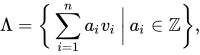
where is a basis for . Different bases can generate the same lattice, but the absolute value of the determinant of the Gram matrix of the vectors is uniquely determined by and denoted by . If one thinks of a lattice as dividing the whole of into equal polyhedra (copies of an n-dimensional parallelepiped, known as the fundamental region of the lattice), then is equal to the n-dimensional volume of this polyhedron. This is why is sometimes called the covolume of the lattice. If this equals 1, the lattice is called unimodular.


Lattice points in convex sets
[edit]Minkowski's theorem relates the number and the volume of a symmetric convex set to the number of lattice points contained in . The number of lattice points contained in a polytope all of whose vertices are elements of the lattice is described by the polytope's Ehrhart polynomial. Formulas for some of the coefficients of this polynomial involve as well.

Computational lattice problems
[edit]Computational lattice problems have many applications in computer science. For example, the Lenstra–Lenstra–Lovász lattice basis reduction algorithm (LLL) has been used in the cryptanalysis of many public-key encryption schemes,[4] and many lattice-based cryptographic schemes are known to be secure under the assumption that certain lattice problems are computationally difficult.[5]
Lattices in two dimensions: detailed discussion
[edit]
There are five 2D lattice types as given by the crystallographic restriction theorem. Below, the wallpaper group of the lattice is given in IUCr notation, Orbifold notation, and Coxeter notation, along with a wallpaper diagram showing the symmetry domains. Note that a pattern with this lattice of translational symmetry cannot have more, but may have less symmetry than the lattice itself. A full list of subgroups is available. For example, below the hexagonal/triangular lattice is given twice, with full 6-fold and a half 3-fold reflectional symmetry. If the symmetry group of a pattern contains an n-fold rotation then the lattice has n-fold symmetry for even n and 2n-fold for odd n.
| cmm, (2*22), [∞,2+,∞] | p4m, (*442), [4,4] | p6m, (*632), [6,3] |
|---|---|---|
  rhombic lattice also centered rectangular lattice isosceles triangular |
  square lattice right isosceles triangular |
 hexagonal lattice (equilateral triangular lattice) |
| pmm, *2222, [∞,2,∞] | p2, 2222, [∞,2,∞]+ | p3m1, (*333), [3[3]] |
  rectangular lattice also centered rhombic lattice right triangular |
  oblique lattice scalene triangular |
 equilateral triangular lattice (hexagonal lattice) |
For the classification of a given lattice, start with one point and take a nearest second point. For the third point, not on the same line, consider its distances to both points. Among the points for which the smaller of these two distances is least, choose a point for which the larger of the two is least. (Not logically equivalent but in the case of lattices giving the same result is just "Choose a point for which the larger of the two is least".)
The five cases correspond to the triangle being equilateral, right isosceles, right, isosceles, and scalene. In a rhombic lattice, the shortest distance may either be a diagonal or a side of the rhombus, i.e., the line segment connecting the first two points may or may not be one of the equal sides of the isosceles triangle. This depends on the smaller angle of the rhombus being less than 60° or between 60° and 90°.
The general case is known as a period lattice. If the vectors p and q generate the lattice, instead of p and q we can also take p and p − q, etc. In general in 2D, we can take a p + b q and c p + d q for integers a,b, c and d such that ad-bc is 1 or −1. This ensures that p and q themselves are integer linear combinations of the other two vectors. Each pair p, q defines a parallelogram, all with the same area, the magnitude of the cross product. One parallelogram fully defines the whole object. Without further symmetry, this parallelogram is a fundamental parallelogram.

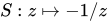
The vectors p and q can be represented by complex numbers. Up to size and orientation, a pair can be represented by their quotient. Expressed geometrically: if two lattice points are 0 and 1, we consider the position of a third lattice point. Equivalence in the sense of generating the same lattice is represented by the modular group: represents choosing a different third point in the same grid, represents choosing a different side of the triangle as reference side 0–1, which in general implies changing the scaling of the lattice, and rotating it. Each "curved triangle" in the image contains for each 2D lattice shape one complex number, the grey area is a canonical representation, corresponding to the classification above, with 0 and 1 two lattice points that are closest to each other; duplication is avoided by including only half of the boundary. The rhombic lattices are represented by the points on its boundary, with the hexagonal lattice as vertex, and i for the square lattice. The rectangular lattices are at the imaginary axis, and the remaining area represents the parallelogrammatic lattices, with the mirror image of a parallelogram represented by the mirror image in the imaginary axis.

Lattices in three dimensions
[edit]The 14 lattice types in 3D are called Bravais lattices. They are characterized by their space group. 3D patterns with translational symmetry of a particular type cannot have more, but may have less, symmetry than the lattice itself.
Lattices in complex space
[edit]A lattice in is a discrete subgroup of which spans as a real vector space. As the dimension of as a real vector space is equal to , a lattice in will be a free abelian group of rank .


For example, the Gaussian integers form a lattice in , as is a basis of over .
![{\displaystyle \mathbb {Z} [i]=\mathbb {Z} +i\mathbb {Z} }](https://wikimedia.org/api/rest_v1/media/math/render/svg/a2749edc2f0a1147036f27d5dd0f5c7e365ac981)


In Lie groups
[edit]More generally, a lattice Γ in a Lie group G is a discrete subgroup, such that the quotient G/Γ is of finite measure, for the measure on it inherited from Haar measure on G (left-invariant, or right-invariant—the definition is independent of that choice). That will certainly be the case when G/Γ is compact, but that sufficient condition is not necessary, as is shown by the case of the modular group in SL2(R), which is a lattice but where the quotient isn't compact (it has cusps). There are general results stating the existence of lattices in Lie groups.
A lattice is said to be uniform or cocompact if G/Γ is compact; otherwise the lattice is called non-uniform.
Lattices in general vector spaces
[edit] |
While we normally consider lattices in this concept can be generalized to any finite-dimensional vector space over any field. This can be done as follows:
Let K be a field, let V be an n-dimensional K-vector space, let be a K-basis for V and let R be a ring contained within K. Then the R lattice in V generated by B is given by:


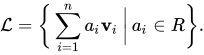
In general, different bases B will generate different lattices. However, if the transition matrix between the bases is in – the general linear group of (in simple terms this means that all the entries of are in and all the entries of are in – which is equivalent to saying that the determinant of T is in – the unit group of elements in R with multiplicative inverses) then the lattices generated by these bases will be isomorphic since T induces an isomorphism between the two lattices.


Important cases of such lattices occur in number theory with K a p-adic field and the p-adic integers.
For a vector space which is also an inner product space, the dual lattice can be concretely described by the set

or equivalently as

Related notions
[edit]- A primitive element of a lattice is an element that is not a positive integer multiple of another element in the lattice.[citation needed]
See also
[edit]Notes
[edit]- ^ Gruber, Peter M.; Lekkerkerker, Cornelis G. (1987). Geometry of numbers. North-Holland Mathematical Library (Second ed.). Amsterdam, The Netherlands: North-Holland. ISBN 978-0-08-096023-4.
- ^ Baake, Michael; Grimm, Uwe (2013). Aperiodic order. Encyclopedia of mathematics and its applications. Cambridge ; New York: Cambridge University Press. ISBN 978-0-521-86991-1.
- ^ "Symmetry in Crystallography Notes". xrayweb.chem.ou.edu. Archived from the original on 2022-08-26. Retrieved 2022-11-06.
- ^ Nguyen, Phong; Stern, Jacques (2001). "The Two Faces of Lattices in Cryptology". Cryptography and Lattices. Lecture Notes in Computer Science. Vol. 2146. pp. 146–180. doi:10.1007/3-540-44670-2_12. ISBN 978-3-540-42488-8.
- ^ Regev, Oded (2005-01-01). "On lattices, learning with errors, random linear codes, and cryptography". Proceedings of the thirty-seventh annual ACM symposium on Theory of computing. STOC '05. New York, NY, USA: ACM. pp. 84–93. CiteSeerX 10.1.1.110.4776. doi:10.1145/1060590.1060603. ISBN 978-1581139600. S2CID 53223958.
References
[edit]- Conway, John Horton; Sloane, Neil J. A. (1999), Sphere Packings, Lattices and Groups, Grundlehren der Mathematischen Wissenschaften, vol. 290 (3rd ed.), Berlin, New York: Springer-Verlag, ISBN 978-0-387-98585-5, MR 0920369
External links
[edit]| Seven 3D systems |
|
|---|---|
| Four 2D systems | |


Lattice (group)
View on GrokipediaDefinitions and Basic Properties
Formal Definition
In the context of topological groups, a lattice in a locally compact abelian group is defined as a discrete subgroup such that the quotient space has finite Haar measure, also known as finite covolume.\] This condition ensures that $\Gamma$ is "full rank" in $G$, capturing the essential structure for applications in [harmonic analysis](/page/Harmonic_analysis) and [geometry](/page/Geometry).\[ Discreteness of means that it is a discrete subset of in the given topology, i.e., for every point , there exists a neighborhood of in such that .\] The finite covolume property is equivalent to the [existence](/page/Existence) of a compact [subset](/page/Subset) $K \subset G$ such that $G$ is the closure of the [subgroup](/page/Subgroup) generated by $K$ and $\Gamma$, meaning $G = \overline{\langle K \cup \Gamma \rangle}$.\[ These conditions together imply that the quotient is compact, providing a fundamental framework for studying periodic phenomena in .$$] A prototypical example is the integer lattice , which forms a discrete subgroup of under addition, with the quotient being the -torus, a compact group of finite measure.[$$Fundamental Properties
A fundamental structural property of lattices in is encapsulated in the rank theorem, which asserts that every lattice has rank , meaning is isomorphic to as an abelian group. This follows from the more general structure theorem for discrete subgroups: any discrete additive subgroup of is free abelian of rank , generated over by linearly independent vectors . For to qualify as a lattice, it must achieve the maximal rank , ensuring it spans over and satisfies the discreteness condition.[3] Another key intrinsic property is the covolume (also called the determinant) of a lattice , denoted , which measures the volume of a fundamental domain for the quotient . For a basis of , this is given by where is the matrix with columns . This value is independent of the choice of basis, as any two bases are related by a matrix in , whose determinant has absolute value 1. The covolume provides a measure-theoretic invariant that quantifies the "density" of the lattice points in .[4] In the context of the quotient space, a discrete subgroup forms a lattice if and only if is compact, which occurs precisely when has full rank . This compactness implies that the quotient is a finite-volume manifold—specifically, an -torus—and the number of cosets is finite in the sense that the space admits a finite fundamental domain. The equivalence highlights the dual role of lattices as both algebraic structures (discrete subgroups) and geometric ones (tiling with finite-volume cells).[5] Lattices also underpin important analytic properties, notably the Poisson summation formula, which originates from the work of Siméon Denis Poisson in 1823 and links summation over a lattice to Fourier analysis on its dual. For a Schwartz function and lattice with dual , the formula states where is the Fourier transform of . This identity reveals deep connections between the lattice and its dual, with applications in number theory and harmonic analysis.Geometric and Algebraic Structures
Lattices in Euclidean Space
In Euclidean space , a lattice is defined as a discrete subgroup that spans over , meaning it is a full-rank discrete additive subgroup of the additive group .[6] This geometric realization bridges the abstract notion of a lattice as a discrete subgroup in a locally compact abelian group to the structured setting of vector spaces equipped with the standard Euclidean inner product.[7] Specifically, is discrete if there exists such that the open ball of radius around the origin contains no other points of besides the origin, ensuring no accumulation points.[8] Any such lattice in is a free -module of rank , generated by linearly independent vectors , so .[6] These vectors form a basis for , and the full-rank condition guarantees that they span over . Two bases for the same lattice differ by right multiplication by a matrix in , the group of unimodular integer matrices with determinant . For integer lattices, where the basis vectors have integer coordinates relative to the standard basis of , the Hermite normal form provides a canonical representative: any full-rank integer matrix can be uniquely transformed into lower triangular form with non-negative diagonal entries and off-diagonal entries strictly smaller than the corresponding diagonal, via unimodular row operations.[9] More generally, two lattices and in are equivalent if there exists a matrix such that , meaning is the image of under the invertible linear transformation defined by .[7] This equivalence captures the space of all full-rank lattices as the quotient , where right action by accounts for basis changes. The dual lattice is defined with respect to the standard inner product on as , forming another full-rank lattice that pairs integrally with .[6] The determinant of a lattice, defined as the volume of the fundamental parallelepiped spanned by a basis (i.e., for basis matrix ), satisfies .[6] This relation arises from the bilinear form induced by the inner product, preserving the integer-valued pairing while inverting the covolume.[10]Dividing Space and Symmetry
Lattices partition Euclidean space into fundamental domains that tile the space without overlaps or gaps, providing a geometric framework for understanding periodic structures. For a lattice generated by a basis , the fundamental parallelepiped is defined as the set . Translations of this parallelepiped by elements of cover all of exactly once, reflecting the discrete translational symmetry of the lattice. The volume of this parallelepiped is given by , where is the matrix whose columns are the basis vectors , which equals the determinant of the lattice .[11] Another key fundamental domain is the Voronoi cell, which captures the nearest-neighbor regions around lattice points. For a lattice containing the origin, the Voronoi cell is the set , consisting of all points closer to the origin than to any other lattice point under the Euclidean norm. This cell is a convex polytope that tiles by translations from and serves as a dual to the fundamental parallelepiped in analyzing lattice geometry and packing densities. The volume of the Voronoi cell equals , matching the volume of the fundamental parallelepiped.[12][13] In crystallography, lattices act as the translation subgroups of space groups, which describe the full symmetry of periodic crystal structures by combining lattice translations with point group operations such as rotations, reflections, and inversions. The translation lattice is an infinite abelian normal subgroup of the space group, and the quotient by this subgroup yields the finite point group. There are 230 distinct space groups in three dimensions, classified according to the 14 Bravais lattice types and compatible point groups; in two dimensions, the analogous 17 wallpaper groups (or plane crystallographic groups) govern periodic patterns.[14] Representative examples illustrate these symmetries in cubic systems. The primitive cubic lattice (denoted P) consists of points at the corners of a cubic unit cell, with one lattice point per cell and belonging to space groups such as Pmm, which has the full octahedral point group symmetry including four threefold rotation axes. In contrast, the body-centered cubic lattice (denoted I) includes an additional lattice point at the body center, resulting in two points per cell and associating with space groups like Imm, also under symmetry but with a denser arrangement that halves the primitive cell volume relative to the conventional cube.[15][16]Low-Dimensional Lattices
Two-Dimensional Lattices
Two-dimensional lattices in are discrete subgroups generated by two linearly independent vectors and , forming a parallelogram of minimal area known as the fundamental domain. Up to rotation and scaling, these lattices are classified by the modular parameter , the upper half-plane where , defined after normalizing and rotating so aligns with the x-axis (thus ), as where ; this captures the aspect ratio and shear. The special linear group acts on via fractional linear transformations for , identifying equivalent lattices under basis changes, with a fundamental domain given by and .[17][18] The five distinct Bravais lattice types in two dimensions arise from symmetry considerations and are characterized by their lattice parameters , (side lengths), and (angle between them). The oblique lattice has and , offering the lowest symmetry. The rectangular lattice features and , while the centered rectangular (or base-centered orthorhombic) also has but includes centering at the parallelogram's center, effectively doubling the unit cell density in certain projections. The square lattice satisfies and , exhibiting four-fold rotational symmetry. Finally, the hexagonal lattice has and , with six-fold symmetry, making it the most symmetric two-dimensional type./02%3A_Rotational_Symmetry/2.06%3A_Bravais_Lattices_(2-d))[19] The hexagonal lattice is generated by basis vectors and , both of unit length, yielding a fundamental parallelogram with area (determinant) . This configuration achieves the densest packing of equal circles in the plane, with packing density , as proven by Thue and later rigorously by Fejes Tóth./02%3A_Rotational_Symmetry/2.06%3A_Bravais_Lattices_(2-d))[20] For lattice polygons—simple polygons with vertices on lattice points—Pick's theorem relates the area to the number of interior lattice points and boundary lattice points via . This formula, originally derived using Euler's polyhedron formula on triangulations, provides a discrete geometric measure without integration and applies directly to counting problems in the plane.[21][22]Three-Dimensional Lattices
In three-dimensional Euclidean space, Bravais lattices are classified into 14 distinct types, grouped according to their symmetry into seven crystal systems: triclinic, monoclinic, orthorhombic, tetragonal, trigonal (or rhombohedral), hexagonal, and cubic.[23] This classification, originally established by Auguste Bravais in 1848, arises from the possible combinations of translation symmetries and centering types (primitive, body-centered, face-centered, or base-centered) that maintain the lattice's regularity.[24] Each type is defined by a set of basis vectors that generate all lattice points through integer linear combinations. The following table summarizes the 14 Bravais lattices, their crystal systems, and common notations:| Crystal System | Bravais Lattice Types | Notation Examples |
|---|---|---|
| Triclinic | Primitive | aP |
| Monoclinic | Primitive, Base-centered | mP, mC |
| Orthorhombic | Primitive, Base-centered, Body-centered, Face-centered | oP, oC, oI, oF |
| Tetragonal | Primitive, Body-centered | tP, tI |
| Trigonal (Rhombohedral) | Primitive | rP |
| Hexagonal | Primitive | hP |
| Cubic | Primitive, Body-centered, Face-centered | cP, cI, cF |
Advanced Generalizations
Lattices in Complex and General Vector Spaces
Lattices in complex vector spaces generalize the Euclidean case by incorporating the complex structure. The space is isomorphic to as a real vector space, and a lattice in is defined as a discrete -submodule of full rank that spans over . This ensures is a free -module of rank and the quotient is compact.[5] A prominent example occurs in , where lattices are generated by two -linearly independent complex numbers . Any such lattice is equivalent under to one of the form with , the upper half-plane . The covolume of , which is the area of the fundamental parallelogram spanned by and , is given by . This measure is invariant under -equivalence and plays a key role in the theory of elliptic functions and curves.[28][29] The Gaussian integers provide a concrete instance in , forming the lattice with basis vectors and , corresponding to and covolume . This lattice is the ring of integers of the quadratic field and exemplifies a Euclidean domain in the complex plane.[29][30] In arbitrary finite-dimensional vector spaces over or , lattices are discrete -submodules of rank equal to (or adjusted for the real dimension). For of real dimension , is a lattice if it is finitely generated, spans over , and is discrete in the Euclidean topology induced by a positive definite inner product. Over -vector spaces, such as embeddings of number fields, lattices correspond to full-rank -modules. Classification of these lattices up to equivalence under involves the space of positive definite quadratic forms, but for complex structures in , the Siegel upper half-space parametrizes period matrices for bases respecting the complex multiplication, with the symplectic group acting to quotient out equivalences.[5][6][31] Arithmetic lattices arise when admits additional ring structure, such as the Minkowski embedding of a number field of degree into . Here, the ring of integers embeds as a full-rank lattice in , and fractional ideals of yield ideal lattices, which are -modules stable under multiplication by elements of . These structures preserve arithmetic properties like norms and discriminants under the embedding and are central to class number computations and ideal class groups in algebraic number theory. For instance, in quadratic fields, ideal lattices often exhibit reduced bases via continued fraction expansions.[5][30]Lattices in Lie Groups
In the context of Lie groups, a lattice is defined as a discrete subgroup of a connected Lie group such that the quotient space has finite volume with respect to the Haar measure on .[32] This generalizes the notion from abelian Lie groups like vector spaces, where lattices correspond to discrete subgroups of finite covolume, but here it applies to non-abelian settings with rich topological and geometric structure. The finiteness of the volume ensures that is "cofinite" in a measure-theoretic sense, making a space of finite measure that often carries significant analytic properties. Lattices in Lie groups are classified as uniform or non-uniform depending on the compactness of the quotient. A lattice is uniform if is compact, meaning acts cocompactly on ; otherwise, it is non-uniform if has finite but infinite volume. For example, in the Lie group , which acts on the hyperbolic plane , the modular group forms a non-uniform lattice since is the modular surface with a cusp, hence non-compact. In contrast, certain Fuchsian groups generated by reflections in hyperbolic triangles yield uniform lattices, where the quotient is a compact hyperbolic surface.[32] Arithmetic lattices provide a key construction of lattices in semisimple Lie groups, arising from rational forms of algebraic groups. Specifically, for a semisimple algebraic group defined over , the integer points form an arithmetic lattice in the real Lie group , under suitable conditions like the absence of non-trivial -characters. A prominent example is as an arithmetic lattice in for , obtained via the natural embedding. These lattices play a central role in analytic number theory, where tools like the Selberg trace formula are applied to study their spectral properties, particularly in rank-one semisimple Lie groups such as , relating the geometry of to automorphic forms.[32] The volume of the quotient for an arithmetic lattice can be computed using reduction theory, which decomposes into fundamental domains like Siegel sets via the Iwasawa or Cartan decomposition. For instance, in the case of hyperbolic space , the volume for a lattice in is given by integrals over these domains, often yielding explicit formulas tied to the group's arithmetic structure, such as -function values in low dimensions.[32] The Borel-Harish-Chandra theorem establishes the existence of such arithmetic lattices in semisimple Lie groups without compact factors and no non-trivial -characters, proving that is indeed a lattice in of finite covolume.[33]Applications and Related Concepts
Lattice Points in Convex Sets
Lattice points within convex sets form a central topic in the geometry of numbers, focusing on the enumeration and distribution of integer points from a lattice that lie inside or on the boundary of a convex body . The volume of , denoted , and the determinant (the volume of a fundamental domain of ) play key roles in asymptotic estimates for the number of such points, denoted . These estimates provide insights into both exact counts for specific shapes like polytopes and probabilistic bounds for general convex sets.[34] For convex polytopes with lattice point vertices, known as lattice polytopes, the Ehrhart polynomial offers an exact formula for the number of lattice points in dilates. Specifically, for a -dimensional lattice polytope and positive integer , the number of lattice points in the dilate is given by the Ehrhart polynomial , where the coefficients are quasipolynomial in the lattice parameters and the leading coefficient . This polynomial arises from the periodic nature of lattice point counting and satisfies reciprocity: , where is the interior of . The explicit form for the Ehrhart polynomial is with the constant term always 1 (accounting for the origin if normalized) and the linear coefficient related to the number of boundary facets. These properties enable precise asymptotic analysis as , where , highlighting the density of lattice points scaling with the volume relative to the lattice spacing. Minkowski's theorem provides a fundamental existence result for lattice points in symmetric convex bodies. For a convex body that is centrally symmetric about the origin (i.e., ) and compact, if , then contains at least one non-zero lattice point from . This threshold is sharp, as the cube scaled by achieves equality without interior non-zero points. The theorem implies that any such with volume exceeding this bound must intersect the lattice non-trivially, with applications to successive minima and reduction theory in lattices. Bounds on the number of lattice points in general convex sets were advanced by Blichfeldt and Mahler. Blichfeldt's theorem states that if a convex body contains lattice points spanning , then , providing a lower bound on the volume in terms of the point count.[35] Complementing this, Mahler's work establishes that for any convex body , the number of lattice points satisfies , with refinements bounding the discrepancy between and by surface area terms.[36] These inequalities yield asymptotic estimates for large convex sets, where the error is sublinear in the volume, and are particularly useful for non-symmetric bodies where Minkowski's theorem does not apply directly. In integer programming, the study of lattice points in convex sets underpins feasibility analysis through the concept of lattice-free convex sets. A convex set is lattice-free if its interior contains no lattice points, yet its boundary may include some; maximal such sets generate valid inequalities for mixed-integer programs by cutting off fractional solutions while preserving integer feasibility.[37] For instance, in the standard integer program , the feasible region projected onto integer points can be characterized using maximal lattice-free sets in the relaxation, enabling stronger linear relaxations and branch-and-cut methods. This connection, rooted in Ehrhart theory and Minkowski's geometry, ensures that if the continuous relaxation intersects a lattice-free set only at boundaries, integer solutions exist within bounded search spaces.Computational Problems
The shortest vector problem (SVP) is a fundamental computational challenge in lattice theory, where the task is to find the shortest non-zero vector in a given lattice, typically represented by a basis. This problem is NP-hard under randomized reductions when considering the Euclidean norm.[39] The closest vector problem (CVP) extends SVP by requiring the identification of the lattice vector closest to a given target point outside the lattice. CVP is also NP-hard, with early proofs establishing its intractability for the Euclidean norm. Lattice reduction algorithms address these problems by transforming a given basis into a more orthogonal one, facilitating approximations. The seminal Lenstra–Lenstra–Lovász (LLL) algorithm, introduced in 1982, achieves this in polynomial time and provides an approximation for SVP within a factor of , where is the lattice dimension.[40] Specifically, LLL produces a reduced basis that is nearly orthogonal, satisfying for each , where denotes the length of the shortest non-zero vector in the lattice .[40] These computational problems underpin key applications in cryptography, including the NTRU cryptosystem, which relies on the hardness of approximating short vectors in ring lattices, and the learning with errors (LWE) problem, whose security reduces to worst-case lattice approximations like SVP and CVP. Lattice reduction techniques, such as LLL, also enable practical attacks on integer factorization by finding short relations in number fields.[40]Related Notions in Group Theory
In group theory, the notion of a lattice as a discrete subgroup of finite covolume in a Lie group extends to broader structures such as cocompact subgroups, which are discrete subgroups whose quotient space with the ambient group is compact.[41] These generalize lattices to non-abelian settings, where the compactness of the quotient ensures a form of uniformity without necessarily requiring finite covolume in all contexts, though in semisimple Lie groups, cocompact lattices inherently have finite volume. Specific examples include Fuchsian groups, which are discrete subgroups of PSL(2,ℝ) acting on the hyperbolic plane, often serving as lattices when they have finite covolume.[42] Similarly, Kleinian groups are discrete subgroups of PSL(2,ℂ) acting on hyperbolic 3-space, functioning as lattices in cases of finite covolume and playing a central role in the study of 3-manifolds. In higher-rank semisimple Lie groups, certain lattices exhibit rigidity properties, where discrete faithful representations into the ambient group are unique up to conjugation, as established by the Mostow rigidity theorem. This theorem implies that such rigid lattices in groups of rank greater than one cannot be deformed non-trivially, distinguishing them from more flexible lattices in rank-one groups like PSL(2,ℝ). Arithmetic groups provide another key connection, defined as subgroups of algebraic groups over number fields that arise from integer points and act as lattices in the corresponding real Lie groups.[43] These groups, such as SL(n,ℤ) in SL(n,ℝ), contain finer lattices like principal congruence subgroups and embody arithmetic constructions that yield discrete subgroups of finite covolume.[43] It is essential to distinguish lattices in group theory from lattices in order theory, where the latter refer to partially ordered sets (posets) in which every pair of elements has a least upper bound (join) and greatest lower bound (meet). In contrast, group-theoretic lattices emphasize discrete subgroups with geometric or measure-theoretic properties in Lie groups, rather than order-theoretic completeness. Lattices in Lie groups represent a special case within these broader group-theoretic extensions, linking algebraic, geometric, and analytic structures.References
- https://www.[researchgate](/page/ResearchGate).net/publication/45859344_An_Analysis_of_Mixed_Integer_Linear_Sets_Based_on_Lattice_Point_Free_Convex_Sets