


Community hub
Recent from talks
Contribute something
Nothing was collected or created yet.
Port of Mobile
View on Wikipedia

Key Information


The Port of Mobile is a deep-water port in Mobile, Alabama, United States. It is the only deep-water port in Alabama. It was ranked by the United States Army Corps of Engineers as the 9th largest port by tonnage in the nation during 2014, with a trade volume of 64.3 million tons. This ranking had increased from 12th largest during 2010, with a trade volume of 55,713,273 tons, an increase of 19.1%.
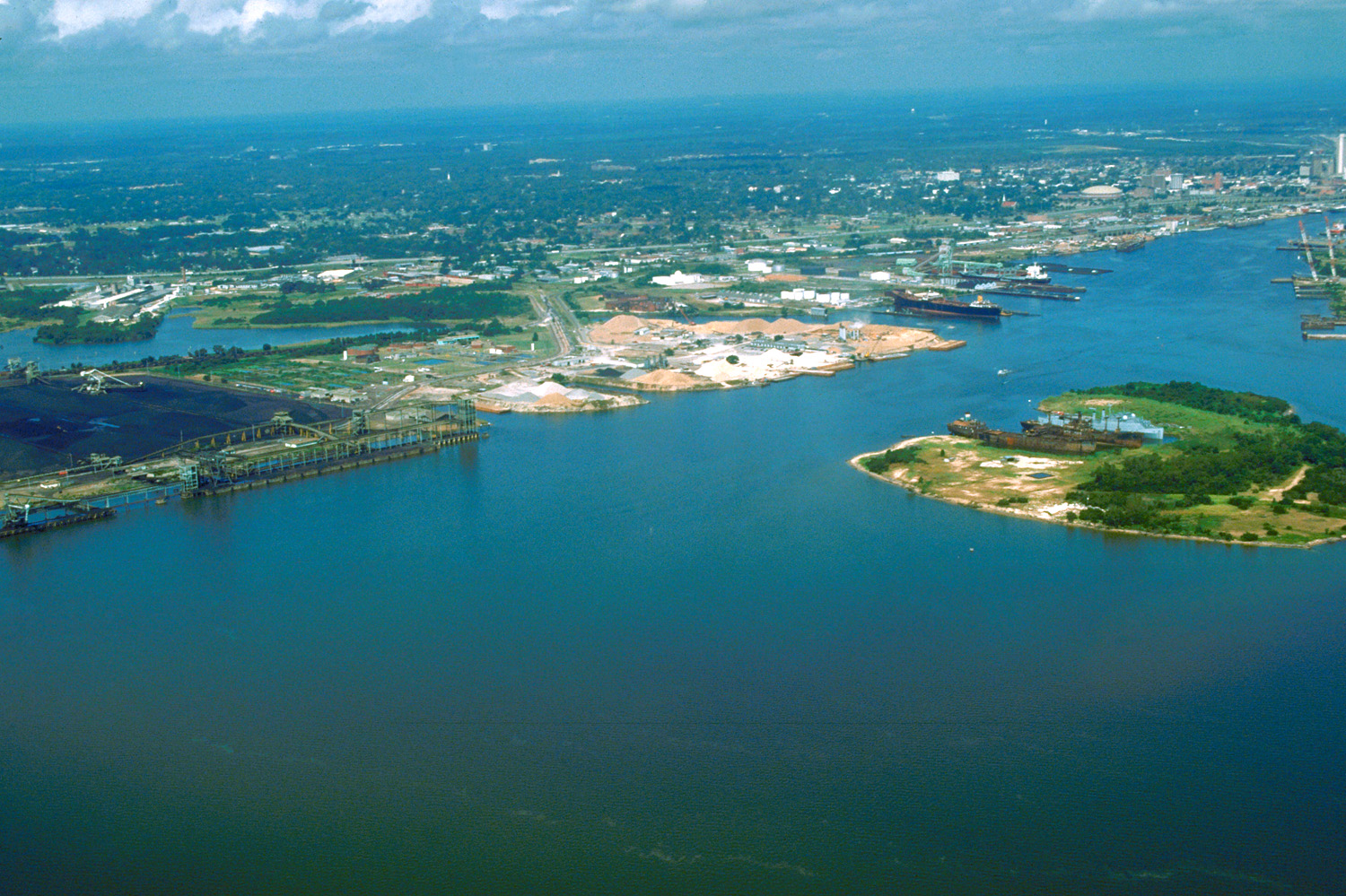
The port is located along the Mobile River where it empties into Mobile Bay. The Port of Mobile has public, deepwater terminals with direct access to 1,500 miles of inland and intracoastal waterways serving the Great Lakes, the Ohio and Tennessee river valleys (via the Tennessee-Tombigbee Waterway), and the Gulf of Mexico. The Alabama State Port Authority owns and operates the public terminals at the Port of Mobile. The public terminals handle containerized, bulk, break bulk, roll-on/roll-off, and heavy lift cargoes. The port is also home to private bulk terminal operators. The container, general cargo and bulk facilities have immediate access to two interstate systems and five Class I railroads. Additionally, the CG Railway operates from the port as a rail ferry service to Coatzacoalcos, Veracruz, in Mexico.[3]
The Port of Mobile is the largest break bulk forest products port in the United States, and the Alabama State Port Authority's McDuffie Terminal is one of the largest coal terminals in the United States and largest import coal terminal.[4] The port was the fourth largest exporter of coal during 2012, with the majority exported for metallurgical processes. The largest shares of coal exports from Mobile went to Europe and South America.[5]
The Alabama State Port Authority announced in 2010 that $360 million would be spent over the following five years to improve infrastructure at the port. Improvements included land acquisition, new rail and inter-modal yards, cargo terminal improvements and enhancements to improve servicing of deep-water oil and gas field vessels and equipment [6] Since 2000, the Port Authority has undergone nearly $500 million in capital improvements and expansion projects to serve containerized, bulk and break bulk commodities. Improvements include a new rail ferry terminal, a steel terminal to service the $4.6 billion steel facility in Calvert, Alabama, new warehousing, a new container terminal, and expansions at the McDuffie Coal Terminal. The Port of Mobile had an estimated statewide economic impact approaching $8 billion annually in 2010.[6]
In 2022, a statue of retiring U.S. Senator Richard Shelby was unveiled at the port. As a senator, Shelby steered millions of dollars in federal money to the port for dredging and widening.[7]
Cruise traffic
[edit]Carnival Cruise Lines has been operating cruises out of Mobile since 2001 with a Holiday-class cruise ship. In 2003 Carnival Holiday was positioned at the port. The city has attempted to grab more cruise lines to place a ship at the port. Carnival left Mobile in 2011 due to rising fuel costs, and the inability to raise prices.[8] Carnival Fantasy was positioned in 2016 to do year around cruises, and adventure cruises. In January 2022 the Carnival Fascination will replace the fantasy offering more year around cruises out of Mobile.[9]
See also
[edit]
References
[edit]- ^ "UNLOCODE (US) - UNITED STATES". service.unece.org. Retrieved 23 September 2020.
- ^ a b "Port of Mobile, U.S.A." www.findaport.com. Shipping Guides Ltd. Retrieved 23 September 2020.
- ^ "Infrastructure". Mobile Area Chamber of Commerce. Archived from the original on July 17, 2007. Retrieved February 9, 2008.
- ^ "Port Facts". Alabama State Port Authority. Archived from the original on January 13, 2008. Retrieved February 9, 2008.
- ^ "Europe and Asia are the leading destinations for U.S. coal exports in 2012". Today in Energy. U.S. Energy Information Administration. November 15, 2012. Retrieved March 16, 2013.
- ^ a b Dave Helms (October 27, 2010). "Alabama State Port Authority approves $360 million to upgrade infrastructure". Press Register. Retrieved October 27, 2010.
- ^ Sharp, John (2022-12-08). "Planes, trains, ports: Mobile readies for a 'big day'". al. Retrieved 2022-12-26.
- ^ staff, AL com (2015-09-03). "City relationship with Carnival has been cozy and cold". al. Retrieved 2020-02-18.
- ^ Parker, Doug. "Carnival Cruise Line Moves Fantasy Out of Mobile". cruiseradio.net. Retrieved 2020-02-18.
External links
[edit]

Port of Mobile
View on GrokipediaHistory
Founding and Early Operations (1920s–1940s)
The Alabama State Docks, precursor to the modern Port of Mobile, were authorized by the Alabama State Legislature in 1922 through the creation of the Alabama State Docks Commission, with construction commencing on roughly 500 acres of land north of the city's historic waterfront to consolidate and modernize scattered private wharves.[1] This initiative aimed to establish Alabama's first dedicated deep-water state-owned port, addressing longstanding limitations in riverine shipping infrastructure along the Mobile River and Bay.[7] The facilities, featuring three steel-and-concrete piers (A, B, and C) equipped for efficient freight transfer between rail, road, and water carriers, were completed in 1927 and officially dedicated in 1928, marking the first fully state-operated interchange terminal in the United States and more than doubling Mobile's prior commercial shipping capacity.[1] [8] [9] Early operations emphasized bulk cargo handling, including lumber, cotton, and paper products from the adjacent International Paper Company mill established in 1928, which bolstered regional export volumes despite economic constraints.[7] [10] By the early 1930s, the port facilitated growing intermodal traffic, supported by federal improvements to inland waterways, though activity remained modest amid the Great Depression.[11] World War II catalyzed expansion, with the port serving as a critical node for military logistics and wartime production; it handled surging volumes of strategic materials while adjacent shipyards constructed Liberty ships under U.S. Maritime Commission contracts, employing nearly 90,000 workers across the complex by the mid-1940s.[1] [7] This period underscored the port's strategic value, as deepened channels and added warehousing enabled rapid throughput of munitions, bauxite, and other commodities essential to Allied efforts, transitioning operations from peacetime commerce to wartime exigencies.[12]World War Era and Post-War Growth (1940s–1970s)
During World War II, the Port of Mobile emerged as a vital hub for shipbuilding and maritime support, contributing significantly to the Allied effort. The Alabama Dry Dock and Shipbuilding Company (ADDSCO) and Gulf Shipbuilding Corporation expanded operations, constructing over 200 vessels, including Liberty ships commissioned by the U.S. Maritime Commission.[12][7] Shipyard employment reached approximately 50,000 workers by 1943, fueling a broader influx of nearly 90,000 personnel into war-related industries at the port and surrounding facilities.[13][1] Anchored by the Alabama State Docks, the port handled increased cargo volumes and ranked as the 15th busiest in the United States, facilitating the movement of military supplies and materials amid a regional population surge from 78,720 in 1940 to over 220,000 by war's end.[14][15] In the immediate post-war period, the port shifted focus from military production to commercial trade, though shipbuilding firms like ADDSCO curtailed activities during the 1950s and 1960s due to reduced demand and industry consolidation.[7] Infrastructure sustained growth through targeted investments, including dredging and facility upgrades to accommodate bulk cargoes such as timber and coal, which diversified exports beyond pre-war cotton reliance.[16] The port's strategic location supported manufacturing and steel sectors, with post-war enhancements improving efficiency for oceangoing traffic.[16] By the late 1960s and 1970s, modernization accelerated with the adoption of containerized shipping, aligning Mobile with global standards for standardized cargo handling.[17] Key projects included a $16 million coal terminal on McDuffie Island completed in 1971 to boost bulk export capacity, followed by a $45 million bond issuance in 1975 for Alabama State Docks expansions, including additional berths and storage.[7] The Tennessee-Tombigbee Waterway's dedication in 1971 enhanced inland connectivity for barge traffic, laying groundwork for future volume increases despite the project's extended timeline to 1984.[7] These developments solidified the port's role in regional economic recovery, handling growing tonnages amid national shifts toward container and bulk specialization.[16]Expansion and Modernization (1980s–Present)
The Alabama State Port Authority, established in 2000, has driven substantial infrastructure investments at the Port of Mobile, totaling over $1.4 billion since 2002 to enhance capacity and efficiency.[1] Early efforts in the 2000s included the launch of a container intermodal investment program from 2001 to 2005, the opening of the first refrigerated cargo terminal in June 2003, and the completion of the McDuffie Coal Terminal expansion in December 2004.[1] These initiatives supported growing container traffic and diversified cargo handling capabilities. In the late 2000s and 2010s, key modernizations addressed larger vessel requirements, such as the christening of a post-Panamax turning basin in October 2010, which enabled the arrival of the first post-Panamax container ship in June 2012.[1] The grain elevator was modernized in July 2008, boosting annual capacity to 3.3 million bushels.[1] Further expansions included a $36 million steel coil handling facility opened in January 2015 and a container terminal upgrade in June 2015 with APM Terminals, alongside the opening of the Intermodal Container Transfer Facility (ICTF) providing CN rail service.[1] In September 2018, a $58 million cold storage facility was announced by MTC Logistics to bolster refrigerated cargo operations.[1] Recent projects have focused on deepening navigation channels and expanding rail connectivity to accommodate mega-vessels and inland distribution. The $366 million Mobile Harbor Modernization Project, a state-federal partnership initiated in May 2021, achieved a 50-foot channel depth by October 2025, making the port the deepest container terminal in the Gulf of Mexico.[18] [19] Construction on the fourth phase of the container terminal began in October 2024, aimed at doubling overall capacity.[20] Expansions at the ICTF and a new Montgomery ICTF with CSX, announced in 2025, enhance rail access to central Alabama and beyond, supporting projected cargo growth.[21] [22] A $49.5 million container facility expansion was also planned in 2018 to increase throughput.[23] These developments position the port for sustained competitiveness in global trade.Geography and Infrastructure
Location and Strategic Advantages
The Port of Mobile is situated in Mobile, Alabama, along the western shore of Mobile Bay at coordinates approximately 30°42′N latitude and 88°03′W longitude.[24] Mobile Bay provides a natural estuary linking the port directly to the Gulf of Mexico via the 36-mile Mobile Ship Channel, enabling maritime traffic from international waters.[25] This positioning places the port within the southeastern United States Gulf Coast region, approximately 1,200 miles south of Chicago and 600 miles east of Houston, facilitating efficient coastal and transoceanic shipping routes.[26] Strategically, the Port of Mobile serves as Alabama's only deep-water seaport, capable of accommodating large oceangoing vessels without reliance on dredging for routine operations following recent channel improvements.[27] In October 2025, the completion of the Mobile Harbor Modernization Project achieved a 50-foot channel depth, establishing it as the deepest container terminal in the Gulf of Mexico and allowing access for post-Panamax ships with greater draft capacities.[18] This depth enhancement reduces transit times and fuel costs for carriers by minimizing ballast requirements and enabling fuller loads, thereby improving competitive positioning against shallower Gulf ports.[28] The port's inland connectivity via the Mobile River integrates it with over 15,000 miles of the U.S. inland waterway system, including the Tennessee-Tombigbee Waterway, which links to the Ohio and Mississippi Rivers and extends reach to Midwestern industrial heartlands.[26] Complementing this, proximity to Interstate 10 and Interstate 65, multiple Class I railroads (CSX and Norfolk Southern), and Mobile International Airport supports multimodal logistics, with new industrial developments like the 900-acre Port Alabama Industrial Center located within 20 minutes to capitalize on these networks.[29] These attributes position the port as a critical node for exporting commodities from southern agricultural and manufacturing bases while importing raw materials for regional processing, underscoring its role in cost-effective supply chain integration without the congestion of larger East or West Coast hubs.[30]Key Facilities and Terminals
The Port of Mobile encompasses a range of specialized terminals operated by the Alabama State Port Authority and private entities, supporting containerized, bulk, breakbulk, roll-on/roll-off (RO/RO), and heavy-lift cargo handling with a channel depth of 45 feet.[31] These facilities benefit from direct multimodal connectivity via Interstates 10 and 65, five Class I railroads, and extensive inland waterways exceeding 15,000 miles.[32] The Mobile Container Terminal (MCT) at Choctaw Point, managed by APM Terminals, spans 135 acres and serves as the primary container facility with a startup capacity exceeding 350,000 twenty-foot equivalent units (TEUs), undergoing phased expansions to surpass 1 million TEUs by completing a fourth phase initiated in October 2024.[33][20] It achieves high productivity, averaging 35 crane moves per hour as of 2022, and accommodates vessels up to 13,000 TEUs.[33][31] The McDuffie Coal Terminal, a major bulk facility, specializes in metallurgical and bituminous coal exports with a ground storage capacity of 2.3 million tons and annual throughput potential of 30 million tons across three berths equipped with one shiploader, three unloaders, and six stacker/reclaimers.[34][35] This terminal accounts for approximately 50% of the port's revenue and supports recent infrastructure upgrades, including new stacker-reclaimers contracted in December 2024 ahead of channel deepening to 50 feet by May 2025.[36][37] Additional key infrastructure includes a state-of-the-art RO/RO terminal with an integrated vehicle processing center for automobiles and heavy equipment, on-dock cold storage for perishables, and breakbulk areas handling forest products—where Mobile ranks as the largest U.S. port by volume—and steel, maintaining the nation's largest steel terminal.[31][38] Liquid bulk operations feature a 1 million-ton capacity pier spanning 1,100 feet for seamless barge, rail, and truck transfers.[39] Private terminals, such as Millard Maritime's 300-acre site with a 1,600-foot wharf for diversified bulk and breakbulk, and Alabama Steel Terminals, complement public assets for heavy-lift and project cargoes.[40][41]Navigation and Access Channels
The Port of Mobile is accessed primarily via the federally maintained Mobile Ship Channel, a composite navigation project extending approximately 36 miles from the Gulf of Mexico through Mobile Bay and up the Mobile and Tensaw Rivers to the main harbor terminals.[42] This channel supports large commercial vessels, including Post-Panamax container ships, and underwent a major deepening project completed in 2025, increasing the authorized depth from 45 feet to 50 feet mean lower low water (MLLW) across its Bar, Bay, and River segments.[43] [44] The project, managed by the U.S. Army Corps of Engineers (USACE) Mobile District at a cost of $366 million, also widened the Bay Channel segment by 100 feet to enhance two-way traffic and vessel maneuverability.[45] [46] The channel's segments include the Outer Bar Channel (crossing the outer Mobile Bar shelf), Inner Bar Channel, Bay Channel (through Mobile Bay), and River Channels (extending inland to terminals).[44] Prior to deepening, the majority of the channel measured 45 feet deep by 400 feet wide, with the River Channel historically limited to 40 feet in some areas; post-2025, the uniform 50-foot depth positions Mobile as the Gulf Coast's deepest container port channel, enabling fuller loads for larger vessels and reducing tidal restrictions. [41] A 1,600-foot-diameter turning basin at the inner harbor facilitates vessel rotation for berthing.[41] Maintenance dredging is conducted year-round by USACE to counteract sedimentation from the Mobile River delta, with material often placed via thin-layer placement (TLP) techniques limited to one-foot-thick layers to minimize environmental disruption while reusing sediment beneficially.[47] [48] Supplemental access is provided by the Theodore Ship Channel, a shallower 42-foot by 600-foot crossing over the inner Mobile Bar leading to 40-foot by 400-foot segments for terminals in the Theodore area, though it occasionally faces draft restrictions (e.g., 37 feet in July 2025 due to shoaling).[49] [50] Vessel traffic is managed under USCG guidelines, with pilots required for channels exceeding certain depths and widths to ensure safe navigation amid currents and bay conditions.[51]Operations
Cargo Handling and Volume Statistics
The Port of Mobile utilizes specialized equipment for efficient cargo handling across diverse commodities, including Super Post Panamax and Post Panamax cranes for container lifts at the MCT terminal, heavy lift cranes for breakbulk and project cargo, and barge-mounted cranes for aggregates and oversized loads.[52] Bulk materials such as steel, grain, and coal are managed via grab unloaders, loaders, and conveyor systems, while general cargo benefits from 2.4 million square feet of covered warehousing and equivalent open storage, supported by on-dock rail access to nine carriers.[52] Roll-on/roll-off operations for automobiles employ a dedicated $60 million terminal with direct berth access.[52] Annual cargo volumes at the port exceed 55 million tons of international and domestic freight, predominantly bulk commodities that account for the majority of tonnage due to the region's industrial exports like steel products and forest materials.[2] Containerized traffic, measured in twenty-foot equivalent units (TEUs), has shown steady growth, reflecting expansions in terminal capacity since 2008. In 2023, the port handled 563,537 TEUs, maintaining year-over-year performance amid a softening global market.[5]| Year | Container TEUs |
|---|---|
| 2021 | 502,623 |
| 2022 | 560,000+ |
| 2023 | 563,537 |
Types of Cargo and Major Commodities
The Port of Mobile accommodates diverse cargo categories, including containerized shipments, dry and liquid bulk, breakbulk, roll-on/roll-off (RO/RO), and heavy-lift cargoes. These capabilities support handling of both import and export traffic across multiple terminals operated by the Alabama Port Authority and private entities.[31][55] Bulk cargo constitutes a major portion, with dry bulk dominated by coal exports; the port processes about 12 million tons annually of Alabama-sourced metallurgical coal destined for international steel production. Other bulk commodities include aggregates such as cement, sand, gravel, crushed stone, and slag, which are essential for construction and industrial applications. Chemicals and metals also feature prominently in bulk movements.[56][57][58] Breakbulk cargoes encompass forest products like wood pulp, lumber, and paper, where the port ranks first nationally in paper product imports and second in wood and wood products exports. Steel imports lead U.S. rankings at Mobile, supporting regional manufacturing.[59][58] Containerized cargo includes a mix of consumer goods, machinery, and intermediate products, with volumes reaching record levels in recent years, such as the third-highest monthly container throughput in March 2024 amid a softening market. RO/RO facilities handle automobiles and related vehicles, alongside parts that rank among top imports by value, totaling $2.92 billion in motor vehicles parts and accessories. Heavy-lift and over-dimensional cargoes, including aircraft components valued at significant import figures, leverage specialized equipment for project cargoes.[5][60]Cruise and Passenger Services
The Alabama Cruise Terminal at 201 South Water Street in Mobile serves as the dedicated facility for cruise embarkations, disembarkations, and passenger services within the Port of Mobile. This city-operated, two-story structure spans 66,000 square feet and includes state-of-the-art security screening, six covered pickup and drop-off lanes, and an adjacent 500-space parking deck with online pre-payment options. A pedestrian tower provides connectivity to the broader port area via four elevators, an escalator, and a stairwell, enabling efficient passenger flow. The terminal's proximity—0.5 miles from Interstate 10 and six miles from the I-10/I-65 interchange—supports quick access for ground transportation while positioning it near downtown Mobile's hotels, restaurants, and attractions for pre- and post-cruise activities. Cruise operations began in 2001 when Carnival Cruise Line established Mobile as a homeport for Western Caribbean itineraries using ships like the Carnival Holiday, with a capacity of approximately 1,600 passengers. Services expanded initially but faced suspension in 2011 due to Carnival's fleet redeployments amid fluctuating demand and economic pressures, leaving the terminal dormant for passenger traffic until Carnival's return with the Carnival Fantasy in October 2023. Year-round departures resumed in spring 2025, the first such schedule since the COVID-19 disruptions, primarily via the Carnival Spirit, a vessel with a capacity of 2,549 passengers offering 5- to 14-night voyages to destinations including Mexico, Honduras, and Belize. Passenger volumes have varied with ship deployments and market conditions; historical data from 2009 recorded 135,000 passengers across 76 departures, while recent operations with the Carnival Spirit generate around 50,000 annual passengers based on typical occupancy and sailing frequency. In a departure from prior exclusivity to Carnival, the terminal will accommodate American Cruise Lines' American Symphony—an 8-day river cruise vessel—as a port of call in March 2026, marking the first multi-line overlap in Mobile's cruise history. Future growth includes Carnival's deployment of the larger Carnival Valor in spring 2027, a Conquest-class ship with 3,000-passenger capacity, expected to boost volumes through extended year-round service and enhanced itinerary options. Local amenities, such as guided tours in the nearby Mobile/Tensaw Delta, complement onboard services to support passenger logistics and regional tourism integration.Economic Impact
Statewide and Regional Contributions
The Port of Mobile generates substantial statewide economic value for Alabama, with marine cargo activity at its terminals contributing $98.3 billion in total economic output in 2022, an increase of $13 billion from 2021.[3][61] This impact supports 351,359 jobs across the state—equivalent to one in every seven jobs—and generates $22.5 billion in personal income, while yielding $2.4 billion in combined state, local, and federal tax revenues.[3][61] These benefits extend to all 67 Alabama counties through interconnected supply chains, particularly in export-oriented sectors such as automotive manufacturing, steel production, and forest products, where port-handled cargo of 43.3 million tons facilitates domestic and international trade.[3][61] Regionally, the port's operations amplify economic activity beyond Alabama's borders, contributing to a total U.S. economic value of $130.3 billion from its 2022 cargo throughput, with spillover effects supporting an additional 101,894 jobs nationwide outside the state.[62] As the deepest harbor on the Gulf Coast following its 2025 deepening to 50 feet, the port enhances regional competitiveness by accommodating larger vessels and bolstering intermodal connections that serve Southeastern supply chains, though specific Gulf Coast-wide metrics remain aggregated within national figures.[62] This positioning drives trade efficiency for commodities like steel and autos, indirectly benefiting adjacent states through shared logistics networks and reduced transportation costs.[63]Employment, Trade, and Supply Chain Effects
The Port of Mobile supports approximately 351,359 jobs across Alabama, equivalent to one in every seven jobs statewide, encompassing direct port operations, indirect supplier roles, and induced effects from employee spending.[64] This figure reflects the 2022 economic impact analysis, which attributes direct employment at port facilities and terminals to around 2,500 positions, with the majority stemming from logistics, manufacturing, and distribution sectors reliant on port activity.[65] These jobs generate over $14 billion in personal income annually, bolstering local and state economies through wage circulation.[64] In trade facilitation, the port handled 563,537 twenty-foot equivalent units (TEUs) of containerized cargo in 2023, marking sustained growth from 563,191 TEUs in 2022 and contributing to Alabama's export economy valued at billions in commodities like steel, chemicals, and forest products.[5] Overall cargo throughput exceeds 55 million tons annually, including bulk goods that support international trade with partners in Europe, Asia, and Latin America, thereby enhancing Alabama's position in global supply networks.[2] This activity underpins $98.3 billion in total economic output for the state in 2022, with trade-related revenues driving state and local tax collections exceeding $1 billion yearly.[64] Regarding supply chain effects, the port's infrastructure investments, including over $1 billion planned through the next decade, improve logistics reliability by integrating rail, highway, and inland waterway connections, reducing transit times for regional manufacturers and distributors compared to congested East Coast alternatives.[2] This connectivity fosters distribution center growth in Mobile County and adjacent areas, amplifying just-in-time inventory efficiencies and mitigating disruptions from national port bottlenecks, as evidenced by volume shifts during 2021-2022 supply chain strains.[66] Consequently, the port lowers overall freight costs for Alabama's automotive, aerospace, and agriculture sectors, which depend on efficient import/export flows to maintain competitive edges in domestic and export markets.[64]Comparative Performance with Other U.S. Ports
The Port of Mobile ranks 14th among U.S. ports by total cargo tonnage, handling 50.5 million short tons in 2022, compared to the leader Port of Houston's 293.8 million short tons. This positions Mobile as a mid-tier performer in overall volume, trailing dominant Gulf Coast peers like South Louisiana (226.2 million short tons, ranked 2nd) and Corpus Christi (174.3 million short tons, ranked 3rd), but ahead of many East and West Coast facilities focused on containers. In dry bulk tonnage—a key strength for Mobile—it ranks 6th nationally with 29.0 million short tons, surpassing Houston (ranked 8th at 26.0 million) and benefiting from commodities like coal, steel, and forest products, while South Louisiana leads at 153.0 million short tons. By container throughput, measured in twenty-foot equivalent units (TEUs), Mobile lags larger ports, ranking 18th with 440.4 thousand loaded TEUs in 2022, versus top performers like New York/New Jersey (6.7 million, ranked 1st) and Los Angeles (6.4 million, ranked 2nd). Total TEU volume at Mobile reached 563,537 in 2023, reflecting growth from prior years but remaining below Gulf leaders such as Houston (3.3 million loaded TEUs, ranked 5th nationally).[5] This disparity underscores Mobile's emphasis on breakbulk and bulk cargoes over containerized trade, where it handles under 1% of national TEU volume dominated by West Coast gateways.| Metric (2022) | Port of Mobile | National Rank | Top U.S. Port Example |
|---|---|---|---|
| Total Tonnage | 50.5 million short tons | 14th | Houston: 293.8 million (1st) |
| Dry Bulk Tonnage | 29.0 million short tons | 6th | South Louisiana: 153.0 million (1st) |
| Loaded TEUs | 440.4 thousand | 18th | New York/New Jersey: 6.7 million (1st) |