Hubbry Logo
search
logo

Posterior probability

logo
Community Hub0 Subscribers
Read side by side
from Wikipedia

The posterior probability is a type of conditional probability that results from updating the prior probability with information summarized by the likelihood via an application of Bayes' rule.[1] From an epistemological perspective, the posterior probability contains everything there is to know about an uncertain proposition (such as a scientific hypothesis, or parameter values), given prior knowledge and a mathematical model describing the observations available at a particular time.[2] After the arrival of new information, the current posterior probability may serve as the prior in another round of Bayesian updating.[3]

In the context of Bayesian statistics, the posterior probability distribution usually describes the epistemic uncertainty about statistical parameters conditional on a collection of observed data. From a given posterior distribution, various point and interval estimates can be derived, such as the maximum a posteriori (MAP) or the highest posterior density interval (HPDI).[4] But while conceptually simple, the posterior distribution is generally not tractable and therefore needs to be either analytically or numerically approximated.[5]

Definition in the distributional case

[edit]

In Bayesian statistics, the posterior probability is the probability of the parameters given the evidence , and is denoted .

It contrasts with the likelihood function, which is the probability of the evidence given the parameters: .

The two are related as follows:

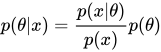
Given a prior belief that a probability distribution function is and that the observations have a likelihood , then the posterior probability is defined as

,[6]

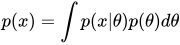
where is the normalizing constant and is calculated as

for continuous , or by summing over all possible values of for discrete .[7]

The posterior probability is therefore proportional to the product Likelihood · Prior probability.[8]

Example

[edit]

Suppose there is a school with 60% boys and 40% girls as students. The girls wear trousers or skirts in equal numbers; all boys wear trousers. An observer sees a (random) student from a distance; all the observer can see is that this student is wearing trousers. What is the probability this student is a girl? The correct answer can be computed using Bayes' theorem.

The event G is that the student observed is a girl, and the event T is that the student observed is wearing trousers. To compute the posterior probability , we first need to know:

  • , or the probability that the student is a girl regardless of any other information. Since the observer sees a random student, meaning that all students have the same probability of being observed, and the percentage of girls among the students is 40%, this probability equals 0.4.
  • , or the probability that the student is not a girl (i.e. a boy) regardless of any other information (B is the complementary event to G). This is 60%, or 0.6.
  • , or the probability of the student wearing trousers given that the student is a girl. As they are as likely to wear skirts as trousers, this is 0.5.
  • , or the probability of the student wearing trousers given that the student is a boy. This is given as 1.
  • , or the probability of a (randomly selected) student wearing trousers regardless of any other information. Since (via the law of total probability), this is .

Given all this information, the posterior probability of the observer having spotted a girl given that the observed student is wearing trousers can be computed by substituting these values in the formula:

An intuitive way to solve this is to assume the school has N students. Number of boys = 0.6N and number of girls = 0.4N. If N is sufficiently large, total number of trouser wearers = 0.6N + 50% of 0.4N. And number of girl trouser wearers = 50% of 0.4N. Therefore, in the population of trousers, girls are (50% of 0.4N)/(0.6N + 50% of 0.4N) = 25%. In other words, if you separated out the group of trouser wearers, a quarter of that group will be girls. Therefore, if you see trousers, the most you can deduce is that you are looking at a single sample from a subset of students where 25% are girls. And by definition, chance of this random student being a girl is 25%. Every Bayes-theorem problem can be solved in this way.[9]

Calculation

[edit]

The posterior probability distribution of one random variable given the value of another can be calculated with Bayes' theorem by multiplying the prior probability distribution by the likelihood function, and then dividing by the normalizing constant, as follows:

gives the posterior probability density function for a random variable given the data , where

  • is the prior density of ,
  • is the likelihood function as a function of ,
  • is the normalizing constant, and
  • is the posterior density of given the data .[10]

Credible interval

[edit]

Posterior probability is a conditional probability conditioned on randomly observed data. Hence it is a random variable. For a random variable, it is important to summarize its amount of uncertainty. One way to achieve this goal is to provide a credible interval of the posterior probability.[11]

Classification

[edit]

In classification, posterior probabilities reflect the uncertainty of assessing an observation to particular class, see also class-membership probabilities. While statistical classification methods by definition generate posterior probabilities, Machine Learners usually supply membership values which do not induce any probabilistic confidence. It is desirable to transform or rescale membership values to class-membership probabilities, since they are comparable and additionally more easily applicable for post-processing.[12]

See also

[edit]

References

[edit]

Further reading

[edit]
Revisions and contributorsEdit on WikipediaRead on Wikipedia
from Grokipedia
In Bayesian statistics, posterior probability refers to the updated probability of a hypothesis or parameter value after incorporating observed data, representing a refined degree of belief based on evidence.[1] This concept, formalized through Bayes' theorem, combines the prior probability (initial belief before data) with the likelihood (probability of data given the hypothesis) to yield the posterior as $ P(\theta | y) \propto P(y | \theta) \cdot P(\theta) $, where the normalizing constant ensures probabilities sum to one.[2] Originating from Thomas Bayes' 1763 essay and later expanded by Pierre-Simon Laplace in 1814, it provides a framework for inductive reasoning by treating probability as a measure of subjective or objective belief updated sequentially with new information.[3] The posterior distribution plays a pivotal role in inference, enabling point estimates like the posterior mean or mode, credible intervals for uncertainty quantification, and model comparison via posterior odds.[1] In practice, conjugate priors—such as the beta distribution for binomial likelihoods—simplify analytical computation, transforming the posterior into a recognizable family (e.g., Beta($ y+1, n-y+1 $) for a uniform prior on a coin toss experiment).[2] For complex models, numerical methods like Markov chain Monte Carlo (MCMC) approximate the posterior, facilitating applications in fields from machine learning to epidemiology.[2] Unlike frequentist approaches, which focus on long-run frequencies, the Bayesian posterior directly incorporates prior knowledge, though its results converge to data-driven estimates as sample size increases.[3]

Core Concepts

Definition

In Bayesian statistics, the posterior probability is defined as the conditional probability of a parameter θ\theta (or a hypothesis) given the observed data xx, denoted as P(θx)P(\theta \mid x) or π(θx)\pi(\theta \mid x).[4] This notation reflects the probability that the parameter takes on a specific value after accounting for the evidence provided by the data.[5] The posterior probability represents the updated belief about the parameter within a probabilistic model, incorporating new information to refine initial assumptions.[2] It quantifies the degree of belief in θ\theta post-observation, distinguishing it from the prior probability, which precedes the data, and the likelihood, which describes the data's compatibility with θ\theta.[5] In contrast to joint probabilities, which capture the combined occurrence of parameters and data P(θ,x)P(\theta, x), or marginal probabilities, which integrate over unobserved variables like P(θ)P(\theta) or P(x)P(x), the posterior specifically conditions the parameter on the data to yield this revised distribution.[4] When the parameter space is continuous, the posterior takes the form of a probability density function, fΘX(θx)f_{\Theta \mid X}(\theta \mid x), allowing for the representation of beliefs across a continuum of values rather than discrete points.[5] This distributional form arises from the conditional nature of the posterior, enabling inference over densities that reflect uncertainty in estimation.[2] The posterior thus serves as the core output of Bayesian updating, blending prior beliefs with the likelihood of the observed data in a single, coherent measure.[4]

Bayesian Interpretation

In Bayesian epistemology, posterior probability represents the subjective degree of belief in a hypothesis or parameter after incorporating observed evidence, serving as a mechanism for rationally updating prior beliefs in light of new data.[3] This approach treats probability not as a long-run frequency but as a measure of credence or confidence, allowing for the quantification and revision of uncertainty in a coherent manner.[3] The key components of this framework include the prior distribution, which encodes initial beliefs about the unknown parameter θ before observing data, and the likelihood, which assesses how well the data x align with a given θ. These elements combine to form the posterior distribution, synthesizing prior knowledge with empirical evidence to yield an updated belief state.[6] The philosophical foundations of posterior probability trace back to Thomas Bayes's 1763 essay, "An Essay towards solving a Problem in the Doctrine of Chances," which introduced the concept of inverse probability to infer causes from observed effects.[7] This work laid the groundwork for Bayesian updating, though it was posthumously published and edited by Richard Price. Bayes's ideas were further developed by Pierre-Simon Laplace in the late 18th and early 19th centuries, who expanded them into a systematic theory of probability as a tool for inductive inference across astronomy, physics, and beyond.[8] Unlike frequentist confidence intervals, which provide a fixed range that contains the true parameter with a specified long-run coverage probability across repeated samples, the Bayesian posterior is a full probability distribution over the parameter, directly representing updated beliefs and enabling probabilistic statements about its value given the data.[9]

Mathematical Foundation

Bayes' Theorem

Bayes' theorem expresses the relationship between the conditional probability of parameters given data and the conditional probability of data given parameters, serving as the cornerstone for updating beliefs in Bayesian inference. Formulated in its modern form by Pierre-Simon Laplace building on the work of Thomas Bayes, it formalizes how prior knowledge is revised by observed evidence. In the discrete case, where θ\theta represents possible parameter values or hypotheses and xx denotes the observed data, Bayes' theorem is stated as
P(θx)=P(xθ)P(θ)P(x), P(\theta \mid x) = \frac{P(x \mid \theta) P(\theta)}{P(x)},
with P(θx)P(\theta \mid x) denoting the posterior probability distribution, P(xθ)P(x \mid \theta) the likelihood function, P(θ)P(\theta) the prior probability distribution, and P(x)P(x) the marginal probability of the data.[10][11] The derivation of Bayes' theorem follows from the basic definition of conditional probability in probability theory. The posterior P(θx)P(\theta \mid x) is the ratio of the joint probability P(θ,x)P(\theta, x) to the marginal P(x)P(x):
P(θx)=P(θ,x)P(x). P(\theta \mid x) = \frac{P(\theta, x)}{P(x)}.
By the chain rule of probability, the joint distribution factors as P(θ,x)=P(xθ)P(θ)P(\theta, x) = P(x \mid \theta) P(\theta). Substituting this factorization yields the theorem's form, assuming P(x)>0P(x) > 0 to ensure the expression is well-defined. This derivation holds under the axioms of probability, requiring non-negative probabilities that sum to one over the sample space.[11]/13%3A_Statistics_and_Probability_Background/13.04%3A_Bayes_Rule_conditional_probability_independence) For continuous parameters θ\theta and data xx, the theorem extends to probability density functions, replacing uppercase PP with lowercase pp to reflect densities rather than point probabilities:
p(θx)=p(xθ)p(θ)p(x). p(\theta \mid x) = \frac{p(x \mid \theta) p(\theta)}{p(x)}.
Here, p(θx)p(\theta \mid x) is the posterior density, p(xθ)p(x \mid \theta) the likelihood density, p(θ)p(\theta) the prior density, and p(x)p(x) the marginal density of the data, obtained by integrating the numerator over θ\theta. This continuous form assumes a well-specified probabilistic model where the densities are properly normalized and positive where relevant, ensuring the posterior integrates to one.[12][13]

Normalization and Evidence

In Bayesian inference, the posterior probability is obtained by normalizing the unnormalized posterior, which requires dividing by the evidence, also known as the marginal likelihood. The evidence, denoted P(x)P(x) or ZZ, represents the probability of the observed data xx marginalized over the parameter space θ\theta. For continuous parameters, it is defined as the integral
P(x)=P(xθ)P(θ)dθ, P(x) = \int P(x \mid \theta) P(\theta) \, d\theta,
where P(xθ)P(x \mid \theta) is the likelihood and P(θ)P(\theta) is the prior distribution.[14] For discrete parameters, the evidence takes the form of a summation,
P(x)=θP(xθ)P(θ). P(x) = \sum_{\theta} P(x \mid \theta) P(\theta).
This normalizing constant ensures that the posterior integrates (or sums) to unity, providing a proper probability distribution over the parameters given the data.[14] The evidence serves as a fundamental quantity in Bayesian model comparison, acting as a measure of how well a model predicts the data while accounting for both fit and complexity. It enables the computation of the Bayes factor, which is the ratio of the evidences for two competing models M1M_1 and M2M_2, defined as B12=P(xM1)/P(xM2)B_{12} = P(x \mid M_1) / P(x \mid M_2). A Bayes factor greater than 1 indicates that M1M_1 provides stronger evidence for the data than M2M_2, with the magnitude reflecting the strength of support; for instance, values between 3 and 10 are often interpreted as substantial evidence favoring one model.[15] This approach inherently penalizes overly complex models through the prior integration, promoting parsimony without arbitrary penalties like those in frequentist criteria.[15] Despite its theoretical elegance, computing the evidence poses significant challenges, as the required integral or sum is often analytically intractable, especially in high-dimensional or non-conjugate settings where closed-form solutions do not exist.[16] This intractability arises from the need to evaluate the likelihood-prior product across the entire parameter space, which can be computationally prohibitive for complex models. As a result, the evidence's role in model selection has driven the development of various approximation strategies, though exact computation remains elusive in many practical scenarios.[16] The terminology of "evidence" for the marginal likelihood, while rooted in earlier Bayesian work by Harold Jeffreys who used it to describe support for hypotheses, was popularized in the context of model selection during the post-1990s resurgence of Bayesian methods. This popularization is largely attributed to the influential advocacy of Bayes factors in statistical practice, which highlighted the evidence's utility in objective model assessment.[15]

Computation Methods

Analytical Approaches

Analytical approaches to computing posterior probabilities rely on exact methods that yield closed-form expressions, particularly through the use of conjugate priors. A conjugate prior is defined as a prior distribution such that, when multiplied by the likelihood function from a specified parametric family, the resulting posterior distribution belongs to the same family as the prior, facilitating straightforward analytical updates.[17] This concept was formalized in the context of Bayesian decision theory.[18] Prominent examples include the Beta-Bernoulli and Normal-Normal conjugate pairs. In the Beta-Bernoulli case, a Beta prior distribution for the success probability $ p $ of a Bernoulli likelihood combines to produce another Beta posterior. For a Binomial likelihood with $ n $ trials and $ s $ successes, the posterior parameters update as follows:
α=α+s,β=β+(ns) \alpha' = \alpha + s, \quad \beta' = \beta + (n - s)
where $ \alpha $ and $ \beta $ are the prior parameters.[19] Similarly, for a Normal likelihood with known variance and a Normal prior on the mean, the posterior mean is a precision-weighted average of the prior mean and the sample mean.[20] The primary advantage of conjugate priors is the availability of closed-form posteriors, which enable exact inference without numerical approximation, simplifying computations and interpretation in Bayesian analysis.[17] However, these priors are limited to specific likelihood-prior pairs and do not generalize easily to complex or non-standard models, potentially restricting their applicability in broader statistical contexts.[21] In hierarchical models, conjugacy can extend to multi-level settings by specifying conditionally conjugate priors at each level, allowing analytical posteriors for hyperparameters under certain structures, though this often requires careful model expansion.[22]

Numerical and Simulation Methods

When analytical solutions for the posterior distribution are intractable due to complex models or high-dimensional parameter spaces, numerical and simulation-based methods provide approximate inferences by generating samples or optimizing surrogates that capture the posterior's key features. These techniques are essential in modern Bayesian statistics, enabling computation for realistic applications where exact marginalization is infeasible. Among them, Markov Chain Monte Carlo (MCMC) methods dominate for their ability to produce samples asymptotically distributed according to the posterior, while variational inference and Laplace approximations offer faster, deterministic alternatives at the cost of some accuracy. Markov Chain Monte Carlo (MCMC) algorithms generate a sequence of dependent samples from the target posterior distribution $ p(\theta \mid y) $ by constructing a Markov chain with the posterior as its stationary distribution. The Metropolis-Hastings algorithm, a foundational MCMC method, proposes candidate parameters from a user-specified proposal distribution $ q(\theta' \mid \theta) $ and accepts or rejects them based on an acceptance probability $ \alpha = \min\left(1, \frac{p(\theta' \mid y) q(\theta \mid \theta')}{p(\theta \mid y) q(\theta' \mid \theta)}\right) $, ensuring detailed balance and convergence to the posterior. This general framework allows flexible proposals, such as random walks, making it adaptable to various models. Gibbs sampling, a special case of Metropolis-Hastings, simplifies updates by sampling each parameter conditionally from its full conditional distribution given the others, which is particularly efficient for block-structured models with conjugate conditionals. The application of MCMC to Bayesian posterior inference gained prominence in the 1990s, with Gelfand and Smith (1990) demonstrating its utility for computing marginal posteriors in non-conjugate settings through Gibbs sampling, sparking widespread adoption. Today, MCMC is implemented in user-friendly probabilistic programming languages like Stan, which employs advanced Hamiltonian Monte Carlo samplers for efficient exploration, and PyMC, which supports both MCMC and variational methods in Python. These tools automate chain construction and inference, lowering barriers for practitioners. Variational inference approximates the intractable posterior $ p(\theta \mid y) $ by finding the member of a tractable family $ q(\theta; \phi) $ (e.g., a mean-field Gaussian with independent components) that minimizes the Kullback-Leibler divergence to the true posterior, often via optimizing the evidence lower bound (ELBO). This optimization-based approach yields a closed-form approximation, trading MCMC's simulation-based accuracy for scalability in large datasets or real-time applications. Mean-field variants assume posterior independence, simplifying computation but potentially underestimating correlations. The Laplace approximation provides a quick Gaussian surrogate to the posterior by expanding the log-posterior around its mode $ \hat{\theta} $, using the negative Hessian matrix $ -\nabla^2 \log p(\hat{\theta} \mid y) $ to estimate the curvature and thus the covariance. This yields an approximate posterior $ p(\theta \mid y) \approx \mathcal{N}(\theta \mid \hat{\theta}, [-\nabla^2 \log p(\hat{\theta} \mid y)]^{-1}) $, which is asymptotically accurate for large samples but less reliable for multimodal or skewed distributions. It is computationally inexpensive, requiring only mode-finding and Hessian evaluation. Practical implementation of these methods demands attention to computational reliability, particularly for MCMC where chain mixing and stationarity are not guaranteed. Convergence diagnostics, such as the Gelman-Rubin statistic comparing within- and between-chain variances, assess whether multiple chains have reached the stationary distribution. Effective sample size (ESS) quantifies the reduction in sample independence due to autocorrelation, with ESS = $ n / (1 + 2 \sum_{k=1}^\infty \rho_k) $ indicating the equivalent number of independent draws from $ n $ total samples, guiding burn-in discard and thinning to ensure precise posterior summaries. Poor convergence may stem from high correlations, addressed by better proposals or reparameterization.

Examples and Applications

Illustrative Example

To illustrate the computation of a posterior probability distribution, consider a classic scenario involving a coin that may be fair or biased toward heads, where the bias parameter θ\theta (the probability of heads) is unknown and assumed to follow a uniform prior distribution over [0,1][0, 1], equivalent to a Beta(1, 1) distribution.[5] This prior reflects complete ignorance about θ\theta, assigning equal probability density across all values in the interval.[23] Suppose we observe data from 10 independent tosses of the coin, resulting in 7 heads and 3 tails. The likelihood of this data under the binomial model is L(θy)=(107)θ7(1θ)3L(\theta \mid y) = \binom{10}{7} \theta^7 (1 - \theta)^3, where yy denotes the number of heads.[2] Applying Bayes' theorem, the posterior distribution p(θy)p(\theta \mid y) is proportional to the likelihood times the prior, yielding p(θy)Beta(8,4)p(\theta \mid y) \sim \text{Beta}(8, 4), as the uniform prior conjugates nicely with the binomial likelihood to produce another Beta distribution with updated parameters α=1+7=8\alpha' = 1 + 7 = 8 and β=1+3=4\beta' = 1 + 3 = 4.[24] The prior density is flat and uniform, spanning [0,1][0, 1] with constant height of 1. In contrast, the posterior density for Beta(8, 4) rises sharply from near 0, peaks around θ0.67\theta \approx 0.67, and then declines, skewed slightly to the right but concentrated toward values greater than 0.5 due to the excess of heads observed. This shift visually demonstrates how the data updates the initial uniform belief toward higher probabilities of heads. The posterior mean provides a natural point estimate for θ\theta, calculated as 88+4=0.667\frac{8}{8 + 4} = 0.667, indicating that, after incorporating the evidence, the updated belief centers on a coin biased about two-thirds toward heads.[2]

Real-World Applications

In medical diagnostics, posterior probabilities are essential for interpreting test results by updating the prior probability of a disease with evidence from sensitivity (true positive rate) and specificity (true negative rate). For instance, in breast cancer screening via mammography, with a low prevalence of 1%, a positive test yields only a 7% posterior probability of disease due to the test's imperfect accuracy, highlighting the need to consider base rates to avoid overdiagnosis. Similarly, for heparin-induced thrombocytopenia antibody testing, a positive result in a low-prevalence population (1%) results in just a 1.5% posterior probability, but this rises to 60% when combined with a high clinical pretest probability (50%), demonstrating how Bayesian updating integrates multiple pieces of evidence for more reliable clinical decisions.[25] In machine learning, posterior probabilities underpin Bayesian classifiers like naive Bayes, which assume feature independence to compute the probability of an email being spam given its word frequencies and other attributes. This approach, introduced in early work on junk email filtering, calculates the posterior as the product of likelihoods scaled by priors, enabling adaptive spam detection that improves with user feedback and achieves high precision by minimizing misclassification costs. Naive Bayes remains a cornerstone for real-time spam filtering in email systems, balancing computational efficiency with robust probabilistic classification.[26] In finance, posterior probabilities facilitate the estimation of stochastic volatility models, which capture time-varying risk in asset returns by treating volatility as a latent process updated via observed prices. Seminal Bayesian methods use Markov chain Monte Carlo to sample from the posterior distribution of volatility parameters, providing finite-sample inference superior to classical estimators and enabling better forecasting of stock return densities that account for uncertainty. These models are widely applied to daily stock data, aiding risk management and option pricing by quantifying the probability of extreme market movements.[27] During the COVID-19 pandemic, posterior probabilities were used in Bayesian mechanistic models to update estimates of infection rates and effective reproduction numbers (RtR_t) as new death data emerged, correcting for underreporting and delays in reporting. For example, across European countries, initial RtR_t posteriors averaged 3.8 but dropped below 1 (with >99% probability) after non-pharmaceutical interventions, allowing policymakers to assess intervention impacts and forecast trajectories with quantified uncertainty. This approach integrated compartmental models like SEIR with hierarchical Bayesian inference, supporting adaptive public health responses.[28] In the technology sector, posterior probabilities guide decision-making in A/B testing by providing the probability that one variant outperforms another, incorporating priors from historical data to accelerate insights in high-stakes environments like website optimization. Companies leverage Bayesian frameworks to compute posteriors for metrics such as conversion rates, enabling early stopping of underperforming tests and risk assessment via expected loss, which has proven effective for scaling experiments in e-commerce and software development. This method addresses limitations of frequentist approaches, offering intuitive probabilities that inform product rollouts with minimal sample sizes.[29] More recently, as of 2025, posterior probabilities have been applied in adaptive clinical trials to update endpoints like time-to-event outcomes based on accruing data, allowing flexible design adjustments while controlling type I error through Bayesian posterior distributions.[30] In artificial intelligence, prior-fitted networks use posteriors for enhanced prediction in time series forecasting, improving accuracy in domains like weather and finance by incorporating learned priors.[31]

Inference and Extensions

Credible Intervals

In Bayesian statistics, a credible interval for a parameter θ\theta is an interval [L,U][L, U] such that the posterior probability P(LθUx)=1αP(L \leq \theta \leq U \mid x) = 1 - \alpha, where xx denotes the observed data and α\alpha is typically small (e.g., 0.05 for a 95% credible interval). This interval directly quantifies the uncertainty in θ\theta given the data and prior beliefs, representing the range of plausible values for the parameter.[32] There are two primary types of credible intervals: equal-tailed intervals and highest posterior density (HPD) regions. An equal-tailed interval is constructed by taking the central 1α1 - \alpha portion of the posterior distribution, specifically the interval between the α/2\alpha/2 and 1α/21 - \alpha/2 quantiles (e.g., the 2.5th and 97.5th percentiles for a 95% interval). This approach is symmetric around the posterior median and simple to compute, but it may not always capture the region of highest plausibility if the posterior is skewed or multimodal.[32] In contrast, an HPD region is the shortest interval that contains 1α1 - \alpha of the posterior probability mass, defined as the set of values where the posterior density exceeds some threshold cc, ensuring no points outside have higher density than those inside. The HPD concept was introduced to provide a more efficient summary of uncertainty, particularly for asymmetric posteriors.[33][32] Credible intervals can be computed analytically when the posterior has a known form, such as using quantile functions for conjugate priors like the Beta distribution in binomial models, or numerically via simulation methods that draw samples from the posterior (e.g., Markov chain Monte Carlo). For instance, from SS posterior samples θ(1),,θ(S)\theta^{(1)}, \dots, \theta^{(S)}, an equal-tailed 95% interval is obtained by sorting the samples and selecting the 2.5th and 97.5th order statistics, while HPD intervals require optimizing for the narrowest interval covering the desired probability mass, often using algorithms that evaluate density thresholds.[32] The interpretation of a credible interval is straightforward and probabilistic: given the data and model, there is a 1α1 - \alpha probability that the true parameter θ\theta lies within [L,U][L, U], making it a direct statement about the parameter's location in the posterior distribution. This contrasts with frequentist confidence intervals, which do not provide such a probability for the specific interval computed from the data but rather a long-run coverage guarantee over repeated samples.[32] Credible intervals offer several advantages over confidence intervals, including their intuitive direct-probability interpretation, seamless incorporation of prior information, and adaptability to complex, hierarchical models without relying on asymptotic approximations. They avoid issues like empty or infinite intervals in small samples and better reflect parameter uncertainty in non-standard settings.[32]

Posterior Predictive Distributions

The posterior predictive distribution, denoted as $ p(\tilde{y} | y) $, represents the probability distribution of future or unobserved data $ \tilde{y} $ conditional on observed data $ y $, obtained by integrating the likelihood of the new data over the posterior distribution of the model parameters $ \theta $:
p(y~y)=p(y~θ)p(θy)dθ. p(\tilde{y} | y) = \int p(\tilde{y} | \theta) \, p(\theta | y) \, d\theta.
This formulation arises naturally in Bayesian inference as a way to generate predictions that account for both the variability inherent in the data-generating process and the uncertainty in the parameter estimates.[32] In predictive tasks, the posterior predictive distribution plays a central role by incorporating parameter uncertainty directly into forecasts, yielding distributions that are typically wider than those based solely on point estimates of $ \theta $. This integration ensures that predictions reflect the full range of plausible outcomes under the model, rather than assuming fixed parameters, which is particularly valuable for risk assessment and decision-making where overconfidence can lead to poor outcomes. For instance, the mean of the posterior predictive distribution equals the posterior mean of the predictive expectation, but its variance includes an additional term from the posterior variance of $ \theta $, emphasizing the importance of uncertainty propagation.[32] Applications of posterior predictive distributions are prominent in fields requiring uncertainty quantification for simulations, such as weather forecasting, where Bayesian methods combine ensemble outputs to produce probabilistic precipitation predictions. In these contexts, the distribution enables forecasters to generate predictive probability density functions that calibrate raw model outputs, improving reliability for events like heavy rainfall by quantifying the spread of possible outcomes.[34] Computation of the posterior predictive distribution is straightforward analytically when the model involves conjugate priors, such as the normal likelihood with a normal-inverse-gamma prior yielding a Student's t distribution for predictions, or the binomial likelihood with a beta prior resulting in a beta-binomial form. In non-conjugate or complex models, Monte Carlo integration is employed: samples $ \theta^{(s)} $ are drawn from the posterior $ p(\theta | y) $ using Markov chain Monte Carlo (MCMC) methods, and then new data $ \tilde{y}^{(s)} $ are simulated from $ p(\tilde{y} | \theta^{(s)}) $, with the empirical distribution of the $ \tilde{y}^{(s)} $ approximating the target.[32] The posterior predictive distribution also connects to the evidence in Bayesian model assessment through posterior predictive checks, where simulated replicate data are compared to observed data to evaluate model fit, such as detecting discrepancies in predictive adequacy that might indicate misspecification. This approach leverages the marginal likelihood implicitly by focusing on the predictive implications of the posterior, aiding in model validation without direct computation of the evidence.

References

User Avatar
No comments yet.