Hubbry Logo
search
logo

Potential vorticity

logo
Community Hub0 Subscribers
Read side by side
from Wikipedia

In fluid mechanics, potential vorticity (PV) is a quantity which is proportional to the dot product of vorticity and stratification. This quantity, following a parcel of air or water, can only be changed by diabatic or frictional processes. It is a useful concept for understanding the generation of vorticity in cyclogenesis (the formation and development of a cyclone), especially along the polar front, and in analyzing flow in the ocean.

Potential vorticity (PV) is seen as one of the important theoretical successes of modern meteorology. It is a simplified approach for understanding fluid motions in a rotating system such as the Earth's atmosphere and ocean. Its development traces back to the circulation theorem by Bjerknes in 1898,[1] which is a specialized form of Kelvin's circulation theorem. Starting from Hoskins et al., 1985,[2] PV has been more commonly used in operational weather diagnosis such as tracing dynamics of air parcels and inverting for the full flow field. Even after detailed numerical weather forecasts on finer scales were made possible by increases in computational power, the PV view is still used in academia and routine weather forecasts, shedding light on the synoptic scale features for forecasters and researchers.[3]

Baroclinic instability requires the presence of a potential vorticity gradient along which waves amplify during cyclogenesis.

Bjerknes circulation theorem

[edit]

Vilhelm Bjerknes generalized Helmholtz's vorticity equation (1858) and Kelvin's circulation theorem (1869) to inviscid, geostrophic, and baroclinic fluids,[1] i.e., fluids of varying density in a rotational frame which has a constant angular speed. If we define circulation as the integral of the tangent component of velocity around a closed fluid loop and take the integral of a closed chain of fluid parcels, we obtain

(1)

where is the time derivative in the rotational frame (not inertial frame), is the relative circulation, is projection of the area surrounded by the fluid loop on the equatorial plane, is density, is pressure, and is the frame's angular speed. With Stokes' theorem, the first term on the right-hand-side can be rewritten as

(2)

which states that the rate of the change of the circulation is governed by the variation of density in pressure coordinates and the equatorial projection of its area, corresponding to the first and second terms on the right hand side. The first term is also called the "solenoid term". Under the condition of a barotropic fluid with a constant projection area , the Bjerknes circulation theorem reduces to Kelvin's theorem. However, in the context of atmospheric dynamics, such conditions are not a good approximation: if the fluid circuit moves from the equatorial region to the extratropics, is not conserved. Furthermore, the complex geometry of the material circuit approach is not ideal for making an argument about fluid motions.

Rossby's shallow water PV

[edit]

Carl Rossby proposed in 1939[4] that, instead of the full three-dimensional vorticity vector, the local vertical component of the absolute vorticity is the most important component for large-scale atmospheric flow, and that the large-scale structure of a two-dimensional non-divergent barotropic flow can be modeled by assuming that is conserved. His later paper in 1940[5] relaxed this theory from 2D flow to quasi-2D shallow water equations on a beta plane. In this system, the atmosphere is separated into several incompressible layers stacked upon each other, and the vertical velocity can be deduced from integrating the convergence of horizontal flow. For a one-layer shallow water system without external forces or diabatic heating, Rossby showed that

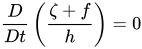
, (3)

where is the relative vorticity, is the layer depth, and is the Coriolis frequency. The conserved quantity, in parentheses in equation (3), was later named the shallow water potential vorticity. For an atmosphere with multiple layers, with each layer having constant potential temperature, the above equation takes the form

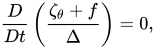
(4)

in which is the relative vorticity on an isentropic surface—a surface of constant potential temperature, and is a measure of the weight of unit cross-section of an individual air column inside the layer.

Interpretation

[edit]
Convergence and divergence of an air parcel

Equation (3) is the atmospheric equivalent to the conservation of angular momentum. For example, a spinning ice skater with her arms spread out laterally can accelerate her rate of spin by contracting her arms. Similarly, when a vortex of air is broadened, it in turn spins more slowly. When the air converges horizontally, the air speed increases to maintain potential vorticity, and the vertical extent increases to conserve mass. On the other hand, divergence causes the vortex to spread, slowing down the rate of spin.

Ertel's potential vorticity

[edit]

Hans Ertel generalized Rossby's work via an independent paper published in 1942.[6][7] By identifying a conserved quantity following the motion of an air parcel, it can be proved that a certain quantity called the Ertel potential vorticity is also conserved for an idealized continuous fluid. We look at the momentum equation and the mass continuity equation of an idealized compressible fluid in Cartesian coordinates:

(5)
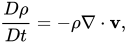
(6)

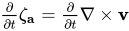
where is the geopotential height. Writing the absolute vorticity as , as , and then take the curl of the full momentum equation (5), we have


(7)

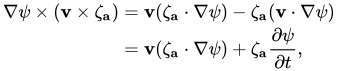
Consider to be a hydrodynamical invariant, that is, equals to zero following the fluid motion in question. Scalar multiplication of equation (7) by , and note that , we have

(8)

The second term on the left-hand side of equation (8) is equal to , in which the second term is zero. From the triple vector product formula, we have

(9)

where the second row is due to the fact that is conserved following the motion, . Substituting equation (9) into equation (8) above,

(10)

Combining the first, second, and fourth term in equation (10) can yield . Dividing by and using a variant form of mass continuity equation,, equation (10) gives

(11)

If the invariant is only a function of pressure and density , then its gradient is perpendicular to the cross product of and , which means that the right-hand side of equation (11) is equal to zero. Specifically for the atmosphere, potential temperature is chosen as the invariant for frictionless and adiabatic motions. Therefore, the conservation law of Ertel's potential vorticity is given by

(12)

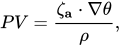
the potential vorticity is defined as

(13)

where is the fluid density, is the absolute vorticity and is the gradient of potential temperature. It can be shown through a combination of the first law of thermodynamics and momentum conservation that the potential vorticity can only be changed by diabatic heating (such as latent heat released from condensation) or frictional processes.

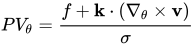
If the atmosphere is stably stratified so that the potential temperature increases monotonically with height, can be used as a vertical coordinate instead of . In the coordinate system, "density" is defined as . Then, if we start the derivation from the horizontal momentum equation in isentropic coordinates, Ertel PV takes a much simpler form[8]

(14)

where is the local vertical vector of unit length and is the 3-dimensional gradient operator in isentropic coordinates. It can be seen that this form of potential vorticity is just the continuous form of Rossby's isentropic multi-layer PV in equation (4).

Interpretation

[edit]

The Ertel PV conservation theorem, equation (12), states that for a dry atmosphere, if an air parcel conserves its potential temperature, its potential vorticity is also conserved following its full three-dimensional motions. In other words, in adiabatic motion, air parcels conserve Ertel PV on an isentropic surface. Remarkably, this quantity can serve as a Lagrangian tracer that links the wind and temperature fields. Using the Ertel PV conservation theorem has led to various advances in understanding the general circulation. One of them was "tropopause folding" process described in Reed et al., (1950).[9] For the upper-troposphere and stratosphere, air parcels follow adiabatic movements during a synoptic period of time. In the extratropical region, isentropic surfaces in the stratosphere can penetrate into the tropopause, and thus air parcels can move between stratosphere and troposphere, although the strong gradient of PV near the tropopause usually prevents this motion. However, in frontal region near jet streaks, which is a concentrated region within a jet stream where the wind speeds are the strongest, the PV contour can extend substantially downward into the troposphere, which is similar to the isentropic surfaces. Therefore, stratospheric air can be advected, following both constant PV and isentropic surfaces, downwards deep into the troposphere. The use of PV maps was also proved to be accurate in distinguishing air parcels of recent stratospheric origin even under sub-synoptic-scale disturbances. (An illustration can be found in Holton, 2004, figure 6.4)

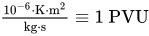
The Ertel PV also acts as a flow tracer in the ocean, and can be used to explain how a range of mountains, such as the Andes, can make the upper westerly winds swerve towards the equator and back. Maps depicting Ertel PV are usually used In meteorological analysis in which the potential vorticity unit (PVU) defined as .
Quasi-geostrophic PV

[edit]

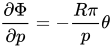
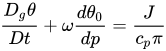
One of the simplest but nevertheless insightful balancing conditions is in the form of quasi-geostrophic equations. This approximation basically states that for three-dimensional atmospheric motions that are nearly hydrostatic and geostrophic, their geostrophic part can be determined approximately by the pressure field, whereas the ageostrophic part governs the evolution of the geostrophic flow. The potential vorticity in the quasi-geostrophic limit (QGPV) was first formulated by Charney and Stern in 1960.[10] Similar to Chapter 6.3 in Holton 2004,[8] we start from horizontal momentum (15), mass continuity (16), hydrostatic (17), and thermodynamic (18) equations on a beta plane, while assuming that the flow is inviscid and hydrostatic,

(15)
(16)
(17)
(18)

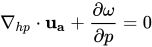
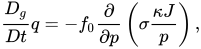
where represents the geostrophic evolution, , is the diabatic heating term in , is the geopotential height, is the geostrophic component of horizontal velocity, is the ageostrophic velocity, is horizontal gradient operator in (x, y, p) coordinates. With some manipulation (see Quasi-geostrophic equations or Holton 2004, Chapter 6 for details), one can arrive at a conservation law

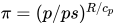
(19)

where is the spatially averaged dry static stability. Assuming that the flow is adiabatic, which means , we have the conservation of QGPV. The conserved quantity takes the form
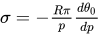
(20)

which is the QGPV, and it is also known as the pseudo-potential-vorticity. Apart from the diabatic heating term on the right-hand-side of equation(19), it can also be shown that QGPV can be changed by frictional forces.

The Ertel PV reduces to the QGPV if one expand the Ertel PV to the leading order, and assume that the evolution equation is quasi-geostrophic, i.e., .[3] Because of this factor, one should also note that the Ertel PV conserves following air parcel on an isentropic surface and is therefore a good Lagrangian tracer, whereas the QGPV is conserved following large-scale geostrophic flow. QGPV has been widely used in depicting large-scale atmospheric flow structures, as discussed in the section PV invertibility principle;

PV invertibility principle

[edit]

Apart from being a Lagrangian tracer, the potential vorticity also gives dynamical implications via the invertibility principle. For a 2-dimensional ideal fluid, the vorticity distribution controls the stream function by a Laplace operator,

(21)

where is the relative vorticity, and is the streamfunction. Hence from the knowledge of vorticity field, the operator can be inverted and the stream function can be calculated. In this particular case (equation 21), vorticity gives all the information needed to deduce motions, or streamfunction, thus one can think in terms of vorticity to understand the dynamics of the fluid. A similar principle was originally introduced for the potential vorticity in three-dimensional fluid in the 1940s by Kleinschmit, and was developed by Charney and Stern in their quasi-geostrophic theory.[11]

Despite theoretical elegance of Ertel's potential vorticity, early applications of Ertel PV are limited to tracer studies using special isentropic maps. It is generally insufficient to deduce other variables from the knowledge of Ertel PV fields only, since it is a product of wind () and temperature fields ( and ). However, large-scale atmospheric motions are inherently quasi-static; wind and mass fields are adjusted and balanced against each other (e.g., gradient balance, geostrophic balance). Therefore, other assumptions can be made to form a closure and deduce the complete structure of the flow in question:[2]

(1) introduce balancing conditions of certain form. These conditions must be physically realizable and stable without instabilities such as static instability. Also, the space and time scales of the motion must be compatible with the assumed balance;

(2) specify a certain reference state, such as distribution of temperature, potential temperature, or geopotential height;

(3) assert proper boundary conditions and invert the PV field globally.

The first and second assumptions are expressed explicitly in the derivation of quasi-geostrophic PV. Leading-order geostrophic balance is used as the balancing condition. The second-order terms such as ageostrophic winds, perturbations of potential temperature and perturbations of geostrophic height should have consistent magnitude, i.e., of the order of Rossby number. The reference state is zonally averaged potential temperature and geopotential height. The third assumption is apparent even for 2-dimensional vorticity inversion because inverting the Laplace operator in equation (21), which is a second-order elliptic operator, requires knowledge of the boundary conditions.

For example, in equation (20), invertibility implies that given the knowledge of , the Laplace-like operator can be inverted to yield geopotential height . is also proportional to the QG streamfunction under the quasi-geostrophic assumption. The geostrophic wind field can then be readily deduced from . Lastly, the temperature field is given by substituting into the hydrostatic equation (17).

See also

[edit]

References

[edit]

Further reading

[edit]
[edit]
Revisions and contributorsEdit on WikipediaRead on Wikipedia
from Grokipedia
Potential vorticity (PV) is a conserved scalar quantity in geophysical fluid dynamics that quantifies the rotation of a fluid element relative to its stratification, defined generally as the dot product of absolute vorticity and the gradient of a conserved thermodynamic property (such as potential temperature) divided by fluid density.[1] In the atmosphere, Ertel's potential vorticity takes the form $ q = \frac{\vec{\zeta}_a \cdot \nabla \theta}{\rho} $, where $ \vec{\zeta}_a $ is absolute vorticity, $ \theta $ is potential temperature, and $ \rho $ is density, making it materially conserved for adiabatic, frictionless flow along isentropic surfaces.[2] This conservation principle, first generalized by Hans Ertel in 1942 building on earlier work by Carl-Gustaf Rossby in 1940, allows PV to serve as a tracer for fluid motion in rotating, stratified systems like the atmosphere and oceans.[2] PV plays a central role in diagnosing large-scale atmospheric and oceanic dynamics, as its conservation implies that changes in vorticity must balance alterations in stratification or planetary rotation effects, such as the Coriolis parameter varying with latitude.[3] For instance, in the shallow-water approximation relevant to both geophysical contexts, PV is expressed as the absolute vorticity divided by fluid depth ($ q = \zeta_a / h $), highlighting how vertical stretching of fluid columns amplifies relative vorticity.[1] This interplay underpins phenomena like cyclone development, where intrusion of high-PV air from the stratosphere into the troposphere can trigger rapid intensification, or oceanic gyre formation driven by wind stress and stratification gradients.[3] Non-conservative processes, including diabatic heating from radiation or friction from surface drag, can generate or destroy PV, influencing weather patterns and climate variability.[1] In practical applications, PV is mapped on isentropic surfaces to identify dynamical tropopause breaks or fronts, aiding meteorologists in forecasting mid-latitude storms and tropical cyclone evolution.[3] Similarly, in oceanography, PV conservation helps model mesoscale eddies and the meridional overturning circulation by tracing water masses with distinct PV signatures.[2] The concept's versatility extends to numerical weather prediction models, where PV inversion techniques reconstruct balanced flows from PV distributions, underscoring its enduring importance since its formalization over eight decades ago.[1]

Historical Foundations

Bjerknes Circulation Theorem

The Bjerknes circulation theorem, formulated by Norwegian meteorologist Vilhelm Bjerknes in 1898, represents a foundational principle in geophysical fluid dynamics, extending Lord Kelvin's earlier circulation theorem to baroclinic fluids on a rotating planet. Published in the Proceedings of the Royal Swedish Academy of Sciences, Bjerknes' work marked a pivotal shift toward applying hydrodynamic principles to atmospheric and oceanic motions, emphasizing the role of density variations in generating circulation changes.[4] The theorem states that the material rate of change of circulation $ C = \oint \mathbf{v} \cdot d\mathbf{l} $ around a closed material curve in an inviscid fluid is given by the line integral of the non-conservative forces per unit mass acting on the fluid elements along the curve. In the context of geophysical fluids in a rotating frame, this simplifies to
DCDt=(1ρpΦ)dl, \frac{DC}{Dt} = \oint \left( -\frac{1}{\rho} \nabla p - \nabla \Phi \right) \cdot d\mathbf{l},
where $ \mathbf{v} $ is the relative velocity, $ \rho $ is density, $ p $ is pressure, and $ \Phi $ is the geopotential. The Coriolis force does not contribute to this integral over a closed loop, as its form $ -2 \boldsymbol{\Omega} \times \mathbf{v} $ (with $ \boldsymbol{\Omega} $ as Earth's angular velocity vector) yields zero when dotted with $ d\mathbf{l} $ and integrated, due to its perpendicularity to the velocity direction. For absolute circulation $ C_a = \oint (\mathbf{v} + \boldsymbol{\Omega} \times \mathbf{r}) \cdot d\mathbf{l} $, the theorem holds analogously, incorporating planetary rotation effects without altering the force contributions.[4] This result derives from the Navier-Stokes momentum equations in a rotating frame, adapted for geophysical applications assuming inviscid, hydrostatic conditions:
DvDt=2Ω×v1ρpΦ. \frac{D\mathbf{v}}{Dt} = -2 \boldsymbol{\Omega} \times \mathbf{v} - \frac{1}{\rho} \nabla p - \nabla \Phi.
To obtain the circulation theorem, consider the total time derivative of $ C $ following the material curve, which accounts for both the local change in velocity and the deformation of the curve itself (via Reynolds transport theorem). This yields
DCDt=DvDtdl. \frac{DC}{Dt} = \oint \frac{D\mathbf{v}}{Dt} \cdot d\mathbf{l}.
Substituting the momentum equation and noting that the advective and Coriolis terms integrate to zero over the closed loop leaves only the pressure gradient and geopotential terms, as shown above. In baroclinic fluids where density varies independently of pressure (i.e., isobars and isopycnals do not coincide), the pressure term does not vanish and generates circulation through "solenoidal" fields—vector areas formed by gradients of pressure and specific volume $ k = 1/\rho $. Applying Stokes' theorem transforms the line integral to a surface integral:
DCDt=S(k×p)dA, \frac{DC}{Dt} = \iint_S \left( \nabla k \times \nabla p \right) \cdot d\mathbf{A},
quantifying the net flux of these solenoids through the material surface $ S $.[5][4] The pressure gradient force $ -\frac{1}{\rho} \nabla p $ drives horizontal flows, while the buoyancy contribution arises from $ -\nabla \Phi $, which integrates to zero over a closed loop in a conservative gravitational field but interacts with density stratification to influence vertical motions indirectly through hydrostatic balance. In Bjerknes' original acceleration form, the theorem equates the circulatory acceleration of fluid elements to the enclosed solenoids, each contributing a unit acceleration proportional to the misalignment of isobaric and isosteric surfaces, thus linking non-uniform density distributions to rotational tendencies in the atmosphere and oceans.[5] By localizing the circulation theorem via Stokes' theorem ($ C \approx \iint \boldsymbol{\zeta} \cdot d\mathbf{A} $, where $ \boldsymbol{\zeta} = \nabla \times \mathbf{v} $ is relative vorticity), Bjerknes' result underpins the derivation of the vorticity equation in rotating, stratified fluids:
DζDt=(ζ)v(v)ζ+1ρ2(ρ×p)+2(Ω)v2(v)Ω, \frac{D \boldsymbol{\zeta}}{Dt} = (\boldsymbol{\zeta} \cdot \nabla) \mathbf{v} - (\nabla \cdot \mathbf{v}) \boldsymbol{\zeta} + \frac{1}{\rho^2} (\nabla \rho \times \nabla p) + 2 (\boldsymbol{\Omega} \cdot \nabla) \mathbf{v} - 2 (\nabla \cdot \mathbf{v}) \boldsymbol{\Omega},
with the baroclinic term $ \frac{1}{\rho^2} \nabla \rho \times \nabla p $ (equivalent to $ -\nabla k \times \nabla p $) directly mirroring the solenoid generation of circulation. This connection highlights how baroclinicity sources vorticity, essential for understanding large-scale geophysical circulations like cyclones.[5][4]

Rossby's Contributions and Early Developments

Carl-Gustaf Rossby made seminal contributions to the development of potential vorticity (PV) during the 1930s, introducing it as a conserved tracer in simplified models of geophysical flows. Building briefly on Vilhelm Bjerknes' circulation theorem from the early 20th century, which described the evolution of circulation in fluid parcels, Rossby shifted focus toward material invariants that could track large-scale motions more effectively. In his 1936 paper "Dynamics of Steady Ocean Currents in the Light of Experimental Fluid Mechanics," he first formulated PV for barotropic shallow water systems, demonstrating its utility in analyzing steady circulations where fluid parcels conserve this quantity under adiabatic, frictionless conditions.[6] Throughout the late 1930s and into the 1940s, Rossby's work evolved amid collaborations with prominent meteorologists, including Bernhard Haurwitz and members of the emerging Chicago school of meteorology, which he helped establish after joining the University of Chicago in 1940. His 1938 publication "On the Mutual Adjustment of Pressure and Velocity Distributions in Simple Current Systems" in the Journal of Marine Research extended PV concepts to continuously stratified atmospheres, emphasizing its role in displacements of circulation patterns. By 1940, in the influential paper "Planetary Flow Patterns in the Atmosphere" published in the Quarterly Journal of the Royal Meteorological Society, Rossby coined the term "potential vorticity" and applied it to explain the dynamics of long atmospheric waves, marking a transition from circulation-based analyses to PV as a fundamental conserved property in barotropic models. These efforts reflected a broader timeline of innovation, as Rossby integrated observational data from weather stations with theoretical insights to interpret hemispheric-scale flows.[7][8] Early applications of PV centered on shallow water approximations, where Rossby conceptualized it as the sum of relative vorticity and planetary vorticity divided by the fluid depth, serving as an invariant that governed parcel trajectories in rotating, stratified systems. This approach proved effective for studying barotropic instabilities and the adjustment of flows to geostrophic balance, providing a tracer-like tool to predict how disturbances propagate without explicit tracking of velocity fields. Rossby's formulations highlighted PV's dimensions akin to ordinary vorticity, facilitating analogies between oceanic and atmospheric circulations.[6] Rossby's PV innovations profoundly influenced the origins of numerical weather prediction (NWP), laying theoretical groundwork for mid-20th-century advances in forecasting large-scale patterns. By framing atmospheric dynamics around PV conservation, his ideas enabled simplifications that his protégés, such as Jule Charney, incorporated into quasi-geostrophic models during World War II efforts at Princeton University. These developments culminated in the first operational NWP systems in the 1950s, where PV-based diagnostics improved the simulation of Rossby waves and jet stream evolutions, transforming subjective weather analysis into computational frameworks.[9]

Core Concepts

Vorticity and Absolute Vorticity

In fluid dynamics, vorticity quantifies the local rotation of fluid elements around a point. The relative vorticity ζ\boldsymbol{\zeta}, which describes the rotation relative to a non-rotating frame, is defined as the curl of the velocity field v\mathbf{v}:
ζ=×v. \boldsymbol{\zeta} = \nabla \times \mathbf{v}.
This vector field captures the infinitesimal circulation per unit area, derived from the antisymmetric part of the velocity gradient tensor.[10] In three-dimensional flows, the components are given by
ζx=wyvz,ζy=uzwx,ζz=vxuy, \zeta_x = \frac{\partial w}{\partial y} - \frac{\partial v}{\partial z}, \quad \zeta_y = \frac{\partial u}{\partial z} - \frac{\partial w}{\partial x}, \quad \zeta_z = \frac{\partial v}{\partial x} - \frac{\partial u}{\partial y},
where uu, vv, and ww are the velocity components in the xx, yy, and zz directions, respectively.[11] In many geophysical contexts, such as atmospheric and oceanic flows approximated as two-dimensional in the horizontal plane (with negligible vertical velocity), attention focuses on the vertical component ζ=ζz=vxuy\zeta = \zeta_z = \frac{\partial v}{\partial x} - \frac{\partial u}{\partial y}, which measures the rotation in the horizontal plane.[12] This scalar form arises directly from the curl operator applied to horizontal velocity gradients, representing the net tendency for fluid parcels to rotate clockwise or counterclockwise.[13] In rotating reference frames like Earth's, the planetary vorticity due to the planet's rotation must be accounted for. The Coriolis parameter ff, which approximates the vertical component of twice the planetary angular velocity vector, is defined as f=2Ωsinϕf = 2 \Omega \sin \phi, where Ω7.292×10⁵\Omega \approx 7.292 \times 10^{-5} s1^{-1} is Earth's angular rotation rate and ϕ\phi is the latitude.[14] At mid-latitudes (around 45°), sinϕ0.707\sin \phi \approx 0.707, yielding f104f \approx 10^{-4} s1^{-1}.[15] The absolute vorticity η\eta, combining relative and planetary contributions, is then η=ζ+f\eta = \zeta + f for the vertical component in shallow, geostrophically balanced flows.[16] Vorticity has units of inverse time (s1^{-1}), reflecting its role as an angular velocity measure. In geophysical scales, such as mid-latitude synoptic systems (e.g., weather fronts spanning ~1000 km), relative vorticity ζ\zeta typically scales as 10510^{-5} to 10410^{-4} s1^{-1}, often comparable to or smaller than ff, highlighting the dominance of planetary rotation in large-scale dynamics. This scaling underscores vorticity's importance in balancing Coriolis effects against relative motions in rotating fluids.[17]

Potential Temperature and Stratification

Potential temperature, denoted as θ\theta, is a thermodynamic variable that represents the temperature a parcel of dry air would attain if adiabatically compressed or expanded to a standard reference pressure p0p_0, typically 1000 hPa, without heat exchange with its surroundings.[18] It is mathematically defined by the formula
θ=T(p0p)R/cp, \theta = T \left( \frac{p_0}{p} \right)^{R / c_p},
where TT is the actual temperature of the air parcel, pp is its pressure, RR is the specific gas constant for dry air (approximately 287 J kg⁻¹ K⁻¹), and cpc_p is the specific heat capacity of dry air at constant pressure (approximately 1004 J kg⁻¹ K⁻¹).[18] This quantity is conserved for reversible adiabatic processes in dry air, making it a fundamental tracer for analyzing atmospheric motion and stability.[18] The derivation of potential temperature stems from the first law of thermodynamics applied to an adiabatic, reversible process for an ideal gas. For such a process, the heat added dq=0dq = 0, leading to cpdT=αdpc_p dT = \alpha dp, where α=RT/p\alpha = RT/p is the specific volume from the ideal gas law. Integrating this yields lnθ=lnT+(R/cp)ln(p0/p)+constant\ln \theta = \ln T + (R/c_p) \ln (p_0 / p) + \text{constant}, which simplifies to the Poisson equation form of θ\theta.[19] Hydrostatic balance, expressed as dp/dz=ρgdp/dz = -\rho g, underpins the vertical structure in the atmosphere, ensuring that pressure decreases with height and providing the context for adiabatic displacements along isentropic surfaces where θ\theta remains constant.[20] This balance is crucial for interpreting θ\theta gradients in stably stratified flows, as it links pressure changes to gravitational forces without horizontal accelerations.[20] In stratified fluids like the atmosphere, potential temperature governs static stability by indicating whether displaced parcels return to their original position. A positive vertical gradient dθ/dz>0d\theta/dz > 0 signifies stable stratification, where the atmosphere resists vertical motions. The Brunt-Väisälä frequency, a measure of this oscillatory stability, is given by
N2=gθdθdz, N^2 = \frac{g}{\theta} \frac{d\theta}{dz},
where gg is gravitational acceleration (approximately 9.81 m s⁻²).[18] When N2>0N^2 > 0, parcels oscillate with frequency NN; if N2<0N^2 < 0, the flow is unstable to convection. This frequency quantifies the restoring force due to buoyancy in a stratified medium, with typical tropospheric values ranging from 10⁻² to 10⁻¹ s⁻¹ in stable layers.[18] Potential temperature is particularly important in dry atmospheres, where it serves as the primary conserved variable for parcel tracking, but its application extends to moist conditions with modifications like equivalent potential temperature θe\theta_e, which accounts for latent heat release during condensation. In moist air, θ\theta alone underestimates buoyancy due to water vapor's lower molecular weight, necessitating virtual potential temperature for accurate density assessments.[19] In oceanography, the analog is potential density, referenced to a standard pressure (often surface level), defined as σθ=ρ(S,Θ,0)1000\sigma_\theta = \rho(S, \Theta, 0) - 1000 kg m⁻³, where ρ\rho is seawater density, SS is salinity, and Θ\Theta is potential temperature; this preserves neutrality in adiabatic displacements and assesses oceanic stratification similarly to θ\theta in air./06%3A_Temperature_Salinity_and_Density/6.05%3A_Density)

Key Formulations

Shallow Water Potential Vorticity

The shallow water potential vorticity represents the foundational and simplest expression of potential vorticity, applicable to barotropic, rotating fluids where the horizontal scale greatly exceeds the vertical scale, such as in idealized models of ocean or atmospheric layers.[10] Developed by Carl-Gustaf Rossby, it quantifies the vertical component of absolute vorticity normalized by the fluid depth, capturing the interplay between rotation, relative motion, and layer thickness in conserving angular momentum.[21] Absolute vorticity here refers to the sum of relative vorticity and the planetary vorticity due to Earth's rotation.[10] The formulation is given by
q=ζ+fh, q = \frac{\zeta + f}{h},
where ζ\zeta is the relative vorticity (the curl of the horizontal velocity), f=2Ωsinϕf = 2 \Omega \sin \phi is the Coriolis parameter (Ω\Omega is Earth's angular velocity and ϕ\phi is latitude), and hh is the total fluid depth.[10][21] This expression arises from applying Bjerknes' circulation theorem, which states that the circulation Γ\Gamma around a closed material contour in a barotropic fluid is conserved in the absence of friction and diabatic heating (DΓ/Dt=0D\Gamma / Dt = 0).[22] To derive qq, consider a vertical material column of fluid with cross-sectional area AA and height hh; the theorem implies conservation of the circulation per unit area, but vertical stretching or compression of the column (via changes in hh) modifies the vorticity, leading to the normalization by hh for material invariance.[10] Specifically, integrating the theorem over the column's base and dividing by AhA h yields the conservation of qq.[22] In this shallow water context, qq carries units of s1^{-1} m1^{-1}, reflecting vorticity (s1^{-1}) divided by depth (m), though it aligns conceptually with the more general potential vorticity unit (PVU) of 106^{-6} K m2^{2} kg1^{-1} s1^{-1} when stratification is absent.[10] Under frictionless and adiabatic conditions, qq is materially conserved, satisfying the equation
DqDt=0, \frac{Dq}{Dt} = 0,
or equivalently q/t+vq=0\partial q / \partial t + \mathbf{v} \cdot \nabla q = 0, where v\mathbf{v} is the horizontal velocity; this ensures that fluid parcels retain their qq value as they advect, enabling diagnostics of flow evolution from initial conditions.[10][21]

Ertel's Potential Vorticity

Ertel's potential vorticity provides a general framework for understanding the dynamics of stratified, rotating fluids in three dimensions, applicable to both atmospheric and oceanic contexts. Defined as
q=1ρωaθ, q = \frac{1}{\rho} \vec{\omega}_a \cdot \nabla \theta,
where ρ\rho denotes the fluid density, ωa=×u+2Ω\vec{\omega}_a = \nabla \times \vec{u} + 2 \vec{\Omega} is the absolute vorticity vector (u\vec{u} being the velocity and Ω\vec{\Omega} the planetary rotation vector), and θ\theta the potential temperature, this quantity captures the interplay between rotation, stratification, and motion.[23] In adiabatic, inviscid, barotropic flow, qq is materially conserved, meaning its value remains constant following individual fluid parcels.[2] The theorem originates from Hans Ertel's 1942 analysis, which leverages fundamental conservation laws via the chain rule applied to material derivatives. The derivation commences with the thermodynamic equation for potential temperature, DθDt=0\frac{D\theta}{Dt} = 0, under adiabatic conditions, and the absolute vorticity equation,
DωaDt=(ωa)u+1ρ2ρ×p+1ρ×F, \frac{D \vec{\omega}_a}{Dt} = \left( \vec{\omega}_a \cdot \nabla \right) \vec{u} + \frac{1}{\rho^2} \nabla \rho \times \nabla p + \frac{1}{\rho} \nabla \times \vec{F},
where F\vec{F} represents body forces (often zero in standard derivations) and the baroclinic term ρ×p\nabla \rho \times \nabla p arises from the momentum equations. The continuity equation, DρDt+ρu=0\frac{D\rho}{Dt} + \rho \nabla \cdot \vec{u} = 0 or equivalently DDt(1ρ)=1ρu\frac{D}{Dt} (\frac{1}{\rho}) = \frac{1}{\rho} \nabla \cdot \vec{u}, ensures mass conservation. To derive the evolution of qq, consider the material derivative:
DqDt=1ρDDt(ωaθ)qρDρDt. \frac{Dq}{Dt} = \frac{1}{\rho} \frac{D}{Dt} (\vec{\omega}_a \cdot \nabla \theta) - \frac{q}{\rho} \frac{D\rho}{Dt}.
Expanding the first term using the product rule and chain rule yields
DDt(ωaθ)=DωaDtθ+ωaDDt(θ)=DωaDtθ+ωa[(u)θ(u)Tθ], \frac{D}{Dt} (\vec{\omega}_a \cdot \nabla \theta) = \frac{D\vec{\omega}_a}{Dt} \cdot \nabla \theta + \vec{\omega}_a \cdot \frac{D}{Dt} (\nabla \theta) = \frac{D\vec{\omega}_a}{Dt} \cdot \nabla \theta + \vec{\omega}_a \cdot \left[ (\nabla \cdot \vec{u}) \nabla \theta - (\nabla \vec{u})^T \cdot \nabla \theta \right],
where the second part follows from the transport theorem for gradients. Substituting the vorticity equation and simplifying, the stretching term (ωa)uθ(\vec{\omega}_a \cdot \nabla) \vec{u} \cdot \nabla \theta partially cancels with the transpose term, leaving the baroclinic contribution 1ρ2(ρ×p)θ\frac{1}{\rho^2} (\nabla \rho \times \nabla p) \cdot \nabla \theta. Incorporating the continuity-derived term qρDρDt=qu-\frac{q}{\rho} \frac{D\rho}{Dt} = -q \nabla \cdot \vec{u} further balances the divergence effects. For barotropic conditions (ρ×p=0\nabla \rho \times \nabla p = 0) and no forcing (F=0\vec{F} = 0), all terms vanish, yielding DqDt=0\frac{Dq}{Dt} = 0. This rigorous application of vector calculus to the primitive equations underscores the theorem's generality.[2][23] In oceanic applications, where salinity influences density stratification, Ertel's theorem is generalized by replacing potential temperature with a conserved scalar incorporating salinity SS, such as the entropy η\eta or a potential density variable that accounts for both temperature and salinity effects. The form becomes q=1ρωaηq = \frac{1}{\rho} \vec{\omega}_a \cdot \nabla \eta, with conservation holding for volumes bounded by surfaces of constant η\eta or SS under moist adiabatic conditions without precipitation or friction; this adaptation preserves the theorem's utility for multi-component fluids.[24] Non-conservative processes modify the evolution equation DqDt0\frac{Dq}{Dt} \neq 0. Diabatic heating introduces a source term 1ρωa(DθDt)\frac{1}{\rho} \vec{\omega}_a \cdot \nabla \left( \frac{D\theta}{Dt} \right), reflecting changes in stratification due to heat addition or removal, while frictional effects contribute through the curl of viscous stresses in the vorticity equation, typically dissipating qq in boundary layers. These terms highlight qq's sensitivity to thermodynamic and dissipative influences, limiting strict conservation to idealized scenarios.[25]

Quasi-Geostrophic Potential Vorticity

The quasi-geostrophic (QG) approximation to potential vorticity arises from scale analysis applied to Ertel's potential vorticity under the assumptions of nearly geostrophic balance and small Rossby number (Ro ≪ 1), where the Rossby number Ro = U/(f L) compares inertial to Coriolis forces, with U the characteristic velocity, f the Coriolis parameter, and L the horizontal length scale.[26] This scaling neglects higher-order advective and ageostrophic terms, retaining leading-order contributions from planetary rotation, relative vorticity gradients, and vertical stretching due to stratification, while assuming hydrostatic balance and a basic state with constant f ≈ f₀ (the Coriolis parameter at a reference latitude).[27] The result is a materially conserved quantity q that governs large-scale, slowly evolving flows, simplifying the full three-dimensional dynamics into a diagnostic equation suitable for numerical modeling and theoretical analysis.[28] The QG potential vorticity is expressed as
q=2ψ+βy+f0θ0θz, q = \nabla^2 \psi + \beta y + \frac{f_0}{\theta_0} \frac{\partial \theta}{\partial z},
where ψ\psi is the geostrophic streamfunction (related to the geopotential via ψ=Φ/f0\psi = \Phi / f_0), β=f/y\beta = \partial f / \partial y is the Rossby parameter (approximately 1.6 × 10⁻¹¹ m⁻¹ s⁻¹ at 45° latitude), y is the northward coordinate, f₀ is the reference Coriolis parameter, θ0\theta_0 is the reference potential temperature, and θ\theta is the perturbation potential temperature.[26] The stretching term f0θ0θz\frac{f_0}{\theta_0} \frac{\partial \theta}{\partial z} accounts for baroclinic effects through the vertical gradient of potential temperature, which modulates the column thickness under hydrostatic balance.[27] This form is conserved following the geostrophic flow: DgqDt=0\frac{D_g q}{Dt} = 0, where DgDt=t+ug\frac{D_g}{Dt} = \frac{\partial}{\partial t} + \mathbf{u}_g \cdot \nabla uses the geostrophic velocity ug=(ψ/y,ψ/x)\mathbf{u}_g = (-\partial \psi / \partial y, \partial \psi / \partial x).[28] In its hybrid representation, q combines three primary contributions: relative vorticity ζg=2ψ\zeta_g = \nabla^2 \psi (from horizontal shears in the geostrophic wind), planetary vorticity βy\beta y (from the latitudinal variation of the Coriolis effect, inducing meridional gradients), and the baroclinic term f0θ0θz\frac{f_0}{\theta_0} \frac{\partial \theta}{\partial z} (reflecting vertical variations in density or temperature that alter vortex stretching).[26] These terms capture the essential dynamics of balanced flows, where anomalies in q drive geopotential tendencies via elliptic inversion, linking surface pressure patterns to upper-level structures.[27] This approximation holds for mid-latitude synoptic-scale motions (horizontal scales of 500–2000 km and timescales of 1–10 days), where Ro ≈ 0.1 and the deformation radius L_D = N H / f₀ (with buoyancy frequency N and height scale H) is comparable to L, ensuring geostrophic dominance.[28] However, it introduces errors in the tropics, where small f and β lead to larger Ro (>0.3) and weaker geostrophic balance, necessitating extensions like equatorial or tropical approximations.[26]

Interpretations and Properties

Physical and Dynamical Interpretation

Potential vorticity (PV) serves as a fundamental diagnostic tracer in atmospheric and oceanic dynamics, representing the intersection of vortex tube surfaces with isentropic surfaces, which are surfaces of constant potential temperature. Physically, PV quantifies the density of vortex lines piercing a unit area of an isentropic surface, providing insight into the three-dimensional structure of fluid motion. This interpretation arises because vortex lines, which are tangent to the vorticity vector, are "frozen" into the fluid in the absence of diabatic processes, and their concentration on isentropic surfaces reflects the interplay between rotation and stratification. The analogy of vortex tube thickness further elucidates this: a thinner tube cross-section on the isentropic surface corresponds to higher PV, as the same circulation is concentrated over a smaller area, amplifying the effective vorticity density.[29] Dynamically, PV encapsulates the balance between absolute vorticity and static stability, offering a qualitative measure of rotational and buoyant forces within fluid parcels. High PV values typically indicate regions of strong cyclonic rotation combined with stable stratification, where the positive alignment of vorticity and the vertical gradient of potential temperature enhances the overall dynamical activity. Conversely, low or negative PV signifies anticyclonic rotation or unstable stratification, often associated with weaker or opposing dynamical influences that can lead to baroclinic instability. This dual role allows PV to diagnose the potential for intense weather systems, as high PV parcels act as coherent structures that influence surrounding flow through their conserved nature.[29]/11:_General_Circulation/11.9:_Types_of_Vorticity) In frontal and upper-level contexts, PV anomalies provide a sharp indicator of dynamical boundaries, particularly at the tropopause where jet streams are prominent. Positive PV anomalies descending from the stratosphere or forming at the tropopause interface often mark the poleward edge of jet streams, with steep PV gradients delineating the transition between tropospheric and stratospheric air masses. These anomalies drive ageostrophic circulations that intensify jets and fronts, as the intrusion of stratospheric air—characterized by high PV—enhances cyclonic shear and vertical motion. Such interpretations underscore PV's utility in mapping synoptic-scale features without relying on direct height or wind fields.[29] To standardize comparisons across scales, PV is conventionally expressed in potential vorticity units (PVU), where $ 1 , \text{PVU} = 10^{-6} , \text{K} , \text{m}^2 , \text{kg}^{-1} , \text{s}^{-1} $. This unit arises from the dimensional form of Ertel's PV, $ \Pi = \frac{1}{\rho} \vec{\zeta}_a \cdot \nabla \theta $, ensuring practical values around 1–2 PVU near the tropopause and lower in the troposphere./11:_General_Circulation/11.9:_Types_of_Vorticity)

Conservation and Invertibility Principle

Potential vorticity (PV), as defined by Ertel, is materially conserved in inviscid, adiabatic flow, meaning that the material derivative of PV vanishes: $ \frac{Dq}{Dt} = 0 $, where $ q = \frac{\boldsymbol{\zeta} \cdot \nabla \theta}{\rho} $ with $ \boldsymbol{\zeta} $ the absolute vorticity, $ \theta $ the potential temperature, and $ \rho $ the density.[2] This conservation follows from Ertel's theorem, which generalizes earlier circulation theorems by considering a conserved scalar like potential temperature and projecting vorticity along its gradient in a stratified fluid.[30] The proof relies on the vector identity for the material derivative of the dot product and the adiabatic, inviscid momentum and thermodynamic equations, ensuring that PV acts as a tracer advected by the flow without sources or sinks under these ideal conditions.[2] In realistic atmospheric and oceanic models, PV is not strictly conserved due to diabatic and frictional processes, such as radiative heating, friction, and moist convection.[31] Cumulus convection, for instance, introduces non-conservation through latent heat release during phase changes, which modifies the potential temperature gradient and thus PV, often leading to generation of positive PV anomalies in the mid-troposphere.[31] These effects are typically parameterized in numerical weather prediction models using schemes like cumulus parameterizations that account for subgrid-scale heating and momentum redistribution, allowing for explicit diagnosis of PV tendencies from diabatic sources.[31] The PV invertibility principle provides a mathematical framework to reconstruct balanced dynamical fields from a specified PV distribution, given suitable boundary conditions.[29] In the quasi-geostrophic (QG) approximation, invertibility involves solving a linear elliptic partial differential equation for the geostrophic streamfunction $ \psi $, such as $ \nabla^2 \psi = -q $, where $ q $ incorporates relative vorticity, planetary vorticity, and stretching terms; this yields the balanced velocity and geopotential height fields.[27] For global applications, Hoskins, McIntyre, and Robertson (1985) extended this to Ertel's PV on isentropic surfaces, stating that the balanced flow is uniquely determined by the global PV distribution on each surface together with the specification of the total mass (or equivalent potential temperature at the surface) beneath it, enabling the solution via nonlinear elliptic equations that account for the full nonlinear balance.[29] This formulation underpins PV-based diagnostic tools in meteorology, emphasizing the sufficiency of PV as a prognostic variable for balanced motions.[29]

Applications and Extensions

Meteorological Forecasting

In meteorological forecasting, potential vorticity (PV) serves as a key diagnostic tool in operational numerical weather prediction models, such as those from the European Centre for Medium-Range Weather Forecasts (ECMWF) and the National Oceanic and Atmospheric Administration (NOAA). These models routinely compute PV fields to identify upper-level features, including the dynamic tropopause, which is defined as the isentropic surface where PV reaches 1.5–2 potential vorticity units (PVU), with 2 PVU commonly used as the threshold separating tropospheric and stratospheric air.[32][33] This PV-based tropopause definition aids in diagnosing jet streaks, where strong PV gradients highlight regions of intense upper-level winds and potential cyclogenesis.[34] Forecasters at ECMWF and NOAA use these PV contours on pressure or isentropic levels to track tropopause undulations and associated weather systems, enhancing the interpretation of model output for short- to medium-range predictions.[35] PV streamers—elongated filaments of high PV descending from the tropopause—play a crucial role in forecasting blocking patterns, where they contribute to quasi-stationary high-pressure systems that disrupt typical westerly flow.[36] These features, often identified in model analyses, signal the onset of persistent anticyclonic blocking over regions like the North Atlantic, leading to prolonged weather extremes such as cold outbreaks or heat domes.[37] Similarly, PV cutoffs, where isolated pockets of stratospheric air become detached, are diagnostic of cut-off lows, which form closed cyclones detached from the main westerly jet and are associated with heavy precipitation and severe weather in midlatitudes.[38] Operational forecasters monitor the evolution of these PV structures in ensemble predictions to anticipate blocking persistence and cut-off low development, improving lead times for impacts like flooding in Europe or North America.[36] Case studies illustrate PV's diagnostic value in extreme events; during the 2003 European heatwave, anomalous PV fluxes from eddy activity sustained an upper-level blocking ridge over the continent, amplifying surface temperatures and contributing to over 70,000 excess deaths.[39][40] In tropical contexts, PV anomalies generated by diabatic heating in convective clusters have been linked to hurricane genesis, as seen in simulations of storms like Gert (1999), where low-level PV maxima from moist convection initiated vortex spin-up, though the principle extends to post-2000 cases analyzed in operational settings.[41][42] These examples underscore how PV anomalies diagnose the dynamical precursors to rapid intensification or blocking, guiding forecaster alerts. Post-2000 advances have integrated PV into nowcasting and short-term forecasting tools, enhancing operational efficiency. The adoption of "PV thinking" in U.S. forecast offices since 2007 emphasizes PV diagnostics for real-time assessment of extratropical cyclogenesis and coastal storms, using model-derived PV fields to blend observations with predictions up to 48 hours ahead.[43] Techniques like piecewise PV inversion, refined in the 2000s, allow forecasters to isolate PV perturbations and improve cyclone track predictions by incorporating localized modifications in numerical models.[44] Additionally, three-dimensional PV tracking methods developed around 2020 enable nowcasting of cutoff life cycles, providing Lagrangian views of PV evolution for sub-daily updates on severe weather risks.[38] These tools have been implemented in systems like ECMWF's Integrated Forecasting System, contributing to forecasts of PV-influenced phenomena.

Oceanographic Dynamics

In oceanography, potential vorticity (PV) is adapted to account for the compressibility of seawater and the influence of salinity on density stratification, differing from atmospheric applications where temperature dominates. The oceanic form of Ertel's PV is defined as $ q = \frac{1}{\rho} \mathbf{\omega}a \cdot \nabla \sigma\theta $, where $ \rho $ is the fluid density, $ \mathbf{\omega}a $ is the absolute vorticity vector, and $ \sigma\theta $ is the potential density referenced to the sea surface.[45] This formulation incorporates salinity effects, which create baroclinic structures through thermohaline variations, leading to PV distributions that control large-scale currents and mixing unlike the primarily barotropic atmospheric jets.[45] PV conservation governs the dynamics of the Antarctic Circumpolar Current (ACC), the strongest oceanic current, where meridional PV gradients drive eddy fluxes that homogenize PV in the interior, enabling the current's zonal extent across varying bottom topography.[46] In subtropical gyres, such as the North Atlantic gyre, wind stress curl inputs PV that balances interior dissipation, shaping the Sverdrup interior flow and recirculations along PV contours, with low-PV mode waters forming in the gyre centers due to subduction.[47] At submesoscale resolutions (1–10 km), frontal instabilities, including symmetric instability and frontogenesis, generate intense PV anomalies that facilitate vertical mixing and restratification, transferring PV from boundaries to the interior and modulating heat uptake in gyres.[48] These processes enhance diapycnal diffusion, with PV destruction at fronts compensating planetary vorticity stretching.[48] Observations from Argo floats enable global PV mapping by providing temperature and salinity profiles to compute $ \sigma_\theta $ and vorticity, revealing homogenized PV in shadow zones and submesoscale variability in the upper ocean.[49] Climate models, such as high-resolution integrations, simulate PV budgets to assess long-term circulation changes, confirming eddy-driven PV fluxes as key to Southern Ocean overturning under climate forcing.[50]

References

User Avatar
No comments yet.