Hubbry Logo
Geostrophic windGeostrophic windMain
Open search
Geostrophic wind
Community hub
Geostrophic wind
logo
7 pages, 0 posts
0 subscribers
Be the first to start a discussion here.
Geostrophic wind
Geostrophic wind
from Wikipedia

In atmospheric science, geostrophic flow (/ˌəˈstrɒfɪk, ˌ-, -ˈstr-/[1][2][3]) is the theoretical wind that would result from an exact balance between the Coriolis force and the pressure gradient force. This condition is called geostrophic equilibrium or geostrophic balance (also known as geostrophy). The geostrophic wind is directed parallel to isobars (lines of constant pressure at a given height). This balance seldom holds exactly in nature. The true wind almost always differs from the geostrophic wind due to other forces such as friction from the ground. Thus, the actual wind would equal the geostrophic wind only if there were no friction (e.g. above the atmospheric boundary layer) and the isobars were perfectly straight. Despite this, much of the atmosphere outside the tropics is close to geostrophic flow much of the time and it is a valuable first approximation. Geostrophic flow in air or water is a zero-frequency inertial wave.

Origin

[edit]

A useful heuristic is to imagine air starting from rest, experiencing a force directed from areas of high pressure toward areas of low pressure, called the pressure gradient force. If the air began to move in response to that force, however, the Coriolis force would deflect it, to the right of the motion in the Northern Hemisphere or to the left in the Southern Hemisphere. As the air accelerated, the deflection would increase until the Coriolis force's strength and direction balanced the pressure gradient force, a state called geostrophic balance. At this point, the flow is no longer moving from high to low pressure, but instead moves along isobars. Geostrophic balance helps to explain why, in the Northern Hemisphere, low-pressure systems (or cyclones) spin counterclockwise and high-pressure systems (or anticyclones) spin clockwise, and the opposite in the Southern Hemisphere.

Geostrophic currents

[edit]

Flow of ocean water is also largely geostrophic. Just as multiple weather balloons that measure pressure as a function of height in the atmosphere are used to map the atmospheric pressure field and infer the geostrophic wind, measurements of density as a function of depth in the ocean are used to infer geostrophic currents. Satellite altimeters are also used to measure sea surface height anomaly, which permits a calculation of the geostrophic current at the surface.

Limitations of the geostrophic approximation

[edit]

The effect of friction, between the air and the land, breaks the geostrophic balance. Friction slows the flow, lessening the effect of the Coriolis force. As a result, the pressure gradient force has a greater effect and the air still moves from high pressure to low pressure, though with great deflection. This explains why high-pressure system winds radiate out from the center of the system, while low-pressure systems have winds that spiral inwards.

The geostrophic wind neglects frictional effects, which is usually a good approximation for the synoptic scale instantaneous flow in the midlatitude mid-troposphere.[4] Although ageostrophic terms are relatively small, they are essential for the time evolution of the flow and in particular are necessary for the growth and decay of storms. Quasigeostrophic and semi geostrophic theory are used to model flows in the atmosphere more widely. These theories allow for a divergence to take place and for weather systems to then develop.

Formulation

[edit]

Newton's second law can be written as follows if only the pressure gradient, gravity, and friction act on an air parcel, where bold symbols are vectors:

Here U is the velocity field of the air, Ω is the angular velocity vector of the planet, ρ is the density of the air, P is the air pressure, Fr is the friction, g is the acceleration vector due to gravity and D/Dt is the material derivative.

Locally this can be expanded in Cartesian coordinates, with a positive u representing an eastward direction and a positive v representing a northward direction. Neglecting friction and vertical motion, as justified by the Taylor–Proudman theorem, we have:

With f = 2Ω sin φ the Coriolis parameter (approximately 10−4 s−1, varying with latitude).

Assuming geostrophic balance, the system is stationary and the first two equations become:

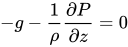
By substituting using the third equation above, we have:

with z the geopotential height of the constant pressure surface, satisfying

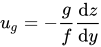
Further simplify those formulae above:

This leads us to the following result for the geostrophic wind components:

The validity of this approximation depends on the local Rossby number. It is invalid at the equator, because f is equal to zero there, and therefore generally not used in the tropics.

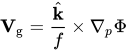
Other variants of the equation are possible; for example, the geostrophic wind vector can be expressed in terms of the gradient of the geopotential Φ on a surface of constant pressure:
See also

[edit]

References

[edit]
[edit]
Revisions and contributorsEdit on WikipediaRead on Wikipedia
from Grokipedia
The geostrophic wind is a theoretical wind in the atmosphere that results from an exact balance between the , which drives air from high to low pressure, and the , which deflects moving air due to , causing the wind to flow parallel to isobars without any net acceleration perpendicular to the flow. This balance assumes straight, frictionless, and steady flow on large spatial scales (greater than a few kilometers) and temporal scales (longer than 12 hours), typically above the where surface friction is negligible. In the , geostrophic winds blow with low pressure to the left and high pressure to the right, while in the , the orientation is reversed with low pressure to the right. The magnitude of the geostrophic wind can be estimated using the formula vg=1fρpnv_g = \frac{1}{f \rho} \frac{\partial p}{\partial n}, where ff is the Coriolis parameter (f=2Ωsinϕf = 2 \Omega \sin \phi, with Ω\Omega as Earth's and ϕ\phi as ), ρ\rho is air , and pn\frac{\partial p}{\partial n} is the perpendicular to the isobars; closer spacing of isobars indicates a stronger geostrophic . This approximation is most valid at mid-s away from the (beyond about 2° latitude) and breaks down in regions of significant curvature, such as around high- or low-pressure centers, where centrifugal forces require modifications like the gradient wind balance. In , the geostrophic wind serves as a foundational concept for analyzing large-scale , particularly in the free atmosphere above 1–2 km altitude, and is widely used in models to derive quantities like and from height fields, such as at the 500 hPa level. Although actual winds deviate from geostrophic due to , ageostrophic components, and other forces, the geostrophic approximation provides a close estimate for synoptic-scale flows in mid-latitudes and underpins understandings of phenomena like the and relationships.

Conceptual Foundations

Definition and Physical Balance

The geostrophic wind describes a state of geostrophic balance in rotating fluids, such as the atmosphere and oceans, where the horizontal velocity of the wind or current is directed perpendicular to the local , leading to no net horizontal of the . In this equilibrium, the flow proceeds parallel to isobars—lines of constant —without crossing them, as the forces maintain a steady motion. This balance is particularly relevant in large-scale fluid systems where other influences, like , are minimal. The equilibrium arises from the interplay of two dominant forces: the pressure gradient force (PGF), which accelerates fluid parcels from regions of high pressure toward low pressure, perpendicular to the isobars, and the , a due to the rotation of that deflects moving parcels to the right of their velocity vector in the (and to the left in the ). As a parcel initially accelerates under the PGF and gains speed, the Coriolis force strengthens proportionally to the velocity until it exactly opposes the PGF in magnitude and direction, halting further deflection or acceleration. This force equilibrium can be visualized through a simple vector diagram: the PGF vector points toward lower (cross-isobar direction), the vector lies parallel to the isobars ( to the PGF), and the Coriolis vector matches the PGF but points in the opposite direction, ensuring the is zero. In the , for instance, a westerly (blowing east) experiences a southward Coriolis force that balances a northward PGF associated with higher to the north. Geostrophic winds approximate actual flows effectively in large-scale systems like mid-latitude cyclones because these phenomena occur over vast horizontal scales where the is small, minimizing relative accelerations and allowing the Coriolis and PGF to dominate over or other perturbations. This approximation underpins much of the understanding of planetary-scale circulations in both atmospheric and oceanic contexts.

Historical Origin

The concept of geostrophic wind emerged from 19th-century investigations into the role of in fluid motions, particularly through the work of American meteorologist William Ferrel. In his 1856 publication, Ferrel described how the Coriolis effect influences , proposing a mid-latitude circulation cell where westerly winds arise from the balance between pressure gradients and rotational forces, laying foundational ideas for later geostrophic approximations. The formal introduction of geostrophic wind as a practical tool in occurred in the early 20th century through the efforts of Norwegian physicist and his collaborators. In their seminal 1910-1911 work Dynamic Meteorology and Hydrography, Bjerknes and Johan Wilhelm Sandström outlined the balance between Coriolis and forces in large-scale atmospheric flows, enabling the approximation of wind speeds from isobaric maps for . This framework was advanced by the Bergen School, founded by Bjerknes in 1917, which applied geostrophic principles to synoptic analysis and development during the and . In , the geostrophic approximation was contrasted with surface-layer dynamics by Swedish oceanographer Vagn Walfrid Ekman in his paper, where he developed the theory of wind-driven currents in the upper ocean, showing that frictional effects dominate near the surface while geostrophy governs deeper, frictionless layers. A key milestone in integrating geostrophy into broader large-scale dynamics came in the 1930s with Carl-Gustaf Rossby, who linked the concept to planetary waves in the atmosphere, demonstrating how zonal flow variations propagate as Rossby waves under geostrophic balance. Following , geostrophic wind principles became integral to models in the 1940s and 1950s, as exemplified by Jule Charney's quasi-geostrophic framework, which filtered high-frequency noise and enabled computational forecasts on early computers like . This evolution solidified geostrophy's role in simulating large-scale atmospheric and oceanic circulations.

Mathematical Formulation

Derivation from Equations of Motion

The derivation of the geostrophic wind begins with the horizontal momentum equations for a rotating fluid, derived from the Navier-Stokes equations in a non-inertial frame rotating with the . These equations, in Cartesian coordinates with xx directed eastward and yy northward, are: dudtfv=1ρpx,\frac{du}{dt} - f v = -\frac{1}{\rho} \frac{\partial p}{\partial x}, dvdt+fu=1ρpy,\frac{dv}{dt} + f u = -\frac{1}{\rho} \frac{\partial p}{\partial y}, where uu and vv are the horizontal velocity components, ρ\rho is the fluid density, pp is , and f=2Ωsinϕf = 2 \Omega \sin \phi is the Coriolis parameter, with Ω\Omega the angular rotation rate of the (Ω7.29×10⁵\Omega \approx 7.29 \times 10^{-5} s1^{-1}) and ϕ\phi the . To arrive at geostrophic balance, the following assumptions are applied: the flow is in a , neglecting local and advective time derivatives (du/dt=dv/dt=0du/dt = dv/dt = 0); frictional forces are absent; vertical accelerations are negligible, restricting attention to horizontal motions; and the flow features a small (Ro=U/(fL)1Ro = U / (f L) \ll 1), where UU is a scale and LL is the horizontal length scale, ensuring the dominates over inertial accelerations. Under these conditions, the equations simplify by setting the acceleration terms to zero, resulting in a direct balance between the and the : fvg=1ρpx,- f v_g = -\frac{1}{\rho} \frac{\partial p}{\partial x}, fug=1ρpy.f u_g = -\frac{1}{\rho} \frac{\partial p}{\partial y}. Solving for the geostrophic velocity components ugu_g and vgv_g yields: vg=1fρpx,v_g = \frac{1}{f \rho} \frac{\partial p}{\partial x}, ug=1fρpy.u_g = -\frac{1}{f \rho} \frac{\partial p}{\partial y}. This component form can be compactly expressed in vector notation as vg=1fρk^×p,\vec{v_g} = \frac{1}{f \rho} \hat{k} \times \nabla p,
Add your contribution
Related Hubs
User Avatar
No comments yet.