



Community hub
Recent from talks
Contribute something
Nothing was collected or created yet.
Power Stage
View on Wikipedia
| World Rally Championship |
|---|
| Current season |
| Support categories |
|
| Current car classes |
| Related lists |
| Organisations |
The Power Stage (abbreviated as PS) is a special stage that usually runs as the final stage of a rally in the World Rally Championship (WRC)[a] and European Rally Championship (ERC). Additional championship points are available to the fastest five crews through the stage regardless of where they actually finished in the rally.[2] Unlike normal special stages, which are timed to a tenth of a second, the timing of the Power Stage is to a thousandth of a second.[3]
Points scoring systems
[edit]The bonus scoring system initially used at the 1999 Tour de Corse and 1999 Rally Finland, branded as the "TV stage".[4][5] Drivers that had retired from the event could take part in the TV stage.[6]
Re-introduced in 2011, the top three crews through the stage could score extra bonus points, with the fastest crew receiving three points, the second-fastest receiving two points, and the third-fastest receiving one point.[5] In 2017, the scoring system was amended so the five fastest drivers through the stage were awarded points from five for first to one for fifth.[7] Manufacturers, WRC-2 and WRC-3 categories were also eligible to score Power Stage points in 2021. From 2022, WRC-2 awarded Power Stage points from three for first place, to one for third place. However, it was axed from 2024 onwards.[8] Power Stage points are no longer awarded in WRC-3.
Power Stages were also introduced during the 2022 European Rally Championship, using the final stage of each rally and awarding points to the five fastest crews in a similar fashion to the WRC.[9][10]
| Seasons | Category | 1st | 2nd | 3rd | 4th | 5th |
|---|---|---|---|---|---|---|
| 1999, 2011–2016 | WRC | 3 | 2 | 1 | ||
| 2017–present | WRC | 5 | 4 | 3 | 2 | 1 |
| 2022–2023 | WRC-2 | 3 | 2 | 1 | ||
| 2022–present | ERC | 5 | 4 | 3 | 2 | 1 |
Cancelled Power Stages
[edit]This list does not include cancelled rallies.
| No. | Rally | Stage name | Reason | Ref |
|---|---|---|---|---|
| 1. |  2013 Monte Carlo Rally 2013 Monte Carlo Rally
|
Lantosque – Lucéram 2 | Increase in local traffic due to bad weather. | [11] |
| 2. |  2020 Rally Mexico 2020 Rally Mexico
|
El Brinco | The rally ended prematurely in response to increased travel restrictions stemming from the COVID-19 pandemic. | [12] |
Most wins in WRC
[edit]| Bold | Drivers or co-drivers active in the World Rally Championship |
| World Rally Championship Drivers' or Co-Drivers' champions |
By drivers
[edit]


By co-drivers
[edit]
Most wins per season
[edit]| Bold | Won the World Championship in the same year |
| Year | Driver(s) | Wins | Races |
|---|---|---|---|
| 1999 |  Didier Auriol Didier Auriol
|
2 | 2[c] |
| 2011 | Sébastien Ogier
|
4 | 13 |
| 2012 | Sébastien Loeb
|
4 | 13 |
| 2013 | Sébastien Ogier
|
7 | 12[d] |
| 2014 | Sébastien Ogier
|
6 | 13 |
| 2015 | Sébastien Ogier
|
9 | 13 |
| 2016 | Sébastien Ogier
|
7 | 13 |
| 2017 |  Thierry Neuville Thierry Neuville
|
4 | 13 |
| 2018 | Thierry Neuville Ott Tänak Ott Tänak Esapekka Lappi Esapekka Lappi
|
3 | 13 |
| 2019 | Ott Tänak
|
6 | 13 |
| 2020 | Thierry Neuville Kalle Rovanperä
|
2 | 6[e] |
| 2021 | Ott Tänak
|
4 | 12 |
| 2022 | Kalle Rovanperä
|
7 | 13 |
| 2023 | Kalle Rovanperä
|
6 | 13 |
| 2024 | Thierry Neuville
|
5 | 13 |
| 2025 | Sébastien Ogier
|
5 | 14 |
Points scored in WRC
[edit]| Bold | Drivers or co-drivers active in the World Rally Championship |
| World Rally Championship Drivers' or Co-Drivers' champions |
By drivers
[edit]


By co-drivers
[edit]
Most points per season
[edit]| Bold | Won the World Championship in the same year |
| Year | Driver(s) | Points | Races |
|---|---|---|---|
| 1999 | Didier Auriol
|
6 | 2[c] |
| 2011 | Sébastien Loeb
|
19 | 13 |
| 2012 | Sébastien Loeb
|
19 | 13 |
| 2013 | Sébastien Ogier
|
28 | 12[d] |
| 2014 | Jari-Matti Latvala
|
25 | 13 |
| 2015 | Sébastien Ogier
|
27 | 13 |
| 2016 | Sébastien Ogier
|
26 | 13 |
| 2017 | Sébastien Ogier Thierry Neuville
|
34 | 13 |
| 2018 | Sébastien Ogier
|
37 | 13 |
| 2019 | Sébastien Ogier
|
41 | 13 |
| 2020 | Ott Tänak Thierry Neuville
|
18 | 6[e] |
| 2021 | Thierry Neuville
|
35 | 12 |
| 2022 | Kalle Rovanperä
|
50 | 13 |
| 2023 | Kalle Rovanperä
|
43 | 13 |
| 2024 | Thierry Neuville
|
45 | 13 |
| 2025 | Kalle Rovanperä
|
44 | 14 |
Gallery
[edit]-
 The Col de Braus mountain pass, which was contested as the power stage of Monte Carlo Rally.
 -
 Kris Meeke and Paul Nagle driving a Citroën DS3 WRC at Vargåsen, which was the power stage of 2014 Rally Sweden.
 -
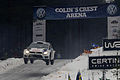 Sébastien Ogier and Julien Ingrassia driving a Volkswagen Polo R WRC at Colin's Crest Arena during 2014 Rally Sweden.
 -
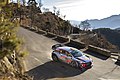
-
 The Ford Fiesta WRC of Elfyn Evans and Daniel Barritt jumping at the Rally de Portugal's iconic Fafe stage.
 -
 The Hyundai i20 Coupe WRC of Hayden Paddon and Sebastian Marshall during the power stage of 2018 Rally Italia Sardegna.
 -
 2018 Rally Finland winning crew Ott Tänak and Martin Järveoja driving through the power stage in a Toyota Yaris WRC.


Notes
[edit]- ^ 2018 Wales Rally GB used fourth to last stage as the power stage.[1]
- ^ a b c d Statistics updated as of the 2025 Rally Saudi Arabia.
- ^ a b 1999 consisted of 14 rallies, but Power Stage was only run on two.
- ^ a b 2013 consisted of 13 rallies, but Power Stage was cancelled in Monte Carlo.
- ^ a b 2020 consisted of seven rallies, but Power Stage was cancelled in Mexico.
References
[edit]- ^ "2018 Dayinsure Wales Rally GB" (PDF). walesrallygb.com. Wales Rally GB. 14 August 2018. Archived from the original (PDF) on 24 October 2018. Retrieved 19 August 2018.
- ^ "World Motor Sport Council: 08 September 2010". fia.com. Fédération Internationale de l'Automobile. 8 September 2010. Archived from the original on 11 September 2010. Retrieved 8 September 2010.
- ^ "Regulations". fia.com. Fédération Internationale de l'Automobile. Retrieved 16 December 2018.
- ^ "Season 1999". e-wrc.com. Retrieved 3 November 2019.
- ^ a b Beer, Matt (8 September 2010). "WRC adds bonus points for TV stages". autosport.com. Haymarket Publications. Archived from the original on 11 September 2010. Retrieved 8 September 2010.
- ^ Barry, Luke (31 July 2024). "The birth of two classic WRC elements". DirtFish. Retrieved 20 May 2025.
- ^ "2017 WRC dates confirmed". wrc.com. WRC Promoter GmbH. 28 September 2016. Retrieved 29 September 2016.
- ^ Barry, Luke (14 November 2023). "WRC2 Powerstage axed for 2024". dirtfish.com. DirtFish. Retrieved 14 November 2023.
- ^ "What is ERC". ERC – European Rally Championship. Retrieved 19 March 2023.
- ^ "ERC 2022: What has changed?". Azoresrallye. Retrieved 19 March 2023.
- ^ Evans, David (19 January 2013). "Monte Carlo Rally: Loeb wins as final stages cancelled". Autosport.com. Haymarket Publications. Archived from the original on 21 January 2013. Retrieved 19 January 2013.
- ^ Ramirez, Luis (14 March 2020). "WRC Rally Mexico to end early as more travel restrictions loom". autosport.com. Motorsport Network. Retrieved 15 March 2020.
External links
[edit]
Power Stage
View on GrokipediaIntroduction
Definition and Purpose
The Power Stage serves as the concluding special stage in a World Rally Championship (WRC) rally weekend, generally scheduled for Sunday to cap the event's competitive action.[1] This stage is designed as a distinct, high-stakes segment within the broader WRC format, where crews navigate a timed course under rally conditions to determine bonus outcomes.[3] Its core purpose is to distribute additional championship points to the top five performers, with 5, 4, 3, 2, and 1 points awarded to the first through fifth place finishers respectively, independent of overall rally positions. This system, in place since 2017, heightens rivalry and maintains suspense until the very end of the rally.[4] By incentivizing aggressive driving from competitors who might otherwise conserve resources, the Power Stage fosters greater unpredictability and excitement for spectators, ensuring that the final leg remains pivotal even for those with established leads.[1] What sets the Power Stage apart from standard special stages is its emphasis on extra rewards beyond mere time accumulation, transforming it into a strategic finale that can influence overall standings and team tactics.[5] This mechanism underscores the WRC's commitment to dynamic racing, where performance in this closing challenge directly bolsters drivers' and manufacturers' championship pursuits.[6]Implementation in WRC
The Power Stage was introduced as a mandatory feature in the 2011 FIA World Rally Championship season, debuting across all 13 rounds of the calendar to heighten the drama of rally finales.[7] This innovation aimed to provide a climactic conclusion to each event, with the stage structured specifically to facilitate global broadcasting.[7] Positioned as the final special stage of every rally, the Power Stage was typically a short test, often ranging from 10 to 20 km in length, though actual distances varied by event—for instance, 10.50 km at the 2011 Jordan Rally.[8] Unlike standard special stages, times are recorded to the nearest thousandth of a second. Its scheduling emphasized live television coverage, with start times coordinated by the championship promoter to maximize international viewership, often including a preceding regroup of at least 30 minutes for setup.[7] In terms of integration with the overall rally itinerary, the Power Stage followed the penultimate section's running order, with competitors tackling it under standard timing protocols that contributed to their total event duration.[7] Due to its relatively brief length compared to the full rally—often exceeding 300 km of special stages—its times had a minimal direct impact on final overall classifications, while serving primarily to allocate bonus points to the top performers.[7]Rules and Scoring
Current Points System
In the current FIA World Rally Championship (WRC) regulations for 2025, the Power Stage awards bonus points to the top five finishers as an addition to the standard rally classification points. The first-place finisher receives 5 bonus points, second place earns 4 points, third place gets 3 points, fourth place is awarded 2 points, and fifth place receives 1 point.[9] These Power Stage bonus points are tallied separately from the overall rally points, which follow a 25-17-15-12-10-8-6-4-2-1 scale for the top ten classified finishers, and the Sunday leg classification points of 5-4-3-2-1 for the top five based on cumulative times across Sunday's special stages. Under the 2025 system, a driver or co-driver achieving first place overall, first on Sunday, and first on the Power Stage can accumulate a maximum of 35 points per rally, with the Power Stage contributing up to 5 of those points.[9][9] Positions in the Power Stage are determined by the fastest cumulative stage times, including any applicable time penalties such as those for false starts, with provisional and final classifications published for the top five. In the event of a dead heat for any Power Stage position, ties are broken by the best time recorded on the rally's first special stage (excluding super special stages); if unresolved, subsequent special stages are reviewed in sequence until a decisive difference is found.[9]Eligibility and Format
The Power Stage is open to all registered competitors in the FIA World Rally Championship across eligible classes, including Rally1, Rally2, Rally3, and others, provided they have completed the necessary sections of the rally following the last overnight regroup.[9] No separate entry or registration is required, as participation is integrated into the standard rally itinerary for all qualified crews.[9] The event operates as a standard special stage, typically the final one held on Sunday, with a length and characteristics approved by the FIA and the event promoter to represent the rally's overall demands.[9] Starting order is determined by the reverse of the current general classification standings at the conclusion of the penultimate leg, ensuring leaders start last to promote competitive equity.[9] Weather and road conditions mirror those of preceding stages, as the Power Stage follows the same route network without alterations.[9] Timing follows conventional special stage protocols, with performances recorded to the thousandth of a second using electronic beams at the finish line, and any discrepancies resolved via manual clocks if needed.[9] Standard penalties apply, such as 10-second additions for minor false starts or longer exclusions for severe infractions, and crews not starting in the prescribed order forfeit eligibility for associated benefits.[9] Importantly, Power Stage results do not influence the overall rally finishing positions or classifications, serving solely to determine supplemental championship points.[9]Historical Developments
Introduction and Early Years
The Power Stage was proposed by the Fédération Internationale de l'Automobile (FIA) in 2010 as a means to heighten the drama of rally finales and counteract declining television viewership for the World Rally Championship (WRC), which had seen reduced audience engagement in prior seasons. The initiative, developed in collaboration with WRC promoter North One Sport, aimed to create a high-stakes concluding stage broadcast live to captivate viewers and maintain competitive tension until the very end.[7] Implemented for the entire 2011 WRC season across all 13 rounds, the Power Stage debuted at the Rally Sweden, the season opener held from February 10 to 13.[10] This final special stage, typically 4 to 8 kilometers in length and run on the last day after a regroup, awarded bonus championship points to the top three finishers: 3 points to the winner, 2 to second place, and 1 to third.[7] The format ensured all classified competitors participated, with starting order based on prior classifications to promote aggressive driving for the televised event.[7] In its inaugural year, the Power Stage added intrigue to several closely contested events, notably influencing the drivers' championship where Sébastien Loeb clinched his eighth consecutive title by 25 points over Sébastien Ogier, with bonus points from the stages contributing to the narrow margins in key rallies like Jordan and Wales Rally GB.[11] This early application demonstrated the format's potential to sustain excitement in tight title fights, setting a precedent for its role in WRC scoring.[12]Rule Changes and Updates
The Power Stage, introduced in 2011 as a final special stage awarding bonus points of 3-2-1 to the top three finishers and remaining unchanged through 2016, underwent its first significant modification in 2017 to heighten competitive intensity.[13] In 2017, the Fédération Internationale de l'Automobile (FIA) revised the Power Stage scoring to 5-4-3-2-1 points for the top five drivers, aiming to provide stronger incentives for aggressive performances in the rally's concluding stage and counteract conservative strategies earlier in the event. This adjustment extended eligibility to one additional competitor while increasing the maximum award by one point, thereby amplifying the potential impact on championship standings without altering the stage's format or timing.[14] The next major evolution occurred in 2024, when the FIA introduced a split points system to combat "Sunday driving"—a tendency for leaders to conserve resources on the final day—and boost excitement across the entire rally weekend. Under this controversial reform, points were awarded provisionally after Saturday (18-15-13-10-8-6-4-3-2-1 for the top 10), with adjustments based on Sunday outcomes, alongside dedicated Sunday points of 7-6-5-4-3-2-1 for the top seven overall finishers and the unchanged Power Stage bonuses of 5-4-3-2-1 for the top five. This expansion tied overall rally positions more directly to Sunday performance, allowing a maximum of 12 points on the final day (7 for the win plus 5 from the Power Stage), but drew criticism for diluting the emphasis on outright victories and complicating scoring logistics.[15] Responding to feedback from teams and stakeholders, the FIA reverted key elements of the system for 2025, capping Sunday position bonuses at 5-4-3-2-1 for the top five overall finishers to sharpen focus on rally wins while eliminating Saturday provisional points. The overall rally scoring shifted to a straightforward 25-17-15-12-10-8-6-4-2-1 scale for the top 10 at the event's conclusion, integrating with the retained Power Stage format of 5-4-3-2-1 for a potential maximum of 35 points per rally (25 for the win, plus 5 from Sunday position and 5 from the Power Stage). This simplification aimed to reward consistent leadership throughout the event more decisively, reducing opportunities for late surges to overshadow full-weekend efforts.[16]Cancellations
Reasons for Cancellation
The Power Stage in the World Rally Championship (WRC) may be omitted due to a variety of factors that compromise participant or spectator safety, primarily governed by the Fédération Internationale de l'Automobile (FIA) regulations. Severe weather conditions, such as heavy rain, fog, or storms, often render the stage unsafe by creating low visibility, slippery surfaces, or flooding that heightens the risk of accidents.[17] Road damage, including ruts, debris, or structural hazards exacerbated by prior stages or environmental factors, can also necessitate cancellation to prevent vehicle instability or collisions.[17] Organizational issues, like delays in timing systems, insufficient marshal coverage, or unauthorized access to the stage, further contribute to these decisions when they delay safety checks or disrupt operations.[17] FIA safety protocols prioritize risk mitigation, empowering officials to assess and cancel the Power Stage before its start if excessive hazards are identified. The Safety Delegate, in consultation with the Clerk of the Course, evaluates conditions such as spectator positioning, emergency access, and environmental threats, recommending cancellation under force majeure or when the stage fails to comply with the approved safety plan.[17] Pre-start inspections by the Zero Car and Safety Cars confirm road compliance; any unresolved issues, including potential water submersion or inadequate rescue capabilities, trigger immediate postponement or omission.[17] These measures ensure that no stage proceeds if it poses undue danger, reflecting the FIA's commitment to protecting all involved parties.[17] When the Power Stage is cancelled, no bonus points are awarded to competitors, as no official times are recorded.[18] The rally concludes based on results from preceding stages, maintaining the overall championship integrity without additional scoring from the omitted event finale.[2] This outcome underscores the balance between competitive elements and safety in WRC events.[17]Notable Instances
The Power Stage has been cancelled in a few WRC events up to 2025, typically due to weather or safety concerns. In the 2013 Monte Carlo Rally, the Power Stage (Lantosque – Lucéram 2) was cancelled due to an increase in local traffic caused by bad weather conditions.[19] The 2020 Rally Mexico saw the Power Stage (El Brinco) omitted, along with the other Sunday stages, as the rally was shortened due to COVID-19 travel restrictions affecting international crews.[20]Records
Most Wins by Drivers
Sébastien Ogier holds the all-time record for the most Power Stage victories in the World Rally Championship, with 49 wins as of November 2025. His successes span from his debut full season in 2012, with early wins in Rally de Portugal and Rally d'Italia Sardegna that year, building to peak performances during his Volkswagen era, including four Power Stage triumphs in 2013 and five in 2016. Ogier has also excelled in repeat victories at individual rallies, such as three consecutive Power Stage wins at Rally de France from 2011 to 2013, leveraging his precise pace management to clinch bonus points in tight championship fights. In 2025, Ogier added six more wins up to the Rally Japan, further extending his lead.[21] Thierry Neuville sits second on the list with 27 Power Stage wins, achieved primarily during his long tenure with Hyundai from 2014 onward. He has shown consistency across surfaces, with notable surges in 2018 (five wins) and 2024 (seven wins during his championship season). Ott Tänak ranks third with 23 Power Stage wins, concentrated in his competitive years with Toyota (2017-2020) and Hyundai (2022-). Tänak recorded a career-high seven in 2019—his title-winning season—including standout performances on snow and asphalt. A defining factor for these drivers' dominance is their proficiency in repeat Power Stage wins within the same rally or season, enabling strategic point accumulation. For example, Ogier's multiple triumphs at events like Rally Monte-Carlo (four times) highlight optimized car setups and risk calibration for the final stage's demands, while seasonal clusters often align with title pursuits where the five bonus points can shift standings dramatically.Most Wins by Co-Drivers
Julien Ingrassia holds the record for the most Power Stage wins by a co-driver in the World Rally Championship, achieving 41 victories during his partnership with driver Sébastien Ogier from 2011 to 2021. These successes highlight the critical role co-drivers play in navigating the high-pressure final stage, where precise pace notes and timing can secure bonus points that often decide championships. Ingrassia's flawless coordination with Ogier contributed to multiple title defenses, underscoring the duo's dominance in the era's hybrid rally formats. Other prominent co-drivers have also amassed significant Power Stage triumphs, often tied to long-term driver pairings that foster exceptional synergy. Jonne Halttunen secured 22 wins alongside Kalle Rovanperä, particularly during their Toyota partnership from 2019 onward, where their strategies on gravel and tarmac yielded key points. Similarly, Martin Järveoja recorded 21 victories with Ott Tänak, emphasizing Hyundai and Toyota resurgences in the late 2010s and 2020s. These records reflect how co-drivers not only provide navigational support but also influence tactical decisions under the intense scrutiny of the Power Stage's short, decisive format. A notable aspect of Power Stage performances is the rarity of co-driver errors leading to losses, as pace note accuracy tends to remain high even in the season's most crucial moments. This reliability stems from extensive pre-event preparation and the co-driver's ability to adapt calls in real-time, minimizing mistakes that could cost valuable bonus points. Such dependability has allowed top co-drivers like Ingrassia, Halttunen, and Järveoja to consistently elevate their drivers' championship contention.| Rank | Co-Driver | Wins | Primary Driver Pairing | Active Years (Key Period) |
|---|---|---|---|---|
| 1 | Julien Ingrassia (France) | 41 | Sébastien Ogier | 2011–2021 |
| 2 | Jonne Halttunen (Finland) | 22 | Kalle Rovanperä | 2019–2025 |
| 3 | Martin Järveoja (Estonia) | 21 | Ott Tänak | 2018–2025 |
Most Wins in a Season
The record for the most Power Stage wins in a single World Rally Championship season is 9, set by Sébastien Ogier in 2013 while competing in the Volkswagen Polo R WRC.[22] That year featured 13 rounds, but the Power Stage at Rallye Monte-Carlo was cancelled due to a spectator incident, leaving 12 opportunities; Ogier's tally included victories at Rally Sweden, Rally Mexico, Rally Portugal, Rally Italia Sardegna, Rally Finland, Rally Australia, Rally France Alsace, RallyRACC Catalunya, and Wales Rally GB. His dominance in the Power Stage contributed significantly to securing his maiden WRC Drivers' Championship with 290 points.[22] Ogier matched this mark in 2015, again with 9 Power Stage wins across 13 full rounds in the Volkswagen Polo R WRC, underscoring the car's superiority on diverse surfaces during Volkswagen's early WRC era.[23] These performances highlight how Power Stage success often aligns with overall rally dominance, particularly in high-performance machinery like the Polo R WRC, which allowed Ogier to maximize bonus points and extend leads in tight championship battles. Other notable seasons include several with 7 Power Stage wins, such as Ogier's 2016 campaign (also in the Polo R WRC) and Kalle Rovanperä's 2022 effort in the Toyota GR Yaris Rally1. The top five seasons by Power Stage wins are:| Rank | Year | Driver | Wins | Car |
|---|---|---|---|---|
| 1 | 2013 | Sébastien Ogier | 9 | Volkswagen Polo R WRC |
| 1 | 2015 | Sébastien Ogier | 9 | Volkswagen Polo R WRC |
| 3 | 2016 | Sébastien Ogier | 7 | Volkswagen Polo R WRC |
| 3 | 2022 | Kalle Rovanperä | 7 | Toyota GR Yaris Rally1 |
| 5 | 2019 | Ott Tänak | 7 | Toyota Yaris WRC |
Most Points by Drivers
Sébastien Ogier holds the record for the most cumulative bonus points earned from Power Stage performances in the World Rally Championship, amassing 357 points across his career as of November 2025. This total accounts for the evolution of the scoring system, with Ogier benefiting significantly from the post-2017 format that awards 5 points to the winner, 4 to second place, 3 to third, 2 to fourth, and 1 to fifth. Prior to 2017, from the Power Stage's introduction in 2011 through 2016, points were limited to the top three finishers at 3, 2, and 1 respectively; Ogier accumulated substantial points in that era through consistent top finishes, including multiple victories. In the higher-stakes 5-1 era, he has added extensively, often securing maximum hauls in rallies where he was not the overall winner, thereby maximizing his championship impact beyond outright victories. His 2025 performances added further to this total. Following Ogier, Thierry Neuville ranks second with 328 Power Stage points, reflecting his consistent top finishes with Hyundai. Neuville's tally includes strong contributions from both scoring eras, with frequent podiums in the early years and multiple wins post-2017. Ott Tänak sits third with 270 points, with his aggressive style yielding high returns, particularly in 2019 and recent Hyundai stints. These totals highlight how sustained excellence in the Power Stage can substantially bolster a driver's championship standing, often turning close title battles in their favor.[12]Most Points by Co-Drivers
The co-driver with the most Power Stage bonus points in World Rally Championship history is Julien Ingrassia, who accumulated approximately 250 points during his career partnership with Sébastien Ogier from 2010 to 2021.[24] These points were earned through consistent top-five finishes in the final stage of rallies, reflecting the duo's dominance in high-stakes situations where bonus points of 5, 4, 3, 2, or 1 are awarded to the fastest five crews. Ingrassia's total underscores the critical role co-drivers play in navigation and strategy during Power Stages, often contributing to maximizing these extra points that can influence championship outcomes. Following Ingrassia, Jonne Halttunen ranks second with around 200 Power Stage points, primarily from his collaboration with Kalle Rovanperä since 2019 with Toyota. Halttunen's tally highlights the value of enduring driver-co-driver synergy, as the pair frequently secured bonus points through aggressive pushes on the final stage despite not always contending for overall rally victories. Similarly, Martin Järveoja holds third place with approximately 180 points, amassed alongside Ott Tänak from 2018 onward with Toyota and Hyundai, where their precise pace notes and composure yielded reliable top finishes in Power Stages. Co-drivers accrue Power Stage points on the same scale as drivers, with each bonus directly shared based on the crew's combined stage result, emphasizing the interdependent nature of the partnership in WRC. This system, introduced in 2011, rewards not just outright speed but also consistency across a career, as seen in these top pairings that leveraged team resources and experience to build substantial totals over multiple seasons.Most Points in a Season
The Power Stage bonus points system, awarding 5-4-3-2-1 points to the top five finishers, has enabled drivers to accumulate significant totals in a single season since its introduction in 2017. The record for the most Power Stage points in a season stands at 50, achieved by Kalle Rovanperä during the 2022 FIA World Rally Championship. Rovanperä secured maximum points in eight of the 13 rounds, including wins on the Power Stage at events such as the Croatia Rally, Rally de Portugal, and Repco Rally New Zealand, contributing substantially to his drivers' title that year.[25][26] Other notable performances include Thierry Neuville's 45 points in 2024, where he claimed the bonus in nine rounds amid a fiercely contested championship. Rovanperä followed with 43 points in 2023, winning the Power Stage seven times, including at the Safari Rally Kenya and EKO Acropolis Rally Greece. Sébastien Ogier holds the fourth-highest total with 41 points in 2019, leveraging consistent top finishes on the stage across 13 events. Ogier's 2018 tally of 37 points rounds out key modern-era highs, with five Power Stage victories that year.[27][28][29][30]| Rank | Driver | Season | Points | Power Stage Wins |
|---|---|---|---|---|
| 1 | Kalle Rovanperä | 2022 | 50 | 8 |
| 2 | Thierry Neuville | 2024 | 45 | 7 |
| 3 | Kalle Rovanperä | 2023 | 43 | 7 |
| 4 | Sébastien Ogier | 2019 | 41 | 4 |
| 5 | Sébastien Ogier | 2018 | 37 | 5 |