Hubbry Logo
Prairie AvenuePrairie AvenueMain
Open search
Prairie Avenue
Community hub
Prairie Avenue
logo
8 pages, 0 posts
0 subscribers
Be the first to start a discussion here.
Prairie Avenue
Prairie Avenue
from Wikipedia

Prairie Avenue is a north–south street on the South Side of Chicago, which historically extended from 16th Street in the Near South Side to the city's southern limits and beyond. The street has a rich history from its origins as a major trail for horseback riders and carriages. During the last three decades of the 19th century, a six-block section of the street served as the residence of many of Chicago's elite families and an additional four-block section was also known for grand homes. The upper six-block section includes part of the historic Prairie Avenue District, which was declared a Chicago Landmark and added to the National Register of Historic Places.

Key Information

Several of Chicago's most important historical figures have lived on the street. This is especially true of the period of recovery from the Great Chicago Fire of 1871 when many of the most important families in the city moved to the street. Residents of the street have influenced the evolution of the city and have played prominent national and international roles. They have influenced the political history, the architecture, the culture, the economy, as well as the law and government of Chicago. The street has over time been influenced by the demographics of Chicago.

The importance of the street declined, but it still has landmark buildings and is the backbone of a historic district. Preservation battles regarding various properties on the street have been notable with one having been chronicled on the front page of The New York Times. In the early 21st century, parts of the street were redeveloped to host townhouses and condominiums. In the late 20th century and early 21st century the street was extended north to accommodate new high-rise condominiums, such as One Museum Park, along Roosevelt Road. The redevelopment extended the street so that it has prominent buildings bordering Grant Park with Prairie Avenue addresses.

History

[edit]
headshot image of a Caucasian male with white hair and a goatie who is wearing a tuxedo with a black tie.
three-quarters length image of a woman in a dress with a headpiece and elbow length white gloves
When Potter Palmer's wife Bertha Palmer built the Palmer Mansion, many Prairie Avenue residents moved to the Gold Coast.

Prairie Avenue once served as an Indian trail linking Fort Dearborn to Fort Wayne in Indiana and thus derived its name from the vast midwestern prairie land between the two endpoints.[1] In 1812, the Battle of Fort Dearborn occurred in the area that is now the northern section of the street, in what is known as the Near South Side community area.[2] Casualties of the battle, such as William Wells and George Ronan, were struck down here.[3]

Over time, the district has evolved from an upscale neighborhood to a factory district and back to an upscale neighborhood. Zoning in 1853 anticipated residential development, although only one grand villa existed at the time. By 1877 the eleven-block area of Prairie Avenue as well as Calumet Avenue housed elite residences. By 1886 the finest mansions in the city, each equipped with its own carriage house, stood on Prairie Avenue.[4] In the 1880s and 1890s, mansions for George Pullman, Marshall Field, John J. Glessner and Philip Armour anchored a neighborhood of over fifty mansions known as "Millionaire's Row".[1] Many of the leading architects of the day, such as Richard Morris Hunt, Henry Hobson Richardson and Daniel Burnham designed mansions on the street. At the time of the 1893 World's Columbian Exposition, guidebooks described the street as "the most expensive street west of Fifth Avenue".[5][6] However, after Bertha Palmer, society wife of Potter Palmer, built the Palmer Mansion that anchored the Gold Coast along Lake Shore Drive, the elite residents began to move north.[1]

Old Otis home at 1709 Prairie

By 1911, warehouses and factories cramped the Prairie Avenue District. Large industry overtook the district by 1950. Early 21st century deindustrialisation, urban congestion, and historic preservation have brought the return of trendy buildings, and restored as well as renovated structures. Simultaneously new infill housing is resuscitating the district.[4] Now, the historic northern section of the street is part of the Chicago Landmark Prairie Avenue District that is listed on the National Register of Historic Places.[7][8] It was added to the National Register of Historic Places on November 15, 1972 and declared a Chicago Landmark on December 27, 1979.[7][9] The historic district includes the 1800 and 1900-blocks of South Prairie, the 1800 block of South Indiana and 211 through 217 East Cullerton.[10]

Background

[edit]
A headshot of a Caucasian male with a long white goatee facing right. He is wearing a black suit jacket and white shirt.
A headshot of a Caucasian male with a white handlebar moustache and white hair. He is wearing a white winged-collar shirt, black cravat and black coat.
A three-quarters length shot of a Caucasian male with his arms grasping behind his back. He is wearing dark sideburns, a goatie, black bow tie, white shirt and a black coat.
Residents: (left to right) George Pullman, Marshall Field, and Philip Armour

In the 1850s, railroad related industries prospered near the lumber district along the South Branch of the Chicago River. Thus, the business district began to supplant the elegant residences along Michigan and Wabash Avenues south of Jackson Boulevard.[11] Shortly after the Civil War, the city's wealthy residents settled on Prairie Avenue due to its proximity to the Loop less than a mile away and the fact that traveling there did not involve crossing the Chicago River. In 1870, Daniel Thompson erected the first large upper-Prairie Avenue home. Marshall Field followed in 1871 with a Richard Morris Hunt design.[12] Prairie Avenue was the most posh Chicago address by the time of the Great Chicago Fire of 1871.[11]

A streetmap of land adjacent to an area marked as Lake Michigan, with a central portion of the map shaded grey.
1871 Map of Chicago: The shaded area was destroyed by the Great Chicago Fire.

Many of South Michigan Avenue's elegant villas were destroyed in the Great Chicago Fire of 1871.[13] The post-fire South Side of Chicago grew rapidly as all economic classes left the city's center. Many of Chicago's elite families settled along Prairie Avenue. By the 1870s and 1880s, Prairie Avenue was the location of elaborate houses between 16th Street and 22nd Street (now Cermak Road).[14] In 1886, the urban elite, including George Pullman, Marshall Field, Philip Armour and John B. Sherman all owned family homes in this area that created an opulent Prairie Avenue streetscape reminiscent of European city streets;[13] as such, it was widely regarded as the city's most fashionable neighborhood. Businesses, such as the Pullman Company, Armour & Company and D.H. Burnham & Company, with ties to Prairie Avenue had national and international reach and impact.[15] Additional grand homes (including many Queen Anne style architecture in the United States and Richardsonian Romanesque) were located on Prairie between 26th and 30th Streets starting in the mid-1880s.[12] The last mansion, a three-story Georgian Revival residence with 21 rooms, was built in the district at 2126 Prairie Avenue in 1905.[5]

However, as the start of the 20th century came, industry's pervasive reach, increased railroad soot, and an encroaching vice district, caused the area to become less desirable, and the social elite vacated the region for quieter neighborhoods such as Kenwood, the Gold Coast and more commonly the suburban North Shore.[13] The Chicago Tribune highlighted 1898 Prairie Avenue as a place that was undesirable to those for whom it was affordable, and unaffordable to those for whom it was desirable.[16] Light industry and vacant lots overtook Prairie Avenue during the second half of the 20th century. The elegant mansions were mostly torn down or fell into extreme disrepair.[12] By the 1970s, most of the residential buildings had been replaced by factories and parking lots.[6] Starting in the late 1990s, the downtown housing market flourished in Chicago and the resulting boom that has transformed many neighborhoods revived Prairie Avenue, causing most of the factories to be demolished or converted to loft condominiums. The factories have been replaced by condominium projects and most of the remaining mansions have been renovated.[6]

Influence

[edit]
The bend of a street with house in the distance. The trees are on the street are just budding.
George Pullman residence: 1729 S. Prairie Ave. (c. 1900)
The interior of a home with several people gathered, but wearing winter coats. Ornate decorative features such as chandeliers and fancy rugs are visible
Interior of Pullman Residence (1922)
Two-story house with cars parked on the street in front of it. It is partially obstructed by a neighboring house on the right. A tall tree is on the lawn in front of the house.
Al Capone residence: 7244 S. Prairie Ave. (1929)
Winter view of a house beyond barren trees with snow on the ground.
Marshall Field residence: 1905 S. Prairie Ave. (c. 1905)
An elevated view of a five-story building on a street corner that takes up a long portion of a block. The building has multiple entrances leading to the sidewalk on the right. Trees line the street rising to the height of about two stories.
Mercy Hospital: 2537 S. Prairie Ave. (1910) (where Theodore Roosevelt went after 1912-10-14 shooting)

During the 1870s, 1880s and 1890s, upper Prairie Avenue residents were central to cultural and social fabric of the city. The economy was supported by the thousands of jobs created by the Pullman Car Company and Armour and Company. Chicago's richest man, Marshall Field, changed the buying habits of the city. John Shorthall saved the property from total chaos after the Great Chicago Fire by saving property records. At one point in the 1880s, sixteen of the 60 members of the Commercial Club of Chicago lived on Prairie Avenue. George Armour headed the Chicago Academy of Fine Arts, which became the Art Institute of Chicago.[17] 1801 South Prairie resident, William Wallace Kimball, employed about 1500 people around the start of the 20th century in his organ and piano manufacturing company.[18] John Glessner, a founder of International Harvester, built what has been described as the centerpiece of the historic district.[5]

As a home to many of Chicago's leading families, Prairie Avenue became the base of many important political movements. Woman's suffrage had activists, such as Illinois Women Suffrage Association President Jane Jones, on Prairie Avenue. Illinois Central Railroad Co. v. State of Illinois, 146 U.S. 387 (1892), pitted the public welfare of the city against the railroad industry and was the foundation for the public trust doctrine which facilitated the city's reclamation of much of the lakefront. Prairie Avenue residents bolstered other efforts to fight against the railroads. The concentration of wealth also made Prairie Avenue the target of complaints about taxation inequities.[19]

Many of these leading families also took part in philanthropy. John Shorthall, founder of Chicago Title & Trust and Prairie Avenue resident, created the Illinois Society for the Prevention of Cruelty to Animals and convened local and state societies to unite under a national organization (American Society for the Prevention of Cruelty to Animals) that could combine its political strength and lobby Congress. The Illinois Institute of Technology was a successor entity of the Armour Institute of Technology, which was an outgrowth of the generosity of Philip and Joseph Armour.[20]

Preservation

[edit]

Historic preservation in Chicago has saved some of the city's architectural heritage. The efforts of the Chicago Architecture Foundation and the Landmarks and Preservation Council of Illinois have been at the forefront of these efforts. The Commission on Chicago Landmarks (now part of the city's Department of Planning and Development) has designated the Prairie Avenue Historic District as a city landmark.[21]

A white house with multiple chimneys and a tower. People are on the front porch and someone is arriving at the home and about to embark up the staircase. The front porch has a roof over a set of four columns. Trees are visible on the lawn.
Pre-American Civil War photo of the Henry B. Clarke House

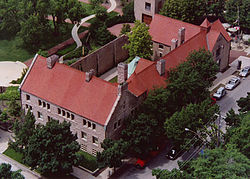
A few of the mansions of the heyday still remain in the 1800-block including the National Historic landmark designated John J. Glessner House designed in 1886 by architect Henry H. Richardson for Glessner;[11][22] these provide a sense of the street's former character. Glessner House, which was the subject of a notable preservation battle in the 1960s,[6] is considered to be Richardson's finest urban residence.[5] This district includes the Henry B. Clarke House, which although twice relocated is purported to be the city's oldest standing house. In addition to the Clarke House and the Glessner House, nine other houses from the late-19th century remain in the historic district portion of Prairie Avenue.[5][21] Both the Glessner House and the Clarke House are on the National Historic Register and now serve as museums.[21] Most of the Prairie Avenue families worshiped at the Chicago Landmark Second Presbyterian Church of Chicago, which is listed on the National Register of Historic Places.[23]

Marshall Field lived at 1905 South Prairie and purchased 1919 South Prairie for Marshall Field, Jr. It is believed that Solon Spencer Beman had contributed to the design of what is now known as the Marshall Field, Jr. Mansion. Then, Field hired Daniel Burnham to design extensions and additions to the property after purchasing it 1890.[10] In 2007, the Commission on Chicago Landmarks announced the rehabilitation of the Marshall Field Jr. Mansion, which had been vacant for 40 years and which was renovated as six private residences, won a Preservation Award.[24]

Today, Prairie Avenue has buildings indexed in the Chicago Historic Resources Survey in the Near South Side, Douglas, Grand Boulevard, Washington Park and Chatham community areas.[25] Among the properties listed is a simple two-flat used by Al Capone in the 1920s at 7244 South Prairie in Greater Grand Crossing.[26] Other current prominent addresses are the Kimball House at 1801 South Prairie (Near South Side),[23] 2801, 3564, 3566, and 3600 South Prairie (Douglas),[27] and 4919 South Prairie (Grand Boulevard).[28]

The William Wallace Kimball House, which is a three-story turreted chateau, was designed by Solon Beman, who is best known for his work in the Pullman District of the Pullman community area.[5] Adjacent to the Kimball House and across from the Glessner House is the Coleman-Ames mansion at 1811 South Prairie.[5] These two houses were formerly owned by R.R. Donnelley & Sons Company and now jointly serve as the national headquarters for the United States Soccer Federation (USSF), which leased them from 1991 until 1998 when it purchased them from the Chicago Architectural Foundation.[5] The Kimball house, which has been the product of a $1 million renovation in the 1990s by the USSF was featured in Richard Gere's Primal Fear as well as several television shows.[5]

Al Capone and his family lived in the two-story red brick duplex at 7244 South Prairie Avenue from 1923, which is shortly after he moved to Chicago, until 1931, when he was sent off to prison for income tax fraud.[29] The Capone family kept the home until his mother's death in 1952. In 1988, the privately owned house was nominated for the National Register of Historic Places by historians as the home of one of Chicago's most famous citizens.[30] The nomination was withdrawn after local politicians and members of Italian-American groups sharply argued that it would appear to validate the life of a murderer and hoodlum. The house retains the security bars on the basement windows and the brick garage out back, which the Capone built for his bullet-proof Cadillac limousine.[29]

Contemporary rowhouses (built 2006) on Prairie Ave.

In 2000, the Howard Van Doren Shaw-designed 1907 Georgian Revival Platt Luggage Building at 2301 South Prairie was the subject of preservation debates when McCormick Place attempted to tear it down to build a parking garage. The conflict, which was not settled before wreckers had knocked a hole in a corner of the building and which included protests and a petition to the Illinois Supreme Court, was described on the front page of The New York Times.[31] Preservationists, including the Landmarks Preservation Council of Illinois and the National Trust for Historic Preservation, eventually dropped their appeals once the Metropolitan Pier and Exposition Authority committed to incorporating the original facade of the building into the exterior of the parking garage at an additional cost of $2.5 million to the project.[32][33] The Harriet F. Rees House at 2110 South Prairie was spared demolition in 2014 and moved one block north to 2017 South Prairie.[34]

A book on the history of the street, entitled Chicago's Historic Prairie Avenue, was published on June 2, 2008, as part of Arcadia Publishing Co.'s Images of America series. William H. Tyre is the author.[35] In 2006, the Prairie District Neighborhood Alliance, a non-profit organization, was formed to provide representation for thousands of South Loop residents, including the Prairie District, Central Station and Museum Park, Motor Row, the South Michigan Ave Corridor, as well as other areas of the Near South Side.[36]

Today

[edit]
Prairie Avenue Buildings
Model of neighborhood of buildings
Silver model of tall building
tall silver skyscraper with blue sky background beyond tall trees
Three-story house on a street. Cars line the street and trees are barren in winter.
Rowhouses along Prairie Ave
Left to right: One Museum Park West and One Museum Park jointly in a model; model of One Museum Park West; One Museum Park, the United States Soccer Federation building (former home of William Wallace Kimball, and rowhouses along Prairie Ave)

In 2003, the area redevelopment was well underway. Deindustrialization and urbanization had pushed out manufacturing. As a result, factories were generally demolished, or converted to loft apartment buildings. Some neglected mansions survive as restored or renovated properties in the historic district.[4] Today, Prairie Avenue is undergoing a redevelopment that includes One Museum Park (1215 South Prairie Avenue) and One Museum Park West (1201 South Prairie Avenue). These Prairie Avenue addresses border the Roosevelt Road side of Grant Park. One Museum Park is the tallest building on Chicago's South Side and among the tallest buildings in Chicago.[37] It surpassed 340 on the Park as the tallest all-residential building in Chicago,[37] and it is second to the Trump World Tower in the United States.

See also

[edit]

References

[edit]
[edit]
Revisions and contributorsEdit on WikipediaRead on Wikipedia
from Grokipedia
Prairie Avenue is a north-south thoroughfare on the South Side of , , that emerged as the city's most prestigious residential street during the , housing industrial titans and merchants in opulent mansions from the 1870s to the 1890s. Known as "Millionaire's Row" or the " of the Midwest," it attracted elites seeking proximity to the while avoiding the industrial odors of the . Development accelerated after the of 1871, with the first prominent home constructed by Daniel Thompson in 1870, followed by 's residence designed by in 1871 and 's mansion in 1873. Residents included retail magnate , railroad car innovator , meatpacking leader Philip Armour, and farm machinery executive John Jacob Glessner, whose homes exemplified styles such as Second Empire in the upper blocks (16th to 22nd Streets) and Richardson Romanesque in structures like the Glessner House, completed in 1887. These families contributed significantly to the 1893 , drawing global attention to Chicago's architectural and cultural prowess. By the late , the avenue's appeal waned due to encroaching railroads depositing and the rise of a nearby vice district, prompting many affluent families to relocate northward. The brought further decline through , demolitions of mansions—including Pullman's in 1922—and , leaving vacant lots and dilapidated structures. Preservation efforts culminated in the designation of the Prairie Avenue Historic District by the City of Chicago on December 27, 1979, encompassing the 1800 and 1900 blocks of South Prairie Avenue, the 1800 block of South Indiana Avenue, and 211-217 East Cullerton Street, with landmarks like the Glessner House Museum (opened 1971) and Clarke House anchoring the area. The district also holds earlier historical ties, as the site of the Fort Dearborn Massacre.

Historical Development

Origins and Early Settlement

Prairie Avenue traces its origins to a pre-colonial Native American trail that extended southward from along the lakeshore toward , facilitating travel and trade. This route gained notoriety during the Fort Dearborn Massacre on August 15, 1812, when survivors of the attack fled along its path, an event later commemorated by a monument near 18th Street. The area's transformation into a residential began with in the 1830s. In 1834, Dr. Elijah D. Harmon purchased a 138-acre tract bounded by 16th Street to the north, Cermak Road (then 22nd Street) to the south, State Street to the west, and to the east, setting the stage for subdivision. The tract was platted in the early amid Chicago's rapid expansion, though it initially lay partially beyond the . The first house on Prairie Avenue was completed in 1853 for merchant John Staples, located between 17th and 18th Streets; this modest structure marked the onset of private development in what remained a sparsely populated, semi-rural extension of the urban grid. Settlement progressed gradually through the Civil War years (1861–1865), constrained by limited and the area's peripheral location. By 1868, only two residences existed along the avenue: Staples' home and another owned by a Mr. Marsh near 16th Street, with horse-drawn streetcars terminating at 12th Street, over a mile to the north. The street's appeal stemmed from its elevated lakeshore position, offering cleaner air and views compared to the polluted riverfront, as well as direct access to the without bridging the —a key deterrent for early elite residents wary of flood-prone crossings. The decade closed with the construction of Daniel Thompson's $100,000 mansion at 1936 South Prairie Avenue in 1870, the first large-scale home on the upper stretch and a precursor to denser elite habitation. This development reflected growing post-war prosperity among Chicago's merchants and industrialists, who valued the avenue's prestige and convenience, though the of October 1871 would accelerate transformation.

Post-Great Chicago Fire Expansion

The of October 8–10, 1871, destroyed over 17,000 structures across approximately 3.3 square miles of the city's core, prompting a swift rebuilding effort that redirected elite residential development southward to areas like Prairie Avenue, which had been spared significant damage. This post-fire reconstruction accelerated the street's transformation from a modest residential corridor into Chicago's premier enclave for the newly wealthy industrial class, with construction booming in the 1870s and 1880s along the blocks between 16th and 22nd Streets. Proximity to , elevated terrain, and speculative land investments by figures such as George M. Pullman and facilitated this expansion, as northern districts grappled with recovery. Key early post-fire developments included Daniel Thompson's $100,000 mansion at 1936 S. Prairie Avenue, constructed in 1870 just prior to the blaze but emblematic of the area's rising status, followed by Pullman's acquisition of property and erection of his residence at 1729 S. Prairie Avenue in the 1870s. Marshall Field commissioned his lavish home at 1905 S. Prairie Avenue in the 1880s, designed by Richard Morris Hunt, while John J. Glessner's Romanesque Revival house at 1800 S. Prairie, completed in 1887 by architects Henry Ives Cobb and Charles Sumner Frost, further solidified the district's architectural prestige. These structures, often exceeding $100,000 in cost and featuring innovative designs, attracted meatpackers, retailers, and railroad magnates seeking to display their fortunes amid Chicago's industrial surge. By the mid-1880s, Prairie Avenue had earned the nickname "Millionaires' Row," with directories recording dozens of opulent homes lining the avenue, supported by infrastructure improvements like widened streets and private security. The 1893 amplified its prominence, hosting 77 millionaire residents in the core four-block stretch, underscoring the neighborhood's role as a symbol of excess and . This expansion not only housed but also networked Chicago's captains of industry, fostering clubs and social institutions that reinforced class exclusivity.

Peak as Gilded Age Elite Enclave

In the decades following the Great Chicago Fire of 1871, Prairie Avenue solidified its status as Chicago's foremost enclave for Gilded Age tycoons, with a six-block section between roughly 16th and 22nd Streets hosting opulent residences of industrial magnates and retail pioneers. The avenue's appeal stemmed from its proximity to Lake Michigan, ample lots for expansive estates, and distance from the smoky industrial north, drawing elites who rebuilt southward amid the city's postwar boom. By the 1880s, it earned the moniker "Millionaire's Row" due to the concentration of multimillionaires, whose homes showcased lavish architecture reflecting newfound fortunes in railroads, meatpacking, and merchandising. George M. Pullman catalyzed the district's prestige by acquiring a lot at 1729 Prairie Avenue in 1870 and erecting a Renaissance Revival mansion completed in 1876, setting a precedent for grandeur that influenced subsequent builds. Other prominent residents followed, including founder , whose residence at 1905 Prairie Avenue exemplified the era's residential scale; meatpacking baron Philip D. Armour; and real estate developer , whose 1885 castle-like home at 1300 Prairie Avenue featured innovative ironwork and hosted elite social events. John J. Glessner and John B. Drake also established households there, contributing to a neighborhood where, by 1887, residents' collective wealth exceeded $50 million amid Chicago's explosive growth as a rail and manufacturing hub. The enclave's exclusivity was reinforced by architectural uniformity—mansions set back from the street with manicured lawns—and social barriers, including private security and adjacency to institutions like the Illinois Club, fostering a sense of insulated opulence amid urban expansion. This peak, reaching its zenith around 1890, symbolized the unbridled of the period, with Prairie Avenue's stables and houses underscoring residents' reliance on horse-drawn transport for to Loop offices. Yet, even at its height, the district reflected causal tensions of industrial wealth, as fortunes tied to labor-intensive enterprises like Pullman's production and Armour's loomed nearby, presaging later conflicts.

Architecture and Notable Residences

Architectural Styles and Innovations

The mansions along Prairie Avenue primarily featured late 19th-century styles such as and Second Empire, reflecting the era's emphasis on grandeur, durability, and eclectic historicism adapted to urban settings. These designs drew from European precedents but incorporated American innovations in site planning and interior functionality to suit the needs of industrial magnates seeking both prestige and privacy. Glessner House at 1800 South Prairie Avenue, designed by and completed in 1887, exemplifies with its rugged, rusticated granite facade, massive round-arched openings, and asymmetrical massing that creates a fortress-like appearance. Innovations in this residence included a site-specific orientation that turned living spaces inward toward a private , enhancing family seclusion amid the growing urban density, and an efficient floor plan that separated service areas from family quarters while maximizing natural light through art glass windows. The interior contrasted the austere exterior with polished wood paneling, intricate , and advanced mechanical systems like steam heating, demonstrating a sophisticated integration of form and modern comfort. The residence at 1729 South Prairie Avenue, constructed in 1876 with later expansions, embodied through its , elaborate dormers, and ornate ironwork, blending French imperial opulence with practical American construction techniques. Architect Henry S. Jaffray's original design was augmented in the by Solon S. Beman, who added extensions that maintained stylistic coherence while accommodating expanded family needs, highlighting in high-status homes. These features underscored innovations in scalable luxury, such as modular room additions and lavish interiors with imported materials, setting precedents for Chicago's evolving residential architecture. Other Prairie Avenue homes incorporated blended Gothic and elements, as seen in residences like the Allerton house, which harmonized pointed arches with classical symmetry to achieve a balanced, non-doctrinaire aesthetic suited to the district's elite character. Collectively, these structures advanced urban mansion design by prioritizing durable materials like and against Chicago's harsh , innovative spatial amid street-facing lots, and the fusion of historical motifs with contemporaneous for enhanced livability.

Key Mansions and Their Builders

![Glessner House, a key surviving mansion on Prairie Avenue][float-right] The most prominent mansions on Prairie Avenue were constructed by industrial titans who amassed fortunes in railroads, retail, and meatpacking during the post-Civil War boom. George M. Pullman, inventor of the , built his residence at 1729 S. Prairie Avenue, completed in 1876 and designed by architect Solon S. Beman in the French Second Empire style. The mansion featured elaborate interiors and was one of the earliest on the street to signal its elite status, with Pullman purchasing the lot in 1870 to establish Prairie Avenue as Chicago's premier address. Marshall Field, founder of the eponymous that revolutionized retail with fixed prices and , erected his at 1905 S. Prairie Avenue between 1873 and 1876, designed by New York architect at a cost exceeding $2 million. This structure was among the first in to incorporate electric lighting and symbolized Field's rise from a farm boy to a merchandising magnate whose store employed thousands. His son, Marshall Field Jr., later built an adjacent home at 1919 S. Prairie in 1884, also by Beman, reflecting the family's continued prominence on the avenue. Philip D. Armour, who built Armour & Company into the world's largest meatpacking firm through innovations in refrigerated railcars and , occupied 2115 S. Prairie Avenue starting in 1877; the Second Empire-style house had been constructed in 1871 for lumber merchant David Kelley by an unknown architect. Armour's relocation to the street alongside Pullman and Field concentrated Chicago's "trinity of business" within four blocks, underscoring the avenue's role as a hub for captains of industry whose enterprises fueled urban expansion. John J. Glessner, a partner in the agricultural implement firm Warder, Bushnell & Glessner, commissioned his home at 1800 S. Prairie Avenue in 1885–1886, designed by in a Romanesque Revival style and completed in 1887. Unlike the more ornate neighbors, Glessner's residence emphasized rugged stonework and functional design, reflecting his Midwestern practicality while preserving one of the few intact examples of Prairie Avenue's architectural legacy. These builders' choices elevated the street's prestige, drawing other elites before northward migration diluted its exclusivity by the 1890s.

Economic and Social Significance

Role in Industrial Capitalism and Urban Growth

Prairie Avenue emerged in the post-Great Chicago Fire era as a premier residential enclave for industrial tycoons whose enterprises drove Chicago's ascent in industrial capitalism. After the 1871 fire, magnates including , Philip Armour, , and relocated southward, establishing mansions that symbolized their vast fortunes from railcar manufacturing, meatpacking, retail, and real estate. , founded in 1867, pioneered luxury sleeping cars and standardized rail production, employing over 12,000 workers by the 1890s and facilitating national transportation networks. Armour's meatpacking operations at the 1865-established processed millions of annually, innovating refrigerated rail cars to enable year-round distribution and creating a vertically integrated industry model. These capitalists' activities underscored Chicago's role as a nexus of production and exchange, with railroads converging to make it the world's largest rail hub by the , handling over 10,000 trains weekly. Field's department store empire, starting from a dry goods partnership in 1858, introduced fixed pricing and innovations, while Palmer's developments like the Palmer House hotel spurred commercial infrastructure. Their Prairie Avenue presence concentrated decision-making power, channeling reinvested profits into urban expansion, including street improvements and southward booms that mirrored the city's population growth from 298,977 in 1870 to 1,698,575 in 1900. The avenue's elite character reinforced causal links between industrial innovation and metropolitan growth, as tycoons' firms generated thousands of jobs in ancillary sectors like and , attracting immigrant labor and elevating to the nation's second-largest city by 1890. This agglomeration effect amplified , with Prairie Avenue serving as a visible emblem of capitalism's capacity to mobilize capital for infrastructural feats, such as lakefront enhancements and expansions, though not without labor tensions that later challenged the model.

Social Structure and Cultural Influence

Prairie Avenue's residents formed Chicago's uppermost social stratum during the late nineteenth century, comprising approximately 70 tycoons by 1886 in fields such as , commerce, , , and . Prominent families at the hierarchy's apex included the Pullmans (railroad car manufacturing), Fields (department stores), Armours (meatpacking), and Shermans (), who constructed opulent mansions reflecting their status and rivaling European urban elite districts. This enclave enforced a rigid , with invitations to private gatherings and "at home" receptions serving as markers of acceptance among the city's , who emulated Eastern and European aristocratic customs while navigating internal class distinctions, such as old-money versus self-made wealth. Culturally, Prairie Avenue's elite exerted profound influence through philanthropy, arts patronage, and civic leadership, shaping Chicago's identity as an industrial powerhouse with global aspirations. Bertha Honoré Palmer, wife of magnate and a leading social arbiter, presided over the Board of Lady Managers for the 1893 , overseeing the Woman's Building to showcase women's achievements and advocating for their expanded roles amid prevailing norms. She hosted dignitaries, including royalty and presidents, elevating the city's international prestige during the fair, while her husband innovated retail practices like money-back guarantees at his stores and developed the Palmer House Hotel as a symbol of luxury. The Palmers amassed an Impressionist art collection featuring works by Monet, Renoir, and Degas, which Bertha donated to the following her 1918 death, bolstering the institution's holdings and establishing as a cultural hub. Other residents, including architect , contributed to the Exposition's design and execution, with Prairie Avenue families lobbying successfully for 's hosting bid and influencing legacies like the fair's "White City." also founded the Chicago Woman's Club, promoting education and welfare for women and children, reflecting the elite's selective embrace of progressive causes tied to their social dominance. This blend of ostentatious display and institutional patronage underscored Prairie Avenue's role in transitioning from frontier outpost to cosmopolitan center, though it masked underlying tensions from industrial labor strife.

Decline and Challenges

Factors Contributing to Residential Decline

The decline of Prairie Avenue as an elite residential enclave began in the early 1900s, following its peak around 1890, as its proximity to the expanding downtown Loop—once a key advantage—turned into a detriment through rising , and commercial intrusion. By , the first commercial buildings had replaced homes on adjacent Indiana Avenue, signaling the onset of southward business expansion. Industrial encroachment accelerated the transition, with factories and warehouses supplanting mansions; for instance, the Hump Hairpin Manufacturing Company erected a on Prairie Avenue in , while the R.R. Donnelley & Sons printing plant opened nearby in 1912, alongside over 100 automobile showrooms on Michigan Avenue. Noise and pollution from nearby train yards and lumberyards further eroded the area's desirability, contributing to the conversion of grand homes into boarding houses and hotels by the post-World War I era. Advancements in transportation, including expanded railroads and the automobile, facilitated the migration of affluent families northward to emerging enclaves like the Gold Coast, Lake Forest, and areas along North and Astor Street. The rise of modern apartment buildings offering conveniences such as and janitorial services also drew residents away from aging mansions, which proved costly and impractical to update. Proximity to expanding vice districts and slums to the west compounded these pressures, diminishing the neighborhood's prestige. By 1910, the district had lost its cachet, with many structures repurposed or demolished as waned and industrial uses dominated; the last longtime resident, Addie Hibbard Gregory, departed in 1944. These factors collectively transformed Prairie Avenue from a symbol of opulence into a landscape of commercial and industrial activity by the mid-20th century.

Labor Conflicts and Public Perceptions

The of 1894 represented the principal labor conflict linked to Prairie Avenue's industrial elite, centered on George M. Pullman, whose mansion at 1729 South Prairie Avenue symbolized the district's wealth concentration. Facing the economic fallout from the , Pullman's company imposed wage reductions averaging 25% on factory workers while keeping rents unchanged in its adjacent model town, sparking a walkout by approximately 4,000 employees on May 11, 1894. Workers protested not only pay cuts but also the company's paternalistic control over housing and utilities, which prioritized corporate profits over employee welfare. The dispute escalated in June when the , under , initiated a nationwide boycott of trains hauling Pullman cars, paralyzing rail service across 27 states and disrupting mail delivery. Riots ensued in and other cities, prompting President to deploy federal troops and obtain a court injunction against union leaders on July 2, 1894; the intervention culminated in 13 striker deaths, over 50 injuries, and an estimated $80 million in property damage nationwide. Pullman himself fled his Prairie Avenue residence amid threats, underscoring the personal risks faced by avenue residents during the upheaval. Public perceptions of Prairie Avenue's magnates soured markedly post-strike, as media accounts depicted Pullman and similar figures as autocratic employers indifferent to worker hardships, fueling narratives of class exploitation. The avenue, home to other industrialists like and Philip Armour, became emblematic of inequities, with widespread labor unrest amplifying views of its parlors as hubs of unaccountable power governing amid urban poverty. This backlash eroded the district's prestige, associating its opulent facades with paternalistic industrial practices that prioritized profit over fair , and hastened elite migration to less conspicuous enclaves like the Gold Coast. The strike's legacy, including Debs's subsequent radicalization and the growth of national unions, further entrenched skepticism toward such concentrated wealth, contributing to Prairie Avenue's transition from elite haven to a site of symbolic contention.

Preservation Efforts

Mid-20th Century Demolitions and Advocacy

In the mid-20th century, Prairie Avenue's once-grand mansions faced widespread demolition as the neighborhood transitioned to industrial and commercial uses, leaving vast areas as vacant lots or sites for factories and parking. By the 1950s, several prominent residences were razed, including the Jr. mansion at 1905 S. Prairie Avenue, which was demolished in March 1955 by the Speedway Wrecking Company amid declining residential viability. This pattern accelerated into the , with all but eleven original houses in the Prairie Avenue area destroyed by that decade, often to accommodate expanding institutions like schools or light industry. Advocacy for preservation emerged in response to these losses, marking an early catalyst for Chicago's historic preservation movement. In 1966, the at 1800 S. Prairie Avenue faced imminent demolition after serving as offices for the Armour Research Foundation; a coalition of architects and preservationists, including figures like , formed to purchase the property for $35,000–$70,000, averting its destruction and establishing it as a . This effort, one of the city's first organized historic preservation initiatives, renewed public appreciation for the street's architectural legacy and prompted discussions on formal protections following the demolition of three adjacent houses shortly thereafter. These actions laid groundwork for broader advocacy, influencing the relocation of the nearby Henry B. Clarke House in 1973 and culminating in the designation of the Prairie Avenue Historic District in 1979, which safeguarded the surviving structures. The Glessner House preservation, in particular, demonstrated the potential of intervention against pressures, though it could not halt all losses in the interim period.

Establishment of Historic District

In the wake of mid-20th-century demolitions that claimed most of Prairie Avenue's original mansions, preservation advocates intensified efforts to protect the surviving structures during the 1960s and 1970s. The successful rescue of the from demolition in 1966, spearheaded by a coalition including the Chicago Architecture Foundation, marked a pivotal moment, generating public awareness and momentum for broader neighborhood protection. This initiative highlighted the architectural and historical significance of the area, prompting further advocacy to prevent further losses to urban redevelopment. By 1972, Mayor established the Prairie Avenue Committee as a collaborative effort between the City of Chicago and the Chicago Architecture Foundation, aimed at documenting and safeguarding the remaining residences and adjacent blocks. This committee facilitated surveys and nominations that led to the inclusion of key properties in the on November 15, 1972, providing federal recognition but limited local regulatory power. These steps underscored the district's role in representing Chicago's industrial elite and post-Great Fire urban resurgence, setting the stage for municipal-level designation. The culmination of these preservation activities occurred with the formal establishment of the Prairie Avenue District as a Chicago Landmark on December 27, 1979, by the Commission on Chicago Landmarks. This designation encompassed approximately two square blocks, including the 1800 and 1900 blocks of South Prairie Avenue, the 1800 block of South Indiana Avenue, and 211-217 East Cullerton Street, protecting five extant mansions—such as the Glessner House, Clarke House, and Joseph G. Coleman House—along with their architectural ensembles. The landmark status imposed review requirements for alterations or demolitions, ensuring long-term integrity amid surrounding commercial and industrial pressures, and reflected a citywide shift toward ordinances enacted in 1968.

Current Status

Preservation Achievements and Ongoing Maintenance

The Prairie Avenue Historic District achieved formal recognition through its listing on the National Register of Historic Places in 1972, followed by designation as a Chicago Landmark District in 1979, encompassing five surviving mansions on the 1800 and 1900 blocks of Prairie Avenue along with three rowhouses on adjacent Cullerton Street. Preservation momentum originated in 1966 with community efforts to rescue the Glessner House from demolition, which catalyzed broader advocacy and led to its individual Chicago Landmark status in 1970 and public opening as a museum in 1971. The Henry B. Clarke House, constructed in 1836, was relocated to the district in the early 1970s and restored, opening as a museum in 1982 to enhance the area's interpretive offerings. Restoration milestones include the Glessner House's installation of a new HVAC system in 2000, funded by the Save America's Treasures Grant Program, ensuring climate control for its interiors while preserving structural integrity. These efforts have stabilized the district's core assets against further urban encroachment, with the remaining residences now serving educational and cultural functions rather than facing the demolitions that claimed most original structures by the mid-20th century. Ongoing maintenance is coordinated through the Commission on Landmarks, which reviews and approves material specifications, repairs, and replacements for district properties to adhere to preservation standards, as evidenced by permitting processes documented in commission minutes from 2020. Tax incentives from the state of support residential and commercial restorations within the district, promoting sustained investment. Museums such as Glessner and Clarke House manage daily upkeep, including public programming like guided tours offered as recently as 2025, fostering public engagement and revenue for conservation. This framework has facilitated a partial residential revival since the , with projects balancing preservation against modern demands.

Modern Residential and Cultural Uses

Several surviving mansions on Prairie Avenue have been restored for modern residential use, marking a revival of private homeownership in structures vacant or institutionally occupied for decades. In August 2023, two adjacent mansions at 2024 and 2036 South Prairie Avenue, previously headquarters of the since the 1990s, were sold for a combined $3.85 million and converted back to single-family residences for the first time since the . These properties, originally built in the late , underwent renovations to meet contemporary living standards while preserving architectural features. Other homes in the district, such as the Clarke House (though on adjacent Indiana Avenue) and select Prairie Avenue structures, remain as private residences or are occasionally listed for sale, with median listing prices around $400,000 as of recent data, though high-end mansions command significantly more. Culturally, Prairie Avenue functions as a preserved attracting architecture enthusiasts and tourists. The Glessner House at 1800 South Prairie Avenue, designed by and completed in 1887, operates as a since 1971, offering guided tours that highlight life and the avenue's role in Chicago's industrial history. The site hosts events, lectures, and exhibits, drawing visitors to explore the remaining mansions and learn about preservation efforts. The broader Prairie Avenue , designated in 1971, supports walking tours and educational programs through organizations like the Prairie District Neighborhood Alliance, fostering public appreciation amid surrounding modern South Loop developments. Adaptive reuse in the area includes loft conversions blending historic facades with modern amenities, though original mansion interiors prioritize residential or functions over commercial adaptation.

References

Add your contribution
Related Hubs
User Avatar
No comments yet.