Respect all members: no insults, harassment, or hate speech.
Be tolerant of different viewpoints, cultures, and beliefs. If you do not agree with others, just create separate note, article or collection.
Clearly distinguish between personal opinion and fact.
Verify facts before posting, especially when writing about history, science, or statistics.
Promotional content must be published on the “Related Services and Products” page—no more than one paragraph per service. You can also create subpages under the “Related Services and Products” page and publish longer promotional text there.
Do not post materials that infringe on copyright without permission.
Always credit sources when sharing information, quotes, or media.
Be respectful of the work of others when making changes.
Discuss major edits instead of removing others' contributions without reason.
If you notice rule-breaking, notify community about it in talks.
Do not share personal data of others without their consent.
The buildings and architecture of Chicago reflect the city's history and multicultural heritage, featuring prominent buildings in a variety of styles. Most structures downtown were destroyed by the Great Chicago Fire in 1871 (an exception being the Water Tower).[1]
The 2010 Chicago skyline as seen from the Adler Planetarium(use cursor to identify buildings)The Chicago Building is an example of Chicago School architecture.
Beginning in the early 1880s, architectural pioneers of the Chicago School explored steel-frame construction and, in the 1890s, the use of large areas of plate glass. These were among the first modern skyscrapers. William LeBaron Jenney's Home Insurance Building was completed in 1885 and is considered to be the first to use steel in its structural frame instead of cast iron. However, this building was still clad in heavy brick and stone. The Montauk Building,[2] designed by John Wellborn Root Sr. and Daniel Burnham, was built from 1882 to 1883 using structural steel. Daniel Burnham and his partners, John Welborn Root and Charles B. Atwood, designed technically advanced steel frames with glass and terra cotta skins in the mid-1890s, in particular the Reliance Building;[3] these were made possible by professional engineers, in particular E. C. Shankland, and modern contractors, in particular George A. Fuller.
Louis Sullivan discarded historical precedent and designed buildings that emphasized their vertical nature. This new form of architecture, by Jenney, Burnham, Sullivan, and others, became known as the "Commercial Style," but was called the "Chicago School" by later historians.
In 1892, the Masonic Temple surpassed the New York World Building, breaking its two-year reign as the tallest skyscraper, only to be surpassed itself two years later by another New York building.
Erik Larson's history of the Columbian Exposition, The Devil in the White City, says that the building techniques developed during the construction of the many buildings of the fair were entirely modern, even if they were adorned in a way Sullivan found aesthetically distasteful.[7][full citation needed]
In the late 1800s, a wave of European immigrants arrived to Chicago from Germany, Poland, and the Czech Republic. Many of them lived in "worker's cottages," narrow, one-story wooden buildings.[10] As industry in the city grew, demand for housing grew, and more and more buildings with two or four units were built, known colloquially as "two-flats." A two-flat includes two apartments, each of which occupies a full floor, usually with a large bay window and with a grey stone or red brick facade. The apartments typically have a layout with a large living and dining room area at the front, the kitchen at the back and the bedrooms running down one side of the unit. Many such buildings were built by architects originating from Bohemia in the 19th and early 20th century.
In the early half of the 20th century, popular residential neighborhoods were developed with Chicago Bungalow style houses, many of which still exist. Buildings with two to four units make up 23.2% of Chicago's housing stock as of 2024.[11] Partly due to a large number of conversions to single-family homes, the stock of such buildings decreased significantly in the 2010s, with over 4,800 two-flats leaving the market between 2012 and 2019.[12]
In 2010, Chicago Magazine selected 40 still existing properties for their historical and architectural importance,[19] opening an on-line forum for debate. The top ten chosen were:
^University, Institute for Housing Studies-DePaul. "Housing Market Indicators Data Portal". Institute for Housing Studies - DePaul University. Archived from the original on June 12, 2025. Retrieved August 18, 2025.
The architecture of Chicago encompasses a broad spectrum of styles and innovations, most notably the pioneering of the modern skyscraper and the Chicago School's emphasis on structural efficiency and functional design following the Great Chicago Fire of 1871.[1][2] The fire, which razed approximately 3.3 square miles of the city, necessitated rapid reconstruction amid booming economic growth, leading to advancements in fireproof materials, elevated foundations, and metal skeleton framing that enabled taller buildings.[3][2]Key to this evolution was the First Chicago School, active from the 1880s to around 1910, where architects like William Le Baron Jenney, Louis Sullivan, and Daniel Burnham developed the steel-framed skyscraper, decoupling walls from load-bearing roles to maximize interior space, light, and ventilation.[4][2] Jenney's Home Insurance Building (1885), often credited as the world's first skyscraper at ten stories with iron-and-steel framing, exemplified this shift, though later additions raised it to twelve stories before its 1931 demolition.[1] Sullivan's mantra of "form follows function" influenced organic ornamentation in works like the Auditorium Building (1889), while Burnham's urban planning, including the 1909 Plan of Chicago, integrated Beaux-Arts grandeur from the 1893 World's Columbian Exposition with practical commercial structures.[4][2]Subsequent phases expanded Chicago's legacy: Frank Lloyd Wright's Prairie School introduced horizontal lines and integration with landscape in residences like the Robie House (1910), countering verticality; the Second Chicago School in the mid-20th century, led by Ludwig Mies van der Rohe, championed minimalist International Style in glass-and-steel towers such as the Lake Shore Drive Apartments (1949–1951).[4] Contemporary developments continue this tradition with supertall structures like the Willis Tower (1973, formerly Sears Tower), blending engineering feats with urban density, though debates persist over preservation amid demolitions of historic buildings.[5] Chicago's built environment thus reflects causal drivers of industrial expansion, technological necessity, and aesthetic experimentation, establishing it as a laboratory for American architectural progress.[4][6]
Historical Development
Pre-Great Fire Foundations (Pre-1871)
Chicago's architectural foundations prior to the Great Fire of 1871 were shaped by its rapid transformation from a frontier outpost to a burgeoning commercial hub. Incorporated as a town on August 12, 1833, with a population of around 300, the settlement relied on simple wooden structures due to the abundance of lumber shipped from Wisconsin and Michigan and the scarcity of local timber on the prairie. Fort Dearborn, established in 1803 as the area's first permanent structure, exemplified early military architecture with its basic log construction, though it was demolished in 1856. The introduction of balloon framing around 1832, credited to builder George W. Snow's warehouse near Lake Shore, revolutionized construction by using lightweight, nailed wood studs instead of heavy timbers and mortise-and-tenon joints, enabling faster and cheaper building of multi-story frames.[7][8][9]Economic catalysts like the Illinois and Michigan Canal, construction of which began in 1836 and was completed in 1848, and the arrival of railroads—reaching 10 trunk lines by 1856—drove explosive population growth from 3,000 in 1837 to approximately 30,000 by 1850 and 300,000 by 1870, necessitating dense clusters of frame houses, shops, and hotels. John M. Van Osdel, arriving in 1837 as Chicago's first professional architect, designed key early commercial buildings such as the Tremont House hotel and Reynolds Block (1864), blending functional wood framing with emerging brick elements in the business district. Institutional structures included the Clarke House (1836), a Greek Revival residence, and the First Baptist Congregational Church, reflecting modest but practical designs suited to a growing port city.[9][8][10]By the 1860s, as the city matured, more durable masonry appeared alongside wood, with examples like Old St. Patrick's Church (1856) in Romanesque style and the Chicago Water Tower (1869), designed by William W. Boyington in Castellated Gothic Revival using Joliet limestone. These later pre-fire buildings demonstrated a shift toward ornamental and fire-resistant materials, though the predominance of wood contributed to the vulnerability exposed by the 1871 conflagration, which destroyed over 17,000 structures. This era's emphasis on speed and economy over permanence laid the groundwork for Chicago's later innovations, prioritizing functionality amid swampy terrain and logistical challenges.[11][12][8]
Post-Fire Reconstruction and the Birth of the Skyscraper Era (1871–1900)
The Great Chicago Fire of October 8–10, 1871, destroyed approximately 3.3 square miles of the city, including over 17,000 structures and rendering around 100,000 residents homeless, prompting a swift reconstruction effort focused on fire-resistant materials.[3] City ordinances enacted post-fire mandated non-combustible construction, such as brick and stone exteriors, prohibiting wooden buildings in the central business district to mitigate future risks.[13] This "Great Rebuilding" capitalized on Chicago's economic resurgence, with population rebounding to 500,000 by 1880, driving demand for commercial space amid escalating land values.[3]Reconstruction initially emphasized low-rise masonry buildings, but escalating real estate pressures necessitated vertical expansion, birthing the skyscraper through structural innovations in framing and elevation. Architects transitioned from load-bearing walls to skeletal metal frames, reducing material weight and enabling greater heights; cast-iron columns evolved into wrought-iron and eventually steel skeletons by the late 1880s.[14] William Le Baron Jenney's Home Insurance Building, completed in 1885 at 10 stories and 138 feet tall on LaSalle Street, pioneered this approach with its partial steel skeleton supporting cast-iron columns, marking it as the world's first skyscraper despite later demolitions in 1931.[15] Fireproofing advancements, including terracotta cladding and hollow-tile floors, addressed safety concerns rooted in the 1871 catastrophe.[13]The era saw proliferation of tall office towers, exemplified by the Rookery Building (1886–1888) by Daniel Burnham and John Wellborn Root, which integrated iron framing with masonry for a 12-story structure blending functionality and ornamentation.[16] Engineering feats like Elisha Otis's safety elevators, installed widely post-1870s, facilitated multi-story occupancy by ensuring safe vertical transport.[14] By 1890, buildings like the Rand McNally Building employed full steel frames, 10 stories high, further advancing load distribution and wind resistance through rigid skeletal designs.[17] These developments, driven by commercial imperatives rather than mythic post-fire tabula rasa, established Chicago as the epicenter of high-rise architecture, influencing global urban form.[13]
Early 20th Century Expansion: Prairie School and Commercial Heights (1900–1930)
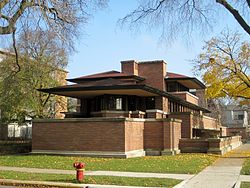
Chicago's architectural landscape expanded significantly between 1900 and 1930, driven by rapid population growth from 1.7 million to over 3 million residents and economic prosperity fueled by industrial expansion and post-World War I recovery.[18][19] This era saw the maturation of the Prairie School in residential and low-rise designs alongside a surge in commercial skyscrapers that tested new height limits in the central business district.[20][21]The Prairie School, pioneered by Frank Lloyd Wright and his contemporaries in the Chicago area, emphasized organic integration with the Midwestern prairie through horizontal massing, low-pitched hipped roofs with broad overhanging eaves, banded windows, and open interior plans that promoted fluid spatial flow.[22][20] These features rejected Victorian ornamentation in favor of site-specific harmony, using materials like brick, wood, and stained glass to evoke natural landscapes.[22] Wright's Oak Park studio, established in 1898, became a hub for this style, producing over 50 Prairie homes by 1910, many clustered in suburbs like Oak Park and River Forest.[23] Notable examples include the Arthur B. Heurtley House (1902) in Oak Park, featuring cantilevered roofs and geometric motifs, and the Avery Coonley House (1908) in Riverside, with its expansive playroom and leaded glass screens.[23]A pinnacle of Prairie design is the Frederick C. Robie House (1908–1910) at 5757 South Woodlawn Avenue in Hyde Park, where Wright employed reinforced concrete for dramatic overhanging roofs spanning 20 feet and a low profile that hugs the terrain, exemplifying the style's emphasis on privacy and indoor-outdoor connectivity.[24][25] The building's 7,600-square-foot layout includes a central hearth anchoring family spaces, influencing global modernism despite its brief occupancy by Robie, who sold it in 1912 due to financial setbacks.[24] Other Prairie works, such as Unity Temple (1905–1908) in Oak Park, innovated with poured concrete for a cubic massing that prioritized function over traditional ecclesiastical forms.[26]
Parallel to Prairie innovations, commercial architecture pursued verticality amid the 1920s building boom, erecting over 20 major skyscrapers as zoning changes and steel framing enabled heights exceeding 400 feet.[21][27] Departing from the austere Chicago School, designs incorporated eclectic ornamentation—Gothic, Renaissance, and proto-Art Deco—to convey prestige for corporate tenants.[28] The Wrigley Building (1921–1924), at 400–410 North Michigan Avenue, rose to 425 feet with twin towers clad in self-cleaning white terra cotta, drawing from Spanish Renaissance precedents like the Giralda Tower, and introduced central air conditioning to Chicago offices.[29][30]The Tribune Tower (1923–1925), a 463-foot Neo-Gothic landmark at 435 North Michigan Avenue designed by John Mead Howells and Raymond Hood, won an international competition in 1922 and featured flying buttresses, crocketed pinnacles, and embedded stone fragments from global monuments, symbolizing journalistic reach.[31] Its 36 stories housed the Chicago Tribune's operations, with setbacks complying with 1923 height ordinances that curbed unchecked density.[31] These "commercial heights" reflected speculative investment in the Loop, where economic optimism before the 1929 crash spurred structures like the London Guarantee Building (1923), blending classical bases with streamlined upper facades.[27] Overall, this period balanced Prairie horizontality with skyscraper ambition, laying foundations for Chicago's iconic skyline while adapting to urban pressures.[32]
Mid-20th Century Modernism and Urban Renewal (1930–1970)
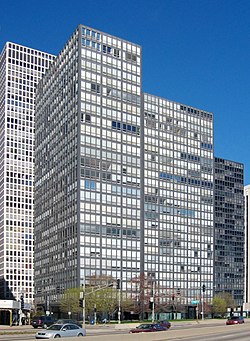
![860-880 Lake Shore Drive Apartments][float-right] Ludwig Mies van der Rohe, appointed director of the Armour Institute of Technology (later Illinois Institute of Technology) in 1938, profoundly shaped Chicago's modernist architecture through his advocacy of the International Style, emphasizing minimalist steel-and-glass structures with open floor plans.[33] His designs prioritized structural honesty and functional simplicity, influencing a generation of architects amid the Great Depression and post-World War II reconstruction. By 1945, Mies had redesigned the IIT campus, incorporating 20 buildings that exemplified rigid grid planning and exposed steel frames.[34]The 860-880 Lake Shore Drive apartments, completed between 1949 and 1951, marked a pivotal advancement as the first high-rises fully clad in non-structural glass curtain walls supported by an exposed steel skeleton, enabling expansive views and flexible interiors for 864 residents across 26 stories per tower.[35] Similarly, Crown Hall at IIT, dedicated in 1956, featured a vast column-free interior under a suspended steel roof, serving as a model for adaptable educational spaces and earning National Historic Landmark status in 2011 for its engineering precision.[36] These projects demonstrated modernism's shift from ornamental facades to skeletal frameworks, reducing material use while maximizing light and space, though critics noted their austere aesthetics alienated some residents accustomed to traditional detailing.[37]Urban renewal initiatives, accelerated under Mayor Richard J. Daley from 1955, involved federal funding via the Housing Act of 1949 to clear "slums" through demolition and highway construction, displacing over 37,000 families citywide by 1965, disproportionately affecting Black neighborhoods swollen by the Great Migration.[38][39] Projects like the Dan Ryan Expressway, opened in 1962, facilitated commuter access but fragmented communities, while high-rise public housing such as the 11,000-unit Robert Taylor Homes (1962) concentrated poverty in isolated towers, leading to elevated crime rates and maintenance failures by the 1970s.[40] Empirical studies indicate these efforts exacerbated racial segregation and economic inequality, as relocated families often faced higher rents without equivalent amenities, contradicting planners' visions of integrated revitalization.[41][42]In response to suburban exodus, private developments like Marina City, designed by Bertrand Goldberg and constructed from 1959 to 1964, introduced mixed-use "city-within-a-city" towers with 900 apartments, offices, theaters, and marinas, standing as the world's tallest residential buildings at 587 feet upon completion.[43] Featuring concrete "corncob" balconies for visual interest and self-contained amenities, the complex aimed to retain middle-class residents downtown, though occupancy fluctuated due to high costs and urban decay nearby.[44] By 1970, these modernist experiments highlighted tensions between innovative form and practical urban challenges, setting precedents for later high-rise clusters while underscoring renewal's mixed outcomes in social cohesion.[45]![Marina City towers][center]
Late 20th to Contemporary Evolution: Postmodernism, High-Rises, and Sustainability (1970–Present)
The period from 1970 onward marked a shift in Chicago's architecture from strict modernism toward postmodernism, which critiqued modernist austerity by incorporating historical references, ornamentation, and contextual responsiveness. Postmodern designs in the city emphasized complexity, metaphor, and cultural expression, often blending high-tech elements with playful historical allusions. Key proponents included Stanley Tigerman, known for ironic critiques like his 1978 collageThe Titanic parodying Mies van der Rohe's Crown Hall, and Helmut Jahn, whose works fused postmodern flair with structural innovation.[46][47]Prominent postmodern buildings include the James R. Thompson Center (1985), designed by Helmut Jahn of Murphy/Jahn, featuring an ovoidal footprint, a bold blue-and-salmon atrium, and a public rotunda intended as a "people's center" with deconstructivist tendencies.[48][47] The Harold Washington Library Center (1991), by Hammond, Beeby & Babka, adopted neoclassical motifs with red brick cladding, classical ornament, and rooftop sculptures, reviving decorative traditions amid urban renewal debates.[46] Other examples, such as 333 West Wacker Drive (1983) by Kohn Pedersen Fox, showcased curved river-reflecting facades with granite bases evoking historical solidity, while Tigerman's projects like the Anti-Cruelty Society (1982) incorporated figural motifs, such as a facade resembling a dog's face.[47]High-rise development persisted vigorously, building on modernist innovations like the bundled-tube system pioneered by Fazlur Khan. The Willis Tower (1974), designed by Bruce Graham and Khan of Skidmore, Owings & Merrill (SOM), reached 1,451 feet across 110 stories, holding the title of world's tallest building until 1998 and exemplifying efficient structural engineering for supertall forms.[49] Subsequent decades saw booms in the 1980s and 2000s, with structures like the 60-story One Magnificent Mile (1983) and the 61-story AT&T Corporate Center (1989), both by SOM, pushing envelope designs. Post-2000, towers such as the 98-story Trump International Hotel and Tower (2009, 1,388 feet, Adrian Smith + Gordon Gill Architecture) and the 101-story St. Regis Chicago (2020, 1,198 feet, Goettsch Partners) continued vertical expansion, incorporating advanced wind-resistant damping systems amid denser infill construction.[47]
Contemporary evolution has prioritized sustainability, driven by LEED certification standards introduced in 2000 by the U.S. Green Building Council, with Chicago achieving over 1,894 LEED-registered or certified projects by recent counts.[50] The Aqua Tower (2009), an 82-story residential-commercial structure by Studio Gang, exemplifies this trend through undulating concrete balconies providing solar shading, reducing energy loads by up to 40% via natural ventilation and views; it also features an 80,000-square-foot green roof for stormwater management and heat mitigation, targeting LEED Silver status.[51] Other initiatives include retrofits of existing high-rises for energy efficiency and citywide policies under Sustainable Chicago 2015, aiming to cut greenhouse gases through green roofs, efficient HVAC, and renewable integrations across 27 government-owned LEED buildings by 2009.[52] These efforts reflect causal priorities on empirical resource conservation, countering modernism's oversight of long-term environmental impacts.
Architectural Innovations and Engineering
Structural Breakthroughs: Steel Frames, Elevators, and Fireproofing
The steel frame, or skeleton construction, emerged as a pivotal innovation in Chicago's architecture following the Great Fire of 1871, enabling buildings to rise beyond the limitations of load-bearing masonry walls. In this system, a framework of vertical steel columns and horizontal I-beams supports the floors and roof, with non-structural curtain walls hung from the skeleton, drastically reducing weight and allowing greater heights.[53][54] The Home Insurance Building, completed in 1885 and designed by William Le Baron Jenney, is widely recognized as the first structure to employ this method at scale, initially with 10 stories (later expanded to 12) using structural steel in its frame rather than relying solely on cast iron or masonry.[15][55] This breakthrough addressed Chicago's high land costs and dense urban demands by permitting efficient vertical expansion, with the building's steel skeleton weighing far less than equivalent masonry while supporting unprecedented loads.[54]Elevators were equally essential, transforming multi-story buildings from impractical novelties into viable commercial spaces by facilitating rapid vertical transportation. Elisha Graves Otis's safety brake, invented in 1852 and publicly demonstrated in 1854 at the New York Crystal Palace Exhibition, prevented free falls by engaging spring-loaded pawls if cables failed, building public confidence in passenger elevators.[56][57] The first commercial passenger elevator, installed in 1857 in a New York department store, paved the way for their adoption in Chicago's nascent skyscrapers, including the Home Insurance Building, which incorporated multiple elevators to serve its floors efficiently.[58][55] By the 1880s, hydraulic and later electric elevators became standard in Chicago's tall buildings, with speeds and capacities increasing to handle office worker volumes, directly enabling the economic feasibility of structures over 10 stories.[59]Fireproofing techniques addressed steel's vulnerability to heat, as temperatures above 1,000°F (538°C) cause it to lose strength, a lesson reinforced by the 1871 fire's devastation of iron-framed precursors. Early methods encased steel members in thick masonry or concrete, but lightweight terracotta blocks—hollow, porous clay units—revolutionized protection by providing insulation without excessive weight, a practice dubbed "Chicago construction."[60][61] In buildings like the Home Insurance, terracotta tiles and blocks clad the steel skeleton, offering fire resistance for up to four hours while allowing slender profiles.[62] This integration of fireproofing with steel framing and elevators not only met stringent post-fire building codes but also set precedents for safe, enduring high-rises, influencing global urban development.[61][3]
Material and Construction Advances
Following the Great Chicago Fire of 1871, which destroyed over 17,000 structures primarily built of wood, city ordinances mandated the use of fire-resistant materials such as brick, stone, marble, and limestone for new construction to prevent future conflagrations.[3] After a subsequent fire in 1874, updated building codes further emphasized non-combustible brick and stone exteriors, shifting away from vulnerable timber framing and promoting masonry load-bearing walls capable of supporting multi-story buildings.[13]A pivotal advance came with the adoption of steel skeleton framing, which transferred structural loads from heavy masonry walls to an internal metal framework, enabling unprecedented building heights without proportional wall thickening. William Le Baron Jenney's Home Insurance Building, completed in 1885, is recognized as the first structure to employ a fully metal-framed system using iron and steel beams, though partial cast-iron frames had appeared earlier in Chicago warehouses.[2] This innovation, refined through riveted steel connections, allowed for lighter, more efficient construction and open floor plans, with exterior walls becoming non-structural cladding.[53]Fireproofing techniques evolved concurrently, incorporating terra cotta tiles over steel frames to encase beams and columns, providing thermal protection against high temperatures that could warp metal. Chicago architects extensively used glazed terra cotta for both its fire resistance—enduring over 2,000°F without failure—and aesthetic versatility in ornamental detailing, as seen in early skyscrapers like the Monadnock Building's masonry base transitioning to steel above.[63] These methods addressed the limitations of iron, which expanded under heat, by combining skeletal efficiency with protective sheathing.By the 1890s, the development of curtain wall systems marked another leap, where facades of glass, metal, and lightweight panels hung from the frame without bearing weight, maximizing natural light and views. The Reliance Building (1890–1895), designed by Burnham and Root with Charles B. Atwood, featured large plate-glass windows comprising nearly 80% of its facade, serving as a prototype for modern curtain walls by minimizing spandrel areas and using terra cotta for fire-rated infill.[64]In the mid-20th century, reinforced concrete gained prominence in Chicago's high-rises, offering superior compressive strength and moldability for complex forms compared to steel alone. Between 1950 and 1986, over half of the city's approximately 400 buildings taller than 12 stories utilized reinforced concrete structures, leveraging innovations like slip-form construction for cores and slabs, which facilitated economical erection of towers such as those in the International Style.[65] Ludwig Mies van der Rohe's designs, including the Lake Shore Drive Apartments (1949), integrated concrete frames with glass curtain walls, emphasizing exposed structural elements and modular prefabrication for precision and speed.[33] These material shifts not only responded to engineering demands but also influenced global standards for urban density and safety.
Engineering Challenges: Wind Loads, Foundations, and Seismic Considerations
Chicago's tall buildings face substantial wind loads due to prevailing gusts from Lake Michigan, which can induce significant lateral forces and accelerations in supertall structures. Structural engineer Fazlur Rahman Khan addressed this challenge through innovative tube-frame systems, starting with the framed tube in the 1965 DeWitt-Chestnut Apartments and evolving to the braced tube in the 1969 John Hancock Center, where exterior mega-columns and belt trusses efficiently transferred wind shear to the foundation, reducing interior column needs and material usage by up to 50% compared to earlier rigid frames.[66][67] The 1973 Willis Tower (formerly Sears Tower) employed a bundled tube system of nine shafts, allowing differential heights and further optimizing wind resistance by distributing loads across the facade, enabling heights exceeding 1,400 feet while limiting sway to habitable levels under design winds of approximately 100 mph.[49] Modern supertall projects, such as the 1,200-foot St. Regis Chicago (completed 2022), incorporate viscous liquid dampers and dual-core systems to mitigate vortex shedding and across-wind oscillations, achieving damping ratios of 2-3% to keep peak accelerations below 15 milli-g for occupant comfort.[68]Foundations in Chicago contend with compressible glacial till and soft silty clay layers up to 100 feet thick overlying a hardpan stratum, necessitating deep support to prevent differential settlement observed in early pile-driven structures like the 1895 Masonic Temple Building, which sank due to inadequate bearing. The Chicago caisson method, developed around 1900, uses corrugated steel pipes sunk through soft soils and belled at the base for end-bearing on dense clay or limestone, filled with concrete to form piers capable of loads exceeding 1,000 tons each; for instance, the 1925 Tribune Tower utilized over 200 such caissons reaching 100 feet deep.[69][70] This technique, refined over decades, supports modern skyscrapers like the Willis Tower with clusters of 100+ caissons extending to 100-150 feet, distributing loads to minimize punching shear in the clay and ensuring long-term stability without reaching bedrock, which lies over 500 feet below in some areas.[71][72]Seismic risks in Chicago remain low, with the region classified under Seismic Design Category A or B per the International Building Code, reflecting peak ground accelerations of 0.05-0.10g from distant sources like the New Madrid Seismic Zone rather than local faults. Building codes mandate ductile detailing in steel moment frames and concrete shear walls primarily for wind governance, but incorporate minimal seismic provisions such as base isolation considerations in rare high-value structures; historical data shows no major quake-induced damage to Chicago's inventory, prioritizing wind and soil over earthquake engineering.[73][74]
Styles and Movements
Chicago School: Functionalism and Commercial Innovation
The Chicago School, emerging in the 1880s amid Chicago's rapid commercial expansion following the Great Fire of 1871, represented a pivotal shift toward functionalist architecture tailored to urban business needs. Architects prioritized structural efficiency over ornamental excess, leveraging steel-frame construction to erect taller buildings that maximized rentable office space. This approach embodied the principle that a building's form should derive directly from its purpose, as articulated by Louis Sullivan in his 1896 essay "The Tall Office Building Artistically Considered," where he argued for designs that express the skyscraper's inherent verticality and skeletal support.[75][76]Central to the school's innovations was the skeleton frame system, first practically implemented in the Home Insurance Building (1884–1885), a 10-story structure designed by William Le Baron Jenney that reached 138 feet in height. By using steel beams and columns to bear loads independently of exterior walls, Jenney enabled thinner facades and expansive windows, allowing natural light to penetrate deeper into interiors—a necessity for dense commercial environments. Later additions in 1891 extended it to 12 stories, demonstrating the frame's adaptability. This engineering breakthrough reduced reliance on load-bearing masonry, which had limited heights to around 10 stories, and facilitated the proliferation of skyscrapers as symbols of commercial prowess.[77][4]Functionalism in the Chicago School manifested through simplified, rectilinear forms and the "Chicago window"—a large fixed pane flanked by operable sashes—which optimized ventilation and daylighting in office towers, often clad in terra cotta for fire resistance and featuring minimal ornamentation, a three-part vertical division of base, shaft, and capital, and grid-like facades that expressed the underlying steel structure. Firms like Burnham and Root advanced these ideas in projects such as the Rookery Building (1885–1886), incorporating iron and steel framing with terra-cotta cladding for fire resistance, while the Monadnock Building (1889–1891) showcased a transitional load-bearing design at 16 stories, the tallest of its kind. Louis Sullivan, partnering with Dankmar Adler, refined ornamental detailing to harmonize with structure, as seen in the Wainwright Building (1890–1891) in St. Louis, where terra-cotta piers articulated the vertical steel skeleton, influencing broader commercial aesthetics. These elements prioritized utility and cost-effectiveness, responding to real estate demands for high-density leasing in Chicago's Loop district.[76][78]The school's commercial innovations extended to integrated systems like passenger elevators, pioneered by Elisha Otis in the 1850s but refined for high-rises, and fireproofing techniques using hollow clay tiles and concrete floors to mitigate risks exposed by earlier conflagrations. Architects such as Holabird and Roche further democratized these methods in the Reliance Building (1890–1895), employing a nearly all-glass facade supported by a lightweight steel frame, which prefigured modernist transparency. This emphasis on structural rationality and efficiency distinguished Chicago's high-rises from those in New York, where developments were more eclectic, influenced by the 1916 zoning resolution requiring setbacks for light and air, leading to ornate detailing, spires, towers, and tapered forms that prioritized corporate prestige and iconic status over pure function, as exemplified by the Woolworth Building (1913, Gothic Revival), Chrysler Building (1930, Art Deco spire), and Empire State Building (1931, with setbacks achieving record height). By the early 1900s, the First Chicago School's rational, technology-driven design laid groundwork for global skyscraper development, though it waned as Beaux-Arts influences and the Prairie School gained traction locally; a Second Chicago School emerged in the mid-20th century, reviving these principles with innovations like the bundled tube structural system in the Willis Tower (1973). Empirical evidence from surviving structures and engineering analyses confirms the school's causal role in enabling vertical urban growth, unencumbered by traditional stylistic dogma.[49][79][80][2]
Prairie School: Organic Integration with Landscape
The Prairie School emerged in Chicago in the late 1890s as a residential architectural movement that prioritized harmony with the Midwestern landscape, rejecting ornate historical styles in favor of forms that extended organically from the flat prairie terrain. Led by Frank Lloyd Wright, who established his Oak Park studio in 1893, the style drew from Arts and Crafts principles and Louis Sullivan's functionalism to create low, horizontal structures that "married" buildings to their sites through site-specific designs using local materials and contours.[22][81][20]Central to this organic integration were features like low-pitched hipped roofs with wide overhanging eaves, continuous bands of casement windows, and cantilevered projections that echoed the horizon line and facilitated indoor-outdoor flow. Natural materials—iron-spotted brick, limestone trim, and wood—blended with the earth tones of the surroundings, while open floor plans centered around massive hearths radiated toward terraces, planters, and gardens, dissolving boundaries between structure and environment. Wright's organic architecture philosophy posited that buildings should grow from their locale, purpose, and era, achieving unity rather than dominance over the landscape.[22][20]The Frederick C. Robie House (1909–1910) in Chicago's Hyde Park neighborhood stands as a definitive example, with its unrelenting horizontal massing, dynamic overhanging roofs, and broad balconies linking interiors to the site via leaded art-glass windows that filter natural light. Constructed of brick and limestone, the design's planters and terraces further embed the residence in its plot, exemplifying Prairie School's peak before Wright's departure for Europe in 1909. Other Chicago-area works, such as those in Oak Park—home to the nation's highest concentration of Prairie buildings, including the Frank W. Thomas House (1901)—refined these techniques, influencing associates like George W. Maher and George Elmslie.[24][20][81]Though the movement declined after World War I amid shifting tastes toward conservatism, its emphasis on landscape-responsive design laid groundwork for modernist architecture, promoting sustainability through contextual adaptation rather than stylistic imposition.[81][20]
Art Deco, Streamline Moderne, and Eclectic Influences
Art Deco architecture flourished in Chicago during the 1920s and early 1930s, reflecting the city's economic boom and post-World War I optimism through vertical emphasis, geometric motifs, and luxurious materials like black marble and bronze.[82] Prominent examples include the Chicago Board of Trade Building, completed in 1930 by Holabird & Root, which features a 605-foot tower capped by a zinc statue of Ceres and Art Deco ornamentation symbolizing commerce.[83] The Carbide & Carbon Building, designed by the Burnham Brothers in 1929, exemplifies the style's jewel-like facade with green terra-cotta cladding mimicking a gemstone and setbacks creating a stepped profile.[82] Other notable structures are the 333 North Michigan Avenue skyscraper (1928, Holabird & Root), with its black granite base and setbacks, and the Civic Opera Building (1929, Graham, Anderson, Probst & White), integrating ornate lobbies with functional office towers.[83] These buildings, concentrated in the Loop district, demonstrated engineering advances in steel framing while prioritizing aesthetic exuberance over pure functionalism.[84]Streamline Moderne, an evolution of Art Deco emerging in the 1930s amid the Great Depression and influenced by aerodynamic forms from automobiles and aircraft, emphasized horizontal lines, curved corners, and smooth surfaces in Chicago's architecture, often in smaller-scale commercial and residential projects rather than skyscrapers.[85]The Marine Drive Apartments in Uptown, constructed in the 1930s by Rapp and Rapp, represent this style with their white-brick facades, rounded bays, and glass-block windows evoking speed and modernity.[86] Industrial examples include factories repurposed by firms like Freedman Seating, featuring porthole windows and streamlined brickwork from the late 1930s.[87] The Adler Planetarium (1930) incorporates Moderne elements such as horizontal banding and nautical motifs, aligning with the era's machine-age aesthetic while serving public institutions.[82] This style's prevalence in Chicago waned by the late 1930s as International Style modernism gained traction, but it persisted in adaptive reuse of structures emphasizing efficiency over ornament.[88]Eclectic influences in Chicago's interwar architecture blended revivalist elements—such as Gothic or Beaux-Arts details—with emerging modern forms, responding to the city's diverse building demands and rejecting strict stylistic purity during the 1920s and 1930s.[89] The Pittsfield Building (1927), designed by the Burnham Brothers, merges Gothic spires and tracery with Art Deco streamlining and vertical massing, creating a hybrid that balanced historic prestige with contemporary height.[83] Similarly, the Merchandise Mart (1930, Graham, Anderson, Probst & White) combined Beaux-Arts symmetry and limestone cladding with Deco-inspired geometric accents, functioning as the world's largest building at the time with over 4 million square feet.[90] These eclectic approaches, driven by firms like Holabird & Root, allowed developers to evoke tradition amid rapid urbanization, though they drew criticism for diluting innovation compared to purer Chicago School functionalism.[91] By the 1940s, such mixtures gave way to more rationalist designs, but they underscored Chicago's pragmatic adaptation of global trends to local economic realities.[92]
International Style, Brutalism, and Mid-Century Modern
The International Style gained prominence in Chicago during the mid-20th century, characterized by rectilinear forms, flat roofs, glass curtain walls, and the absence of ornamentation, emphasizing structural clarity and open interior spaces. Ludwig Mies van der Rohe, who served as director of the Illinois Institute of Technology (IIT) from 1938 to 1958, was instrumental in establishing this style in the city, designing over 20 buildings on the IIT campus using steel frames and brick or glass facades.[33] His 860-880 Lake Shore Drive apartments, completed in 1951, exemplify the style with their skeletal steel structure clad in floor-to-ceiling glass, marking one of the earliest uses of curtain walls in residential high-rises.[93] Other notable Mies designs include S.R. Crown Hall at IIT (1956), a single-story pavilion with a vast column-free interior supported by a rigid steel frame and glass enclosure, hailed as a pinnacle of modernist functionalism.[33] The 330 North Wabash building (originally IBM Plaza, completed 1972) further demonstrates the style's influence on commercial skyscrapers, featuring bronze-tinted glass and a grid-like facade.[94]Brutalism emerged in Chicago during the 1960s and 1970s, employing exposed concrete (béton brut) to create monolithic, textured forms that prioritized raw materiality and sculptural massing over sleek minimalism. Architect Bertrand Goldberg's Marina City (1964), twin cylindrical towers rising 179 meters with radiating concrete balconies, integrated residential, commercial, and parking functions in a mixed-use urban form, though its curved geometry deviates from strict orthogonal Brutalism.[95] Walter Netsch of Skidmore, Owings & Merrill applied his "Field Theory" system—generating complex geometries from geometric grids—to University of Illinois Chicago (UIC) structures, such as the Richard J. Daley Library (1965) and the Art and Architecture Building (1966), resulting in interlocking concrete volumes that convey dynamism amid institutional rigidity.[96] Harry Weese's Seventeenth Church of Christ, Scientist (1968) showcases Brutalist restraint with its bush-hammered concrete exterior and asymmetrical massing, balancing monumentality with subtle geometric modulation.[97] While some Brutalist works, like the demolished Prentice Women's Hospital (1975) by Bertrand Goldberg, faced criticism for their imposing scale and maintenance challenges, they reflected postwar urban renewal's emphasis on durable public architecture.[95]Mid-Century Modern in Chicago built on International Style foundations but incorporated organic curves, exposed materials, and site-responsive elements, flourishing from the 1940s to 1960s amid economic recovery and suburban expansion. The Inland Steel Building (1958), designed by Bruce Graham and Walter Netsch, introduced innovative fireproofing with stainless steel and aluminum framing, allowing a setback-free 139-meter tower with a luminous Cor-Ten steel and glass facade, pioneering central core construction for open floor plans.[98]Marina City also embodies Mid-Century Modern vitality through its helical parking ramps and protruding "corncob" balconies, fostering vertical urbanism with marinas and theaters at the base to combat downtown decline.[99]Lake Point Tower (1968) by Schipporeit & Heinrich, inspired by Mies, features a Y-shaped plan with curved glass walls minimizing wind loads, rising 196 meters as a residential landmark on the Chicago River.[100] These structures prioritized human scale and technological optimism, contrasting Brutalism's austerity while advancing Chicago's role as a testing ground for postwar high-rise innovations.[99]
Postmodernism, Deconstructivism, and Neomodern Trends
Postmodern architecture in Chicago, emerging prominently from the late 1970s through the 1990s, rejected the stark functionalism of modernism by reintroducing ornament, historical allusions, and contextual references to the city's built environment.[101] This shift reflected broader cultural critiques of modernism's perceived uniformity, favoring eclectic compositions that engaged with Chicago's layered urban history, such as nods to 19th-century masonry traditions amid glass-and-steel towers.[47] Key examples include the James R. Thompson Center at 100 W. Randolph Street, designed by Helmut Jahn and completed in 1985, which features a dynamic curved glasscurtainwall, exposed trusswork, and a nine-story atrium clad in colorful granite and stainless steel, blending high-tech elements with populist accessibility.[102] Another is the Harold Washington Library Center at 400 S. State Street, designed by Hammond Beeby & Babka and opened in 1991, spanning 756,000 square feet with a granite facade incorporating Corinthian columns, arched windows, and a mansard roof, evoking Beaux-Arts grandeur while housing modern library functions across 10 floors.[103] The 190 South LaSalle Street tower, by Philip Johnson and John Burgee, completed in 1989, draws from the 1892 Masonic Temple's proportions with its masonry base, green granitegable, and setbacks, integrating postmodern historicism into the Loop's skyline.[46]Deconstructivism, a more radical postmodern offshoot emphasizing fragmentation, asymmetry, and the destabilization of form, found limited expression in Chicago compared to its European and coastal manifestations, often manifesting in sculptural public works rather than buildings.[104] Frank Gehry's Jay Pritzker Pavilion in Millennium Park, completed in 2004, stands as a signature instance, with its 120-foot-high proscenium of interlocking, brushed stainless steel ribbons twisting in apparent chaos over a 90-by-50-foot stage, supported by a trellis system that diffuses sound while visually challenging orthogonal geometry and evoking auditory waves.[104] This structure, part of a 24.5-acre park redevelopment, prioritizes experiential dynamism over static stability, aligning with deconstructivism's philosophical roots in disrupting conventional spatial hierarchies, though its engineering—featuring 106 custom steel pieces—ensures acoustic performance for 11,000 patrons.[105]Neomodern trends in Chicago since the early 2000s have revived stripped-down modernist principles of clarity and efficiency, augmented by computational design, advanced materials, and sustainability imperatives, yielding high-rises that prioritize verticality, light optimization, and environmental resilience amid the city's wind-prone site.[106] These structures often feature seamless glass envelopes, rational geometries, and integrated green technologies, contrasting postmodern eclecticism while addressing post-9/11 engineering demands for fireproofing and evacuation. The Aqua Tower at 225 N. Columbus Drive, designed by Studio Gang and completed in 2009 at 82 stories and 870 feet, exemplifies this through its terraced balconies—comprising 26,000 undulating fiber-cement panels—that mitigate wind loads by diffusing gusts up to 140 mph, enhance resident views, and add 250,000 square feet of communal outdoor space.[106] Similarly, Vista Tower at 360 E. South Water Street, also by Studio Gang and topped out in 2019 at 1,071 feet with 101 stories, employs parametric modeling for its concrete core and glass facade, incorporating energy-efficient glazing and setback gardens to reduce urban heat island effects while maximizing lakefront sightlines.[106] These developments underscore Chicago's ongoing role in skyscraper evolution, where neomodernism leverages BIM software and composite materials to achieve densities exceeding 10,000 residents per tower without sacrificing structural integrity.[107]
Notable Buildings and Structures
Pioneering Skyscrapers and Commercial Icons
The Home Insurance Building, completed in 1885 at the corner of LaSalle and Adams streets, marked the advent of the modern skyscraper through its pioneering use of a metal skeleton frame, which transferred the structure's weight to the ground via vertical columns and horizontal beams rather than relying solely on thick masonry walls.[15] Designed by engineer William Le Baron Jenney for the Home Insurance Company, the ten-story structure—later expanded to twelve—stood 138 feet tall and incorporated cast-iron elements alongside steel in its framing, enabling greater height and open interior spaces amid Chicago's constrained urban land after the 1871 Great Fire.[108] This innovation addressed the causal pressures of booming commercial demand and high real estate costs by maximizing vertical expansion, though the building was demolished in 1931 to make way for newer construction.[109]Subsequent early skyscrapers built on these foundations, exemplified by the Rookery Building (1886–1888) at 209 South LaSalle Street, designed by Daniel Burnham and John Wellborn Root. This twelve-story office structure employed a wrought-iron skeleton with fireproof terracotta encasement and featured a light court with glass skylights for natural illumination, influencing later designs by prioritizing functional efficiency and interior daylighting in dense urban settings.[94] The Monadnock Building (1891–1893), also by Burnham and Root, represented the culmination of load-bearing masonry construction with its seventeen stories and 212-foot height, featuring progressively thicker granite walls at the base—up to six feet—to support the immense weight without a full metal frame, demonstrating the engineering limits of traditional methods before steel-frame dominance.[94]The Reliance Building (1890–1895), another Burnham and Root project at 1 West Washington Street, advanced facade innovation with its early adoption of a non-load-bearing terracotta curtain wall supported by a steel skeleton, allowing expansive window areas—covering over 60 percent of the exterior—for enhanced natural light and ventilation in office spaces, a hallmark of Chicago School functionalism.[94] Commercial icons like Louis Sullivan's Carson Pirie Scott Store (1899, originally Schlesinger & Mayer) at 1 South State Street showcased ornamental ironwork and rhythmic window piers, embodying Sullivan's "form follows function" principle while serving as a department store anchor that drew retail activity to the Loop district.[110] These structures collectively established Chicago as the epicenter of skyscraper development, driven by empirical advancements in steel production and elevator technology, such as Elisha Otis's safety brakes, which made multi-story occupancy practical and economically viable.[111]
Cultural, Institutional, and Public Landmarks
Chicago's cultural, institutional, and public landmarks embody the city's architectural legacy, integrating Beaux-Arts monumentalism from the World's Columbian Expositionera with later neoclassical and modern designs that prioritize public accessibility and cultural function.[94] These structures, often commissioned for expositions or civic purposes, demonstrate engineering feats like load-bearing masonry adapted for large-scale assembly halls and galleries, while later additions incorporate steel framing for expansive interiors.[112]The Art Institute of Chicago's main building, constructed between 1892 and 1893 for the World's Columbian Exposition, exemplifies Beaux-Arts classicism with its limestone facade, Corinthian columns, and symmetrical layout designed by Shepley, Rutan and Coolidge atop an earlier Burnham and Root foundation.[113] The 2009 Modern Wing, engineered by Renzo Piano Building Workshop, adds 264,000 square feet of glass-enclosed galleries supported by a cantilevered "flying carpet" roof, bridging the museum to Millennium Park via a pedestrian bridge and emphasizing transparency and natural light.[114] This expansion, costing approximately $300 million, enhanced visitor flow to over 1.5 million annually by integrating with the urban landscape.[115]The Field Museum of Natural History, completed in 1921 after construction from 1917 to 1920, features a neoclassical facade of white Georgia marble with Ionic columns inspired by the Erechtheion in Athens, designed by Peirce Anderson of Graham, Anderson, Probst & White at a cost of $7 million.[116] Spanning 385 feet in length with a central rotunda and transverse halls, the building's fossilized limestone floors and four corner muses symbolize scientific inquiry, aligning with Daniel Burnham's 1909 Plan of Chicago for lakefront cultural institutions.[117] Its Greek Revival elements provide a durable enclosure for extensive exhibits, accommodating over 1.4 million visitors yearly.[118]Symphony Center's Orchestra Hall, dedicated in 1904, was designed by Daniel Burnham in a Georgian Revival style with brick cladding, arched windows, and a 2,500-seat auditorium optimized for acoustics through coffered ceilings and plaster finishes.[119] A 1993-1997 renovation by Skidmore, Owings & Merrill restored structural integrity, added Buntrock Hall for rehearsals, and incorporated modern HVAC while preserving Burnham's original form, ensuring the venue hosts over 150 Chicago Symphony Orchestra performances annually.[120]Millennium Park, opened on July 4, 2004, covers 24.5 acres atop a parking garage as a green roof landscape designed under a master plan by Skidmore, Owings & Merrill, featuring Frank Gehry's Jay Pritzker Pavilion—a $60 million steel trellis structure spanning 120 by 120 feet that supports acoustic panels for outdoor concerts.[121] The park's integration of architecture and public art, including pedestrian bridges and reflective sculptures, transformed a former rail yard into a venue drawing 25 million visitors since inception, with Gehry's undulating metal form exemplifying deconstructivist influences in civic space.[122]The Chicago Cultural Center, originally the city's central library built in 1897, showcases Beaux-Arts opulence with a granite and limestone exterior, a grand Tiffany dome rising 38 feet in diameter, and mosaic-decorated interiors by Shepard, Berger & Shepley.[110] Repurposed in 1991 for cultural events, its Preston Bradley Hall and grand staircase highlight ornamental plasterwork and marble, serving as a free public venue for exhibitions and performances that underscore Chicago's commitment to accessible institutional architecture.[94]
Residential and Mixed-Use Exemplars
Marina City, completed in 1968 and designed by Bertrand Goldberg, represents a pioneering mixed-use development in Chicago, featuring two 65-story cylindrical towers with 896 residential units, commercial spaces, a theater, and marina facilities.[43] The project, constructed from 1960 to 1967, aimed to reverse suburban flight by integrating urban living with amenities, marking the first U.S. high-rise complex to combine housing, offices, and recreation in a self-contained "city within a city."[45] Its concrete honeycomb structure, with pie-shaped apartments spiraling around central cores, innovated post-war residential design by prioritizing views and communal facilities over traditional street-level retail.[123]The 860-880 North Lake Shore Drive apartments, built between 1949 and 1951 by Ludwig Mies van der Rohe, exemplify International Style residential architecture through their minimalist steel-frame and glass curtain wall construction.[35] These 26-story twin towers, containing 254 units each, were the first high-rises to employ full glass facades for private residences, emphasizing structural honesty and open floor plans adaptable to varying layouts.[37] Designated a Chicago Landmark in 1998, the buildings influenced subsequent modernist housing by demonstrating how skeletal frames could support expansive views of Lake Michigan while minimizing ornamentation.[124]Aqua Tower, an 82-story mixed-use skyscraper completed in 2010 and designed by Jeanne Gang of Studio Gang Architects, integrates 1,888 residential units, hotel rooms, offices, and parking in Chicago's Lakeshore East neighborhood.[51] Its distinctive undulating concrete balconies, varying in depth up to 10 feet, create a sculptural facade that enhances shading, wind diffusion, and neighborly interactions across floors.[125] Rising 870 feet, the tower's design reinterprets high-rise typology by mimicking natural water contours, promoting sustainability through reduced solar gain and improved ventilation in a dense urban context.[126]
Residential Architecture
Historic Single-Family and Row Houses
Chicago's historic single-family houses emerged prominently after the Great Chicago Fire of 1871, which destroyed much of the city's wooden residential stock and prompted stricter building codes favoring brick and masonry construction. Workers' cottages, a quintessential type, consisted of compact, one- or one-and-a-half-story gable-roofed structures typically measuring 16 to 20 feet wide by 40 to 50 feet deep, designed for affordability amid rapid industrialization and population growth from 500,000 in 1880 to over 2 million by 1910. These homes, often featuring a front parlor, kitchen, and two bedrooms upstairs, were built primarily between the 1870s and 1910s in working-class neighborhoods such as Bridgeport, Pilsen, and the Back of the Yards, reflecting utilitarian vernacular architecture adapted to Chicago's narrow 25-foot lots. [127][128][129]Larger single-family residences incorporated Victorian-era styles like Italianate, Second Empire, and Queen Anne, with ornate cornices, bay windows, and mansard roofs, concentrated in emerging middle-class enclaves such as Lincoln Park and Hyde Park during the 1870s to 1890s. These homes, varying from 2,000 to 5,000 square feet, served professionals and merchants, exemplified by surviving structures in the Gold Coast and Old Town areas that blended functionality with decorative elements like pressed brick facades and iron balconies. The shift to brick not only complied with fire ordinances but also enabled denser urban infill, though many early examples succumbed to later demolitions for multi-family conversions or urban renewal. [130][131]Row houses, while less prevalent than in Eastern cities due to Chicago's expansive land availability and preference for detached homes, appeared in clustered developments post-1871, often as speculative ventures for laborers. The Burling Row House District, comprising ten contiguous brick row houses erected between 1873 and 1875 on the Near North Side, represents one of the earliest intact post-fire groupings, with unified Italianate detailing including bracketed cornices and arched windows to promote visual cohesion on narrow lots. Similarly, the Greenwood Row House District in Hyde Park features twenty brick row houses from the 1880s, built to house university-affiliated workers and showcasing restrained Queen Anne influences. [132][133]The Pullman district stands as the most ambitious example of planned row housing, developed from 1880 onward by the Pullman Palace Car Company under George M. Pullman's vision of a model industrial town on Chicago's Far South Side. Architect Solon S. Beman designed over 1,300 uniform brick row houses in graduated sizes—from modest two-bedroom units for entry-level workers to larger three-story homes for supervisors—featuring shared walls, green lawns, and Gothic Revival elements like pointed arches to instill discipline and community pride, though this paternalistic approach later fueled labor unrest culminating in the 1894 Pullman Strike. These structures, preserved as a National Historic Landmark, highlight how employer-controlled housing integrated architecture with social engineering, prioritizing stability over individual autonomy. [134][135]
High-Rise and Multi-Family Developments
Chicago's high-rise multi-family developments represent an extension of the city's skyscraper innovation into residential architecture, enabling dense urban living amid limited land availability. Post-World War II, architects adapted steel-frame and curtain-wall technologies from commercial buildings to create residential towers, prioritizing efficiency, light, and views. These structures proliferated along the lakefront and in the Loop, transforming Chicago into a leader in vertical housing with over 1,250 high-rises, many residential.[136]Pioneering examples include the twin 26-story towers at 860–880 North Lake Shore Drive, designed by Ludwig Mies van der Rohe and completed in 1951. Commissioned by developer Herbert S. Greenwald, these buildings featured the first extensive use of glass-and-steel curtain walls in residential high-rises, with a minimalist International Style aesthetic emphasizing structural expression and open floor plans. Designated a Chicago Landmark in 1998, they influenced subsequent modernist apartments by demonstrating feasible high-density living without ornate facades.[137][124]In the 1960s, Bertrand Goldberg's Marina City introduced curved, concrete "corncob" towers at 300 North State Street, completed in 1964. This mixed-use complex, with 896 wedge-shaped apartments across two 60-story structures, integrated parking spirals, theaters, and marinas to combat suburban flight and promote self-contained urbanism. Its helical form and prefabricated components marked a departure from rectilinear modernism, housing middle-class residents while symbolizing Chicago's adaptive reuse of riverfront industrial sites.[43][123]From the 1970s onward, high-rise residential construction accelerated, with luxury condominiums and apartments dominating lakefront corridors like the Gold Coast. By the 2000s boom, residential projects comprised 78% of new tall buildings completed between 2000 and 2019, driven by demand for amenities like fitness centers and concierge services. Chicago ranked second nationally in the share of residential skyscrapers by 2019, reflecting zoning allowances for heights exceeding 500 feet in select zones. Recent developments, such as the 2023 completion of supertall mixed-use towers, incorporate sustainable features like energy-efficient glazing, though economic cycles like the 2008 recession temporarily halted progress.[136][138]
These developments have shaped neighborhood demographics, concentrating affluent residents in vertical enclaves while raising debates on affordability, as median unit sizes shrank from 1,200 square feet in mid-century towers to under 900 in newer builds. Architectural variety spans Brutalist influences in the 1970s to sleek glass facades today, with firms like Solomon Cordwell Buenz designing over 20,000 units since 2000.[139]
Public Housing Initiatives: Design, Implementation, and Outcomes
Public housing initiatives in Chicago, overseen by the Chicago Housing Authority (CHA) founded in 1937, shifted post-World War II toward large-scale high-rise complexes rooted in modernist architectural tenets, aiming to clear slums and house the urban poor through efficient vertical density. Designs drew from Le Corbusier's "towers in the park" model, featuring linear slab towers of 6 to 22 stories with open-air galleries, expansive green spaces, and superblock layouts that prioritized light, air, and land economy over street-level integration or communal surveillance. These elements, intended to foster orderly living, instead created isolated environments with long, impersonal corridors and elevator-dependent access, complicating maintenance and social oversight in high-occupancy settings.[140]Implementation accelerated from 1948 to 1966, with federal funding under acts like the 1949 Housing Act enabling roughly 20,000 units across projects such as the Robert Taylor Homes—completed in 1963 as 28 buildings with 4,400 apartments stretching two miles along the South Side—and Cabrini-Green, which expanded from 1942 low-rise rowhouses to 1958 high-rise additions totaling about 3,600 units near the Near North Side. Site selections, influenced by racial politics and urban renewal priorities, confined most developments to existing Black neighborhoods, concentrating over 70% Black and overwhelmingly low-income residents without mechanisms for economic diversity or tenant screening beyond basic eligibility. By the 1960s, these complexes housed tens of thousands, but policy mandates limiting tenancy to households below poverty thresholds—often welfare-dependent single mothers—intensified demographic imbalances, such as 21,000 youths to 7,000 adults in Robert Taylor, straining resources from inception.[140][141]Outcomes manifested as systemic collapse by the 1970s, with projects devolving into hubs of concentrated poverty, gang dominance, and violent crime due to causal chains of policy-driven isolation, absent community ties, and chronic underfunding rather than design alone. High youth densities overwhelmed elevators and galleries, enabling vandalism and territorial control, while superblock isolation severed residents from jobs and norms, yielding vacancy rates exceeding 50% and homicide spikes—Cabrini-Green alone saw over 100 murders in the 1980s amid media notoriety for squalor. Physical decay from deferred repairs compounded social pathologies, as anonymity in high-rises facilitated drug markets and breakdown of family structures, rendering the model untenable despite initial occupancy peaks near 27,000 in Robert Taylor.[140][142]The CHA's 1999 Plan for Transformation addressed these failures through demolition of nearly all family-oriented high-rises—Robert Taylor by 2007, Cabrini-Green towers by 2011—replacing them with 17,000 mixed-income low-rise units under New Urbanist designs emphasizing street-facing homes, retail integration, and income caps allowing working families alongside public housing. This yielded tangible gains: by 2009, 77% of relocated CHA residents rated their housing excellent or good, versus 78% reporting multiple severe issues pre-move, with problems like leaks dropping from 58% to 17%; broader areas saw net violent crime reductions post-closures, though displacement scattered some social issues. Retained senior high-rises, totaling 9,480 units, underwent renovations with mixed-income infusions, validating dispersal over concentration as a corrective to prior causal errors in tenant selection and spatial organization.[143][144][140]
Preservation, Regulation, and Urban Policy
Historic Preservation Efforts and Landmarks
The Commission on Chicago Landmarks was established in 1968 by city ordinance to safeguard architecturally and historically significant properties.[145] Composed of nine members appointed by the mayor and city council, the commission recommends designations to the City Council after evaluating sites against criteria such as association with historic events, exemplary architecture, or embodiment of cultural heritage, requiring at least two criteria plus preserved integrity.[145][146] Designated landmarks receive legal protections, mandating commission review for any alterations, new construction, or potential demolitions to maintain historic features.[145]Preservation advocacy predates the commission, with early concerns evident in the 1905 demolition of the Green Tree Tavern amid absent protective laws.[146] The 1957 Commission on Chicago Historical and Architectural Landmarks, a precursor, designated 39 sites, while civic groups saved structures like the 1893 Palace of Fine Arts—relocated and restored as the Museum of Science and Industry by 1921—and John J. Glessner House in 1966 through the Chicago Architecture Foundation's efforts.[146] High-profile losses, including the Garrick Theater in 1962 and Chicago Stock Exchange Trading Room in 1972—during which photographer Richard Nickel perished—intensified calls for robust ordinances.[146] The 1983–1996 Chicago Historic Resources Survey systematically inventoried over 17,300 pre-1940 buildings, guiding future designations and highlighting architectural diversity from Prairie School to early skyscrapers.[146]As of 2024, the commission had designated 384 individual landmarks and 62 historic districts protecting around 10,000 buildings, reflecting sustained efforts to balance heritage with urban evolution.[146] Advocacy organizations like Preservation Chicago, operational since 2001, and statewide Landmarks Illinois continue to influence policy through annual "most threatened" lists and restoration campaigns.[147][148]Architecturally significant preserved landmarks underscore Chicago's innovation legacy. The Chicago Water Tower, constructed in 1867 and one of the few Great Fire of 1871 survivors, stands as a limestone icon of Victorian engineering and city resilience.[149] The Rookery Building (1888, Burnham and Root) exemplifies early skyscraper design with its pioneering steel frame and light court.[90] Frank Lloyd Wright's Frederick C. Robie House (1910), a Prairie Style exemplar with open floor plans and horizontal lines, remains intact as a testament to domestic modernism.[90]
Other notables include the Monadnock Building (1893), the world's tallest load-bearing masonry structure at completion, and the Tribune Tower (1925, Gothic Revival skyscraper).[90] These designations have prevented further erosions of the city's built heritage, though ongoing threats prompt vigilant monitoring.[150]
Zoning, Building Codes, and Regulatory Impacts
Chicago's first comprehensive zoning ordinance, adopted on April 6, 1923, established use districts, height limits, and bulk regulations to control urban density and building form, marking one of the earliest such systems in the United States following New York's 1916 precedent.[151][152] This ordinance divided the city into zones for residential, commercial, and industrial uses, with height districts capping buildings at 264 feet in the central business district and requiring setbacks to ensure light and air access, which influenced the terraced profiles of early skyscrapers like those designed in the 1920s.[153] Subsequent revisions, including the 1957 code and a major overhaul in 2004 under Mayor Richard M. Daley, introduced floor area ratios (FARs) that permitted higher densities in downtown areas—often exceeding 12:1—while maintaining low-density single-family zoning across 41% of the city's land, constraining multi-family development in outer neighborhoods.[154][155]Building codes evolved significantly after the Great Chicago Fire of 1871, with the 1875 ordinance mandating fire-resistant materials like brick exteriors and interior framing limits to mitigate wooden construction risks, fundamentally shifting architecture toward masonry and iron skeletons.[156][13] The 1950-1951 Building Code modernization discarded two-thirds of outdated provisions, simplifying standards and enabling postwar innovations such as curtain-wall facades and spandrel designs that reduced material costs and allowed slender, efficient high-rises, though it embedded commercial interests by favoring steel-frame flexibility over rigid masonry requirements.[157][158] Recent updates, including 2019 amendments, have incorporated sustainability mandates like green roofs and energy efficiency, but these add compliance costs that disproportionately affect smaller projects.[159]These regulations have profoundly shaped Chicago's architectural landscape by enabling vertical density in the Loop—where permissive FARs facilitated supertalls exceeding 1,000 feet—while imposing setbacks and lot coverage limits that promote open space at upper levels, resulting in tapered forms rather than uniform slabs.[160] However, restrictive zoning in residential areas has limited urban infill, reducing housing supply and exacerbating price pressures, as evidenced by downtown's high-densityzoning (over 16% of land allowing multifamily) contrasting with peripheral exclusionary districts that correlate with population stagnation and inequality.[161][154]Building code stringency, including air rights transfers and signage restrictions on high-rises, has preserved skyline aesthetics but increased development costs by 20-30% through layered approvals, hindering adaptive reuse and new construction amid rising demand.[162][163] Overall, while promoting safety and orderly growth post-disasters, these frameworks have causally constrained supply-responsive architecture, favoring established interests over market-driven density.[164]
Debates on Preservation Versus Economic Development
In Chicago, debates over historic preservation versus economic development center on the tension between safeguarding architectural heritage—often credited with fostering tourism, property values, and adaptive reuse projects—and the perceived barriers to new construction that could alleviate housing shortages, enable denser urban infill, and stimulate job growth through large-scale projects. Proponents of preservation, including advocacy groups like Preservation Chicago, cite studies showing that rehabilitating older structures generates significant local economic activity; for instance, a 2018 analysis by the Advisory Council on Historic Preservation found that such efforts in U.S. cities, including Chicago, support jobs in construction, real estate, and hospitality at rates comparable to or exceeding new builds. Critics, however, contend that stringent landmark designations and demolition reviews by the Commission on Chicago Landmarks impose undue regulatory hurdles, inflating development costs and deterring investment in high-density housing amid the city's chronic affordability crisis, as argued in a 2016 Cato Institute commentary on over-preservation stifling urban revitalization.[165][166]A pivotal case illustrating development's precedence occurred with the demolition of Bertrand Goldberg's Prentice Women's Hospital in 2013, a Brutalist landmark completed in 1975 whose cantilevered "cages" were hailed for innovative form but deemed functionally obsolete by Northwestern University, which sought to replace it with a biomedical research facility to advance medical innovation and economic contributions from campus expansion. Preservationists, including architects and the Landmarks Commission, failed to secure landmark status despite petitions citing its architectural significance, with a lawsuit dismissed in 2013; Northwestern argued reuse was infeasible due to structural and zoning constraints, prioritizing a $600 million project expected to generate thousands of jobs and billions in economic output over heritage retention. The episode drew national attention, with some likening it to New York City's Penn Station loss, but underscored how economic imperatives—tied to research funding and real estate yields—often override preservation when tied to institutional growth.[167][168]Conversely, recent Commission decisions have favored preservation, blocking demolitions that developers claimed were essential for viable projects. In August 2024, the Commission issued a preliminary recommendation against razing the 1900-built former Fiat dealership and E2 nightclub at 2357 S. Michigan Avenue in the Motor Row Landmark District, citing its contribution to the area's historic automotive fabric despite the owner's arguments for economic redevelopment into modern uses amid vacancy and maintenance costs exceeding $100,000 annually. Similarly, in April 2025, the Century and Consumers Buildings—early 20th-century skyscrapers at 202-218 S. State Street—gained landmark designation after federal plans for a $52 million demolition were halted, with advocates emphasizing their role in Chicago's pioneering tall-building typology against government assertions of underutilization hindering adjacent site activation. These rulings highlight how preservation can preserve urban character and potentially catalyze niche economic activity, yet developers and economists warn that accumulating designations—Chicago now boasts over 400 landmarks—may exacerbate land scarcity, with a 2009 appellate court ruling striking down aspects of the Landmarks Ordinance as unconstitutionally vague for imposing arbitrary burdens on property rights.[169][170][171]The ongoing friction reflects broader causal dynamics: while preservation sustains cultural capital that indirectly bolsters sectors like tourism—contributing $15 billion annually to Chicago's economy—overly rigid policies risk entrenching low-density patterns, as evidenced by stalled projects in landmark-heavy districts where approval processes average 18-24 months and add 10-20% to costs, per developer testimonies in Commission hearings. Empirical data from national comparisons, such as a 1998 study in the Journal of Urban Affairs, affirm preservation's net positive housing and economic effects through reuse, but Chicago-specific critiques emphasize that without balanced deregulation, the city forfeits opportunities for market-driven innovations akin to those fueling its historic skyscraper boom.[172]
Controversies and Criticisms
Failures of Public Housing and Social Engineering
The Chicago Housing Authority (CHA), established in 1937, expanded public housing significantly after World War II, constructing high-rise developments such as Cabrini-Green (beginning 1942, peaking at 3,600 units) and the Robert Taylor Homes (opened 1962, with 4,400 units housing 21,000 youths and 7,000 adults).[140] These projects embodied modernist architectural principles, featuring superblock layouts, elevator-dependent towers up to 22 stories, and 79% of units with three or more bedrooms to accommodate large, low-income families displaced by urban renewal.[140] Intended to deconcentrate slums and promote social uplift through state-provided shelter, the designs prioritized density and green space over street-level surveillance or individual property incentives, drawing from Le Corbusier-inspired models that assumed physical environment could engineer behavioral improvements.[142]By the 1970s, operational and social pathologies emerged, driven by acute youth densities—such as 70% of Cabrini-Green residents under 16—and policy preferences for admitting the poorest households, including many female-headed families with multiple children.[142] Maintenance collapsed amid vandalism (e.g., 18,000 light bulbs replaced monthly by 1958 across CHA properties) and fiscal shortfalls from rising vacancies as working-class tenants departed, exacerbating isolation in segregated enclaves where poverty rates approached 100%.[140] Gang control and drug epidemics intensified, with Robert Taylor Homes recording among Chicago's highest violent crime rates; residents faced double the victimization risk compared to city averages, exemplified by Cabrini-Green's 11 homicides in early 1981 and chronic elevator failures trapping occupants.[142] These outcomes reflected not mere neglect but systemic incentives: lifetime tenancies without upkeep requirements discouraged stewardship, while concentration amplified social dysfunction, including high fatherlessness rates that undermined informal social controls.[142]The high-rises represented overambitious social engineering, positing that subsidized vertical isolation could supplant market signals and community bonds in fostering self-reliance, yet empirical evidence showed compounding failures from unaddressed human factors like family instability and absent economic mobility pathways.[173] CHA mismanagement, including corruption and inadequate services, interacted with design anonymity—open galleries and anonymous elevators—to erode defensible space, per critiques emphasizing causal links between architecture and behavior.[142] The 1998 Plan for Transformation marked policy reversal, demolishing approximately 19,000 high-rise units (including all Robert Taylor and Cabrini-Green towers by 2011) in favor of low-rise, mixed-income developments and vouchers, reducing CHA's inventory from 43,000 to 25,000 units.[140][142] Post-demolition data indicated localized crime drops (e.g., 8.8% within a quarter-mile) and relocation to marginally less impoverished areas, though educational disruptions like elevated dropout rates persisted for some youth, underscoring incomplete resolution of entrenched dependency cycles.[174][175]
Preservation Overreach and Barriers to Growth
Critics argue that Chicago's historic preservation regime, administered by the Commission on Chicago Landmarks since its establishment under the 1968 Landmarks Ordinance, imposes excessive restrictions that stifle urban growth and housing development. The ordinance prohibits demolition or significant alterations to designated landmarks—numbering over 400 individual properties and 20 districts as of 2023—without proving economic hardship, often requiring lengthy reviews and appeals that delay or deter projects. This framework has been faulted for prioritizing architectural stasis over adaptive reuse, as owners face high compliance costs for maintenance and seismic retrofitting mandated under preservation rules, which can exceed new construction expenses in constrained urban sites.[176]A prominent example of alleged overreach emerged in a 2022 federal lawsuit filed by developers against the city over the North Kenwood Historic District, where landmark status blocked the construction of 96 affordable housing units on a vacant lot, purportedly perpetuating racial and economic segregation by limiting housing supply in a historically Black neighborhood.[177] The suit contended that such designations reduce density potential, as preserved low-rise structures prevent taller infill developments that could alleviate shortages; Chicago's metro area issued housing permits at a rate of just 4.7 per 1,000 existing homes in 2024, the lowest among the 10 largest U.S. metros and less than half the national average of 10.1.[178] By March 2025, the city sought a court ruling to defend the district's validity, highlighting ongoing tensions between preservation mandates and fair housing imperatives.[179]Empirical analyses underscore the growth barriers: landmark designations correlate with 10-20% higher property values for affected attached homes in Chicago from 1990-1999, signaling restricted supply that inflates costs and discourages redevelopment, particularly in aging stock where demolition could enable denser, energy-efficient builds.[180] Preservation advocates, often affiliated with nonprofits like Preservation Chicago, counter that reuse generates jobs and stabilizes neighborhoods, citing studies from PlaceEconomics showing positive local economic multipliers.[181] However, these claims overlook broader opportunity costs, as stringent rules contribute to Chicago's net population loss of over 100,000 residents since 2010, partly by hampering construction responsive to market demand amid rising rents averaging $2,100 monthly in 2024.[182] In districts like Oak Park, preservation zones originated in the mid-20th century to curb perceived threats from demographic shifts, embedding exclusionary dynamics that persist in limiting supply today.[183]Overall, while preserving icons like the Water Tower amid the 1871 Great Fire exemplifies judicious stewardship, unchecked expansion of landmark protections risks entrenching underutilized parcels, exacerbating affordability crises, and impeding the innovation that defined Chicago's 19th- and 20th-century architectural ascent. Reforms proposed include streamlined hardship exemptions and incentives for compatible density, though entrenched interests in academia and advocacy groups—prone to systemic biases favoring stasis over dynamism—have slowed progress.[184]
Aesthetic and Ideological Clashes in Modern Design
The 1922 Chicago Tribune Tower competition exemplified early aesthetic tensions between emerging modernist principles and established traditional forms. Organized by the Chicago Tribune to design "the world's most beautiful office building," the contest attracted over 260 entries worldwide, including stark modernist submissions like Adolf Loos's unadorned limestone cube, which emphasized functional purity over ornamentation.[185] However, judges awarded first prize to John Mead Howells and Raymond Hood's neo-Gothic design, featuring intricate buttresses and setbacks inspired by medieval cathedrals, reflecting a preference for symbolic grandeur and historical continuity amid the skyscraper's novel scale. Eliel Saarinen's second-place proto-modern entry, blending verticality with subtle Art Deco elements, influenced later towers but underscored modernism's initial marginalization in favor of aesthetically richer, ideologically conservative styles that evoked cultural heritage.[185]Post-World War II, Ludwig Mies van der Rohe's International Style dominated Chicago's architectural landscape, prioritizing structural honesty, minimalism, and glass-and-steel curtain walls as in the 860-880 Lake Shore Drive apartments completed in 1951.[186] This approach embodied modernism's ideological commitment to universal efficiency and rejection of superfluous decoration—famously encapsulated in Mies's "less is more"—but drew criticism for producing austere, impersonal environments that critics labeled a "glass menagerie," alienating users through their clinical transparency and lack of human-scale detail.[187] In Chicago, Mies's redesign of the Illinois Institute of Technology campus further entrenched this orthodoxy, yet detractors argued it imposed a monolithic aesthetic that stifled contextual responsiveness and prioritized abstract purity over lived experience, fostering debates on whether such functionalism truly served urban vitality or merely corporate uniformity.By the 1970s, the Chicago Seven—a collective of architects including Stanley Tigerman, Tom Beeby, and Laurence Booth—mounted an ideological revolt against Miesian hegemony through exhibitions and writings that championed postmodern pluralism over modernism's rigid dogmas.[188] Formed in response to the perceived stifling dominance of glass-box orthodoxy, the group advocated for designs incorporating historical allusions, irony, and local context, as seen in their 1976 "Chicago 7" show critiquing modernism's erasure of ornament and narrative.[189] This shift birthed Chicago's postmodern buildings, such as Helmut Jahn's eclectic State of Illinois Center (1985), which blended metallic sheen with whimsical volumes to counter modernism's severity, highlighting ongoing clashes between efficiency-driven ideology and demands for aesthetic diversity that resonate in contemporary skyline debates.[47]
Legacy and Global Influence
Economic Drivers and Market Innovations
Chicago's architectural evolution was driven by its rapid transformation into a transportation and commercial nexus during the 19th century. The Chicago Board of Trade, founded in 1848, introduced standardized grain futures trading, solidifying the city's dominance in agricultural commodities and attracting merchants and capital.[190] Complementing this, the Union Stock Yards, established in 1865, centralized livestock auctions and processing on 320 acres, positioning Chicago as the heart of the American meatpacking sector and spurring industrial expansion.[191] By mid-century, the convergence of multiple railroad lines—eleven by 1860—made Chicago the continent's primary rail hub, enabling efficient distribution of goods from the Midwest to eastern markets and fueling population influx alongside economic output.[192]The Great Chicago Fire from October 8 to 10, 1871, razed 17,450 structures across 3.3 square miles, displacing 98,500 residents and inflicting $200 million in damages, yet it accelerated modernization by clearing outdated wooden edifices.[193] Reconstruction gained momentum as the economy stabilized, culminating in a 1883 boom that saw 4,000 new buildings constructed, driven by surging demand for office and warehouse space amid unchecked urbanization.[194] Premium land prices in the Loop, hemmed by Lake Michigan, the Chicago River, and soft soil conditions, imposed structural economics that favored height over sprawl to amortize costs through multiplied rentable square footage.[194]These pressures birthed pivotal market innovations, exemplified by William LeBaron Jenney's Home Insurance Building of 1885—the inaugural skyscraper at 10 stories and 138 feet—employing a steel skeleton frame to bear loads independently of exterior walls, thus slashing material weights and enabling unprecedented verticality.[195]The Chicago School architects advanced this with curtain walls of plate glass, non-load-bearing facades maximizing natural light and views, paired with Otis elevators for vertical mobility and terracotta cladding for fire resistance.[4] Developers innovated financing via speculation on future tenancies in the financial district, where high-rises yielded superior returns per acre compared to low-rise alternatives, aligning building cycles with GDP surges and urban density.[196]Skyscraper economics in Chicago demonstrated causal links between height premiums and fundamentals like falling construction costs from steel production efficiencies—via Bessemer processes—and rising inequality amplifying demand for prestige addresses.[197] This framework optimized capital deployment in a land-scarce market, proving tall buildings' profitability and disseminating techniques globally as blueprints for accommodating explosive commercial growth without territorial overreach.[198]
Contributions to Worldwide Architectural Practice
Chicago's architectural innovations, particularly the development of the skyscraper, revolutionized high-rise construction globally by introducing the steel skeleton frame, which enabled buildings taller than load-bearing masonry limits. The Home Insurance Building, completed in 1885 and designed by William LeBaron Jenney, marked the first practical use of this method, supporting ten stories with internal steel columns and beams while exterior walls served as non-structural cladding.[198][199] This structural breakthrough addressed urban density pressures post-Great Chicago Fire of 1871, allowing vertical expansion in land-constrained cities and influencing skyscraper designs from New York to Asia.[111]The Chicago School of Architecture, active from the late 19th to early 20th centuries, advanced functionalist principles and terracotta cladding over steel frames, exemplified by Louis Sullivan's Wainwright Building (1891), which embodied his dictum "form follows function." These practices spread internationally, shaping early 20th-century office towers and establishing Chicago as a model for efficient, tall commercial structures.[200] Sullivan's emphasis on organic ornamentation integrated with structure influenced generations, including Frank Lloyd Wright, whose Prairie Style homes originating in Chicago suburbs promoted horizontal lines and open plans responsive to the landscape, impacting residential modernism worldwide.[201][202]Daniel Burnham's 1909 Plan of Chicago pioneered comprehensive urban planning, advocating radial boulevards, unified lakefront parks, and neoclassical civic centers, which inspired the City Beautiful movement and city plans in cities like Cleveland, San Francisco, and Manila.[203][204] This document's focus on coordinated infrastructure and aesthetics elevated city planning as a discipline, influencing post-World War II urban renewal efforts globally.[205]In the mid-20th century, the Second Chicago School, led by Ludwig Mies van der Rohe after his 1938 relocation to Chicago, refined the International Style with glass curtain walls and minimalist "less is more" aesthetics, as seen in the Seagram Building (1958) collaboration and IIT campus expansions. Mies's non-load-bearing facades and structural honesty became standards for corporate high-rises, proliferating in urban centers from London to Tokyo and defining postwar modernism.[206][33]Chicago firms' export of these techniques via architects trained at local institutions like IIT further disseminated steel-and-glass typology, enabling energy-efficient, adaptable towers amid global economic booms.[199]
Enduring Challenges and Future Directions
Chicago's architectural landscape continues to grapple with the tension between preserving its historic built environment and accommodating modern development pressures. Preservation efforts, while safeguarding landmarks, often impose regulatory and financial hurdles that deter adaptive reuse, with groups like Preservation Chicago identifying dozens of endangered structures annually, including factories, churches, and residential blocks threatened by demolition.[207][150] These challenges are compounded by financing constraints and zoning restrictions that favor new construction over rehabilitation, potentially stifling economic vitality in aging districts.[208]High-rise development faces persistent engineering demands due to the city's exposure to wind and, to a lesser extent, seismic activity. Updated building codes, such as the 2019 Chicago Building Code, have introduced stricter wind load calculations and seismic provisions, elevating structural costs—particularly for buildings under 300 feet—by requiring enhanced materials and designs that resist forces up to 50% greater in some cases.[209][210] These mandates, while improving safety, contribute to higher construction expenses, exacerbating the housing affordability crisis where new units cost upwards of $400,000 per affordable home in city-funded projects as of 2025.[211]Zoning policies remain a core barrier to increasing density, dividing the city into low-development zones that limit infillhousing despite population pressures and a shortage of over 100,000 units.[161] Restrictive height and parking requirements in many neighborhoods hinder skyline evolution, fostering debates over whether upzoning corridors like Broadway could add 10,000 units but risk overshadowing streets and amplifying urban heat.[212]Climate vulnerabilities, including rising Lake Michigan levels and extreme weather, pose risks to the city's low-lying and flood-prone structures, necessitating retrofits for resilience amid projections of intensified storms.[213] The building sector, responsible for a significant share of emissions, struggles with retrofitting inefficient 19th-century masonry structures, which, despite inherent thermal mass benefits, often lack modern insulation.[214]Looking ahead, Chicago's 2022 Climate Action Plan targets a 62% emissions reduction by 2040 through incentives for low-carbon materials and passive design in new builds, with projects like Assemble Chicago incorporating water reuse and energy-efficient envelopes set for completion by 2028.[213][215] Reforms to expand additional dwelling units citywide and streamline zoning could unlock denser, mixed-use developments, while performance-based seismic standards may reduce costs for supertalls without compromising safety.[216][217] Regional plans emphasize comprehensive GHG cuts across sectors, integrating architecture with transportation to foster resilient, inclusive growth.[218]




.jpg)