
.jpg/250px-Prince_Constantijn_van_Oranje-Nassau_on_29_January_2024_(cropped).jpg)


.jpg)
Community hub
Recent from talks
Contribute something
Nothing was collected or created yet.
Prince Constantijn of the Netherlands
View on Wikipedia
Key Information

.jpg)
| Dutch royal family |
 |
|
|
| * Member of the Dutch royal house |
Prince Constantijn of the Netherlands (Constantijn Christof Frederik Aschwin; born 11 October 1969) is the third and youngest son of the former Dutch queen, Beatrix, and her husband, Claus von Amsberg, and is the younger brother of the reigning Dutch king, Willem-Alexander. He is a member of the Dutch Royal House and currently fourth in the line of succession to the Dutch throne behind his nieces.[1]
Life and career
[edit] | This section of a biography of a living person does not include any references or sources. (June 2018) |
Prince Constantijn was born on 11 October 1969 at Academic Hospital Utrecht (now the University Medical Center Utrecht) in Utrecht[2][3][4] following the births of his brothers, Willem-Alexander (b. 1967), and Johan Friso (1968–2013). He goes by the nickname Tijn. His godparents are former King Constantine II of Greece (1940–2023), Prince Aschwin of Lippe-Biesterfeld, Axel Freiherr von dem Bussche-Streithorst, Max Kohnstamm, and Corinne de Beaufort-Sickinghe.
Prince Constantijn studied law at Leiden University, becoming a lawyer, and then worked at the Brussels department of the (Dutch) European Union commissioner of foreign relations, Hans van den Broek. Later, he was hired by the EU and continued to work there in various capacities until the end of 1999. In December 2000, he was awarded a Master of Business Administration at INSEAD in Fontainebleau, France. He spent a summer working for the International Finance Corporation (part of the World Bank Group) in Washington, DC. He worked until late 2002 for strategic consultants Booz Allen Hamilton in London. Since 2003, he works for the RAND Corporation Europe in Brussels. Furthermore, he has a part-time position at the Netherlands Ministry of Foreign Affairs in The Hague.
Prince Constantijn rarely attends public events in his capacity as a member of the Dutch royal family. He is a keen sportsman and enjoys football, tennis, golf, and skiing. His other hobbies include drawing, cooking, and reading.
Marriage and family
[edit]The engagement of Prince Constantijn and Petra Laurentien Brinkhorst was announced on 16 December 2000. The civil marriage was conducted by the mayor of The Hague, Wim Deetman, in the Oude Raadzaal, Javastraat, The Hague, on 17 May 2001. The church wedding took place two days later on 19 May in the Grote or St Jacobskerk, with the Reverend Carel ter Linden officiating.
Prince Constantijn and Princess Laurentien have three children: Eloise (b. 2002), Claus-Casimir (b. 2004), and Leonore (b. 2006). The family then moved from Brussels, where they lived, to The Hague.
Upon the abdication of Queen Beatrix on 30 April 2013, the children of Prince Constantijn and Princess Laurentien ceased to be members of the Royal House, although they continue to be members of the royal family and remain in the line of succession.[5]
Honours and arms
[edit]
National
[edit] Netherlands : Knight Grand Cross of the Order of the Netherlands Lion[6]
- Netherlands/
 Luxembourg : Knight of the Order of the Gold Lion of the House of Nassau (11 oktober 1969; by birth)[7]
 - Netherlands : Queen Beatrix Investiture Medal (30 April 1980)
- Netherlands : Royal Wedding Medal 2002 (2 February 2002)
- Netherlands : King Willem-Alexander Investiture Medal (30 April 2013)


Foreign
[edit] Belgium: Grand Cross of the Order of the Crown (20 June 2006)[8]
 France: Grand Officer of the Order of the Legion of Honour (11 April 2023)[9]
 Jordan: Grand Cordon of the Supreme Order of the Renaissance (30 October 2006)[10]


Arms
[edit].svg)
|
|
.svg)
Ancestry
[edit]| Ancestors of Prince Constantijn of the Netherlands | |||||||||||||||||||||||||||||||||||||||||||||||||||||||||||||||||||||||||||||||||||||||||||||||||||||||||||||||||||||||||||||||||||||||||||||||||||||||||||||||||||||||||||||||||||||||||||||||||||||||||||||||||||||||||||||||||||||||||||||||||||||||||||||||||||||||||||||||||||||||||
|---|---|---|---|---|---|---|---|---|---|---|---|---|---|---|---|---|---|---|---|---|---|---|---|---|---|---|---|---|---|---|---|---|---|---|---|---|---|---|---|---|---|---|---|---|---|---|---|---|---|---|---|---|---|---|---|---|---|---|---|---|---|---|---|---|---|---|---|---|---|---|---|---|---|---|---|---|---|---|---|---|---|---|---|---|---|---|---|---|---|---|---|---|---|---|---|---|---|---|---|---|---|---|---|---|---|---|---|---|---|---|---|---|---|---|---|---|---|---|---|---|---|---|---|---|---|---|---|---|---|---|---|---|---|---|---|---|---|---|---|---|---|---|---|---|---|---|---|---|---|---|---|---|---|---|---|---|---|---|---|---|---|---|---|---|---|---|---|---|---|---|---|---|---|---|---|---|---|---|---|---|---|---|---|---|---|---|---|---|---|---|---|---|---|---|---|---|---|---|---|---|---|---|---|---|---|---|---|---|---|---|---|---|---|---|---|---|---|---|---|---|---|---|---|---|---|---|---|---|---|---|---|---|---|---|---|---|---|---|---|---|---|---|---|---|---|---|---|---|---|---|---|---|---|---|---|---|---|---|---|---|---|---|---|---|---|---|---|---|---|---|---|---|---|---|---|---|---|---|---|---|---|
| |||||||||||||||||||||||||||||||||||||||||||||||||||||||||||||||||||||||||||||||||||||||||||||||||||||||||||||||||||||||||||||||||||||||||||||||||||||||||||||||||||||||||||||||||||||||||||||||||||||||||||||||||||||||||||||||||||||||||||||||||||||||||||||||||||||||||||||||||||||||||
References
[edit]- ^ Current line of succession Archived 25 January 2011 at the Wayback Machine – Official website of the Dutch Royal House
- ^ "Birth Prince Constantijn (1969) - Netherlands". LastDodo. Retrieved 23 October 2024.
- ^ Limited, Alamy. "Claus makes names youngest prince known University Hospital Utrecht. The birth certificate prince Constantijn Christof Frederik Aschwin Date: 14 October 1969 Location: Utrecht Keywords: NAMES, birth certificates, princes Personal name: Claus, prince, Prince Constantijn Christof Frederik Aschwin Stock Photo - Alamy". www.alamy.com. Retrieved 24 October 2024.
{{cite web}}:|last=has generic name (help) - ^ Limited, Alamy. "Prince Claus shows Prince Constantijn to mayor de Ranitz at the University Hospital Utrecht. Prince Constantijn Date: October 24, 1969 Keywords: mayors, princes, hospitals Personal name: Constantijn, prince Institution name: University Hospital Utrecht Stock Photo - Alamy". www.alamy.com. Retrieved 4 January 2025.
{{cite web}}:|last=has generic name (help) - ^ "Abdication information". Dutch Royal House. Archived from the original on 22 June 2015.
- ^ Belga Pictures, Victoria of Sweden's wedding, Constantijn & Laurentien Archived 15 May 2013 at the Wayback Machine
- ^ "Huisorden". Het Koninklijk Huis. Retrieved 13 October 2023.
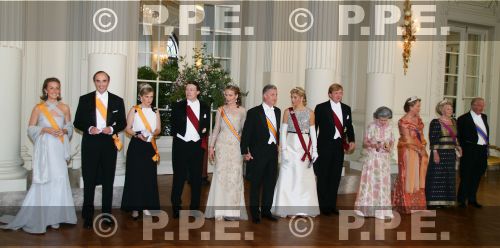
- ^ PPE group photo
- ^ Prince Constantijn wearing the order
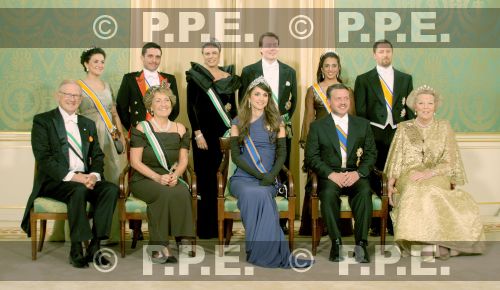
- ^ PPE Agency, Group photo
- ^ a b (in Dutch) Wapens van leden van het Koninklijk Huis, Dutch Royal House. Retrieved 2013-05-06.
External links
[edit]- Official page created by the Dutch Royal House (English version)
Prince Constantijn of the Netherlands
View on GrokipediaConstantijn Christof Frederik Aschwin, Prince of the Netherlands, Prince of Orange-Nassau, Jonkheer van Amsberg (born 11 October 1969 in Utrecht) is the third and youngest son of former Queen Beatrix and Prince Claus, and brother to King Willem-Alexander and the late Prince Friso.[1] Married to Princess Laurentien (Petra Laurentien Brinkhorst) since 17 May 2001, he is father to three children: Countess Eloise (born 2002), Count Claus-Casimir (born 2004), and Countess Leonore (born 2006).[1] The family resides in The Hague.[1]
Educated in law at Leiden University and business economics at INSEAD, Prince Constantijn pursued a career in strategy consulting and policy advising, including roles at the European Commission and RAND Europe.[1] Since 2016, he has served as Special Envoy for TechLeap.NL, promoting the Dutch startup ecosystem and innovation, co-founding events like Startup Fest Europe, and holding directorial positions at Macro Advisory Partners while contributing to initiatives such as the NATO Innovation Fund and the European Quantum Strategy Board.[1]
Early Life and Education
Birth and Upbringing
Prince Constantijn Christof Frederik Aschwin, Prince of the Netherlands, Prince of Orange-Nassau, Jonkheer van Amsberg, was born on 11 October 1969 at the University Medical Center Utrecht in Utrecht, Netherlands.[2][3] He is the third and youngest son of then-Princess Beatrix of the Netherlands (later Queen Beatrix from 1980 to 2013) and Prince Claus of the Netherlands, a German-born diplomat who married Beatrix in 1966.[1][4] His elder brothers are King Willem-Alexander, born in 1967, and Prince Johan Friso, born in 1968 and deceased in 2013 following a skiing accident.[3] Constantijn spent his early childhood at Drakensteyn Castle in Baarn, a residence used by the royal family for privacy and normalcy, where his mother and father emphasized a relatively ordinary upbringing despite their status.[3] Following Beatrix's accession to the throne on 30 April 1980 after Queen Juliana's abdication, the family relocated to Eikenhorst, an estate in Wassenaar near The Hague, to accommodate heightened security and official duties while maintaining proximity to public life.[1][3] This move reflected the Dutch royal tradition of balancing monarchical responsibilities with efforts to integrate the princes into mainstream society, including attendance at state-funded schools rather than isolated private institutions.[1]Academic Achievements
Prior to enrolling in university, Prince Constantijn spent the 1987–1988 academic year studying languages in France and Italy.[3] He began studying law at Leiden University following this preparatory period, earning a master's degree in civil law in 1995 with a specialization in civil law.[1][5] In 2000, he completed an MBA in business economics at the European Institute of Business Administration (INSEAD) in Fontainebleau, France.[1][5] In recognition of his contributions to promoting entrepreneurship and innovation, the University of Twente awarded him an honorary doctorate on May 12, 2022.[6]Professional Career
Initial Positions in Consulting and Research
Following the completion of his MBA at INSEAD in 1995, Prince Constantijn began his career in strategic consulting as a management consultant at Booz Allen & Hamilton in London.[1] In this capacity, he advised clients on management and technology strategies, marking his initial foray into private-sector consulting after earlier governmental advisory work.[7] He remained with the firm until late 2002.[8] In 2003, Prince Constantijn transitioned to research, joining RAND Europe as a policy researcher with a focus on information policy and economics.[1] Initially based in Leiden, he later worked in Brussels, where he advanced to lead research teams and, by 2008, headed the organization's newly established Brussels office.[9] [10] His tenure at RAND emphasized empirical policy analysis, including studies on European innovation and regulatory frameworks, before he departed in early 2010 to join the European Commission.[7]Role at the European Commission
Prince Constantijn served at the European Commission from 1995 to 1999 in the cabinet of Commissioner Hans van den Broek, who held responsibility for foreign affairs and enlargement.[11][12] In this role, he contributed to policy coordination on external relations during a period of EU expansion preparations, including the integration of Central and Eastern European countries.[13] He returned to the Commission in 2010, initially as an advisor, and subsequently became Head of Cabinet to Vice-President Neelie Kroes, who oversaw the Digital Agenda portfolio until 2014.[1][14] As Chief of Staff, he managed the cabinet's operations, coordinating policy development and implementation aimed at fostering a single digital market, enhancing broadband infrastructure, and promoting competition in telecommunications across the EU.[15][16] This involved advising on regulatory reforms to reduce barriers to digital innovation and supporting initiatives like the reform of EU telecom rules to encourage investment in high-speed networks.[17] The Digital Agenda prioritized measurable goals, such as achieving universal broadband coverage by 2013 and gigabit speeds in major cities by 2020, with Constantijn's team playing a key role in stakeholder engagement and legislative proposals.[15]Transition to Advisory Roles
Following the end of his tenure as Chief of Staff to European Commission Vice-President Neelie Kroes in 2014, Prince Constantijn transitioned from public sector roles to advisory positions in the private domain, concentrating on digital strategy, technological innovation, and macro-economic implications of emerging technologies.[7] This shift enabled him to apply his prior experience in policy research and EU affairs to corporate and strategic consulting.[1] In July 2015, he assumed the role of Edge Fellow at the Deloitte Centre for the Edge, where he contributed to initiatives exploring how organizations adapt to exponential technologies and networked economies.[15] Concurrently, Prince Constantijn joined Macro Advisory Partners as Director of Digital Technology and Macro Strategy, advising clients in London and New York on digital transformation, geopolitical risks associated with technology, and strategic positioning in global tech ecosystems.[18] These positions marked a deliberate move toward flexible, expertise-driven advisory work rather than fixed governmental or institutional commitments.[1] Through these roles, Prince Constantijn has emphasized practical guidance for businesses navigating regulatory, innovative, and competitive challenges in the digital sphere, drawing on his background without direct involvement in operational management.[11] His advisory contributions have included board-level input on technology policy and investment strategies, reflecting a focus on long-term economic resilience.[18]Advocacy for Innovation and Entrepreneurship
Establishment of Techleap and Startup Initiatives
In 2016, Prince Constantijn was appointed Special Envoy for StartupDelta, a Dutch government-backed initiative launched to accelerate the national startup ecosystem by addressing barriers to growth such as access to finance, talent, and international markets.[1] Under his leadership, StartupDelta organized trade missions, quantified ecosystem metrics, and facilitated events like StartupFest Europe, which he co-founded and which remains the largest startup event hosted in the Netherlands.[15] The program emphasized scaling promising ventures, with Constantijn advocating for policy reforms to position the Netherlands as a leading European tech hub.[19] By mid-2019, StartupDelta rebranded and expanded into TechLeap.NL, effective from July 1, reflecting a strategic shift toward deeper knowledge development, new scaling programs, and a focus on creating "unicorn" companies—startups valued at over $1 billion.[20] Prince Constantijn, recognized as a co-founder of TechLeap, continued as Special Envoy, directing efforts to build pillars for founder growth, including international showcases such as sending 50 Dutch startups to CES 2020.[5][21] TechLeap operates as a non-profit, publicly funded accelerator, prioritizing data-driven interventions over broad subsidies to foster sustainable ecosystem expansion.[22] Key initiatives under TechLeap include the Rise program, which selects and supports high-potential scaleups through mentorship, investor matchmaking, and global exposure, aiming to retain Dutch talent amid competition from larger markets.[23] Constantijn's involvement has emphasized evidence-based advocacy, such as lobbying for improved venture capital flows and regulatory adjustments, while critiquing over-reliance on government funding in favor of private-sector dynamism. These efforts have contributed to measurable growth, with the Dutch ecosystem producing multiple unicorns like Adyen and Takeaway.com during this period, though challenges persist in areas like follow-on funding.[19]Leadership in Tech Events and Funds
Prince Constantijn co-founded TechLeap.NL in 2016, initially as StartupDelta, and has served as its Special Envoy to accelerate the Dutch tech ecosystem by improving access to capital, talent, markets, and regulatory support for startups and scaleups.[1][24] Under his leadership, TechLeap has organized scaling programs, matchmaking events, and policy advocacy, contributing to the growth of over 1,000 Dutch tech companies, with a focus on sectors like AI, cybersecurity, and sustainability.[15][5] In tech events, he co-initiated Startup Fest Europe in 2015, a five-day festival across Amsterdam that drew over 20,000 attendees and remains the largest startup event in Dutch history, fostering networking between entrepreneurs, investors, and policymakers.[1] He has led annual Dutch delegations to the Consumer Electronics Show (CES) since 2016, showcasing up to 70 companies per year and securing partnerships that boosted Dutch tech exports, such as opening the Netherlands Pavilion at CES 2024 with a focus on sustainable innovations.[25][26] Additionally, he has keynoted at events like the RSA Conference 2023, opening the Dutch cybersecurity pavilion to highlight national strengths in secure digital infrastructure.[27] Regarding funds, Prince Constantijn serves on the board of the €20 billion National Growth Fund, established in 2020 to invest in frontier technologies including semiconductors, quantum computing, and health tech, with allocations exceeding €5 billion by 2023 directed toward innovation clusters.[5] Through TechLeap, he has advocated for venture capital reforms, noting that Dutch startups face hurdles in scaling due to limited domestic funding compared to the U.S., where 55% of startups reach scaleup status versus lower rates in Europe.[28] His efforts emphasize public-private partnerships to bridge funding gaps without direct management of private investment vehicles.Recent Developments in Policy and Investment
In June 2024, Prince Constantijn voiced apprehension regarding Europe's emphasis on regulating artificial intelligence over fostering innovation, warning that data restrictions and regulatory burdens could leave the continent trailing the United States and China in AI leadership.[29][30] He advocated for policies that prioritize technological advancement alongside safeguards, drawing from his prior experience in EU digital strategy roles. By March 2025, as Special Envoy for TechLeap.nl, Constantijn highlighted the Netherlands' marginal involvement in AI development, attributing it to difficulties in retaining U.S. investors and attracting global businesses to hubs like Amsterdam amid competitive shifts.[31] This aligned with TechLeap's broader push for deregulation, as Dutch venture capital inflows to tech firms rose 47% to €3.1 billion in 2024 despite persistent regulatory complaints from entrepreneurs.[32] In September 2025, the Dutch cabinet introduced an action agenda to bolster startups and scale-ups, extending TechLeap's incentive programs by three years, enhancing risk-bearing capital availability, and introducing tax incentives—initiatives reflecting Constantijn's longstanding advocacy for ecosystem strengthening.[33][34] Concurrently, TechLeap scaleups in its network secured €920 million in funding, supporting employment for 26,000 workers across innovative sectors.[24] Constantijn maintains oversight roles in key investment vehicles, including the board of the €20 billion National Growth Fund, which allocates resources to frontier technologies such as quantum computing and cybersecurity.[5] He also participates in the NATO Innovation Fund, focusing on defense-related tech scaling. In October 2025, he emphasized the critical role of international founders in Dutch innovation during the tenth anniversary of the Startup Visa program, which has facilitated global talent influx to counter domestic skill shortages.[35] These efforts coincide with Dutch tech firms raising €1.5 billion in the first half of 2025 alone, signaling tentative recovery amid policy reforms.[36]Royal Duties and Public Engagements
Limited Official Monarchical Responsibilities
Prince Constantijn, as the youngest brother of King Willem-Alexander and fourth in line to the Dutch throne, performs only a minimal set of official duties within the monarchy, prioritizing his independent career in innovation and advisory roles over full-time royal engagements.[37] Unlike the monarch and immediate heirs, who handle state representation, legislative approvals, and frequent ceremonial obligations, Constantijn's responsibilities are largely confined to occasional attendance at major national events, such as Prinsjesdag (the annual state opening of Parliament) and King's Day celebrations, where he appears alongside family members without leading protocols.[3][38] These limited tasks include representing the Royal House at family-linked ceremonies, including weddings, funerals, investitures, and award presentations tied to the Prince Claus Fund—established in memory of his father, Prince Claus—which he has addressed in official speeches, such as those on December 11, 2013, and December 7, 2022.[3][39][40] He rarely participates in public events explicitly in his royal capacity, reflecting the Dutch monarchy's structure that allows non-core members greater personal freedom and does not assign him a state apanage for duties, as this allowance is reserved for those with substantive official roles.[37] This arrangement aligns with the constitutional emphasis on the sovereign's direct involvement in governance, leaving peripheral royals like Constantijn to support the institution symbolically rather than operationally.[41]Key Speeches and Advocacy Positions
Prince Constantijn has delivered speeches emphasizing the preservation of cultural heritage during crises, underscoring the need for rapid intervention to complement humanitarian efforts. In a March 7, 2008, address at the TEFAF fair in Maastricht, he advocated for the Cultural Emergency Response initiative, arguing that swift stabilization of cultural sites rebuilds community identity, prevents irreversible historical loss, and aligns with broader recovery goals, citing examples such as the Baghdad Library and Afghan synagogues.[42] He has highlighted the societal value of humour and satire as tools for challenging authority and promoting freedom. During the Prince Claus Prize presentation on December 7, 2005, in Amsterdam, Constantijn praised the laureate Jonathan Shapiro (Zapiro) for using cartoons to address apartheid and global injustices, distinguishing constructive satire—which fosters dialogue and self-reflection—from exclusionary forms, and noting its particular relevance in serious times like post-WWII Europe or contemporary Dutch discourse.[43] In discussions on journalism and truth, he has called for diverse perspectives to counter bias. At the World Press Photo exhibition on May 16, 2025, in Amsterdam, Constantijn stressed building a transparent system for verifying truth amid digital disruptions like AI, urging the organization to maintain principled standards against political pressures while supporting vulnerable photojournalists facing budget cuts and censorship.[44] Constantijn has positioned technology as essential for addressing global challenges like poverty. In a June 30, 2011, speech opening the renovated ECDPM building in Maastricht, he asserted that technological applications, combined with cultural shifts, are indispensable for development, reflecting broader advocacy for innovation in international policy contexts.[45]Perspectives on Migration, Technology, and Society
Prince Constantijn has articulated a nuanced perspective on migration, recognizing its capacity to either enrich or impoverish societies depending on management and integration efforts. In a November 2007 speech, he stated that "migration enriches or impoverishes society" and emphasized the choice between fostering dialogue and interaction or allowing polarization, underscoring the need for proactive societal responses to mitigate tensions.[46] Earlier that year, in a March 2007 address, he identified migration as one of several policy areas—alongside counterterrorism, environment, and foreign policy—where public expectations lean toward stronger European Union coordination to address cross-border challenges effectively.[47] His involvement as chairman of The Hague Process on Refugees and Migration further reflects engagement with global migration governance, including contributions to projects like Global Migration Futures that explore future demographic trends and policy implications.[48][49] In the intersection of migration and technology, Constantijn advocates for facilitating skilled immigration to bolster innovation ecosystems. During a 2017 discussion with Dutch parliamentary committees, he addressed migratory pathways for startups and innovative entrepreneurs, highlighting barriers to attracting international talent essential for technological advancement.[50] He has noted structural challenges, including migration policies, that hinder entrepreneurial growth in Europe compared to more dynamic regions, as discussed in a 2019 fireside chat where fiscality, migration, and cultural entrenchment were cited as obstacles to scaling tech ventures. This pragmatic stance aligns with his broader efforts to position the Netherlands as a hub for high-skilled migrants in tech, participating in forums like the 2008 migration business forum in the Philippines to explore economic dimensions of population movements.[51] Regarding technology's role in society, Constantijn views it as a cornerstone of progress, praising the Netherlands' "enterprising and commercial spirit" and "open society" as enablers of innovation in a 2007 speech that credited these traits for technological prowess.[47] As special envoy for Techleap.nl, he promotes policies to cultivate a "unicorn nation" through ecosystem connectivity, frontier tech investments via the €20 billion National Growth Fund, and initiatives like Startup Fest Europe, emphasizing technology's potential to drive economic resilience and societal benefits.[5] His advisory roles, including at the European Innovation Council, focus on digital strategy and macro policy, advocating for reduced regulatory hurdles to foster startups that address societal needs, such as in AI and sustainable tech.[15] Constantijn cautions against complacency, urging adaptations to global competition, as evidenced in 2023-2025 interviews where he stressed scaling Dutch tech amid international pressures like U.S. tariffs and talent mobility.[52][53] This reflects a causal view that technological leadership requires societal openness to innovation, balanced against risks like over-regulation or insufficient talent inflows.Personal Life
Marriage and Partnership
Petra Laurentien Brinkhorst was born on 25 May 1966 in Leiden to Laurens Jan Brinkhorst, a Dutch politician who served as Minister of Housing, Spatial Planning and the Environment and as a Member of the European Parliament, and Jantien Brinkhorst-Heringa.[54] She completed secondary education in The Hague and at the Lycée Français in Tokyo, earning a Baccalauréat A diploma, before studying history at the University of Groningen, where she finished her foundation year in 1986. Laurentien subsequently obtained a Bachelor of Arts in political science from Queen Mary College at the University of London in 1989 and a Master of Journalism from the University of California, Berkeley in 1991.[54] Prince Constantijn and Laurentien's engagement was announced on 16 December 2000.[55] They married in a civil ceremony on 17 May 2001 in The Hague, conducted by the city's mayor, followed by a religious blessing on 19 May 2001 in the Grote of St. Jacobskerk.[54][1] The couple resides in The Hague and maintains a partnership in philanthropic endeavors, notably co-founding the Number 5 Foundation in 2017 to promote innovative solutions for social challenges such as poverty and inequality.[1] Laurentien has focused her professional efforts on issues including literacy, dyslexia awareness, and sustainable development, while supporting Constantijn's advocacy in technology and entrepreneurship.[54]Children and Family Dynamics
Prince Constantijn and Princess Laurentien have three children: Countess Eloise of Orange-Nassau (Eloise Beatrix Sophie Laurence, born 8 June 2002), Count Claus-Casimir of Orange-Nassau (Claus Casimir Bernhard Frederik Rudolf, born 21 March 2004), and Countess Leonore of Orange-Nassau (Leonore Clare Alice, born 3 June 2006).[1][2] The children hold the predicate jonkheer or jonkvrouw van Amsberg and are members of the Royal House, retaining positions in the line of succession to the Dutch throne.[56][57] The family resides in The Hague, prioritizing a private upbringing shielded from intensive media scrutiny through media agreements that limit coverage to occasional photo opportunities.[58][59] The children attend state schools to foster independence and normalcy, aligning with the broader Dutch royal approach to education.[59] Eloise completed secondary education at Maerlant Lyceum in The Hague in 2020 before studying hospitality management at Hotelschool The Hague, from which she graduated in March 2025.[60][61] Claus-Casimir is pursuing a business degree at the University of Turin in Italy.[62] Family dynamics emphasize educational engagement and literacy, influenced by Princess Laurentien's advocacy against illiteracy; the parents jointly participated in the National Voorleesdagen event on 7 January 2025, reading a children's book about a young rhinoceros to promote early reading habits.[63] Public appearances involving the children remain rare, reflecting a deliberate balance between royal heritage and personal autonomy, with the siblings occasionally joining their parents at low-key family-oriented events.[64]Position in Line of Succession
Prince Constantijn holds the fourth position in the line of succession to the Dutch throne, immediately following the three daughters of his elder brother, King Willem-Alexander: Catharina-Amalia, Princess of Orange (born 7 December 2003), Princess Alexia (born 26 June 2005), and Princess Ariane (born 10 April 2007).[65][66] This placement stems from the exclusion of the line descending from the late Prince Johan Friso, the second son of former Queen Beatrix, who forfeited his succession rights upon marrying Mabel Wisse Smit in 2004 without prior approval from the Dutch parliament as required by Article 28 of the Constitution and the Act of Succession.[67] Friso's daughters, Joanna and Luisa, thus remain ineligible, shifting the succession to Constantijn as the next eligible sibling.[65] The Dutch succession operates under absolute primogeniture, enshrined in the 1983 amendment to the Act of Succession, granting equal rights to male and female heirs by order of birth, provided they meet criteria including Dutch nationality, adherence to the Reformed faith (though not strictly enforced), and kinship no further than three degrees from the monarch.[67] Constantijn's own children—Countess Eloise (born 2 July 2002), Count Claus-Casimir (born 21 March 2004), and Countess Josephine (born 12 June 2005)—follow him in the line (positions 5 through 7), remaining eligible while King Willem-Alexander reigns, as their kinship falls within the three-degree limit relative to the current monarch.[68][66] Should Catharina-Amalia ascend, Constantijn and his descendants would be displaced beyond the three-degree threshold unless reinstated by parliamentary act.[67]Honours and Distinctions
Dutch National Honours
Prince Constantijn holds the dignity of Knight Grand Cross (Ridder Grootkruis) in the Order of the Netherlands Lion (Orde van de Nederlandse Leeuw), the Kingdom's oldest and most prestigious chivalric order, instituted on 29 September 1815 by King William I to recognize exceptional merit, particularly among royalty, heads of state, and select high officials.[69] This rank is reserved for members of the Dutch royal house, reflecting his position as the third son of former Queen Beatrix.[70] He routinely wears the insignia associated with this honour during formal state events, including the button (bouton or knoop) of the Grand Cross on his attire for Prinsjesdag addresses to the States General.[70][71] No public records indicate conferral of additional Dutch national orders, such as the Order of Orange-Nassau, which is more commonly awarded to non-royal recipients for civil or military service.[69]International Awards and Recognitions
Prince Constantijn has received foreign orders of chivalry as diplomatic recognitions during official engagements with other monarchies. These awards reflect standard protocols for royal family members participating in state visits, emphasizing mutual respect between nations rather than individual achievements. From Belgium, he holds the Grand Cross of the Order of the Crown, which he has worn at subsequent events such as the 2016 Belgian state visit to the Netherlands.[72] From France, he was appointed Grand Officer of the Order of the Legion of Honour in connection with the 2023 French state visit.[73] From Jordan, he received the Grand Cordon of the Supreme Order of the Renaissance, one of the kingdom's highest honors, alongside family members during interactions with the Jordanian royal family.[74]Heraldic Elements
Prince Constantijn employs a coat of arms derived from the national arms of the Netherlands, quartered with the historic arms of the House of Orange and differenced with an escutcheon of pretence bearing the arms of his father's house, Amsberg—gules, two towers argent. This design distinguishes the arms of Princess Beatrix's sons, including Constantijn, from the sovereign's version.[75] His personal standard is a square orange flag divided into four quarters by a Nassau blue cross, with the arms of the Kingdom surmounted by a crown at the center. The upper left and lower right quarters display the bugle-horn from the House of Orange, while the upper right and lower left quarters feature the white castles from the Van Amsberg arms. This standard, also used by his brothers prior to King Willem-Alexander's accession, is flown during official visits on vehicles, aircraft, or residences.[76] The royal monogram of Prince Constantijn consists of his initials "CC" intertwined beneath a heraldic crown of the Netherlands, symbolizing his position in the House of Orange-Nassau.[77]Ancestral Background
Paternal Lineage
Prince Constantijn's paternal lineage derives from the German noble family von Amsberg, through his father, Prince Claus of the Netherlands, born Klaus-Georg Wilhelm Otto Friedrich Gerd von Amsberg on 6 September 1926 at Schloss Dötzingen in Hitzacker, Lower Saxony.[78] Prince Claus, who died on 6 October 2002, was the second child and only son of seven siblings.[79] Prince Claus's father, Claus Felix Friedrich Leopold Gabriel Archim Julius von Amsberg, was born on 1 September 1890 in Rehna, Mecklenburg-Schwerin, and died on 19 December 1953 in Jasebeck, Germany.[80] Claus Felix, a member of the untitled German nobility, managed a paper mill in Tanganyika (present-day Tanzania) during the interwar period, where the family resided for several years before returning to Germany ahead of World War II.[81] His own parents were Wilhelm Carl Friedrich August Louis von Amsberg (1856–1929), a landowner from the Mecklenburg region, and Elise Hedwig Alexandrine von Vieregge (1866–1951).[82][83] The von Amsberg family, part of the Junker class of lesser nobility in northern Germany, held estates in areas such as Lower Saxony and Mecklenburg, with involvement in agriculture, forestry, and industry.[84] Wilhelm von Amsberg's father was Gabriel Ludwig Johann von Amsberg (1823–1889), continuing the male line in the region's patrician and noble circles.[85] This lineage introduced non-sovereign German aristocratic heritage into the Dutch royal family upon Prince Claus's marriage to then-Princess Beatrix on 10 March 1966.[86]Maternal Lineage
Prince Constantijn's direct maternal lineage descends through a series of Dutch queens, originating from German nobility in the 19th century. His mother, Princess Beatrix, born on 31 January 1938, ascended the throne as Queen of the Netherlands on 30 April 1980 following her own mother's abdication, reigning until 30 April 2013.[87] Beatrix's upbringing emphasized education and public service, reflecting the stable monarchical tradition upheld by her forebears. Beatrix's mother, Queen Juliana, born 30 April 1909 in The Hague and reigning from 4 September 1948 to 30 April 1980, was the only child of Queen Wilhelmina and thus the sole heir in her generation.[87] [88] Juliana's early life included exile in Canada during World War II, underscoring the lineage's resilience amid geopolitical upheavals. Juliana's mother, Queen Wilhelmina, born 31 August 1880 in The Hague and reigning from 6 September 1890 to 4 September 1948—the longest in Dutch history—was the only surviving child of King William III and Queen Emma of Waldeck and Pyrmont.[89] Wilhelmina's regency under her mother Emma from age ten until 1898 marked a pivotal stabilization of the monarchy after her father's death. Emma, born 2 August 1858 in Arolsen, served as queen consort from 1879 and regent until 1898, hailing from the minor German principality of Waldeck and Pyrmont; her own mother, Princess Helena of Nassau (1831–1888), linked the line to the House of Nassau-Weilburg, a branch with ties to earlier European houses including Württemberg.[90] [89] This maternal chain thus bridges Dutch sovereignty with modest German princely origins, devoid of the broader Orange-Nassau paternal expansions.References
- https://commons.wikimedia.org/wiki/File:Royal_Monogram_of_Prince_Constantijn_of_the_Netherlands.svg