
.jpeg/250px-Zijne_Majesteit_Koning_Willem-Alexander_met_koningsmantel_april_2013_(cropped).jpeg)


.jpeg)
Community hub
Recent from talks
Contribute something
Nothing was collected or created yet.
Willem-Alexander of the Netherlands
View on Wikipedia
Key Information

.jpeg)

| Dutch royal family |
 |
|
|
| * Member of the Dutch royal house |
Willem-Alexander (Dutch: [ˈʋɪləm aːlɛkˈsɑndər]; Willem-Alexander Claus George Ferdinand; born 27 April 1967) is King of the Netherlands.
Willem-Alexander was born in Utrecht during the reign of his maternal grandmother, Queen Juliana, as the eldest child of Princess Beatrix (later Queen) and Prince Claus. He became Prince of Orange as heir apparent upon his mother's accession on 30 April 1980. He went to public primary and secondary schools in the Netherlands, and an international sixth-form college in Wales. He served in the Royal Netherlands Navy, and studied history at Leiden University. He married Máxima Zorreguieta Cerruti in 2002, and they have three daughters: Catharina-Amalia, Alexia, and Ariane. Willem-Alexander succeeded his mother as monarch upon her abdication on 30 April 2013. He is the first man to hold this position since the death of his great-great-grandfather William III in 1890, as the intervening three monarchs—his great-grandmother Wilhelmina, his grandmother Juliana and his mother Beatrix—had all been women.
Willem-Alexander is interested in sports and international water management issues. Until his accession to the throne, he was a member of the International Olympic Committee (1998–2013),[1] chairman of the Advisory Committee on Water to the Dutch Minister of Infrastructure and the Environment (2004–2013),[2] and chairman of the Secretary-General of the United Nations' Advisory Board on Water and Sanitation (2006–2013).[3][4]
Early life and education
[edit]
Willem-Alexander was born on 27 April 1967 at Academic Hospital Utrecht (now known as the University Medical Center Utrecht) in Utrecht. He is the first child of Princess Beatrix (later Queen) and Prince Claus,[5] and the first grandchild of Queen Juliana and Prince Bernhard. He was the first male Dutch royal baby since the birth of Prince Alexander in 1851, and the first immediate male heir since Alexander's death in 1884.
From birth, Willem-Alexander has held the titles Prince of the Netherlands (Dutch: Prins der Nederlanden), Prince of Orange-Nassau, and Jonkheer of Amsberg.[5] He was baptised as a member of the Dutch Reformed Church[6] on 2 September 1967[7] in Saint Jacob's Church in The Hague.[8] His godparents are his maternal grandfather Prince Bernhard of Lippe-Biesterfeld, his paternal grandmother Gösta Freiin von dem Bussche-Haddenhausen, Prince Ferdinand von Bismarck, former Prime Minister Jelle Zijlstra, Jonkvrouw Renée Röell, and Queen Margrethe II.[7]
He had two younger brothers: Prince Friso (1968–2013) and Prince Constantijn (b. 1969). He lived with his family at the castle Drakensteyn in the hamlet Lage Vuursche near Baarn from his birth until 1981, when they moved to the larger palace Huis ten Bosch in The Hague. His mother, Beatrix, became Queen of the Netherlands in 1980, after his grandmother Juliana abdicated. He then received the title of Prince of Orange as heir apparent to the throne of the Kingdom of the Netherlands at the age of 13.[5]
Willem-Alexander attended local state primary school Nieuwe Baarnse Elementary School in Baarn from 1973 to 1979. He went to two different state secondary schools (the Baarns Lyceum in Baarn from 1979 to 1981 and the Eerste Vrijzinnig Christelijk Lyceum in The Hague from 1981 to 1983) and the private sixth-form college United World College of the Atlantic in Wales (1983 to 1985), where he received his International Baccalaureate.[5][9]
After his military service from 1985 to 1987, Willem-Alexander studied history at Leiden University from 1987 onwards and received his Master of Arts degree (doctorandus) in 1993.[10][11] His final thesis was on the Dutch response to France's decision under President Charles de Gaulle to leave NATO's integrated command structure.[5]
Willem-Alexander speaks English, Spanish, French, and German (his father's native language) in addition to his native Dutch.[12]
Military training and career
[edit]
Between secondary school and his university education, Willem-Alexander performed military service in the Royal Netherlands Navy from August 1985 until January 1987. He received his training at the Royal Netherlands Naval College and in the frigates HNLMS Tromp and HNLMS Abraham Crijnssen, where he was an ensign. In 1988 he received additional training in the ship HNLMS Van Kinsbergen and became a lieutenant (junior grade) (wachtofficier).[13]
As a reservist for the Royal Netherlands Navy, Willem-Alexander was promoted to lieutenant commander in 1995, commander in 1997, Captain at Sea in 2001, and commodore in 2005. As a reservist for the Royal Netherlands Army, he was made a major (Grenadiers' and Rifles Guard Regiment) in 1995, and was promoted to lieutenant colonel in 1997, colonel in 2001, and brigadier general in 2005. As a reservist for the Royal Netherlands Air Force, he was made squadron leader in 1995 and promoted to air commodore in 2005. As a reservist for the Royal Marechaussee, he was made brigadier general in 2005.[9]
Before his investiture as king in 2013, Willem-Alexander was honourably discharged from the armed forces. The government declared that the head of state cannot be a serving member of the armed forces, since the government itself holds supreme command over the armed forces. As king, Willem-Alexander may choose to wear a military uniform with royal insignia, but not with his former rank insignia.[14]
Activities and social interests
[edit]
Since 1985, when he became 18 years old, Willem-Alexander has been a member of the Council of State of the Netherlands. This is the highest council of the Dutch political system and is chaired by the head of state (then Queen Beatrix).[15]
Willem-Alexander is interested in water management and sports issues. He was an honorary member of the World Commission on Water for the 21st century and patron of the Global Water Partnership, a body established by the World Bank, the UN, and the Swedish Ministry of Development. He was appointed as the Chairperson of the United Nations Secretary General's Advisory Board on Water and Sanitation on 12 December 2006.[16]
On 10 October 2010, Willem-Alexander and Máxima went to the Netherlands Antilles' capital, Willemstad, to attend and represent his mother, the Queen, at the Antillean Dissolution ceremony.
He was a patron of the Dutch Olympic Games Committee until 1998 when he was made a member of the International Olympic Committee (IOC). After becoming King, he relinquished his membership and received the Gold Olympic Order at the 125th IOC Session.[17] To celebrate the 100th anniversary of the 1928 Summer Olympics held in Amsterdam, he had expressed support to bid for the 2028 Summer Olympics.[18]
He was a member of the supervisory board of De Nederlandsche Bank (the Dutch central bank), a member of the Advisory Council of ECP (the information society forum for government, business and civil society), patron of Veterans' Day and held several other patronages and posts.[19]
Reign
[edit].jpeg)
On 28 January 2013, Beatrix announced her intention to abdicate. On the morning of 30 April 2013 (Koninginnedag), Beatrix signed the instrument of abdication at the Moseszaal (Moses Hall) at the Royal Palace of Amsterdam. Later that afternoon, Willem-Alexander was inaugurated as king before a joint session of the States General in a ceremony held at the Nieuwe Kerk.
As king, Willem-Alexander has weekly meetings with the prime minister and speaks regularly with ministers and state secretaries. He also signs all new Acts of Parliament and royal decrees. He represents the kingdom at home and abroad. At the State Opening of Parliament, he delivers the Speech from the Throne, which announces the plans of the government for the parliamentary year. The Constitution requires that the king appoint, dismiss and swear in all government ministers and state secretaries. As king, he is also the President of the Council of State, an advisory body that reviews proposed legislation. In modern practice, the monarch seldom chairs council meetings.[20]
At his accession at age 46, he was Europe's youngest monarch; one of the current youngest monarch in Europe, alongside Frederik X of Denmark, Felipe VI of Spain and Guillaume V of Luxembourg. He is also the first male monarch of the Netherlands since the death of his great-great-grandfather William III in 1890. Willem-Alexander was one of four new sovereign monarchs in 2013 along with Pope Francis, Emir Tamim bin Hamad Al Thani of Qatar, and King Philippe of Belgium.
Other activities
[edit]
Willem-Alexander is an avid pilot and has said that, had he not been a royal, he would have chosen a career as an airline pilot, ideally flying large aircraft such as the Boeing 747.[21] During his mother's reign, he regularly flew the Dutch royal aircraft on trips.[22]
Willem-Alexander revealed in May 2017 that he had quietly been working as a first officer with KLM since the 1990s, flying Fokker 70s for KLM Cityhopper twice a month, even after becoming king. He said he is rarely recognized while in uniform, although some passengers recognized his voice when he made announcements, despite never introducing himself by name.[21][23] Following the retirement of the Fokker 70, he transitioned to the Boeing 737, and in 2025 transitioned to the Airbus A321neo.[21][24]
Using the name "W. A. van Buren", one of the least-known titles of the House of Orange-Nassau, he completed the 1986 Frisian Elfstedentocht, a 200-kilometre-long (120 mi) distance ice skating tour.[25] He ran the full New York City Marathon under the same pseudonym in 1992.[26]
Marriage and children
[edit]
On 2 February 2002, he married Máxima Zorreguieta[27][28][29] at the Nieuwe Kerk in Amsterdam. The marriage triggered significant controversy due to the role the bride's father, Jorge Zorreguieta, had in the Argentinian military dictatorship. The couple have three daughters: The Princess of Orange, Princess Alexia, and Princess Ariane.

| Name | Date of birth | Place of birth | Age |
|---|---|---|---|
| Catharina-Amalia, Princess of Orange | 7 December 2003 | The Hague, Netherlands | 21 |
| Princess Alexia of the Netherlands | 26 June 2005 | The Hague, Netherlands | 20 |
| Princess Ariane of the Netherlands | 10 April 2007 | The Hague, Netherlands | 18 |
Privacy and the press
[edit]In an attempt to strike a balance between privacy for the royal family and availability to the press, the Netherlands Government Information Service (RVD) instituted a media code on 21 June 2005 which essentially states that:[30]
- Photographs of the members of the royal house while performing their duties are always permitted.
- For other occasions (like holidays or vacations), the RVD will arrange a photo-op on condition that the press leave the family alone for the rest of the activity.
During a ski vacation in Argentina, several photographs were taken of the prince and his family during the private part of their holiday, including one by Associated Press staff photographer Natacha Pisarenko, in spite of the media code, and after a photo opportunity had been provided earlier.[31] The Associated Press decided to publish some of the photos, which were subsequently republished by several Dutch media. Willem-Alexander and the RVD jointly filed suit against the Associated Press on 5 August 2009, and the trial started on 14 August 2009 at the district court in Amsterdam. On 28 August 2009, the district court ruled in favour of the prince and RVD, citing that the couple has a right to privacy, that the pictures in question add nothing to any public debate, and that they are not of any particular value to society since they are not photographs of his family "at work". Associated Press was sentenced to stop further publication of the photographs, on pain of a €1,000 fine per violation with a €50,000 maximum.[32]
In October 2020, Willem-Alexander apologised for a family holiday trip to Greece which had taken place while his country was under partial lockdown during the COVID-19 pandemic.[33] He and his family cut their trip short, and in a two-minute video he stated that it "hurts to have betrayed" people's trust.[33] Earlier in August 2020, he and his wife were photographed with a restaurant owner during another trip to Greece, which was a violation of social distancing rules at the time.[33]
Properties
[edit]From 2003 until 2019, Willem-Alexander and his family lived in Villa Eikenhorst on the De Horsten Estate in Wassenaar.[34] After his mother abdicated and became Princess Beatrix once again, she moved to the castle of Drakensteyn, after which the King and his family moved to the newly renovated monarch's palace of Huis ten Bosch in The Hague in 2019.[35]
Willem-Alexander has a villa near Kranidi, Greece.[36]
Villa in Machangulo
[edit]On 10 July 2008, the Prince of Orange and Princess Máxima announced that they had invested in a development project on the Mozambican peninsula of Machangulo.[37] The development project was aimed at building an ecologically responsible vacation resort, including a hotel and several luxury holiday homes for investors. The project was to invest heavily in the local economy of the peninsula (building schools and a local clinic) with an eye both towards responsible sustainability and maintaining a local staff.[38] After contacting Mozambican President Armando Guebuza to verify that the Mozambican government had no objections, the couple decided to invest in two villas.[39] In 2009, controversy erupted in parliament and the press about the project and the prince's involvement.[39] Politician Alexander Pechtold questioned the morality of building such a resort in a poor country like Mozambique. After public and parliamentary controversy, the royal couple announced that they had decided to sell the property in Machangulo once their house was completed.[40] In January 2012, it was confirmed that the villa had been sold.[41]
Titles, styles, honours and arms
[edit]Titles and styles
[edit]- 27 April 1967 – 30 April 1980: His Royal Highness Prince Willem-Alexander of the Netherlands, Prince of Orange-Nassau, Jonkheer van Amsberg
- 30 April 1980 – 30 April 2013: His Royal Highness The Prince of Orange
- 30 April 2013 – present: His Majesty The King[42]
Willem-Alexander's full title is: His Majesty King Willem-Alexander, King of the Netherlands, Prince of Orange-Nassau, etc., etc., etc.[42]
Willem-Alexander is the first Dutch king since Willem III (d. 1890). Willem-Alexander had earlier indicated that when he became king, he would take the name Willem IV,[43] but it was announced in January 2013 that his regnal name would be Willem-Alexander.[44]
Military ranks
[edit]

Royal Netherlands Navy
[edit] Lieutenant at sea third class - conscripted (Ensign) (August 1985 – January 1987)
 Lieutenant at sea second class - conscripted (Sub-lieutenant) (watch officer, 1988)
 Lieutenant at sea second class, senior grade - reserve (Lieutenant) (1988–1995)
 Lieutenant at sea first class - reserve (Lieutenant Commander) (1995–1997)
 Captain-lieutenant at sea - reserve(Commander) (1997–2001)
 Captain at Sea - reserve (2001–2005)
 Commodore - reserve (2005–2013)
 King's insignia (2013–present)


Royal Netherlands Air Force
[edit] Squadron Leader - reserve (1995–2005)
 Air Commodore - reserve (2005–2013)
 King's insignia (2013–present)
.svg)
.svg)

Royal Netherlands Army
[edit] Major, Grenadiers' and Rifles Guard Regiment – reserve (1995–1997)
 Lieutenant colonel – reserve (1997–2001)
 Colonel – reserve (2001–2005)
 Brigadier general – reserve (2005–2013)
 King's insignia (2013–present)


Royal Marechaussee
[edit] Brigadier general – reserve (2005–2013)
 Royal insignia[45] (2013–present)


Qualifications
[edit]
Honours
[edit]Willem-Alexander has been awarded with the following distinctions:[46]
National
[edit] Grand Master of the Military William Order (since 30 April 2013)
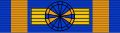 Grand Master of the Order of the Netherlands Lion (since 30 April 2013; Knight Grand Cross, 1985 – 2013)[a]
 Grand Master of the Order of Orange-Nassau (since 30 April 2013)
 Co-Grand Master of the Order of the Gold Lion of the House of Nassau (since 30 April 2013; Knight, 1967 – 2013)[b]
 Grand Master of the Order of the House of Orange (since 30 April 2013)
 Recipient of the Officer Long Service Cross, with "XXV" insignia (6 December 2011)[c]
 Recipient of the Queen Beatrix Inauguration Medal (30 April 1980)
 Recipient of the Wedding Medal of Willem-Alexander and Máxima Zorreguieta (2 February 2002)
 Recipient of the King Willem-Alexander Inauguration Medal (30 April 2013)
 Honorary Commander of the Order of Saint John in the Netherlands (since 2013)[52][53]
 Recipient of the Eleven Cities Cross (26 February 1986)[54][55]


Foreign
[edit] Argentina: Collar of the Order of the Liberator General San Martín[56]
 Austria: Grand Star of the Decoration of Honour for Services to the Republic of Austria
 Belgium:
- Grand Cordon of the Order of Leopold (2016)
- Grand Cross of the Order of the Crown (1993)
 Brazil: Grand Cross of the National Order of the Southern Cross
 Brunei: Honorary Member 1st Class (with Collar) of the Family Order of Laila Utama
 Cape Verde: Member 1st Class of the Order of Amílcar Cabral (7 December 2018)[57]
 Chile: Grand Cross of the Order of the Merit
 Cyprus: Grand Collar of the Order of Makarios III (4 March 2025)
 Czech Republic: Member 1st Class with Collar of the Order of the White Lion (4 June 2025)[58][59]
 Denmark: Knight of the Order of the Elephant (RE, 31 January 1998)[60]
 Estonia: Collar of the Order of the Cross of Terra Mariana (5 June 2018)[61][62][63]
 France:
- Grand Cross of the Order of the Legion of Honour (20 January 2014)[64]
- Grand Cross of the National Order of Merit
 Germany:
- Grand Cross 1st class of the Order of Merit of the Federal Republic of Germany[65][66][67]
- Grand Cross special class of the Order of Merit of the Federal Republic of Germany (5 July 2021)
 Greece: Grand Cross of the Order of the Redeemer (31 October 2022)
 Indonesia: Star of Mahaputera 1st Class
 Italy: Knight Grand Cross with Collar of the Order of Merit of the Italian Republic (19 June 2017)[68]
 Japan: Collar of the Supreme Order of the Chrysanthemum (24 October 2014)[69]
 Jordan: Collar of the Order of al-Hussein bin Ali (20 March 2018)
 Latvia: Commander Grand Cross with Chain of the Order of the Three Stars (6 June 2018)[70]
 Lithuania: Order of Vytautas the Great with the Golden Chain (13 June 2018)[71]
 Luxembourg:
- Grand Cross of the Order of Adolphe of Nassau
- Grand Cross of the Order of the Oak Crown
 Mexico: Grand Cross of the Mexican Order of the Aztec Eagle (2009)
 Norway: Grand Cross with Collar of the Royal Norwegian Order of Saint Olav (GC, 1996; w/ collar, 2021)
 Oman:
Oman:
- Collar of the Order of Al Said (15 April 2025)
- Collar of the Grand Order of the Rennaissance (10 January 2012)[72][73]
 Poland: Grand Cross of the Order of the White Eagle (2014)
 Portugal:
- Grand Collar of the Order of Prince Henry (GCollH, 10 October 2017)[74]
- Grand Collar of the Order of Christ (GCol, 10 December 2024)
 Slovakia: Grand Cross of the Order of the White Double Cross (7 March 2023)[75]
 South Korea: Recipient of the Grand Order of Mugunghwa (12 December 2023)[76][77]
 Spain:
- Knight of the Collar of the Order of Charles III (26 March 2024)[78]
- Knight Grand Cross of the Order of Isabella the Catholic (GYC, 19 October 2001)[79]
 Sweden: Knight with Collar of the Order of the Seraphim (RSerafO, 1993; w/ collar, 2022)
 Thailand: Knight Grand Cordon of the Order of Chula Chom Klao[80]
 United Arab Emirates: Grand Cross of the Order of Union
 United Kingdom: Stranger Knight Companion of the Order of the Garter (KG, 23 October 2018)[81][82]
 Venezuela: Grand Cross of the Order of the Liberator


Awards
[edit]- International Olympic Committee: Recipient of the Gold Olympic Order[17] (8 September 2013)
Honorary appointment
[edit]- Aide-de-camp to Her Majesty The Queen (until 2013)
Arms
[edit]|
|
|


Ancestry
[edit]Through his father, a member of the House of Amsberg, he is descended from families of the lower German nobility, and through his mother, from several royal German–Dutch families such as the House of Lippe, Mecklenburg-Schwerin, the House of Orange-Nassau, Waldeck and Pyrmont, and the House of Hohenzollern. He is descended from the first king of the Netherlands, William I of the Netherlands, who was also a ruler in Luxembourg and several German states, and all subsequent Dutch monarchs.
Through his mother, Willem-Alexander also descends from Paul I of Russia and thus from German princess Catherine the Great and Swedish King Gustav I. Through his father, he is also descended from several Dutch–Flemish families who left the Low Countries during Spanish rule, such as the Berenbergs. His paternal great-great-grandfather Gabriel von Amsberg, a major-general of Mecklenburg, was recognized as noble as late as 1891, the family having adopted the "von" in 1795.[84][85]
Willem-Alexander is a descendant of King George II and, more relevant for his succession rights, of his granddaughter Princess Augusta of Great Britain. Under the British Act of Settlement, King Willem-Alexander temporarily forfeited his (distant) succession rights to the throne of the United Kingdom by marrying a Roman Catholic. This right has since been restored in 2015 under the Succession to the Crown Act 2013.[86]
Finally, Willem-Alexander is also a distant descendent of William the Silent, who is held to be the Father of the Nation in the Netherlands, since John William Friso, a great-great-grandson of William the Silent, is known to be a common ancestor to all current European monarchs.
| Ancestors of Willem-Alexander of the Netherlands | |||||||||||||||||||||||||||||||||||||||||||||||||||||||||||||||||||||||||||||||||||||||||||||||||||||||||||||||||||||||||||||||||||||||||||||||||||||||||||||||||||||||||||||||||||||||||||||||||||||||||||||||||||||||||||||||||||||||||||||||||||||||||||||||||||||||||||||||||||||||||
|---|---|---|---|---|---|---|---|---|---|---|---|---|---|---|---|---|---|---|---|---|---|---|---|---|---|---|---|---|---|---|---|---|---|---|---|---|---|---|---|---|---|---|---|---|---|---|---|---|---|---|---|---|---|---|---|---|---|---|---|---|---|---|---|---|---|---|---|---|---|---|---|---|---|---|---|---|---|---|---|---|---|---|---|---|---|---|---|---|---|---|---|---|---|---|---|---|---|---|---|---|---|---|---|---|---|---|---|---|---|---|---|---|---|---|---|---|---|---|---|---|---|---|---|---|---|---|---|---|---|---|---|---|---|---|---|---|---|---|---|---|---|---|---|---|---|---|---|---|---|---|---|---|---|---|---|---|---|---|---|---|---|---|---|---|---|---|---|---|---|---|---|---|---|---|---|---|---|---|---|---|---|---|---|---|---|---|---|---|---|---|---|---|---|---|---|---|---|---|---|---|---|---|---|---|---|---|---|---|---|---|---|---|---|---|---|---|---|---|---|---|---|---|---|---|---|---|---|---|---|---|---|---|---|---|---|---|---|---|---|---|---|---|---|---|---|---|---|---|---|---|---|---|---|---|---|---|---|---|---|---|---|---|---|---|---|---|---|---|---|---|---|---|---|---|---|---|---|---|---|---|---|
| |||||||||||||||||||||||||||||||||||||||||||||||||||||||||||||||||||||||||||||||||||||||||||||||||||||||||||||||||||||||||||||||||||||||||||||||||||||||||||||||||||||||||||||||||||||||||||||||||||||||||||||||||||||||||||||||||||||||||||||||||||||||||||||||||||||||||||||||||||||||||
Notes
[edit]- ^ Per tradition, all children of a Dutch monarch are awarded the highest Dutch civil honour, the Grand Cross of the Order of the Netherlands Lion, on their eighteenth birthday,[47] including Willem-Alexander on 27 april 1985. He held this grade until he ascended the throne on 30 April 2013, at which point he became the Grand Master of the order.
- ^ As a son of Queen Beatrix of the Netherlands at the time, Willem-Alexander was automatically appointed a Knight in the Order of the Golden Lion of Nassau at birth. He held this grade until he ascended the throne on 30 April 2013, at which point he became joint Grand Master of the order (with Henri, Grand Duke of Luxembourg being the other).
- ^ Willem-Alexander received the Officer's Cross on 6 December 2001, marked with "XV" insignia for 15 years of service.[48] It was upgraded with the "XX" insignia in 2006 for 20 years and with the "XXV" insignia in 2011 for 25 years of service.[49] In 2013, he was honorably discharged upon becoming king, as monarchs cannot serve as soldiers, and he no longer receives new year insignia.[50][51]
References
[edit]- ^ "Dutch Crown Prince quits IOC in preparation to become king". Sports Illustrated. 2013-01-29. Archived from the original on 2013-12-13. Retrieved 2013-04-19.
- ^ "Prins Willem-Alexander neemt afscheid van Adviescommissie Water" [Prince Willem-Alexander says goodbye to the Water Advisory Committee]. de Volkskrant (in Dutch). 2013-04-16. Archived from the original on 2013-05-06. Retrieved 2013-04-19.
- ^ "Who We Are". United Nations Secretary-General's Advisory Board on Water and Sanitation. Archived from the original on 2013-05-19. Retrieved 2013-04-19.
- ^ "Willem-Alexander neemt afscheid als 'waterprins'" [Willem-Alexander says goodbye as 'water prince']. Trouw (in Dutch). 2013-03-21. Archived from the original on 2013-05-17. Retrieved 2013-04-19.
- ^ a b c d e "The Prince of Orange" (PDF). Dutch Royal House. May 2009. Archived from the original (PDF) on 2009-05-09. Retrieved 2009-07-19.
- ^ "Doop Willem-Alexander" [Baptism of Willem-Alexander]. Nederlandse Omroep Stichting (in Dutch). Archived from the original on 2009-03-31. Retrieved 2009-12-13.
- ^ a b "40 meest gestelde vragen" [40 most frequently asked questions]. Dutch Royal House (in Dutch). Archived from the original on 2011-06-04. Retrieved 2009-12-13.
- ^ "Doopplechtigheid Prins Willem-Alexander in Sint Jacobskerk" [Baptism ceremony of Prince Willem-Alexander in St. Jacob Church: 3 parts]. Radio Netherlands Worldwide (in Dutch). 2009-04-27. Archived from the original on 2011-07-27. Retrieved 2009-12-13.
- ^ a b "Z.M. koning Willem-Alexander, koning der Nederlanden, prins van Oranje-Nassau" [H.M. King Willem-Alexander, King of the Netherlands, Prince of Orange-Nassau]. Parlement (in Dutch). Archived from the original on 2021-05-06. Retrieved 2013-04-05.
- ^ Hoff, Ruud. "Leiden, 2 juli 1993" [Leiden, 2 July 1993]. ANP Historisch Archief Community. Archived from the original on 2013-12-12. Retrieved 2017-06-15.
- ^ "Dutch royals in Leiden". Leiden University. 2019-04-26. Archived from the original on 2021-05-17. Retrieved 2022-04-26.
- ^ "Prins Willem-Alexander blundert tijdens staatsbezoek Mexico" [Prince Willem-Alexander blunders during state visit to Mexico]. 925. 2009-11-05. Archived from the original on 2013-12-10. Retrieved 2013-05-03.
- ^ "Military career". Dutch Royal House. 2005-05-04. Archived from the original on 2009-11-24. Retrieved 2009-12-17.
- ^ "King will retain close relationship with armed forces". Ministry of Defence (Press release). 2013-04-11. Archived from the original on 2015-02-17. Retrieved 2013-03-03.
- ^ "The Dutch Council of State". Raad van State. Archived from the original on 2022-03-14. Retrieved 2022-04-26.
- ^ "About UNSGAB". United Nations Secretary-General's Advisory Board on Water and Sanitation. Archived from the original on 2012-07-30. Retrieved 2013-01-28.
- ^ a b "Dutch King given Olympic gold order". ESPN. 2013-09-08. Archived from the original on 2020-11-27. Retrieved 2022-04-27.
- ^ "Netherlands May Bid For 2028 Games". Gamesbids.com. 2008-08-14. Archived from the original on 2020-08-04.
- ^ "Preparing for the role of monarch". Dutch Royal House. 2015-01-15. Archived from the original on 2021-12-31. Retrieved 2022-04-26.
- ^ "Position and role as head of state". Dutch Royal House. 2015-01-15. Archived from the original on 2022-02-03. Retrieved 2022-04-26.
- ^ a b c "Dutch King Willem-Alexander reveals secret flights as first officer". BBC News. 2017-05-17. Archived from the original on 2017-05-17. Retrieved 2017-05-17.
- ^ "FAQ – Dutch royalty". Radio Netherlands Worldwide. 2011. Archived from the original on 2013-01-27. Retrieved 2013-01-28.
- ^ Sephton, Connor (2017-05-17). "Dutch king reveals double life as an airline pilot for KLM". Sky News. Archived from the original on 2017-05-18. Retrieved 2017-05-17.
- ^ Woerkom, Klaas-Jan van (2025-04-25). "Koning Willem-Alexander laat zich omscholen naar Airbus A321neo". Luchtvaartnieuws (in Dutch). Retrieved 2025-06-08.
- ^ Teunissen, Bas (2012-10-04). "FAQ: eleven facts about the Eleven Cities Race". Radio Netherlands Worldwide. Archived from the original on 2013-03-17. Retrieved 2013-01-28.
- ^ Brooks, James (2013-04-19). "Dutch abdication: Ten things you never knew about the royal family of the Netherlands". The Daily Telegraph. London. Archived from the original on 2013-05-02. Retrieved 2013-05-04.
- ^ "Queen Máxima". Holland.com. 2012-06-06. Archived from the original on 2023-08-25. Retrieved 2023-08-25.
Máxima Zorreguieta was born in Argentina on 17 May 1971.
- ^ "Queen Máxima — Youth". Het Koninklijk Huis. 2015-01-15. Archived from the original on 2023-08-25. Retrieved 2023-08-25.
Queen Máxima was born in Buenos Aires, Argentina, on 17 May 1971 as Máxima Zorreguieta.
- ^ "Máxima Zorreguieta". Paleis Het Loo. Archived from the original on 2023-08-25. Retrieved 2023-08-25.
- ^ "Media Code". Dutch Royal House. 2005-06-21. Archived from the original on 2020-11-27. Retrieved 2022-04-26.
- ^ "Royals sue Associated Press over holiday photos". NRC. 2005-08-05. Archived from the original on 2009-09-09. Retrieved 2010-06-11.
- ^ "Willem-Alexander wint rechtszaak tegen AP" [Willem-Alexander wins lawsuit against AP] (in Dutch). 2009-08-28. Archived from the original on 2012-03-08.
- ^ a b c "Covid: Dutch king expresses regret over Greek holiday scandal". BBC News. 2020-10-21. Retrieved 2024-03-15.
- ^ "Villa Eikenhorst | De Horsten Royal Estates". Royal House of the Netherlands. Archived from the original on 2021-11-29. Retrieved 2022-06-09.
- ^ "Drakensteyn Castle". Dutch Royal House. Archived from the original on 2021-04-17. Retrieved 2022-04-27.
- ^ "Dutch prince buys villa next to James Bond actor". BBC News. 2012-04-16. Archived from the original on 2012-04-17. Retrieved 2013-07-24.
- ^ "Willem-Alexander wil huis voor kust Mozambique" [Willem-Alexander wants a house off the coast of Mozambique]. Trouw (in Dutch). 2008-07-10. Archived from the original on 2015-01-23. Retrieved 2015-01-23.
- ^ Waterfield, Bruno (2009-10-10). Written at Brussels. "Dutch Crown Prince Willem-Alexander accused over Mozambique villa". The Daily Telegraph. London. Archived from the original on 2010-06-01. Retrieved 2010-06-13.
- ^ a b "Prins had contact met president Mozambique". Algemeen Dagblad (in Dutch). 2009-11-19. Archived from the original on 2015-01-23. Retrieved 2022-04-27.
- ^ "Crown prince bows to public pressure over Mozambique villa". NRC. 2009-11-23. Archived from the original on 2010-03-02. Retrieved 2010-06-11.
- ^ "Prins verkoopt villa in Mozambique". Nederlandse Omroep Stichting (in Dutch). 2012-01-18. Archived from the original on 2015-01-23. Retrieved 2015-01-23.
- ^ a b "Aanspreektitels - Titels, aanspreektitels en beschermheerschappen - Het Koninklijk Huis". 2015-01-14.
- ^ "Interview met Willem-Alexander" (in Dutch). Archived from the original on 2007-03-07. Retrieved 2006-05-06.
- ^ "Prince of Orange to become King Willem-Alexander". Archived from the original on 2015-10-07. Retrieved 2017-06-15.
- ^ "Royal insignia struck | News item | Defensie.nl". Archived from the original on 2016-03-07.
- ^ "Onderscheidingen van Koning Willem-Alexander" [Honours of King Willem-Alexander]. koninklijkhuis.nl (in Dutch). Netherlands: Royal House of the Netherlands. 2025-01-01. Retrieved 2025-05-21.
- ^ "Prinses van Oranje 18 jaar: Onderscheidingsvlag, Ridder Grootkruis en Huisorde" [Princess of Orange 18 years: Flag of Distinction, Knight Grand Cross and House Order]. koninklijkhuis.nl (in Dutch). Netherlands: The Royal House of the Netherlands. 2016-07-05. Retrieved 2025-05-21.
- ^ "Officierskruis en promotie voor Willem-Alexander" [Officer's Cross and promotion for Willem-Alexander]. rd.nl (in Dutch). Netherlands: Reformatorisch Dagblad. 2001-12-07. Retrieved 2025-05-21.
- ^ "Jeneverkruiscijfers voor Willem-Alexander" [Jenever cross numbers for Willem-Alexander]. bnr.nl (in Dutch). Netherlands: BNR Newsradio. 2011-12-06. Retrieved 2025-05-22.
- ^ "Nieuws defensie" [Defense news]. koninklijkhuis.nl (in Dutch). Netherlands: Royal House of the Netherlands. 2024-04-12. Retrieved 2025-05-22.
- ^ "Prins Willem-Alexander neemt ontslag bij marine" [Prince Willem-Alexander resigns from the Navy]. Volkskrant.nl (in Dutch). Netherlands: De Volkskrant. 2013-03-07. Retrieved 2025-05-22.
- ^ "Koning Willem-Alexander erecommendeur van Johanniter Orde". Reformatorisch Dagblad (in Dutch). 2014-12-01. Archived from the original on 2016-05-31. Retrieved 2016-05-27.
- ^ "Koning ontvangt versierselen Johanniter Orde" [King receives decorations of the Johanniter Order]. Johanniter.nl (in Dutch). Netherlands: Order of Saint John in the Netherlands. 2016-07-05. Retrieved 2025-05-21.
- ^ "Tocht van 1986" [Tour of 1986]. elfstedentocht.fr (in Dutch). Friesland: Koninklijke Vereniging De Friesche Elf Steden. Retrieved 2025-05-21.
- ^ "Koning draagt Elfstedenkruis" [King wears Eleven Cities Cross]. NOS.nl (in Dutch). Netherlands: Nederlandse Omroep Stichting. 2013-04-30. Retrieved 2025-05-21.
- ^ "Máxima de Holanda, anfitriona de Juliana Awada en su visita de Estado a Holanda" [Máxima of the Netherlands, hostess of Juliana Awada on her state visit to the Netherlands]. El Confidencial (in Spanish). 2017-03-27. Archived from the original on 2017-05-18. Retrieved 2017-06-15.
- ^ "Boletim Oficial" [Official Bulletin]. Imprensa Nacional de Cabo Verde (in Portuguese). Vol. 1, no. 80. 2018-12-07. Archived from the original on 2022-03-27. Retrieved 2019-11-11.
- ^ "Prezident Pavel a nizozemský král Vilém-Alexandr si vyměnili vyznamenání" [President Paul and King Wilhelm-Alexander of the Netherlands exchanged decorations]. Novinky.cz (in Czech). Czech Republic: Právo. 2025-06-04. Retrieved 2025-06-06.
- ^ "State Visit of the Royal Couple of the Kingdom of the Netherlands to the Czech Republic". hrad.cz. Czech Republic: Prague Castle. 2025-06-04. Retrieved 2025-06-06.
- ^ "Ordensdetaljer" [Order details]. borger.dk (in Danish). Archived from the original on 2013-12-07. Retrieved 2019-11-11.
- ^ "Kuningas Willem-Alexander" [King Willem-Alexander]. Office of the President of the Republic (in Estonian). Archived from the original on 2022-04-27. Retrieved 2022-04-27.
- ^ King of Netherlands to visit Estonia next week - website of the Estionian public radio and television organisation Eesti Rahvusringhääling
- ^ 265. Riiklike autasude andmine - website of the President of Estonia
- ^ "Koning krijgt grootkruis van Legioen van Eer" [King receives Grand Cross of Legion of Honour]. De Telegraaf (in Dutch). 2014-01-20. Archived from the original on 2014-01-23.
- ^ "Prince Willem-Alexander attends a state banquet offered by president" (JPG). Alamy. Archived from the original on 2017-04-03. Retrieved 2017-06-15.
- ^ "Queen Beatrix Netherlands Through the Years". Socialite Life. Archived from the original (JPG) on 2016-12-27. Retrieved 2017-06-15.
- ^ "Queen Beatrix of the Netherlands and Crown Prince Willem-Alexander" (JPG). Alamy. Archived from the original on 2017-04-03. Retrieved 2017-06-15.
- ^ "van Oranje-Nassau S.M. Willem Alexander Claus George Decorato di Gran Cordone" [van Orange-Nassau H.M. Willem-Alexander Claus George Decorated with Grand Cordon]. Presidenza della Repubblica (in Italian). Archived from the original on 2017-09-07.
- ^ "Gaikoku hito jokun jushō-sha meibo Heisei 26-nen" 外国人叙勲受章者名簿 平成26年 [List of recipients of foreign awards 2014]. Ministry of Foreign Affairs (in Japanese). Archived from the original on 2016-03-03. Retrieved 2017-06-15.
- ^ "Par Triju Zvaigžņu ordeņa piešķiršanu" [On the awarding of the Order of the Three Stars]. Latvijas Vēstnesis (in Latvian). Archived from the original on 2021-04-13. Retrieved 2018-06-11.
- ^ "Royal visit crowns Lithuanian-Dutch friendship". President of the Republic of Lithuania (Press release). Vilnius. 2018-06-13. Archived from the original on 2022-03-27. Retrieved 2022-04-27.
- ^ "Oman Observer" (PDF). Archived from the original (PDF) on 2013-04-01.
- ^ "[DNF] Fotoarchief Denieuwsfoto". www.ppe-agency.com.
- ^ "Entidades Estrangeiras Agraciadas com Ordens Portuguesas" [Foreign Entities Awarded with Portuguese Orders]. Ordens Honoríficas Portuguesas (in Portuguese). Archived from the original on 2022-04-09. Retrieved 2022-04-27.
- ^ "Holandský kráľovský pár pricestoval na návštevu Slovenska". Prezidentka Slovenskej republiky. 2023-03-07.
- ^ "President van de Republiek Korea, December 2023 - Foto en video - Het Koninklijk Huis". 2023-12-12.
- ^ "x.com".
- ^ "Real Decreto 349/2024" [Royal Decree 349/2024]. Boletín Oficial del Estado (in Spanish). Archived (PDF) from the original on 2016-03-04. Retrieved 2024-04-02.
- ^ "Real Decreto 1141" [Royal Decree 1141] (PDF). Boletín Oficial del Estado (in Spanish). Archived (PDF) from the original on 2016-03-04. Retrieved 2017-06-15.
- ^ "Prakāṣ̄ s̄ảnạk nāykrạṭ̄hmntrī" ประกาศสำนักนายกรัฐมนตรี [Announcement of the Prime Minister's Office] (PDF). ราชกิจจานุเบกษา (Press release) (in Thai). Archived from the original (PDF) on 2014-12-31. Retrieved 2022-04-27.
- ^ Willem-Alexander benoemd tot ridder in Orde van de Kousenband - Dutch online newspaper NU.nl
- ^ King and Queen to visit Windsor: investuture in the Order of the Garter - official website of the Dutch royal house
- ^ "Coats of arms". 2015-04-14. Archived from the original on 2021-11-29. Retrieved 2022-04-27.
- ^ "Ancestors of Willem-Alexander, King of the Netherlands". Hein's Royal Genealogy Page. Archived from the original on 2021-12-27. Retrieved 2022-04-27.
- ^ Tebbe, F. J. J.; Aerts, W. D. E.; Cruyningen, Arnout van; Klare, Jean, eds. (2005). Encyclopedie van het Koninklijk Huis [Encyclopædia of the Royal House] (in Dutch). Utrecht: Winkler Prins. p. 17. ISBN 978-90-274-9745-1. OCLC 66011838. OL 33221156M – via Internet Archive.
- ^ "Willem-Alexander maakt nu kans op de Britse troon" [Willem-Alexander now has a chance at the British throne]. Nederlandse Omroep Stichting (in Dutch). 2015-03-27. Archived from the original on 2016-03-04. Retrieved 2017-06-15.
External links
[edit]

- Official website (English)
- Official website (Dutch)
- Appearances on C-SPAN
Born 27 April 1967 | ||
| Monarchies |
|  |
| Reign | ||
| Ancestry | ||
| Family |
| |


| International | |
|---|---|
| National | |
| People | |
| Other | |


Willem-Alexander of the Netherlands
View on GrokipediaWillem-Alexander Claus George Ferdinand (born 27 April 1967) has served as King of the Netherlands since 30 April 2013, succeeding his mother Beatrix upon her abdication.[1][2] He is the first male monarch to reign over the country since the death of King Willem III in 1890, marking a return to kingship after over a century of queens.[1] Married to Máxima Zorreguieta since 2002, the royal couple has three daughters—Catharina-Amalia (the Princess of Orange), Alexia, and Ariane—who constitute the immediate line of succession.[3] Prior to ascending the throne, Willem-Alexander completed military service in the Royal Netherlands Navy and Air Force, earned a degree in history from Leiden University in 1993, and engaged in international water management projects, reflecting his expertise in a field critical to the low-lying nation.[4] His reign emphasizes a "participatory monarchy," balancing ceremonial duties with advocacy on issues like sustainability and global cooperation, while maintaining the constitutional limits of the role.[5]