Hubbry Logo
Shahnaz PahlaviShahnaz PahlaviMain
Open search
Shahnaz Pahlavi
Community hub
Shahnaz Pahlavi
logo
8 pages, 0 posts
0 subscribers
Be the first to start a discussion here.
Shahnaz Pahlavi
Shahnaz Pahlavi
from Wikipedia

Key Information

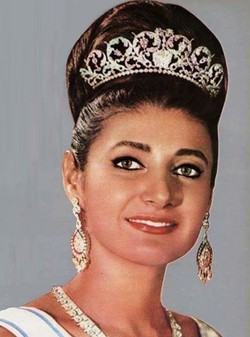
Princess Shahnaz Pahlavi (Persian: شهناز پهلوی, born 27 October 1940) is the first child of the former Shah of Iran, Mohammad Reza Pahlavi, and his first wife, Fawzia of Egypt.

Early life and education

[edit]

Shahnaz Pahlavi was born in Tehran on 27 October 1940, a year before the accession of her father to the throne.[1] She is the only child of Mohammad Reza Pahlavi and his first wife Queen Fawzia.[2][3] Shahnaz is the paternal half-sister of Crown Prince Reza Pahlavi, Princess Farahnaz Pahlavi, Prince Ali Reza Pahlavi and Princess Leila Pahlavi – the four children of the Shah by his third wife, Farah Pahlavi.[4] Her maternal grandparents were King Fuad I and Queen Nazli of Egypt; and her paternal grandparents were Reza Shah and Queen Tadj ol-Molouk of Iran. She is also the niece of King Farouk I of Egypt and thus a cousin of the last Egyptian king, Fuad II.[5]

Shahnaz Pahlavi was educated in a Belgian boarding school, the Lycée Léonie de Waha, in Liège and then in Switzerland.[6]

Personal life

[edit]

Her father had plans for Shahnaz's marriage with King Faisal II of Iraq which did not materialise due to her unwillingness.[7] Her first marriage, at age sixteen, was to Ardeshir Zahedi on 11 October 1957, at Golestan Palace, Tehran.[6] He was one-time Iranian foreign minister and twice Iranian ambassador to the United States (1957–64 and 1972–79).[6][8] She and Zahedi first met in Germany in 1955.[6] The couple have one daughter.[9] They divorced in 1964.

Shahnaz later married Khosrow Jahanbani in February 1971 at the Iranian embassy in Paris.[10] Their marriage lasted until Jahanbani's death on 13 April 2014.

During her father's reign, Shahnaz had investments in agricultural enterprises and assembly plants of Honda bicycles and motorcycles in Iran.[11]

Later years

[edit]

Since the Iranian Revolution, Shahnaz Pahlavi has lived in Switzerland.[4] She has Swiss citizenship.[1] In December 2013, she was granted Egyptian citizenship by the Egyptian government.[1]

Honours

[edit]
[edit]

References

[edit]
[edit]
Revisions and contributorsEdit on WikipediaRead on Wikipedia
from Grokipedia
Princess Shahnaz Pahlavi (Persian: شهناز پهلوی; born 27 October 1940) is the eldest child and only daughter of , the last of , and his first wife, Princess Fawzia Fuad of . Born in at Sa'adabad Palace, she was the sole issue of her parents' marriage, which dissolved in divorce in 1948 amid reported incompatibilities and political pressures. Educated partly in , Shahnaz married , son of a prominent general, in 1957 at age 17, bearing a daughter, Zahra Mahnaz Zahedi, before their divorce in 1964. In 1971, she wed , with whom she had a son, Keykhosrow; her second husband was executed by the revolutionary regime shortly after the , which forced the Pahlavi family into exile. Since then, Shahnaz has resided primarily in , maintaining a low public profile while her half-siblings from the Shah's subsequent marriages pursued varied paths in opposition to the .

Early Life and Family Background

Birth and Parentage

Shahnaz Pahlavi was born on October 27, 1940, at the Sa'adabad Palace in Tehran, Iran. She is the only child of Mohammad Reza Pahlavi, who was then the Crown Prince of Iran and later became the last Shah, and his first wife, Princess Fawzia Fuad, an Egyptian royal and daughter of Fuad I of Egypt. The marriage of her parents, arranged for diplomatic and dynastic reasons, took place on March 16, 1939, in Cairo, uniting the Pahlavi dynasty with the Egyptian monarchy. Her birth occurred during a period of political transition in , as her grandfather Reza Shah Pahlavi ruled until his abdication in September 1941, elevating her father to the throne shortly after her first birthday. As the first and only offspring of this union, Shahnaz held a unique position in the Pahlavi family lineage prior to her parents' separation.

Parents' Divorce and Childhood Upbringing

The marriage of and Fawzia Fuad of , arranged in 1939 for political alliance, deteriorated amid reports of incompatibility and health issues attributed to Fawzia's adjustment to . Fawzia departed in 1945, filing for in that year, though Iranian authorities initially resisted recognition. An official Iranian was finalized on November 17, 1948, stipulating that their sole child, Shahnaz—born October 27, 1940—remain in under her father's custody. Shahnaz, then eight years old, was thus separated from her mother, who returned to and remarried in 1949, limiting subsequent maternal contact to occasional visits. Raised primarily in the Pahlavi court in , she experienced the privileges of royal life, including residence in opulent palaces amid her father's consolidation of power following his ascension. Her upbringing occurred against the backdrop of post-World War II Iran, marked by political turbulence including the 1946 Azerbaijan crisis, yet insulated by court protocols and familial influence. While sources describe a stable environment within the imperial household, accounts note Shahnaz's relative isolation from her mother's Egyptian heritage and infrequent family reconciliations.

Education

Formal Education and Influences

Shahnaz Pahlavi received her secondary education at the Lycée Léonie de Waha, a in , . She subsequently continued her formal studies in , reflecting the Pahlavi family's preference for European institutions to provide a Western-oriented amid Iran's modernization efforts under Mohammad Reza Shah. No records indicate completion of university-level education or specific academic degrees. Documented influences on her formative years primarily stemmed from her upbringing in the Iranian following her parents' 1948 divorce, where she remained under her father's custody and was exposed to courtly duties and from an early age, though these were not part of structured formal curricula. Her European schooling likely fostered multilingual proficiency and cultural adaptability, aligning with the bilingual environment of the Pahlavi household, but primary intellectual or influences beyond familial oversight are not detailed in contemporary accounts.

Marriages and Family

First Marriage to Ardeshir Zahedi

Shahnaz Pahlavi married , an Iranian diplomat and son of General , on October 11, 1957, at in . At the time, Pahlavi was 16 years old, while Zahedi was 28; the ceremony was described as relatively simple, attended by her father, Mohammad Reza Shah Pahlavi, and his second wife, . The union occurred amid Zahedi's rising prominence in Iranian , following his father's role in the 1953 coup that restored the Shah to power. The couple had one daughter, Zahra Mahnaz Zahedi, born during the marriage. Zahedi's diplomatic postings, including as ambassador to the from 1960 to 1962, strained the relationship, contributing to its eventual breakdown. Despite the personal tensions, the in 1964 did not sever Zahedi's ties to the imperial family; he remained a close advisor to the and advanced in his career.

Second Marriage to Khosrow Jahanbani

Shahnaz Pahlavi entered her second marriage on February 1971, wedding at the Iranian Embassy in . Jahanbani, born on 27 February 1941, was the son of , a prominent general in the Imperial Iranian Army during the Pahlavi era. The union represented a personal alliance outside the immediate royal circle, with Jahanbani maintaining a low public profile compared to Shahnaz's prior diplomatic ties through her first marriage. The couple resided primarily in following the wedding, aligning with Shahnaz's established patterns from her and earlier separations. Their marriage yielded two children: a son, Keykhosrow Jahanbani, born in 1971, and a daughter, Fawzieh Jahanbani, born in 1973. This partnership endured without public reports of discord, contrasting the brevity of her previous union, and persisted until Jahanbani's death in April 2014 in , , where the family had settled amid post-revolutionary .

Children and Family Dynamics

Shahnaz Pahlavi has three children across her two marriages. Her first marriage to produced one daughter, Zahra Mahnaz Zahedi, who was approximately one year old as of December 13, 1959. Her second marriage to resulted in two children: a son, Keykhosrow Jahanbani, born on November 20, 1971, and a daughter, Fawzia Jahanbani, born in 1973. Following the 1979 Islamic Revolution, Shahnaz Pahlavi and her family relocated to , where they have maintained a low public profile. Khosrow Jahanbani died in April 2014 after a battle with cancer, leaving Shahnaz to oversee family matters amid ongoing . Little verified public information exists on the children's professional lives or intra-family relationships, reflecting the Pahlavi family's deliberate privacy post-revolution to avoid political entanglement.

Public Role and Philanthropy in Pre-Revolutionary Iran

Involvement in Charitable Organizations

Princess Shahnaz Pahlavi maintained a relatively private existence within the Pahlavi court, with limited documented personal leadership in charitable endeavors compared to relatives such as her stepmother or aunt , who headed prominent initiatives in , women's welfare, and . Available records do not detail her holding positions like president, honorary chair, or patron in specific organizations, reflecting her preference for discretion amid family dynamics following her parents' . As a member of the imperial family, Shahnaz indirectly supported philanthropic activities channeled through the Pahlavi Foundation, founded by her father Mohammad Reza Shah in 1958 as a tax-exempt entity ostensibly dedicated to public welfare. The foundation distributed aid including artificial limbs to amputees, fuel subsidies to low-income households, and support for orphanages, alongside broader social programs. However, contemporary reports highlighted its substantial investments in commercial ventures like and , raising questions about the separation between charitable aims and imperial asset management.

Role Within the Pahlavi Court and Society

As the eldest child and only daughter from 's first marriage, held the formal title of within the , entitling her to participation in imperial court functions despite the 1948 divorce of her parents. Her position, however, was marked by direct influence, as noted by Court Minister , who recorded in his diaries that the devoted little personal attention to her upbringing and court involvement. Shahnaz attended major ceremonial events, including the October 26, 1967, of her father and stepmother Empress Farah at , where she appeared in official photographs alongside immediate family members such as and . Her presence underscored her enduring familial ties to the throne, though dynastic priorities shifted toward the children of Farah, potentially marginalizing her role in core court decision-making. In broader Pahlavi society, Shahnaz's connections through marriages—to from 1957 to 1964 and later to military officer —integrated her into networks, facilitating indirect social and political linkages without assigning her executive duties. These alliances reflected the court's emphasis on strategic familial bonds to stability, yet her personal estrangement from the limited her prominence compared to siblings like or half-siblings from subsequent unions.

Honors and Recognitions

Imperial Iranian Awards

Princess Shahnaz Pahlavi received several decorations from the Imperial State of , reflecting her status as the eldest daughter of Mohammad Reza Pahlavi. On 11 October 1957, she was awarded the Order of the , 2nd class, the principal order reserved for women in the Iranian court, symbolizing excellence and service. In 1967, coinciding with her father's , Shahnaz received the Order of Aryamehr, 2nd class, on 26 September, established to recognize contributions to Iran's modernization and development efforts. She also obtained the Coronation Medal on 26 October, commemorating the imperial ceremony. Further commemorative honors followed in 1971, including the 25th Anniversary Medal on 14 October and the 2,500th Anniversary of the Persian Empire Medal on 15 October, awarded during the Persepolis celebrations marking ancient imperial heritage.

International and Other Honors

Princess Shahnaz Pahlavi received no foreign orders, decorations, or international honors documented in royal genealogical records. Her recognitions were limited to those bestowed by the Imperial Iranian court, reflecting her role within the rather than broader diplomatic or global engagements. This absence of international distinctions aligns with her relatively low-profile public activities compared to other Pahlavi family members who engaged extensively in foreign state visits and alliances.

Exile and Post-Revolutionary Life

Departure from Iran and Immediate Aftermath

Following the escalation of unrest during the , Princess Shahnaz Pahlavi departed in early 1979, prior to the establishment of the on April 1, 1979. She settled in with her husband, , and their daughter, obtaining Swiss citizenship and maintaining residence there thereafter. The immediate aftermath brought significant losses for associated Pahlavi loyalists. On March 13, 1979, Shahnaz's brother-in-law, Lieutenant General —Khosrow's elder brother and former commander of the Imperial Iranian —was executed by firing squad in alongside ten other high-ranking officials after brief, closed-door trials lacking defense counsel. The executions, reported in Iranian state media like newspaper, exemplified the revolutionary regime's swift purge of the prior military and court elite. Khosrow Jahanbani himself evaded capture by having already fled, preserving the family's continuity in exile. Shahnaz adopted a reclusive stance amid these events, eschewing political or public commentary on the upheaval that ousted her father, , who died of cancer in Egyptian exile on July 27, 1980. This period underscored the Pahlavi family's dispersal and diminished influence, with Shahnaz focusing on private life rather than restoration efforts pursued by her half-brother, Reza Pahlavi.

Life in Switzerland and Personal Challenges

Following the Iranian Revolution of 1979, which led to the overthrow of her father, Mohammad Reza Pahlavi, Shahnaz Pahlavi relocated to Switzerland, where she has maintained her primary residence ever since. She acquired Swiss citizenship, enabling a stable life in the country amid the upheavals faced by the exiled Pahlavi family. Unlike her half-siblings, such as Crown Prince Reza Pahlavi or Empress Farah Pahlavi, who have engaged in public advocacy against the Islamic Republic, Shahnaz has adopted a notably low-profile existence, avoiding media attention and political activism. Her life in has been marked by personal losses and the broader difficulties of . Shahnaz's second husband, Lieutenant General , whom she married in 1971, died of cancer on July 23, 2014, at the age of 87, leaving her widowed after over four decades of marriage. This event compounded the emotional toll of prior family tragedies, including her father's death in on July 27, 1980, her mother Fawzia's passing in 2013, and the suicides of her half-siblings Prince Ali Reza in 2011 and Princess Leila in 2001. Despite these challenges, she has continued to reside privately in , focusing on family matters rather than public endeavors.

Recent Developments and Low-Profile Activities

Following the death of her second husband, , from cancer on April 16, 2014, Shahnaz Pahlavi has resided quietly in , where she has lived since the 1979 . She maintains a low public profile, with no reported involvement in political advocacy, philanthropy, or media appearances in recent years, consistent with her post-exile seclusion. Her family includes daughter Zahra Mahnaz Zahedi from her first marriage to , and son Keykhosrow Jahanbani and daughter Fawzia Jahanbani from her second marriage; details on their activities remain private. Absence of verifiable public engagements underscores her deliberate withdrawal from spotlight, amid the Pahlavi family's broader challenges in .

Legacy and Perspectives

Contributions to Iranian Modernization Efforts

Princess Shahnaz Pahlavi's documented involvement in Iran's included holding the Iranian shares in a with Japanese partners to assemble bicycles and motorcycles, an initiative that bolstered local manufacturing capabilities during the Pahlavi era's industrialization push. This participation aligned with the regime's efforts to foster foreign and technological transfer for industrial growth, though her role appears to have been investment-oriented rather than operational. Unlike more prominent family members such as Princess , who led women's organizations, or Empress Farah, who championed cultural and literacy projects, Shahnaz's public engagements in modernization were limited and less extensively recorded in available sources. Her European education at institutions in and exemplified the Pahlavi emphasis on Western-style schooling to cultivate a modern elite, indirectly supporting educational reforms that increased literacy and professional opportunities. However, no primary evidence indicates she spearheaded specific policy-driven initiatives in infrastructure, , or social programs central to the launched in 1963.

Criticisms and Family Strains

Shahnaz Pahlavi experienced profound family strains stemming from her parents' on 17 September 1948, when she was eight years old. Under Iranian custody laws favoring the father, she remained in with , while her mother, Fawzia Fuad, returned to , resulting in limited contact between mother and daughter thereafter—limited to occasional visits, such as in later in life. Within the Pahlavi household, Shahnaz was reportedly marginalized and neglected by her father, who prioritized his later marriages and the children born to them, particularly after his union with Farah Diba in 1959 produced a male heir, , in 1960. Court Minister , a close of the , documented in his diaries that Shahnaz grew up virtually overlooked amid the family's dynamics, overshadowed by her half-siblings and the empress's influence. Tensions extended to her stepmother, Farah Diba, with accounts describing a difficult relationship marked by Shahnaz's resistance to the new family structure; she reportedly confronted her father over personal matters and taunted him regarding her lifestyle choices, at one point narrowly avoiding disinheritance. Her independent demeanor, including two marriages—first to diplomat from 11 October 1957 to 1964, ending in , and later to on 12 April 1971, who was executed by the revolutionary regime on 14 February 1979—further highlighted frictions, as these personal decisions clashed with court expectations. Public and familial criticisms of Shahnaz were muted compared to other royals, but her birth on 27 1940 drew initial disappointment from the Pahlavi family, who had anticipated a male successor to secure the dynasty's continuity amid Reza Shah's fragile health. Post-exile, her low-profile existence in drew indirect commentary from family members, with her mother noting in 2001 that Shahnaz struggled intensely with separation from , amplifying emotional strains amid the clan's dispersal.

Views on the Iranian Revolution and Current Regime

Shahnaz Pahlavi was compelled to leave following the 1979 , which resulted in the overthrow of her father, , and the establishment of the under Ayatollah Ruhollah Khomeini on February 11, 1979. She relocated to , where she has resided since, severing ties with the homeland governed by the new theocratic regime. Unlike her half-brother, Crown Prince Reza Pahlavi, who has actively campaigned against the Islamic Republic—describing it as a collapsing apparatus of repression in statements as recent as June 17, 2025—Shahnaz Pahlavi has adopted a notably reticent stance on political discourse. No public interviews, declarations, or documented critiques from her specifically targeting the Revolution's events, Khomeini's ideology, or the regime's policies—such as its enforcement of compulsory hijab, suppression of dissent, or export of revolutionary fervor—appear in available records. This discretion aligns with her post-Revolution life, marked by personal endeavors including her marriage to businessman in and focus on family, rather than engagement in opposition networks. Her silence may reflect a deliberate choice amid the Pahlavi family's broader narrative of loss, where the Revolution is framed by surviving members as a catastrophic reversal of modernization efforts under the , leading to , abuses, and for . Yet, absent direct attribution, her personal assessment remains unarticulated in verifiable sources.

References

Add your contribution
Related Hubs
User Avatar
No comments yet.