
.svg/250px-Prismatoid_(parameters_h,A₁,A₂,A₃).svg.png)


.svg/2000px-Prismatoid_(parameters_h,A₁,A₂,A₃).svg.png)
Community hub
Recent from talks
Contribute something
Nothing was collected or created yet.
Prismatoid
View on Wikipedia.svg)
In geometry, a prismatoid is a polyhedron whose vertices all lie in two parallel planes. Its lateral faces can be trapezoids or triangles.[1] If both planes have the same number of vertices, and the lateral faces are either parallelograms or trapezoids, it is called a prismoid.[2]
Volume
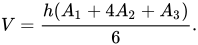
[edit]If the areas of the two parallel faces are A1 and A3, the cross-sectional area of the intersection of the prismatoid with a plane midway between the two parallel faces is A2, and the height (the distance between the two parallel faces) is h, then the volume of the prismatoid is given by[3] This formula follows immediately by integrating the area parallel to the two planes of vertices by Simpson's rule, since that rule is exact for integration of polynomials of degree up to 3, and in this case the area is at most a quadratic function in the height.
Prismatoid families
[edit]| Pyramids | Wedges | Parallelepipeds | Prisms | Antiprisms | Cupolae | Frusta | ||
|---|---|---|---|---|---|---|---|---|

|

|

|

|

|

|

|

|

|
Families of prismatoids include:
- Pyramids, in which one plane contains only a single point;[4]
- Wedges, in which one plane contains only two points;
- Prisms, whose polygons in each plane are congruent and joined by rectangles or parallelograms;
- Antiprisms, whose polygons in each plane are congruent and joined by an alternating strip of triangles;[5]
- Star antiprisms;
- Cupolae, in which the polygon in one plane contains twice as many points as the other and is joined to it by alternating triangles and rectangles;
- Frusta obtained by truncation of a pyramid or a cone;
- Quadrilateral-faced hexahedral prismatoids:
- Parallelepipeds – six parallelogram faces
- Rhombohedrons – six rhombus faces
- Trigonal trapezohedra – six congruent rhombus faces
- Cuboids – six rectangular faces
- Quadrilateral frusta – an apex-truncated square pyramid
- Cube – six square faces
Higher dimensions
[edit]
In general, a polytope is prismatoidal if its vertices exist in two hyperplanes. For example, in four dimensions, two polyhedra can be placed in two parallel 3-spaces, and connected with polyhedral sides.
References
[edit]- ^ Kern, William F.; Bland, James R. (1938). Solid Mensuration with proofs. p. 75.
- ^ Alsina, Claudi; Nelsen, Roger B. (2015). A Mathematical Space Odyssey: Solid Geometry in the 21st Century. Vol. 50. Mathematical Association of America. p. 85. ISBN 978-1-61444-216-5.
- ^ Meserve, B. E.; Pingry, R. E. (1952). "Some Notes on the Prismoidal Formula". The Mathematics Teacher. 45 (4): 257–263. doi:10.5951/MT.45.4.0257. JSTOR 27954012.
- ^ Grünbaum, Branko (1997). "Isogonal Prismatoids". Discrete & Computational Geometry. 18: 13–52. doi:10.1007/PL00009307..
- ^ Alsina & Nelsen (2015), p. 87.
External links
[edit]Prismatoid
View on GrokipediaDefinition and Terminology
Formal Definition
A prismatoid is defined as a polyhedron in which all vertices lie in exactly two distinct parallel planes.[5][6] The two faces formed by the intersections of these planes with the polyhedron serve as the bases, which are simple polygons that need not be congruent or regular.[5][7] The lateral faces of a prismatoid connect corresponding edges of the two bases and are either trapezoids, when the bases have the same number of sides, or triangles, in cases where one base degenerates to a point (as in pyramids).[5][2] This structure visually resembles a prism with parallel and equal bases but generalizes to allow unequal bases, providing flexibility in connecting polygonal outlines across the parallel planes.Etymology and History
The term "prismatoid" derives from the Greek prīsmat- (stem of prîsma, meaning "prism" or "something sawed") combined with the suffix "-oid," indicating resemblance, thus describing a polyhedral form akin to a prism.[8][9] The earliest recorded use of the term in English dates to 1858, attributed to Robert Mayne in his expository lexicon.[8] By the late 19th century, "prismatoid" had entered mathematical discourse more widely, appearing in George Bruce Halsted's Metrical Geometry: An Elementary Treatise on Mensuration in 1881 and in encyclopedic references circa 1890.[10][11] This development occurred amid 19th-century advancements in polyhedral classification, where the prismatoid concept addressed solids confined between parallel planes, extending foundational ideas from prisms studied in earlier geometry.[12]Geometric Structure
Bases and Lateral Faces
A prismatoid is defined as a polyhedron with two polygonal bases lying in parallel planes, which may have different numbers of sides, such as a triangular base connected to a hexagonal one.[5] These bases form the foundational parallel faces of the structure, with all vertices confined to these two planes. The bases are polygons, typically convex.[5] The lateral faces of a prismatoid connect the edges or vertices between the two bases, typically consisting of trapezoids or triangles.[13] If the bases have the same number of sides and corresponding edges align, the lateral faces are quadrilateral trapezoids, as seen in frustums where each trapezoid spans parallel edges from both bases.[14] In cases where one base has fewer vertices, such as a pyramid-like configuration with an apex base, the lateral faces become triangles, each connecting an edge of the larger base to a vertex of the smaller one.[5] Connectivity between bases and lateral faces follows strict rules to maintain the polyhedron's integrity, with each lateral face spanning directly from an edge or vertex of one base to the other without crossing edges.[7] This arrangement typically results in a convex prismatoid when the bases are convex polygons, with the lateral faces adjoining sequentially around the perimeter of the bases, forming a continuous band that links the two parallel polygons; non-convex variants also exist.[14][7]Vertex and Edge Configurations
In a prismatoid, all vertices are partitioned between two distinct parallel planes, with no vertices located elsewhere in space, ensuring the polyhedron's structure is confined to these bounding planes.[5][2] One plane contains the vertices of the first base polygon, while the other holds those of the second base polygon, allowing for flexible arrangements such as a triangular base with three vertices opposite a rectangular base with four vertices.[15] The edges of a prismatoid fall into two primary categories: base edges, which lie entirely within one of the parallel planes and form the boundaries of the polygonal bases, and lateral edges, which connect vertices between the two planes and may be slanted rather than perpendicular.[5][15] Base edges outline the polygons in each plane, while lateral edges bound the triangular or trapezoidal faces that link the bases, with each such edge spanning from a vertex in one plane to a vertex in the other.[2] Configurations of vertices and edges in prismatoids permit arbitrary numbers of vertices per base, typically at least three for each polygonal base when assuming convex polygons.[15] The total number of edges equals the sum of the base edges from both polygons plus the lateral edges, where the latter depend on the specific connections required to form the enclosing faces without gaps or overlaps; for instance, a configuration with m vertices on one base and n on the other yields m + n base edges plus at least m + n lateral edges in minimal convex hulls.[5][15] From a graph-theoretic perspective, the 1-skeleton of a prismatoid consists of two disjoint polygonal graphs for the bases connected by a simple bipartite graph of lateral edges between the vertex sets of the two planes.[15] For validity as a polyhedron, these vertices and edges must assemble into a simply connected structure without self-intersections, ensuring the structure remains a well-defined, non-degenerate solid.[2]Volume Calculation
Prismatoid Volume Formula
The volume of a prismatoid is given by the formulawhere is the perpendicular distance between the two parallel planes containing the bases, and are the areas of the respective bases, and is the area of the mid-parallel cross-section.[5][2][7] The term refers to the area of the polygonal section parallel to the bases and located at a height of from each base. This midsection arises from the linear interpolation of the positions between the bases, forming a polygon whose vertices are determined by averaging the coordinates of corresponding vertices from the two bases or by projecting vectors along the lateral edges to the midway plane.[5][1][2] In special cases, the formula simplifies accordingly. If the bases are congruent and equal in area (), the prismatoid reduces to a prism with volume . If one base has zero area (e.g., ), it becomes a pyramid with base area and volume , assuming the midsection area due to the quadratic scaling of cross-sectional areas in a pyramid.[5][16][1] To compute practically, identify corresponding vertices on the bases—typically aligned via the trapezoidal or triangular lateral faces—and calculate their midpoint positions in the midway plane, then determine the area of the resulting polygon using standard polygonal area methods, such as the shoelace formula or decomposition into triangles. Alternatively, vector projections from base vertices to the mid-plane can yield the same cross-section for verification.[2][1]
Derivation and Applications
The volume of a prismatoid can be derived by considering the variation of the cross-sectional area parallel to the bases along the height. For a prismatoid with straight lateral edges, the cross-sectional area at height from one base varies quadratically with , as the linear interpolation of vertices between the two bases results in a quadratic dependence of the area on height. This leads to the integral form for the volume: where is the height between the parallel bases, and can be expressed as , with and as the areas of the two bases, and a coefficient determined by the geometry such that the area at the midpoint matches the midsection area .[17] To evaluate this integral, Simpson's 1/3 rule is applied, which approximates the integral using the areas at the endpoints ( and ) and the midpoint (). The rule states that for a function over , yielding . This approximation is exact when is a quadratic polynomial, as Simpson's rule integrates polynomials of degree up to 3 precisely, aligning with the quadratic nature of the cross-sectional area in a prismatoid.[17] In civil engineering, the prismatoid formula is widely applied to compute earthwork volumes, such as in excavation and road cuts, where cross-sections are measured at intervals and approximated as prismatoids to estimate cut-and-fill quantities efficiently.[18] In surveying, it serves to approximate the volumes of irregular solids, like stockpiles or borrow pits, by using measured end and midsection areas to provide a more accurate estimate than simpler trapezoidal methods for non-prismatic shapes.[19] The formula also finds use in architecture for calculating volumes of truncated polyhedral structures, such as stepped pyramids or vault approximations, aiding in material estimation for construction.[16] However, the formula assumes linear interpolation of edges between bases, leading to quadratic area variation; it introduces errors when the cross-sectional area deviates significantly from quadratic behavior, such as in solids with curved or irregular lateral surfaces.[18]Types and Families
Prismoids as a Subclass
A prismoid constitutes a specific subclass of prismatoids, characterized by two parallel polygonal bases that possess an identical number of vertices and sides. In this configuration, the lateral faces connecting corresponding vertices of the bases are exclusively parallelograms or trapezoids, ensuring all sides remain planar.[20] This distinguishes prismoids from general prismatoids, where bases may differ in the number of vertices, potentially resulting in triangular lateral faces to accommodate the mismatch; in contrast, prismoids avoid such degenerate triangular faces and align with the term "prismoid" as used in certain geometric texts.[20] The lateral edges of a prismoid connect corresponding vertices between the bases and may be slanted in oblique variants rather than perpendicular to the bases. The volume formula for prismatoids applies directly to prismoids without modification, treating them as a special case.[20] Representative examples of prismoids include frustums of pyramids, such as a frustum of a square pyramid where both bases are squares of differing sizes connected by trapezoidal faces, or oblique hexagonal prisms featuring matching hexagonal bases with parallelogram lateral faces.[20]Specific Prismatoid Families
Prismatoids encompass several distinct families based on the configuration of their bases and lateral faces, each representing variations on the general structure of two parallel polygonal bases connected by trapezoidal or triangular sides. In some classifications, such as S_{m,n}-prismatoids, lateral faces are triangulated, while in standard geometric descriptions, they may be trapezoids or parallelograms.[13] Pyramids form one fundamental family of prismatoids, characterized by a single point as the degenerate upper base and a convex polygonal lower base, with all lateral faces being triangles connecting the apex to the base edges. This structure arises in S_{1,m}-prismatoids for m ≥ 3, where the top consists of one vertex linked to an m-gon bottom. A classic example is the square pyramid, which has a square base and four triangular lateral faces meeting at the apex.[13] Frusta, or frustums, represent truncated versions of pyramids or cones within the prismatoid family, featuring two parallel polygonal bases of different sizes and lateral faces that are trapezoids connecting corresponding sides. These occur as truncated pyramids, preserving the parallelism of the bases while removing the apex. An illustrative example is the pentagonal frustum, with a smaller pentagonal top, a larger pentagonal bottom, and five trapezoidal sides. Prisms constitute a family of prismatoids with two congruent, parallel polygonal bases connected by rectangular or parallelogram lateral faces, aligning directly with the equal-base cases known as prismoids. The triangular prism exemplifies this, having two equilateral triangular bases and three rectangular sides. Antiprisms extend the prism family by twisting one base relative to the other, resulting in two parallel n-gonal bases linked exclusively by triangular lateral faces in an alternating band. Formally, an n-sided antiprism is a 3D polyhedron with two parallel n-sided polygonal bases connected by such triangles, fitting the S_{n,n}-prismatoid classification.[13] Wedges and parallelepipeds appear as degenerate cases within prismatoid families, often with rectangular or triangular bases and simplified lateral connectivity. Wedges, as S_{2,m}-prismatoids for m ≥ 2, feature a digonal (degenerate line segment) top connected to an m-gon base via triangular facets, such as in a basic wedge with a rectangular base. Parallelepipeds, meanwhile, generalize prisms with parallelogram faces and can degenerate to forms like the rectangular parallelepiped, akin to a skewed box with rectangular bases.[13] Cupolae form another notable family, joining an n-gonal upper base to a 2n-gonal lower base through a combination of triangular and square (or rectangular) lateral faces, often appearing in uniform polyhedra like Archimedean solids. The triangular cupola, for instance, connects a triangle to a hexagon with three triangles and three squares as sides, serving as a building block in more complex polyhedral constructions.[21]Generalizations
Higher Dimensions
A four-dimensional prismatoid, or 4D prismatoid, is a polychoron whose vertices all lie in two parallel three-dimensional hyperplanes. The two polyhedral facets in these hyperplanes serve as the bases, while the connecting facets, known as lateral faces, are three-dimensional prismatoids themselves. This structure ensures that the entire polytope is the convex hull of the vertices in the bases, maintaining convexity as a fundamental property. In general, an n-dimensional prismatoid is defined as a convex polytope with all vertices contained in two parallel (n-1)-dimensional hyperplanes, which form the base facets. The lateral facets of such a polytope are themselves (n-1)-dimensional prismatoids, providing a recursive geometric structure. The n-dimensional content (volume) of an n-dimensional prismatoid generalizes the three-dimensional case through integration of the (n-1)-dimensional volumes of parallel cross-sections between the bases or via Cavalieri's principle, which equates contents of figures with matching cross-sectional measures at corresponding heights in higher dimensions.[22][23] Examples of higher-dimensional prismatoids include the 4D pyramid, where one base is a degenerate polyhedron consisting of a single point in one hyperplane and the other base is a three-dimensional polyhedron in the parallel hyperplane. Another example is the 4D frustum, formed by truncating a 4D pyramid parallel to its base, resulting in two non-degenerate three-dimensional polyhedral bases connected by lateral prismatoid facets. These constructions preserve the prismatoid properties, such as bounded width in lower dimensions (e.g., at most 4 in 4D).Related Concepts
Prismatoids generalize prisms in three-dimensional geometry by permitting the two parallel polygonal bases to differ in shape and size, while prisms require congruent and parallel bases connected by rectangular or parallelogram lateral faces.[5] This extension allows for more varied polyhedral forms, such as frustums, where the lateral faces are trapezoids rather than parallelograms. Prismatoids illustrate Cavalieri's principle, which equates the volumes of solids sharing the same height and identical cross-sectional areas at every level between parallel bounding planes; in prismatoids, cross-sections parallel to the bases interpolate linearly between the base areas, enabling volume comparisons without direct integration. Special cases of prismatoids featuring exclusively parallelogram lateral faces correspond to parallelotopes, which in three dimensions are parallelepipeds and represent zonotopes formed as Minkowski sums of line segments along linearly independent directions.[24] In the broader classification of polyhedra, prismatoids occupy a distinct position, contrasting with bipyramids whose vertices span more than two parallel planes due to apical points offset from a central polygonal base. Convex prismatoids satisfy the Euler characteristic formula , where , , and denote vertices, edges, and faces, respectively, consistent with the topology of spherical polyhedra.References
- https://proofwiki.org/wiki/Definition:Prismatoid