Hubbry Logo
ProarticulataProarticulataMain
Open search
Proarticulata
Community hub
Proarticulata
logo
8 pages, 0 posts
0 subscribers
Be the first to start a discussion here.
Proarticulata
Proarticulata
from Wikipedia

Proarticulata
Temporal range: Ediacaran, 567–550 Ma
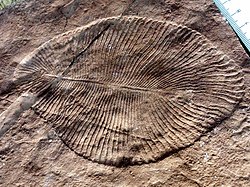
Fossil of Dickinsonia costata
Fossil of Spriggina
Scientific classification Edit this classification
Kingdom: Animalia
Clade: Bilateria (?)
Phylum: Proarticulata
Fedonkin, 1985
Classes and families

For more taxa, see text

Proarticulata (also known as Dickinsoniomorpha[1]) is a phylum of extinct, near-bilaterally symmetrical animals known from fossils found in the Ediacaran (Vendian) marine deposits, and dates to approximately 567 to 550 million years ago.[2][3][4] The name comes from the Greek προ (pro-) = "before" and Articulata, i.e. prior to animals with true segmentation such as annelids and arthropods. This phylum was established by Mikhail A. Fedonkin in 1985 for such animals as Dickinsonia, Vendia, Cephalonega, Praecambridium[5] and currently many other Proarticulata are described (see list).[6][7]

Due to their simplistic morphology, their affinities and mode of life are subject to debate. They are almost universally considered to be metazoans, and due to possessing a clear central axis have been suggested to be stem-bilaterians. In the traditional interpretation, the Proarticulatan body is divided into transverse articulation (division) into isomers as distinct from the transverse articulation segments in annelids and arthropods, as their individual isomers occupy only half the width of their bodies, and are organized in an alternating pattern along the longitudinal axis of their bodies.[7] In other words, one side is not the direct mirror image of its opposite (chirality). Opposite isomers of left and right side are located with displacement of half of their width. This phenomenon is described as the symmetry of gliding reflection.[8][9] Some recent research suggests that some proarticulatans like Dickinsonia have genuine segments, and the isomerism is superficial and due to taphonomic distortion.[10] However, other researchers dispute this.[11][12] Displacement of left-right axis is known in bilaterians, notably lancelets.[13][14]

Morphology

[edit]
Examples of the classes Proarticulata, including reconstructions of Vendia sokolovi, Dickinsonia costata and Yorgia waggoneri.

Vendiamorpha

[edit]

The body is completely segmented, with all isomers curved towards the posterior, and the first isomer is normally much larger than the rest. The first two isomers at the anterior dorsal end are partly fused. (e.g., Vendia, Paravendia and Karakhtia).[8][15][16][17]

Cephalozoa

[edit]

These proarticulatans are incompletely segmented, as the anterior zone is free of isomers, often making a "hairband" like appearance (example cephalozoans include Yorgia, Praecambridium, Andiva, Archaeaspinus, Ivovicia, Podolimirus, Tamga, Spriggina, Marywadea and Cyanorus).[8][15][17][18] Some cephalozoans from the family Yorgiidae demonstrate pronounced asymmetry of the left and right parts of the body. For instance, Yorgia's initial right isomer is the only one which spreads far towards the left side of the body. Archaeaspinus has an unpaired anterior lobe confined by the furrow to the left side only.[8][9][17]

Artist's reconstruction of Cephalonega stepanovi.[19]
Artist's reconstruction of Lossinia feeding on surface algae.

In Cephalonega stepanovi and Tamga hamulifera the zone containing the isomers is encircled by a peripheral, undivided zone.[18] The Cephalonega's isomers are connected to each other, forming a body resembling a rubber raft; the Tamga's isomers are separated from each other, and do not touch.

In Lossinia, the center undivided region has no visible isomers, instead having the lobe-like isomers emanate from the periphery of the undivided region as "transverse articulations."[18]

Dipleurozoa

[edit]

The dipleurozoan body is subradial, divided by isomers entirely (e.g., Dickinsonia and Phyllozoon). Dickinsonia juveniles show undivided anterior areas but these regions were reduced in the course of ontogeny, and in the adult stages Dickinsonia-like proarticulates changed so radically that they became almost indistinguishable from isomers.[15][18][20]

List of Proarticulates

[edit]
Andiva ivantsovi
Andiva ivantsovi
Dickinsonia costata
Dickinsonia costata
Spriggina floundersi
Ovatoscutum concentricum
Yorgia waggoneri
Yorgia waggoneri
Tamga hamulifera
Tamga hamulifera

Body fossils

[edit]
A. parva Fedonkin, 1980
A. ivantsovi Fedonkin, 2002
A. fedonkini Ivantsov, 2001
C. stepanovi (Fedonkin, 1976)[18][24]
C. bilobatum Wade, 1971
C. singularis Ivantsov, 2004
D. costata Sprigg, 1947
D. menneri Keller 1976[18] (=Vendomia menneri Keller 1976[24])
D. tenuis Glaessner & Wade, 1966
I. rugulosa Ivantsov, 2007
K. nessovi Ivantsov, 2004
L. lissetskii Ivantsov, 2007
M. ovata Glaessner & Wade, 1966
O. concentricum Glaessner & Wade, 1966
P. janae Ivantsov, 2001 (=Vendia janae Ivantsov, 2001)
P. mirus Fedonkin, 1983 (Valdainia plumosa Fedonkin, 1983)
P. siggilum Glaessner & Wade, 1966
S. floundersi Glaessner, 1958
T. hamulifera Ivantsov, 2007
V. sokolovi Keller, 1969
V. rachiata Ivantsov, 2004
W. aitkeni Narbonne, 1994[26]
Y. waggoneri Ivantsov, 1999

Trace fossils

[edit]
E. axiferus Ivantsov, 2002.
E. waggoneris Ivantsov, 2011. This is a trace of Yorgia waggoneri
E. costatus Ivantsov, 2011. This is a trace of Dickinsonia costata
P. hanseni Jenkins & Gehling, 1978

See also

[edit]

References

[edit]
[edit]
Revisions and contributorsEdit on WikipediaRead on Wikipedia
from Grokipedia
Proarticulata is an extinct of bilateral metazoans that inhabited shallow marine environments during the Late period, approximately 558–541 million years ago. These animals featured a distinctive dorsoventrally flattened with transverse elements called isomers arranged in alternating rows along the left and right sides, exhibiting a unique that distinguishes them from later arthropods or annelids; however, the nature of this "segmentation" is debated, with some evidence suggesting it may result from taphonomic distortion rather than true biological segments in taxa like . Known from negative and positive relief impressions on bed soles, often associated with microbial mats, Proarticulata represents the largest known mobile benthic organisms of the , with some specimens exceeding 1 meter in length. The phylum encompasses around 15 genera, primarily from (eastern and northern Europe) and , including well-known forms such as Dickinsonia, Vendia, Yorgia, , and Paravendia. Morphologically, Proarticulata can be divided into three main groups: Dipleurozoa (fully segmented bodies without a distinct head, e.g., Dickinsonia), Vendiamorpha (curved isomers forming a fan-like shape, e.g., Vendia), and Cephalozoa (with an anterior zone free of isomers, sometimes featuring a cephalic lobe, e.g., Yorgia and ). Their integuments displayed organized tissue polarity, supporting classification as eumetazoans within , though their exact phylogenetic position remains debated, with some evidence suggesting links to early stem-bilaterians or a separate vendobiont lineage. Proarticulata likely employed an osmotrophic feeding strategy, absorbing dissolved organic nutrients from bacterial films on the seafloor using ventral hair-like structures, as inferred from traces and body impressions showing microbial mat interactions. They moved by peristaltic gliding over soft substrates, leaving behind low-relief traces that represent some of the earliest evidence of metazoan mobility. The phylum became extinct before the , leaving a fossil record that provides critical insights into the diversification of early animal life.

History and discovery

Initial findings

The first fossils attributable to Proarticulata were discovered in 1946 by geologist Reginald Sprigg in the Ediacara Hills of South Australia, where he encountered impressions of Dickinsonia costata on sandstone slabs. Initially, Sprigg and subsequent describers, such as Martin Glaessner, interpreted these as jellyfish-like medusoids or possibly algal structures from the early Cambrian, given the prevailing view that complex multicellular life appeared only near the Cambrian boundary. This misinterpretation stemmed from the discoidal and segmented forms' superficial resemblance to known cnidarians or thallophytes, delaying recognition of their Precambrian age and distinct nature. Further discoveries in the and expanded the known record, particularly through excavations led by Boris Sokolov along the coast in northwestern , where additional Proarticulata specimens were unearthed alongside other Vendian biota. Sokolov and collaborators recognized these as metazoan remains based on their preservational mode and association with trace fossils, but they did not propose a unified higher-level grouping, instead classifying them broadly within early multicellular animals of the late . These finds highlighted the global distribution of such fossils, with similar forms appearing in Ukraine's region. In the early , Mikhail A. Fedonkin advanced interpretations of the Vendian biota through detailed studies, notably identifying bilateral in segmented forms like Vendia from Ukrainian deposits, suggesting a closer affinity to early bilaterians than previously thought. Fedonkin's analyses emphasized the quilted, articulated body plans as evidence of metazoan organization, building on Sokolov's groundwork without yet formalizing a . This work paved the way for later taxonomic proposals. Key fossil sites for Proarticulata include the in and the region in , with the group's temporal range spanning approximately 567 to 550 million years ago during the late Period.

Establishment of the phylum

The phylum Proarticulata was formally named by Mikhail A. Fedonkin in to encompass a group of extinct Vendian metazoans characterized by a unique form of bilateral symmetry involving "isomer" segmentation, where body segments exhibit glide reflection symmetry rather than strict mirror symmetry. The name derives from the Greek pro- (before) and articulatus (jointed), highlighting their position as precursors to more advanced segmented animals like arthropods. Fedonkin distinguished Proarticulata as the most primitive representatives of Vendian , separate from other assemblages such as frond-like or discoidal forms. One year earlier, in 1984, Martin F. Glaessner had proposed the alternative name Dickinsoniomorpha for morphologically similar organisms, primarily based on fossils like , but this term was later synonymized under Proarticulata as additional shared traits, such as the isomer pattern, became evident in broader analyses. Initially, the included key genera such as (representing the class Dipleurozoa), Vendia (class Vendiamorpha), and , which were recognized as stem-group bilaterians due to their bilateral organization and potential for directed locomotion, setting them apart from non-bilaterian taxa. Fedonkin's foundational work appeared in the Russian journal Paleontologicheskii Zhurnal and was elaborated in English in a 1985 publication, where he outlined the phylum's systematic position and classes. Subsequent taxonomic developments in the 1990s and 2000s, particularly by Andrey Yu. Ivantsov, refined understandings of Proarticulata through detailed studies of morphology, revealing quilted, modular body walls that supported the phylum's distinctiveness and provided insights into preservation biases. These efforts solidified Proarticulata as a cohesive group of early bilaterians, influencing ongoing interpretations of diversity.

Description

Overall body plan

Proarticulata were extinct animals characterized by a near-bilaterally symmetrical , featuring a distinctive segmentation into transverse units known as isomers, which alternated in offset between the left and right sides, conferring a rather than strict mirror . This segmentation divided the body into two rows of half-segments, forming a quilted or articulated structure that enveloped both dorsal and ventral surfaces. The overall shape was typically flattened and elliptical to , with lengths ranging from a few millimeters to over 1.4 meters in the largest specimens, such as certain individuals. Lacking any mineralized , their bodies were supported by a resilient, dense composed of epidermal tissue over a basal matrix, preserved primarily as negative relief impressions on the soles of beds from marine deposits. The integument's modular, articulated design likely allowed for flexibility, enabling the body to undulate or stretch during movement, while the dorsal side formed a continuous shield and the ventral side exhibited grooves potentially associated with ciliary structures. Growth occurred through the sequential addition of new isomers at the posterior end, with evidence of regeneration in some cases, resulting in an anteroposterior polarity that oriented the body along its long axis. This metameric organization, combined with dorsoventral differentiation, distinguished Proarticulata from contemporaneous radial or frond-like taxa, supporting their affinity to early eumetazoans with true bilateral symmetry.

Vendiamorpha

Vendiamorpha represents a class within Proarticulata characterized by fully segmented bodies composed of repeating units known as , arranged in two offset rows that curve posteriorly to produce a glide-reflected pattern. This arrangement differs from simple bilateral , as the isomers are shifted relative to the body's central axis, creating an alternating, non-mirrored configuration along the length. The first isomer is typically larger than those following it, giving the anterior end a broader appearance that tapers gradually toward the posterior. The body lacks a distinct head region, featuring uniform segmentation from anterior to posterior, which contrasts with variations seen in other proarticulate classes. This consistent segmentation likely supported an undulatory mode of locomotion, enabling the organism to propel itself across soft substrates through wave-like motions generated by the flexible isomer chain. Fossils suggest the ventral surface interacted directly with the seafloor, facilitating nutrient absorption during movement. Exemplary genera include Vendia, known from Vendian deposits in the region of , where specimens exhibit 5–7 isomers per side and reach lengths up to 1.1 cm. Other forms such as Paravendia and Podolimirus share this morphology and occur alongside Vendia in similar assemblages. Preservation typically consists of external impressions with raised margins, often appearing as chains of positive reliefs on the undersides of fine-grained beds; these traces, from sites in the southeastern region of and , indicate the animals left imprints while grazing on microbial films during locomotion.

Cephalozoa

Cephalozoa represent a class within the Proarticulata characterized by incomplete segmentation, featuring a distinct anterior cephalized zone that lacks isomers, followed by a trunk region composed of offset, alternating segments arranged in two rows. This exhibits with gliding reflection, where the isomers—repeating structural elements—show a metameric that supports directed orientation, potentially facilitating locomotion along a preferred axis. The pre-isomeric head region is unornamented and broader, contrasting with the narrower, segmented post-isomeric trunk, which may include internal structures such as branching channels interpreted as distributive or secretory systems. A notable feature of Cephalozoa is the presence of asymmetry in segment development, where individual isomers may extend unevenly across the midline, deviating from perfect bilateral mirroring. For instance, Yorgia waggoneri, a representative taxon, displays such asymmetry, with its initial right-side isomer extending farther toward the left side of the body; specimens reach lengths of up to 19 cm and typically bear 10-12 isomers in the trunk. Fossils of Yorgia are primarily known from the southeastern White Sea region of Russia, including sites like Zimnii Bereg in the Ust-Pinega Formation. Similarly, Spriggina floundersi exemplifies the class with a crescent-shaped anterior structure resembling a fringe or head shield, followed by 20-30 narrower segments; it attains lengths of 3-5 cm and shows a tapered posterior. Spriggina fossils occur in the Ediacara Hills of South Australia, within the Rawnsley Member of the Pound Subgroup. The morphological traits of Cephalozoa were first outlined in the 1980s by Mikhail Fedonkin, who established Proarticulata as a distinct metazoan and highlighted the cephalized anterior in preliminary classifications during the . Subsequent reinterpretations by Ivantsov in the early formalized Cephalozoa as the third class alongside Vendiamorpha and Dipleurozoa, emphasizing the unsegmented head and asymmetric isomer offset as diagnostic for distinguishing it from other proarticulate body plans. These features suggest an for substrate interaction, with the head zone possibly aiding in sensory or anchoring functions, though remains limited to body impressions preserved on undersurfaces.

Dipleurozoa

Dipleurozoa represents the most diverse class within the Proarticulata , characterized by a fully segmented body exhibiting subradial symmetry and gliding . The body is organized into two lateral rows of alternating half-segments, known as isomers, arranged without a strong bilateral offset, forming a quilted appearance due to impressions from modular, stiff-walled transverse elements. These isomers divide the entire body transversely, creating a sack-like that envelops both dorsal and ventral surfaces, providing resilient support while maintaining anteroposterior and dorsoventral polarity. In juveniles, the anterior region features an undivided, triangular or rhombic lobe that fully embraces the isomeric area, lacking distinct segmentation at the front. As individuals mature into adults, this anterior lobe narrows to a lanceolate shape, and the dorsal surface may develop tubercles, with the ventral side showing external segmentation possibly associated with ciliated structures. Adult body sizes can reach significant dimensions, up to dozens of centimeters or more, reflecting the class's capacity for substantial growth. Representative genera include , which displays an elliptical body plan with a ribbed, quilted texture, ranging from 4 cm to 140 cm in length and known from global Ediacaran deposits including , , , and Newfoundland. Andiva exhibits a similar morphology but on a smaller scale, with comparable segmentation and integument structure, though typically more compact in form. Ontogeny in Dipleurozoa proceeds through the posterior addition of new isomers, resulting in size gradients observable in assemblages where younger segments are narrower and more numerous toward the rear. This modular growth pattern is evidenced by transitional s showing bifurcation and regeneration at the posterior end, allowing for indeterminate expansion without a fixed maximum size.

Classification and phylogeny

Position within Bilateria

Proarticulata is widely regarded as a stem-group to , comprising early metazoans that exhibit bilateral and primitive metamerism, positioning them as precursors to more derived bilaterian clades such as and . These organisms share segmentation-like traits with annelids (Lophotrochozoa) and arthropods (), but display a distinctive "glide " in their offset isomers, suggesting a pre-articulated form of body organization that predates the jointed appendages and true segmentation of crown-group bilaterians. The phylum was established by Mikhail Fedonkin in 1985 based on Vendian fossils from the region, emphasizing their bilaterian affinities through dorsoventral and anteroposterior polarity. In 1992, Adolf Seilacher proposed the informal group , interpreting and related forms as non-metazoan, fungal-like organisms with quilted, fluid-filled structures adapted to a low-oxygen environment, rather than true animals. This hypothesis was influential but later rejected due to evidence of active locomotion, ontogenetic growth patterns, and tissue consistent with eumetazoans; by the , consensus shifted to recognizing as early . Ontogenetic studies of key taxa like , for instance, reveal pre-terminal addition of body units via a generative zone, aligning with bilaterian developmental modes and constraining the group to the total-group . The temporal appearance of Proarticulata during the Period (approximately 567–550 Ma) aligns with estimates for the divergence of early bilaterian lineages, supporting their role as basal forms coexisting with other stem bilaterians like . Cladistic analyses place Proarticulata basal to crown , highlighting their significance in understanding the transition from simple diploblastic animals to complex triploblastic forms.

Alternative interpretations

One prominent alternative interpretation of Proarticulata posits that they belong to the extinct kingdom , proposed by Adolf Seilacher in 1992, where their quilted body plans are viewed as non-metazoan, coenocytic structures akin to osmotrophic lichens or fungi that absorbed nutrients directly through their surfaces. Under this hypothesis, the apparent segmentation or isomerism observed in fossils like results not from true metamerism but from modular growth patterns in a quilted that maintained structural integrity during expansion. This model emphasizes the Vendobionta's adaptation to a mat-bound, low-oxygen seafloor environment, with their bodies functioning as inflated, fluid-filled modules for support rather than locomotion. This Vendobionta framework has faced significant challenges from geochemical evidence, particularly stable carbon isotope analyses in the 2010s that indicate a metazoan affinity for Proarticulata fossils. For instance, lipid biomarkers extracted from specimens, including high levels of cholestane derived from , align with eukaryotic sterol biosynthesis pathways rather than those of fungi or lichens. A 2025 reassessment of coprostane/cholestane ratios confirms this affinity via sterol pathways, though it suggests coprostanol enrichment may not indicate internal . Such isotopic and data contradict the osmotrophic, non- nutrition implied by , suggesting instead active metabolic processes consistent with early bilaterians. Taphonomic processes have been invoked to explain aspects of the quilted and segmented appearances of Proarticulata. fossils like are often preserved through interactions with microbial mats, where sediment infiltration and mat adhesion can influence outlines during early , potentially contributing to observed impressions alongside biological structures. Proarticulata interacted closely with microbial mats on the seafloor, as evidenced by body and trace fossils showing and mobility over mat surfaces. However, trace fossils from the provide counter-evidence for mobility, including sinuous trails attributed to -like gliding over mats, indicating active repositioning incompatible with a sessile, mat-affiliated . Ongoing debates center on whether the quilted modules functioned as pneumatophores for flotation, as initially suggested by Seilacher, allowing buoyant drifting rather than benthic crawling. Proponents argue this explains the lack of vertical burrowing traces and the fossils' preservation in low-energy settings, with gas-filled chambers providing lift in a pre-oxygenated ocean. Recent analyses of asymmetry and trail orientations challenge this, favoring directed movement over passive flotation, though the pneumatophore model remains influential for interpreting .

Paleobiology

Locomotion and behavior

Proarticulata likely achieved locomotion through undulatory waves propagating along their segmented bodies, facilitated by the alternating arrangement of isomers in a manner akin to . This mechanism would have enabled slow gliding over soft sediment surfaces, as inferred from the bilateral yet offset segmentation that suggests coordinated contraction and relaxation of body units. Trace fossils provide direct evidence of movement in genera like , where Epibaion trails form elongated paths 1–2 cm wide, extending posteriorly from the body and showing unidirectional progression consistent with rotational pivoting or inching. These traces, preserved alongside body fossils in deposits, indicate deliberate relocation rather than passive drift, with the trail width matching the organism's body breadth. Feeding behavior involved on microbial mats, as evidenced by low-relief impressions forming irregular chains of shallow scratches and depressions. A 2011 by Ivantsov identified these as Epibaion ichnospecies, produced by the ventral surface scraping or probing the substrate to extract organic films, with trace morphology implying a slow, systematic pattern without burrowing. Growth proceeded via sequential addition of isomers at the posterior margin. This modular ontogeny maintained proportional body scaling across ontogenetic stages, from juveniles with few isomers to mature forms exceeding 1 m in length. No traces of gonads or sexual dimorphism appear in the fossil record. Certain taxa, such as Spriggina, exhibit pronounced anterior-posterior asymmetry with a crescent-shaped frontal region, consistent with directed crawling that oriented the organism toward food sources or away from environmental stressors.

Ecology and distribution

Proarticulata inhabited shallow marine basins of normal salinity during the late Period, approximately 558 to 550 million years ago, where they were commonly associated with microbial mats in low-oxygen benthic environments. These settings featured soft, sandy or silty substrates conducive to the preservation of their quilted body impressions, with suggesting they thrived in stable, low-energy seafloors dominated by bacterial and algal mats that provided both structural support and potential nutrient sources. Fossils of Proarticulata exhibit a global distribution across multiple paleocontinents, including in present-day and , in and Newfoundland, and in . This widespread occurrence reflects their adaptation to similar shallow-shelf habitats worldwide during the assemblage phase of diversification, though local variations in and mat coverage influenced their abundance. Ecologically, Proarticulata are interpreted as benthic osmotrophs or grazers that absorbed dissolved organic compounds or scraped microbial films from the seafloor, filling a primary niche in simple, mat-dominated food webs with limited trophic complexity. There is no of predation on these organisms. The group disappeared during the event around 539 million years ago, possibly linked to rising oceanic oxygenation levels at the Ediacaran-Cambrian transition that disrupted their low-oxygen affinities and mat-dependent lifestyles.

Known taxa

Body fossils

Body fossils of Proarticulata are primarily preserved as negative relief impressions on the undersides of beds in deposits, dating to approximately 558–550 million years ago, with occurrences concentrated in shallow marine environments of what is now and the region of (eastern ). These impressions often exhibit a range of sizes within the same bedding plane, interpreted as evidence of growth series in ontogenetically related individuals, reflecting continuous body expansion through the addition of segmental units rather than discrete molting. Approximately 15 genera are currently recognized, comprising over 30 , though taxonomic revisions continue to refine these counts based on new discoveries and morphological analyses. The most prominent genus is , which includes several species exhibiting elliptical to elongate bodies composed of repeating isometric segments arranged in bilateral rows. Specimens range from small juveniles as short as 4 mm to exceptionally large adults reaching 1.4 m in length, with the latter indicating significant biomass accumulation in late ecosystems. Fossils occur in both (Ediacara Member) and (White Sea and Onega Peninsula), where they dominate assemblages and preserve details of a quilted, inflated . Other key genera include Vendia, with two recognized species featuring compact, oval bodies divided into short rows of alternating segments and lateral appendages. These measure 2–6 cm in length and are known from Vendian deposits in the region of (Arkhangel'sk region). Yorgia, represented by a single species (Y. waggoneri), displays a distinctive anterior "head" region and elongated segmented trunk, attaining lengths of 5–18 cm; it is documented from both Russian sites and Australian . Spriggina, also monospecific (S. floundersi), is notable for its crescent-shaped anterior structure interpreted as a possible head, followed by a segmented body up to 9 cm long, preserved in South Australian sandstones. Smaller forms, typically 1–5 cm, encompass genera such as Andiva, Palaeoplatoda, and Paravendia. Andiva (A. ivantsovi) features a shield-like carapace with fine ribs and a medial suture, reaching up to 10 cm, from White Sea localities. Palaeoplatoda (P. segmentata) exhibits radially arranged segments in a discoid body under 5 cm, known from Russian Vendian strata. Paravendia (P. janae), reclassified from Vendia, shows overlapping scale-like segments in forms 1–4 cm long, from the White Sea area. Discoveries in the 2000s expanded the known diversity, including Cyanorus singularis (under 1 cm, with a distinct unsegmented head) from the Onega Peninsula, highlighting finer-scale morphological variation within Proarticulata.

Trace fossils

Trace fossils attributed to Proarticulata primarily consist of surface impressions formed during feeding activities on microbial mats, providing evidence of mobility without deep burrowing. These ichnofossils are characterized by low-relief, positive imprints on the undersides of bedding planes, representing casts of the ventral body surfaces of the organisms as they grazed and rotated in place. Unlike typical trace fossils, they lack complex branching or vertical penetration, instead showing chains or clusters of overlapping imprints that disrupted the mat structure, indicating a unique osmotrophic feeding strategy where the animals absorbed nutrients directly through their body walls. The primary ichnogenus is Epibaion Ivantsov, 2002, with three described species: E. axiferus Ivantsov, 2002; E. costatus Ivantsov, 2011; and E. waggoneris Ivantsov, 2011. These traces are 1–2 cm wide and up to several centimeters long, formed by the sequential placement and rotation of the body, leaving behind axis-like trails of impressions. E. axiferus, the , features elongated, spindle-shaped platforms aligned in rows, often overlapping to form meandering paths up to 20 cm long. Specimens occur in late (Vendian) deposits of the region, , , particularly in the Yorgia Bed, and similar forms have been identified in . E. costatus and E. waggoneris differ in the degree of segmentation visible in the imprints, with the former showing more pronounced costae (ridges) and the latter broader, less defined outlines. These traces support interpretations of Proarticulata as mobile epibenthic organisms capable of directed movement over soft substrates. An additional ichnotaxon potentially attributable to Proarticulata is Phyllozoon Jenkins et Gehling, 1978, from the Ediacara Member in , reinterpreted as a feeding trace rather than a body fossil. This consists of fan-like arrays of leaf-shaped impressions, 5–10 cm across, suggesting a similar rotational grazing mechanism that disrupted the without deep excavation. Overall, fewer than five ichnogenera are confidently assigned to Proarticulata, with all known traces limited to surficial mat-ground interactions that highlight their gliding locomotion and absence of infaunal burrowing. Attribution of these traces to Proarticulata has faced debate since the , with some analyses proposing abiotic origins such as periglacial structures or sediment deformation rather than biogenic activity. For instance, radiating grooves around body fossils like have been reinterpreted as ice-wedge casts or shrinkage cracks, challenging the biogenic nature of some Epibaion-like features. Despite this, the association of traces with body imprints in multiple sites supports a biological origin linked to Proarticulata mobility.

References

Add your contribution
Related Hubs
User Avatar
No comments yet.