


Community hub
Recent from talks
Contribute something
Nothing was collected or created yet.
Prometheus (moon)
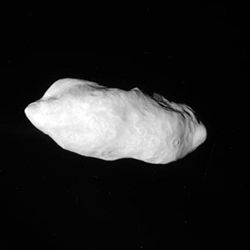
View on Wikipedia Prometheus image from Cassini (December 26, 2009) | |
| Discovery | |
|---|---|
| Discovered by | Stewart A. Collins D. Carlson Voyager 1 |
| Discovery date | 24 October 1980 |
| Designations | |
Designation | Saturn XVI |
| Pronunciation | /prəˈmiːθiːəs/[1] |
Named after | Προμηθεύς Promētheys |
| Adjectives | Promethean, -ian /prəˈmiːθiːən/[2] |
| Orbital characteristics [3] | |
| Epoch 31 December 2003 (JD 2453005.5) | |
| 139380±10 km | |
| Eccentricity | 0.0022 |
| 0.612990038 d | |
| Inclination | 0.008°±0.004° to Saturn's equator |
| Satellite of | Saturn |
| Group | Inner shepherd moon of the F Ring |
| Physical characteristics | |
| Dimensions | 137.0 × 81.0 × 56.2 km (± 1.0 × 2.8 × 0.8 km)[4]: 2 |
| 85.6±1.4 km[4]: 2 | |
| Volume | 327740±1710 km3[5]: 4 |
| Mass | (1.59720±0.00072)×1017 kg[a] |
Mean density | 0.4873±0.0026 g/cm3[5]: 4 |
| 0.0007–0.0056 m/s2[4]: 3 | |
| 0.018 km/s at longest axis to 0.028 km/s at poles | |
| synchronous | |
| zero | |
| Albedo | 0.6 |
| Temperature | ≈ 74 K |
Prometheus /prəˈmiːθiːəs/ is an inner satellite of Saturn. It was discovered on 24 October 1980 from images taken by the Voyager 1 probe, and was provisionally designated S/1980 S 27.[6]
In late 1985 it was officially named after Prometheus, a Titan in Greek mythology.[7] It is also designated Saturn XVI.[8]
Prometheus is extremely elongated, measuring approximately 137 km × 81 km × 56 km (85 mi × 50 mi × 35 mi). It has several ridges and valleys and a number of impact craters of about 20 km (12 mi) diameter are visible, but it is less cratered than nearby Pandora, Epimetheus, and Janus. From its very low density and relatively high albedo, it is likely that Prometheus is a very porous icy body. There is much uncertainty in these values, however, and so this remains to be confirmed.
Interactions with F Ring and other moons
[edit]Prometheus is a shepherd satellite for the inner edge of Saturn's narrow F Ring. Pandora orbits just outside the F Ring, and has traditionally been viewed as an outer shepherd of the ring; however, recent studies indicate that only Prometheus contributes to the confinement of the ring.[9][10]
Images from the Cassini probe show that Prometheus's gravitational influence creates kinks and knots in the F Ring as it shepherds material from it. The orbit of Prometheus appears to be chaotic, due to a series of four 121:118 mean-motion resonances with Pandora.[11] The most appreciable changes in their orbits occur approximately every 6.2 years,[3] when the periapsis of Pandora lines up with the apoapsis of Prometheus, as they approach to within approximately 1400 km. Prometheus is itself a significant perturber of Atlas, with which it is in a 53:54 mean-longitude resonance.[3]
Selected images
[edit]-
 Prometheus pulling material from the F Ring
 -
 Prometheus tugging kinks into the F Ring
 -
 Voyager 2 (August 25, 1981) image
 -
 Cassini image (with moon's Saturn-facing end at lower right) reveals a surface covered with a blanket of fine material.
 -
 Image from Jan. 27, 2010. Saturnshine illuminates the moon's night side.
 -
 Brightened version of same image
 -
 Prometheus flyby
(December 6, 2015)


Animations
[edit]-
Prometheus collides with the F ring, pulls a streamer, and leaves behind a dark channel. 12 seconds 107 kbit/s
-
Movie of Prometheus and the F Ring looped once. 5 seconds 48 kbit/s
Notes
[edit]- ^ Calculated from the standard gravitational parameter GM = (1.06602±0.00048)×10−2 km3·s–2 given by Lainey et al. (2023), divided by the gravitational constant G = 6.6743×10⁻² km3·kg–1·s–2.[5]
References
[edit]Citations
[edit]- ^ "Prometheus". Lexico UK English Dictionary. Oxford University Press. Archived from the original on March 20, 2020.
- ^ "Promethean". Lexico UK English Dictionary UK English Dictionary. Oxford University Press. Archived from the original on March 20, 2020.
- ^ a b c Spitale Jacobson et al. 2006.
- ^ a b c Thomas & Helfenstein 2020.
- ^ a b c Lainey et al. 2023.
- ^ IAUC 3532.
- ^ IAUC 4157.
- ^ USGS: Planet and Satellite Names and Discoverers.
- ^ Lakdawalla, E. (2014-07-05). "On the masses and motions of mini-moons: Pandora's not a "shepherd," but Prometheus still is". Planetary Society. Retrieved 2015-04-17.
- ^ Cuzzi, J. N.; Whizin, A. D.; Hogan, R. C.; Dobrovolskis, A. R.; Dones, L.; Showalter, M. R.; Colwell, J. E.; Scargle, J. D. (April 2014). "Saturn's F Ring core: Calm in the midst of chaos". Icarus. 232: 157–175. Bibcode:2014Icar..232..157C. doi:10.1016/j.icarus.2013.12.027. ISSN 0019-1035.
- ^ Renner et al. 2005.
Sources
[edit]- Marsden, Brian G. (October 31, 1980). "Satellites of Saturn" (discovery). IAU Circular (3532). Retrieved 2011-12-29.
- Marsden, Brian G. (January 3, 1986). "Satellites of Saturn and Pluto" (naming the moon). IAU Circular (4157). Retrieved 2011-12-29.
- Renner, Stéfan F.; Sicardy, Bruno; French, Richard G. (March 2005). "Prometheus and Pandora: Masses and orbital positions during the Cassini tour". Icarus. 174 (1): 230–240. Bibcode:2005Icar..174..230R. doi:10.1016/j.icarus.2004.09.005.
- Spitale, J. N.; Jacobson, R. A.; Porco, C. C.; Owen, W. M. Jr. (2006). "The orbits of Saturn's small satellites derived from combined historic and Cassini imaging observations". The Astronomical Journal. 132 (2): 692–710. Bibcode:2006AJ....132..692S. doi:10.1086/505206.
- Thomas, P. C. (July 2010). "Sizes, shapes, and derived properties of the saturnian satellites after the Cassini nominal mission" (PDF). Icarus. 208 (1): 395–401. Bibcode:2010Icar..208..395T. doi:10.1016/j.icarus.2010.01.025. Archived from the original (PDF) on 2018-12-23. Retrieved 2015-09-04.
- USGS/IAU (July 21, 2006). "Planet and Satellite Names and Discoverers". Gazetteer of Planetary Nomenclature. USGS Astrogeology. Retrieved 2011-12-29.
- Thomas, P. C.; Helfenstein, P. (July 2020). "The small inner satellites of Saturn: Shapes, structures and some implications". Icarus. 344: 20. Bibcode:2020Icar..34413355T. doi:10.1016/j.icarus.2019.06.016. S2CID 197474587. 113355.
- Lainey, V.; Rambaux, N.; Cooper, N.; Dahoumane, R.; Zhang, Q. (February 2023). "Characterising the interior of five inner Saturnian moons using Cassini ISS data". Astronomy & Astrophysics. 670: 6. Bibcode:2023A&A...670L..25L. doi:10.1051/0004-6361/202244757. L25.
External links
[edit]
 Media related to Prometheus (moon) at Wikimedia Commons
- "Cassini–Huygens: Multimedia-Videos / Soft Collision". NASA. Archived from the original on 29 October 2007.
Prometheus slowly collides with the diffuse inner edge of Saturn's F ring ... pulls a streamer of material from the ring and leaves behind a dark channel.
- Prometheus Profile at NASA's Solar System Exploration site
- The Planetary Society: Prometheus
- 3-D anaglyph view of Prometheus
| Geography | |
|---|---|
| Moons | |
| Astronomy | |
| Exploration | |
| Related | |

Prometheus (moon)
View on GrokipediaDiscovered in October 1980 by the Voyager 1 spacecraft during its flyby of Saturn, it was initially designated S/1980 S 27.[1] Named after the Titan from Greek mythology who defied the gods by stealing fire for humanity, Prometheus orbits in a prograde direction just outside the F ring.[1]
With a mean radius of 43.1 kilometers (26.8 miles) and a diameter of about 86 kilometers (53 miles), Prometheus has an extremely elongated, potato-like shape due to its low gravity.[1] Its surface is pockmarked with craters reaching up to 20 kilometers (12.4 miles) in diameter, though it appears less cratered than neighboring moons like Pandora.[1] The moon's low density indicates it is likely a porous body composed mainly of water ice.[1] Prometheus orbits Saturn at an average distance of 139,000 kilometers (87,000 miles), completing one revolution every 14.7 hours.[1]
Detailed imaging by NASA's Cassini spacecraft, including close approaches such as one on December 6, 2015, revealed Prometheus's dynamic interactions with the F ring, where its gravitational pull creates features like streamers, plumes, and channels as it passes through the ring's particles.[1][2] These observations highlighted how Prometheus "steals" ring material, contributing to the ring's evolving, braided structure.[3]
Discovery and Observation
Discovery
Prometheus was discovered on October 24, 1980, by astronomer Stewart A. Collins, D. Carlson, and members of the Voyager 1 imaging team.[4] The identification occurred through detailed analysis of photographs captured by the Voyager 1 spacecraft as it approached Saturn.[5] The moon's initial detection came from images showing an elongated object near the outer edges of Saturn's ring system, distinguishing it from previously known features.[1] It was provisionally designated S/1980 S 27, following the International Astronomical Union's naming convention for newly identified satellites.[6] This designation highlighted its status as the 27th such provisional discovery around Saturn in 1980, confirming it as a separate celestial body rather than an extension of the recently observed F Ring.[1] It was officially named Prometheus in late 1985. The Voyager 1 mission's Saturn encounter, beginning in early November 1980, provided the critical dataset for this breakthrough, with the spacecraft passing within 124,000 kilometers of the planet on November 12.[5] These observations expanded knowledge of Saturn's complex satellite system during the probe's grand tour of the outer solar system. Subsequent imaging from the Cassini orbiter in the 2000s offered higher-resolution confirmation of the moon's features.[1]Voyager Observations
Voyager 1 discovered Prometheus on October 24, 1980, while approaching the Saturn system, identifying it as a small inner moon from initial images taken by the spacecraft's imaging system. The probe achieved its closest approach to Saturn on November 12, 1980, passing within approximately 124,000 km of the planet's cloud tops and capturing low-resolution images of Prometheus near its orbital distance of about 139,000 km from Saturn's center. These early observations revealed the moon's highly irregular, potato-like shape but were limited by the spacecraft's distance and imaging capabilities, which provided only broad outlines without fine surface details.[7][1][4] Voyager 2 supplemented these findings during its Saturn encounter in August 1981, with closest approach to the planet on August 25 at about 101,000 km, offering additional views that confirmed Prometheus's elongated form and its close orbital proximity to the dynamic F Ring. Photometric analysis from both Voyagers yielded early estimates of the moon's dimensions at roughly 100 km across and a geometric albedo of around 0.6, suggesting a bright, icy surface consistent with other small Saturnian satellites.[8][4] The Voyager images were pivotal in highlighting Prometheus's influence on the F Ring, as they depicted prominent kinks and edge waves in the ring's inner boundary, indicating gravitational interactions that first suggested the moon's shepherding role in maintaining the ring's narrow structure. Despite these insights, the missions' low-resolution data—typically on the order of kilometers per pixel for distant shots—precluded any detailed mapping of surface features like craters or ridges. Subsequent observations by the Cassini spacecraft offered significantly higher resolution for refined analysis.[9]Cassini Observations
The Cassini spacecraft arrived at the Saturn system on July 1, 2004, entering orbit and commencing extensive observations of the planet's moons, including Prometheus. Initial imaging captured the moon's potato-like shape and its gravitational interactions with nearby ring material, providing early insights into its role as a shepherd satellite. These preliminary views, taken from distances of hundreds of thousands of kilometers, revealed a heavily cratered surface with prominent ridges and grooves, contrasting with the lower-resolution Voyager snapshots from 1980.[10] The mission's first targeted flyby of Prometheus occurred on December 26, 2009, approaching to a distance of approximately 59,000 km and yielding visible-light images that highlighted the moon's irregular, elongated form measuring roughly 137 km by 79 km by 59 km. Subsequent close approaches, including non-targeted passes in 2005 at distances exceeding 100,000 km, the January 27, 2010, encounter at about 34,000 km, and the December 6, 2015, flyby at 37,000 km, enabled high-resolution imaging with pixel scales as fine as 230 meters, resolving details of craters up to 20 km in diameter, elongated ridges, and grooved terrain suggestive of tidal reshaping. These multi-year observations documented subtle surface evolution, such as the appearance of fresh impact craters and modifications to ridge structures, attributed to ongoing meteoroid bombardment and internal stresses in the low-gravity environment.[11][12][13] Cassini imaging data facilitated precise measurements of Prometheus's rotational dynamics, confirming a synchronous rotational period of approximately 15 hours—matching its orbital period—and detecting physical libration with an amplitude of about 1°, indicative of a non-homogeneous interior and tidal influences from Saturn. The spacecraft's long-term monitoring, spanning over a decade, contributed significantly to ephemeris refinements through astrometric positions derived from thousands of images, improving orbital predictions to within a few kilometers by the mission's end in September 2017. Post-mission analyses of archived Cassini data have further enhanced these models; for instance, a 2023 study reprocessed 2,635 astrometric measurements to refine orbital parameters and interior properties, incorporating updated Saturn gravity field data for greater accuracy.[14]Orbital Characteristics
Orbital Parameters
Prometheus orbits Saturn in a prograde, low-eccentricity path just interior to the F ring, with its motion governed by gravitational interactions within the Saturnian system. The semi-major axis of the orbit measures 139,380 ± 10 km, placing it at approximately 2.3 times Saturn's mean radius of 58,232 km.[15] The eccentricity is 0.0022, indicating a nearly circular trajectory.[16] The sidereal orbital period is 0.612990038 days, equivalent to roughly 14.7 hours.[16] The orbital inclination relative to Saturn's equatorial plane is 0.008° ± 0.004°, reflecting a close alignment with the planet's equator.[16] Current ephemerides provide the longitude of the ascending node as 0.0° and the argument of pericenter as 341.9° at epoch 2000 January 1.5 TDB.[15] These parameters define the basic Keplerian elements for Prometheus's orbit in Saturn-centric coordinates, where the radial distance follows the polar equation for an ellipse: with the semi-major axis, the eccentricity, and the true anomaly; given the small eccentricity, the orbit approximates a circle of radius .[15]| Parameter | Value | Unit |
|---|---|---|
| Semi-major axis | 139,380 ± 10 | km |
| Eccentricity | 0.0022 | - |
| Orbital period | 0.612990038 (≈14.7 h) | days |
| Inclination | 0.008° ± 0.004° | degrees |
| Longitude of ascending node | 0.0° | degrees |
| Argument of pericenter | 341.9° | degrees |
Resonances and Orbital Chaos
Prometheus and Pandora, the inner and outer shepherd moons of Saturn's F ring, interact through a 121:118 mean motion resonance that drives significant orbital chaos. This resonance arises from the near commensurability of their orbital periods, where 121 orbits of Prometheus closely match 118 orbits of Pandora, leading to repeated close approaches and gravitational exchanges of angular momentum and energy between the two bodies. As a result, their orbits exhibit chaotic behavior, with observable drifts in longitude of about 20 degrees relative to Keplerian predictions over the two decades between Voyager and Cassini observations.[17][18][19] The chaotic evolution manifests on a Lyapunov timescale of approximately 3.3 years, during which small perturbations amplify exponentially, but significant structural changes, such as jumps in pericenter longitude by up to 20 degrees, occur roughly every 20–30 years as the satellites' apses anti-align approximately every 6.2 years, amplifying resonant torques. In mathematical terms, the resonance condition is defined by the ratio of orbital periods satisfying for integers and , where the associated critical argument librates or circulates, but the overlap of four apse-type sub-resonances destabilizes the motion into chaos. These interactions cause periodic swaps in semi-major axis and eccentricity, with the inner moon temporarily adopting a slightly larger orbit and vice versa.[18][20][21] Prometheus also maintains a 53:54 mean motion resonance with the inner moon Atlas, positioning it as the dominant perturber and inducing chaos in Atlas's orbit with a Lyapunov time of about 10 years through coupled resonant forcing. Numerical simulations incorporating Cassini imaging data from 2004–2017 predict continued orbital shifts for Prometheus, including semi-major axis variations of several kilometers and longitude drifts exceeding 10 degrees by the 2030s, with pericenter jumps potentially altering its interaction geometry with ring particles.[22][23][24] These resonant dynamics underscore the confined nature of the chaos in Saturn's inner satellite system, where short-term unpredictability coexists with long-term stability over billions of years, as the overlapping resonances prevent wholesale ejection while allowing gradual evolution that shapes the overall architecture of the ring-moon subsystem.[18][25]Physical Characteristics
Size and Shape
Prometheus exhibits a highly elongated, irregular shape, often described as resembling a peanut or walnut due to its triaxial form. Its dimensions along the principal axes measure 137.0 × 81.0 × 56.2 km, yielding an aspect ratio of approximately 2.4:1 between the longest and shortest axes.[26] The moon's volume is estimated at 327,740 ± 1,710 km³, corresponding to an equivalent spherical radius of about 43 km.[26] This mean radius aligns with NASA's measurement of 43.1 km, emphasizing its compact yet asymmetric structure.[1] Prometheus rotates synchronously with its orbital period of roughly 15 hours, maintaining a fixed orientation relative to Saturn, though observations indicate physical libration that introduces slight oscillations in its rotational motion. Like other small inner Saturnian moons such as Atlas (dimensions approximately 41 × 35 × 19 km) and Pandora (104 × 81 × 64 km), Prometheus displays a potato-like irregularity, likely shaped by accretion processes and impacts rather than tidal relaxation.[26] High-resolution images reveal subtle surface undulations that accentuate its overall geometric asymmetry.Surface Features
The surface of Prometheus is characterized by a heavily cratered terrain, as revealed by high-resolution images from the Cassini spacecraft. Numerous impact craters, some reaching diameters of up to 20 km, are distributed across its irregular, potato-like form, with particularly dense clustering observed on lower-elevation regions. These craters exhibit shallow depths and partial infilling by ejecta, indicative of a porous regolith that absorbs impact energy or experiences minor resurfacing.[28][29][30] Prominent ridges and bulges mark the moon's topography, especially in the northern hemisphere, alongside long scarps that delineate distinct higher and lower terrains, extending several kilometers in length. These linear features, including possible grooves and valleys, suggest structural boundaries possibly arising from internal stresses or differential impacts during the moon's formation. The overall morphology reflects an ancient surface, with the division between terrains hinting at early geological evolution.[31][30] Albedo variations appear as bright and dark patches on the surface, attributed to differences in regolith exposure and downslope transport of material in the low-gravity environment. Evidence of mass wasting is evident through subtle smoothing and color gradients, where fine particles migrate and alter local brightness, competing with ongoing cratering.[30] Comparisons between Voyager and Cassini observations show no major morphological changes, consistent with a surface age estimated at approximately 1 billion years, though minor impacts may have contributed to subtle modifications over time.[29][30]Composition and Density
Prometheus has a mean density of 0.4873 ± 0.0026 g/cm³, which is substantially lower than that of pure water ice (approximately 0.92 g/cm³), indicating a highly porous internal structure.[32] This low density suggests porosity levels of up to 50-60%, consistent with the moon's formation through collisional processes that left it as a loosely consolidated aggregate rather than a monolithic body.[32] The moon's mass is estimated at 1.597 × 10¹⁷ kg, derived from measurements of its gravitational influence on nearby ring particles and combined with volume estimates from Cassini imaging.[32] The primary composition of Prometheus is dominated by water ice, inferred from its high albedo (around 0.6) and spectral signatures observed by the Cassini spacecraft, which show strong reflectance in the visible and near-infrared consistent with icy surfaces.[33] Trace amounts of organics or silicates may be present as non-ice contaminants, similar to those in Saturn's rings, contributing to subtle darkening on the surface but not altering the overall icy dominance.[33] Its porous structure is likely that of a rubble pile, formed by the accumulation of loosely bound icy aggregates from ring debris around a pre-existing core, as supported by dynamical models of its growth. The equilibrium surface temperature of Prometheus is approximately 74 K, reflecting its distance from the Sun and lack of significant internal heat sources.[1] The moon's formation remains speculative, but evidence points to origins in the early Solar System, possibly through fragmentation of a larger parent body or capture from a disrupted satellite, leading to its current irregular, porous form amid Saturn's ring system.[33]Role as a Shepherd Moon
Shepherding the F Ring
Prometheus serves as the inner shepherd moon for Saturn's F Ring, gravitationally confining its inner edge through periodic perturbations that prevent the ring particles from spreading outward.[34] These interactions primarily occur via gravitational wakes from periodic close encounters and corotation-eccentricity resonances, such as the 110:109 CER, where the differential orbital motion between Prometheus and the ring particles generates inward-directed torques on the ring material.[35] During each orbital period of approximately 14.7 hours, Prometheus approaches within about 139 km of the F Ring's inner edge, creating temporary distortions as its gravity tugs on nearby particles.[34] This results in observable features such as kinks, knots, and streamer-channels along the inner edge, where particles are displaced into elongated structures that shear apart over time.[36] The mechanism involves ring particles entering short-lived horseshoe orbits relative to Prometheus during close encounters, which contribute to the excitation of density waves that propagate through the ring.[37] NASA's Cassini spacecraft documented these dynamics through time-lapse imaging, revealing the formation and azimuthal propagation of knots consistent with resonance models.[38] The perturbing gravitational force from Prometheus on individual ring particles is approximated by , where is the gravitational constant, is Prometheus' mass (about kg), and is the distance to the affected particles, on the order of 100 km during encounters.[34] Prometheus' mildly chaotic orbit further amplifies these periodic effects over longer timescales.[34] Recent analysis indicates that the F ring possesses a stable "true core" of larger particles (> few mm in size), dominating its mass and confined in discontinuous short arcs spanning ~3.3° azimuthally via the m=110 corotation-eccentricity resonance with Prometheus; this confinement is intermittent, with disruptions such as a glitch observed in 2013.[34]Interactions with Other Moons
Prometheus and Pandora act as co-shepherding moons for Saturn's F ring, with their mutual gravitational perturbations confining the ring's particles; Prometheus primarily influences the inner edge, while Pandora constrains the outer edge. These interactions occur through periodic gravitational encounters, occurring approximately every 28 days when Pandora passes interior to Prometheus, exchanging momentum that maintains the ring's narrow structure despite the moons' chaotic orbits.[39] The two moons are locked in a 121:118 mean-motion resonance, which splits into four overlapping components due to apsidal differences, leading to chaotic orbital behavior with a Lyapunov exponent of approximately 0.3 yr⁻¹.[40] This resonance drives energy exchanges via separatrix crossings in the phase space, causing irregular jumps in their mean motions and semi-major axes on decadal timescales, with significant swaps occurring roughly every 25 years as the system transitions between libration states.[40] These variations result from the resonance's sensitivity to the 6.2-year precession cycle, where antialignment of periapses amplifies perturbations, rendering long-term predictions unreliable.[40] Prometheus also perturbs Atlas through a 54:53 co-rotation-eccentricity resonance (CER) coupled with an inner Lindblad resonance (ILR), inducing chaotic libration in Atlas's orbit with a Lyapunov time of about 10 years.[41] This interaction confines Atlas to a horseshoe-like path around Prometheus's orbital trajectory, with irregular radial excursions driven by the resonant arguments φ₁ = 54λ_Prom - 53λ_Atlas - ϖ_Atlas and φ₂ = 54λ_Prom - 53λ_Atlas - ϖ_Prom.[41] Cassini Imaging Science Subsystem observations from February 2004 to August 2013, comprising 2580 astrometric measurements, revealed correlated orbital drifts in Atlas's longitude and semi-major axis directly tied to Prometheus's position, confirming the resonance's influence through episodes of short circulation interspersed with libration.[41] Over millennial timescales, these inter-moon dynamics contribute to the instability of Saturn's inner satellite system, as the chaotic exchanges in the Prometheus-Pandora pair can lead to orbital convergence and ejection risks within 20 million years without external damping.[25] Numerical simulations of three-body interactions involving Prometheus, Pandora, and F ring test particles demonstrate how mutual resonances create stable particle accumulations at specific locations (e.g., near Prometheus's 119:1 outer Lindblad resonance) while expelling unstable ones, thus aiding long-term confinement amid chaos.Media and Visualizations
Selected Images
The Voyager 1 spacecraft captured the first clear images of Prometheus in 1980, revealing its highly elongated shape silhouetted against the narrow F Ring and confirming its role as a small inner moon.[1] These early views, taken during the probe's flyby of Saturn, provided initial estimates of the moon's irregular form but were limited in resolution, spanning several kilometers per pixel.[42] A significant advancement came from NASA's Cassini spacecraft, which obtained a high-resolution close-up of Prometheus on December 26, 2009, at a distance of approximately 57,000 kilometers, achieving an image scale of 339 meters per pixel. This narrow-angle camera image, credited to NASA/JPL/Space Science Institute, illuminated the moon's leading hemisphere and exposed fine surface details such as numerous impact craters, refining prior size measurements to about 86 kilometers across.[1] Composite images from the same Cassini flyby combine multiple wavelengths to highlight albedo contrasts across Prometheus's potato-like surface, emphasizing brighter and darker regions that suggest varying material compositions or ages. These multi-view composites, also credited to NASA/JPL/Space Science Institute, enhanced understanding of the moon's irregular topography by detecting subtle ridges and enhancing contrast in low-light areas illuminated by Saturnshine. Such visualizations have been used to derive animations from sequential image sets, illustrating the moon's rotation.Animations
One prominent animation derived from NASA's Cassini spacecraft data illustrates Prometheus's orbital path around Saturn over approximately one orbital period of 14.7 hours, highlighting its gravitational interactions with the F ring. Captured on January 30, 2009, the sequence depicts the moon's eccentric orbit pulling icy particles from the ring's inner edge, forming elongated trails 75 to 250 kilometers long as Prometheus drags material outward.[43] This visualization, released in 2012, uses 11 hours and 5 minutes of imaging to show the dynamic sculpting effect, with Prometheus appearing as a potato-shaped body perturbing the ring's diffuse structure.[43] A key simulation of knot formation in the F ring draws from 2009 Cassini flyby observations, presenting a time-lapse of streamer-channels created by Prometheus's passages. Developed by the Cassini imaging team, this 2010 animation models an 8-day initial encounter followed by a 4-day return 60 days later, demonstrating how the moon's gravity bunches ring particles into dense clumps up to 20 kilometers across, evolving into "giant snowballs" at channel edges over 72 days.[44][45] The sequence underscores the moon's role in generating transient knots through repeated disruptions, with particles clumping due to self-gravity in the stirred ring material.[45] Visualizations of the 121:118 resonance between Prometheus and Pandora utilize numerical models to depict their orbital interactions, showing the chaotic drift resulting from overlapping mean-motion components. A 2015 Cassini-based animation captures both moons' motions over several hours, illustrating Pandora's outer orbit stabilizing the ring's edge while Prometheus's inner path creates braided structures and dispersing knots, reflecting the resonance-driven chaos.[46] This 98-frame sequence, compiled from images taken 163 seconds apart and played at 20 frames per second initially, highlights the moons' relative speeds and eccentricities exchanging angular momentum.[46] NASA animations from 2010 onward, including 3D rotations of Prometheus's irregular shape, provide additional perspectives on its dynamics. A 2010 composite animation rotates the moon based on Cassini images, revealing its 148-kilometer length and potato-like form derived from stereo views, emphasizing surface irregularities illuminated by Saturn's light.[47] These resources, often built using NASA's SPICE kernels for precise ephemeris data, run at variable frame rates (e.g., 2-20 fps) to simulate real-time motion.[44][47] Such animations hold significant educational value by demonstrating the chaotic evolution of Prometheus's orbit over approximately 20 years, as predicted by resonance models, where longitude drifts accumulate due to mutual perturbations with Pandora.[17] They illustrate how these dynamics sustain the F ring's variability without requiring exhaustive computations, offering insights into shepherd moon behavior in planetary ring systems.[46] Static images occasionally serve as keyframes in these sequences to anchor the motion.References
- https://science.[nasa](/page/NASA).gov/saturn/moons/prometheus/