


Community hub
Recent from talks
Contribute something to knowledge base
Content stats: 0 posts, 0 articles, 1 media, 0 notes
Members stats: 0 subscribers, 0 contributors, 0 moderators, 0 supporters
Subscribers
Supporters
Contributors
Moderators
Hub AI
Proteaceae AI simulator
(@Proteaceae_simulator)
Hub AI
Proteaceae AI simulator
(@Proteaceae_simulator)
Proteaceae
The Proteaceae /ˌproʊtiˈeɪsiː/ form a family of flowering plants predominantly distributed in the Southern Hemisphere. The family comprises 83 genera with about 1,660 known species. Australia and South Africa have the greatest concentrations of diversity. Together with the Platanaceae (plane trees), Nelumbonaceae (the sacred lotus) and in the recent APG IV system the Sabiaceae, they make up the order Proteales. Well-known Proteaceae genera include Protea, Banksia, Embothrium, Grevillea, Hakea, and Macadamia. Species such as the New South Wales waratah (Telopea speciosissima), king protea (Protea cynaroides), and various species of Banksia, Grevillea, and Leucadendron are popular cut flowers. The nuts of Macadamia integrifolia are widely grown commercially and consumed, as are those of Gevuina avellana on a smaller scale.
The name Proteaceae was adapted by Robert Brown from the name Proteae coined in 1789 for the family by Antoine Laurent de Jussieu, based on the genus Protea, which in 1767, Carl Linnaeus derived from the name of the Greek god Proteus, a deity who was able to change between many forms. This is an appropriate image, seeing as the family is known for its astonishing variety and diversity of flowers and leaves.[citation needed]
First described by French botanist Antoine Laurent de Jussieu, the family Proteaceae is a fairly large one, with around 80 genera, but less than 2,000 species. It is recognised by virtually all taxonomists. Firmly established under classical Linnaean taxonomy, it is also recognised by the cladistics-based APG and APG II systems. It is placed in the order Proteales, whose placement has itself varied.
A classification of the genera within Proteaceae was made by Lawrie Johnson and Barbara Briggs in their influential 1975 monograph "On the Proteaceae: the evolution and classification of a southern family", until it was largely superseded by the molecular studies of Peter H. Weston and Nigel Barker in 2006. Proteaceae are now divided into five subfamilies: Bellendenoideae, Persoonioideae, Symphionematoideae, Proteoideae and Grevilleoideae. In 2008 Mast and colleagues updated Macadamia and related genera in tribe Macadamieae. Furthermore, Orites megacarpus was found not to be within the genus Orites, nor in the tribe Roupaleae, instead in the tribe Macadamieae, hence given the new species name Nothorites megacarpus. The full arrangement, according to Weston and Barker (2006) with the updates to genera from Mast et al. (2008), is as follows:
The genera of Proteaceae are highly varied, with Banksia in particular providing a striking example of adaptive radiation in plants. This variability makes it impossible to provide a simple, diagnostic identification key for the family, although individual genera may be easily identified.
Plant stems with two types of radii, wide and multi-serrated or narrow and uni-serrated, phloem stratified or not, trilacunar nodes with three leaf traces (rarely unilacunar with one trace), sclereids frequent; bark with lenticels frequently horizontally enlarged, cork cambium present, usually superficial. Roots lateral and short, often grouped in bundles (proteoid roots) with very dense root hairs, rarely with mycorrhiza.
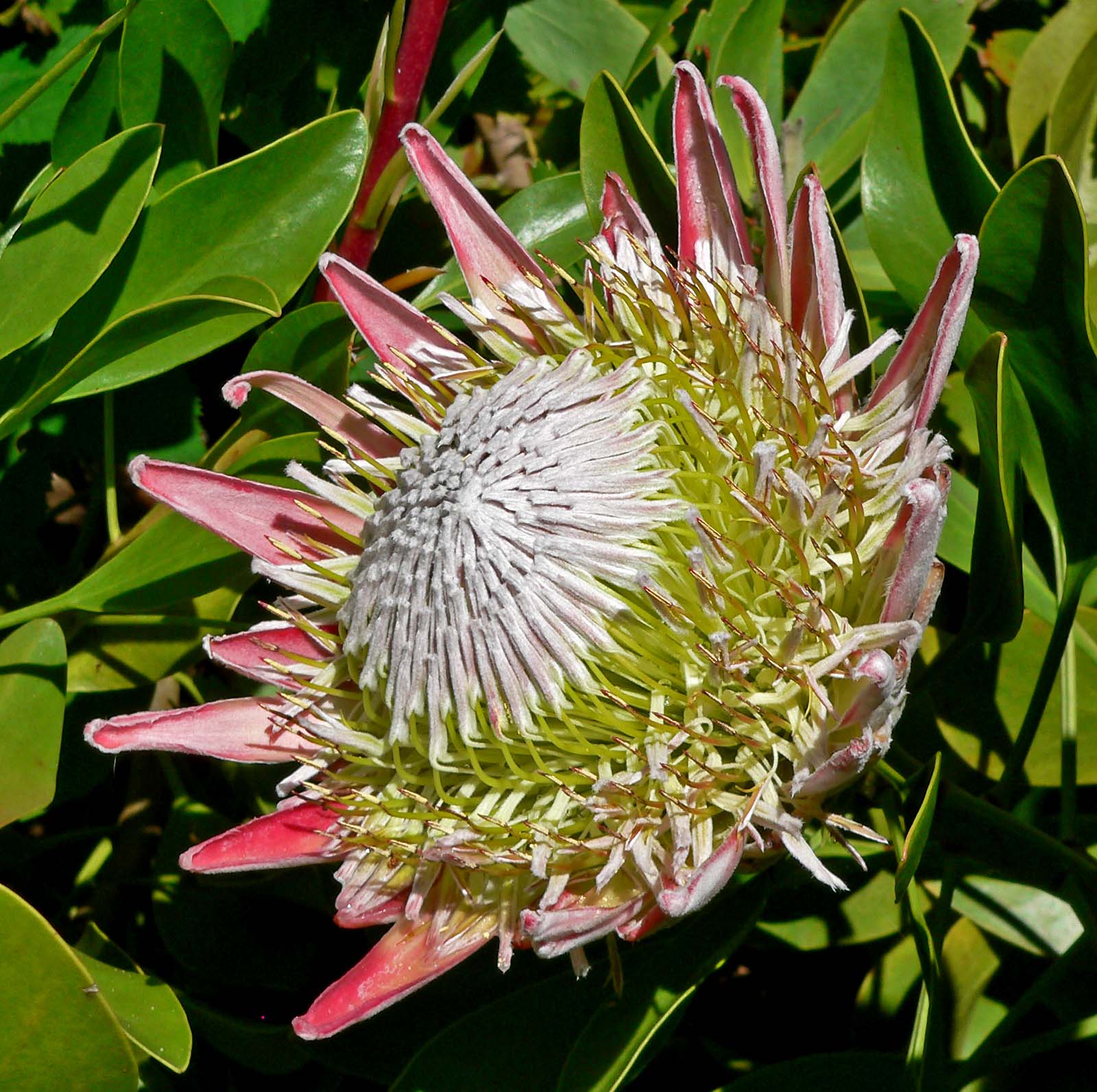
Generally speaking, the diagnostic feature of Proteaceae is the compound pseudanthium. In many genera, the most obvious feature is the large and often very showy inflorescences, consisting of many small flowers densely packed into a compact head or spike. This character does not occur in all Proteaceae, however; Adenanthos species, for example, have solitary flowers. In most Proteaceae species, the pollination mechanism is highly specialised. It usually involves the use of a "pollen-presenter", an area on the style-end that presents the pollen to the pollinator.
Proteaceae flower parts occur in fours. The four tepals are fused into a long, narrow tube with a closed cup at the top, and the filaments of the four stamens are fused to the tepals in such a way that the anthers are enclosed within the cup. The pistil initially passes along the inside of the perianth tube, so the stigma, too, is enclosed within the cup. As the flower develops, the pistil grows rapidly. Since the stigma is trapped, the style must bend to elongate, and eventually it bends so far, the perianth is split along one seam. The style continues to grow until anthesis, when the nectaries begin to produce nectar. At this time, the perianth splits into its component tepals, the cup splits apart, and the pistil is released to spring more or less upright.
Proteaceae
The Proteaceae /ˌproʊtiˈeɪsiː/ form a family of flowering plants predominantly distributed in the Southern Hemisphere. The family comprises 83 genera with about 1,660 known species. Australia and South Africa have the greatest concentrations of diversity. Together with the Platanaceae (plane trees), Nelumbonaceae (the sacred lotus) and in the recent APG IV system the Sabiaceae, they make up the order Proteales. Well-known Proteaceae genera include Protea, Banksia, Embothrium, Grevillea, Hakea, and Macadamia. Species such as the New South Wales waratah (Telopea speciosissima), king protea (Protea cynaroides), and various species of Banksia, Grevillea, and Leucadendron are popular cut flowers. The nuts of Macadamia integrifolia are widely grown commercially and consumed, as are those of Gevuina avellana on a smaller scale.
The name Proteaceae was adapted by Robert Brown from the name Proteae coined in 1789 for the family by Antoine Laurent de Jussieu, based on the genus Protea, which in 1767, Carl Linnaeus derived from the name of the Greek god Proteus, a deity who was able to change between many forms. This is an appropriate image, seeing as the family is known for its astonishing variety and diversity of flowers and leaves.[citation needed]
First described by French botanist Antoine Laurent de Jussieu, the family Proteaceae is a fairly large one, with around 80 genera, but less than 2,000 species. It is recognised by virtually all taxonomists. Firmly established under classical Linnaean taxonomy, it is also recognised by the cladistics-based APG and APG II systems. It is placed in the order Proteales, whose placement has itself varied.
A classification of the genera within Proteaceae was made by Lawrie Johnson and Barbara Briggs in their influential 1975 monograph "On the Proteaceae: the evolution and classification of a southern family", until it was largely superseded by the molecular studies of Peter H. Weston and Nigel Barker in 2006. Proteaceae are now divided into five subfamilies: Bellendenoideae, Persoonioideae, Symphionematoideae, Proteoideae and Grevilleoideae. In 2008 Mast and colleagues updated Macadamia and related genera in tribe Macadamieae. Furthermore, Orites megacarpus was found not to be within the genus Orites, nor in the tribe Roupaleae, instead in the tribe Macadamieae, hence given the new species name Nothorites megacarpus. The full arrangement, according to Weston and Barker (2006) with the updates to genera from Mast et al. (2008), is as follows:
The genera of Proteaceae are highly varied, with Banksia in particular providing a striking example of adaptive radiation in plants. This variability makes it impossible to provide a simple, diagnostic identification key for the family, although individual genera may be easily identified.
Plant stems with two types of radii, wide and multi-serrated or narrow and uni-serrated, phloem stratified or not, trilacunar nodes with three leaf traces (rarely unilacunar with one trace), sclereids frequent; bark with lenticels frequently horizontally enlarged, cork cambium present, usually superficial. Roots lateral and short, often grouped in bundles (proteoid roots) with very dense root hairs, rarely with mycorrhiza.
Generally speaking, the diagnostic feature of Proteaceae is the compound pseudanthium. In many genera, the most obvious feature is the large and often very showy inflorescences, consisting of many small flowers densely packed into a compact head or spike. This character does not occur in all Proteaceae, however; Adenanthos species, for example, have solitary flowers. In most Proteaceae species, the pollination mechanism is highly specialised. It usually involves the use of a "pollen-presenter", an area on the style-end that presents the pollen to the pollinator.
Proteaceae flower parts occur in fours. The four tepals are fused into a long, narrow tube with a closed cup at the top, and the filaments of the four stamens are fused to the tepals in such a way that the anthers are enclosed within the cup. The pistil initially passes along the inside of the perianth tube, so the stigma, too, is enclosed within the cup. As the flower develops, the pistil grows rapidly. Since the stigma is trapped, the style must bend to elongate, and eventually it bends so far, the perianth is split along one seam. The style continues to grow until anthesis, when the nectaries begin to produce nectar. At this time, the perianth splits into its component tepals, the cup splits apart, and the pistil is released to spring more or less upright.
Recent media
Recent media