Hubbry Logo
ToltecToltecMain
Open search
Toltec
Community hub
Toltec
logo
8 pages, 0 posts
0 subscribers
Be the first to start a discussion here.
Toltec
Toltec
from Wikipedia

Toltec
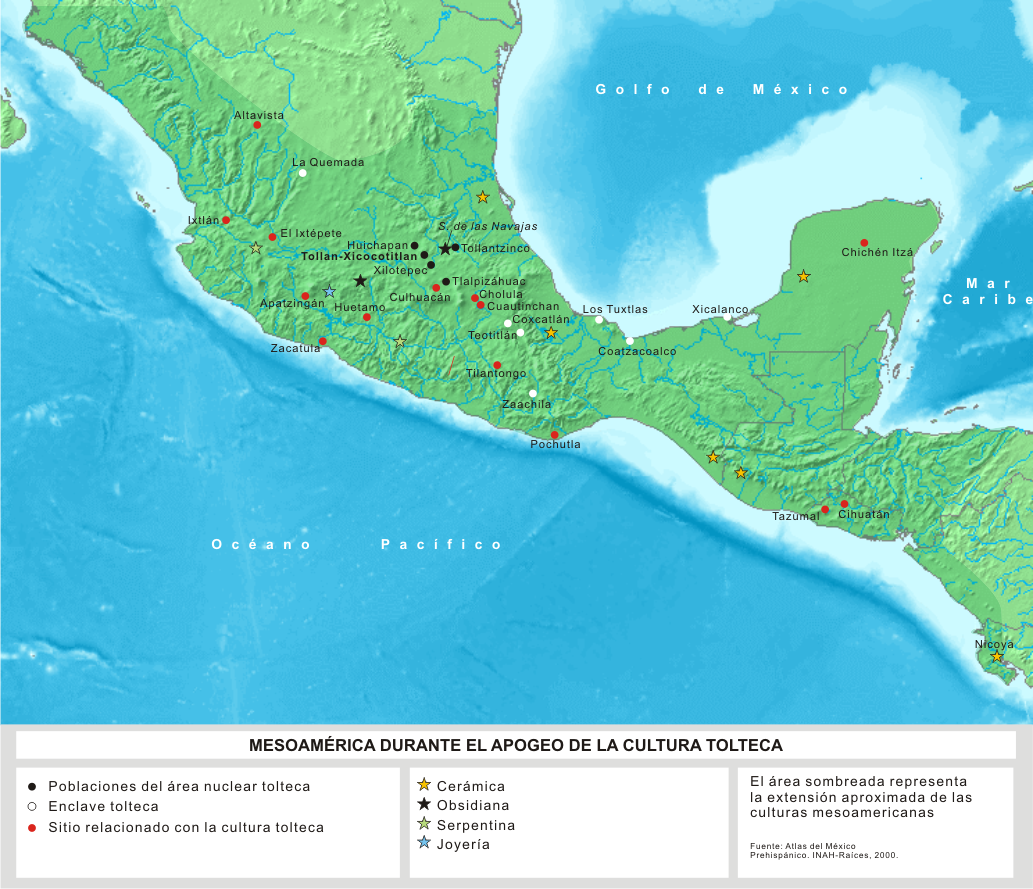
Distribution and influence of the Toltecs in Mesoamerica
ReligionToltec religion
LanguageNahuatl, Otomi
Geographical rangeMesoamerica (historically)
PeriodPostclassic Period
Datesc. 950–1168
Major sites Tollan-Xicocotitlan (capital), Huapalcalco
Preceded by Teotihuacan, Calakmul, Mezcala culture, Otomi, Chupícuaro, Coba, Chichen Itza, Puuc
Followed byLeague of Mayapan, Totonacapan, Azcapotzalco, Acolhua, Ecatepec, Chalco
Cause of collapseArrival of Chichimec peoples who conquered Tula
A Toltec-style clay vessel (American Museum of Natural History).

The Toltec culture (/ˈtɒltɛk/) was a pre-Columbian Mesoamerican culture that ruled a state centered in Tula, Hidalgo, Mexico, during the Epiclassic and the early Post-Classic period of Mesoamerican chronology, reaching prominence from 950 to 1150 CE.[1] The later Aztec culture considered the Toltec to be their intellectual and cultural predecessors and described Toltec culture emanating from Tōllān [ˈtoːlːãːn̥] (Nahuatl for Tula) as the epitome of civilization.[2] In the Nahuatl language the word Tōltēkatl [toːɬˈteːkat͡ɬ] (singular) or Tōltēkah [toːɬˈteːkaḁ] (plural) came to take on the meaning "artisan".[3] The Aztec oral and pictographic tradition also described the history of the Toltec Empire, giving lists of rulers and their exploits.

Modern scholars debate whether the Aztec narratives of Toltec history should be given credence as descriptions of actual historical events. While all scholars acknowledge that there is a large mythological part of the narrative, some maintain that, by using a critical comparative method, some level of historicity can be salvaged from the sources. Others maintain that continued analysis of the narratives as sources of factual history is futile and hinders access to learning about the culture of Tula.

Other controversies relating to the Toltec include the question of how best to understand the reasons behind the perceived similarities in architecture and iconography between the archaeological site of Tula and the Maya site of Chichén Itzá. Researchers are yet to reach a consensus in regard to the degree or direction of influence between these two sites.[4]

Origins of society at Tula

[edit]

While the exact origins of the culture are unclear, it likely developed from a mixture of the Nonoalca people from the southern Gulf Coast and a group of sedentary Chichimeca from northern Mesoamerica. The former of these is believed to have composed the majority of the new culture and were influenced by the Mayan culture.[5] During Teotihuacan's apogee in the Early Classic period, these people were tightly integrated into the political and economic systems of the state and formed large settlements in the Tula region, most notably Villagran and Chingu.[6]

Beginning around 650 CE, the majority of these settlements were abandoned as a result of Teotihuacan's decline. The Coyotlatelco rose as the dominant culture in the region. It is with the Coyotlatelco that Tula, as it relates to the Toltec, was founded along with a number of hilltop communities.[7]

Tula Chico, as the settlement is referred to during this phase, grew into a small regional state out of the consolidation of the surrounding Coyotlatelco sites. The settlement was roughly three to six square kilometers in size with a gridded urban plan and a relatively large population.[8] The complexity of the main plaza was especially distinct from other Coyotlatelco sites in the area, as it had multiple ball courts and pyramids. The Toltec culture, as it is understood during its peak, can be tied directly to Tula Chico; after the site was burned and abandoned at the end of the Epiclassic period, Tula Grande was soon constructed bearing strong similarities 1.5 kilometers to the south.[9] It is during the Early Postclassic period that Tula Grande and its associated Toltec culture would become the dominant force in the broader region.

Archaeology

[edit]
Pyramid C at Tula, Hidalgo

Some archaeologists, such as Richard Diehl, argue for the existence of a Toltec archaeological horizon characterized by certain stylistic traits associated with Tula, Hidalgo and extending to other cultures and polities in Mesoamerica. Traits associated with this horizon are include the Mixtec-Puebla style[10] of iconography, Tohil plumbate ceramic ware, and Silho or X-Fine Orange Ware ceramics.[11] The presence of stylistic traits associated with Tula in Chichén Itzá is also taken as evidence for a Toltec horizon. The nature of interaction between Tula and Chichén Itzá has been especially controversial, with scholars arguing for either military conquest of Chichén Itzá by the Toltec, Chichén Itzá establishing Tula as a colony, or only loose connections between the two. Whether the Mixteca-Puebla art style has any meaning is also disputed.[12]

A contrary viewpoint is argued in a 2003 study by Michael E. Smith and Lisa Montiel, who compare the archaeological record related to Tula Hidalgo to those of the polities centered in Teotihuacan and Tenochtitlan. They conclude that relative to the influence exerted in Mesoamerica by Teotihuacan and Tenochtitlan, Tula's influence on other cultures was negligible and was probably not deserving of being defined as an empire, but more of a kingdom. While Tula does have the urban complexity expected of an imperial capital, its influence and dominance were not very far reaching.[13] Evidence for Tula's participation in extensive trade networks has been uncovered; for example, the remains of a large obsidian workshop.[14]

Material culture at Tula Grande

[edit]

At its height, Tula Grande had an estimated population of as many as 60,000 and covered 16 square kilometers of hills, plains, valleys, and marsh.[7] Some of the most prominent examples of the Toltec material culture at the site include pyramids, ball-courts, and the Atlantean warrior sculptures on top of Pyramid B.[15] Various civic buildings surrounding a central plaza are especially distinctive, as excavations show the use of columns inside these buildings and in surrounding colonnades. One of these buildings, known as Building 3, is argued to have been a symbolically powerful building for the Toltec due to its reference in architecture to the historic and mythic homes of the people's ancestors.[16]

The physical layout of the broader plaza also partakes in referencing a shared past; its sunken colonnaded hall units are incredibly similar to those at cities of Tula's ancestral peoples. Importantly, these halls are known to have served as places to engage with both regional and long-distance trade networks and were possibly also used for diplomatic relations, suggesting that Tula Grande used these structures for a similar end. To that point, imported goods at Tula Grande shows that the Toltecs indeed interacted commercially with sites throughout Mesoamerica; shared ceramic and ritual figurine styles between Tula and regions such as Socunusco supplement this idea.[15][7]

Additionally, surveys of Tula Grande have suggested the existence of an "extensive and highly specialized workshop-based obsidian industry," at the site that could have been one of the sources of the city's economic and political power, taking on Teotihuacan's previous role as the region's distributor.[7] A survey done by Healan et al. recovered roughly 16,000 pieces of obsidian from the site's urban zone and over 25,000 from its surrounding residential areas. Tula's involvement in obsidian trade is also evidence for the city's interaction with another powerful city in the region, Chichén Itzá, as the vast majority of obsidian at both sites comes from the same two geological sources.

History of research

[edit]
Tempo Tlahuizcalpantecuhtl (Pyramid B), the largest structure at the Tula archaeological site. Atlantean figures are on its apex.
Stucco relief at Tula: coyotes, jaguars and eagles feast on human hearts.
Carved relief of a jaguar at Tula

One of the earliest historical mentions of Toltecs was in the 16th century by the Dominican friar Diego Durán, who was best known for being one of the first westerners to study the history of Mesoamerica. Durán's work remains relevant to Mesoamerican societies, and based on his findings Durán claims that the Toltecs were disciples of the "High Priest Topiltzin."[17] Topiltzin and his disciples were said to have preached and performed miracles. "Astonished, the people called these men Toltecs," which Duran says, "means Masters, or Men Wise in Some Craft."[18] Duran speculated that this Topilzin may have been the Thomas the Apostle sent to preach the Christian Gospel among the "Indians", although he provides nothing more than circumstantial evidence of any contact between the hemispheres.

The later debate about the nature of the Toltec culture goes back to the late 19th century. Mesoamericanist scholars such as Mariano Veytia, Manuel Orozco y Berra, Charles Etienne Brasseur de Bourbourg, and Francisco Clavigero all read the Aztec chronicles and believed them to be realistic historic descriptions of a pan-Mesoamerican empire based at Tula, Hidalgo.[19] This historicist view was first challenged by Daniel Garrison Brinton who argued that the "Toltecs" as described in the Aztec sources were merely one of several Nahuatl-speaking city-states in the Postclassic period, and not a particularly influential one at that. He attributed the Aztec view of the Toltecs to the "tendency of the human mind to glorify the good old days" and the confounding of the place of Tollan with the myth of the struggle between Quetzalcoatl and Tezcatlipoca.[20] Désiré Charnay, the first archaeologist to work at Tula, Hidalgo, defended the historicist views based on his impression of the Toltec capital, and was the first to note similarities in architectural styles between Tula and Chichén Itza. This led him to posit the theory that Chichén Itzá had been violently taken over by a Toltec military force under the leadership of Kukulcan.[21][22] Following Charnay the term Toltec has since been associated with the influx of certain Central Mexican cultural traits into the Maya sphere of dominance that took place in the late Classic and early Postclassic periods; the Postclassic Mayan civilizations of Chichén Itzá, Mayapán and the Guatemalan highlands have been referred to as "Toltecized" or "Mexicanized" Mayas.

The historicist school of thought persisted well into the 20th century, represented in the works of scholars such as David Carrasco, Miguel León-Portilla, Nigel Davies and H. B. Nicholson, which all held the Toltecs to have been an actual ethnic group. This school of thought connected the "Toltecs" to the archaeological site of Tula, which was taken to be the Tollan of Aztec myth.[23] This tradition assumes that much of central Mexico was dominated by a Toltec Empire between the 10th and 12th century AD. The Aztecs referred to several Mexican city states as Tollan, "Place of Reeds", such as "Tollan Cholollan". Archaeologist Laurette Séjourné, followed by the historian Enrique Florescano, have argued that the "original" Tollan was probably Teotihuacán.[24] Florescano adds that the Mayan sources refer to Chichén Itzá when talking about the mythical place Zuyua (Tollan).[citation needed]

Many historicists such as H. B. Nicholson (2001 (1957)) and Nigel Davies (1977) were fully aware that the Aztec chronicles were a mixture of mythical and historical accounts; this led them to try to separate the two by applying a comparative approach to the varying Aztec narratives. For example, they seek to discern between the deity Quetzalcoatl and a Toltec ruler often referred to as Topiltzin Ce Acatl Quetzalcoatl.[4]

Toltecs as myth

[edit]
Depiction of an anthropomorphic bird-snake deity, probably Quetzalcoatl at the Temple of Tlahuizcalpantecuhtli at Tula, Hidalgo
View of the columns of the burned palace at Tula Hidalgo. The second ballcourt is in the background.
Toltec warriors represented by the famous Atlantean figures in Tula.
Toltec carving representing the Aztec eagle, found in Veracruz, 10th–13th century. Metropolitan Museum of Art.[25]

Since the 1990s, the historicist position has fallen out of favor for a more critical and interpretive approach to the historicity of the Aztec mythical accounts based on the original approach of Brinton. This approach applies a different understanding of the word Toltec to the interpretation of the Aztec sources, interpreting it as largely a mythical and philosophical construct by either the Aztecs or Mesoamericans generally that served to symbolize the might and sophistication of several civilizations during the Mesoamerican Postclassic period. The Nahuatl word for 'Toltec', for example, can mean 'master artisan' as well as 'inhabitant of Tula, Hidalgo', and the word Tollan (known as Tula in modern times) can refer specifically to Tula, Hidalgo, or more generally to all great cities through meaning 'place of the reeds'.[2]

Much of the questioning of these Aztec narratives is due to the lack of archaeological evidence to support them. Aztec accounts tell that the Toltec discovered medicine, designed the calendar system, created the Nahuatl language. More broadly, the Aztec traced most of their own societal achievements to the Toltec and their city Tollan, which was idolized as the epitome of state civilization with an enormous influence in the surrounding region. However, Tula—the site attributed with this Tollan—lacks much of the splendor that the Aztecs describe. For example, Tula was mainly built out of the relatively soft and unimpressive adobe brick, and while Tula certainly was a major regional city in its time, it was minuscule both in population and in influence in comparison to both its predecessor, Teotihuacan, and its Aztec descendant, Tenochtitlan.[2] Additional material remains at Tula, such as the destruction of Toltec buildings and monumental art coinciding with the arrival of Aztec ceramics, suggest that the Aztecs' reverence of the Toltec might have been mostly propagandistic, intentionally overexaggerating the previous culture to use it as a steppingstone for their own.[2]

Scholars such as Michel Graulich (2002) and Susan D. Gillespie (1989) maintained that the difficulties in salvaging historic data from the Aztec accounts of Toltec history are too great to overcome. For example, there are two supposed Toltec rulers identified with Quetzalcoatl: the first ruler and founder of the Toltec dynasty and the last ruler, who saw the end of the Toltec glory and was forced into humiliation and exile. The first is described as a valiant triumphant warrior, but the last as a feeble and self-doubting old man.[26] This caused Graulich and Gillespie to suggest that the general Aztec cyclical view of time,[citation needed] in which events repeated themselves at the end and beginning of cycles or eras was being inscribed into the historical record by the Aztecs, making it futile to attempt to distinguish between a historical Topiltzin Ce Acatl and a Quetzalcoatl deity.[27] Graulich argued that the Toltec era is best considered the fourth of the five Aztec mythical "Suns" or ages, the one immediately preceding the fifth Sun of the Aztec people, presided over by Quetzalcoatl. This caused Graulich to consider that the only possibly historical data in the Aztec chronicles are the names of some rulers and possibly some of the conquests ascribed to them.[27]

Furthermore, among the Nahuan peoples the word Tolteca was synonymous with artist, artisan or wise man, and Toltecayotl,[14] literally 'Toltecness', meant art, culture, civilization, and urbanism and was seen as the opposite of Chichimecayotl ('Chichimecness'), which symbolized the savage, nomadic state of peoples who had not yet become urbanized.[28] This interpretation argues that any large urban center in Mesoamerica could be referred to as Tollan and its inhabitants as Toltecs – and that it was a common practice among ruling lineages in Postclassic Mesoamerica to strengthen claims to power by asserting Toltec ancestry. Mesoamerican migration accounts often state that Tollan was ruled by Quetzalcoatl (or Kukulkan in Yucatec and Q'uq'umatz in Kʼicheʼ), a godlike mythical figure who was later sent into exile from Tollan and went on to found a new city elsewhere in Mesoamerica. According to Patricia Anawalt, a professor of anthropology at UCLA, assertions of Toltec ancestry and claims that their elite ruling dynasties were founded by Quetzalcoatl have been made by such diverse civilizations as the Aztec, the Kʼicheʼ and the Itza' Mayas.[29]

While the skeptical school of thought does not deny that cultural traits of a seemingly central Mexican origin have diffused into a larger area of Mesoamerica, it tends to ascribe this to the dominance of Teotihuacán in the Classic period and the general diffusion of cultural traits within the region. Recent scholarship, then, does not see Tula, Hidalgo as the capital of the Toltecs of the Aztec accounts. Rather, it takes Toltec to mean simply an inhabitant of Tula during its apogee. Separating the term Toltec from those of the Aztec accounts, it attempts to find archaeological clues to the ethnicity, history and social organization of the inhabitants of Tula.[4]

See also

[edit]

References

[edit]

Further reading

[edit]
[edit]
Revisions and contributorsEdit on WikipediaRead on Wikipedia
from Grokipedia
The Toltecs were a civilization, often considered a cultural rather than strictly ethnic group, that flourished from approximately 900 to 1150 CE in central , with their capital at Tula (also known as Tollan) in the modern state of Hidalgo, north of . This Postclassic period culture is renowned for its militaristic expansion, sophisticated , and monumental architecture, including the iconic Pyramid B (Pyramid of the Morning Star) adorned with colossal Atlantean warrior statues. The Toltecs exerted profound influence across Mesoamerica, shaping the art, religion, and political structures of subsequent societies like the —who revered them as an idealized era of wisdom, craftsmanship, and divine rulership—and the Maya at sites such as , where Toltec-style elements like motifs and warrior imagery appear. Emerging in the wake of the Epiclassic period's disruptions following the decline of Teotihuacán around 650 CE, the Toltecs consolidated power through a combination of migration, , and conquest, establishing Tula as a major urban center that may have housed up to 40,000 inhabitants at its peak. Archaeological evidence from Tula reveals a society centered on a priestly-military , with key figures like the semi-legendary ruler Ce Acatl Topiltzin—often equated with the deity Quetzalcoatl—leading expansions that extended Toltec influence from the Basin of Mexico to the Yucatán Peninsula and possibly . Their economy relied on , including cultivation supported by irrigation systems and dry farming techniques, alongside extensive and featherwork networks that facilitated . Toltec religion blended polytheistic worship with rituals involving , emphasizing deities such as Quetzalcoatl (the feathered serpent) and (the smoking mirror), whose rivalry features prominently in ethnohistoric accounts recorded by later Aztec chroniclers. Artistic achievements included finely carved stone reliefs, pottery with militaristic motifs, and the widespread adoption of the ballgame, a ceremonial sport symbolizing cosmic battles. The civilization's decline around 1150–1200 CE is attributed to environmental stresses, such as prolonged droughts, internal civil wars—possibly triggered by factional conflicts between Quetzalcoatl's followers and rivals—and invasions by nomadic Chichimec groups, leading to Tula's abandonment and the fragmentation of Toltec political authority. Despite their fall, the Toltecs' legacy endured as a cultural , inspiring Aztec imperial ideology and contributing to the notion of a "" in Mesoamerican , though modern debates the extent of their territorial control versus ideological influence.

Etymology and Identity

Terminology and sources

The term "Toltec" originates from the plural form Tōltēkah, denoting the "inhabitants of Tollan," the Nahuatl name for the ancient city now known as Tula in central . This etymology reflects the cultural and linguistic associations of the Toltecs with their urban center, where Tollan translates to "place of reeds" or "among the rushes," symbolizing a foundational site in Mesoamerican narratives. Primary historical sources on the Toltecs derive from post-conquest Aztec codices and Spanish colonial records, which portray them as a civilized precursor society revered by later Nahua peoples. The (also known as Tira de la Peregrinación), a 16th-century Aztec manuscript, depicts the Toltecs within the broader migration history of the , positioning Tollan as a key waypoint and the Toltecs as exemplars of urban sophistication and artistic mastery. Similarly, the , compiled around 1550–1560, illustrates Toltec figures and events in its historical and divinatory sections, emphasizing their role as legendary builders and rulers who influenced subsequent Mesoamerican polities. Spanish chronicler further documented Toltec legends in his (completed circa 1577), drawing from indigenous informants to record oral traditions of Toltec kings like Topiltzin Quetzalcoatl and their contributions to crafts, , and , framing them as an idealized ancient . In modern scholarship, "Toltec" is primarily understood as a cultural phase rather than a distinct ethnic group, spanning approximately –1150 CE during the Early Postclassic period of . This designation highlights the Toltecs' emergence in the Basin of Mexico following the decline of around 600 CE and the around CE, marking the onset of the broader Postclassic era (c. –1521 CE) characterized by increased , networks, and stylistic . Archaeologists often describe the Toltec influence as a "horizon style," referring to the widespread dissemination of architectural motifs, ceramic forms, and iconography—such as the and warrior columns—from Tula across , including to sites in the , without implying a unified ethnic identity. This interpretive framework underscores the Toltecs' role in cultural integration rather than imperial conquest, distinguishing the term from earlier ethnic-centric views.

Debates on ethnic and cultural identity

Scholarly debates on the ethnic and of the Toltecs center on whether they constituted a distinct historical or a constructed ideal largely shaped by later Mesoamerican groups, particularly the . Early 20th-century interpretations, influenced by colonial sources, often portrayed the Toltecs as "barbarian conquerors" from the north who overthrew and imposed a militaristic , but this view has been widely rejected in favor of more nuanced understandings based on archaeological evidence from Tula (Tollan). Nigel Davies, in his reconstruction of Toltec history, argued for the existence of a real centered at Tula, emphasizing military expansions and cultural legacies that influenced subsequent societies like the . In contrast, Richard Diehl described the Toltecs as a cultural complex rather than a monolithic , highlighting the site's as a hub of interaction without clear evidence of widespread political domination. The ethnic composition of Toltec society at Tula appears to have been multi-ethnic, incorporating Nahua-speaking groups, Otomi, and Chichimec elements, rather than a singular "Toltec" ethnicity. Archaeological and linguistic evidence suggests that Tula was a diverse urban center where these groups coalesced, possibly through migration and alliance, forming a hybrid identity that later Aztecs idealized as their noble ancestry. This multi-ethnic makeup challenges notions of a unified Toltec people, instead pointing to fluid social dynamics in the post-Teotihuacan era. Diehl's excavations at Tula support this view, identifying material culture indicative of blended traditions from central Mexican and northern influences. Culturally, Toltec identity is increasingly seen as a stylistic horizon— a shared set of artistic and architectural motifs, such as the feathered serpent and warrior columns— that spread through trade and emulation rather than imperial conquest, extending to sites like Chichén Itzá in the Maya region. This perspective rejects the Aztec-invented myth of a singular golden-age empire, positing instead that "Toltec" became a symbolic term for civilized sophistication in Mesoamerican lore. Evidence from Chichén Itzá shows Toltec-style elements coexisting with local Maya traditions, suggesting mutual exchange over domination. The Tollan/many Tollans debate underscores this, with Tula as one prominent center among several idealized "Tollans" in Aztec historical memory. By 2025, scholarly consensus emphasizes regional interactions and cultural continuity over a centralized Toltec state, bolstered by studies revealing genetic continuity from Epiclassic (ca. 600–900 CE) to early Postclassic periods in central , including a 2023 analysis of genomes from eight pre-Hispanic sites across showing persistent local ancestry with minor during climate shifts around 900–1100 CE and supporting demographic stability that contradicts models of large-scale invasions. Studies from central Mexican sites indicate biological links to earlier populations, implying that Toltec society emerged from indigenous developments rather than external ethnic impositions. This genetic evidence reinforces the view of Toltecs as a cultural synthesis rooted in Mesoamerican continuity.

Historical Overview

Pre-Toltec context in Mesoamerica

The Late Classic period in (c. 600–900 CE) was marked by significant disruptions, including the decline of the urban center of around 600 CE and the collapse of political structures in the southern between approximately 800 and 950 CE. 's fall, evidenced by widespread burning and abandonment, created regional instability in central , while the Maya collapse involved the depopulation of major cities like and , driven by a combination of environmental stress and internal conflicts. This era transitioned into the Epiclassic period (c. 650–900 CE), characterized by the emergence of new cultural complexes such as those at in and in , which filled the void left by 's dominance through fortified hilltop settlements and militaristic iconography. Regional migrations played a key role in these shifts, with groups from northern moving into central amid environmental pressures. Prolonged droughts, reconstructed from paleoclimate data like lake sediment cores, intensified between 800 and 900 CE, exacerbating resource scarcity and prompting population movements from arid frontiers toward more fertile highland valleys. These influxes included semi-nomadic peoples often retroactively termed Chichimecs in later sources, though their organized migrations are more clearly documented from the onward; earlier waves during the Epiclassic contributed to cultural hybridization in sites like . Cultural continuities from the Classic period provided a foundation for these transformations, particularly in architectural styles and economic networks. The construction technique—featuring sloping talud bases surmounted by rectangular tablero panels—originated at and persisted into the Epiclassic at sites like and , symbolizing ideological links to the earlier metropolis. Trade routes connecting the Gulf Coast's and feather sources to highland centers remained active, facilitating the exchange of goods like cacao and ceramics despite political fragmentation. By around 900 CE, the cumulative effects of these changes resulted in a widespread across central and southern , as Epiclassic centers waned and no single dominated. This instability enabled the formation of new urban agglomerations, including the early development of Tula in Hidalgo, which capitalized on the region's depopulated landscapes and incoming populations to establish a fresh cultural and political order.

Rise and chronology of Toltec society

The rise of Toltec society is marked by the initial settlement and development at Tula (also known as Tollan), beginning in the early phase around 900–950 CE, when small communities established agricultural bases and basic structures in the Hidalgo region, building on Epiclassic period foundations. Archaeological evidence from stratified excavations indicates a gradual consolidation of habitation, with styles transitioning from local variants to more standardized forms indicative of emerging cultural cohesion. This early period evolved into the Tollan phase (c. 950–1150 CE), characterized by rapid urban expansion and the construction of monumental , divided into Early Tollan (c. 900–1050 CE, featuring initial urban expansion, elite residences, and the start of monumental construction including the Pyramid B complex) and Late Tollan (c. 1050–1150 CE, marked by peak occupation, refinements, and intensified craft production). Stratigraphic analysis at sites like Tula Grande reveals layered deposits of construction fill and ceramics, supporting these divisions and highlighting a shift toward a centralized urban center. Founding narratives in post-conquest sources suggest possible migrations from northern regions or evolution from earlier Mesoamerican groups, though archaeological data favors continuity with local Epiclassic traditions rather than mass influxes. A central figure in these accounts is Topiltzin Ce Acatl Quetzalcoatl, portrayed as a priest-ruler in the whose remains disputed, with no direct epigraphic or skeletal confirming his existence amid mythological embellishments. Societal growth during the Tollan phase propelled Tula's population to an estimated 30,000–40,000 at its peak, supported by intensive and across the Tula Valley. Expansion occurred primarily through diplomatic alliances and extensive networks linking central to the Gulf Coast and , as evidenced by imported and shell artifacts, rather than widespread conquest. A key turning point in Toltec chronology involves internal conflicts around 987 CE, as described in legendary accounts of strife between priestly and warrior factions leading to Quetzalcoatl's exile, which aligns archaeologically with surges in temple construction and urban elaboration during the Tollan phase. This period of turmoil paradoxically coincided with architectural booms, including the erection of colonnaded halls and , signaling resilience and cultural flourishing before later disruptions.

Urban Centers and Architecture

Tula as the primary capital

Tula, situated in the municipality of in the state of Hidalgo, , approximately 80 kilometers northwest of , functioned as the central hub of Toltec political, religious, and economic power from around 950 to 1150 CE. The archaeological site occupies a strategic position on a rocky ridge overlooking the Tula River valley, facilitating control over regional trade routes and agricultural lands. Covering at least 16 square kilometers, the urban expanse integrated hills, plains, alluvial valleys, and marshlands, supporting a dense estimated at 30,000 to 40,000 inhabitants at its peak. Construction phases at Tula aligned closely with Toltec societal development, beginning in the Early Tollan phase (ca. 900–1000 CE) with foundational earthen platforms and expanding dramatically in the Late Tollan phase (ca. 1000–1150 CE) through monumental stone and urban extension. This progression reflects the influx of populations and resources that transformed Tula from a regional center into a sprawling , with core ceremonial constructions veneered in stone over earlier and rubble bases. Prominent among Tula's key structures is Pyramid B, a terraced platform temple rising about 7 meters high and adjacent to the , a platform displaying skulls of sacrificial victims. At its summit, four warrior columns—each over 4.6 meters tall and depicting armed figures with atlatls, shields, and incense bags—supported the roof of the upper temple, symbolizing military prowess and ritual authority. Enclosing much of the ceremonial precinct is the Coatepantli, a low wall approximately 70 meters long adorned with carved stone plaques of undulating feathered serpents, evoking Quetzalcoatl and delineating sacred space. Nearby, Ballcourt 1 facilitated the ritual ballgame, while elite complexes like the Burnt Palace—a multi-room structure with floors and benches—and the Hall of Columns, featuring over 50 pillars, served as residences and administrative centers for Toltec nobility. Tula's emphasized functional zoning, with a monumental ceremonial core at the site's center, including aligned pyramids, plazas, and colonnaded halls, surrounded by residential barrios featuring grid-patterned streets and multi-family compounds built from and stone. Peripheral areas incorporated agricultural terraces along slopes and riverbanks to maximize for , beans, and other crops, sustaining the urban populace. Water management was integral, with engineered reservoirs and canals harnessing seasonal flows from the Tula River to irrigate fields and supply the city during dry periods, demonstrating sophisticated . In Toltec and subsequent Mesoamerican traditions, Tula embodied the mythic Tollan, an idealized city of opulence, wisdom, and divine order, where legendary figures like Topiltzin-Quetzalcoatl ruled and from which cultural knowledge radiated to later societies such as the . This symbolic stature elevated Tula as a paradigmatic urban archetype, influencing perceptions of civilized achievement across central . Architectural motifs, including platforms, echo earlier influences, underscoring Tula's role in continuing Mesoamerican building traditions.

Associated sites and regional influence

Beyond the primary urban center of Tula, several secondary sites reflect early Toltec development and expansion, including Tula Chico, an initial settlement established around 600 CE that served as an outpost predating the main city's apogee and demonstrating cultural continuity through shared ceramics and architecture. In the southern Basin of Mexico, areas around Chalco and yield evidence of pre-Toltec occupation via Mazapan ceramics, though such materials remain scarce compared to later Aztec wares, indicating peripheral influence rather than dense occupation. These findings stem from systematic surveys in the Chalco-Xochimilco region, highlighting sporadic Mazapan-style pottery amid predominantly local Formative and Postclassic assemblages. Toltec cultural markers extended farther, notably to the at , where shared such as Atlantean warrior figures—massive statues supporting temple structures—suggests stylistic emulation originating from Tula around the 10th century CE. This distant parallel, over 1,000 kilometers away, underscores a broader Mesoamerican network of ideas rather than migration or , as architectural and sculptural similarities align with interactive exchanges during the Postclassic period. Archaeological evidence points to a regional network of Toltec outposts in neighboring areas like and , where Postclassic sites incorporate Toltec-inspired elements in settlement layouts and artifacts, facilitating connections from central outward. Trade routes linked these zones to in the south and the Gulf Coast to the east, evidenced by the distribution of Postclassic goods and stylistic motifs that integrated Toltec influences into local and Zapotec traditions. Key indicators of Toltec influence include architectural emulation, such as colonnaded halls at sites like on the coast, which echo Tula's civic designs and reflect the adoption of open, pillared spaces for ceremonial functions without evidence of centralized Toltec governance. This pattern of —characterized by borrowed motifs like feathered serpents and warrior imagery—prevailed over direct political control, as no inscriptions or artifacts confirm Toltec overlordship in these distant locales. Excavations at secondary Toltec-linked sites remain limited, with many areas underexplored due to modern development and dense vegetation, though post-2010 surveys across central and southern have revealed extensive rural extensions, including low-density settlements and causeways that expand the known footprint of Toltec-influenced landscapes. These efforts, covering thousands of square kilometers, have identified over 400 previously unknown Postclassic features, providing crucial context for understanding Toltec regional reach beyond urban cores as of .

Society and Daily Life

Social organization and economy

Toltec society exhibited a hierarchical structure, with an elite class of priests and dominating political and religious authority, as evidenced by monumental architecture and at Tula that depict animal motifs such as coyotes and jaguars symbolizing specialized warrior orders. Commoners primarily engaged in and craft production, forming the backbone of the population. This stratification is inferred from residential zones at Tula, where elite palaces contrast with denser commoner housing. roles appear male-dominated among elites, with warrior-priests prominent in , though household suggests women contributed to crafts and , consistent with broader Postclassic Mesoamerican patterns where Toltec-specific data remains limited. The Toltec economy relied on , centered on cultivation supplemented by beans, squash, chili peppers, and , which provided fiber, food, and for consumption. Craft specialization was prominent, with artisans producing tools from nearby sources—a key economic driver—and featherwork, , and textiles for local use and exchange. Archaeological surveys indicate no widespread use of systems like those later developed by the , but irrigation and terracing supported intensive farming in the semi-arid highlands around Tula. Trade networks were extensive, with Tula serving as a hub for distributing green obsidian tools and weapons across , exchanged for cacao, , feathers, and metals from and Tarascan regions to the west. Market systems are inferred from diverse imported goods in residential areas, including pottery from , , , and , highlighting Tula's role in long-distance commerce that bolstered elite wealth. from comprised over 90% of tools at Tula and its hinterlands, underscoring centralized control and economic integration. Data on daily life remains limited due to sparse skeletal remains and organic preservation issues, with gender roles unclear beyond elite warrior-priest associations.

Religion, rituals, and cosmology

The Toltec religion centered on a pantheon of deities that emphasized cosmic balance and renewal, with Quetzalcoatl, the , serving as the primary patron god associated with creation, wisdom, and wind. Quetzalcoatl was revered at Tula, the Toltec capital, where temples and iconography underscored his role in guiding human civilization and agricultural fertility. In opposition to Quetzalcoatl stood , the Smoking Mirror, a embodying night, sorcery, and conflict, whose rivalry with Quetzalcoatl symbolized fundamental tensions in the universe. This duality reflected a broader Toltec worldview where divine forces perpetually contested for dominance, influencing rituals aimed at maintaining equilibrium. Human sacrifice formed a core ritual practice, believed necessary to nourish the gods and sustain cosmic order, with archaeological evidence from Tula including a tzompantli structure—a skull rack displaying the remains of victims after heart extraction. These sacrifices, often involving captives or volunteers, were performed atop pyramids, where priests removed the still-beating heart to offer vital energy to deities like Quetzalcoatl and . Auto-sacrifice, including from the tongue, ears, or genitals, complemented these acts, allowing elites—supported by a dedicated priesthood—to participate in divine renewal and avert catastrophe. Tula itself functioned as a major pilgrimage center, drawing worshippers for ceremonies that reinforced communal ties to the sacred landscape. The held profound cosmological significance for the Toltecs, enacted in Tula's ballcourt as a metaphor for the eternal struggle between light and darkness, life and death. Players, often representing divine heroes, mimicked celestial movements, with the game's outcome invoking or foretelling societal fate, as seen in myths where Quetzalcoatl's defeat in a ballgame precipitated Tula's decline. This integrated physical prowess with spiritual drama, underscoring the Toltecs' belief in reenacting cosmic battles to ensure the sun's daily rebirth. Toltec cosmology embodied a dualistic framework of order versus chaos, where the world emerged from primordial conflict and required constant ritual intervention to prevent dissolution. Deities like Quetzalcoatl and Tezcatlipoca personified these poles—creation against destruction—mirroring cycles of renewal in nature and society. Calendar systems played a key role, with Toltec adaptations of Mesoamerican cycles, akin to Maya Long Count influences in the Postclassic period, tracking Venus's 584-day synodic period to align rituals with Quetzalcoatl's astral identity. This emphasis on Venus cycles, linking the planet's phases to themes of death and resurrection, profoundly shaped later Aztec religious practices, where Quetzalcoatl's morning star aspect demanded synchronized offerings.

Art, Material Culture, and Technology

Iconography and artistic styles

Toltec prominently features warrior atlantes, colossal columns at B in Tula, depicting stern warriors clad in eagle feather headdresses, knee pads, and back racks, while wielding atlatls and bearing or shields that symbolize military prowess and predatory strength. These figures, standing over 4.6 meters tall, embody the Toltec emphasis on identity, with their rigid postures and standardized attire reflecting a collective ideal of disciplined soldiery rather than individualized portraits. Feathered serpents and recur as core motifs across sculptures and reliefs, the former evoking divine authority and cosmic renewal through undulating forms with plumes and rattles, often coiled around temple doorways, while represent nocturnal power and elite warriors in prowling poses integrated into friezes. Artistic styles in Toltec works exhibit a hybrid fusion of Teotihuacan's precise geometric patterns—such as interlocking scrolls and stepped frets—with Postclassic realism that favors dynamic, scenes of , processions, and deities. This evolution from abstract, symmetrical compositions to more figurative and contextual depictions is evident in relief panels showing warriors in action, marking a shift toward that influenced later Mesoamerican . exemplifies this through fine orange wares, where thin-walled vessels bear incised or painted motifs of serpents, shields, and symbols in a controlled, linear style that balances ornamentation with functionality. Symbolism permeates these elements, with shields on atlantes denoting cunning and endurance, and imagery—frequently shown with vibrating tails—invoking and forces in ceremonial contexts like temple altars. Innovations such as low-relief bench figures—seated dignitaries or deities carved into architectural niches—and elaborate burners shaped as extended symbolic expression into everyday ritual, profoundly shaping the Mixteca-Puebla tradition's codices and murals with shared motifs of serpents and warriors.

Craft production and trade networks

The Toltec civilization excelled in craft production, particularly the manufacture of prismatic blades, which were essential tools for cutting, , and practices. The primary source of this material was the Sierra de las Navajas in Hidalgo, , a major underground deposit that the Toltecs heavily exploited during the Early Postclassic period (ca. 900–1150 CE), enabling Tula to dominate regional distribution networks. Archaeological excavations in northern Tula uncovered specialized workshops dedicated to obsidian processing, where raw nodules were knapped into polyhedral cores and then pressure-flaked into standardized blades, indicating organized labor and high-volume output sufficient to supply both local needs and long-distance exchange. These workshops, concentrated in peripheral zones of the city, demonstrate craft specialization, with debris patterns suggesting production scales that supported Tula's economic influence across central Mexico. Lapidary work among the Toltecs focused on greenstone, a hard valued for its durability and luster, used to create prestige items such as , beads, and ear ornaments. Artisans employed grinding and polishing techniques with abrasives like sand to shape and finish these objects, often sourced from regional quarries in central . Evidence from Tula's residential and ceremonial areas reveals workshops where such items were produced, highlighting the integration of skills into . Metallurgy in Toltec society remained limited, primarily involving the casting of bells using lost-wax techniques imported from West Mexican traditions; these tinkling ornaments, often attached to costumes or sculptures, served ceremonial functions rather than utilitarian ones. Recent archaeometallurgical analyses confirm that Toltec artifacts were simple alloys of nearly pure with trace elements, predating more complex Aztec bronzes and underscoring the transitional nature of Mesoamerican . Specialization extended to shell ornaments and , with workshops in Tula producing intricate items from marine shells sourced via coastal trade and cotton-based fabrics woven on backstrap looms. Shell working involved drilling, incising, and inlaying to create pendants and mosaics, while textile production emphasized mantles dyed with local pigments, contributing to both daily use and economies. These crafts were concentrated in areas like the fringes of Tula Grande, where artifact scatters indicate dedicated production zones. Toltec trade networks facilitated the exchange of these crafted goods across , with routes extending southward to for quetzal feathers and , integrating the Yucatan into a broader economic sphere through maritime and overland paths. To the north, Tula controlled turquoise inflows from deposits in present-day and , routing the semiprecious stone through outposts like La Quemada to fuel elite adornments and rituals. Professional merchants, akin to later Aztec , managed these exchanges, traveling in caravans to procure luxury items like cacao and exotic feathers while distributing Toltec and greenstone products, fostering without draft animals or wheeled transport. This system emphasized prestige goods over bulk commodities, with on crafted items occasionally depicting merchant figures to underscore their societal role.

Military and Political Expansion

Warfare tactics and military symbols

The Toltec military relied heavily on projectile weaponry for offensive tactics, with the atlatl serving as a primary tool for hurling darts over greater distances and with increased force compared to hand-throwing. Slings were also employed to launch stone projectiles, enabling effective harassment and ranged engagements before close combat. Defensive strategies at Tula incorporated substantial walls encircling key areas of the site, likely designed to deter invasions and protect the urban core, as evidenced by archaeological surveys revealing these structures' strategic placement along elevated terrain. Toltec warfare emphasized ritualistic elements, where battles often aimed at capturing live enemies for ceremonial purposes rather than outright territorial expansion, aligning with broader Mesoamerican practices that integrated combat with religious obligations. The military's primary role extended to safeguarding vital routes that facilitated the flow of goods like and feathers across central , underscoring its economic function over aggressive conquest. Archaeological evidence for direct military incursions remains sparse, limited to stylistic similarities in artifacts and indicating a focus on influence through and rather than empire-building. The standing army comprised an core of professional warriors, supplemented by levies and integrated with Chichimec nomadic groups whose guerrilla-style tactics enhanced mobility and scouting capabilities. Military symbols were vividly represented in , such as the Atlantean columns on Tula's Pyramid B, which depict fighters clad in padded armor, chest ornaments, and back racks, grasping atlatls alongside curved blades symbolizing both practical weapons and ritual authority. Warrior society was structured around totemic orders including the , Eagle, and , denoting hierarchical ranks and specialized roles within the forces, with these animal motifs appearing in relief carvings to evoke ferocity and divine patronage. frequently featured weapon bundles, such as chimalli shields for protection and early forms of the club edged with blades, rendered in stone friezes to commemorate military prowess and integrate fighters into the cosmological order.

Interactions with neighboring cultures

The Toltecs forged significant alliances with groups known as the Tolteca-Chichimeca in the region, where these migrants from integrated Toltec cultural and political elements into their settlements around Cuauhtinchan during the Postclassic period. The Historia Tolteca-Chichimeca, a 16th-century manuscript, documents how these groups adopted Toltec identities, claiming descent from Tula's ruling lineages to legitimize their authority and land claims in central . This alliance facilitated the spread of Toltec administrative practices and eastward, blending nomadic traditions with sedentary Toltec urbanism. At in the Yucatan, Toltec interactions manifested through cultural emulation and possible elite migrations around 1000 CE, marking a transformative phase in Maya-Toltec relations. Ethnohistoric accounts from early colonial Maya sources indicate that Central Mexican influences, attributed to Toltecs, arrived via or small-scale migrations, leading to the adoption of Toltec-style such as colonnaded halls and imagery without evidence of large-scale . This period saw 's elite incorporating Toltec motifs like the into their monumental constructions, suggesting diplomatic or kinship ties rather than domination. Modern archaeology debates the extent of Toltec political expansion, emphasizing ideological and cultural influence over direct territorial control. Toltec conflicts with neighboring groups, particularly nomadic Chichimec bands from the north and west, contributed to pressures on Tula's stability and eventual decline by the CE. These clashes involved raids and territorial disputes over resources in the arid frontiers, exacerbating internal strife and disrupting trade routes. Trade rivalries with emerging western polities, including proto-Tarascan () communities, likely intensified competition for and metal resources, though direct military engagements remain archaeologically elusive. Cultural exchanges between the Toltecs and neighboring societies were evident in the synthesis of Puuc Maya and Toltec elements at sites like , where motifs such as lattice patterns and rain deity iconography (e.g., Chac masks with lightning axes) were incorporated into hybrid art forms, enriching both traditions. This exchange extended westward, influencing and Cora communities, who trace aspects of their ritual practices and cosmology to Toltec-era disruptions, including migrations and refuge in the following Toltec expansions. Peaceful diplomacy among the Toltecs, including marriage alliances, remains underexplored in the , though recent ethnoarchaeological studies of Postclassic Mesoamerican networks suggest these mechanisms fostered stability with neighbors like the Maya and . Such alliances likely involved intermarriages to secure trade access and buffer zones, as inferred from patterns in related Nahuatl-speaking societies.

Decline and Aftermath

Factors leading to collapse

The collapse of the Toltec state, centered at Tula (modern-day Hidalgo, ), occurred between approximately 1150 and 1200 CE, marked by the burning and abandonment of the urban core and subsequent population dispersal across central . Archaeological evidence from the Fuego phase at Tula reveals widespread destruction layers, including burned structures and dismantled buildings, indicating a violent episode around 1150 CE that accelerated the site's depopulation. Environmental stressors played a central role, particularly a severe spanning 1149–1167 CE, reconstructed from tree-ring data of Montezuma baldcypress trees near Barranca de Amealco, —about 60 km from Tula. This 19-year arid period, the most intense in the past for the region, likely caused widespread crop failures, , and resource scarcity, undermining the agricultural base that supported Toltec urbanism and trade. Soil exhaustion in the central highlands may have compounded these effects, as practices depleted fertility amid prolonged dry conditions, though direct evidence remains limited. Internal dynamics exacerbated vulnerabilities, with evidence suggesting elite factionalism and political instability. Scholarly interpretations link later Aztec myths of rivalry between Quetzalcoatl and to historical Toltec infighting, where competing noble factions weakened centralized authority and led to civil unrest. Overpopulation pressures in the Tula region, driven by earlier expansion, strained limited resources during the , contributing to social tensions and migration. External threats included invasions by nomadic Chichimec groups from , beginning around 1120 CE, which disrupted Toltec control and directly targeted Tula. These incursions, combined with the , culminated in the site's sack and burning circa 1150 CE, severing key trade networks that had sustained Toltec influence across . The resulting dispersal of Toltec populations integrated with local groups, marking the end of the state's hegemonic phase.

Legacy in Postclassic Mesoamerica

The , or , regarded the Toltecs as their cultural forebears, integrating Toltec elements into their foundational myths and to legitimize their own imperial authority. In Tenochtitlan's origin stories, the positioned themselves as heirs to the Toltecs' sophisticated civilization, adopting myths that portrayed Toltec rulers like Topiltzin Quetzalcoatl as divine exemplars of wisdom and artistry. This ideological linkage extended to architecture, where the featured warrior columns modeled after the Toltec from Tula, symbolizing continuity in military prowess and sacred kingship. Such adoptions reinforced the Mexica's claim to a prestigious lineage, blending Toltec motifs with local innovations to project an image of cultural supremacy. Toltec influences profoundly shaped Yucatec , particularly at , where a synthesis of Toltec and local styles emerged around the 10th century CE, evident in shared architectural features like colonnaded halls and carvings. The Temple of the Warriors at directly echoes Tula's Pyramid B, with its altars and warrior columns reflecting Toltec ritual practices rather than outright conquest. This cultural exchange facilitated the spread of Quetzalcoatl worship, reinterpreted by the Maya as Kukulcan, who became central to elite ideology and cosmology, promoting long-distance trade and political alliances across . Archaeological evidence suggests these connections arose from mutual interactions, not invasion, fostering a hybrid aesthetic that persisted in Maya . Beyond the and Maya, Toltec artistic motifs permeated Mixteca codices, where elite figures don Toltec-inspired headdresses, such as the temilotl top-knot, and wield weapons, signaling prestige and historical continuity in genealogical narratives. Under hegemony, a "Toltec Revival" manifested in the 14th–15th centuries, reviving Toltec imagery and urban layouts to unify diverse subjects under a shared , as seen in the emulation of Tula's monumental sculptures in Aztec tribute systems. This revival extended into modern Mexican nationalism, where Toltec symbols—symbolizing ingenuity and resilience—have been invoked in post-independence and to forge a unified indigenous identity, as in murals depicting Toltec achievements alongside Aztec ones. Recent scholarship, including studies up to 2025, reframes the Toltecs not as a centralized empire but as a cultural bridge facilitating idea exchange across Postclassic , supported by genetic analyses revealing population continuity rather than large-scale migrations. Biodistance data from central Mexican sites indicate biological affinities between Toltec-era and later groups, underscoring gradual over disruption. At , ancient DNA confirms local persistence with subtle external inputs, aligning with views of Toltec influence as networked interactions. This reassessment highlights the Toltecs' enduring role in shaping Mesoamerican interconnectedness.

Archaeological Research

Key excavations and discoveries

Archaeological investigations at the Toltec capital of Tula began in earnest during the under the direction of Jorge R. Acosta, sponsored by Mexico's Instituto Nacional de Antropología e Historia (INAH). Acosta's excavations focused on the central precinct of Tula Grande, where he uncovered and partially reconstructed Pyramid B, a key ceremonial structure featuring multiple terraces, a talud-tablero facade reminiscent of influences, and associated warrior sculptures. These efforts revealed the pyramid's role as a major temple platform, with debris layers indicating construction phases from the early Toltec period around 900–1000 CE. Building on this foundation, INAH teams in the 1960s conducted stratigraphic trenches across Tula Grande and surrounding areas to refine the site's occupational sequence. These excavations exposed layered deposits that documented the transition from Epiclassic to Toltec phases, including domestic refuse and architectural foundations dating to 650–1150 CE, helping to delineate the city's growth from a modest settlement to a regional power. Significant discoveries in the stemmed from INAH salvage projects amid urban expansion near Tula Grande, unearthing human skulls associated with sacrificial practices, echoing Mesoamerican rituals. Residential middens from these digs yielded craft debris, such as tools, fragments, and shell ornaments, shedding light on everyday production activities. Additionally, excavations at Tula Chico, the site's early monumental core, revealed foundational phases from ca. 650–775 CE, including platform mounds and ceremonial plazas that predate the main Toltec florescence. In 2023, INAH excavations in Tula uncovered over 10 burials and more than 100 artifacts, including ceramics and tools, while a nearby Toltec settlement at El Salitre revealed additional residential structures. A 2024 discovery at Tula included a deposit of five , highlighting oceanic symbolism in Toltec cosmology. Beyond Tula, collaborative research with projects has confirmed stylistic affinities through comparative excavations at , where Toltec-inspired elements like colonnaded halls and warrior mirror Tula's , suggesting cultural exchanges around 900–1200 CE. Preservation challenges persist due to extensive and natural erosion of exposed stonework, prompting the adoption of in ongoing studies to document and virtually reconstruct vulnerable features. These excavations have also produced representative , including fineware ceramics and metal artifacts, underscoring Tula's role in regional networks.

Methods and challenges in Toltec studies

Archaeological methods employed in Toltec studies primarily rely on stratigraphic analysis to establish site sequences and construction phases at key locations like Tula, Hidalgo, where layered deposits reveal occupational histories spanning the Epiclassic to Postclassic periods. has been instrumental in refining chronologies, with calibrated dates from over 60 samples using programs like CALIB confirming the core Toltec span from approximately 900 to 1150 CE and highlighting phases of growth and abandonment. Ceramic seriation complements these techniques by ordering assemblages based on stylistic changes, enabling of regional sites and correlations with broader Mesoamerican sequences. tools, including and magnetometry, have increasingly aided in mapping settlement patterns and detecting subsurface features across the Tula region's varied terrain, though their application remains more limited compared to Classic-period sites. Significant challenges persist in Toltec research, notably the destruction of sites due to modern agricultural practices in the Hidalgo region, where plowing and land clearance have eroded surface remains and buried contexts, complicating surveys and excavations. There is a pronounced toward investigating monumental structures at Tula's core, such as pyramids and colonnaded halls, which overshadows commoner residential areas and peripheral settlements, leading to incomplete understandings of daily life and . Integrating ethnohistoric accounts from Aztec sources with archaeological data poses further difficulties, as textual references to Toltecs often blend and history, requiring cautious cross-verification to avoid anachronistic interpretations. Post-2000 advances have incorporated DNA and isotope analyses to illuminate aspects of Toltec society previously inaccessible through traditional methods. Stable isotope studies of human remains from sites like Cerro Magoni near Tula have revealed dietary patterns dominated by maize and C4 plants during the Epiclassic transition, with strontium and oxygen ratios indicating localized mobility and limited long-distance migration within central Mexico. Ancient DNA research in the Basin of Mexico, encompassing Toltec-period contexts, has identified genetic continuity with earlier populations while suggesting minor influxes from northern groups, challenging notions of widespread population replacement. Interdisciplinary efforts combining archaeological data with paleoclimate proxies, such as tree-ring records from central Mexico, have linked Toltec decline around 1150 CE to prolonged droughts that disrupted agriculture and trade networks. Despite these progresses, notable gaps remain in Toltec studies, particularly the understudied rural , where for agricultural intensification, specialization, and market exchange beyond urban centers is sparse due to insufficient surveys. There is a pressing need for expanded excavations at non-Tula sites across the Toltec interaction sphere, including the northern frontier and Gulf Coast peripheries, to better assess regional variability and the extent of political influence.

Historiography and Modern Interpretations

Aztec historical narratives

The Aztec historical narratives constructed a mythic and idealized history of the Toltecs, portraying them as the pinnacle of Mesoamerican civilization and ancestors of the to bolster imperial legitimacy. Central to these accounts were migration stories linking the Toltecs to the same legendary origins as the Aztecs themselves, emerging from Aztlan—a northern paradise—and passing through , the "place of the seven caves," where various -speaking groups diverged. The Annals of Cuauhtitlan, a 16th-century chronicle compiled from pre-Hispanic oral traditions, describes the Toltecs (or ) as part of these Chichimec migrants who settled in Tollan (modern Tula, Hidalgo) around the 8th century CE, establishing a prosperous urban center renowned for its order and wisdom. A pivotal figure in these narratives was Topiltzin Quetzalcoatl, depicted as a divine priest-king and son of the hunter god , who ascended to rule Tollan circa 900–987 CE according to some accounts. In the Annals of Cuauhtitlan, Topiltzin Quetzalcoatl is shown reforming Toltec society by promoting peace, agriculture, and craftsmanship, but his reign ended in exile after a sorcerous rivalry with , who tricked him into breaking his ascetic vows. Fleeing eastward, he reached the Gulf Coast at Tlapallan (likely near modern ), where he immolated himself on a , ascending as the planet (the morning star) and promising return. The , compiled by with Nahua informants between 1545 and 1590, further elevates the Toltecs as the inventors of essential arts, sciences, and religious practices, including the sacred (tonalpohualli), , , and . It praises them as "skillful in natural " and the originators of as the "true language," casting Tollan as a lost of harmony and abundance before its fall to internal strife and nomadic incursions. These narratives served primarily to legitimize Mexica (Aztec) rule by asserting direct descent from the Toltecs through intermarriages and shared migrations, with emperors like Motecuhzoma II invoking Toltec lineage to claim divine mandate over central . Tollan was idealized as a , symbolizing cultural perfection that the sought to revive through rituals and , such as emulating Toltec warrior columns at . Variations exist across chronicles, particularly in chronology; while the Annals of Cuauhtitlan dates Topiltzin Quetzalcoatl's reign from approximately 923 to 947 CE (1 Reed to 1 Flint in the ), other sources like the Historia Tolteca-Chichimeca shift events earlier or later by full 52-year cycles, reflecting adjustments to align with founding myths or post-conquest redactions. Such discrepancies highlight the fluid, oral nature of these histories, adapted to emphasize continuity between Toltec glory and Aztec empire-building.

Evolution of scholarly views

In the 19th century, Western scholars adopted a romanticized perspective on the Toltecs, envisioning them as a sophisticated empire that paralleled classical civilizations like , serving as the cultural forebears of the . , in his influential History of the Conquest of Mexico (), drew on Spanish chronicles to depict Tollan (identified with Tula) as the apex of pre-Columbian achievement, marked by advanced , arts, and governance, though he acknowledged the scarcity of direct evidence. This view was reinforced by explorer Désiré Charnay, who in The Ancient Cities of the (1887) identified Tula as the Toltec capital and proposed a military conquest of in , attributing shared architectural motifs like colonnaded halls and warrior figures to Toltec expansionism. Such interpretations blended emerging archaeological observations with Eurocentric ideals of imperial progress, often exaggerating Toltec influence to fit narratives of civilizational ascent. By the early , Mexican archaeologists like Alfonso Caso began integrating Toltec studies into national , linking Tula's to broader Mesoamerican networks, including potential ties to through shared iconography such as the . This period saw growing emphasis on an "empire model," particularly from the to , as excavations at Tula by Jorge R. Acosta revealed monumental structures like the Pyramid B with its Atlantean columns, interpreted as evidence of a centralized, militaristic state exerting hegemony over central and beyond. Scholars such as Tozzer and Morley further popularized the "Toltec invasion" hypothesis for Chichén Itzá's Toltec-Maya phase (ca. 900–1150 CE), positing a migration or that introduced central Mexican styles, based on stylistic parallels and Aztec migration myths. From the late onward, interpretations shifted toward models of rather than or , challenging the monolithic Toltec narrative. A. Diehl's comprehensive study Tula: The Toltec Capital of Ancient (1983) portrayed Tula as a with economic and stylistic influence extending to the Maya area and U.S. Southwest, but without evidence for vast territorial control, emphasizing and emulation over military dominance. David M. Healan, through excavations and analyses in the Tula region, supported this by highlighting gradual stylistic exchanges, such as warrior imagery and , as products of interaction in a interconnected Postclassic world rather than imposition. Post-2000 archaeological critiques, including stratigraphic and ceramic data from , have dismantled the "invasion myth" for many scholars, with epigraphic and radiocarbon evidence indicating overlapping timelines and local innovations; however, Stanley Guenter (2019) has reconsidered the hypothesis, arguing for a Toltec based on Central Mexican script and ethnohistoric accounts of domination. By the 2020s, scholarly consensus views the Postclassic as multi-centric, with Toltec-related traits representing a shared Mesoamerican koine rather than a singular originating from Tula. A synthesis by Healan et al. further refined Tula's , documenting pre-Toltec settlement phases under Teotihuacán influence and confirming the Tollan phase from ca. 950–1150 CE, underscoring gradual regional development. This perspective draws on decolonial theory to interrogate Eurocentric constructs, such as Prescott's romantic , which imposed linear models on indigenous histories; works like Shannon L. Iverson's analysis () of Tula's colonial-era reinterpretations highlight how such views perpetuated colonial erasure of local agency, advocating instead for nuanced, indigenous-centered narratives of cultural resilience and hybridity.

References

Add your contribution
Related Hubs
User Avatar
No comments yet.