Hubbry Logo
search
logo
2166207

Quantum Zeno effect

logo
Community Hub0 Subscribers
Read side by side
from Wikipedia
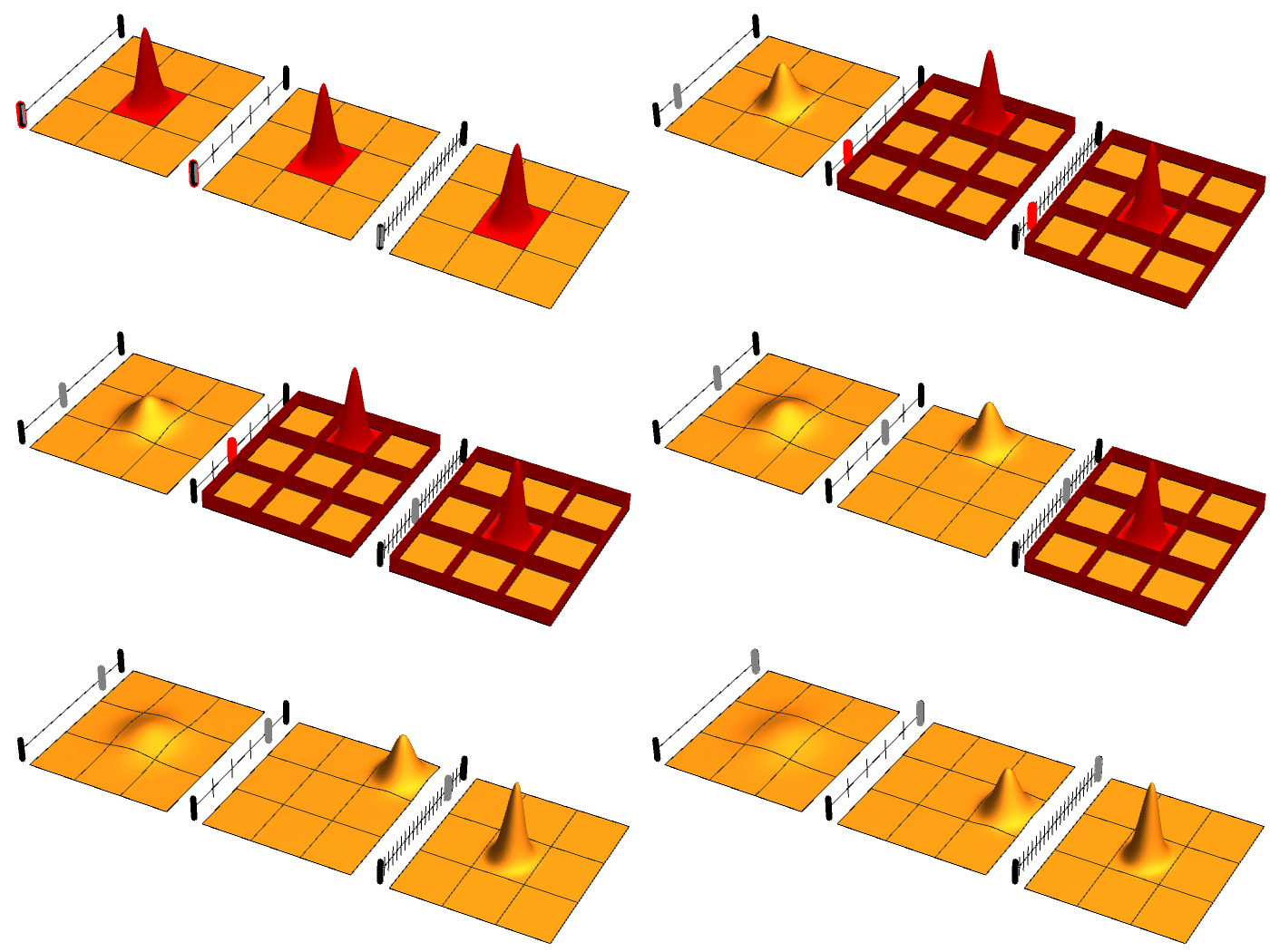
With the increasing number of measurements the wave function tends to stay in its initial form. In the animation, a free time evolution of a wave function, depicted on the left, is in the central part interrupted by occasional position measurements that localize the wave function in one of nine sectors. On the right, a series of very frequent measurements leads to the quantum Zeno effect.

In quantum mechanics, frequent measurements cause the quantum Zeno effect, a reduction in transitions away from the system's initial state, slowing a system's time evolution.[1]: 5 

Sometimes this effect is interpreted as "a system cannot change while you are watching it".[2] One can "freeze" the evolution of the system by measuring it frequently enough in its known initial state. The meaning of the term has since expanded, leading to a more technical definition, in which time evolution can be suppressed not only by measurement: the quantum Zeno effect is the suppression of unitary time evolution in quantum systems provided by a variety of sources: measurement, interactions with the environment, stochastic fields, among other factors.[3] As an outgrowth of study of the quantum Zeno effect, it has become clear that applying a series of sufficiently strong and fast pulses with appropriate symmetry can also decouple a system from its decohering environment.[4]

The comparison with Zeno's paradox is due to a 1977 article by Baidyanath Misra & E. C. George Sudarshan. The name comes by analogy to Zeno's arrow paradox, which states that because an arrow in flight is not seen to move during any single instant, it cannot possibly be moving at all. In the quantum Zeno effect an unstable state seems frozen – to not 'move' – due to a constant series of observations.

According to the reduction postulate, each measurement causes the wavefunction to collapse to an eigenstate of the measurement basis. In the context of this effect, an observation can simply be the absorption of a particle, without the need of an observer in any conventional sense. However, there is controversy over the interpretation of the effect, sometimes referred to as the "measurement problem" in traversing the interface between microscopic and macroscopic objects.[5][6]

Another crucial problem related to the effect is strictly connected to the time–energy indeterminacy relation (part of the indeterminacy principle). If one wants to make the measurement process more and more frequent, one has to correspondingly decrease the time duration of the measurement itself. But the request that the measurement last only a very short time implies that the energy spread of the state in which reduction occurs becomes increasingly large. However, the deviations from the exponential decay law for small times is crucially related to the inverse of the energy spread, so that the region in which the deviations are appreciable shrinks when one makes the measurement process duration shorter and shorter. An explicit evaluation of these two competing requests shows that it is inappropriate, without taking into account this basic fact, to deal with the actual occurrence and emergence of Zeno's effect.[7]

Closely related (and sometimes not distinguished from the quantum Zeno effect) is the watchdog effect, in which the time evolution of a system is affected by its continuous coupling to the environment.[8][9][10][11]

Description

[edit]

Unstable quantum systems are predicted to exhibit a short-time deviation from the exponential decay law.[12][13] This universal phenomenon has led to the prediction that frequent measurements during this nonexponential period could inhibit decay of the system, one form of the quantum Zeno effect. Subsequently, it was predicted that measurements applied more slowly could also enhance decay rates, a phenomenon known as the quantum anti-Zeno effect.[14]

In quantum mechanics the interaction mentioned is called "measurement" because its result can be interpreted in terms of classical mechanics. Frequent measurement prohibits the transition. It can be a transition of a particle from one half-space to another (which could be used for an atomic mirror in an atomic nanoscope[15]) as in the time-of-arrival problem,[16][17] a transition of a photon in a waveguide from one mode to another, and it can be a transition of an atom from one quantum state to another. It can be a transition from the subspace without decoherent loss of a qubit to a state with a qubit lost in a quantum computer.[18][19] In this sense, for the qubit correction, it is sufficient to determine whether the decoherence has already occurred or not. All these can be considered as applications of the Zeno effect.[20] By its nature, the effect appears only in systems with distinguishable quantum states, and hence is inapplicable to classical phenomena and macroscopic bodies.

The idea is implicit in John von Neumann's early work Mathematical Foundations of Quantum Mechanics, and in particular the rule sometimes called the reduction postulate.[21] It was later shown that the quantum Zeno effect of a single system is equivalent to the indetermination of the quantum state of a single system.[22][23][24]

History

[edit]

The unusual nature of the short-time evolution of quantum systems and the consequences for measurement was noted by John von Neumann in his Mathematical Foundations of Quantum Mechanics, published in 1932. This aspect of quantum mechanics lay unexplored until 1967 when Beskow and Nilsson[25] suggested that the mathematics indicated that an unstable particle in a bubble chamber would not decay. In 1977, Baidyanath Misra and E. C. George Sudarshan presented[26] a mathematical analysis of this quantum effect and proposed its association with Zeno's arrow paradox. This paradox of Zeno of Elea imagines seeing an flying arrow at any fixed instant: it is immobile, frozen in the space it occupies.[1]

Despite continued theoretical work, experimental confirmation did not appear[1] until 1990 when Itano et al.[27] applied the idea proposed by Cook[28] to study oscillating systems rather than unstable ones. Itano drove a transition between two levels in trapped 9Be+ ions while simultaneously measuring absorption of laser pulses proportional to population of the lower level.

Various realizations and general definition

[edit]

The treatment of the Zeno effect as a paradox is not limited to the processes of quantum decay. In general, the term Zeno effect is applied to various transitions, and sometimes these transitions may be very different from a mere "decay" (whether exponential or non-exponential).

One realization refers to the observation of an object (Zeno's arrow, or any quantum particle) as it leaves some region of space. In the 20th century, the trapping (confinement) of a particle in some region by its observation outside the region was considered as nonsensical, indicating some non-completeness of quantum mechanics.[29] Even as late as 2001, confinement by absorption was considered as a paradox.[30] Later, similar effects of the suppression of Raman scattering was considered an expected effect,[31][32][33] not a paradox at all. The absorption of a photon at some wavelength, the release of a photon (for example one that has escaped from some mode of a fiber), or even the relaxation of a particle as it enters some region, are all processes that can be interpreted as measurement. Such a measurement suppresses the transition, and is called the Zeno effect in the scientific literature.

In order to cover all of these phenomena (including the original effect of suppression of quantum decay), the Zeno effect can be defined as a class of phenomena in which some transition is suppressed by an interaction – one that allows the interpretation of the resulting state in the terms 'transition did not yet happen' and 'transition has already occurred', or 'The proposition that the evolution of a quantum system is halted' if the state of the system is continuously measured by a macroscopic device to check whether the system is still in its initial state.[34]

Periodic measurement of a quantum system

[edit]

Consider a system in a state , which is the eigenstate of some measurement operator. Say the system under free time evolution will decay with a certain probability into state . If measurements are made periodically, with some finite interval between each one, at each measurement, the wave function collapses to an eigenstate of the measurement operator. Between the measurements, the system evolves away from this eigenstate into a superposition state of the states and . When the superposition state is measured, it will again collapse, either back into state as in the first measurement, or away into state . However, its probability of collapsing into state after a very short amount of time is proportional to , since probabilities are proportional to squared amplitudes, and amplitudes behave linearly. Thus, in the limit of a large number of short intervals, with a measurement at the end of every interval, the probability of making the transition to goes to zero.

According to decoherence theory, measurement of a system is not a one-way "collapse" but an interaction with its surrounding environment, which in particular includes the measurement apparatus.[citation needed] A measurement is equivalent to correlating or coupling the quantum state to the apparatus state in such a way as to register the measured information. If this leaves it still able to decohere further to a different state perhaps due to the noisy thermal environment, this state may last only for a brief period of time; the probability of decaying increases with time. Then frequent measurement reestablishes or strengthens the coupling, and with it the measured state, if frequent enough for the probability to remain low. The time it expectedly takes to decay is related to the expected decoherence time of the system when coupled to the environment. The stronger the coupling is, and the shorter the decoherence time, the faster it will decay. So in the decoherence picture, an "ideal" quantum Zeno effect corresponds to the mathematical limit where a quantum system is continuously coupled to the environment, and where that coupling is infinitely strong, and where the "environment" is an infinitely large source of thermal randomness.

Experiments and discussion

[edit]

Experimentally, strong suppression of the evolution of a quantum system due to environmental coupling has been observed in a number of microscopic systems.

In 1989, David J. Wineland and his group at NIST[35] observed the quantum Zeno effect for a two-level atomic system that was interrogated during its evolution. Approximately 5,000 9Be+ ions were stored in a cylindrical Penning trap and laser-cooled to below 250 mK. A resonant RF pulse was applied, which, if applied alone, would cause the entire ground-state population to migrate into an excited state. After the pulse was applied, the ions were monitored for photons emitted due to relaxation. The ion trap was then regularly "measured" by applying a sequence of ultraviolet pulses during the RF pulse. As expected, the ultraviolet pulses suppressed the evolution of the system into the excited state. The results were in good agreement with theoretical models.

In 2001, Mark G. Raizen and his group at the University of Texas at Austin observed the quantum Zeno effect for an unstable quantum system,[36] as originally proposed by Sudarshan and Misra.[26] They also observed an anti-Zeno effect. Ultracold sodium atoms were trapped in an accelerating optical lattice, and the loss due to tunneling was measured. The evolution was interrupted by reducing the acceleration, thereby stopping quantum tunneling. The group observed suppression or enhancement of the decay rate, depending on the regime of measurement.

In 2015, Mukund Vengalattore and his group at Cornell University demonstrated a quantum Zeno effect as the modulation of the rate of quantum tunnelling in an ultracold lattice gas by the intensity of light used to image the atoms.[37]

In 2024, Björn Annby-Andersson and his colleagues from Lund University in their experiment with a system of two quantum dots with one electron сame to the conclusion that "As the measurement strength is further increased, the Zeno effect prohibits interdot tunneling. A Zeno-like effect is also observed for weak measurements, where measurement errors lead to fluctuations in the on-site energies, dephasing the system." https://journals.aps.org/prresearch/abstract/10.1103/PhysRevResearch.6.043216

The quantum Zeno effect is used in commercial atomic magnetometers and proposed to be part of birds' magnetic compass sensory mechanism (magnetoreception).[38]

It is still an open question how closely one can approach the limit of an infinite number of interrogations due to the Heisenberg uncertainty involved in shorter measurement times. It has been shown, however, that measurements performed at a finite frequency can yield arbitrarily strong Zeno effects.[39] In 2006, Streed et al. at MIT observed the dependence of the Zeno effect on measurement pulse characteristics.[40]

The interpretation of experiments in terms of the "Zeno effect" helps describe the origin of a phenomenon. Nevertheless, such an interpretation does not bring any principally new features not described with the Schrödinger equation of the quantum system.[41][42]

Even more, the detailed description of experiments with the "Zeno effect", especially at the limit of high frequency of measurements (high efficiency of suppression of transition, or high reflectivity of a ridged mirror) usually do not behave as expected for an idealized measurement.[15]

It was shown that the quantum Zeno effect persists in the many-worlds and relative-states interpretations of quantum mechanics.[43]

See also

[edit]

References

[edit]

Further reading

[edit]
[edit]
Revisions and contributorsEdit on WikipediaRead on Wikipedia
from Grokipedia
The quantum Zeno effect is a quantum mechanical phenomenon in which frequent or continuous measurements of an observable inhibit the evolution of a quantum system, effectively suppressing transitions between states and "freezing" the system in its initial configuration, analogous to the classical Zeno paradoxes where motion is denied through infinite subdivisions of time.[1] This effect arises from the projection postulate in quantum measurement theory, where each measurement collapses the wave function to an eigenstate of the measured observable, resetting the system's dynamics and preventing unitary evolution under the Hamiltonian.[1] The concept draws its name from the ancient Greek philosopher Zeno of Elea (c. 490–430 BCE), whose paradoxes, such as the arrow paradox, posited that motion is illusory if analyzed in infinitesimal instants; in quantum theory, this is realized through the discrete nature of measurements disrupting continuous evolution.[2] It was first formally described in 1977 by physicists Baidyanath Misra and E. C. George Sudarshan, who demonstrated mathematically that the survival probability of an unstable quantum state approaches unity as the frequency of measurements increases to infinity.[1] Their analysis focused on unstable systems, like radioactive decay, showing that ideal measurements at intervals τ → 0 yield a decay rate scaling as 1/τ², effectively halting the process.[1] Experimental verification came in 1990 through a study by Wayne M. Itano and colleagues at NIST, using beryllium ions in a Paul trap to observe inhibited excitation in a three-level atomic system via pulsed radiofrequency measurements, confirming the effect's dependence on measurement frequency.[3] Subsequent demonstrations have extended the effect to diverse platforms, including Bose-Einstein condensates where repeated projections realize quantum Zeno dynamics in a five-level Hilbert space, and optical systems exhibiting Zeno-protected subspaces.[4] Notably, the effect has a counterpart, the quantum anti-Zeno effect, where appropriately timed measurements can accelerate transitions, highlighting the nuanced role of measurement timing in quantum control. Applications of the quantum Zeno effect span quantum information science, including stabilizing qubits against decoherence and enabling interaction-free measurements, while theoretical extensions explore its implications for open quantum systems and non-Markovian dynamics.[2] Ongoing research continues to probe limits, such as in relativistic regimes or with weak measurements, underscoring its foundational role in understanding the measurement problem in quantum mechanics.[5]

Overview

Definition and Basic Concept

The quantum Zeno effect refers to the phenomenon in quantum mechanics where frequent projective measurements on a quantum system, prepared in an initial state, inhibit its evolution toward other states, effectively suppressing transitions and "freezing" the system's dynamics. This occurs because each measurement collapses the system's wave function back to the initial state if it is found there, repeatedly resetting the evolution and preventing the accumulation of changes over time. The effect was theoretically proposed by Misra and Sudarshan in 1977, with the first experimental confirmation reported by Itano et al. in 1990. The name draws an analogy to Zeno's paradoxes from ancient Greek philosophy, particularly the arrow paradox, where an arrow in flight appears stationary at every instant it is observed, implying that motion is an illusion halted by continuous scrutiny. Similarly, in the quantum Zeno effect, a "watched" quantum system resists decay or evolution, as if constant observation paralyzes its natural progression under the laws of quantum mechanics. To understand this effect, familiarity with core quantum concepts is essential. Quantum superposition allows a system to exist in a linear combination of multiple states simultaneously, described by a wave function $ |\psi\rangle = \sum c_i |\alpha_i\rangle $. Under undisturbed conditions, the system undergoes unitary time evolution according to the Schrödinger equation, $ i\hbar \frac{d}{dt} |\psi(t)\rangle = H |\psi(t)\rangle $, where $ H $ is the Hamiltonian operator governing deterministic changes. However, a measurement induces a non-unitary collapse, or von Neumann projection, reducing the superposition to one of the eigenstates of the measured observable with probability given by the Born rule. An intuitive example is the decay of an unstable particle, such as an excited atom prone to spontaneous emission. Without intervention, the particle's survival probability in the initial excited state follows an exponential decay over time. If its state is repeatedly measured—say, by probing its position or energy—frequent confirmations of the initial state interrupt the decay process, causing the survival probability to plateau near 1 rather than dropping exponentially, especially as the measurement frequency increases. Qualitatively, a plot of survival probability versus time would show the undisturbed curve curving downward smoothly, while the Zeno-suppressed curve remains flat for longer durations before any eventual decline.

Historical Background

The quantum Zeno effect derives its name from the paradoxes posed by the ancient Greek philosopher Zeno of Elea in the 5th century BCE, particularly the arrow paradox, which posits that a flying arrow is instantaneously at rest at every point of its trajectory, thereby questioning the reality of motion. This classical philosophical conundrum provided an inspirational analogy for a quantum phenomenon where frequent observations appear to "freeze" the evolution of a system, preventing transitions between states.[6] Early hints of the effect emerged in the foundational work on quantum measurement. In his 1932 book Mathematical Foundations of Quantum Mechanics, John von Neumann formalized the measurement process, including the wave function collapse postulate, and noted that repeated projections onto a subspace could inhibit the system's time evolution.[7] The effect was formally proposed and named in 1977 by physicists Baidyanath Misra and E. C. George Sudarshan in their paper "The Zeno's Paradox in Quantum Theory," published in the Journal of Mathematical Physics. They rigorously demonstrated that, under ideal conditions of frequent measurements returning the system to its initial state, the probability of decay or transition approaches zero, effectively halting the system's dynamics as described by the Schrödinger equation.[1] Initial reception of the proposal was marked by debates over its physical realizability, centered on the unavoidable backaction of real measurements, which could disrupt the system rather than merely observe it without alteration. In the 1980s, theoretical extensions mitigated these concerns; for instance, Asher Peres analyzed the effect in the context of photon polarization measurements, showing its robustness under imperfect conditions. Other contributions, including early proposals by Wayne M. Itano for atomic systems, refined the models to account for measurement strength and frequency, paving the way for experimental tests while emphasizing the distinction between ideal and practical implementations.[2]

Theoretical Foundations

Mathematical Formulation

Consider a quantum system prepared in an initial state $ |\psi(0)\rangle $ at time $ t = 0 $, evolving under the Hamiltonian $ H $. The state at time $ t $ without measurements is $ |\psi(t)\rangle = e^{-i H t / \hbar} |\psi(0)\rangle $, and the survival probability—the probability of finding the system in the initial state—is given by $ P(t) = |\langle \psi(0) | \psi(t) \rangle|^2 $. For short evolution times $ t $, the survival probability can be expanded using the Baker-Campbell-Hausdorff formula or time-dependent perturbation theory, yielding $ P(t) \approx 1 - \left( \frac{\Delta E , t}{\hbar} \right)^2 $, where $ \Delta E = \sqrt{ \langle H^2 \rangle - \langle H \rangle^2 } $ is the energy uncertainty in the initial state $ |\psi(0)\rangle $. This quadratic decay reflects the unitary evolution's initial slowness for unstable systems. In the Zeno regime, perform $ N $ ideal projective measurements at equal intervals $ \tau = t / N $, each projecting onto the initial state subspace. Conditional on survival at each measurement, the state resets to $ |\psi(0)\rangle $, so the overall survival probability is $ P_Z(t) = [P(\tau)]^N \approx \left[ 1 - \left( \frac{\Delta E , \tau}{\hbar} \right)^2 \right]^N = \left[ 1 - \frac{ (\Delta E , t / \hbar)^2 }{N^2} \right]^N $. As $ N \to \infty $, $ P_Z(t) \to 1 $ for any fixed $ t $, demonstrating that frequent measurements suppress evolution and "freeze" the system in the initial state. The derivation proceeds via the iterated map for the state. The unitary evolution over interval $ \tau $ is $ U(\tau) = e^{-i H \tau / \hbar} $, and the projector is $ P = |\psi(0)\rangle \langle \psi(0)| $. Starting from $ |\psi_0\rangle = |\psi(0)\rangle $, after evolution and measurement, the unnormalized state is $ P U(\tau) |\psi_0\rangle = \langle \psi(0) | U(\tau) | \psi(0) \rangle |\psi(0)\rangle $, which normalizes back to $ |\psi(0)\rangle $ upon survival. This process repeats $ N $ times, with the survival probability at each step $ |\langle \psi(0) | U(\tau) | \psi(0) \rangle|^2 = P(\tau) $, yielding the product form above. For a general subspace projector $ P $, the effective evolution is $ P_Z(t) = \lim_{N \to \infty} | [P U(\tau)]^N |^2 = | e^{-i P H P t / \hbar} |^2 $ restricted to the subspace, confining dynamics within $ P $'s range. This formulation assumes ideal projective measurements that instantaneously collapse the state without introducing decoherence from the measurement apparatus, and that the system is isolated except during measurements.

Periodic Measurement Model

In unstable quantum systems, such as an excited atomic state prone to spontaneous decay, the survival probability of the initial state under free unitary evolution typically exhibits exponential decay at long times, given by $ P(t) = e^{-t/\tau} $, where $ \tau $ is the characteristic lifetime. However, at short times, the decay is inherently quadratic, $ P(t) \approx 1 - (t/\tau_Q)^2 $, with $ \tau_Q^{-2} $ related to the energy variance of the initial state. The quantum Zeno effect, induced by frequent measurements, extends this quadratic regime to longer timescales, effectively suppressing the transition to exponential decay and stabilizing the initial state beyond what free evolution would allow. The discrete periodic measurement model formalizes this suppression by considering projective measurements performed at equal time intervals $ \Delta t $, repeated $ n = t / \Delta t $ times over a fixed total time $ t $. Under free evolution interspersed with these projections onto the initial state $ | \psi_0 \rangle $, the survival probability becomes $ P_n(t) = |\langle \psi_0 | U(\Delta t) | \psi_0 \rangle|^{2n} $, where $ U(\Delta t) $ is the short-time unitary evolution operator. For small $ \Delta t $, this approximates $ P_n(t) \approx [1 - (\Delta E \Delta t / \hbar)^2]^n \approx e^{-n (\Delta E \Delta t / \hbar)^2} $, and in the Zeno limit $ \Delta t \to 0 $ with $ n \to \infty $ and $ t $ fixed, $ P_n(t) \to 1 $, halting the decay. This stroboscopic evolution can be recast using an effective Hamiltonian $ H_Z = P H P $, where $ P = | \psi_0 \rangle \langle \psi_0 | $ projects onto the initial state, restricting dynamics within the measured subspace and deriving from the Trotter-like decomposition of the measurement-evolution cycle.[8] In the continuous measurement limit, frequent discrete projections are approximated by strong, ongoing coupling of the system to a measurement apparatus or environment, akin to "watching a pot that never boils." This regime emerges when the measurement rate diverges, leading to watched-pot dynamics where decoherence is confined to the measured observable. The quantum jump approach provides an unravelling of this continuous monitoring, particularly for systems like fluorescing atoms where decay is observed via photon emission. Here, the evolution conditioned on no jumps (no detected decay events) follows a non-Hermitian effective Hamiltonian $ H_\mathrm{eff} = H - i \hbar (\Gamma/2) |e\rangle \langle e| $, with $ |e\rangle $ the decaying state; the imaginary term accelerates the norm decay, mimicking enhanced stability under observation until a jump occurs. This no-jump trajectory exhibits Zeno suppression, as the probability of remaining in the initial state aligns with the projected dynamics. Despite these effects, the periodic measurement model has limitations: for weak measurements (small $ \eta $), the suppression fails as backaction becomes negligible compared to free evolution, allowing decay to proceed unimpeded. At long times, even strong measurements break down due to quantum backaction accumulating perturbations, eventually permitting transitions outside the initial state after the quadratic regime exhausts the available coherence.

Realizations and Generalizations

Implementations in Physical Systems

The quantum Zeno effect can be implemented in any physical system where strong, frequent projections onto an initial subspace inhibit the system's evolution, extending beyond simple decay processes to suppress coherent oscillations or transitions.[9] This general framework applies to diverse platforms, where measurements act as projectors that "freeze" the state by repeatedly confirming its presence in the desired subspace, altering the effective dynamics without requiring full collapse at each step.[9] In atomic and ionic systems, the quantum Zeno effect has been theoretically realized using trapped ions, where laser-induced measurements project the ion's internal state, inhibiting spin flips and slowing transitions between quantum levels.[10] For example, in proposals involving single trapped ions like Ca⁺, continuous or frequent laser pulses serve as measurements that suppress unwanted evolution, such as dephasing or excitation, by repeatedly projecting the spin onto its initial configuration.[11] These setups leverage the long coherence times of ions in electromagnetic traps, making them ideal for demonstrating Zeno inhibition of coherent internal-state dynamics. More recent theoretical proposals, as of 2024, explore harnessing the Zeno effect to enhance stability in ion trapping.[12] Theoretical optical implementations propose utilizing photon polarization in cavities or interferometric setups, where beam splitters function as non-destructive measurements to freeze precession or rotational dynamics.[13] In such systems, a photon's polarization state undergoes repeated partial projections via polarizing beam splitters, which detect without fully absorbing the photon, thereby suppressing free evolution and stabilizing the initial polarization against rotations induced by birefringent media or cavities.[13] This approach highlights the Zeno effect in bosonic systems like single photons, where the measurement strength scales with the number of beam splitters, effectively halting coherent oscillations in the polarization degree of freedom.[14] Solid-state qubits provide another platform for the quantum Zeno effect, particularly in superconducting circuits and nitrogen-vacancy (NV) centers in diamond, where frequent readout pulses project the qubit state to suppress decoherence. Theoretical proposals for superconducting flux qubits suggest that sequences of projective measurements can counteract 1/f dephasing noise, freezing the qubit's evolution and extending coherence times by inhibiting non-exponential decay processes.[15] Similarly, for NV centers, theoretical studies propose using microwave pulses to repeatedly measure the electron spin (m_s = 0 to m_s = ±1 transitions), which in turn protects nearby ¹³C nuclear spins from dephasing; numerical simulations demonstrate Zeno suppression over approximately 20,000 cycles with cycle times of about 5 μs.[16] These implementations adapt the Zeno effect to mesoscopic scales, using dispersive readout to project without fully disturbing the qubit subspace.[16] In Bose-Einstein condensates (BECs), theoretical models show the quantum Zeno effect freezing collective excitations through position-specific measurements, such as electron beam depletion that projects the atomic density onto its initial profile.[17] For a one-dimensional ⁸⁷Rb BEC in a harmonic trap, simulations indicate that an electron beam impinging at varying positions (e.g., center or wings) creates localized dissipation, halting the filling of depleted "holes" in the density when the dissipation rate exceeds a critical threshold, thus suppressing diffusive or oscillatory excitations.[17] This spatial variant illustrates how frequent projections on position subspaces stabilize macroscopic quantum states against loss or reconfiguration, with the effect's onset independent of the depletion site's exact location but enhanced by narrow beam widths. Additionally, a 2025 theoretical study examined quantum Zeno dynamics for two interacting particles, extending generalizations to few-body systems.[18][17]

Quantum Zeno Dynamics

In the quantum Zeno effect, frequent measurements can confine the system's evolution to a specific subspace, a phenomenon known as quantum Zeno dynamics. This occurs when measurements repeatedly project the system onto a degenerate initial manifold, defined by a projector PP onto that subspace, thereby suppressing transitions to orthogonal subspaces while permitting unitary evolution within the manifold itself.[8] Under the limit of continuous strong measurements, the dynamics within this Zeno subspace are governed by an effective Hamiltonian Heff=PHPH_{\text{eff}} = P H P, where HH is the original Hamiltonian of the system. The time evolution operator restricted to the subspace then takes the form
UZ(t)=eiHefft/, U_Z(t) = e^{-i H_{\text{eff}} t / \hbar},
ensuring that the state remains within the PP-space and evolves coherently according to the projected interactions.[8] In many-body systems, such as spin chains or lattices, quantum Zeno dynamics manifest through the suppression of entanglement propagation across the system. Frequent local measurements hinder the spread of quantum correlations, effectively isolating sites and stabilizing Zeno-protected phases where coherence is preserved against dissipative or interactive decoherence.[19] Theoretical advances in 2021 highlighted measurement-induced criticality in monitored many-body systems, particularly in spin-1/2 chains under continuous transverse-field Ising interactions. At high measurement rates exceeding a critical threshold, the system enters a Zeno phase characterized by an uncorrelated, volume-law entangled state, with the transition marked by gap closing in the non-Hermitian effective spectrum and revealed through stochastic fluctuations rather than average observables.[20] Unlike the standard quantum Zeno effect, which fully freezes evolution in a single initial state, Zeno dynamics enable partial freezing that allows controlled intra-subspace motion, facilitating applications such as targeted state preparation in quantum systems.[8]

Experimental Observations

Early Confirmations

The pioneering experimental confirmation of the quantum Zeno effect was provided by Itano et al. in 1990, using a system of laser-cooled ^9Be^+ ions confined in a Penning trap at NIST. The experiment focused on the evolution of the internal hyperfine states of the ions, specifically the clock transition between the |F=1, m_F=0⟩ and |F=2, m_F=0⟩ levels at approximately 1.07 GHz, driven by an external radiofrequency field to induce Rabi oscillations. Measurements were performed by briefly illuminating the ions with laser light resonant with a transition from the ground state to an excited state, inducing fluorescence only if the ions were in the initial state, thereby projecting the system back to that state without significantly affecting the trap dynamics. By varying the number of such measurements N over a fixed total interrogation time t, they observed that the survival probability in the initial state followed a quadratic dependence P(t) ≈ 1 - (t/τ)^2 for large N, where τ is proportional to the measurement interval, contrasting with the linear decay expected without frequent projections. This inhibition was particularly evident with up to 200 measurements, where Rabi oscillations were strongly suppressed, and the transition probability scaled as 1/N, directly verifying the Zeno effect for an induced quantum transition.[21] Methodological challenges in this experiment included minimizing heating of the ion trap due to imperfect projections and residual off-resonant excitations, which could introduce decoherence and mimic the Zeno inhibition through classical effects; these were addressed by optimizing laser intensities and pulse durations to achieve measurement fidelities above 99% and limiting total heating to less than one quantum per measurement cycle. Error rates were quantified through repeated runs, showing systematic deviations below 5% from theoretical predictions, confirming the quantum nature of the observed freezing. The experiment's success hinged on the long coherence times of trapped ions, enabling precise control over the measurement frequency without excessive environmental noise.[21] A complementary early realization in cavity quantum electrodynamics was pursued by the group of Serge Haroche, leveraging Rydberg atoms interacting with a microwave cavity to demonstrate Zeno-like inhibition of field evolution. In their 2008 experiment, circular Rydberg atoms in high-n states (~51) were sent through a superconducting microwave cavity, performing dispersive, non-absorbing measurements of the photon number via the atoms' phase shift upon interaction. This setup allowed conditional projections that froze the coherent buildup of the cavity field from an initial coherent state, effectively halting its decay-like evolution toward higher photon numbers by repeated interrogations, with the field's variance remaining suppressed over times much longer than the natural Rabi period. Methodological hurdles involved maintaining cavity quality factors above 10^8 to reduce photon loss and ensuring atomic trajectories minimized Doppler broadening, achieving measurement-induced backaction with error rates under 2% per probe. This work extended the Zeno effect to continuous-variable systems, highlighting its robustness against weak decoherence.[22] These early experiments transformed the quantum Zeno effect from a theoretical paradox into a verifiable quantum phenomenon, inspiring subsequent studies on measurement backaction and paving the way for applications in quantum control, with the ion-trap demonstration setting benchmarks for precision in quantum state stabilization.[2]

Recent Advances

A significant advance in many-body systems came in 2021, when theoretical and numerical studies of the quantum Ising spin-1/2 chain under continuous weak monitoring of the transverse magnetization revealed the emergence of a measurement-induced Zeno phase, characterized by suppressed entanglement growth and a transition to subradiant-like dynamics akin to a many-body Zeno effect.[20] In 2025, a proposal emerged for enhancing dark matter detection by leveraging the quantum Zeno effect to amplify weak magnetic signals from axion-like particles using ensembles of nuclear spins, where frequent measurements stabilize spin precession and boost sensitivity in nuclear magnetic resonance setups.[23] Also in 2025, a comprehensive review provided a unified framework for the quantum Zeno and anti-Zeno effects in open quantum systems, elucidating crossover mechanisms driven by measurement frequency and environmental decoherence, which reconcile the suppression and acceleration of quantum transitions under different regimes.[24]

Applications and Implications

Role in Quantum Computing

The quantum Zeno effect plays a crucial role in quantum computing by enabling error suppression through frequent measurements that act as a form of dynamical decoupling, thereby extending qubit coherence times against decoherence.[25] In this approach, repeated projective measurements pin the system within a desired subspace, mimicking the suppression of unwanted transitions and effectively stabilizing quantum states during computation.[26] For instance, in superconducting qubit systems, Zeno-based gates have been implemented to perform multi-qubit operations by confining dynamics to measurement-protected subspaces, achieving gate fidelities up to 75% in circuit QED architectures despite measurement-induced dephasing.[27][28] Recent advancements in Zeno-effect computation highlight its application in adiabatic optimizers, where frequent measurements confine the evolution paths of quantum states to avoid excitations out of the ground state manifold, facilitating efficient solving of optimization problems.[29] This 2025 framework demonstrates how Zeno dynamics can enhance adiabatic quantum computing by enforcing subspace restrictions, though it faces challenges in handling frustrated systems without additional dissipative elements. In state engineering for quantum algorithms, the Zeno effect protects fragile superpositions from environmental noise, particularly in variational quantum eigensolvers (VQE) where it stabilizes trial states during iterative optimization.[30] By applying repeated non-selective measurements, Zeno dynamics confines the wavefunction to constraint-satisfying subspaces, improving convergence in constrained optimization tasks akin to VQE applications in molecular simulations.[31] Despite these benefits, implementing Zeno protocols introduces challenges, including significant overhead from the need for rapid measurement cycles that can limit scalability and increase resource demands in large-scale circuits. Integration with quantum error-correcting codes remains complex, as Zeno measurements must be tuned to avoid interfering with syndrome extraction, though early schemes show compatibility by using weak measurements within stabilizer codes to enhance error detection rates.[32] Practical examples include ion-trap quantum processors, where Zeno-assisted mid-circuit measurements enable real-time feedback for state stabilization, as demonstrated in systems using continuous weak monitoring to suppress decay in trapped-ion qubits during gate operations.[33] These implementations leverage the Zeno effect to maintain coherence in multi-qubit entangling gates, bridging theoretical subspace dynamics with fault-tolerant computing goals.[34]

Broader Scientific Uses

The quantum Zeno effect has found applications in precision sensing, particularly for enhancing the detection of weak signals in searches for fundamental particles like axion-like dark matter. In a theoretical proposal, the effect is leveraged to amplify minuscule magnetic fields induced by axions interacting with nuclear spins, using frequent measurements to suppress unwanted evolution and boost the signal-to-noise ratio. This approach achieves an enhancement factor of approximately $ e^{1/2} $ compared to traditional Markovian noise mitigation methods under Gaussian noise conditions, potentially enabling more sensitive haloscope experiments with nuclear spin ensembles.[23] In cosmology, the quantum Zeno effect raises intriguing questions about why the universe does not experience universal freezing of quantum evolution due to pervasive interactions acting as measurements. A model analyzing a two-level system interacting with an environment demonstrates that free quantum evolution typically dominates over decoherence, as the latter scales with $ \gamma_n \propto n^{1/2} $ for measurement intervals $ n $, allowing cosmic structures to develop without Zeno-induced stasis. This explains the observed dynamical expansion and complexity of the universe, where short-time quadratic evolutions outpace environmental coupling in generic cases.[35] The quantum Zeno effect serves as a valuable tool for probing the quantum-to-classical transition and testing objective collapse models, which posit spontaneous wave function reduction to resolve measurement paradoxes. By simulating frequent projections that mimic environmental decoherence, Zeno dynamics reveal how repeated observations suppress superpositions, facilitating the emergence of classical behavior without invoking hidden variables. In objective collapse frameworks, such as continuous spontaneous localization, the effect highlights tensions with continuous monitoring, where Zeno freezing challenges simple collapse rates but refines models through empirical tests like those proposed for quantum processors.[36][37] Beyond these areas, the quantum Zeno effect enables control over laboratory processes like chemical reactions and nuclear decays. In ultracold molecular systems, frequent measurements suppress reactive losses by inhibiting state transitions, as demonstrated in fermionic KRb molecules where Zeno dynamics reduces chemical reaction rates below natural tunneling limits. Similarly, for simulated nuclear decays in trapped ions or qubits, the effect stabilizes unstable states, effectively slowing decay probabilities through projective measurements. In quantum metrology, Zeno-based protocols enhance parameter estimation precision, including for atomic time standards, by freezing ancillary evolution to isolate frequency shifts with reduced uncertainty via Fisher information optimization.[38][39][40][41] Looking ahead, integrating the quantum Zeno effect with quantum networks promises distributed protection schemes, where local measurements at nodes safeguard entanglement against decoherence across links. Local Zeno strategies have been shown to superactivate bound entanglement in networked qubits, enabling robust information transfer and error suppression in multi-node architectures without global control.[42]

Quantum Anti-Zeno Effect

The quantum anti-Zeno effect is the counterpart to the quantum Zeno effect, in which repeated measurements accelerate the decay or transition processes of an unstable quantum system rather than suppressing them. This phenomenon arises when measurements perturb the system in a way that promotes evolution toward other states, effectively enhancing the transition rate. It has been particularly noted in open quantum systems coupled to non-Markovian baths or environments with structured spectral densities, where memory effects in the bath allow for such acceleration.[43][44] The underlying mechanism involves the constructive interference between the system's natural dynamics and the perturbations induced by frequent measurements, leading to a faster departure from the initial state. In the short-time regime, the survival probability P(t)P(t) of the initial state exhibits quadratic behavior modified by an enhancement factor:
P(t)1(ΔEt)2(1+α), P(t) \approx 1 - \left( \frac{\Delta E \, t}{\hbar} \right)^2 (1 + \alpha),
where ΔE\Delta E is the energy uncertainty, \hbar is the reduced Planck's constant, and α>0\alpha > 0 quantifies the positive contribution from measurement-induced broadening or dephasing that amplifies the decay. This contrasts with the standard Zeno case where the factor is reduced below 1. The enhancement α\alpha depends on the measurement strength and the system's coupling to its environment, often scaling with the measurement frequency ν\nu in regimes where ν\nu matches the natural linewidth.[45][46] The quantum anti-Zeno effect typically requires conditions such as weak or projective measurements that do not fully collapse the state, combined with structured environments like non-Markovian baths that support coherent backflow of information. It is absent in purely Markovian settings but emerges when the bath correlation time exceeds the measurement interval. A 2025 theoretical unification frames both Zeno and anti-Zeno effects within a single framework, introducing a crossover parameter that interpolates between suppression and acceleration based on the relative strengths of measurement and dissipation. This parameter, often tied to bath spectral width or coupling strength, allows tuning the transition between regimes.[24] Representative examples include the accelerated loss of atoms from optical lattices under repeated perturbations mimicking measurements, and enhanced decay rates in superconducting qubit systems where feedback loops amplify transitions via environmental coupling. In qubit setups, measurement feedback can drive the system into anti-Zeno dynamics by broadening the effective linewidth, speeding up relaxation to ground states.[47][40] Experimental confirmation came in 2001 from the Raizen group, who observed speedup in the decay of cold sodium atoms trapped in a far-detuned, accelerating standing-wave optical lattice. By varying the "measurement" frequency through lattice pulses, they demonstrated an increase in atom ejection rate compared to free evolution, directly evidencing the anti-Zeno acceleration in a controlled atomic system. Subsequent experiments in solid-state platforms have replicated similar enhancements, solidifying the effect's observability. Recent demonstrations, such as in nitrogen-vacancy centers in diamond as of 2024, have shown anti-Zeno acceleration in spin relaxation dynamics.[47][48]

Connections to Measurement Theory

The quantum Zeno effect provides compelling evidence for the reality of wave function collapse in quantum measurement, challenging the sufficiency of unitary evolution alone to explain observed outcomes. In standard quantum mechanics, the measurement process involves a non-unitary projection that selects a definite state from a superposition, as formalized by von Neumann's projection postulate, which underpins the Zeno effect by repeatedly enforcing such collapses to inhibit evolution.[49] This contrasts with decoherence theories, which attribute apparent collapse to environmental interactions without invoking projection, yet fail to fully resolve the measurement problem since decoherence preserves superpositions in the global state, whereas Zeno dynamics demonstrably suppress transitions through discrete interventions.[50] Thus, the effect underscores the need for a mechanism beyond unitary Schrödinger evolution to account for the irreversibility and definiteness of measurement results.[51] By 2025, the quantum Zeno effect has evolved into a practical toolbox for probing the nature of quantum measurement, bridging philosophical paradoxes with experimental control in systems like trapped ions and superconducting qubits.[6] Researchers now leverage frequent projective measurements to stabilize fragile quantum states against decoherence, effectively "freezing" dynamics to study collapse-like processes in real time, framing the effect as a bridge from von Neumann's theoretical insights to modern quantum engineering. This shift emphasizes the Zeno effect's role in testing foundational questions, such as whether measurement induces true ontological change or merely epistemic updates. The Zeno effect carries implications for quantum interpretations seeking to resolve the measurement problem. In objective collapse models like the Ghirardi-Rimini-Weber (GRW) theory, spontaneous collapses occur at a low rate for microscopic systems but amplify for macroscopic ones, naturally incorporating Zeno-like suppression as an emergent feature of these stochastic reductions without requiring observers.[52] Conversely, in the many-worlds interpretation, the effect arises from repeated measurements confining the system to a single branch of the universal wave function, effectively suppressing branching proliferation in the observed subspace while the full superposition persists globally.[53] In broader contexts, the Zeno effect relates to thought experiments probing observer roles in measurement. It intersects with Wigner's friend paradox, where an external observer's repeated interventions on an internal measurement can Zeno-lock the system, questioning the locality and consistency of collapse across nested observers. Similarly, in delayed-choice experiments, Zeno dynamics can retroactively influence path information erasure by stabilizing superpositions before the choice is made, reinforcing the non-local and atemporal aspects of quantum measurement.[54] Open questions persist regarding whether the Zeno effect implies a role for consciousness in measurement, reviving historical debates. Physicist Henry Stapp has argued that conscious intentions could exploit the Zeno effect in neural microtubules to select outcomes via rapid mental "measurements," linking mind to brain dynamics without succumbing to decoherence, though this remains controversial and unverified experimentally. Such proposals echo von Neumann-Wigner interpretations but face criticism for lacking empirical support beyond theoretical modeling.[55]

References

User Avatar
No comments yet.