


Community hub
Recent from talks
Contribute something
Nothing was collected or created yet.
Quantum computing
View on Wikipedia




A quantum computer is a (real or theoretical) computer that uses quantum mechanical phenomena in an essential way: it exploits superposed and entangled states, and the intrinsically non-deterministic outcomes of quantum measurements, as features of its computation. Quantum computers can be viewed as sampling from quantum systems that evolve in ways that may be described as operating on an enormous number of possibilities simultaneously, though still subject to strict computational constraints. By contrast, ordinary ("classical") computers operate according to deterministic rules. (A classical computer can, in principle, be replicated by a classical mechanical device, with only a simple multiple of time cost. On the other hand (it is believed), a quantum computer would require exponentially more time and energy to be simulated classically.) It is widely believed that a quantum computer could perform some calculations exponentially faster than any classical computer. For example, a large-scale quantum computer could break some widely used public-key cryptographic schemes and aid physicists in performing physical simulations. However, current hardware implementations of quantum computation are largely experimental and only suitable for specialized tasks.
The basic unit of information in quantum computing, the qubit (or "quantum bit"), serves the same function as the bit in ordinary or "classical" computing.[1] However, unlike a classical bit, which can be in one of two states (a binary), a qubit can exist in a linear combination of two states known as a quantum superposition. The result of measuring a qubit is one of the two states given by a probabilistic rule. If a quantum computer manipulates the qubit in a particular way, wave interference effects amplify the probability of the desired measurement result. The design of quantum algorithms involves creating procedures that allow a quantum computer to perform this amplification.
Quantum computers are not yet practical for real-world applications. Physically engineering high-quality qubits has proven to be challenging. If a physical qubit is not sufficiently isolated from its environment, it suffers from quantum decoherence, introducing noise into calculations. National governments have invested heavily in experimental research aimed at developing scalable qubits with longer coherence times and lower error rates. Example implementations include superconductors (which isolate an electrical current by eliminating electrical resistance) and ion traps (which confine a single atomic particle using electromagnetic fields). Researchers have claimed, and are widely believed to be correct, that certain quantum devices can outperform classical computers on narrowly defined tasks, a milestone referred to as quantum advantage or quantum supremacy. These tasks are not necessarily useful for real-world applications.
History
[edit]For many years, the fields of quantum mechanics and computer science formed distinct academic communities.[2] Modern quantum theory developed in the 1920s to explain perplexing physical phenomena observed at atomic scales,[3][4] and digital computers emerged in the following decades to replace human computers for tedious calculations.[5] Both disciplines had practical applications during World War II; computers played a major role in wartime cryptography,[6] and quantum physics was essential for nuclear physics used in the Manhattan Project.[7]
As physicists applied quantum mechanical models to computational problems and swapped digital bits for qubits, the fields of quantum mechanics and computer science began to converge. In 1980, Paul Benioff introduced the quantum Turing machine, which uses quantum theory to describe a simplified computer.[8] When digital computers became faster, physicists faced an exponential increase in overhead when simulating quantum dynamics,[9] prompting Yuri Manin and Richard Feynman to independently suggest that hardware based on quantum phenomena might be more efficient for computer simulation.[10][11][12] In a 1984 paper, Charles Bennett and Gilles Brassard applied quantum theory to cryptography protocols and demonstrated that quantum key distribution could enhance information security.[13][14]
Quantum algorithms then emerged for solving oracle problems, such as Deutsch's algorithm in 1985,[15] the Bernstein–Vazirani algorithm in 1993,[16] and Simon's algorithm in 1994.[17] These algorithms did not solve practical problems, but demonstrated mathematically that one could gain more information by querying a black box with a quantum state in superposition, sometimes referred to as quantum parallelism.[18]

Peter Shor built on these results with his 1994 algorithm for breaking the widely used RSA and Diffie–Hellman encryption protocols,[19] which drew significant attention to the field of quantum computing. In 1996, Grover's algorithm established a quantum speedup for the widely applicable unstructured search problem.[20][21] The same year, Seth Lloyd proved that quantum computers could simulate quantum systems without the exponential overhead present in classical simulations,[22] validating Feynman's 1982 conjecture.[23]
Over the years, experimentalists have constructed small-scale quantum computers using trapped ions and superconductors.[24] In 1998, a two-qubit quantum computer demonstrated the feasibility of the technology,[25][26] and subsequent experiments have increased the number of qubits and reduced error rates.[24]
In 2019, Google AI and NASA announced that they had achieved quantum supremacy with a 54-qubit machine, performing a computation that is impossible for any classical computer.[27][28][29][30]
This announcement was met with a rebuttal from Google's direct competitor, IBM. IBM contended that the calculation Google claimed would take 10,000 years could be performed in just 2.5 days on its own Summit supercomputer if its architecture were optimized, sparking a debate over the precise threshold for "quantum supremacy".[31]
Quantum information processing
[edit]Computer engineers typically describe a modern computer's operation in terms of classical electrodynamics. Within these "classical" computers, some components (such as semiconductors and random number generators) may rely on quantum behavior, but these components are not isolated from their environment, so any quantum information quickly decoheres. While programmers may depend on probability theory when designing a randomized algorithm, quantum mechanical notions like superposition and interference are largely irrelevant for program analysis.
Quantum programs, in contrast, rely on precise control of coherent quantum systems. Physicists describe these systems mathematically using linear algebra. Complex numbers model probability amplitudes, vectors model quantum states, and matrices model the operations that can be performed on these states. Programming a quantum computer is then a matter of composing operations in such a way that the resulting program computes a useful result in theory and is implementable in practice.
As physicist Charlie Bennett describes the relationship between quantum and classical computers,[32]
A classical computer is a quantum computer ... so we shouldn't be asking about "where do quantum speedups come from?" We should say, "well, all computers are quantum. ... Where do classical slowdowns come from?"
Quantum information
[edit]Just as the bit is the basic concept of classical information theory, the qubit is the fundamental unit of quantum information. The same term qubit is used to refer to an abstract mathematical model and to any physical system that is represented by that model. A classical bit, by definition, exists in either of two physical states, which can be denoted 0 and 1. A qubit is also described by a state, and two states often written and serve as the quantum counterparts of the classical states 0 and 1. However, the quantum states and belong to a vector space, meaning that they can be multiplied by constants and added together, and the result is again a valid quantum state. Such a combination is known as a superposition of and .[33][34]
A two-dimensional vector mathematically represents a qubit state. Physicists typically use Dirac notation for quantum mechanical linear algebra, writing 'ket psi' for a vector labeled . Because a qubit is a two-state system, any qubit state takes the form , where and are the standard basis states,[a] and and are the probability amplitudes, which are in general complex numbers.[34] If either or is zero, the qubit is effectively a classical bit; when both are nonzero, the qubit is in superposition. Such a quantum state vector acts similarly to a (classical) probability vector, with one key difference: unlike probabilities, probability amplitudes are not necessarily positive numbers.[36] Negative amplitudes allow for destructive wave interference.


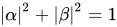
When a qubit is measured in the standard basis, the result is a classical bit. The Born rule describes the norm-squared correspondence between amplitudes and probabilities—when measuring a qubit , the state collapses to with probability , or to with probability . Any valid qubit state has coefficients and such that . As an example, measuring the qubit would produce either or with equal probability.



Each additional qubit doubles the dimension of the state space.[35] As an example, the vector 1/√2|00⟩ + 1/√2|01⟩ represents a two-qubit state, a tensor product of the qubit |0⟩ with the qubit 1/√2|0⟩ + 1/√2|1⟩. This vector inhabits a four-dimensional vector space spanned by the basis vectors |00⟩, |01⟩, |10⟩, and |11⟩. The Bell state 1/√2|00⟩ + 1/√2|11⟩ is impossible to decompose into the tensor product of two individual qubits—the two qubits are entangled because neither qubit has a state vector of its own. In general, the vector space for an n-qubit system is 2n-dimensional, and this makes it challenging for a classical computer to simulate a quantum one: representing a 100-qubit system requires storing 2100 classical values.
Unitary operators
[edit]The state of this one-qubit quantum memory can be manipulated by applying quantum logic gates, analogous to how classical memory can be manipulated with classical logic gates. One important gate for both classical and quantum computation is the NOT gate, which can be represented by a matrix Mathematically, the application of such a logic gate to a quantum state vector is modelled with matrix multiplication. Thus
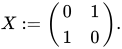
- and .


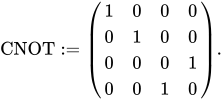
The mathematics of single qubit gates can be extended to operate on multi-qubit quantum memories in two important ways. One way is simply to select a qubit and apply that gate to the target qubit while leaving the remainder of the memory unaffected. Another way is to apply the gate to its target only if another part of the memory is in a desired state. These two choices can be illustrated using another example. The possible states of a two-qubit quantum memory are The controlled NOT (CNOT) gate can then be represented using the following matrix: As a mathematical consequence of this definition, , , , and . In other words, the CNOT applies a NOT gate ( from before) to the second qubit if and only if the first qubit is in the state . If the first qubit is , nothing is done to either qubit.







In summary, quantum computation can be described as a network of quantum logic gates and measurements. However, any measurement can be deferred to the end of quantum computation, though this deferment may come at a computational cost, so most quantum circuits depict a network consisting only of quantum logic gates and no measurements.
Quantum parallelism
[edit]Quantum parallelism is the heuristic that quantum computers can be thought of as evaluating a function for multiple input values simultaneously. This can be achieved by preparing a quantum system in a superposition of input states and applying a unitary transformation that encodes the function to be evaluated. The resulting state encodes the function's output values for all input values in the superposition, allowing for the computation of multiple outputs simultaneously. This property is key to the speedup of many quantum algorithms. However, "parallelism" in this sense is insufficient to speed up a computation, because the measurement at the end of the computation gives only one value. To be useful, a quantum algorithm must also incorporate some other conceptual ingredient.[37][38]
Quantum programming
[edit]There are a number of models of computation for quantum computing, distinguished by the basic elements in which the computation is decomposed.
Gate array
[edit]
A quantum gate array decomposes computation into a sequence of few-qubit quantum gates. A quantum computation can be described as a network of quantum logic gates and measurements. However, any measurement can be deferred to the end of quantum computation, though this deferment may come at a computational cost, so most quantum circuits depict a network consisting only of quantum logic gates and no measurements.
Any quantum computation (which is, in the above formalism, any unitary matrix of size over qubits) can be represented as a network of quantum logic gates from a fairly small family of gates. A choice of gate family that enables this construction is known as a universal gate set, since a computer that can run such circuits is a universal quantum computer. One common such set includes all single-qubit gates as well as the CNOT gate from above. This means any quantum computation can be performed by executing a sequence of single-qubit gates together with CNOT gates. Though this gate set is infinite, it can be replaced with a finite gate set by appealing to the Solovay-Kitaev theorem. Implementation of Boolean functions using the few-qubit quantum gates is presented here.[39]


Measurement-based quantum computing
[edit]A measurement-based quantum computer decomposes computation into a sequence of Bell state measurements and single-qubit quantum gates applied to a highly entangled initial state (a cluster state), using a technique called quantum gate teleportation.
Adiabatic quantum computing
[edit]An adiabatic quantum computer, based on quantum annealing, decomposes computation into a slow continuous transformation of an initial Hamiltonian into a final Hamiltonian, whose ground states contain the solution.[40]
Neuromorphic quantum computing
[edit]Neuromorphic quantum computing (abbreviated as 'n.quantum computing') is an unconventional type of computing that uses neuromorphic computing to perform quantum operations. It was suggested that quantum algorithms, which are algorithms that run on a realistic model of quantum computation, can be computed equally efficiently with neuromorphic quantum computing. Both traditional quantum computing and neuromorphic quantum computing are physics-based unconventional computing approaches to computations and do not follow the von Neumann architecture. They both construct a system (a circuit) that represents the physical problem at hand and then leverage their respective physics properties of the system to seek the "minimum". Neuromorphic quantum computing and quantum computing share similar physical properties during computation.
Topological quantum computing
[edit]A topological quantum computer decomposes computation into the braiding of anyons in a 2D lattice.[41]
Quantum Turing machine
[edit]A quantum Turing machine is the quantum analog of a Turing machine.[8] All of these models of computation—quantum circuits,[42] one-way quantum computation,[43] adiabatic quantum computation,[44] and topological quantum computation[45]—have been shown to be equivalent to the quantum Turing machine; given a perfect implementation of one such quantum computer, it can simulate all the others with no more than polynomial overhead. This equivalence need not hold for practical quantum computers, since the overhead of simulation may be too large to be practical.
Noisy intermediate-scale quantum computing
[edit]The threshold theorem shows how increasing the number of qubits can mitigate errors,[46] yet fully fault-tolerant quantum computing remains "a rather distant dream".[47] According to some researchers, noisy intermediate-scale quantum (NISQ) machines may have specialized uses in the near future, but noise in quantum gates limits their reliability.[47] Scientists at Harvard University successfully created "quantum circuits" that correct errors more efficiently than alternative methods, which may potentially remove a major obstacle to practical quantum computers.[48] The Harvard research team was supported by MIT, QuEra Computing, Caltech, and Princeton University and funded by DARPA's Optimization with Noisy Intermediate-Scale Quantum devices (ONISQ) program.[49][50]
Quantum cryptography and cybersecurity
[edit]Digital cryptography allows communications without observation by unauthorized parties. Conventional encryption, the obscuring of a message with a key through an algorithm, relies on the algorithm being difficult to reverse. Encryption is also the basis for digital signatures and authentication mechanisms. Quantum computing may be sufficiently more powerful that difficult reversals are feasible, allowing messages relying on conventional encryption to be read.[51]
Quantum cryptography replaces conventional algorithms with computations based on quantum computing. In principle, quantum encryption would be impossible to decode even with a quantum computer. This advantage comes at a significant cost in terms of elaborate infrastructure as well as preventing legitimate decoding of messages by governmental security officials.[51]
Ongoing research in quantum and post-quantum cryptography has led to new algorithms for quantum key distribution, initial work on quantum random number generation and to some early technology demonstrations.[52]: 1012–1036
Communication
[edit]Quantum cryptography enables new ways to transmit data securely; for example, quantum key distribution uses entangled quantum states to establish secure cryptographic keys.[52]: 1017 When a sender and receiver exchange quantum states, they can guarantee that an adversary does not intercept the message, as any unauthorized eavesdropper would disturb the delicate quantum system and introduce a detectable change.[53] With appropriate cryptographic protocols, the sender and receiver can thus establish shared private information resistant to eavesdropping.[13][54]
Modern fiber-optic cables can transmit quantum information over relatively short distances. Ongoing experimental research aims to develop more reliable hardware (such as quantum repeaters), hoping to scale this technology to long-distance quantum networks with end-to-end entanglement. Theoretically, this could enable novel technological applications, such as distributed quantum computing and enhanced quantum sensing.[55][56]
Algorithms
[edit]Progress in finding quantum algorithms typically focuses on this quantum circuit model, though exceptions like the quantum adiabatic algorithm exist. Quantum algorithms can be roughly categorized by the type of speedup achieved over corresponding classical algorithms.[57]
Quantum algorithms that offer more than a polynomial speedup over the best-known classical algorithm include Shor's algorithm for factoring and the related quantum algorithms for computing discrete logarithms, solving Pell's equation, and more generally solving the hidden subgroup problem for abelian finite groups.[57] These algorithms depend on the primitive of the quantum Fourier transform. No mathematical proof has been found that shows that an equally fast classical algorithm cannot be discovered, but evidence suggests that this is unlikely.[58] Certain oracle problems like Simon's problem and the Bernstein–Vazirani problem do give provable speedups, though this is in the quantum query model, which is a restricted model where lower bounds are much easier to prove and doesn't necessarily translate to speedups for practical problems.
Other problems, including the simulation of quantum physical processes from chemistry and solid-state physics, the approximation of certain Jones polynomials, and the quantum algorithm for linear systems of equations, have quantum algorithms appearing to give super-polynomial speedups and are BQP-complete. Because these problems are BQP-complete, an equally fast classical algorithm for them would imply that "no quantum algorithm" provides a super-polynomial speedup, which is believed to be unlikely.[59]
In addition to these problems, quantum algorithms are being explored for applications in cryptography, optimization, and machine learning, although most of these remain at the research stage and require significant advances in error correction and hardware scalability before practical implementation.[60]
Some quantum algorithms, like Grover's algorithm and amplitude amplification, give polynomial speedups over corresponding classical algorithms.[57] Though these algorithms give comparably modest quadratic speedup, they are widely applicable and thus give speedups for a wide range of problems.[21] These speed-ups are, however, over the theoretical worst-case of classical algorithms, and concrete real-world speed-ups over algorithms used in practice have not been demonstrated.
Simulation of quantum systems
[edit]Since chemistry and nanotechnology rely on understanding quantum systems, and such systems are impossible to simulate in an efficient manner classically, quantum simulation may be an important application of quantum computing.[61] Quantum simulation could also be used to simulate the behavior of atoms and particles at unusual conditions such as the reactions inside a collider.[62] In June 2023, IBM computer scientists reported that a quantum computer produced better results for a physics problem than a conventional supercomputer.[63][64]
About 2% of the annual global energy output is used for nitrogen fixation to produce ammonia for the Haber process in the agricultural fertiliser industry (even though naturally occurring organisms also produce ammonia). Quantum simulations might be used to understand this process and increase the energy efficiency of production.[65] It is expected that an early use of quantum computing will be modeling that improves the efficiency of the Haber–Bosch process[66] by the mid-2020s[67] although some have predicted it will take longer.[68]
Post-quantum cryptography
[edit]A notable application of quantum computing is in attacking cryptographic systems that are currently in use. Integer factorization, which underpins the security of public key cryptographic systems, is believed to be computationally infeasible on a classical computer for large integers if they are the product of a few prime numbers (e.g., the product of two 300-digit primes).[69] By contrast, a quantum computer could solve this problem exponentially faster using Shor's algorithm to factor the integer.[70] This ability would allow a quantum computer to break many of the cryptographic systems in use today, in the sense that there would be a polynomial time (in the number of digits of the integer) algorithm for solving the problem. In particular, most of the popular public key ciphers are based on the difficulty of factoring integers or the discrete logarithm problem, both of which can be solved by Shor's algorithm. In particular, the RSA, Diffie–Hellman, and elliptic curve Diffie–Hellman algorithms could be broken. These are used to protect secure Web pages, encrypted email, and many other types of data. Breaking these would have significant ramifications for electronic privacy and security.
Identifying cryptographic systems that may be secure against quantum algorithms is an actively researched topic under the field of post-quantum cryptography.[71][72] Some public-key algorithms are based on problems other than the integer factorization and discrete logarithm problems to which Shor's algorithm applies, such as the McEliece cryptosystem, which relies on a hard problem in coding theory.[71][73] Lattice-based cryptosystems are also not known to be broken by quantum computers, and finding a polynomial time algorithm for solving the dihedral hidden subgroup problem, which would break many lattice-based cryptosystems, is a well-studied open problem.[74] It has been shown that applying Grover's algorithm to break a symmetric (secret-key) algorithm by brute force requires time equal to roughly 2n/2 invocations of the underlying cryptographic algorithm, compared with roughly 2n in the classical case,[75] meaning that symmetric key lengths are effectively halved: AES-256 would have comparable security against an attack using Grover's algorithm to that AES-128 has against classical brute-force search (see Key size).
Search problems
[edit]The most well-known example of a problem that allows for a polynomial quantum speedup is unstructured search, which involves finding a marked item out of a list of items in a database. This can be solved by Grover's algorithm using queries to the database, quadratically fewer than the queries required for classical algorithms. In this case, the advantage is not only provable but also optimal: it has been shown that Grover's algorithm gives the maximal possible probability of finding the desired element for any number of oracle lookups. Many examples of provable quantum speedups for query problems are based on Grover's algorithm, including Brassard, Høyer, and Tapp's algorithm for finding collisions in two-to-one functions,[76] and Farhi, Goldstone, and Gutmann's algorithm for evaluating NAND trees.[77]


Problems that can be efficiently addressed with Grover's algorithm have the following properties:[78][79]
- There is no searchable structure in the collection of possible answers,
- The number of possible answers to check is the same as the number of inputs to the algorithm, and
- There exists a Boolean function that evaluates each input and determines whether it is the correct answer.
For problems with all these properties, the running time of Grover's algorithm on a quantum computer scales as the square root of the number of inputs (or elements in the database), as opposed to the linear scaling of classical algorithms. A general class of problems to which Grover's algorithm can be applied[80] is a Boolean satisfiability problem, where the database through which the algorithm iterates is that of all possible answers. An example and possible application of this is a password cracker that attempts to guess a password. Breaking symmetric ciphers with this algorithm is of interest to government agencies.[81]
Quantum annealing
[edit]Quantum annealing relies on the adiabatic theorem to undertake calculations. A system is placed in the ground state for a simple Hamiltonian, which slowly evolves to a more complicated Hamiltonian whose ground state represents the solution to the problem in question. The adiabatic theorem states that if the evolution is slow enough the system will stay in its ground state at all times through the process. Quantum annealing can solve Ising models and the (computationally equivalent) QUBO problem, which in turn can be used to encode a wide range of combinatorial optimization problems.[82] Adiabatic optimization may be helpful for solving computational biology problems.[83]
Machine learning
[edit]Since quantum computers can produce outputs that classical computers cannot produce efficiently, and since quantum computation is fundamentally linear algebraic, some express hope in developing quantum algorithms that can speed up machine learning tasks.[47][84]
For example, the HHL Algorithm, named after its discoverers Harrow, Hassidim, and Lloyd, is believed to provide speedup over classical counterparts.[47][85] Some research groups have recently explored the use of quantum annealing hardware for training Boltzmann machines and deep neural networks.[86][87][88]
Deep generative chemistry models emerge as powerful tools to expedite drug discovery. However, the immense size and complexity of the structural space of all possible drug-like molecules pose significant obstacles, which could be overcome in the future by quantum computers. Quantum computers are naturally good for solving complex quantum many-body problems[22] and thus may be instrumental in applications involving quantum chemistry. Therefore, one can expect that quantum-enhanced generative models[89] including quantum GANs[90] may eventually be developed into ultimate generative chemistry algorithms.
Engineering
[edit].jpg)
As of 2023,[update] classical computers outperform quantum computers for all real-world applications. While current quantum computers may speed up solutions to particular mathematical problems, they give no computational advantage for practical tasks. Scientists and engineers are exploring multiple technologies for quantum computing hardware and hope to develop scalable quantum architectures, but serious obstacles remain.[91][92]
Challenges
[edit]There are a number of technical challenges in building a large-scale quantum computer.[93] Physicist David DiVincenzo has listed these requirements for a practical quantum computer:[94]
- Physically scalable to increase the number of qubits
- Qubits that can be initialized to arbitrary values
- Quantum gates that are faster than decoherence time
- Universal gate set
- Qubits that can be read easily.
Sourcing parts for quantum computers is also very difficult. Superconducting quantum computers, like those constructed by Google and IBM, need helium-3, a nuclear research byproduct, and special superconducting cables made only by the Japanese company Coax Co.[95]
The control of multi-qubit systems requires the generation and coordination of a large number of electrical signals with tight and deterministic timing resolution. This has led to the development of quantum controllers that enable interfacing with the qubits. Scaling these systems to support a growing number of qubits is an additional challenge.[96]
Decoherence
[edit]One of the greatest challenges involved in constructing quantum computers is controlling or removing quantum decoherence. This usually means isolating the system from its environment as interactions with the external world cause the system to decohere. However, other sources of decoherence also exist. Examples include the quantum gates and the lattice vibrations and background thermonuclear spin of the physical system used to implement the qubits. Decoherence is irreversible, as it is effectively non-unitary, and is usually something that should be highly controlled, if not avoided. Decoherence times for candidate systems in particular, the transverse relaxation time T2 (for NMR and MRI technology, also called the dephasing time), typically range between nanoseconds and seconds at low temperatures.[97] Currently, some quantum computers require their qubits to be cooled to 20 millikelvin (usually using a dilution refrigerator[98]) in order to prevent significant decoherence.[99] A 2020 study argues that ionizing radiation such as cosmic rays can nevertheless cause certain systems to decohere within milliseconds.[100]
As a result, time-consuming tasks may render some quantum algorithms inoperable, as attempting to maintain the state of qubits for a long enough duration will eventually corrupt the superpositions.[101]
These issues are more difficult for optical approaches as the timescales are orders of magnitude shorter and an often-cited approach to overcoming them is optical pulse shaping. Error rates are typically proportional to the ratio of operating time to decoherence time; hence any operation must be completed much more quickly than the decoherence time.
As described by the threshold theorem, if the error rate is small enough, it is thought to be possible to use quantum error correction to suppress errors and decoherence. This allows the total calculation time to be longer than the decoherence time if the error correction scheme can correct errors faster than decoherence introduces them. An often-cited figure for the required error rate in each gate for fault-tolerant computation is 10−3, assuming the noise is depolarizing.
Meeting this scalability condition is possible for a wide range of systems. However, the use of error correction brings with it the cost of a greatly increased number of required qubits. The number required to factor integers using Shor's algorithm is still polynomial, and thought to be between L and L2, where L is the number of binary digits in the number to be factored; error correction algorithms would inflate this figure by an additional factor of L. For a 1000-bit number, this implies a need for about 104 bits without error correction.[102] With error correction, the figure would rise to about 107 bits. Computation time is about L2 or about 107 steps and at 1 MHz, about 10 seconds. However, the encoding and error-correction overheads increase the size of a real fault-tolerant quantum computer by several orders of magnitude. Careful estimates[103][104] show that at least 3 million physical qubits would factor 2,048-bit integer in 5 months on a fully error-corrected trapped-ion quantum computer. In terms of the number of physical qubits, to date, this remains the lowest estimate[105] for practically useful integer factorization problem sizing 1,024-bit or larger.
One approach to overcoming errors combines low-density parity-check code with cat qubits that have intrinsic bit-flip error suppression. Implementing 100 logical qubits with 768 cat qubits could reduce the error rate to on part in 108 per cycle per bit.[106]
Another approach to the stability-decoherence problem is to create a topological quantum computer with anyons, quasi-particles used as threads, and relying on braid theory to form stable logic gates.[107][108] Non-Abelian anyons can, in effect, remember how they have been manipulated, making them potentially useful in quantum computing.[109] As of 2025, Microsoft and other organizations are investing in quasi-particle research.[109]
Quantum supremacy
[edit]Physicist John Preskill coined the term quantum supremacy to describe the engineering feat of demonstrating that a programmable quantum device can solve a problem beyond the capabilities of state-of-the-art classical computers.[110][47][111] The problem need not be useful, so some view the quantum supremacy test only as a potential future benchmark.[112]
In October 2019, Google AI Quantum, with the help of NASA, became the first to claim to have achieved quantum supremacy by performing calculations on the Sycamore quantum computer more than 3,000,000 times faster than they could be done on Summit, generally considered the world's fastest computer.[28][113][114] This claim has been subsequently challenged: IBM has stated that Summit can perform samples much faster than claimed,[115][116] and researchers have since developed better algorithms for the sampling problem used to claim quantum supremacy, giving substantial reductions to the gap between Sycamore and classical supercomputers[117][118][119] and even beating it.[120][121][122]
In December 2020, a group at USTC implemented a type of Boson sampling on 76 photons with a photonic quantum computer, Jiuzhang, to demonstrate quantum supremacy.[123][124][125] The authors claim that a classical contemporary supercomputer would require a computational time of 600 million years to generate the number of samples their quantum processor can generate in 20 seconds.[126]
Claims of quantum supremacy have generated hype around quantum computing,[127] but they are based on contrived benchmark tasks that do not directly imply useful real-world applications.[91][128]
In January 2024, a study published in Physical Review Letters provided direct verification of quantum supremacy experiments by computing exact amplitudes for experimentally generated bitstrings using a new-generation Sunway supercomputer, demonstrating a significant leap in simulation capability built on a multiple-amplitude tensor network contraction algorithm. This development underscores the evolving landscape of quantum computing, highlighting both the progress and the complexities involved in validating quantum supremacy claims.[129]
Skepticism
[edit]Despite high hopes for quantum computing, significant progress in hardware, and optimism about future applications, a 2023 Nature spotlight article summarized current quantum computers as being "For now, [good for] absolutely nothing".[91] The article elaborated that quantum computers are yet to be more useful or efficient than conventional computers in any case, though it also argued that in the long term such computers are likely to be useful. A 2023 Communications of the ACM article[92] found that current quantum computing algorithms are "insufficient for practical quantum advantage without significant improvements across the software/hardware stack". It argues that the most promising candidates for achieving speedup with quantum computers are "small-data problems", for example in chemistry and materials science. However, the article also concludes that a large range of the potential applications it considered, such as machine learning, "will not achieve quantum advantage with current quantum algorithms in the foreseeable future", and it identified I/O constraints that make speedup unlikely for "big data problems, unstructured linear systems, and database search based on Grover's algorithm".
This state of affairs can be traced to several current and long-term considerations.
- Conventional computer hardware and algorithms are not only optimized for practical tasks, but are still improving rapidly, particularly GPU accelerators.
- Current quantum computing hardware generates only a limited amount of entanglement before getting overwhelmed by noise.
- Quantum algorithms provide speedup over conventional algorithms only for some tasks, and matching these tasks with practical applications proved challenging. Some promising tasks and applications require resources far beyond those available today.[130][131] In particular, processing large amounts of non-quantum data is a challenge for quantum computers.[92]
- Some promising algorithms have been "dequantized", i.e., their non-quantum analogues with similar complexity have been found.
- If quantum error correction is used to scale quantum computers to practical applications, its overhead may undermine speedup offered by many quantum algorithms.[92]
- Complexity analysis of algorithms sometimes makes abstract assumptions that do not hold in applications. For example, input data may not already be available encoded in quantum states, and "oracle functions" used in Grover's algorithm often have internal structure that can be exploited for faster algorithms.
In particular, building computers with large numbers of qubits may be futile if those qubits are not connected well enough and cannot maintain sufficiently high degree of entanglement for a long time. When trying to outperform conventional computers, quantum computing researchers often look for new tasks that can be solved on quantum computers, but this leaves the possibility that efficient non-quantum techniques will be developed in response, as seen for Quantum supremacy demonstrations. Therefore, it is desirable to prove lower bounds on the complexity of best possible non-quantum algorithms (which may be unknown) and show that some quantum algorithms asymptomatically improve upon those bounds.
Bill Unruh doubted the practicality of quantum computers in a paper published in 1994.[132] Paul Davies argued that a 400-qubit computer would even come into conflict with the cosmological information bound implied by the holographic principle.[133] Skeptics like Gil Kalai doubt that quantum supremacy will ever be achieved.[134][135][136] Physicist Mikhail Dyakonov has expressed skepticism of quantum computing as follows:
- "So the number of continuous parameters describing the state of such a useful quantum computer at any given moment must be... about 10300... Could we ever learn to control the more than 10300 continuously variable parameters defining the quantum state of such a system? My answer is simple. No, never."[137]
Physical realizations
[edit].jpg)
A practical quantum computer must use a physical system as a programmable quantum register.[139] Researchers are exploring several technologies as candidates for reliable qubit implementations.[140] Superconductors and trapped ions are some of the most developed proposals, but experimentalists are considering other hardware possibilities as well.[141] For example, topological quantum computer approaches are being explored for more fault-tolerance computing systems.[142]
The first quantum logic gates were implemented with trapped ions and prototype general purpose machines with up to 20 qubits have been realized. However, the technology behind these devices combines complex vacuum equipment, lasers, microwave and radio frequency equipment making full scale processors difficult to integrate with standard computing equipment. Moreover, the trapped ion system itself has engineering challenges to overcome.[143]
The largest commercial systems are based on superconductor devices and have scaled to 2000 qubits. However, the error rates for larger machines have been on the order of 5%. Technologically these devices are all cryogenic and scaling to large numbers of qubits requires wafer-scale integration, a serious engineering challenge by itself.[144]
Potential applications
[edit]With focus on business management's point of view, the potential applications of quantum computing into four major categories are cybersecurity, data analytics and artificial intelligence, optimization and simulation, and data management and searching.[145]
Other applications include healthcare (i.e. drug discovery), financial modeling, and natural language processing.[146]
Theory
[edit]Computability
[edit]Any computational problem solvable by a classical computer is also solvable by a quantum computer.[147] Intuitively, this is because it is believed that all physical phenomena, including the operation of classical computers, can be described using quantum mechanics, which underlies the operation of quantum computers.
Conversely, any problem solvable by a quantum computer is also solvable by a classical computer. It is possible to simulate both quantum and classical computers manually with just some paper and a pen, if given enough time. More formally, any quantum computer can be simulated by a Turing machine. In other words, quantum computers provide no additional power over classical computers in terms of computability. This means that quantum computers cannot solve undecidable problems like the halting problem, and the existence of quantum computers does not disprove the Church–Turing thesis.[148]
Complexity
[edit]While quantum computers cannot solve any problems that classical computers cannot already solve, it is suspected that they can solve certain problems faster than classical computers. For instance, it is known that quantum computers can efficiently factor integers, while this is not believed to be the case for classical computers.
The class of problems that can be efficiently solved by a quantum computer with bounded error is called BQP, for "bounded error, quantum, polynomial time". More formally, BQP is the class of problems that can be solved by a polynomial-time quantum Turing machine with an error probability of at most 1/3. As a class of probabilistic problems, BQP is the quantum counterpart to BPP ("bounded error, probabilistic, polynomial time"), the class of problems that can be solved by polynomial-time probabilistic Turing machines with bounded error.[149] It is known that and is widely suspected that , which intuitively would mean that quantum computers are more powerful than classical computers in terms of time complexity.[150]


The exact relationship of BQP to P, NP, and PSPACE is not known. However, it is known that ; that is, all problems that can be efficiently solved by a deterministic classical computer can also be efficiently solved by a quantum computer, and all problems that can be efficiently solved by a quantum computer can also be solved by a deterministic classical computer with polynomial space resources. It is further suspected that BQP is a strict superset of P, meaning there are problems that are efficiently solvable by quantum computers that are not efficiently solvable by deterministic classical computers. For instance, integer factorization and the discrete logarithm problem are known to be in BQP and are suspected to be outside of P. On the relationship of BQP to NP, little is known beyond the fact that some NP problems that are believed not to be in P are also in BQP (integer factorization and the discrete logarithm problem are both in NP, for example). It is suspected that ; that is, it is believed that there are efficiently checkable problems that are not efficiently solvable by a quantum computer. As a direct consequence of this belief, it is also suspected that BQP is disjoint from the class of NP-complete problems (if an NP-complete problem were in BQP, then it would follow from NP-hardness that all problems in NP are in BQP).[151]


See also
[edit]
- D-Wave Systems – Quantum computing company
- Electronic quantum holography – Information storage technology
- Glossary of quantum computing
- IARPA – American government agency
- India's quantum computer – Indian proposed quantum computer
- IonQ – US information technology company
- List of emerging technologies – New technologies actively in development
- List of quantum computing journals
- List of quantum processors
- Magic state distillation – Quantum computing algorithm
- Metacomputing – Computing for the purpose of computing
- Natural computing – Academic field
- Non-local quantum computation – Method of quantum computing via entanglement
- Optical computing – Computer that uses photons or light waves
- Quantum bus – Device to store or transfer information in quantum computing
- Quantum cognition – Application of quantum theory mathematics to cognitive phenomena
- Quantum sensor – Device measuring quantum mechanical effects
- Quantum volume – Metric for a quantum computer's capabilities
- Quantum weirdness – Unintuitive aspects of quantum mechanics
- Rigetti Computing – American quantum computing company
- Supercomputer – Type of extremely powerful computer
- Theoretical computer science – Subfield of computer science and mathematics
- Unconventional computing – Computing by new or unusual methods
- Valleytronics – Experimental area in semiconductors
Notes
[edit]- ^ The standard basis is also the computational basis.[35]
References
[edit]- ^ Mermin 2007, p. 1.
- ^ Aaronson 2013, p. 132.
- ^ Zwiebach, Barton (2022). Mastering Quantum Mechanics: Essentials, Theory, and Applications. MIT Press. §1. ISBN 978-0-262-04613-8.
Quantum physics has replaced classical physics as the correct fundamental description of our physical universe. It is used routinely to describe most phenomena that occur at short distances. [...] The era of quantum physics began in earnest in 1925 with the discoveries of Erwin Schrödinger and Werner Heisenberg. The seeds for these discoveries were planted by Max Planck, Albert Einstein, Niels Bohr, Louis de Broglie, and others.
- ^ Weinberg, Steven (2015). "Historical Introduction". Lectures on Quantum Mechanics (2nd ed.). Cambridge University Press. pp. 1–30. ISBN 978-1-107-11166-0.
- ^ Ceruzzi, Paul E. (2012). Computing: A Concise History. Cambridge, Massachusetts: MIT Press. pp. 3, 46. ISBN 978-0-262-31038-3. OCLC 796812982.
- ^ Hodges, Andrew (2014). Alan Turing: The Enigma. Princeton, New Jersey: Princeton University Press. p. xviii. ISBN 978-0-691-16472-4.
- ^ Mårtensson-Pendrill, Ann-Marie (1 November 2006). "The Manhattan project—a part of physics history". Physics Education. 41 (6): 493–501. Bibcode:2006PhyEd..41..493M. doi:10.1088/0031-9120/41/6/001. ISSN 0031-9120. S2CID 120294023.
- ^ a b Benioff, Paul (1980). "The computer as a physical system: A microscopic quantum mechanical Hamiltonian model of computers as represented by Turing machines". Journal of Statistical Physics. 22 (5): 563–591. Bibcode:1980JSP....22..563B. doi:10.1007/bf01011339. S2CID 122949592.
- ^ Buluta, Iulia; Nori, Franco (2 October 2009). "Quantum Simulators". Science. 326 (5949): 108–111. Bibcode:2009Sci...326..108B. doi:10.1126/science.1177838. ISSN 0036-8075. PMID 19797653. S2CID 17187000.
- ^ Manin, Yu. I. (1980). Vychislimoe i nevychislimoe [Computable and Noncomputable] (in Russian). Soviet Radio. pp. 13–15. Archived from the original on 10 May 2013. Retrieved 4 March 2013.
- ^ Feynman, Richard (June 1982). "Simulating Physics with Computers" (PDF). International Journal of Theoretical Physics. 21 (6/7): 467–488. Bibcode:1982IJTP...21..467F. doi:10.1007/BF02650179. S2CID 124545445. Archived from the original (PDF) on 8 January 2019. Retrieved 28 February 2019.
- ^ Nielsen & Chuang 2010, p. 214.
- ^ a b Bennett, C. H.; Brassard, G. (1984). "Quantum cryptography: Public key distribution and coin tossing". Proceedings of the International Conference on Computers, Systems & Signal Processing, Bangalore, India. Vol. 1. New York: IEEE. pp. 175–179. Reprinted as Bennett, C. H.; Brassard, G. (4 December 2014). "Quantum cryptography: Public key distribution and coin tossing". Theoretical Computer Science. Theoretical Aspects of Quantum Cryptography – celebrating 30 years of BB84. 560 (1): 7–11. arXiv:2003.06557. doi:10.1016/j.tcs.2014.05.025.
- ^ Brassard, G. (2005). "Brief history of quantum cryptography: A personal perspective". IEEE Information Theory Workshop on Theory and Practice in Information-Theoretic Security, 2005. Awaji Island, Japan: IEEE. pp. 19–23. arXiv:quant-ph/0604072. doi:10.1109/ITWTPI.2005.1543949. ISBN 978-0-7803-9491-9. S2CID 16118245.
- ^ Deutsch, D. (8 July 1985). "Quantum theory, the Church–Turing principle and the universal quantum computer". Proceedings of the Royal Society of London. A. Mathematical and Physical Sciences. 400 (1818): 97–117. Bibcode:1985RSPSA.400...97D. doi:10.1098/rspa.1985.0070. ISSN 0080-4630. S2CID 1438116.
- ^ Bernstein, Ethan; Vazirani, Umesh (1993). "Quantum complexity theory". Proceedings of the twenty-fifth annual ACM symposium on Theory of computing – STOC '93. San Diego, California, United States: ACM Press. pp. 11–20. doi:10.1145/167088.167097. ISBN 978-0-89791-591-5. S2CID 676378.
- ^ Simon, D. R. (1994). "On the power of quantum computation". Proceedings 35th Annual Symposium on Foundations of Computer Science. Santa Fe, New Mexico, USA: IEEE Comput. Soc. Press. pp. 116–123. doi:10.1109/SFCS.1994.365701. ISBN 978-0-8186-6580-6. S2CID 7457814.
- ^ Nielsen & Chuang 2010, p. 30-32.
- ^ Shor 1994.
- ^ Grover, Lov K. (1996). A fast quantum mechanical algorithm for database search. ACM symposium on Theory of computing. Philadelphia: ACM Press. pp. 212–219. arXiv:quant-ph/9605043. doi:10.1145/237814.237866. ISBN 978-0-89791-785-8.
- ^ a b Nielsen & Chuang 2010, p. 7.
- ^ a b Lloyd, Seth (23 August 1996). "Universal Quantum Simulators". Science. 273 (5278): 1073–1078. Bibcode:1996Sci...273.1073L. doi:10.1126/science.273.5278.1073. ISSN 0036-8075. PMID 8688088. S2CID 43496899.
- ^ Cao, Yudong; Romero, Jonathan; Olson, Jonathan P.; Degroote, Matthias; Johnson, Peter D.; et al. (9 October 2019). "Quantum Chemistry in the Age of Quantum Computing". Chemical Reviews. 119 (19): 10856–10915. arXiv:1812.09976. doi:10.1021/acs.chemrev.8b00803. ISSN 0009-2665. PMID 31469277. S2CID 119417908.
- ^ a b Grumbling & Horowitz 2019, pp. 164–169.
- ^ Chuang, Isaac L.; Gershenfeld, Neil; Kubinec, Markdoi (April 1998). "Experimental Implementation of Fast Quantum Searching". Physical Review Letters. 80 (15). American Physical Society: 3408–3411. Bibcode:1998PhRvL..80.3408C. doi:10.1103/PhysRevLett.80.3408.
- ^ Holton, William Coffeen. "quantum computer". Encyclopedia Britannica. Encyclopædia Britannica. Retrieved 4 December 2021.
- ^ Gibney, Elizabeth (23 October 2019). "Hello quantum world! Google publishes landmark quantum supremacy claim". Nature. 574 (7779): 461–462. Bibcode:2019Natur.574..461G. doi:10.1038/d41586-019-03213-z. PMID 31645740.
- ^ a b Lay summary: Martinis, John; Boixo, Sergio (23 October 2019). "Quantum Supremacy Using a Programmable Superconducting Processor". Nature. 574 (7779). Google AI: 505–510. arXiv:1910.11333. Bibcode:2019Natur.574..505A. doi:10.1038/s41586-019-1666-5. PMID 31645734. S2CID 204836822. Retrieved 27 April 2022.
• Journal article: Arute, Frank; Arya, Kunal; Babbush, Ryan; Bacon, Dave; Bardin, Joseph C.; et al. (23 October 2019). "Quantum supremacy using a programmable superconducting processor". Nature. 574 (7779): 505–510. arXiv:1910.11333. Bibcode:2019Natur.574..505A. doi:10.1038/s41586-019-1666-5. PMID 31645734. S2CID 204836822. - ^ Aaronson, Scott (30 October 2019). "Opinion | Why Google's Quantum Supremacy Milestone Matters". The New York Times. ISSN 0362-4331. Retrieved 25 September 2021.
- ^ Pan, Feng; Zhang, Pan (4 March 2021). "Simulating the Sycamore quantum supremacy circuits". arXiv:2103.03074 [quant-ph].
- ^ Sample, Ian (23 October 2019). "Google claims it has achieved 'quantum supremacy' – but IBM disagrees". The Guardian. ISSN 0261-3077. Retrieved 1 August 2025.
- ^ Bennett, Charlie (31 July 2020). Information Is Quantum: How Physics Helped Explain the Nature of Information and What Can Be Done With It (Videotape). Event occurs at 1:08:22 – via YouTube.
- ^ Nielsen & Chuang 2010, p. 13.
- ^ a b Mermin 2007, p. 17.
- ^ a b Mermin 2007, p. 18.
- ^ Aaronson 2013, p. 110.
- ^ Nielsen & Chuang 2010, p. 30–32.
- ^ Mermin 2007, pp. 38–39.
- ^ Kurgalin, Sergei; Borzunov, Sergei (2021). Concise guide to quantum computing: algorithms, exercises, and implementations. Texts in computer science. Cham: Springer. ISBN 978-3-030-65054-4.
- ^ Das, A.; Chakrabarti, B. K. (2008). "Quantum Annealing and Analog Quantum Computation". Rev. Mod. Phys. 80 (3): 1061–1081. arXiv:0801.2193. Bibcode:2008RvMP...80.1061D. CiteSeerX 10.1.1.563.9990. doi:10.1103/RevModPhys.80.1061. S2CID 14255125.
- ^ Nayak, Chetan; Simon, Steven; Stern, Ady; Das Sarma, Sankar (2008). "Nonabelian Anyons and Quantum Computation". Reviews of Modern Physics. 80 (3): 1083–1159. arXiv:0707.1889. Bibcode:2008RvMP...80.1083N. doi:10.1103/RevModPhys.80.1083. S2CID 119628297.
- ^ Chi-Chih Yao, A. (1993). "Quantum circuit complexity". Proceedings of 1993 IEEE 34th Annual Foundations of Computer Science. pp. 352–361. doi:10.1109/SFCS.1993.366852. ISBN 0-8186-4370-6. S2CID 195866146.
- ^ Raussendorf, Robert; Browne, Daniel E.; Briegel, Hans J. (25 August 2003). "Measurement-based quantum computation on cluster states". Physical Review A. 68 (2) 022312. arXiv:quant-ph/0301052. Bibcode:2003PhRvA..68b2312R. doi:10.1103/PhysRevA.68.022312. S2CID 6197709.
- ^ Aharonov, Dorit; van Dam, Wim; Kempe, Julia; Landau, Zeph; Lloyd, Seth; Regev, Oded (1 January 2008). "Adiabatic Quantum Computation Is Equivalent to Standard Quantum Computation". SIAM Review. 50 (4): 755–787. arXiv:quant-ph/0405098. Bibcode:2008SIAMR..50..755A. doi:10.1137/080734479. ISSN 0036-1445. S2CID 1503123.
- ^ Freedman, Michael H.; Larsen, Michael; Wang, Zhenghan (1 June 2002). "A Modular Functor Which is Universal for Quantum Computation". Communications in Mathematical Physics. 227 (3): 605–622. arXiv:quant-ph/0001108. Bibcode:2002CMaPh.227..605F. doi:10.1007/s002200200645. ISSN 0010-3616. S2CID 8990600.
- ^ Nielsen & Chuang 2010, p. 481.
- ^ a b c d e Preskill, John (6 August 2018). "Quantum Computing in the NISQ era and beyond". Quantum. 2 79. arXiv:1801.00862. Bibcode:2018Quant...2...79P. doi:10.22331/q-2018-08-06-79. S2CID 44098998.
- ^ Bluvstein, Dolev; Evered, Simon J.; Geim, Alexandra A.; Li, Sophie H.; Zhou, Hengyun; Manovitz, Tom; Ebadi, Sepehr; Cain, Madelyn; Kalinowski, Marcin; Hangleiter, Dominik; Ataides, J. Pablo Bonilla; Maskara, Nishad; Cong, Iris; Gao, Xun; Rodriguez, Pedro Sales (6 December 2023). "Logical quantum processor based on reconfigurable atom arrays". Nature. 626 (7997): 58–65. arXiv:2312.03982. doi:10.1038/s41586-023-06927-3. ISSN 1476-4687. PMC 10830422. PMID 38056497. S2CID 266052773.
- ^ "DARPA-Funded Research Leads to Quantum Computing Breakthrough". darpa.mil. 6 December 2023. Retrieved 5 January 2024.
- ^ Choudhury, Rizwan (30 December 2023). "Top 7 innovation stories of 2023 – Interesting Engineering". interestingengineering.com. Retrieved 6 January 2024.
- ^ a b Gisin, Nicolas; Ribordy, Grégoire; Tittel, Wolfgang; Zbinden, Hugo (8 March 2002). "Quantum cryptography". Reviews of Modern Physics. 74 (1): 145–195. arXiv:quant-ph/0101098. Bibcode:2002RvMP...74..145G. doi:10.1103/RevModPhys.74.145. ISSN 0034-6861.
- ^ a b Pirandola, S.; Andersen, U. L.; Banchi, L.; Berta, M.; Bunandar, D.; Colbeck, R.; Englund, D.; Gehring, T.; Lupo, C.; Ottaviani, C.; Pereira, J.; Razavi, M.; Shamsul Shaari, J.; Tomamichel, M.; Usenko, V. C.; Vallone, G.; Villoresi, P.; Wallden, P. (2020). "Advances in quantum cryptography". Advances in Optics and Photonics. 12 (4): 1012. arXiv:1906.01645. Bibcode:2020AdOP...12.1012P. doi:10.1364/AOP.361502.
- ^ Xu, Feihu; Ma, Xiongfeng; Zhang, Qiang; Lo, Hoi-Kwong; Pan, Jian-Wei (26 May 2020). "Secure quantum key distribution with realistic devices". Reviews of Modern Physics. 92 (2): 025002-3. arXiv:1903.09051. Bibcode:2020RvMP...92b5002X. doi:10.1103/RevModPhys.92.025002. S2CID 210942877.
- ^ Xu, Guobin; Mao, Jianzhou; Sakk, Eric; Wang, Shuangbao Paul (22 March 2023). "An Overview of Quantum-Safe Approaches: Quantum Key Distribution and Post-Quantum Cryptography". 2023 57th Annual Conference on Information Sciences and Systems (CISS). IEEE. p. 3. doi:10.1109/CISS56502.2023.10089619. ISBN 978-1-6654-5181-9.
- ^ Kozlowski, Wojciech; Wehner, Stephanie (25 September 2019). "Towards Large-Scale Quantum Networks". Proceedings of the Sixth Annual ACM International Conference on Nanoscale Computing and Communication. ACM. pp. 1–7. arXiv:1909.08396. doi:10.1145/3345312.3345497. ISBN 978-1-4503-6897-1.
- ^ Guo, Xueshi; Breum, Casper R.; Borregaard, Johannes; Izumi, Shuro; Larsen, Mikkel V.; Gehring, Tobias; Christandl, Matthias; Neergaard-Nielsen, Jonas S.; Andersen, Ulrik L. (23 December 2019). "Distributed quantum sensing in a continuous-variable entangled network". Nature Physics. 16 (3): 281–284. arXiv:1905.09408. doi:10.1038/s41567-019-0743-x. ISSN 1745-2473. S2CID 256703226.
- ^ a b c Jordan, Stephen (14 October 2022) [22 April 2011]. "Quantum Algorithm Zoo". Archived from the original on 29 April 2018.
- ^ Aaronson, Scott; Arkhipov, Alex (6 June 2011). "The computational complexity of linear optics". Proceedings of the forty-third annual ACM symposium on Theory of computing. San Jose, California: Association for Computing Machinery. pp. 333–342. arXiv:1011.3245. doi:10.1145/1993636.1993682. ISBN 978-1-4503-0691-1.
- ^ a b Nielsen & Chuang 2010, p. 42.
- ^ Preskill 2018.
- ^ Norton, Quinn (15 February 2007). "The Father of Quantum Computing". Wired.
- ^ Ambainis, Andris (Spring 2014). "What Can We Do with a Quantum Computer?". Institute for Advanced Study.
- ^ Chang, Kenneth (14 June 2023). "Quantum Computing Advance Begins New Era, IBM Says – A quantum computer came up with better answers to a physics problem than a conventional supercomputer". The New York Times. Archived from the original on 14 June 2023. Retrieved 15 June 2023.
- ^ Kim, Youngseok; et al. (14 June 2023). "Evidence for the utility of quantum computing before fault tolerance". Nature. 618 (7965): 500–505. Bibcode:2023Natur.618..500K. doi:10.1038/s41586-023-06096-3. PMC 10266970. PMID 37316724.
- ^ Morello, Andrea (21 November 2018). Lunch & Learn: Quantum Computing. Sibos TV. Archived from the original on 15 February 2021. Retrieved 4 February 2021 – via YouTube.
{{cite AV media}}: CS1 maint: bot: original URL status unknown (link) - ^ Ruane, Jonathan; McAfee, Andrew; Oliver, William D. (1 January 2022). "Quantum Computing for Business Leaders". Harvard Business Review. ISSN 0017-8012. Retrieved 12 April 2023.
- ^ Budde, Florian; Volz, Daniel (12 July 2019). "Quantum computing and the chemical industry | McKinsey". www.mckinsey.com. McKinsey and Company. Retrieved 12 April 2023.
- ^ Bourzac, Katherine (30 October 2017). "Chemistry is quantum computing's killer app". cen.acs.org. American Chemical Society. Retrieved 12 April 2023.
- ^ Lenstra, Arjen K. (2000). "Integer Factoring" (PDF). Designs, Codes and Cryptography. 19 (2/3): 101–128. doi:10.1023/A:1008397921377. S2CID 9816153. Archived from the original (PDF) on 10 April 2015.
- ^ Nielsen & Chuang 2010, p. 216.
- ^ a b Bernstein, Daniel J. (2009). "Introduction to post-quantum cryptography". Post-Quantum Cryptography. Berlin, Heidelberg: Springer. pp. 1–14. doi:10.1007/978-3-540-88702-7_1. ISBN 978-3-540-88701-0. S2CID 61401925.
- ^ See also pqcrypto.org, a bibliography maintained by Daniel J. Bernstein and Tanja Lange on cryptography not known to be broken by quantum computing.
- ^ McEliece, R. J. (January 1978). "A Public-Key Cryptosystem Based On Algebraic Coding Theory" (PDF). DSNPR. 44: 114–116. Bibcode:1978DSNPR..44..114M.
- ^ Kobayashi, H.; Gall, F. L. (2006). "Dihedral Hidden Subgroup Problem: A Survey". Information and Media Technologies. 1 (1): 178–185. doi:10.2197/ipsjdc.1.470.
- ^ Bennett, Charles H.; Bernstein, Ethan; Brassard, Gilles; Vazirani, Umesh (October 1997). "Strengths and Weaknesses of Quantum Computing". SIAM Journal on Computing. 26 (5): 1510–1523. arXiv:quant-ph/9701001. Bibcode:1997quant.ph..1001B. doi:10.1137/s0097539796300933. S2CID 13403194.
- ^ Brassard, Gilles; Høyer, Peter; Tapp, Alain (2016). "Quantum Algorithm for the Collision Problem". In Kao, Ming-Yang (ed.). Encyclopedia of Algorithms. New York, New York: Springer. pp. 1662–1664. arXiv:quant-ph/9705002. doi:10.1007/978-1-4939-2864-4_304. ISBN 978-1-4939-2864-4. S2CID 3116149.
- ^ Farhi, Edward; Goldstone, Jeffrey; Gutmann, Sam (23 December 2008). "A Quantum Algorithm for the Hamiltonian NAND Tree". Theory of Computing. 4 (1): 169–190. doi:10.4086/toc.2008.v004a008. ISSN 1557-2862. S2CID 8258191.
- ^ Williams, Colin P. (2011). Explorations in Quantum Computing. Springer. pp. 242–244. ISBN 978-1-84628-887-6.
- ^ Grover, Lov (29 May 1996). "A fast quantum mechanical algorithm for database search". arXiv:quant-ph/9605043.
- ^ Ambainis, Ambainis (June 2004). "Quantum search algorithms". ACM SIGACT News. 35 (2): 22–35. arXiv:quant-ph/0504012. Bibcode:2005quant.ph..4012A. doi:10.1145/992287.992296. S2CID 11326499.
- ^ Rich, Steven; Gellman, Barton (1 February 2014). "NSA seeks to build quantum computer that could crack most types of encryption". The Washington Post.
- ^ Lucas, Andrew (2014). "Ising formulations of many NP problems". Frontiers in Physics. 2: 5. arXiv:1302.5843. Bibcode:2014FrP.....2....5L. doi:10.3389/fphy.2014.00005.
- ^ Outeiral, Carlos; Strahm, Martin; Morris, Garrett; Benjamin, Simon; Deane, Charlotte; Shi, Jiye (2021). "The prospects of quantum computing in computational molecular biology". WIREs Computational Molecular Science. 11 e1481. arXiv:2005.12792. doi:10.1002/wcms.1481. S2CID 218889377.
- ^ Biamonte, Jacob; Wittek, Peter; Pancotti, Nicola; Rebentrost, Patrick; Wiebe, Nathan; Lloyd, Seth (September 2017). "Quantum machine learning". Nature. 549 (7671): 195–202. arXiv:1611.09347. Bibcode:2017Natur.549..195B. doi:10.1038/nature23474. ISSN 0028-0836. PMID 28905917. S2CID 64536201.
- ^ Harrow, Aram; Hassidim, Avinatan; Lloyd, Seth (2009). "Quantum algorithm for solving linear systems of equations". Physical Review Letters. 103 (15) 150502. arXiv:0811.3171. Bibcode:2009PhRvL.103o0502H. doi:10.1103/PhysRevLett.103.150502. PMID 19905613. S2CID 5187993.
- ^ Benedetti, Marcello; Realpe-Gómez, John; Biswas, Rupak; Perdomo-Ortiz, Alejandro (9 August 2016). "Estimation of effective temperatures in quantum annealers for sampling applications: A case study with possible applications in deep learning". Physical Review A. 94 (2) 022308. arXiv:1510.07611. Bibcode:2016PhRvA..94b2308B. doi:10.1103/PhysRevA.94.022308.
- ^ Ajagekar, Akshay; You, Fengqi (5 December 2020). "Quantum computing assisted deep learning for fault detection and diagnosis in industrial process systems". Computers & Chemical Engineering. 143 107119. arXiv:2003.00264. doi:10.1016/j.compchemeng.2020.107119. ISSN 0098-1354. S2CID 211678230.
- ^ Ajagekar, Akshay; You, Fengqi (1 December 2021). "Quantum computing based hybrid deep learning for fault diagnosis in electrical power systems". Applied Energy. 303 117628. Bibcode:2021ApEn..30317628A. doi:10.1016/j.apenergy.2021.117628. ISSN 0306-2619.
- ^ Gao, Xun; Anschuetz, Eric R.; Wang, Sheng-Tao; Cirac, J. Ignacio; Lukin, Mikhail D. (2022). "Enhancing Generative Models via Quantum Correlations". Physical Review X. 12 (2) 021037. arXiv:2101.08354. Bibcode:2022PhRvX..12b1037G. doi:10.1103/PhysRevX.12.021037. S2CID 231662294.
- ^ Li, Junde; Topaloglu, Rasit; Ghosh, Swaroop (9 January 2021). "Quantum Generative Models for Small Molecule Drug Discovery". IEEE Transactions on Quantum Engineering. 2: 1–8. arXiv:2101.03438. Bibcode:2021ITQE....2E4804L. doi:10.1109/TQE.2021.3104804.
- ^ a b c Brooks, Michael (24 May 2023). "Quantum computers: what are they good for?". Nature. 617 (7962): S1 – S3. Bibcode:2023Natur.617S...1B. doi:10.1038/d41586-023-01692-9. PMID 37225885. S2CID 258847001.
- ^ a b c d Torsten Hoefler; Thomas Häner; Matthias Troyer (May 2023). "Disentangling Hype from Practicality: On Realistically Achieving Quantum Advantage". Communications of the ACM.
- ^ Dyakonov, Mikhail (15 November 2018). "The Case Against Quantum Computing". IEEE Spectrum.
- ^ DiVincenzo, David P. (13 April 2000). "The Physical Implementation of Quantum Computation". Fortschritte der Physik. 48 (9–11): 771–783. arXiv:quant-ph/0002077. Bibcode:2000ForPh..48..771D. doi:10.1002/1521-3978(200009)48:9/11<771::AID-PROP771>3.0.CO;2-E. S2CID 15439711.
- ^ Giles, Martin (17 January 2019). "We'd have more quantum computers if it weren't so hard to find the damn cables". MIT Technology Review. Retrieved 17 May 2021.
- ^ Pauka SJ, Das K, Kalra B, Moini A, Yang Y, Trainer M, Bousquet A, Cantaloube C, Dick N, Gardner GC, Manfra MJ, Reilly DJ (2021). "A cryogenic CMOS chip for generating control signals for multiple qubits". Nature Electronics. 4 (4): 64–70. arXiv:1912.01299. doi:10.1038/s41928-020-00528-y. S2CID 231715555.
- ^ DiVincenzo, David P. (1995). "Quantum Computation". Science. 270 (5234): 255–261. Bibcode:1995Sci...270..255D. CiteSeerX 10.1.1.242.2165. doi:10.1126/science.270.5234.255. S2CID 220110562.
- ^ Zu, H.; Dai, W.; de Waele, A.T.A.M. (2022). "Development of Dilution refrigerators – A review". Cryogenics. 121. doi:10.1016/j.cryogenics.2021.103390. ISSN 0011-2275. S2CID 244005391.
- ^ Jones, Nicola (19 June 2013). "Computing: The quantum company". Nature. 498 (7454): 286–288. Bibcode:2013Natur.498..286J. doi:10.1038/498286a. PMID 23783610.
- ^ Vepsäläinen, Antti P.; Karamlou, Amir H.; Orrell, John L.; Dogra, Akshunna S.; Loer, Ben; et al. (August 2020). "Impact of ionizing radiation on superconducting qubit coherence". Nature. 584 (7822): 551–556. arXiv:2001.09190. Bibcode:2020Natur.584..551V. doi:10.1038/s41586-020-2619-8. ISSN 1476-4687. PMID 32848227. S2CID 210920566.
- ^ Amy, Matthew; Matteo, Olivia; Gheorghiu, Vlad; Mosca, Michele; Parent, Alex; Schanck, John (30 November 2016). "Estimating the cost of generic quantum pre-image attacks on SHA-2 and SHA-3". arXiv:1603.09383 [quant-ph].
- ^ Dyakonov, M. I. (14 October 2006). S. Luryi; Xu, J.; Zaslavsky, A. (eds.). "Is Fault-Tolerant Quantum Computation Really Possible?". Future Trends in Microelectronics. Up the Nano Creek: 4–18. arXiv:quant-ph/0610117. Bibcode:2006quant.ph.10117D.
- ^ Ahsan, Muhammad (2015). Architecture Framework for Trapped-ion Quantum Computer based on Performance Simulation Tool. Bibcode:2015PhDT........56A. OCLC 923881411.
- ^ Ahsan, Muhammad; Meter, Rodney Van; Kim, Jungsang (28 December 2016). "Designing a Million-Qubit Quantum Computer Using a Resource Performance Simulator". ACM Journal on Emerging Technologies in Computing Systems. 12 (4): 39:1–39:25. arXiv:1512.00796. doi:10.1145/2830570. ISSN 1550-4832. S2CID 1258374.
- ^ Gidney, Craig; Ekerå, Martin (15 April 2021). "How to factor 2048 bit RSA integers in 8 hours using 20 million noisy qubits". Quantum. 5 433. arXiv:1905.09749. Bibcode:2021Quant...5..433G. doi:10.22331/q-2021-04-15-433. ISSN 2521-327X. S2CID 162183806.
- ^ Ruiz, Diego; Guillaud, Jérémie; Leverrier, Anthony; Mirrahimi, Mazyar; Vuillot, Christophe (26 January 2025). "LDPC-cat codes for low-overhead quantum computing in 2D". Nature Communications. 16 1040. arXiv:2401.09541. doi:10.1038/s41467-025-56298-8. ISSN 2041-1723.
- ^ Freedman, Michael H.; Kitaev, Alexei; Larsen, Michael J.; Wang, Zhenghan (2003). "Topological quantum computation". Bulletin of the American Mathematical Society. 40 (1): 31–38. arXiv:quant-ph/0101025. doi:10.1090/S0273-0979-02-00964-3. MR 1943131.
- ^ Monroe, Don (1 October 2008). "Anyons: The breakthrough quantum computing needs?". New Scientist.
- ^ a b Cossins, Daniel (28 June 2025). "How to think about...Quasiparticles". New Scientist. 266 (3549): 34. doi:10.1016/S0262-4079(25)01046-2.
- ^ Preskill, John (26 March 2012). "Quantum computing and the entanglement frontier". arXiv:1203.5813 [quant-ph].
- ^ Boixo, Sergio; Isakov, Sergei V.; Smelyanskiy, Vadim N.; Babbush, Ryan; Ding, Nan; et al. (2018). "Characterizing Quantum Supremacy in Near-Term Devices". Nature Physics. 14 (6): 595–600. arXiv:1608.00263. Bibcode:2018NatPh..14..595B. doi:10.1038/s41567-018-0124-x. S2CID 4167494.
- ^ Savage, Neil (5 July 2017). "Quantum Computers Compete for "Supremacy"". Scientific American.
- ^ Giles, Martin (20 September 2019). "Google researchers have reportedly achieved 'quantum supremacy'". MIT Technology Review. Retrieved 15 May 2020.
- ^ Tavares, Frank (23 October 2019). "Google and NASA Achieve Quantum Supremacy". NASA. Retrieved 16 November 2021.
- ^ Pednault, Edwin; Gunnels, John A.; Nannicini, Giacomo; Horesh, Lior; Wisnieff, Robert (22 October 2019). "Leveraging Secondary Storage to Simulate Deep 54-qubit Sycamore Circuits". arXiv:1910.09534 [quant-ph].
- ^ Cho, Adrian (23 October 2019). "IBM casts doubt on Google's claims of quantum supremacy". Science. doi:10.1126/science.aaz6080. ISSN 0036-8075. S2CID 211982610.
- ^ Liu, Yong (Alexander); Liu, Xin (Lucy); Li, Fang (Nancy); Fu, Haohuan; Yang, Yuling; et al. (14 November 2021). "Closing the "quantum supremacy" gap". Proceedings of the International Conference for High Performance Computing, Networking, Storage and Analysis. SC '21. New York, New York: Association for Computing Machinery. pp. 1–12. arXiv:2110.14502. doi:10.1145/3458817.3487399. ISBN 978-1-4503-8442-1. S2CID 239036985.
- ^ Bulmer, Jacob F. F.; Bell, Bryn A.; Chadwick, Rachel S.; Jones, Alex E.; Moise, Diana; et al. (28 January 2022). "The boundary for quantum advantage in Gaussian boson sampling". Science Advances. 8 (4) eabl9236. arXiv:2108.01622. Bibcode:2022SciA....8.9236B. doi:10.1126/sciadv.abl9236. ISSN 2375-2548. PMC 8791606. PMID 35080972.
- ^ McCormick, Katie (10 February 2022). "Race Not Over Between Classical and Quantum Computers". Physics. 15 19. Bibcode:2022PhyOJ..15...19M. doi:10.1103/Physics.15.19. S2CID 246910085.
- ^ Pan, Feng; Chen, Keyang; Zhang, Pan (2022). "Solving the Sampling Problem of the Sycamore Quantum Circuits". Physical Review Letters. 129 (9) 090502. arXiv:2111.03011. Bibcode:2022PhRvL.129i0502P. doi:10.1103/PhysRevLett.129.090502. PMID 36083655. S2CID 251755796.
- ^ Cho, Adrian (2 August 2022). "Ordinary computers can beat Google's quantum computer after all". Science. 377. doi:10.1126/science.ade2364.
- ^ "Google's 'quantum supremacy' usurped by researchers using ordinary supercomputer". TechCrunch. 5 August 2022. Retrieved 7 August 2022.
- ^ Ball, Philip (3 December 2020). "Physicists in China challenge Google's 'quantum advantage'". Nature. 588 (7838): 380. Bibcode:2020Natur.588..380B. doi:10.1038/d41586-020-03434-7. PMID 33273711. S2CID 227282052.
- ^ Garisto, Daniel. "Light-based Quantum Computer Exceeds Fastest Classical Supercomputers". Scientific American. Retrieved 7 December 2020.
- ^ Conover, Emily (3 December 2020). "The new light-based quantum computer Jiuzhang has achieved quantum supremacy". Science News. Retrieved 7 December 2020.
- ^ Zhong, Han-Sen; Wang, Hui; Deng, Yu-Hao; Chen, Ming-Cheng; Peng, Li-Chao; et al. (3 December 2020). "Quantum computational advantage using photons". Science. 370 (6523): 1460–1463. arXiv:2012.01625. Bibcode:2020Sci...370.1460Z. doi:10.1126/science.abe8770. ISSN 0036-8075. PMID 33273064. S2CID 227254333.
- ^ Roberson, Tara M. (21 May 2020). "Can Hype Be a Force for Good?". Public Understanding of Science. 29 (5): 544–552. doi:10.1177/0963662520923109. ISSN 0963-6625. PMID 32438851. S2CID 218831653.
- ^ Cavaliere, Fabio; Mattsson, John; Smeets, Ben (September 2020). "The security implications of quantum cryptography and quantum computing". Network Security. 2020 (9): 9–15. doi:10.1016/S1353-4858(20)30105-7. ISSN 1353-4858. S2CID 222349414.
- ^ Liu, Yong; Chen, Yaojian; Guo, Chu; Song, Jiawei; Shi, Xinmin; Gan, Lin; Wu, Wenzhao; Wu, Wei; Fu, Haohuan; Liu, Xin; Chen, Dexun; Zhao, Zhifeng; Yang, Guangwen; Gao, Jiangang (16 January 2024). "Verifying Quantum Advantage Experiments with Multiple Amplitude Tensor Network Contraction". Physical Review Letters. 132 (3) 030601. arXiv:2212.04749. Bibcode:2024PhRvL.132c0601L. doi:10.1103/PhysRevLett.132.030601. ISSN 0031-9007. PMID 38307065.
- ^ Monroe, Don (December 2022). "Quantum Computers and the Universe". Communications of the ACM.
- ^ Swayne, Matt (20 June 2023). "PsiQuantum Sees 700x Reduction in Computational Resource Requirements to Break Elliptic Curve Cryptography With a Fault Tolerant Quantum Computer". The Quanrum Insider.
- ^ Unruh, Bill (1995). "Maintaining coherence in Quantum Computers". Physical Review A. 51 (2): 992–997. arXiv:hep-th/9406058. Bibcode:1995PhRvA..51..992U. doi:10.1103/PhysRevA.51.992. PMID 9911677. S2CID 13980886.
- ^ Davies, Paul (6 March 2007). "The implications of a holographic universe for quantum information science and the nature of physical law". arXiv:quant-ph/0703041.
- ^ Regan, K. W. (23 April 2016). "Quantum Supremacy and Complexity". Gödel's Lost Letter and P=NP.
- ^ Kalai, Gil (May 2016). "The Quantum Computer Puzzle" (PDF). Notices of the AMS. 63 (5): 508–516.
- ^ Rinott, Yosef; Shoham, Tomer; Kalai, Gil (13 July 2021). "Statistical Aspects of the Quantum Supremacy Demonstration". arXiv:2008.05177 [quant-ph].
- ^ Dyakonov, Mikhail (15 November 2018). "The Case Against Quantum Computing". IEEE Spectrum. Retrieved 3 December 2019.
- ^ Russell, John (10 January 2019). "IBM Quantum Update: Q System One Launch, New Collaborators, and QC Center Plans". HPCwire. Retrieved 9 January 2023.
- ^ Tacchino, Francesco; Chiesa, Alessandro; Carretta, Stefano; Gerace, Dario (19 December 2019). "Quantum Computers as Universal Quantum Simulators: State-of-the-Art and Perspectives". Advanced Quantum Technologies. 3 (3) 1900052. arXiv:1907.03505. doi:10.1002/qute.201900052. ISSN 2511-9044. S2CID 195833616.
- ^ Grumbling & Horowitz 2019, p. 127.
- ^ Grumbling & Horowitz 2019, p. 114.
- ^ Nayak, Chetan; Simon, Steven H.; Stern, Ady; Freedman, Michael; Das Sarma, Sankar (12 September 2008). "Non-Abelian anyons and topological quantum computation". Reviews of Modern Physics. 80 (3): 1083–1159. arXiv:0707.1889. Bibcode:2008RvMP...80.1083N. doi:10.1103/RevModPhys.80.1083.
- ^ Grumbling & Horowitz 2019, p. 119.
- ^ Grumbling & Horowitz 2019, p. 126.
- ^ Leong, Kelvin; Sung, Anna (November 2022). "What Business Managers Should Know About Quantum Computing?" (PDF). Journal of Interdisciplinary Sciences. Retrieved 13 August 2023.
- ^ "10 Quantum Computing Applications & Examples to Know". Built In. Retrieved 21 June 2025.
- ^ Nielsen & Chuang 2010, p. 29.
- ^ Nielsen & Chuang 2010, p. 126.
- ^ Nielsen & Chuang 2010, p. 41.
- ^ Nielsen & Chuang 2010, p. 201.
- ^ Bernstein, Ethan; Vazirani, Umesh (1997). "Quantum Complexity Theory". SIAM Journal on Computing. 26 (5): 1411–1473. CiteSeerX 10.1.1.144.7852. doi:10.1137/S0097539796300921.
Sources
[edit]- Aaronson, Scott (2013). Quantum Computing Since Democritus. Cambridge University Press. doi:10.1017/CBO9780511979309. ISBN 978-0-521-19956-8. OCLC 829706638.
- Grumbling, Emily; Horowitz, Mark, eds. (2019). Quantum Computing: Progress and Prospects. Washington, DC: The National Academies Press. doi:10.17226/25196. ISBN 978-0-309-47970-7. OCLC 1091904777. S2CID 125635007.
- Mermin, N. David (2007). Quantum Computer Science: An Introduction. doi:10.1017/CBO9780511813870. ISBN 978-0-511-34258-5. OCLC 422727925.
- Nielsen, Michael; Chuang, Isaac (2010). Quantum Computation and Quantum Information (10th anniversary ed.). doi:10.1017/CBO9780511976667. ISBN 978-0-511-99277-3. OCLC 700706156. S2CID 59717455.
- Shor, Peter W. (1994). Algorithms for Quantum Computation: Discrete Logarithms and Factoring. Symposium on Foundations of Computer Science. Santa Fe, New Mexico: IEEE. pp. 124–134. doi:10.1109/SFCS.1994.365700. ISBN 978-0-8186-6580-6.
Further reading
[edit]Textbooks
[edit]- Benenti, Giuliano; Casati, Giulio; Rossini, Davide; Strini, Giuliano (2019). Principles of Quantum Computation and Information: A Comprehensive Textbook (2nd ed.). doi:10.1142/10909. ISBN 978-981-3237-23-0. OCLC 1084428655. S2CID 62280636.
- Bernhardt, Chris (2019). Quantum Computing for Everyone. MIT Press. ISBN 978-0-262-35091-4. OCLC 1082867954.
- Exman, Iaakov; Pérez-Castillo, Ricardo; Piattini, Mario; Felderer, Michael, eds. (2024). Quantum Software: Aspects of Theory and System Design. Springer Nature. doi:10.1007/978-3-031-64136-7. ISBN 978-3-031-64136-7.
- Hidary, Jack D. (2021). Quantum Computing: An Applied Approach (2nd ed.). doi:10.1007/978-3-030-83274-2. ISBN 978-3-03-083274-2. OCLC 1272953643. S2CID 238223274.
- Hiroshi, Imai; Masahito, Hayashi, eds. (2006). Quantum Computation and Information: From Theory to Experiment. Topics in Applied Physics. Vol. 102. doi:10.1007/3-540-33133-6. ISBN 978-3-540-33133-9.
- Hughes, Ciaran; Isaacson, Joshua; Perry, Anastasia; Sun, Ranbel F.; Turner, Jessica (2021). Quantum Computing for the Quantum Curious. doi:10.1007/978-3-030-61601-4. ISBN 978-3-03-061601-4. OCLC 1244536372. S2CID 242566636.
- Jaeger, Gregg (2007). Quantum Information: An Overview. doi:10.1007/978-0-387-36944-0. ISBN 978-0-387-36944-0. OCLC 186509710.
- Johnston, Eric R.; Harrigan, Nic; Gimeno-Segovia, Mercedes (2019). Programming Quantum Computers: Essential Algorithms and Code Samples. O'Reilly Media, Incorporated. ISBN 978-1-4920-3968-6. OCLC 1111634190.
- Kaye, Phillip; Laflamme, Raymond; Mosca, Michele (2007). An Introduction to Quantum Computing. OUP Oxford. ISBN 978-0-19-857000-4. OCLC 85896383.
- Kitaev, Alexei Yu.; Shen, Alexander H.; Vyalyi, Mikhail N. (2002). Classical and Quantum Computation. American Mathematical Soc. ISBN 978-0-8218-3229-5. OCLC 907358694.
- Kurgalin, Sergei; Borzunov, Sergei (2021). Concise Guide to Quantum Computing: Algorithms, Exercises, and Implementations. Springer. doi:10.1007/978-3-030-65052-0. ISBN 978-3-030-65052-0.
- Stolze, Joachim; Suter, Dieter (2004). Quantum Computing: A Short Course from Theory to Experiment. doi:10.1002/9783527617760. ISBN 978-3-527-61776-0. OCLC 212140089.
- Susskind, Leonard; Friedman, Art (2014). Quantum Mechanics: The Theoretical Minimum. New York: Basic Books. ISBN 978-0-465-08061-8.
- Wichert, Andreas (2020). Principles of Quantum Artificial Intelligence: Quantum Problem Solving and Machine Learning (2nd ed.). doi:10.1142/11938. ISBN 978-981-12-2431-7. OCLC 1178715016. S2CID 225498497.
- Wong, Thomas (2022). Introduction to Classical and Quantum Computing (PDF). Rooted Grove. ISBN 979-8-9855931-0-5. OCLC 1308951401. Archived from the original (PDF) on 29 January 2022. Retrieved 6 February 2022.
- Zeng, Bei; Chen, Xie; Zhou, Duan-Lu; Wen, Xiao-Gang (2019). Quantum Information Meets Quantum Matter. arXiv:1508.02595. doi:10.1007/978-1-4939-9084-9. ISBN 978-1-4939-9084-9. OCLC 1091358969. S2CID 118528258.
Academic papers
[edit]- Abbot, Derek; Doering, Charles R.; Caves, Carlton M.; Lidar, Daniel M.; Brandt, Howard E.; et al. (2003). "Dreams versus Reality: Plenary Debate Session on Quantum Computing". Quantum Information Processing. 2 (6): 449–472. arXiv:quant-ph/0310130. Bibcode:2003QuIP....2..449A. doi:10.1023/B:QINP.0000042203.24782.9a. hdl:2027.42/45526. S2CID 34885835.
- Berthiaume, Andre (1 December 1998). "Quantum Computation". Solution Manual for Quantum Mechanics. pp. 233–234. doi:10.1142/9789814541893_0016. ISBN 978-981-4541-88-6. S2CID 128255429 – via Semantic Scholar.
- DiVincenzo, David P. (2000). "The Physical Implementation of Quantum Computation". Fortschritte der Physik. 48 (9–11): 771–783. arXiv:quant-ph/0002077. Bibcode:2000ForPh..48..771D. doi:10.1002/1521-3978(200009)48:9/11<771::AID-PROP771>3.0.CO;2-E. S2CID 15439711.
- DiVincenzo, David P. (1995). "Quantum Computation". Science. 270 (5234): 255–261. Bibcode:1995Sci...270..255D. CiteSeerX 10.1.1.242.2165. doi:10.1126/science.270.5234.255. S2CID 220110562. Table 1 lists switching and dephasing times for various systems.
- Jeutner, Valentin (2021). "The Quantum Imperative: Addressing the Legal Dimension of Quantum Computers". Morals & Machines. 1 (1): 52–59. doi:10.5771/2747-5174-2021-1-52. S2CID 236664155.
- Krantz, P.; Kjaergaard, M.; Yan, F.; Orlando, T. P.; Gustavsson, S.; Oliver, W. D. (17 June 2019). "A Quantum Engineer's Guide to Superconducting Qubits". Applied Physics Reviews. 6 (2): 021318. arXiv:1904.06560. Bibcode:2019ApPRv...6b1318K. doi:10.1063/1.5089550. ISSN 1931-9401. S2CID 119104251.
- Mitchell, Ian (1998). "Computing Power into the 21st Century: Moore's Law and Beyond".
- Simon, Daniel R. (1994). "On the Power of Quantum Computation". Institute of Electrical and Electronics Engineers Computer Society Press.
External links
[edit] Media related to Quantum computer at Wikimedia Commons
 Learning materials related to Quantum computing at Wikiversity
- Stanford Encyclopedia of Philosophy: "Quantum Computing" by Amit Hagar and Michael E. Cuffaro
- "Quantum computation, theory of", Encyclopedia of Mathematics, EMS Press, 2001 [1994]
- Introduction to Quantum Computing for Business by Koen Groenland
- Schneider, J., & Smalley, I. (2024, August 5). What Is Quantum Computing? | IBM. https://www.ibm.com/think/topics/quantum-computing

- Lectures
- Quantum computing for the determined – 22 video lectures by Michael Nielsen
- Video Lectures by David Deutsch
- Lomonaco, Sam. Four Lectures on Quantum Computing given at Oxford University in July 2006
| General | |||||||||
|---|---|---|---|---|---|---|---|---|---|
| Theorems | |||||||||
| Quantum communication |
| ||||||||
| Quantum algorithms | |||||||||
| Quantum complexity theory | |||||||||
| Quantum processor benchmarks | |||||||||
| Quantum computing models | |||||||||
| Quantum error correction | |||||||||
| Physical implementations |
| ||||||||
| Quantum programming | |||||||||


| Background | |
|---|---|
| Fundamentals | |
| Formulations | |
| Equations | |
| Interpretations | |
| Experiments | |
| Science | |
| Technology |
|
| Extensions | |
| Related | |

Quantum computing
View on GrokipediaHistorical Development
Origins and Theoretical Foundations
In 1980, physicist Paul Benioff developed a microscopic quantum mechanical Hamiltonian model of Turing machines, representing computation as a physical process governed by quantum dynamics rather than classical discrete steps. This model incorporated reversible quantum operations on a lattice of spins, allowing for unitary evolution that preserved information without inherent energy dissipation in the ideal case, thereby bridging classical computability with quantum mechanics' continuous evolution.[7] The motivation for quantum-specific computing gained prominence in 1981 when Richard Feynman highlighted the limitations of classical computers in simulating quantum systems. Feynman noted that the state space of a quantum system with particles scales exponentially as dimensions due to superposition, rendering classical simulation infeasible for large as computational resources grow factorially. He proposed constructing a "quantum mechanical computer" whose natural dynamics would mirror quantum physics, enabling efficient simulation through inherent parallelism in quantum evolution rather than explicit enumeration.[8] David Deutsch advanced these foundations in 1985 by defining a universal quantum computer capable of simulating any physical quantum process, extending the Church-Turing thesis to include quantum operations. Deutsch introduced the quantum Turing machine, which processes superposed inputs via unitary transformations on a quantum tape, exploiting quantum parallelism to compute multiple classical inputs in parallel without intermediate measurement. This framework theoretically predicted speedups over classical computation for problems requiring evaluation of many possibilities, such as distinguishing constant from balanced functions, by leveraging interference to amplify correct outcomes.[9] These early models emphasized derivation from quantum principles like unitarity and superposition, establishing quantum computing's potential to transcend classical efficiency for inherently quantum tasks while remaining universal in scope.Key Experimental Milestones
In 1995, researchers at NIST demonstrated the first two-qubit entangling quantum logic gate using trapped beryllium ions in a Paul trap, realizing a conditional-NOT operation with fidelity sufficient to produce entangled states, a foundational step for quantum computation.[10] This experiment validated the Cirac-Zoller proposal for scalable ion-trap quantum computing by achieving coherent control over ion motion and internal states.[11] In 1998, the Deutsch-Jozsa algorithm was experimentally implemented for the first time using nuclear magnetic resonance (NMR) techniques on a three-qubit system of carbon-13 labeled chloroform molecules, demonstrating quantum parallelism to distinguish constant from balanced functions with a single query. This marked the first experimental demonstration of a quantum algorithm achieving an exponential speedup over deterministic classical algorithms for determining whether a function is constant or balanced, requiring only one oracle query compared to up to 2^n / 2 + 1 classically in the worst case.[12][13] This liquid-state NMR approach, leveraging ensemble averaging for signal readout, enabled early proof-of-principle quantum gates with gate fidelities around 99% but was limited by scalability due to pseudopure state preparation.[14] Superconducting qubits emerged in the late 1990s, with the first demonstration of quantum superposition and coherent oscillations in a charge-based superconducting qubit in 1999, achieving Rabi oscillations with coherence times of approximately 1 nanosecond.[15] By the early 2000s, advancements included the realization of two-qubit entangling gates in superconducting circuits, such as controlled-phase gates with fidelities exceeding 80% in flux and phase qubit implementations around 2003-2005, highlighting the platform's potential for microwave-controlled operations despite challenges from flux noise.[16] In 2011, a 14-qubit Greenberger-Horne-Zeilinger (GHZ) state was created using trapped calcium ions, demonstrating multi-qubit entanglement with fidelities above 60% and coherence times scaling quadratically with qubit number due to collective dephasing, providing empirical insight into error accumulation relevant to surface code thresholds.[17] This milestone underscored progress in ion-chain control for fault-tolerant architectures, where entanglement distribution laid groundwork for stabilizer measurements in quantum error correction.[18] By the mid-2010s, superconducting systems scaled to mid-scale processors; IBM deployed a 20-qubit device in 2017 via cloud access, featuring two-qubit gate fidelities of about 95% and connectivity for small circuits, enabling benchmarks like random circuit sampling.[19] This progression continued to over 50 qubits by 2019 in superconducting prototypes, with average single-qubit gate fidelities reaching 99.9% and two-qubit fidelities around 98%, though error rates limited applications beyond noisy intermediate-scale quantum (NISQ) regimes.[20] Trapped-ion systems paralleled this, achieving 10+ qubit entangling operations with gate fidelities over 99% by shuttling ions in segmented traps.[11]Recent Advances and Claims
In October 2025, Google Quantum AI announced that its Willow quantum processor, a 105-qubit superconducting chip introduced in December 2024, executed the Quantum Echoes algorithm to simulate complex physics problems 13,000 times faster than the Frontier supercomputer, marking a verifiable quantum advantage in a task resistant to classical optimization.[21][22] This claim builds on error-corrected logical qubits demonstrated below the surface code threshold with Willow, enabling scalable error suppression verified through peer-reviewed benchmarks.[23] Google's Willow quantum processor, despite its advancements in error correction and demonstrated speedups, provides no empirical evidence of accessing information from other universes; such notions stem from speculative interpretations like the many-worlds hypothesis and hype, while quantum computing operates effectively under alternative frameworks such as the Copenhagen interpretation without requiring multiverses.[24] Subsequent critiques of Google's earlier 2019 Sycamore quantum supremacy demonstration, which involved random circuit sampling, have persisted post-2020, highlighting potential classical simulability improvements that undermine supremacy assertions, though Willow's focused simulation avoids such ambiguities.[25] IonQ reported achieving a world-record two-qubit gate fidelity of over 99.99% in October 2025 using its trapped-ion platform with Electronic Qubit Control technology, accomplished without resource-intensive ground-state cooling and validated in peer-reviewed technical papers.[26][27] This milestone enhances gate precision for deeper quantum circuits, with independent analyses confirming the fidelity's implications for fault-tolerant scaling.[28] D-Wave Systems claimed quantum advantage in March 2025 via its annealing quantum computer, performing magnetic materials simulations—modeling quantum phase transitions—in minutes, a task estimated to require nearly one million years on classical supercomputers like Frontier.[29] The peer-reviewed results emphasize utility in real-world optimization, distinguishing annealing from gate-based approaches by solving industrially relevant problems beyond classical reach.[30] PsiQuantum advanced photonic quantum scaling in 2025, securing $1 billion in funding in September to develop million-qubit fault-tolerant systems using silicon photonics, with groundbreaking planned for utility-scale deployments.[31][32] A June study outlined loss-tolerant architectures for photonic qubits, enabling high-fidelity entanglement distribution over scalable networks, supported by monolithic integration benchmarks.[33][34] Experiments with logical qubits proliferated in 2024–2025, including Microsoft's collaboration with Atom Computing to entangle 24 logical qubits from neutral atoms in November 2024, demonstrating commercial viability for error-corrected computation.[35] IBM detailed a fault-tolerant roadmap in June 2025 using quantum low-density parity-check codes for large-scale memory, while Quantinuum advanced logical teleportation fidelity in trapped-ion systems.[36][37] These efforts prioritize verifiable error rates below correction thresholds, with multiple groups reporting coherence extensions up to 357% for encoded qubits.[38]Fundamental Concepts
Qubits and Quantum States
A qubit, or quantum bit, is the fundamental unit of quantum information, realized as a two-level quantum mechanical system capable of existing in superpositions of its basis states, in contrast to a classical bit that holds a definite value of either 0 or 1.[39][2] The computational basis states, conventionally denoted |0⟩ and |1⟩, correspond to orthonormal vectors in a two-dimensional complex Hilbert space, such as the spin-up and spin-down states of an electron or the ground and excited states of a photon polarization.[39] The general pure state of a qubit is a normalized superposition given by |ψ⟩ = α|0⟩ + β|1⟩, where α and β are complex amplitudes satisfying the normalization condition |α|² + |β|² = 1, ensuring the total probability of measurement outcomes sums to unity.[40] This superposition principle arises from the linearity of the Schrödinger equation, allowing linear combinations of solutions as valid quantum states.[40] Geometrically, pure qubit states can be represented on the Bloch sphere, a unit sphere in three-dimensional real space where the state is parameterized by polar angle θ (0 ≤ θ ≤ π) and azimuthal angle φ (0 ≤ φ < 2π), with |0⟩ at the north pole (θ=0) and |1⟩ at the south pole (θ=π); the expectation values of the Pauli operators σ_x, σ_y, σ_z correspond to the Cartesian coordinates (sinθ cosφ, sinθ sinφ, cosθ).[41][42] Mixed states, which describe ensembles of pure states due to statistical mixtures or partial tracing over environmental degrees of freedom, are represented by density matrices ρ that are Hermitian, positive semi-definite operators with trace 1; for a qubit, ρ = (1/2)(I + r · σ), where r is the Bloch vector with |r| ≤ 1, reducing to the pure state case when |r| = 1.[43] The no-cloning theorem prohibits the creation of a perfect copy of an arbitrary unknown quantum state, proven by showing that no unitary evolution can map |ψ⟩|0⟩ to |ψ⟩|ψ⟩ for all |ψ⟩ while preserving orthogonality, due to the non-orthogonal nature of distinct superpositions; this linearity-based result underscores a core distinction from classical information, where bits can be cloned indefinitely.[44]Quantum Gates and Circuits
Quantum gates are reversible unitary operators acting on qubits, implementing the discrete approximation of continuous time evolution governed by the Schrödinger equation under time-independent Hamiltonians.[45] [46] Single-qubit gates include the Pauli operators—X for bit flips (matrix ), Y for bit and phase flips (), and Z for phase flips ()—along with the Hadamard gate H () that creates equal superpositions.[47] Multi-qubit gates, such as the controlled-NOT (CNOT), apply a Pauli X to a target qubit conditional on the control qubit's state, enabling entanglement between qubits.[47] These gates preserve the norm of quantum states and are physically realizable through controlled interactions in quantum hardware.[48] A universal gate set, such as the Pauli gates combined with Hadamard and CNOT, suffices to approximate any multi-qubit unitary operation to arbitrary precision via Solovay-Kitaev decomposition, establishing the gate model's expressive power for quantum computation.[49] [47] Quantum circuits model computation as sequences of such gates applied in parallel to qubit wires, forming a directed acyclic graph, with projective measurements in the computational basis at the end to extract classical probabilistic outcomes.[50] [51] Arbitrary quantum circuits defy efficient classical simulation in general, as the exponential growth in Hilbert space dimension ( for qubits) renders state-vector tracking intractable without exploitable structure like low entanglement.[52] [53] Alternative paradigms include adiabatic quantum computing, which evolves a system slowly from an initial Hamiltonian with known ground state to a problem Hamiltonian, relying on the adiabatic theorem to remain in the instantaneous ground state for solution readout, and is polynomially equivalent to the gate model.[54] Measurement-based quantum computation, conversely, preprocesses highly entangled cluster states and drives universality through adaptive single-qubit measurements and feedforward corrections, offering fault-tolerance advantages in certain architectures without direct gate implementations.[55] [56]Entanglement, Superposition, and Measurement
In quantum computing, superposition allows a qubit to occupy multiple states simultaneously, represented mathematically as a linear combination , where and are complex coefficients satisfying .[57][58] This principle, derived from the linearity of the Schrödinger equation, enables a single qubit to encode an infinite continuum of states on the Bloch sphere, facilitating the exploration of exponentially many possibilities in multi-qubit systems without classical analogs.[2] Entanglement describes correlated quantum states that cannot be expressed as a product of individual subsystem states, exemplified by Bell states such as the maximally entangled two-qubit state .[59] These states exhibit correlations violating Bell's inequalities, empirically confirming quantum mechanics over local hidden variable theories proposed in the 1935 Einstein-Podolsky-Rosen (EPR) paradox, which questioned the completeness of quantum theory due to apparent instantaneous influences.[60][61] Entanglement's monogamy property restricts its shareability: if one qubit is maximally entangled with another, it cannot be significantly entangled with a third, limiting multipartite correlations in quantum information processing.[62][63] Quantum measurement projects the system onto an eigenstate of the observable, with outcomes governed by the Born rule: the probability of measuring is and is , collapsing the superposition into a classical bit.[64][65] This irreversible process extracts usable classical output from quantum computations but destroys coherence, necessitating interference effects beforehand to amplify desired amplitudes.[66] Interference arises from the wave-like superposition of probability amplitudes, where relative phases determine constructive enhancement or destructive cancellation of paths.[67] Phase kicks—controlled rotations altering these phases—enable selective amplification of target states' amplitudes, boosting their measurement probabilities while suppressing others, a core mechanism for quantum parallelism beyond mere superposition.[68][69]Theoretical Framework
Quantum Algorithms
Quantum algorithms utilize principles such as superposition and entanglement to perform computations that can offer speedups relative to classical algorithms for particular problems. Shor's algorithm, developed by Peter Shor in 1994, factors an integer N into its prime factors using a quantum computer in polynomial time, specifically with a complexity of O((log N)^3) operations, providing an exponential speedup over the best known classical algorithms which require subexponential time.[70][71] The algorithm employs a quantum Fourier transform to efficiently determine the period of the function f(x) = a^x mod N, where a is a randomly chosen integer coprime to N; this period finding step exploits quantum parallelism to achieve the speedup, enabling subsequent classical post-processing to extract the factors.[72] Grover's algorithm, introduced by Lov Grover in 1996, addresses unstructured search problems, such as finding a marked item in an unsorted database of N entries, requiring only O(√N) oracle queries compared to the classical O(N) lower bound, yielding a quadratic speedup.[73][74] The procedure iteratively applies an oracle that amplifies the amplitude of the target state and a diffusion operator that reflects probabilities about the mean, converging after approximately π/4 * √N iterations to a probability near 1 for measuring the solution.[75] This advantage, while polynomial, can be substantial for large N and forms the basis for amplitude amplification techniques in other quantum algorithms. Quantum simulation algorithms enable the efficient modeling of quantum systems on quantum hardware, a task intractable for classical computers in general due to exponential state space growth. One key approach is Trotterization, which approximates the time evolution operator e^{-iHt} for a Hamiltonian H as a product of short-time exponentials of its commuting terms, with error controllable by the number of Trotter steps; higher-order formulas reduce the approximation error from O(t^2/n) to smaller orders for n steps and evolution time t.[76] This method underpins digital simulations of molecular dynamics and condensed matter systems, offering potential exponential scaling advantages for problems where classical approximations like density functional theory falter.[77] For near-term noisy intermediate-scale quantum (NISQ) devices, hybrid algorithms like the variational quantum eigensolver (VQE), proposed by Peruzzo et al. in 2014, approximate ground state energies of Hamiltonians by optimizing parameterized quantum circuits variationally.[78] The quantum processor prepares trial states and measures expectation values, while a classical optimizer adjusts parameters to minimize the variational energy upper bound, mitigating noise through shallow circuits and avoiding full fault-tolerant requirements.[79] VQE targets chemistry and materials problems but lacks proven general speedups, relying on empirical performance in regimes where quantum correlations capture correlations intractable classically. Quantum annealing addresses combinatorial optimization by evolving a system adiabatically from an initial Hamiltonian with known ground state to a problem Hamiltonian encoding the objective function, aiming to remain in the ground state throughout.[80] This heuristic maps problems to the Ising model, leveraging quantum tunneling to escape local minima unlike classical simulated annealing, though theoretical guarantees are limited to adiabatic conditions satisfied only for sufficiently slow evolution; practical implementations show advantages in specific hard instances but not universal exponential speedup.[81][82]Computational Complexity
Bounded-error quantum polynomial time (BQP) is the complexity class consisting of decision problems solvable by a quantum Turing machine in polynomial time, with the probability of error bounded by 1/3 for infinitely many input lengths.[83] Formally, it includes languages where there exists a polynomial-time uniform family of quantum circuits such that for yes-instances, the acceptance probability is at least 2/3, and for no-instances, at most 1/3.[84] It is established that P ⊆ BQP ⊆ PSPACE, with the upper bound following from the polynomial-space solvability of quantum circuits via classical simulation techniques.[83] [85] The precise relationship between BQP and NP remains unresolved, though prevailing conjecture holds that NP ⊈ BQP, as quantum computers are not believed to efficiently solve NP-complete problems like 3-SAT without additional structure.[83] Similarly, the position of BQP relative to the polynomial hierarchy (PH) is open; while BQP might intersect PH non-trivially, it is suspected neither to contain PH nor be contained within it.[86] These uncertainties underscore that quantum polynomial-time computation does not straightforwardly subsume classical nondeterminism, despite quantum advantages in specific structured problems. Oracle separations highlight potential divergences between quantum and classical complexity classes. For instance, Simon's problem provides a black-box oracle where quantum query complexity is linear in the input size n, while any classical randomized algorithm requires Ω(2^{n/2}) queries in the worst case, establishing a relative separation BQP^O ⊈ BPP^O for the Simon oracle O.[87] [88] This query model separation relativizes to demonstrate that quantum access to oracles can yield exponential advantages unavailable classically, though it does not resolve absolute separations due to the limitations of relativization.[89] Further relativized results separate BQP from PH: there exist oracles A such that PH^A ⊆ BQP^A (e.g., via PSPACE oracles enhancing quantum power) and oracles B (such as the BBBV forrelation oracle) where BQP^B ⊈ PH^B, placing NP outside BQP relative to B.[90] These bidirectional separations imply that techniques relativizing to both quantum and classical models cannot settle whether BQP ⊆ PH or vice versa. In the fault-tolerant regime, where error correction enables reliable polynomial-time quantum computation, the associated complexity class remains BQP, as overhead from error-correcting codes is polynomial under the quantum threshold theorem, preserving the core definitional bounds without expanding the class beyond known inclusions.[86]Limits and Impossibilities
Quantum computers provide no known polynomial-time algorithms for NP-complete problems, and it is widely conjectured that the complexity class BQP does not contain NP, implying no general speedup for such problems. This belief stems from the observation that quantum speedups typically require problem structure exploitable by interference or entanglement, which NP-complete problems lack in their verification definition, as argued by complexity theorist Scott Aaronson.[91] [92] Although unproven, relativization and natural proof barriers suggest quantum algorithms cannot collapse NP into BQP without resolving long-standing open questions in classical complexity.[93] In the black-box query model, where algorithms access an oracle without exploiting internal structure, proven lower bounds limit quantum advantages. For unstructured search over an unsorted database of size , Grover's algorithm requires queries to find a marked item with high probability, and this quadratic speedup over classical is optimal: any quantum algorithm needs queries, as established by polynomial method lower bounds in quantum query complexity.[94] [95] This impossibility arises because quantum queries approximate acceptance probabilities via low-degree polynomials, constraining the distinguishing power against unstructured oracles. Quantum theory imposes information-theoretic and thermodynamic constraints rooted in unitarity and reversibility. Unitary evolution preserves von Neumann entropy, requiring computations to be logically reversible except at measurement, where projection discards information and incurs irreversibility; this aligns with no-cloning and no-deletion theorems, preventing arbitrary state duplication or erasure without auxiliary systems.[96] Thermodynamically, ideal quantum gates dissipate no heat due to reversibility, but physical implementation of measurement and reset obeys Landauer's bound of per erased bit, limiting error-free operation without energy costs proportional to information processed.[97] These principles ensure quantum computation cannot violate causal structure or extract work indefinitely from closed systems, bounding efficiency by second-law constraints.[98]Physical Implementations
Hardware Platforms
Quantum computers are broadly classified into gate-based (universal) models capable of implementing arbitrary quantum algorithms via quantum gates and annealing-based models specialized for optimization problems through quantum tunneling effects. Gate-based systems encompass various physical implementations.[99] The primary hardware approaches in gate-based quantum computing include superconducting qubits, trapped-ion systems, neutral atom arrays, photonic platforms, quantum dots, and topological proposals. Superconducting qubits, often implemented as transmon circuits comprising superconducting loops with Josephson junctions, represent one of the most mature platforms, requiring dilution refrigerator cooling to millikelvin temperatures for operation via microwave pulses. These systems achieve gate times on the order of 10–100 nanoseconds, enabling high-speed computations, but are constrained by coherence times typically spanning 10–100 microseconds due to coupling with environmental phonons and two-level defects. Companies leading this field include IBM with its Eagle and Heron processors, Google with Sycamore achieving quantum supremacy in 2019, Rigetti, and Amazon Web Services.[100][101] Scalability leverages semiconductor-like lithographic fabrication for 2D or 3D chip architectures, though initial connectivity is limited to fixed nearest-neighbor or lattice patterns.[102] Trapped ion qubits exploit internal electronic states of ions, such as ytterbium or calcium, held in Paul or Penning traps and manipulated by laser fields for state preparation, gates, and readout. This approach yields coherence times up to seconds or even minutes under vacuum isolation, with two-qubit gate fidelities routinely above 99.9%, facilitated by native all-to-all connectivity through shared motional modes. IonQ's Aria system and Quantinuum's H2 with 56 qubits demonstrate strong performance in quantum volume metrics.[103][104][105] Gate operations, however, proceed more slowly at 10–100 microseconds, reflecting the need for precise laser addressing and potential ion shuttling for modular scaling.[100] Photonic qubits encode quantum information in properties like polarization, time-bin, or spatial modes of photons, processed using beam splitters, phase shifters, and detectors in integrated silicon or silica waveguides. Operating at or near room temperature, they exhibit negligible decoherence over long distances in fiber optics, with gate speeds potentially reaching picoseconds for single-photon operations. Companies such as Xanadu with Borealis (216 modes), PsiQuantum aiming for million-qubit scales using silicon photonics, and ORCA Computing focusing on modular systems pursue this approach. Scalability hinges on measurement-based or fusion-based architectures to overcome probabilistic Bell-state measurements for entanglement generation, though non-deterministic elements limit efficiency.[106][107] Neutral atom qubits, typically alkali atoms like rubidium or strontium trapped in optical tweezers arrays, utilize ground or Rydberg excited states for qubit encoding, with interactions induced via van der Waals forces in Rydberg blockade regimes. Coherence times range from milliseconds to seconds, supported by low-temperature operation in vacuum, while gate speeds align with laser pulse durations in the microsecond regime. Platforms from Pasqal and QuEra's Aquila with 256 qubits excel in analog simulations for materials science. This platform enables dynamic reconfiguration of qubit arrays for flexible connectivity and parallel gate execution, positioning it for intermediate-scale scaling through automated trap reloading.[105][108] Other gate-based approaches include quantum dot spin qubits, where electrons are confined in semiconductor nanostructures such as silicon or gallium arsenide, using electron spin as the qubit state manipulated by magnetic or electric fields; Intel's Tunnel Falls represents efforts in this area for scalable manufacturing. Topological qubits employ exotic quasiparticles called anyons in 2D materials, storing information in braiding patterns resistant to local errors, with Microsoft investing in Majorana zero modes in nanowires, though practical realization remains challenging. Nuclear magnetic resonance (NMR) qubits, based on nuclear spins in liquid molecules probed by radiofrequency pulses, demonstrated early quantum algorithms but suffer from ensemble averaging and short effective coherence, rendering them unsuitable for scalable fault-tolerant computing.[109] Silicon spin qubits, confined in quantum dots or donors, achieve coherence times exceeding seconds at cryogenic temperatures, benefiting from mature CMOS-compatible fabrication, with gate speeds in the nanosecond range via electron spin resonance or exchange interactions, though precise control of spin-orbit effects poses hurdles.[106][108] Annealing-based quantum computers, such as D-Wave's Advantage system with over 5,000 qubits using superconducting loops, solve optimization problems by evolving the system toward its ground state, mimicking quantum tunneling but lacking universality for general algorithms.[110] Trade-offs across platforms center on coherence versus operational speed and connectivity: trapped ions and neutral atoms prioritize extended coherence and versatile interactions at the expense of slower gates, suiting algorithms tolerant of lower clock rates, whereas superconducting systems favor rapid cycles and fabrication scalability despite heightened sensitivity to noise, influencing suitability for near-term noisy intermediate-scale quantum devices.[101][111] Photonic and silicon variants extend potential for distributed or hybrid systems but require advances in deterministic control to compete.[112]Device Specifications and Performance Metrics
Google's Willow quantum processor, announced in December 2024 and demonstrated in simulations through October 2025, features 105 superconducting qubits with advancements in error-corrected logical qubits, enabling algorithms that outperform classical supercomputers by factors up to 13,000 in specific physics tasks.[113][114] The chip's architecture supports low-error two-qubit gates, though exact fidelity figures remain proprietary beyond demonstrations of scalable error reduction below classical noise thresholds.[115] IBM's Condor processor, a superconducting system with 1,121 physical qubits, prioritizes scale over per-qubit fidelity, achieving performance metrics comparable to its 433-qubit predecessor Osprey, including two-qubit gate error rates around 1% in operational benchmarks.[116][20] Coherence times (T1 relaxation and T2 dephasing) for its transmon qubits typically exceed 100 microseconds in optimized conditions, but noise accumulation limits effective circuit depths to thousands of gates without correction.[117] IonQ's Aria, a trapped-ion platform with 25 qubits and an algorithmic qubit (#AQ) rating of 25, delivers two-qubit gate fidelities of 99.99% (error rate of 0.01%) as of October 2025, supporting circuits with up to 400 entangling operations.[118][119] This high fidelity stems from electronic qubit control, yielding longer coherence times—often milliseconds for ion storage—compared to superconducting alternatives.[120] Across leading systems, single-qubit gate errors fall below 0.1%, while two-qubit errors range from 0.01% in ion traps to 0.5-1% in larger superconducting arrays; T1/T2 times in best-case superconducting qubits surpass 100 microseconds, with ions achieving superior isolation from environmental noise.[121][122] Globally, operational quantum devices number approximately 100-200 as of 2025, with most featuring fewer than 100 physical qubits and negligible logical qubit capacity absent error correction, as high qubit counts correlate with elevated noise floors.[123]| System | Qubit Type | Physical Qubits | Two-Qubit Fidelity | Key Benchmark |
|---|---|---|---|---|
| Google Willow | Superconducting | 105 | <1% error (demo) | 13,000x classical speedup |
| IBM Condor | Superconducting | 1,121 | ~1% error | Circuits ~5,000 gates deep |
| IonQ Aria | Trapped Ion | 25 | 99.99% | #AQ 25, 400+ entangling gates |