Hubbry Logo
Wave function collapseWave function collapseMain
Open search
Wave function collapse
Community hub
Wave function collapse
logo
8 pages, 0 posts
0 subscribers
Be the first to start a discussion here.
Wave function collapse
from Wikipedia

Particle impacts during a double-slit experiment. The total interference pattern represents the original wave function, while each particle impact represents an individual wave function collapse.

In various interpretations of quantum mechanics, wave function collapse, also called reduction of the state vector,[1] occurs when a wave function—initially in a superposition of several eigenstates—reduces to a single eigenstate due to interaction with the external world. This interaction is called an observation and is the essence of a measurement in quantum mechanics, which connects the wave function with classical observables such as position and momentum. Collapse is one of the two processes by which quantum systems evolve in time; the other is the continuous evolution governed by the Schrödinger equation.[2]

In the Copenhagen interpretation, wave function collapse connects quantum to classical models, with a special role for the observer. By contrast, objective-collapse proposes an origin in physical processes. In the many-worlds interpretation, collapse does not exist; all wave function outcomes occur while quantum decoherence accounts for the appearance of collapse.

Historically, Werner Heisenberg was the first to use the idea of wave function reduction to explain quantum measurement.[3][4]

Mathematical description

[edit]

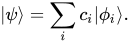
In quantum mechanics each measurable physical quantity of a quantum system is called an observable which, for example, could be the position and the momentum but also energy , components of spin (), and so on. The observable acts as a linear function on the states of the system; its eigenvectors correspond to the quantum state (i.e. eigenstate) and the eigenvalues to the possible values of the observable. The collection of eigenstates/eigenvalue pairs represent all possible values of the observable. Writing for an eigenstate and for the corresponding observed value, any arbitrary state of the quantum system can be expressed as a vector using bra–ket notation: The kets specify the different available quantum "alternatives", i.e., particular quantum states.

The wave function is a specific representation of a quantum state. Wave functions can therefore always be expressed as eigenstates of an observable though the converse is not necessarily true.

Collapse

[edit]

To account for the experimental result that repeated measurements of a quantum system give the same results, the theory postulates a "collapse" or "reduction of the state vector" upon observation,[5]: 566 abruptly converting an arbitrary state into a single component eigenstate of the observable:

where the arrow represents a measurement of the observable corresponding to the basis.[6] For any single event, only one eigenvalue is measured, chosen randomly from among the possible values.

Meaning of the expansion coefficients

[edit]

The complex coefficients in the expansion of a quantum state in terms of eigenstates , can be written as an (complex) overlap of the corresponding eigenstate and the quantum state: They are called the probability amplitudes. The square modulus is the probability that a measurement of the observable yields the eigenstate . The sum of the probability over all possible outcomes must be one:[7]

As examples, individual counts in a double slit experiment with electrons appear at random locations on the detector; after many counts are summed the distribution shows a wave interference pattern.[8] In a Stern-Gerlach experiment with silver atoms, each particle appears in one of two areas unpredictably, but the final conclusion has equal numbers of events in each area.

This statistical aspect of quantum measurements differs fundamentally from classical mechanics. In quantum mechanics the only information we have about a system is its wave function and measurements of its wave function can only give statistical information.[5]: 17 

Terminology

[edit]

The two terms "reduction of the state vector" (or "state reduction" for short) and "wave function collapse" are used to describe the same concept. A quantum state is a mathematical description of a quantum system; a quantum state vector uses Hilbert space vectors for the description.[9]: 159  Reduction of the state vector replaces the full state vector with a single eigenstate of the observable.

The term "wave function" is typically used for a different mathematical representation of the quantum state, one that uses spatial coordinates also called the "position representation".[9]: 324  When the wave function representation is used, the "reduction" is called "wave function collapse".

The measurement problem

[edit]

The Schrödinger equation describes quantum systems but does not describe their measurement. Solution to the equations include all possible observable values for measurements, but measurements only result in one definite outcome. This difference is called the measurement problem of quantum mechanics. To predict measurement outcomes from quantum solutions, the orthodox interpretation of quantum theory postulates wave function collapse and uses the Born rule to compute the probable outcomes.[10] Despite the widespread quantitative success of these postulates scientists remain dissatisfied and have sought more detailed physical models. Rather than suspending the Schrödinger equation during the process of measurement, the measurement apparatus should be included and governed by the laws of quantum mechanics.[11]: 127 

Physical approaches to collapse

[edit]

Quantum theory offers no dynamical description of the "collapse" of the wave function. Viewed as a statistical theory, no description is expected. As Fuchs and Peres put it, "collapse is something that happens in our description of the system, not to the system itself".[12]

Various interpretations of quantum mechanics attempt to provide a physical model for collapse.[13]: 816  Three treatments of collapse can be found among the common interpretations. The first group includes hidden-variable theories like de Broglie–Bohm theory; here random outcomes only result from unknown values of hidden variables. Results from tests of Bell's theorem shows that these variables would need to be non-local. The second group models measurement as quantum entanglement between the quantum state and the measurement apparatus. This results in a simulation of classical statistics called quantum decoherence. This group includes the many-worlds interpretation and consistent histories models. The third group postulates additional, but as yet undetected, physical basis for the randomness; this group includes for example the objective-collapse interpretations. While models in all groups have contributed to better understanding of quantum theory, no alternative explanation for individual events has emerged as more useful than collapse followed by statistical prediction with the Born rule.[13]: 819 

The significance ascribed to the wave function varies from interpretation to interpretation and even within an interpretation (such as the Copenhagen interpretation). If the wave function merely encodes an observer's knowledge of the universe, then the wave function collapse corresponds to the receipt of new information. This is somewhat analogous to the situation in classical physics, except that the classical "wave function" does not necessarily obey a wave equation. If the wave function is physically real, in some sense and to some extent, then the collapse of the wave function is also seen as a real process, to the same extent.[citation needed]

Quantum decoherence

[edit]

Quantum decoherence explains why a system interacting with an environment transitions from being a pure state, exhibiting superpositions, to a mixed state, an incoherent combination of classical alternatives.[14] This transition is fundamentally reversible, as the combined state of system and environment is still pure, but for all practical purposes irreversible in the same sense as in the second law of thermodynamics: the environment is a very large and complex quantum system, and it is not feasible to reverse their interaction. Decoherence is thus very important for explaining the classical limit of quantum mechanics, but cannot explain wave function collapse, as all classical alternatives are still present in the mixed state, and wave function collapse selects only one of them.[15][16][14]

The form of decoherence known as environment-induced superselection proposes that when a quantum system interacts with the environment, the superpositions apparently reduce to mixtures of classical alternatives. The combined wave function of the system and environment continue to obey the Schrödinger equation throughout this apparent collapse.[17] More importantly, this is not enough to explain actual wave function collapse, as decoherence does not reduce it to a single eigenstate.[15][14]

History

[edit]

The concept of wavefunction collapse was introduced by Werner Heisenberg in his 1927 paper on the uncertainty principle, "Über den anschaulichen Inhalt der quantentheoretischen Kinematik und Mechanik", and incorporated into the mathematical formulation of quantum mechanics by John von Neumann, in his 1932 treatise Mathematische Grundlagen der Quantenmechanik.[4] Heisenberg did not try to specify exactly what the collapse of the wavefunction meant. However, he emphasized that it should not be understood as a physical process.[18] Niels Bohr never mentions wave function collapse in his published work, but he repeatedly cautioned that we must give up a "pictorial representation". Despite the differences between Bohr and Heisenberg, their views are often grouped together as the "Copenhagen interpretation", of which wave function collapse is regarded as a key feature.[19]

John von Neumann's influential 1932 work Mathematical Foundations of Quantum Mechanics took a more formal approach, developing an "ideal" measurement scheme[20][21]: 1270 that postulated that there were two processes of wave function change:

  1. The probabilistic, non-unitary, non-local, discontinuous change brought about by observation and measurement (state reduction or collapse).
  2. The deterministic, unitary, continuous time evolution of an isolated system that obeys the Schrödinger equation.

In 1957 Hugh Everett III proposed a model of quantum mechanics that dropped von Neumann's first postulate. Everett observed that the measurement apparatus was also a quantum system and its quantum interaction with the system under observation should determine the results. He proposed that the discontinuous change is instead a splitting of a wave function representing the universe.[21]: 1288  While Everett's approach rekindled interest in foundational quantum mechanics, it left core issues unresolved. Two key issues relate to origin of the observed classical results: what causes quantum systems to appear classical and to resolve with the observed probabilities of the Born rule.[21]: 1290 [20]: 5 

Beginning in 1970 H. Dieter Zeh sought a detailed quantum decoherence model for the discontinuous change without postulating collapse. Further work by Wojciech H. Zurek in 1980 lead eventually to a large number of papers on many aspects of the concept.[22] Decoherence assumes that every quantum system interacts quantum mechanically with its environment and such interaction is not separable from the system, a concept called an "open system".[21]: 1273  Decoherence has been shown to work very quickly and within a minimal environment, but as yet it has not succeeded in a providing a detailed model replacing the collapse postulate of orthodox quantum mechanics.[21]: 1302 

By explicitly dealing with the interaction of object and measuring instrument, von Neumann[2] described a quantum mechanical measurement scheme consistent with wave function collapse. However, he did not prove the necessity of such a collapse. Von Neumann's projection postulate was conceived based on experimental evidence available during the 1930s, in particular Compton scattering. Later work refined the notion of measurements into the more easily discussed first kind, that will give the same value when immediately repeated, and the second kind that give different values when repeated.[23][24][25]

See also

[edit]

References

[edit]
[edit]
Revisions and contributorsEdit on WikipediaRead on Wikipedia
from Grokipedia
In , wave function collapse, also known as reduction of the state vector, is the postulated process by which a quantum system's —initially in a superposition of multiple possible states—abruptly transitions to a single definite eigenstate corresponding to the outcome of a . This discontinuous change contrasts with the continuous, unitary evolution governed by the , and it occurs instantaneously upon interaction with a measuring apparatus, yielding a probabilistic outcome determined by the , where the probability of each possible result is the square of the absolute value of the corresponding coefficient in the wave function expansion. The concept addresses the , which questions how quantum superpositions resolve into classical-like definite outcomes observed in experiments, such as the position of a particle or the spin of an . Historically, wave function collapse emerged as a central feature of the Copenhagen interpretation, developed in the 1920s by Niels Bohr and Werner Heisenberg to reconcile quantum theory with empirical observations, though it was mathematically formalized by John von Neumann in his 1932 treatise Mathematical Foundations of Quantum Mechanics, where he described collapse as a non-unitary projection onto an eigenstate during measurement. Von Neumann's framework highlighted the role of the observer, leading to later variants like the von Neumann–Wigner interpretation, which controversially proposed that conscious awareness triggers the collapse, placing the process at the interface between quantum physics and mind. However, this idea has faced significant criticism for lacking empirical support and implying a special role for consciousness, which contradicts evidence of quantum behavior in pre-conscious cosmic evolution and macroscopic interactions that mimic measurement without awareness. The postulate of collapse has sparked ongoing debate and alternative . In the standard formulation, collapse is an addition to resolve the , but it raises issues like the undefined boundary between quantum and classical realms (the "") and potential violations of relativity due to instantaneous action. Competing views, such as the proposed by Hugh Everett in 1957, eliminate collapse entirely by positing that all possible outcomes occur in branching parallel universes, while decoherence theory explains apparent collapse through environmental interactions without fundamental non-unitarity. Modern spontaneous collapse models, like the Ghirardi–Rimini–Weber (GRW) theory introduced in 1986, modify the with stochastic, nonlinear terms to induce objective collapses at rates scaling with system size, suppressing macroscopic superpositions while preserving quantum behavior at microscopic scales; these models are experimentally testable and have been constrained by precision tests in and . Ongoing experiments, including those probing entanglement and signatures, continue to refine bounds on such theories, potentially distinguishing them from standard .

Overview

Definition and Basic Concept

Wave function collapse, also known as the reduction of the wave function or state vector reduction, refers to the postulated process in where the wave function of a quantum system, which describes a superposition of possible states with associated probabilities, instantaneously transitions to a single definite eigenstate corresponding to the outcome of a . This concept was formalized as the projection postulate by in his seminal 1932 work, , where he described it as an abrupt change triggered by interaction with a measuring apparatus. The resulting state reflects the observed value, with the probability of each outcome given by the square of the in the original superposition, per the . In the standard framework of , the evolution of an isolated system's follows the unitary and deterministic , preserving superpositions and allowing reversible dynamics. , however, introduces a non-unitary and irreversible step that breaks this coherence, transforming the quantum description into a classical-like definite outcome and marking the transition from probabilistic possibilities to a single reality. This distinction highlights the foundational role of in quantum theory, where is not derived from the but added as an ad hoc postulate to account for empirical observations. A classic illustration of superposition prior to collapse is Erwin Schrödinger's 1935 , known as . In this scenario, a cat is placed in a sealed chamber containing a radioactive atom with a 50% chance of decaying within an hour, linked to a mechanism that would release poison if decay occurs; until the chamber is observed, the entire system—including the cat—exists in a superposition of "alive" and "dead" states, entangled with the atom's undecayed and decayed possibilities. Upon opening the chamber and measuring the system, the wave function collapses instantaneously to either the alive or dead state, demonstrating how quantum indeterminacy can seemingly extend to macroscopic scales before observation resolves it. This collapse mechanism remains a core postulate of standard , accepted to reconcile the theory's predictions with everyday classical experiences, though its physical basis and precise trigger continue to be subjects of debate in the broader .

Role in Quantum Measurement

In , the measurement process involves the interaction of a quantum with a classical measuring apparatus, which induces the collapse of the 's into one of the eigenstates of the measured , resulting in a definite outcome such as a specific position or spin value. This collapse transitions the from a superposition of possible states to a single realized state, aligning the quantum description with the classical observation recorded by the apparatus. A prominent observational demonstration of this role is provided by the , where particles like electrons exhibit wave-like interference patterns on a detection screen when both slits are open and no measurement is made at the slits, indicating no collapse and preservation of the superposition. However, introducing a detector at one slit to determine which path the particle takes causes the interference pattern to disappear, with the impacts forming two distinct bands as if the particles behave classically, signifying wave function collapse to a definite . According to von Neumann's analysis of the measurement chain, this collapse occurs specifically at the point of irreversible amplification, where the quantum interaction propagates through successive apparatus components until it reaches a that prevents reversal, marking the boundary between quantum coherence and classical definiteness. The collapse mechanism ensures the of quantum measurements, as the post-measurement state is an eigenstate of the , yielding the same outcome with probability one upon immediate repetition under identical conditions. Yet, this process raises fundamental questions about the role of , as the exact location of the collapse within the chain—from the initial interaction to conscious —remains ambiguous in the standard .

Mathematical Formulation

Superposition and the Wave Function

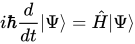
In , the state of a physical system is described by the wave function ψ(r,t)\psi(\mathbf{r}, t), a complex-valued function of position r\mathbf{r} and time tt that encodes all observable information about the system. This representation is formulated within the framework of , an infinite-dimensional equipped with an inner product, where the wave functions form a complete basis for square-integrable functions L2(R3)L^2(\mathbb{R}^3). The structure ensures that the can be treated as a vector, allowing for rigorous mathematical operations like orthogonality and completeness relations essential to the theory. The of the wave function is deterministic and unitary, governed by the time-dependent : iψ(r,t)t=H^ψ(r,t),i \hbar \frac{\partial \psi(\mathbf{r}, t)}{\partial t} = \hat{H} \psi(\mathbf{r}, t), where \hbar is the reduced Planck's constant and H^\hat{H} is the Hamiltonian operator, typically H^=22m2+V(r,t)\hat{H} = -\frac{\hbar^2}{2m} \nabla^2 + V(\mathbf{r}, t) for a single particle in a potential VV. This was postulated by in 1926, drawing from wave-particle duality and analogies to classical wave mechanics, ensuring conservation of probability and reversible dynamics in the absence of . A cornerstone of is the , arising from the linearity of the : if ψ1\psi_1 and ψ2\psi_2 are valid wave functions satisfying the equation, then any linear combination ψ=c1ψ1+c2ψ2\psi = c_1 \psi_1 + c_2 \psi_2, with complex coefficients c1,c2c_1, c_2 satisfying normalization, is also a solution. More generally, the wave function can be expanded in a basis of orthonormal states as ψ=ncnϕn\psi = \sum_n c_n \phi_n, where ϕn\phi_n are eigenfunctions of an and cn2|c_n|^2 are probabilities. This principle enables interference effects, such as those observed in double-slit experiments, where the system exhibits behaviors impossible in . Superposition implies that a quantum system can exist in a coherent combination of multiple states simultaneously, reflecting the non-classical of quantum . To connect with experimental outcomes, in the position basis, the ψ(r,t)2|\psi(\mathbf{r}, t)|^2 represents the probability density for locating the particle at r\mathbf{r} at time tt, with the normalization condition ψ(r,t)2d3r=1\int |\psi(\mathbf{r}, t)|^2 d^3\mathbf{r} = 1 ensuring total probability unity. This probabilistic interpretation was introduced by in 1926, linking the mathematical formalism to measurable frequencies in scattering processes.

The Collapse Postulate

The collapse postulate, formally known as the projection postulate, constitutes a core axiom of , specifying the discontinuous change in a quantum system's state vector upon measurement of an . As articulated by , if an observable AA possesses a discrete spectrum with eigenvalues ana_n and associated orthonormal eigenstates n|n\rangle, then a system initially in a superposition ψ=ncnn|\psi\rangle = \sum_n c_n |n\rangle undergoes an instantaneous, non-unitary transition to the state n|n\rangle (normalized if necessary) upon yielding the outcome ana_n, with the probability of this outcome given by cn2|c_n|^2. In operator terms, the post-measurement state is more precisely ψ=PnψPnψ|\psi'\rangle = \frac{P_n |\psi\rangle}{\|P_n |\psi\rangle\|}, where Pn=nnP_n = |n\rangle\langle n| is the onto the eigenspace corresponding to ana_n; this formulation accounts for possible degeneracy in the . The collapse operation is probabilistic, injecting irreducible into the system's description that is absent from the underlying unitary dynamics. A defining property of this postulate is its : performing a repeated of the same on the collapsed state invariably reproduces the same eigenvalue, ensuring consistency with empirical observations of definite, repeatable results. This feature underscores the postulate's role in bridging the abstract superposition of states—such as those discussed in the context of representation—with the concrete outcomes of physical . Unlike the continuous, reversible evolution dictated by the Schrödinger equation via unitary operators, which conserves probabilities and allows in-principle time reversal, the collapse process is fundamentally irreversible, effectively erasing interference between non-selected eigencomponents and marking a departure from pure quantum dynamics.

Probabilistic Interpretation

The probabilistic interpretation of wave function collapse is encapsulated in the Born rule, which provides the probability for the collapse to occur into a specific eigenstate n|n\rangle of the measured observable. According to this rule, if the pre-measurement state of the system is described by the wave function ψ=ncnn|\psi\rangle = \sum_n c_n |n\rangle, where the cnc_n are complex coefficients, the probability P(n)P(n) of collapsing to the state n|n\rangle is given by P(n)=nψ2=cn2P(n) = |\langle n | \psi \rangle|^2 = |c_n|^2. This ensures that the probabilities are normalized, satisfying ncn2=1\sum_n |c_n|^2 = 1, which corresponds to the total probability being unity across all possible outcomes. The coefficients cnc_n represent complex probability amplitudes, where the modulus cn|c_n| determines the square root of the collapse probability, while the phase of cnc_n encodes essential for quantum interference effects in the evolution prior to measurement. These amplitudes are inherently complex to account for the wave-like superposition that allows constructive and destructive interference, distinguishing quantum behavior from classical probabilities. Upon collapse, the process randomly selects one outcome according to these Born probabilities, thereby resolving the quantum superposition into a definite classical state with certainty for that particular measurement. This interpretation connects quantum probabilities to frequentist , where the predicted cn2|c_n|^2 emerges as the long-run relative frequency of observing the corresponding outcome in repeated identical measurements on an ensemble of systems.

The Measurement Problem

Origins and Statement

The measurement problem in quantum mechanics arises from the apparent tension between the deterministic, unitary evolution of the wave function described by the and the probabilistic, irreversible collapse that occurs upon measurement, yielding a definite outcome. This discrepancy challenges classical intuitions about physical reality, where systems evolve continuously and deterministically without abrupt changes triggered by observation. A famous articulation of this issue comes from , who, during a conversation with , questioned whether the moon exists only when looked at, highlighting the observer-dependent nature implied by quantum formalism if collapse is not resolved. John von Neumann formalized this problem in his analysis of the measurement process, describing a chain of interactions where the quantum system under measurement becomes entangled with the measuring apparatus, which in turn entangles with the observer and potentially further systems, extending indefinitely without a mechanism to halt the superposition unless collapse intervenes. This "von Neumann chain" leads to an infinite regress, as each link in the chain remains in a quantum superposition until an undefined point where collapse is postulated to occur, underscoring the ad hoc nature of the collapse mechanism within the theory. The problem thus reveals an incompleteness in , as the postulate—referring to the non-unitary projection of the wave function onto an eigenstate upon —is introduced axiomatically rather than derived from the theory's fundamental equations, leaving the dynamics of unexplained and incompatible with the otherwise reversible unitary evolution. Eugene Wigner's friend paradox further illustrates the observer dependence and timing ambiguity in , where an external observer (Wigner) considers a friend inside a who measures a quantum system, entangling it with themselves; from Wigner's perspective, the entire remains in superposition until he measures it, raising questions about when and how occurs relative to different observers. Recent experiments have realized extended versions of this scenario, such as a six-photon that violated Bell-type inequalities consistent with , confirming observer-dependent facts.

Challenges to Determinism

The governs the of the quantum in a fully deterministic manner, predicting the future state of a system precisely from its initial conditions without any inherent randomness. In stark contrast, the collapse during measurement introduces fundamental indeterminism, as the outcome selects one eigenstate probabilistically according to the , rendering future predictions inherently uncertain even with complete knowledge of the pre-measurement state. This duality directly conflicts with classical , epitomized by —a hypothetical intellect that could predict all future events by knowing the positions and momenta of all particles at a given instant—since quantum collapse precludes such exhaustive foresight. A central challenge arises from non-locality in entangled quantum systems, as illustrated by the Einstein-Podolsky-Rosen (EPR) paradox, where the of one particle's property appears to instantaneously determine the state of a distant entangled partner, seemingly violating local and the deterministic propagation of influences within . This non-local correlation implies that either abandons locality or accepts "spooky action at a distance," undermining the deterministic framework of and . Furthermore, the exposes the ambiguous boundary between the quantum realm of superpositions and the classical realm of definite outcomes, as the trigger for collapse—deemed a "" by a classical apparatus—lacks a precise physical criterion, complicating the transition from probabilistic quantum evolution to observed classical reality. At its core, the measurement problem casts doubt on the reality of unmeasured quantum states, which persist in indefinite superpositions without objective properties until observed, and on the objectivity of measurement results, which may depend on the observer's interaction rather than an intrinsic system attribute. These issues have spurred ongoing debates over hidden variables theories, such as Bohmian mechanics, which aim to restore by introducing definite particle trajectories guided by the wave function, thereby eliminating the need for collapse while reproducing quantum predictions.

Interpretations and Resolutions

Copenhagen Interpretation

The Copenhagen interpretation, formulated in the late 1920s by and , posits that wave function collapse is an irreducible process triggered by involving a classical observing apparatus. According to this view, the quantum system remains in superposition until interacted with by such an apparatus, at which point the wave function abruptly collapses to one of the possible eigenstates, yielding a definite classical outcome. This collapse is not a physical evolution governed by the but a pragmatic update reflecting the acquisition of observational knowledge. Central to Bohr's contribution is of complementarity, which holds that wave and particle descriptions of quantum phenomena are mutually exclusive yet complementary aspects of reality, selectable only through the choice of experimental arrangement. In his Como lecture, Bohr emphasized that any of atomic phenomena entails an unavoidable interaction with the measuring agency, rendering classical space-time coordination inapplicable and limiting the precision of state descriptions to probabilistic terms. Heisenberg complemented this by stressing the role of in defining measurable quantities, arguing that the act of measurement actualizes potentialities inherent in the , thereby resolving ambiguities in the formalism without invoking hidden variables. Together, their perspectives treat the wave function as a symbolic tool for predicting statistical outcomes rather than a depiction of an objective reality independent of . The interpretation underscores the epistemic nature of the wave function, where collapse serves to refine our information about the system upon , effectively "resolving" the by decree rather than mechanism. This approach pragmatically accepts the formalism's success in matching experimental results while avoiding deeper ontological commitments. However, a key internal criticism is the vagueness in defining what qualifies as a "" or classical observer, leaving unclear the boundary between quantum and classical realms and why collapse occurs precisely at that juncture.

Many-Worlds Interpretation

The (MWI) posits that the is described by a single, universal that evolves deterministically and unitarily according to the , without any collapse mechanism. Proposed by physicist in his 1957 paper, this interpretation eliminates the need for a special measurement postulate by treating the entire , including observers and measuring devices, as part of the quantum system. Instead of a collapse reducing the to a single outcome, every possible outcome of a quantum event corresponds to a branching of the into parallel worlds, each realizing one definite result from the observer's perspective. A central concept in the MWI is the entanglement of the observer with the quantum system during . When an observer interacts with a system in superposition—such as a particle whose position is uncertain—the combined of system and observer becomes entangled, leading to a superposition of states where the observer is correlated with each possible outcome. This entanglement results in decohered branches of the , each appearing as a classical world with a definite measurement result; from within any given branch, the observer experiences only one outcome, while all branches coexist in the . Everett's formulation resolves the by showing that the probabilistic appearance of arises from the relative states between systems and observers, without invoking non-unitary collapse or observer-dependent reality. The MWI offers significant advantages as an interpretation of quantum mechanics. It provides a fully deterministic framework at the level of the entire multiverse, removing randomness and instantaneous action at a distance from fundamental physics, as the evolution remains governed solely by the unitary Schrödinger equation. Furthermore, the interpretation aligns seamlessly with quantum field theory, the relativistic extension of quantum mechanics, because both rely on linear, unitary dynamics in Hilbert or Fock space without additional postulates; extensions of the MWI to quantum field theory have been developed to handle particle creation and annihilation processes consistently.

Physical Approaches

Quantum Decoherence

Quantum decoherence provides a physical mechanism to understand how quantum superpositions evolve into classical-like mixtures, addressing aspects of the by showing how environmental interactions suppress quantum interference without requiring a fundamental collapse postulate. This process occurs when a quantum system becomes entangled with a larger environment, leading to the rapid loss of coherence in the system's description. Developed primarily in the 1970s by H. Dieter Zeh and expanded in the 1980s by and collaborators, decoherence explains the of classical probabilities from unitary quantum evolution but does not inherently select a single outcome, necessitating an interpretive framework to account for the definite results observed in measurements. The core mechanism of decoherence arises from the entanglement between the system and its environment. Consider a system initially in a superposition ψ=icii|\psi\rangle = \sum_i c_i |i\rangle, with the environment in a pure state E0|E_0\rangle. Following a unitary interaction, the joint state evolves to Ψ=iciiEi|\Psi\rangle = \sum_i c_i |i\rangle |E_i\rangle, where the environmental states Ei|E_i\rangle become effectively orthogonal due to the large number of environmental degrees of freedom. The reduced density matrix for the system, obtained by tracing over the environment, is ρ=\TrE(ΨΨ)=i,jcicjijEjEi\rho = \Tr_E (|\Psi\rangle\langle\Psi|) = \sum_{i,j} c_i c_j^* |i\rangle\langle j| \langle E_j | E_i \rangle. The off-diagonal elements, weighted by the overlap EjEi\langle E_j | E_i \rangle for iji \neq j, decay exponentially to near zero on short timescales, diagonalizing ρ\rho into ρici2ii\rho \approx \sum_i |c_i|^2 |i\rangle\langle i|, which describes an incoherent classical statistical mixture. This loss of phase relationships eliminates interference terms, making the system's behavior appear classical. The dynamics of this process for open quantum systems is captured by the Lindblad master equation, which governs the evolution of the reduced density operator: dρdt=i[H,ρ]+k(LkρLk12{LkLk,ρ}),\frac{d\rho}{dt} = -i [H, \rho] + \sum_k \left( L_k \rho L_k^\dagger - \frac{1}{2} \{ L_k^\dagger L_k, \rho \} \right), where HH is the system's Hamiltonian, and the LkL_k are Lindblad operators representing environmental dissipators, such as or absorption processes. The term preserves unitarity for the , while the dissipator terms induce the irreversible decoherence, with rates depending on environmental strength. This equation demonstrates how coherence is suppressed on timescales much shorter than typical system evolution times for macroscopic systems, leading to the effective classicality of preferred states (pointer states) robust against . While decoherence accounts for the transition to classical statistics and the absence of observable superpositions in everyday scales, it does not resolve the issue of outcome definiteness, as the diagonalized represents an ensemble average rather than a single realized state; additional interpretive elements are required to explain why observers perceive one particular outcome. Experimental verification has been achieved in controlled settings, such as (QED) experiments where the decoherence of field superpositions—creating mesoscopic "Schrödinger cat" states—was directly observed through progressive loss of interference fringes as atoms scattered photons from the cavity mode. Similarly, in matter-wave interferometry, coherence suppression was demonstrated with molecules (C₆₀), where thermal emission of or collisions with background gas atoms led to measurable reductions in interference visibility, confirming environmental decoherence rates scaling with molecular size and temperature. These observations highlight decoherence's role in bridging quantum and classical realms without altering the unitary Schrödinger evolution.

Objective Collapse Theories

Objective collapse theories propose modifications to the standard quantum mechanical formalism by introducing non-unitary, stochastic processes that cause the spontaneously and objectively, independent of any measurement apparatus. These theories aim to provide a dynamical mechanism for collapse that applies universally to all systems, resolving the by eliminating the need for special rules during observation. The collapses occur at a low rate for microscopic systems but amplify for macroscopic ones, ensuring consistency with everyday experience while deviating from pure quantum evolution. A seminal model is the Ghirardi––Weber (GRW) theory, introduced in , which posits that each particle in a undergoes independent spontaneous localization events at a fixed rate λ, typically on the order of 10^{-16} s^{-1} per particle for elementary systems, with a localization length σ ≈ 10^{-7} m. During a collapse, the wave function is multiplied by a narrow centered at a random position drawn from the current according to the , effectively localizing the state while preserving normalization. For a of N particles, the mean number of collapses increases linearly with N, leading to rapid suppression of superpositions in macroscopic objects. The evolution between collapses follows the standard , but the overall dynamics is described by a involving discrete jumps. A continuous variant, the Continuous Spontaneous Localization (CSL) model developed in the , replaces these discrete jumps with a while retaining similar parameters. Another prominent approach is Roger Penrose's gravity-induced collapse model from the , which links the collapse rate to gravitational effects rather than an parameter. Penrose proposed that superpositions of geometries become unstable when the gravitational difference between the branches exceeds a threshold on the order of ℏ/t, where t is the superposition lifetime, leading to objective reduction with a rate λ proportional to the and spatial separation of the superposed states. For example, in a superposition of a particle at two locations separated by distance d, the collapse time scales as τ ≈ ℏ / E_G, where E_G is the gravitational interaction energy between the mass distributions. This mechanism suggests that larger or more massive systems collapse faster due to stronger gravitational influences. A related model by Lajos Diósi incorporates similar gravitational ideas into a framework. These theories address the by providing an objective, physical process for that does not rely on conscious observers or environmental interactions, treating all systems uniformly. They are testable through predicted deviations from standard , such as excess heating or reduced interference visibility in large-scale superposition experiments, where larger systems should exhibit faster collapse rates and thus measurable non-unitary effects. Experiments, including those with massive particles or biomolecules, aim to bound parameters like λ or detect such signatures; as of 2025, matter-wave has constrained λ to upper limits like 10^{-5} s^{-1} for systems of thousands of atoms.

Historical Development

Early Quantum Formulations

The development of in the mid-1920s introduced the concept of wave function collapse as a means to reconcile the continuous evolution of quantum states with the discrete outcomes observed in experiments. Werner Heisenberg's , formulated in 1925, represented observables as infinite arrays of complex numbers, where the eigenvalues corresponded to the possible discrete results of measurements, implying that interactions with measuring devices would yield definite values from this spectrum. In 1926, provided the probabilistic interpretation of the wave function, proposing that the square of its modulus represents the probability density for finding a particle at a given position, which necessitated a collapse mechanism to transition from superposition to a single observed outcome upon . This interpretation was detailed in Born's analysis of collision processes using Schrödinger's emerging wave mechanics framework. Shortly thereafter, introduced his , describing the deterministic, continuous evolution of the wave function over time; however, to account for the irreversible nature of measurement results, collapse was incorporated ad hoc, projecting the wave function onto an eigenstate of the measured observable. The formalization of this collapse as a postulate occurred in Paul Dirac's 1930 textbook, where it was described as the projection of the onto the eigenspace of the measured quantity, yielding a probability given by the . This was further formalized by in his 1932 book , introducing the projection postulate as part of the axiomatic structure of , distinguishing the unitary evolution under the from the non-unitary reduction during observation. This projection postulate became a cornerstone of the theory, distinguishing the unitary evolution under the from the non-unitary reduction during observation. Early recognition of the conceptual challenges posed by this dual dynamics was evident at the 1927 , where defended the approach, emphasizing the role of measurement in inducing collapse, while questioned the completeness of , highlighting tensions between and probabilistic outcomes. These debates underscored the provisional nature of collapse in the foundational formulations.

Developments and Debates

Following , the Einstein-Podolsky-Rosen (EPR) paradox, originally proposed in 1935, gained renewed attention in debates over ' completeness and the nature of wave function collapse. Physicists revisited EPR's challenge to quantum theory's description of entangled particles, questioning whether nonlocal influences or incomplete wave functions better explained measurement outcomes, fueling discussions on realism and locality in the 1950s and 1960s. In 1957, introduced the , proposing that the universal evolves unitarily without collapse, with measurement outcomes branching into parallel worlds; this addressed the by eliminating collapse altogether, though it initially faced skepticism. By 1964, John Bell's theorem demonstrated that no could reproduce ' predictions for entangled systems, effectively ruling out local realist alternatives to collapse and intensifying post-war scrutiny of wave function reduction. These milestones highlighted the as an ongoing driver, prompting alternative frameworks. The 1970s saw the emergence of theory, pioneered by H. Dieter Zeh, which explained how interactions with the environment rapidly suppress quantum superpositions, producing apparent collapse without invoking a fundamental reduction postulate. Building on this, the 1980s introduced objective collapse models, such as the Ghirardi-Rimini-Weber (GRW) theory in 1986, which posited spontaneous, collapses for macroscopic systems to resolve the while preserving quantum predictions for microscopic scales. Concurrently, experiments, including Alain Aspect's 1982 Bell inequality tests using entangled photons, confirmed and collapse-like effects in entangled systems, while later 1990s-2000s advancements in demonstrated controlled superpositions and decoherence in single atoms and photons. In the 21st century, weak measurement techniques, developed by Yakir Aharonov and colleagues in 1988, enabled probing of quantum states between pre- and post-selection without full collapse, offering insights into "pre-collapse" trajectories and anomalous weak values that challenge traditional collapse interpretations. By 2025, no definitive resolution to the collapse debate has emerged, but experiments have tightened limits on macroscopic superpositions; for instance, optomechanical tests in the 2020s, such as those using μHBAR resonators, have achieved coherence times exceeding 6 ms for systems with masses around 7.5 × 10^{-9} kg, constraining objective collapse models without falsifying quantum mechanics. Ongoing debates center on wave function collapse's role in quantum computing, where environmental decoherence mimics collapse but is mitigated through error correction codes that preserve superpositions without inducing actual reduction, enabling scalable qubit operations.
Add your contribution
Related Hubs
User Avatar
No comments yet.