Hubbry Logo
Red LeicesterRed LeicesterMain
Open search
Red Leicester
Community hub
Red Leicester
logo
8 pages, 0 posts
0 subscribers
Be the first to start a discussion here.
Red Leicester
Red Leicester
from Wikipedia
Red Leicester
Other namesLeicestershire, Leicester
Country of originEngland
RegionLeicestershire
Source of milkCattle
PasteurisedFrequently
TextureHard
Fat content33% total (48% as FDM)
Aging time6 to 12 months
Named afterLeicester, Leicestershire[*]
Related media on Commons

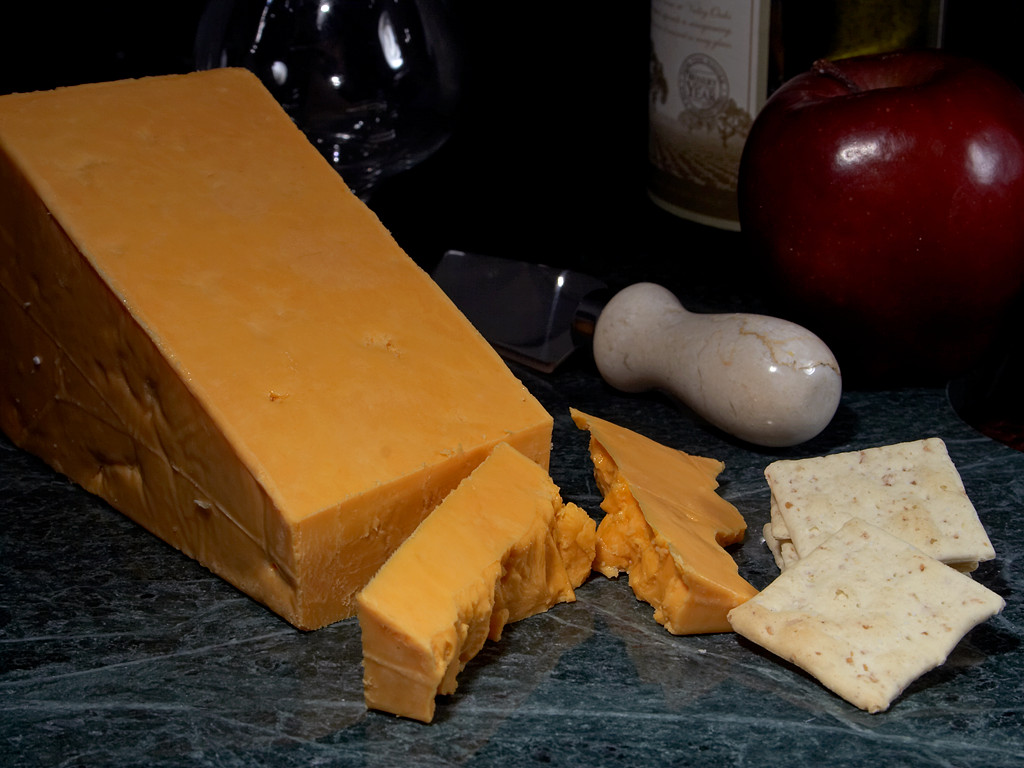
Red Leicester (also known simply as Leicester or Leicestershire cheese)[1] (/ˈlɛstə/, /ˈlɛstərʃə/) is an English cheese similar to Cheddar cheese, but crumbly in texture. It is typically aged 6 to 12 months. The rind is reddish-orange with a powdery mould on it. Since the 18th century, it has been coloured orange by the addition of annatto extract during manufacture.[2] It is a cow's milk cheese, and is named after the city of Leicester, or the ceremonial county it is located in, Leicestershire.

Traditionally made wheels are fairly firm and dry, with a friable texture and a slightly sweet, mellow flavour that becomes stronger as the cheese matures. Block-made cheeses are moister, and they have a slightly sweet aftertaste and a creamy texture.[3] The cheese has a slightly nutty taste. Versions sold in supermarkets are typically coloured with annatto, although it is possible to obtain Red Leicester without it.

Red Leicester is aged anywhere from four to nine months. "Young" Leicesters, at the beginning of that range, will be very mild; it is usually after six months that a Leicester begins to develop enough of a tang to be classified as "old". The modern industrial method for ageing is with vacuum packing. Smaller "farmhouse" makers usually still use the traditional way of maturing it in cloth, for a better flavour development.

History

[edit]

The cheese was originally made on farms in Leicestershire, England, with surplus milk, once all the Stilton desired was made. It was originally coloured with carrot or beetroot juice.

It used to be called Leicestershire Cheese but came to be called Red Leicester. This was to distinguish it from "White Leicester," which was made to a national wartime recipe in the 1940s due to rationing.[3]

When fresh, the fat content of Red Leicester cheese is generally 33 to 34%. Regulations require that minimum fat levels to be stated in terms of the "fat in dry matter" or FDM. This is because moisture levels decrease as cheese ages. FDM measures the amount of fat present in the solids, which includes protein, minerals, vitamins and salt. The minimum FDM listed for Red Leicester is generally 48%.[4]

References

[edit]
[edit]
Revisions and contributorsEdit on WikipediaRead on Wikipedia
from Grokipedia
Red Leicester is a traditional hard cheese originating from in the of , characterized by its distinctive russet red-orange color derived from dye, firm yet flaky texture, and mellow, sweet flavor with nutty, caramel, and subtle citrus notes. Made from unpasteurized cow's milk, it is produced in large, flat cylindrical wheels weighing 10 to 20 kilograms, typically cloth-bound and matured for 3 to 12 months to develop its smooth, rich profile, which is milder and more savory than Cheddar. Historically, Red Leicester—originally known simply as Leicestershire cheese—emerged in the as a way for local farmers to utilize surplus after producing , providing a stable income alongside the more seasonal . A dedicated cheese market was established in in 1759, enforcing quality standards that helped standardize the cheese, which was initially colored with natural ingredients like or juice before became common in the 18th century to signify its creamy quality. By the late , factory production began around , leading to widespread industrialization, but traditional farm-made versions largely ceased by 1956 due to the dominance of the and block-style cheeses. The production process involves using raw cow's milk from local herds, such as Friesians, with to form a smaller than in Cheddar, followed by a lower scald temperature and shorter cooking time for higher moisture content. The are milled, salted, and pressed into molds, then wrapped in cloth, often larded to protect during aging in cool, humid conditions where a fine powdery mold develops on the rind. Today, authentic Red Leicester is rare, with Sparkenhoe Farm in serving as the sole producer of traditionally made, cloth-bound versions since its revival in 2005, emphasizing sustainable practices and the region's high-quality grazing pastures. This resurgence highlights efforts to preserve the cheese's heritage, as recognized by organizations like , amid concerns over its potential decline without greater awareness.

Characteristics

Appearance and Composition

Red Leicester is a hard cheese traditionally made from unpasteurized cow's , originating in , . According to UK compositional standards, it requires a minimum of 48% fat in , minimum total fat content of 28%, and maximum not exceeding 42%. These parameters ensure a rich, concentrated profile that distinguishes it from similar English cheeses. The cheese's signature reddish-orange hue derives from , a sourced from the achiote tree seeds, which has been added during production since the to mimic the desirable color of summer from grass-fed cows. Prior to annatto's widespread use, the coloring was achieved with natural plant extracts such as or juice, helping to differentiate higher-fat cheeses in markets where pale winter was common. Traditionally formed into large cylindrical wheels approximately 20 inches (50 cm) in diameter and 6 inches (15 cm) high, weighing 10 to 20 kg, Red Leicester develops a firm yet crumbly texture upon maturation. Modern production often yields smaller blocks for convenience, but the classic shape promotes even aging and rind formation. The rind on traditional wheels is natural, dry, and flaky, featuring a bright orange-red exterior often dusted with fine, powdery molds that contribute to the cheese's earthy character without imparting off-flavors.

Flavor Profile and Texture

Red Leicester cheese exhibits a flavor profile that evolves significantly with maturity, beginning with a mild, slightly sweet, and nutty taste in younger varieties aged 4-6 months. This initial stage offers clean, creamy notes with a delicately sweet undertone, often described as mellow and reminiscent of , making it approachable for those preferring subtler cheeses. As the cheese matures to 9-12 months, the flavor intensifies into richer, tangy, and savory dimensions, developing full nutty undertones alongside earthy and citrus-like finishes that add complexity without overwhelming sharpness. The texture of Red Leicester is characteristically crumbly yet creamy when cut, featuring a smooth, close body that can range from supple in young examples to more friable and flaky in mature ones. Younger cheeses (4-6 months) present a firmer, moister feel with balanced suppleness, while medium-aged varieties (around 6-9 months) offer a harmonious crumbly-creamy balance, and fully mature versions become intensely crumbly with a drier, granular edge that snaps cleanly. Its aroma starts with mild milky sweetness in youth, progressing to earthy and caramel-like scents in aged forms, enhancing the overall sensory warmth subtly influenced by coloring. Compared to Cheddar, Red Leicester shares a similar crumbliness but distinguishes itself with a sweeter, less sharp profile, attributed to its specific fat content and the annatto's contribution to perceived richness, resulting in a more mellow savoriness across maturity levels.

Production

Ingredients and Manufacturing Process

Red Leicester cheese is traditionally produced using unpasteurised cow's milk sourced from local herds, which provides the base for its characteristic flavor and texture. Key additives include mesophilic starter cultures, primarily strains of to initiate , animal for , and salt at approximately 1.5-2% of the curd weight for preservation and flavor enhancement. , a natural colorant derived from achiote seeds, is briefly incorporated during the early curd stage to impart the cheese's signature orange-red hue. The manufacturing process begins with warming the fresh to around 30°C in a cheese vat, followed by the addition of starter cultures, which are allowed to ripen for about 45 minutes to develop acidity. is then introduced, causing the to coagulate into a firm over 30-60 minutes, depending on and . The is cut into small cubes, approximately 1 cm in size, using a cheese or knife to expel while preserving moisture for the cheese's crumbly texture. Next, the curds undergo scalding, where they are gently heated to 35-38°C and stirred for 30-60 minutes to further contract and release whey, achieving the desired acidity and firmness without the intensive cooking typical of cheddar. The curds are then drained, often formed into blocks and stacked or turned by hand to promote even acidification, before being milled into smaller particles for uniform salting. Salt is evenly distributed by tossing the milled curds, typically at a rate of 1.5-2%, to draw out additional moisture and inhibit unwanted bacteria. The salted curds are packed into cylindrical molds, about 20 inches in diameter and 6 inches deep, and pressed progressively—increasing from light pressure to around 50 pounds over 24-48 hours—while being turned regularly to ensure even shape and density. Traditionally, the pressed wheels are cloth-bound and rubbed with to form a natural rind and facilitate shaping; modern productions may use plastic coatings for block formats to simplify handling. The process yields approximately 1 kg of cheese from 10 liters of , reflecting efficient use of surplus output in traditional farms.

Aging and Maturation Techniques

The aging and maturation of Red Leicester cheese involves a post-pressing process in controlled environments that promote enzymatic and microbial activities, leading to the development of its firm texture and nutty flavor. Traditionally, wheels are cloth-bound and coated with before being stored in cool, conditions of 10-12°C and 85% relative for at least six months, allowing for gradual loss and rind formation. During this time, the cheeses are turned regularly by hand to promote even and prevent uneven mold growth, fostering a natural rind that contributes to the cheese's flaky interior. In modern production, larger blocks are often vacuum-packed in shortly after pressing to retain and enable consistent maturation under similar and controls, though without the development of a natural rind. These blocks are periodically flipped and brushed to inhibit unwanted mold while allowing controlled —the breakdown of proteins by endogenous enzymes and starter cultures—which intensifies savory and notes over time. Maturation timelines vary by desired maturity: young Red Leicester ripens for about four months, yielding a milder, moister profile; medium versions age six to nine months for balanced nuttiness; and extra-mature cheeses mature 12 months or longer, resulting in denser, crystalline textures from advanced proteolysis. Producers like Sparkenhoe Farm employ raw milk in traditional cloth-bound aging, one of the few adhering to this method amid widespread industrialized approaches. Key challenges in aging include preventing surface cracking from low humidity in traditional dry environments, which can lead to moisture imbalances, or managing excess internal moisture in vacuum-packed modern methods that may soften the texture undesirably. Proper monitoring of environmental conditions is essential to mitigate these issues and ensure quality.

History

Origins in Leicestershire

Red Leicester cheese emerged in the 17th century on dairy farms across in the English , where producers utilized surplus unpasteurised cow's milk remaining after producing or other dairy products. This approach reflected the region's agricultural practices, centered on efficient use of local cow milk to minimize waste in a predominantly rural economy focused on . Early production was carried out in farmhouses for consumption and sale in nearby markets, drawing inspiration from hard cheeses like Cheddar while adapting to the characteristics of from local dual-purpose breeds suited to the area's pasture-based systems. These yielded a firm cheese with a flaky texture, distinct from creamier varieties. The surplus formed the basis of a simple pressing and salting process, enabling preservation for local trade without advanced equipment. By the early , records indicate active cheese-making and vending at Leicestershire markets, where the product was referred to as "Leicestershire cheese" without a specific designation. A dedicated cheese market opened in in 1759, introducing initial quality controls to standardize output for regional buyers. This cheese-making tradition bolstered the socio-economic fabric of rural amid the agricultural transformations spurred by the Enclosure Acts of the late , which reorganized open fields into consolidated holdings and intensified operations to generate additional farm income from surpluses.

Development and Commercialization

The introduction of annatto as a coloring agent for Leicester cheese occurred in the 18th century, when producers sought to mimic the appealing orange hues of fashionable imported Dutch cheeses like Edam and to differentiate their product from uncolored white variants. This natural dye, derived from the seeds of the achiote tree, was preferred for its stability and vibrant red-orange tint, gradually replacing earlier natural colorants such as carrot or beetroot juice by the early 19th century. The practice not only enhanced visual appeal in markets but also signaled the use of high-quality, full-cream milk, boosting consumer confidence in the cheese's richness. Commercialization accelerated in the amid Britain's industrial expansion, with the first dedicated for cheese established in 1875, marking a shift from small-scale production to mechanized operations. This enabled larger volumes to meet growing demand, particularly in markets where the cheese rivaled Cheddar in popularity, and facilitated exports to urban centers and overseas British colonies. By the late , standardized methods, including consistent addition, had solidified its market position as a versatile, exportable staple. The name "Red " became formalized post-World War II to distinguish the traditional annatto-colored version from the uncolored "White ," a lower-fat wartime variant produced under government mandates to conserve resources. Following the war, traditional handmade Red Leicester declined sharply due to postwar industrialization, Milk Marketing Board regulations favoring bulk pasteurized production, and competition from cheaper factory cheeses, with the last farmhouse examples ceasing by 1956. Artisanal revival efforts emerged in the , notably by Sparkenhoe Farm, which in became the sole producer of raw-milk, clothbound Red Leicester using historic recipes and local milk. Today, while most Red Leicester is made in factories with pasteurized milk, it lacks (PDO) status as of 2025 but adheres to UK compositional standards set by Dairy UK, requiring a minimum of 48% fat in (FDM).

Uses and Varieties

Culinary Applications

Red Leicester cheese is commonly enjoyed on its own or paired with simple accompaniments such as crackers, fresh apples, pears, and traditional British ales, which complement its rich, nutty flavor. It forms a key component of the classic , a traditional British pub meal featuring cheese, , pickles, and , where its firm texture and tangy notes provide a satisfying contrast. In cooking, Red Leicester excels due to its excellent meltability, making it ideal for dishes like cheese toasties, —a savory cheese sauce poured over toasted bread—and creamy , where it adds a smooth, golden finish. It can also be grated over salads for a bold topping or incorporated into baked goods such as cheese scones and savory pastries, enhancing their flavor with its subtle sweetness. For pairings, Red Leicester harmonizes well with chutneys and pickles, which cut through its richness, while mature varieties offer a tangy contrast on charcuterie boards alongside cured meats and fruits. Its robust profile also pairs effectively with red wines like Rioja or , balancing the cheese's intensity with the wine's and fruit notes. Nutritionally, Red Leicester is calorie-dense at approximately 400 kcal per 100g and provides about 25g of protein per 100g, supporting muscle maintenance, along with high calcium content (around 290mg per 100g) for . It is suitable for vegetarians when produced with vegetarian , though some artisanal versions use animal rennet.

Traditional vs. Modern Variants

Traditional Red Leicester cheese is produced using unpasteurized milk from local herds, handmade processes, and cloth-bound maturation in large wheels, with Sparkenhoe Farm in Leicestershire serving as the sole producer since its revival in 2005 by David and Jo Clarke. This method emphasizes terroir through the use of farm-specific raw milk, resulting in complex flavors that reflect regional grasses and seasonal variations, with Sparkenhoe being the sole small-scale producer maintaining this authentic approach in the UK. In contrast, modern variants are made from pasteurized cow's milk sourced broadly across the , utilizing automated factory production to create uniform blocks suitable for distribution, as exemplified by large-scale operations like those of Joseph Heler Cheese. These cheeses are typically vacuum-sealed for maturation, enabling higher volumes and extended while achieving a milder, more consistent taste. Key differences lie in texture and flavor profile: traditional versions develop a crumbly, friable consistency with deeper, earthier, and nuttier notes from rind development and , whereas modern ones are creamier and smoother but often critiqued for diminished authenticity and complexity due to and standardized processes. The absence of (PDO) status for Red Leicester permits widespread imitation without geographic or methodological restrictions, further blurring distinctions in the market. Market trends indicate a post-2000s revival of traditional Red Leicester for premium artisanal sectors, driven by consumer demand for heritage products, predominantly from modern industrial methods.

References

Add your contribution
Related Hubs
User Avatar
No comments yet.