Hubbry Logo
Battenberg cakeBattenberg cakeMain
Open search
Battenberg cake
Community hub
Battenberg cake
logo
8 pages, 0 posts
0 subscribers
Be the first to start a discussion here.
Battenberg cake
Battenberg cake
from Wikipedia
Battenberg Cake
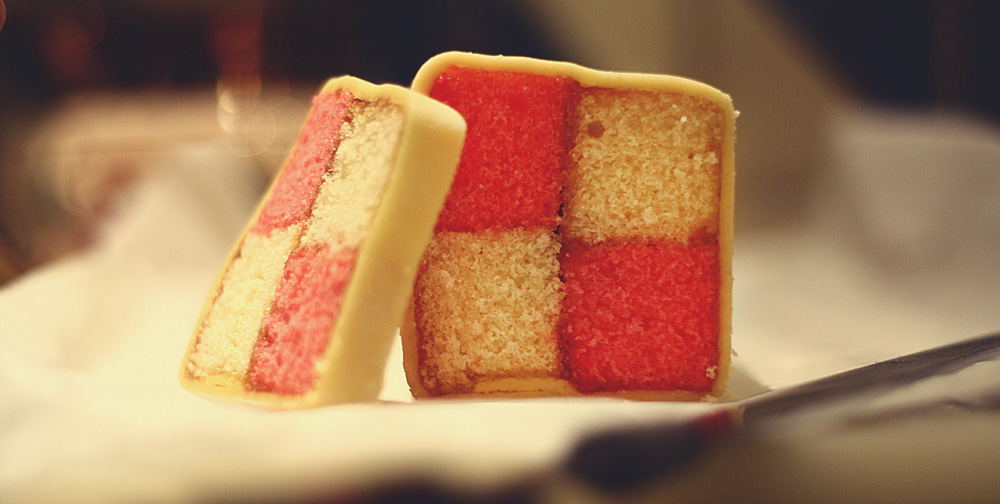
A homemade Battenberg cake with typical chequered pink-and-yellow squares
TypeSponge cake
Place of originEngland
Created byUnknown
Main ingredientsFlour, jam, marzipan
  •   Media: Battenberg Cake

Battenberg[1] or Battenburg[2] cake is a light sponge cake with coloured sections held together with jam and covered in marzipan. In cross section, the cake has a distinctive pink-and-yellow check pattern. It originated in England.

The chequered patterns on many emergency vehicles' liveries are officially referred to as Battenburg markings because of their resemblance to the cake.

Recipe

[edit]
Battenberg cake by British food manufacturer Lyons
A coffee and walnut Battenberg with tea to celebrate the Platinum Jubilee of Elizabeth II
Battenberg accompanied with tea

Bakers construct Battenberg cakes by baking yellow and pink almond sponge-cakes separately, then cutting and combining the pieces in a chequered pattern. The cake is held together by jam and covered with marzipan.[3]

Origins

[edit]

While the cake originates in England, its exact origins are unclear,[4][5] with early recipes also using the alternative names "Domino Cake" (recipe by Agnes Bertha Marshall, 1898), "Neapolitan Roll" (recipe by Robert Wells, 1898),[6] or "Church Window Cake".[citation needed]

The cake was purportedly named in honour of the marriage of Princess Victoria, a granddaughter of Queen Victoria, to Prince Louis of Battenberg in 1884.[7] It refers to the German town of Battenberg, Hesse, which was the seat of an aristocratic family who died out in the early Middle Ages and whose title was transferred in 1851 to Countess Julia Hauke on the occasion of her marriage to Prince Alexander of Hesse and by Rhine; then first Countess of Battenberg, afterwards Princess of Battenberg, known in Britain since 1917 as Mountbatten.[8]

The food historian Ivan Day refuted the idea that the four panels are in reference to four princes or houses, as older recipes show as many as 25 panels. He said the four panels were likely standardised by industrial bakers such as Lyons, as this was easier to produce on a production line.[9]

According to The Oxford Companion to Food, the name "Battenberg cake" first appeared in print in 1903.[10] However, a "Battenburg cake" appears in Frederick Vine, Saleable Shop Goods for Counter-Tray and Window … (London, England: Office of the Baker and Confectioner, 1898).[4][11]

See also

[edit]

References

[edit]
Revisions and contributorsEdit on WikipediaRead on Wikipedia
from Grokipedia
Battenberg cake is a British tea-time confection consisting of two colors of —typically yellow and pink—baked in equal-sized rectangles, assembled in an alternating pattern, brushed with , and encased in a layer of . The cake's distinctive design evokes a or windowpane effect, and it is often sliced to reveal the patterned interior. The origins of Battenberg cake are popularly linked to 1884, purportedly created to commemorate the marriage of Princess Victoria (Queen Victoria's granddaughter) to Prince Louis of Battenberg, with the four squares symbolizing the prince and his three brothers, and the yellow and pink colors representing the British and German royal houses. However, no contemporary evidence supports this royal connection, and the cake is not documented as having been served at royal residences like Osborne House. The name derives from the House of Battenberg, the German noble family of Prince Louis, whose name was later anglicized to Mountbatten amid World War I anti-German sentiment. The earliest published appears in Frederick Vine's 1898 book Saleable Shop Goods, describing a nine-square version made with pink and white Genoese sponge wrapped in . A similar followed in A.G. Bromley's 1903 Book of Cakes. By the early , the design simplified to four squares using Victoria sponge for easier commercial production, and apricot jam became standard for assembly. Modern variations include flavors like and or lemon and , but the traditional form remains a staple of British . In preparation, separate batters for the yellow (vanilla) and pink (with ) sponges are baked side-by-side in a tin divided by foil or to ensure equal sizes. The cooled rectangles are trimmed, alternated with jam between layers and on the sides, then rolled in to form a log shape. Culturally, Battenberg cake embodies Anglo-German culinary fusion and is associated with afternoon tea traditions, while its high-visibility pattern inspired the "Battenberg markings" on British emergency vehicles.

History

Origins

The Battenberg cake is popularly believed to have originated in 1884 as a celebratory creation for the marriage of Prince Louis of Battenberg to Princess Victoria of Hesse and by Rhine, the granddaughter of Queen Victoria. This union symbolized the integration of the German House of Battenberg—a morganatic branch of the Grand Ducal House of Hesse and by Rhine, elevated to princely status in 1858—into the British royal family, with Prince Louis later becoming a prominent British naval officer and Marquess of Milford Haven. However, archival research indicates no direct evidence linking the cake's invention to this wedding, suggesting the association may have been a later marketing ploy to capitalize on royal prestige. The exact inventor of the Battenberg cake remains unclear, though it emerged within the context of Victorian-era English baking traditions, characterized by elaborate sponge cakes and decorative confections suited for afternoon teas and special occasions. Early references to a cake named "Battenberg" appear in British newspapers as early as 1885, describing a fruit-based version sold by bakers, but these predate any standardized checkered design. The most substantiated recipe for the cake's distinctive form is attributed to pastry chef Frederick Vine, who included a nine-paneled version coated in almond paste in his 1898 book Saleable Shop Goods for the Bakery, marking its formal entry into professional baking literature. Prior to its standardization as "Battenberg," the cake's checkered pattern inspired alternative names such as "Domino Cake," evoking the tiled appearance of domino pieces, and "Neapolitan Cake" or "Neapolitan Roll," drawing from multicolored layered desserts. Similar confections, like the French-influenced "Gateau à la Domino" documented by culinary author in the 1890s, further illustrate the era's experimentation with visually striking, paneled cakes that preceded the Battenberg name's widespread adoption.

Early Recipes and Naming

The first documented recipe for a cake closely resembling the modern Battenberg appeared in 1898, published by food writer Frederick Vine in his book Saleable Shop Goods for Bakers. This recipe described a genoese sponge cake divided into nine alternating red and white sections, flavored with almond and encased in almond paste, intended for commercial bakers. Earlier that same year, similar multi-paneled sponge cakes were recorded under different names, such as Agnes Bertha Marshall's "Domino Cake" in The Table magazine, which featured nine pink and white genoese sections coated in vanilla- and maraschino-flavored almond paste. Pre-1900 recipe variations deviated from the eventual standard pink-and-yellow scheme, incorporating diverse flavors to enhance the sponge layers. For instance, Robert Wells's 1898 "Neapolitan Roll" in Cakes and Buns used four pink sections dusted with coconut, while advertisements from bakers like John Scrymgeour in 1885 promoted a fresh fruit-flavored version, and Thomas Sims in 1887 offered a lemon-flavored iteration. These early examples, often with fruit or citrus notes, highlighted the cake's adaptability before it solidified into a more uniform almond-based design. The design later simplified to the familiar four squares in the , likely developed by J. Lyons & Co. for easier . Initially known by descriptive names evoking its checkered, window-like cross-section, the cake was referred to as "Battenberg" in Vine's 1898 recipe, though the name had appeared in earlier advertisements. In , it was commonly called "Church Window Cake" or "Chapel Window Cake" due to the stained-glass effect of its colored panels when sliced. This naming evolution likely drew from the 1884 marriage of to Princess Victoria, granddaughter of , though the cake's recipes postdate that event.

Description

Composition and Appearance

The Battenberg cake consists of four rectangular strips of light , two in a shade and two in , arranged alternately in a two-by-two formation and adhered together with apricot jam to create a cohesive block. When sliced perpendicular to its length, the cake reveals a distinctive checkered cross-section composed of four equal panels, alternating between the contrasting colors. The sponge is typically flavored with , while the pink version incorporates extract and a small amount of for its hue. The assembled cake forms an oblong loaf shape, measuring approximately 8 to 10 inches in length, with a rectangular prism profile that is fully encased in a thin sheet of rolled . The marzipan covering provides a smooth, pale exterior, often featuring a diamond-patterned design on the sides achieved through crimping or scoring with a knife for aesthetic appeal. This outer layer contrasts texturally with the interior, where the airy, fluffy crumb of the sponge offers a light tenderness against the denser, slightly chewy firmness of the .

Key Ingredients

The Battenberg cake's sponge layers are made from a classic batter consisting of , , eggs, and , typically leavened with or self-raising to achieve a light, tender crumb that contrasts with the denser exterior. The eggs contribute both structure and the natural hue to one set of layers, while the other is tinted using red or natural alternatives like beet juice or freeze-dried raspberries for visual distinction without altering the base flavor significantly. The outer coating is provided by , an composed of ground almonds, (often a mix of caster and icing ), and egg whites or yolks, which offers a pliable texture for wrapping, along with a nutty sweetness that complements the mild . This layer not only seals the cake but also adds richness and a smooth finish. Apricot jam serves as the traditional filling, brushed between the alternating and strips to bind them securely, while its tart fruitiness provides a subtle acidity that balances the sweetness of the other components. Optional flavorings such as enhance the yellow sponge's mild profile, and almond extract may be added to the pink batter for a complementary nutty note, though these are not essential to the classic recipe.

Preparation

Batter Preparation

The batter for Battenberg cake is prepared as a light sponge mixture, incorporating core ingredients such as self-raising flour, eggs, , , and ground almonds to achieve a crumb texture. The mixture is typically creamed by beating the and until pale and fluffy, followed by gradual incorporation of the eggs to prevent , and finally folding in the dry ingredients until smooth and of dropping consistency. This batter is then divided evenly into two portions; one remains plain (often with a subtle or flavor), while the other is colored pale using a few drops of or gel , folded in until uniformly distributed without overmixing to preserve airiness. To bake the two contrasting sponges simultaneously for the cake's signature checkered pattern, a standard 2-pound (900g) loaf tin is greased and lined with , and a divider constructed from folded or doubled aluminum foil—or a dedicated Battenberg cake tin—is inserted lengthwise down the center to create two equal compartments and prevent batter crossover. The is preheated to 350°F (175°C), and the divided tin is placed on the center rack for even heat distribution. Each portion of batter is spooned into its respective side and spread level, then baked for 25-30 minutes until a or inserted into the center emerges clean, indicating full , and the surface springs back lightly when touched. Upon completion, the tin is removed from the , and the sponges are left to cool in place for 10 minutes to set structure, then fully cooled on a wire rack outside the tin to avoid sogginess or crumbling during later handling—this step is essential as warm sponges are prone to breaking. Once completely cold, the baked slabs are carefully unmolded, leveled if necessary, and trimmed of crusty edges to ensure uniform size and shape.

Assembly and Finishing

Once the sponges have cooled completely after baking, assembly begins by trimming any remaining uneven edges from the pink and yellow sponges to ensure uniform size. The pink and yellow sponges are each sliced lengthwise into two equal strips, yielding two pink and two yellow strips total, typically measuring about 20 cm long and trimmed to 5 cm wide (with width and height adjusted to match the baked sponge height for a square cross-section) to form the characteristic checkerboard pattern. Alternating colors, the strips are brushed with warmed apricot on their sides and stacked in pairs to create a square log: one pink strip is placed next to a yellow strip, then topped with the remaining yellow and pink strips, respectively, with additional applied between layers to act as and add subtle flavor. This results in a compact, four-layered structure that maintains stability during handling. The next step involves preparing and applying the marzipan coating. A block of marzipan, typically around 500 g for a standard cake, is kneaded until pliable and rolled out on a surface dusted with icing sugar into a large , approximately 30 cm by 40 cm and 3-5 mm thick, to accommodate the assembled log. The log is placed along one edge of the marzipan , which has been lightly brushed with more warmed apricot jam for adhesion, and then carefully rolled and wrapped around the cake, ensuring no air pockets form and the marzipan adheres smoothly to the sides. The overlapping seam at the bottom is sealed by pressing firmly, and excess marzipan is trimmed away. To finish, the top edges are crimped with fingers or a to create a decorative diamond pattern, enhancing the cake's elegant appearance while securing the wrap. After assembly, the cake is refrigerated for 1-2 hours to allow the to firm up and the structure to set, preventing any shifting or cracking during slicing. This chilling step also aids in achieving clean cuts and improves the cake's texture for serving. The finished Battenberg is then sliced into portions about 1.25 cm (1/2 inch) thick to reveal the vibrant interior, ideally dusted lightly with icing for presentation. Wrapped tightly in cling or stored in an airtight container, it can be kept at for up to 3 days or refrigerated longer to maintain freshness.

Cultural Significance

Role in British Cuisine

The Battenberg cake holds a prominent place in afternoon tea traditions, serving as a staple sweet in both home settings and tearooms across the country. Its checkered pattern and coating make it an ideal accompaniment to , often enjoyed alongside scones and robust brews like , enhancing the ritual of mid-afternoon refreshment that dates back to the . Prestigious venues continue to feature it as a classic offering, underscoring its enduring appeal in everyday culinary practices. Since the early , the cake has gained popularity in British baking competitions and community events, where its intricate assembly challenges bakers while evoking national baking heritage. It frequently appears in shows like , serving as a signature or technical challenge that highlights precision and creativity in sponge work. Such events reinforce its status in local gatherings, from church halls to outdoor fêtes, where homemade versions symbolize shared culinary skills and festivity. Commercial production has broadened the cake's accessibility beyond homemade efforts, with mass manufacturing of the simplified four-square design beginning in the to meet growing demand for convenient treats. Brands like , launched in 1967, have offered pre-packaged versions since the , featuring the traditional pink-and-yellow sponge wrapped in and apricot jam, available in supermarkets nationwide. This democratization has embedded the Battenberg in daily British snacking, transforming it from a labor-intensive bake into an everyday indulgence. Symbolically, the Battenberg cake embodies a harmonious blend of flavors and colors, reflecting Britain's layered , particularly in the post-WWII era of reconstruction and integration. A popular but unverified legend links its design to an Anglo-German royal union in , evoking unity through contrasting yet complementary elements, much like the nation's evolving multicultural fabric following global conflicts and waves. This resonance has sustained its role as a quintessentially British confection, celebrating balance in diversity. The cake's distinctive chequerboard pattern has also influenced vehicle design, inspiring "Battenberg markings"—high-visibility alternating stripes used on British emergency vehicles since the mid-1990s to enhance road safety.

Royal and Historical Associations

The Battenberg cake maintains an enduring association with the through its namesake linkage to the House of Battenberg, which was anglicized to Mountbatten in 1917 amid widespread anti-German sentiment during . This renaming, decreed by King George V as part of a broader of royal titles—including the change from Saxe-Coburg-Gotha to Windsor—reflected efforts to distance the monarchy from its German roots while preserving familial legacies. Although the family adopted Mountbatten, the cake retained its original name, symbolizing the persistence of this royal heritage in British culinary tradition. The cake's creation in 1884, purportedly to honor the wedding of Princess Victoria of Hesse (granddaughter of Queen Victoria) to Prince Louis of Battenberg, underscored early ties to Anglo-German royal intermarriages that strengthened diplomatic bonds between Britain and German states. Prince Louis, born in Hesse to a morganatic branch of the Hessian nobility, rose to prominence in the British Royal Navy, embodying the era's complex web of European royal alliances. This union highlighted the Battenberg lineage's role in fostering cross-cultural ties within the extended Windsor family. In the , the Battenberg cake experienced revivals during significant royal milestones, reconnecting it to its Victorian origins. It was anticipated to feature in celebrations for Queen Elizabeth II's in 2022, marking 70 years of her reign and evoking the monarchy's historical depth. These occasions reinforced the cake's symbolic place in commemorating the Mountbatten lineage, including its connection to , whose family bore the anglicized name.

Variations

Traditional Flavors and Colors

The traditional Battenberg cake is characterized by its alternating pink and white or pink and yellow sponge layers, creating a distinctive checkered when sliced. Early recipes from the late , such as Robert Wells' 1898 Neapolitaine Roll in Cakes and Buns, describe a four-pane cake with pink and white genoese sponge, where the pink hue was achieved through flavoring rather than artificial dyes. Frederick Vine's 1898 version in Saleable Shop Goods describes a separate multi-pane cake. By the , variations emerged with yellow sponges flavored with or zest for the lighter layer, while the pink retained essence, reflecting the cake's core almond-forward profile. Apricot jam serves as the standard filling to bind the sponge layers, providing a tart contrast to the sweet exterior, as seen in Robert Wells' 1898 Neapolitaine Roll recipe, an early precursor to the Battenberg. These jam choices complemented the subtle and flavors, maintaining the cake's role as a refined tea-time treat.

Modern Adaptations

In recent years, health-conscious adaptations of Battenberg cake have gained traction, particularly gluten-free versions that substitute with almond flour or gluten-free blends to maintain the cake's light texture and almond flavor. Commercial brands like Lovemore Foods have offered ready-made gluten-free Battenberg cakes since 2008, featuring chequered sponge layers sandwiched with apricot jam and wrapped in , catering to coeliac diets without compromising the traditional structure. Vegan interpretations have also proliferated since the , using plant-based ingredients such as and vegan milk to achieve fluffy sponges, alongside plant-based butters and dairy-free . Recipes from established cookbooks, such as those in The Great British Vegan, highlight this shift, producing light almond-flavored layers that mimic the original while aligning with plant-based trends. International influences have inspired flavorful fusions, incorporating global ingredients into the checkered design. Middle Eastern-inspired versions feature pistachio-infused green sponge paired with rose-flavored pink layers, assembled with jam and rolled in for a nutty, floral twist that evokes Persian sweets. This adaptation appears in recipes from BBC Good Food, emphasizing the cake's versatility for afternoon tea spreads. Asian variations, such as matcha-green and sponges, draw on Japanese , using powder for natural coloring and earthiness, assembled with apricot jam and coated in homemade . Bake from Scratch magazine showcases this innovation, blending the classic pattern with subtle bitterness and sweetness. Commercial developments have expanded accessibility, with brands like introducing mini Battenberg portions since the —small, individually wrapped pink-and-yellow sponges ideal for sharing or snacking, available at retailers like . Gluten-free commercial lines, such as those from Lovemore, further demonstrate post-2000 innovations in inclusive baking. Event-specific customizations have broadened the cake's appeal beyond traditional time, incorporating seasonal themes. For Halloween, adaptations use purple and green sponges to evoke spooky hues, encased in for a festive effect, as detailed in recipes that transform the bake into a centerpiece.

References

Add your contribution
Related Hubs
User Avatar
No comments yet.