



Community hub
Recent from talks
Contribute something
Nothing was collected or created yet.
Redlich–Kwong equation of state
View on WikipediaIn physics and thermodynamics, the Redlich–Kwong equation of state is an empirical, algebraic equation that relates temperature, pressure, and volume of gases. It is generally more accurate than the van der Waals equation and the ideal gas equation at temperatures above the critical temperature. It was formulated by Otto Redlich and Joseph Neng Shun Kwong in 1949.[1][2] It showed that a two-parameter, cubic equation of state could well reflect reality in many situations, standing alongside the much more complicated Beattie–Bridgeman model and Benedict–Webb–Rubin equation that were used at the time. Although it was initially developed for gases, the Redlich–Kwong equation has been considered the most modified equation of state since those modifications have been aimed to generalize the predictive results obtained from it.[3] Although this equation is not currently employed in practical applications,[4] modifications derived from this mathematical model like the Soave Redlich-Kwong (SRK), and Peng Robinson have been improved and currently used in simulation and research of vapor–liquid equilibria.[3][5]
Equation
[edit]The Redlich–Kwong equation is formulated as:[6][7]

where:
- p is the gas pressure
- R is the gas constant,
- T is temperature,
- Vm is the molar volume (V/n),
- a is a constant that corrects for attractive potential of molecules, and
- b is a constant that corrects for volume.
The constants are different depending on which gas is being analyzed. The constants can be calculated from the critical point data of the gas:[6]
![{\displaystyle {\begin{aligned}a&={\frac {1}{9({\sqrt[{3}]{2}}-1)}}\,{\frac {R^{2}\,{T_{c}}^{2.5}}{P_{c}}}=0.42748\,{\frac {R^{2}\,{T_{c}}^{2.5}}{P_{c}}},\\[1ex]b&={\frac {{\sqrt[{3}]{2}}-1}{3}}\,{\frac {R\,T_{c}}{P_{c}}}=0.08664\,{\frac {R\,T_{c}}{P_{c}}},\end{aligned}}}](https://wikimedia.org/api/rest_v1/media/math/render/svg/6b1691aa4bb0bf59e91c58d60aec1f073e6a2d23)
where:
- Tc is the temperature at the critical point, and
- Pc is the pressure at the critical point.
The Redlich–Kwong equation can also be represented as an equation for the compressibility factor of gas, as a function of temperature and pressure:[8]

where:
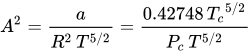
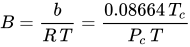
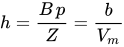
Or more simply:

This equation only implicitly gives Z as a function of pressure and temperature, but is easily solved numerically, originally by graphical interpolation, and now more easily by computer. Moreover, analytic solutions to cubic functions have been known for centuries and are even faster for computers. The Redlich-Kwong equation of state may also be expressed as a cubic function of the molar volume.[7]
For all Redlich–Kwong gases:

where:
- Zc is the compressibility factor at the critical point

Using , , the equation of state can be written in the reduced form:


And since it follows: with


![{\displaystyle b'={\sqrt[{3}]{2}}-1\approx 0.26}](https://wikimedia.org/api/rest_v1/media/math/render/svg/578b7130159a520fdd079b4a4857ef08fc6e898f)
From the Redlich–Kwong equation, the fugacity coefficient of a gas can be estimated:[8]

Critical constants
[edit]It is possible to express the critical constants Tc and Pc as functions of a and b by reversing the following system of 2 equations a(Tc, Pc) and b(Tc, Pc) with 2 variables Tc, Pc:
![{\displaystyle {\begin{aligned}a&={\frac {1}{9({\sqrt[{3}]{2}}-1)}}\,{\frac {R^{2}\,{T_{c}}^{5/2}}{P_{c}}}={\frac {1}{9({\sqrt[{3}]{2}}-1)}}\,{\frac {R^{2}\,{T_{c}}^{5/2}}{{\frac {{\sqrt[{3}]{2}}-1}{3}}\,{\frac {R\,T_{c}}{b}}}}\\[1ex]\implies a&={\frac {bR\,{T_{c}}^{3/2}}{3{\left({\sqrt[{3}]{2}}-1\right)}^{2}}}\\[1ex]\implies T_{c}&=3^{2/3}{\left({\sqrt[{3}]{2}}-1\right)}^{4/3}{\left({\frac {a}{bR}}\right)}^{2/3}\end{aligned}}}](https://wikimedia.org/api/rest_v1/media/math/render/svg/e4b1b311b1f0668e67b6bea108f85556e3edb062)
![{\displaystyle {\begin{aligned}b&={\frac {{\sqrt[{3}]{2}}-1}{3}}\,{\frac {R\,T_{c}}{P_{c}}}\\[1ex]\implies P_{c}&={\frac {{\sqrt[{3}]{2}}-1}{3}}\,{\frac {R\,T_{c}}{b}}\\[1ex]\implies P_{c}&={\frac {({\sqrt[{3}]{2}}-1)^{7/3}}{3^{1/3}}}R^{1/3}{\frac {a^{2/3}}{b^{5/3}}}\end{aligned}}}](https://wikimedia.org/api/rest_v1/media/math/render/svg/926e38e95dd16ad6c6010291326f948e3be7754e)
Because of the definition of compressibility factor at critical condition, it is possible to reverse it to find the critical molar volume Vm,c, by knowing previous found Pc, Tc and Zc=1/3.

![{\displaystyle V_{m,c}={\frac {R}{3}}{\frac {3^{2/3}({\sqrt[{3}]{2}}-1)^{4/3}({\frac {a}{bR}})^{2/3}}{{\frac {({\sqrt[{3}]{2}}-1)^{7/3}}{3^{1/3}}}R^{1/3}{\frac {a^{2/3}}{b^{5/3}}}}}={\frac {R}{3}}{\frac {3b}{R({\sqrt[{3}]{2}}-1)}}={\frac {b}{{\sqrt[{3}]{2}}-1}}}](https://wikimedia.org/api/rest_v1/media/math/render/svg/5053621f5f313d0cbc3257b1accf8c27a6de55d1)
Multiple components
[edit]The Redlich–Kwong equation was developed with an intent to also be applicable to mixtures of gases. In a mixture, the b term, representing the volume of the molecules, is an average of the b values of the components, weighted by the mole fractions:
or
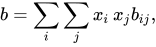
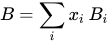
where:
- xi is the mole fraction of the ith component of the mixture,
- bij is the covolume parameter of the i-j pair in the mixture, and
- Bi is the B value of the ith component of the mixture
The cross-terms of bij (i.e. terms for which ), are commonly computed as


where is an often empirically fitted interaction parameter accounting for asymmetry in the cross interactions.[9]

The constant representing the attractive forces, a, is not linear with respect to mole fraction, but rather depends on the square of the mole fractions. That is:
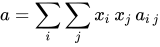
where:
- ai j is the attractive term between a molecule of species i and species j,
- xi is the mole fraction of the ith component of the mixture, and
- xj is the mole fraction of the jth component of the mixture.
It is generally assumed that the attractive cross terms represent the geometric average of the individual a terms, adjusted using an interaction parameter , that is:[9]


Where the interaction parameter is an often empirically fitted parameter accounting for asymmetry in the molecular cross-interactions.[9] In this case, the following equation for the attractive term is furnished:
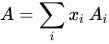
where Ai is the A term for the i'th component of the mixture.
These manners of creating a and b parameters for a mixture from the parameters of the pure fluids are commonly known as the van der Waals one-fluid mixing and combining rules.[9]
History
[edit]The Van der Waals equation, formulated in 1873 by Johannes Diderik van der Waals, is generally regarded as the first somewhat realistic equation of state (beyond the ideal gas law):
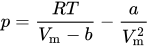
However, its modeling of real behavior is not sufficient for many applications, and by 1949, had fallen out of favor, with the Beattie–Bridgeman and Benedict–Webb–Rubin equations of state being used preferentially, both of which contain more parameters than the Van der Waals equation.[10] The Redlich–Kwong equation was developed by Redlich and Kwong while they were both working for the Shell Development Company at Emeryville, California. Kwong had begun working at Shell in 1944, where he met Otto Redlich when he joined the group in 1945. The equation arose out of their work at Shell - they wanted an easy, algebraic way to relate the pressures, volumes, and temperatures of the gasses they were working with - mostly non-polar and slightly polar hydrocarbons (the Redlich–Kwong equation is less accurate for hydrogen-bonding gases). It was presented jointly in Portland, Oregon at the Symposium on Thermodynamics and Molecular Structure of Solutions in 1948, as part of the 14th Meeting of the American Chemical Society.[11] The success of the Redlich–Kwong equation in modeling many real gases accurately demonstrate that a cubic, two-parameter equation of state can give adequate results, if it is properly constructed. After they demonstrated the viability of such equations, many others created equations of similar form to try to improve on the results of Redlich and Kwong.
Derivation
[edit]The equation is essentially empirical – the derivation is neither direct nor rigorous. The Redlich–Kwong equation is very similar to the Van der Waals equation, with only a slight modification being made to the attractive term, giving that term a temperature dependence. At high pressures, the volume of all gases approaches some finite volume, largely independent of temperature, that is related to the size of the gas molecules. This volume is reflected in the b in the equation. It is empirically true that this volume is about 0.26Vc (where Vc is the volume at the critical point). This approximation is quite good for many small, non-polar compounds – the value ranges between about 0.24Vc and 0.28Vc.[12] In order for the equation to provide a good approximation of volume at high pressures, it had to be constructed such that

The first term in the equation represents this high-pressure behavior.
The second term corrects for the attractive force of the molecules to each other. The functional form of a with respect to the critical temperature and pressure is empirically chosen to give the best fit at moderate pressures for most relatively non-polar gasses.[11]
In reality
[edit]The values of a and b are completely determined by the equation's shape and cannot be empirically chosen. Requiring it to hold at its critical point , ,



enforcing the thermodynamic criteria for a critical point,
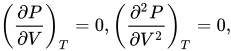
and without loss of generality defining and yields 3 constraints,


![{\displaystyle {\begin{aligned}a&={\frac {(1+b')^{2}}{(b'-1)^{2}(2+b')}}{\frac {R^{2}T_{c}^{5/2}Z_{c}}{P_{c}}}\\[2pt]a&={\frac {(1+b')^{3}}{(1-b')^{3}(3+3b'+b'^{2})}}{\frac {R^{2}T_{c}^{5/2}Z_{c}}{P_{c}}}\\[2pt]a&={\frac {(1+b')(1-Z_{c}+b'Z_{c})}{b'-1}}{\frac {R^{2}T_{c}^{5/2}Z_{c}}{P_{c}}}.\end{aligned}}}](https://wikimedia.org/api/rest_v1/media/math/render/svg/adefcbfe96db0748e3824623d47d89b2b689a2bd)
Simultaneously solving these while requiring b' and Zc to be positive yields only one solution:
![{\displaystyle {\begin{aligned}Z_{c}&={\frac {1}{3}},\qquad \qquad b'={\sqrt[{3}]{2}}-1,\\[1ex]a&={\frac {P_{c}V_{c}^{2}{\sqrt {T_{c}}}}{b'}}={\frac {1}{{\sqrt[{3}]{2}}-1}}\,{\frac {R^{2}\,{T_{c}}^{5/2}}{9P_{c}}}.\end{aligned}}}](https://wikimedia.org/api/rest_v1/media/math/render/svg/6e626dcd774e4b0efc0257b95202ef726eacf01c)
Modification
[edit]The Redlich–Kwong equation was designed largely to predict the properties of small, non-polar molecules in the vapor phase, which it generally does well. However, it has been subject to various attempts to refine and improve it. In 1975, Redlich himself published an equation of state adding a third parameter, in order to better model the behavior of both long-chained molecules, as well as more polar molecules. His 1975 equation was not so much a modification to the original equation as a re-inventing of a new equation of state, and was also formulated so as to take advantage of computer calculation, which was not available at the time the original equation was published.[12] Many others have offered competing equations of state, either modifications to the original equation, or equations quite different in form. It was recognized by the mid 1960s that to significantly improve the equation, the parameters, especially a, would need to become temperature dependent. As early as 1966, Barner noted that the Redlich–Kwong equation worked best for molecules with an acentric factor (ω) close to zero. He therefore proposed a modification to the attractive term:
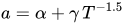
where
- α is the attractive term in the original Redlich–Kwong equation
- γ is a parameter related to ω, with γ = 0 for ω = 0[13]
It soon became desirable to obtain an equation that would also model well the Vapor–liquid equilibrium (VLE) properties of fluids, in addition to the vapor-phase properties.[10] Perhaps the best known application of the Redlich–Kwong equation was in calculating gas fugacities of hydrocarbon mixtures, which it does well, that was then used in the VLE model developed by Chao and Seader in 1961.[10][14] However, in order for the Redlich–Kwong equation to stand on its own in modeling vapor–liquid equilibria, more substantial modifications needed to be made. The most successful of these modifications is the Soave modification to the equation, proposed in 1972.[15] Soave's modification involved replacing the T1/2 power found in the denominator attractive term of the original equation with a more complicated temperature-dependent expression. He presented the equation as follows:
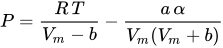
where
- Tr is the reduced temperature of the compound, and
- ω is the acentric factor

![{\displaystyle a={\frac {1}{9({\sqrt[{3}]{2}}-1)}}\,{\frac {R^{2}\,{T_{c}}^{2}}{P_{c}}}=0.42748\,{\frac {R^{2}\,{T_{c}}^{2}}{P_{c}}},}](https://wikimedia.org/api/rest_v1/media/math/render/svg/52f68cd33b8ab3faf57e059e85d0f6ed8299be17)
![{\displaystyle b={\frac {{\sqrt[{3}]{2}}-1}{3}}\,{\frac {R\,T_{c}}{P_{c}}}=0.08664\,{\frac {R\,T_{c}}{P_{c}}},}](https://wikimedia.org/api/rest_v1/media/math/render/svg/bed7d5d2ad50b41e963f81d78754c6519616765d)
The Peng–Robinson equation of state further modified the Redlich–Kwong equation by modifying the attractive term, giving

the parameters a, b, and α are slightly modified, with[16]

The Peng–Robinson equation typically gives similar VLE equilibria properties as the Soave modification, but often gives better estimations of the liquid phase density.[10]
Several modifications have been made that attempt to more accurately represent the first term, related to the molecular size. The first significant modification of the repulsive term beyond the Van der Waals equation's

(where Phs represents a hard spheres equation of state term.) was developed in 1963 by Thiele:[17]

where

This expression was improved by Carnahan and Starling to give [18]

The Carnahan-Starling hard-sphere equation of state has term been used extensively in developing other equations of state,[10] and tends to give very good approximations for the repulsive term.[19]
Beyond improved two-parameter equations of state, a number of three parameter equations have been developed, often with the third parameter depending on either Zc, the compressibility factor at the critical point, or ω, the acentric factor. Schmidt and Wenzel proposed an equation of state with an attractive term that incorporates the acentric factor:[20]

This equation reduces to the original Redlich–Kwong equation in the case when ω = 0, and to the Peng–Robinson equation when ω = 1/3.
See also
[edit]References
[edit]- ^ Murdock, James W. (1993), Fundamental fluid mechanics for the practicing engineer, CRC Press, pp. 25–27, ISBN 978-0-8247-8808-7
- ^ Redlich, Otto; Kwong, J. N. S. (1949). "On The Thermodynamics of Solutions". Chem. Rev. 44 (1): 233–244. doi:10.1021/cr60137a013. PMID 18125401.
- ^ a b Valderrama, José O. (2003-04-01). "The State of the Cubic Equations of State". Industrial & Engineering Chemistry Research. 42 (8): 1603–1618. doi:10.1021/ie020447b. hdl:10533/174221. ISSN 0888-5885.
- ^ "10.3: Redlich-Kwong EOS (1949)". Engineering LibreTexts. 2016-07-31. Retrieved 2024-09-13.
- ^ Perry, John H.; Green, Don W.; Southard, Marylee Z., eds. (2019). Perry's chemical engineers' handbook (Ninth ed.). New York Chicago San Francisco Athens London Madrid Mexico City Milan New Delhi Singapore Sydney Toronto: McGraw-Hill Education. ISBN 978-0-07-183408-7.
- ^ a b Murdock, James W. (1993), Fundamental fluid mechanics for the practicing engineer, CRC Press, pp. 25–27, ISBN 978-0-8247-8808-7
- ^ a b McQuarrie, Donald A.; Simon, John D. (1997). Physical Chemistry: A Molecular Approach. Sausalito: University Science Books. pp. 645–648. ISBN 0-935702-99-7.
- ^ a b Redlich, Otto; Kwong, J. N. S. (1949). "On The Thermodynamics of Solutions". Chem. Rev. 44 (1): 233–244. doi:10.1021/cr60137a013. PMID 18125401.
- ^ a b c d Coutinho, João A. P.; Kontogeorgis, Georgios M.; Stenby, Erling H. (1994-11-28). "Binary interaction parameters for nonpolar systems with cubic equations of state: a theoretical approach 1. CO2/hydrocarbons using SRK equation of state". Fluid Phase Equilibria. 102 (1): 31–60. doi:10.1016/0378-3812(94)87090-X. ISSN 0378-3812.
- ^ a b c d e Tsonopoulos, C.; Heidman, J. L. (1985). "From Redlich–Kwong to the Present". Fluid Phase Equilibria. 24 (1–2): 1–23. doi:10.1016/0378-3812(85)87034-5.
- ^ a b Reif-Acherman, Simón (2008). "Joseph Neng Shun Kwong: A Famous and Obscure Scientist". Química Nova. 31 (7): 1909–1911. doi:10.1590/S0100-40422008000700054.
- ^ a b Redlich, Otto (1975). "On the Three-Parameter Representation of the Equation of State". Industrial & Engineering Chemistry Fundamentals. 14 (3): 257–260. doi:10.1021/i160055a020. S2CID 92316637.
- ^ Barner, H. E.; Pigford, R. L.; Schreiner, W. C. (1966). "A Modified Redlich–Kwong Equation of State". 31st Midyear Meeting, API Div Refining.
- ^ Chao, K. C.; Seader, J. D. (1961). "A general correlation of vapor-liquid equilibria in hydrocarbon mixtures". AIChE Journal. 7 (4): 598–605. doi:10.1002/aic.690070414.
- ^ Soave, Giorgio (June 1972). "Equilibrium constants from a modified Redlich–Kwong equation of state". Chemical Engineering Science. 27 (6): 1197–1203. doi:10.1016/0009-2509(72)80096-4.
- ^ Peng, Ding-Yu; Robinson, Donald (1985). "A New Two-Constant Equation of State". Industrial & Engineering Chemistry Fundamentals. 15 (1): 59–64. doi:10.1021/i160057a011. S2CID 98225845.
- ^ Thiele, Everett (1963). "Equation of State for Hard Spheres". Journal of Chemical Physics. 39 (2): 474–479. Bibcode:1963JChPh..39..474T. doi:10.1063/1.1734272. Archived from the original on 24 February 2013. Retrieved 6 May 2012.
- ^ Carnahan, Norman; Starling, Kenneth (1969). "Equation of State for Nonattracting Rigid Spheres". Journal of Chemical Physics. 51 (2): 635–636. Bibcode:1969JChPh..51..635C. doi:10.1063/1.1672048. Archived from the original on 23 February 2013. Retrieved 6 May 2012.
- ^ Song, Yuhua; Mason, E. A.; Stratt, Richard (1989). "Why does the Carnahan-Starling equation work so well?". The Journal of Physical Chemistry. 93 (19): 6916–6919. doi:10.1021/j100356a008.
- ^ Schmidt, G.; Wenzel, H. (1980). "A modified van der Waals type equation of state". Chemical Engineering Science. 35 (7): 1503–1512. doi:10.1016/0009-2509(80)80044-3.
Redlich–Kwong equation of state
View on Grokipediawhere is pressure, is molar volume, is temperature, is the gas constant, and and are substance-specific parameters derived from critical properties ( and , with and as critical temperature and pressure).[1] This equation improves upon the van der Waals model by incorporating a temperature-dependent attractive term () to better capture intermolecular forces at elevated temperatures and pressures above the critical point.[1] The Redlich–Kwong equation is fundamentally empirical, justified by its accuracy in approximating experimental P-V-T data for nonpolar gases, while satisfying theoretical limits such as the high-pressure molar volume approaching (where is critical volume).[1] It outperforms earlier equations like Berthelot's at supercritical conditions but shows limitations for polar compounds or low-temperature liquid phases due to inaccuracies in vapor pressure predictions.[2] For mixtures, the parameters are combined using mixing rules, with as a linear mole-fraction average and incorporating binary interaction terms, enabling applications to multicomponent systems.[1] In chemical engineering, the equation has been widely applied for thermodynamic property estimations, including phase equilibrium calculations, enthalpy departures, and compressibility factors in processes like gas compression and reaction equilibria under high pressure.[2] Its simplicity and reliance on minimal input data (critical constants) made it practical for industrial simulations, though it often requires empirical adjustments for hydrogen or light hydrocarbons.[3] Subsequent modifications have extended its utility; notably, Giorgio Soave's 1972 revision (Soave-Redlich-Kwong or SRK equation) replaced the term with a more accurate function of reduced temperature to improve vapor-liquid equilibrium predictions for hydrocarbons.[4] Further developments, such as the Peng-Robinson equation in 1976, addressed liquid density shortcomings, establishing the Redlich–Kwong framework as a cornerstone for modern cubic equations of state in reservoir engineering and process design. Despite these evolutions, the original form remains influential for its balance of accuracy and computational efficiency in supercritical gas modeling.[2]
Mathematical Formulation
Single-Component Equation
The Redlich–Kwong equation of state provides an empirical relation for the pressure of a single-component real gas as a function of temperature and molar volume.[5] It is expressed in the form where is the pressure, is the absolute temperature, is the molar volume, and is the universal gas constant.[5] The parameters and are substance-specific constants that account for intermolecular forces.[5] The first term, , represents the repulsive contribution from the finite volume occupied by gas molecules, with serving as the excluded co-volume per mole.[6] The second term, , captures the attractive intermolecular forces that reduce the pressure exerted on the container walls, where the temperature dependence in the denominator () models the weakening of attractions at higher temperatures.[5] This modification to the attractive parameter, compared to the constant in the van der Waals equation, enhances accuracy for predicting real gas behavior at elevated pressures by better accounting for temperature effects on molecular interactions.[6] In SI units, the parameter has dimensions of , reflecting its role in the attractive pressure term, while is in , corresponding to a volume per mole.[6] These constants are typically determined from the critical temperature and pressure of the substance.[5]Relation to Critical Constants
The parameters and in the Redlich–Kwong equation of state for a pure substance are expressed in terms of the critical temperature , critical pressure , and universal gas constant . The co-volume parameter is given by while the attraction parameter is [5] These numerical coefficients are obtained by applying the critical point conditions to the equation of state, namely that at and , the pressure equals and the slope of the isotherm vanishes: . Additionally, the form satisfies to align with experimental critical volumes, with the coefficients solved from the resulting system of equations, yielding a critical compressibility factor of 1/3 ≈ 0.333.[5] As a numerical example, consider carbon dioxide (CO₂), for which K and MPa, using J mol⁻¹ K⁻¹. The co-volume parameter computes to m³ mol⁻¹, and the attraction parameter to Pa m⁶ K^{0.5} mol⁻².[7][5]Multicomponent Mixtures
To extend the Redlich–Kwong equation of state to multicomponent mixtures, the parameters and for the mixture are calculated using specific mixing rules based on the mole fractions of the components.[1] The co-volume parameter for the mixture is obtained by a simple linear (arithmetic) average: This rule assumes that the repulsive interactions in the mixture are additively combined according to the mole fractions, reflecting the total excluded volume in a random mixing scenario.[1] For the attractive parameter , the mixing rule employs a quadratic form that incorporates the geometric mean for unlike-pair interactions: This corresponds to the Lorentz–Berthelot combining rule, where the cross-term assumes that the attractive energy between unlike molecules is the geometric mean of the pure-component attractions, again under the assumption of random mixing without specific ordering.[1] The pure-component and values are derived from the critical constants of each species, as defined in prior sections. In practice, the geometric mean term for binary pairs can be adjusted with an optional binary interaction parameter to account for deviations from ideal mixing, particularly in non-ideal systems: where recovers the original rule, and values are fitted from experimental vapor-liquid equilibrium data for specific pairs. As an illustrative example, consider an equimolar binary mixture of methane and ethane (y_\text{CH}_4 = y_\text{C}_2\text{H}_6 = 0.5), using pure-component parameters in consistent units (atm cm⁶ K^{0.5} mol^{-2} for , cm³ mol^{-1} for ): a_\text{CH}_4 = 31.59 \times 10^6, b_\text{CH}_4 = 29.6; a_\text{C}_2\text{H}_6 = 97.42 \times 10^6, b_\text{C}_2\text{H}_6 = 45.1. Assuming , These mixture parameters can then be substituted into the Redlich–Kwong equation to compute properties like pressure or fugacity for the mixture.[8]Historical Development
Origins and Motivation
By the early 20th century, the van der Waals equation of state, introduced in 1873, had become a foundational model for describing real gas behavior by accounting for molecular volume and intermolecular attractions. However, it exhibited significant limitations at high pressures and temperatures, particularly in predicting liquid densities and compressibility factors. For instance, van der Waals-type cubic equations often failed to accurately model liquid-phase properties, leading to substantial deviations from experimental data in dense fluid regimes. These shortcomings became increasingly apparent in industrial applications involving high-pressure processes, such as petrochemical engineering, where precise volumetric and thermodynamic predictions were essential.[9][1] The principle of corresponding states, originally proposed by van der Waals and further refined in the early 20th century, played a pivotal role in motivating improvements to cubic equations of state during the 1930s and 1940s. This principle posits that substances exhibit similar behavior when expressed in reduced variables relative to their critical points, enabling generalized models with few parameters. In this era, researchers sought to enhance cubic models like van der Waals by incorporating temperature-dependent terms and better aligning with corresponding states to extend applicability to wider pressure and temperature ranges, driven by advances in experimental data for hydrocarbons and the growing demands of chemical engineering. Early efforts focused on semi-empirical adjustments to capture non-ideal behaviors more reliably, setting the stage for more robust thermodynamic modeling.[1][10] Otto Redlich, born in 1896 in Vienna, brought a strong foundation in physical chemistry to these challenges, having earned his doctorate in 1922 from the University of Vienna with work on nitric acid equilibria and later publishing extensively on thermodynamics and strong electrolytes during the 1920s and 1930s at the Vienna Institute of Technology. Emigrating to the United States in 1938 due to political persecution, he continued research on non-ideal solutions at institutions like Washington State College before joining Shell Development Company in 1945, where industrial needs for accurate fugacity calculations in high-pressure systems influenced his thermodynamic pursuits. Joseph N. S. Kwong, born in 1916 in China and educated in the U.S. with a Ph.D. in chemical engineering from the University of Minnesota in 1942, contributed expertise in volumetric data analysis and hydrocarbon thermodynamics; after early work on mineral crushing energetics, he joined Shell in 1944, focusing on practical modeling for process optimization. Their collaboration at Shell was motivated by the necessity to develop an equation that better represented P-V-T relations for pure substances and mixtures under extreme conditions, addressing gaps in prior models for engineering applications.[11][12][1]Publication and Early Impact
The Redlich–Kwong equation of state was introduced in the 1949 paper "On the Thermodynamics of Solutions. V. An Equation of State. Fugacities of Gaseous Solutions" by Otto Redlich and J. N. S. Kwong, published in Chemical Reviews, volume 44, issue 1, pages 233–248.[1] The work, originating from the Shell Development Company, presented the equation as a two-parameter cubic model designed to enhance predictions of real gas behavior, particularly for fugacity calculations in gaseous solutions above the critical temperature.[1][5] Upon publication, the equation was immediately applied to forecast gas-phase properties and fugacities in hydrocarbon mixtures, addressing limitations in prior models like the van der Waals equation for high-pressure systems common in petroleum processing.[1] Its temperature-dependent attractive term allowed for more accurate representation of intermolecular forces in non-polar fluids such as methane and ethane, yielding satisfactory results for pressures up to several hundred atmospheres.[1] In the 1950s, the Redlich–Kwong equation gained traction within the chemical engineering community, with early citations appearing in studies on thermodynamic properties of industrial gases and phase equilibria.[13] It was adopted for process simulations involving hydrocarbon systems, facilitating calculations of compressibility factors and fugacity coefficients in vapor-liquid separations and reactor design.[14] By the mid-1950s, its cubic form enabled straightforward analytical solutions for volume, contributing to its integration into generalized corresponding-states methods for multicomponent predictions.[14]Theoretical Derivation
Modification of van der Waals Equation
The van der Waals equation of state, given byserves as the foundational model for the Redlich–Kwong equation, where is pressure, is molar volume, is temperature, is the gas constant, and and are substance-specific parameters accounting for intermolecular attractions and excluded volume, respectively. To address limitations in representing real gas behavior, particularly the temperature dependence of attractive forces, Redlich and Kwong modified the attractive term by replacing with , yielding the form
This adjustment incorporates a volume exclusion factor in the denominator to reduce the attractive correction at high densities, while the factor introduces an inverse square-root temperature dependence that empirically improves agreement with experimental vapor pressure data over a wider temperature range compared to the constant in the van der Waals model. The repulsive term and the excluded volume parameter are retained unchanged in structure, though the values of and are recalibrated to better match critical point properties such as critical temperature and pressure.