Recent from talks
Nothing was collected or created yet.
Compressibility factor
View on Wikipedia| Thermodynamics |
|---|
In thermodynamics, the compressibility factor (Z), also known as the compression factor or the gas deviation factor, describes the deviation of a real gas from ideal gas behaviour. It is simply defined as the ratio of the molar volume of a gas to the molar volume of an ideal gas at the same temperature and pressure. It is a useful thermodynamic property for modifying the ideal gas law to account for the real gas behaviour.[1] In general, deviation from ideal behaviour becomes more significant the closer a gas is to a phase change, the lower the temperature or the larger the pressure. Compressibility factor values are usually obtained by calculation from equations of state (EOS), such as the virial equation which take compound-specific empirical constants as input. For a gas that is a mixture of two or more pure gases (air or natural gas, for example), the gas composition must be known before compressibility can be calculated.
Alternatively, the compressibility factor for specific gases can be read from generalized compressibility charts[1] that plot as a function of pressure at constant temperature.
The compressibility factor should not be confused with the compressibility (also known as coefficient of compressibility or isothermal compressibility) of a material, which is the measure of the relative volume change of a fluid or solid in response to a pressure change.
Definition and physical significance
[edit]
The compressibility factor is defined in thermodynamics and engineering frequently as:
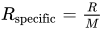
where p is the pressure, is the density of the gas and is the specific gas constant,[2] being the molar mass, and the is the absolute temperature (kelvin or Rankine scale).
In statistical mechanics the description is:
where is the pressure, is the number of moles of gas, is the absolute temperature, is the gas constant, and is unit volume.
For an ideal gas the compressibility factor is per definition. In many real world applications requirements for accuracy demand that deviations from ideal gas behaviour, i.e., real gas behaviour, be taken into account. The value of generally increases with pressure and decreases with temperature. At high pressures molecules are colliding more often. This allows repulsive forces between molecules to have a noticeable effect, making the molar volume of the real gas () greater than the molar volume of the corresponding ideal gas (), which causes to exceed one.[3] When pressures are lower, the molecules are free to move. In this case attractive forces dominate, making . The closer the gas is to its critical point or its boiling point, the more deviates from the ideal case.
Fugacity
[edit]The compressibility factor is linked to the fugacity by the relation:[citation needed]
Generalized compressibility factor graphs for pure gases
[edit]
The unique relationship between the compressibility factor and the reduced temperature, , and the reduced pressure, , was first recognized by Johannes Diderik van der Waals in 1873 and is known as the two-parameter principle of corresponding states. The principle of corresponding states expresses the generalization that the properties of a gas which are dependent on intermolecular forces are related to the critical properties of the gas in a universal way. That provides a most important basis for developing correlations of molecular properties.
As for the compressibility of gases, the principle of corresponding states indicates that any pure gas at the same reduced temperature, , and reduced pressure, , should have the same compressibility factor.
The reduced temperature and pressure are defined by
- and
Here and are known as the critical temperature and critical pressure of a gas. They are characteristics of each specific gas with being the temperature above which it is not possible to liquify a given gas and is the minimum pressure required to liquify a given gas at its critical temperature. Together they define the critical point of a fluid above which distinct liquid and gas phases of a given fluid do not exist.
The pressure-volume-temperature (PVT) data for real gases varies from one pure gas to another. However, when the compressibility factors of various single-component gases are graphed versus pressure along with temperature isotherms many of the graphs exhibit similar isotherm shapes.
In order to obtain a generalized graph that can be used for many different gases, the reduced pressure and temperature, and , are used to normalize the compressibility factor data. Figure 2 is an example of a generalized compressibility factor graph derived from hundreds of experimental PVT data points of 10 pure gases, namely methane, ethane, ethylene, propane, n-butane, i-pentane, n-hexane, nitrogen, carbon dioxide and steam.
There are more detailed generalized compressibility factor graphs based on as many as 25 or more different pure gases, such as the Nelson-Obert graphs. Such graphs are said to have an accuracy within 1–2 percent for values greater than 0.6 and within 4–6 percent for values of 0.3–0.6.
The generalized compressibility factor graphs may be considerably in error for strongly polar gases which are gases for which the centers of positive and negative charge do not coincide. In such cases the estimate for may be in error by as much as 15–20 percent.
The quantum gases hydrogen, helium, and neon do not conform to the corresponding-states behavior. Rao recommended that the reduced pressure and temperature for those three gases should be redefined in the following manner to improve the accuracy of predicting their compressibility factors when using the generalized graphs:
- and
where the temperatures are in kelvins and the pressures are in atmospheres.[4]
Reading a generalized compressibility chart
[edit]In order to read a compressibility chart, the reduced pressure and temperature must be known. If either the reduced pressure or temperature is unknown, the reduced specific volume must be found. Unlike the reduced pressure and temperature, the reduced specific volume is not found by using the critical volume. The reduced specific volume is defined by,
where is the specific volume.[5]
Once two of the three reduced properties are found, the compressibility chart can be used. In a compressibility chart, reduced pressure is on the x-axis and Z is on the y-axis. When given the reduced pressure and temperature, find the given pressure on the x-axis. From there, move up on the chart until the given reduced temperature is found. Z is found by looking where those two points intersect. the same process can be followed if reduced specific volume is given with either reduced pressure or temperature.
Observations made from a generalized compressibility chart
[edit]There are three observations that can be made when looking at a generalized compressibility chart. These observations are:
- Gases behave as an ideal gas regardless of temperature when the reduced pressure is much less than one (PR ≪ 1).
- When reduced temperature is greater than two (TR > 2), ideal-gas behavior can be assumed regardless of pressure, unless pressure is much greater than one (PR ≫ 1).
- Gases deviate from ideal-gas behavior the most in the vicinity of the critical point.[6]
Theoretical models
[edit]The virial equation is especially useful to describe the causes of non-ideality at a molecular level (very few gases are mono-atomic) as it is derived directly from statistical mechanics:
Where the coefficients in the numerator are known as virial coefficients and are functions of temperature.
The virial coefficients account for interactions between successively larger groups of molecules. For example, accounts for interactions between pairs, for interactions between three gas molecules, and so on. Because interactions between large numbers of molecules are rare, the virial equation is usually truncated after the third term.[7]
When this truncation is assumed, the compressibility factor is linked to the intermolecular-force potential φ by:
The Real gas article features more theoretical methods to compute compressibility factors.
Physical mechanism of temperature and pressure dependence
[edit]Deviations of the compressibility factor, Z, from unity are due to attractive and repulsive intermolecular forces. At a given temperature and pressure, repulsive forces tend to make the volume larger than for an ideal gas; when these forces dominate Z is greater than unity. When attractive forces dominate, Z is less than unity. The relative importance of attractive forces decreases as temperature increases (see effect on gases).
As seen above, the behavior of Z is qualitatively similar for all gases. Molecular nitrogen, N2, is used here to further describe and understand that behavior. All data used in this section were obtained from the NIST Chemistry WebBook.[8] It is useful to note that for N2 the normal boiling point of the liquid is 77.4 K and the critical point is at 126.2 K and 34.0 bar.

The figure on the right shows an overview covering a wide temperature range. At low temperature (100 K), the curve has a characteristic check-mark shape, the rising portion of the curve is very nearly directly proportional to pressure. At intermediate temperature (160 K), there is a smooth curve with a broad minimum; although the high pressure portion is again nearly linear, it is no longer directly proportional to pressure. Finally, at high temperature (400 K), Z is above unity at all pressures. For all curves, Z approaches the ideal gas value of unity at low pressure and exceeds that value at very high pressure.

To better understand these curves, a closer look at the behavior for low temperature and pressure is given in the second figure. All of the curves start out with Z equal to unity at zero pressure and Z initially decreases as pressure increases. N2 is a gas under these conditions, so the distance between molecules is large, but becomes smaller as pressure increases. This increases the attractive interactions between molecules, pulling the molecules closer together and causing the volume to be less than for an ideal gas at the same temperature and pressure. Higher temperature reduces the effect of the attractive interactions and the gas behaves in a more nearly ideal manner.
As the pressure increases, the gas eventually reaches the gas-liquid coexistence curve, shown by the dashed line in the figure. When that happens, the attractive interactions have become strong enough to overcome the tendency of thermal motion to cause the molecules to spread out; so the gas condenses to form a liquid. Points on the vertical portions of the curves correspond to N2 being partly gas and partly liquid. On the coexistence curve, there are then two possible values for Z, a larger one corresponding to the gas and a smaller value corresponding to the liquid. Once all the gas has been converted to liquid, the volume decreases only slightly with further increases in pressure; then Z is very nearly proportional to pressure.
As temperature and pressure increase along the coexistence curve, the gas becomes more like a liquid and the liquid becomes more like a gas. At the critical point, the two are the same. So for temperatures above the critical temperature (126.2 K), there is no phase transition; as pressure increases the gas gradually transforms into something more like a liquid. Just above the critical point there is a range of pressure for which Z drops quite rapidly (see the 130 K curve), but at higher temperatures the process is entirely gradual.

The final figures shows the behavior at temperatures well above the critical temperatures. The repulsive interactions are essentially unaffected by temperature, but the attractive interaction have less and less influence. Thus, at sufficiently high temperature, the repulsive interactions dominate at all pressures.
This can be seen in the graph showing the high temperature behavior. As temperature increases, the initial slope becomes less negative, the pressure at which Z is a minimum gets smaller, and the pressure at which repulsive interactions start to dominate, i.e. where Z goes from less than unity to greater than unity, gets smaller. At the Boyle temperature (327 K for N2), the attractive and repulsive effects cancel each other at low pressure. Then Z remains at the ideal gas value of unity up to pressures of several tens of bar. Above the Boyle temperature, the compressibility factor is always greater than unity and increases slowly but steadily as pressure increases.
Experimental values
[edit]It is extremely difficult to generalize at what pressures or temperatures the deviation from the ideal gas becomes important. As a rule of thumb, the ideal gas law is reasonably accurate up to a pressure of about 2 atm, and even higher for small non-associating molecules. For example, methyl chloride, a highly polar molecule and therefore with significant intermolecular forces, the experimental value for the compressibility factor is at a pressure of 10 atm and temperature of 100 °C.[9] For air (small non-polar molecules) at approximately the same conditions, the compressibility factor is only (see table below for 10 bars, 400 K).
Compressibility of air
[edit]Normal air comprises in crude numbers 80 percent nitrogen N
2 and 20 percent oxygen O
2. Both molecules are small and non-polar (and therefore non-associating). We can therefore expect that the behaviour of air within broad temperature and pressure ranges can be approximated as an ideal gas with reasonable accuracy. Experimental values for the compressibility factor confirm this.
- Z for air as function of pressure 1–500 bar
-
75–200 K isotherms
-
250–1000 K isotherms
| Temp. (K) |
Pressure, absolute (bar) | |||||||||||||
|---|---|---|---|---|---|---|---|---|---|---|---|---|---|---|
| 1 | 5 | 10 | 20 | 40 | 60 | 80 | 100 | 150 | 200 | 250 | 300 | 400 | 500 | |
| 75 | 0.0052 | 0.0260 | 0.0519 | 0.1036 | 0.2063 | 0.3082 | 0.4094 | 0.5099 | 0.7581 | 1.0125 | ||||
| 80 | 0.0250 | 0.0499 | 0.0995 | 0.1981 | 0.2958 | 0.3927 | 0.4887 | 0.7258 | 0.9588 | 1.1931 | 1.4139 | |||
| 90 | 0.9764 | 0.0236 | 0.0453 | 0.0940 | 0.1866 | 0.2781 | 0.3686 | 0.4681 | 0.6779 | 0.8929 | 1.1098 | 1.3110 | 1.7161 | 2.1105 |
| 100 | 0.9797 | 0.8872 | 0.0453 | 0.0900 | 0.1782 | 0.2635 | 0.3498 | 0.4337 | 0.6386 | 0.8377 | 1.0395 | 1.2227 | 1.5937 | 1.9536 |
| 120 | 0.9880 | 0.9373 | 0.8860 | 0.6730 | 0.1778 | 0.2557 | 0.3371 | 0.4132 | 0.5964 | 0.7720 | 0.9530 | 1.1076 | 1.5091 | 1.7366 |
| 140 | 0.9927 | 0.9614 | 0.9205 | 0.8297 | 0.5856 | 0.3313 | 0.3737 | 0.4340 | 0.5909 | 0.7699 | 0.9114 | 1.0393 | 1.3202 | 1.5903 |
| 160 | 0.9951 | 0.9748 | 0.9489 | 0.8954 | 0.7803 | 0.6603 | 0.5696 | 0.5489 | 0.6340 | 0.7564 | 0.8840 | 1.0105 | 1.2585 | 1.4970 |
| 180 | 0.9967 | 0.9832 | 0.9660 | 0.9314 | 0.8625 | 0.7977 | 0.7432 | 0.7084 | 0.7180 | 0.7986 | 0.9000 | 1.0068 | 1.2232 | 1.4361 |
| 200 | 0.9978 | 0.9886 | 0.9767 | 0.9539 | 0.9100 | 0.8701 | 0.8374 | 0.8142 | 0.8061 | 0.8549 | 0.9311 | 1.0185 | 1.2054 | 1.3944 |
| 250 | 0.9992 | 0.9957 | 0.9911 | 0.9822 | 0.9671 | 0.9549 | 0.9463 | 0.9411 | 0.9450 | 0.9713 | 1.0152 | 1.0702 | 1.1990 | 1.3392 |
| 300 | 0.9999 | 0.9987 | 0.9974 | 0.9950 | 0.9917 | 0.9901 | 0.9903 | 0.9930 | 1.0074 | 1.0326 | 1.0669 | 1.1089 | 1.2073 | 1.3163 |
| 350 | 1.0000 | 1.0002 | 1.0004 | 1.0014 | 1.0038 | 1.0075 | 1.0121 | 1.0183 | 1.0377 | 1.0635 | 1.0947 | 1.1303 | 1.2116 | 1.3015 |
| 400 | 1.0002 | 1.0012 | 1.0025 | 1.0046 | 1.0100 | 1.0159 | 1.0229 | 1.0312 | 1.0533 | 1.0795 | 1.1087 | 1.1411 | 1.2117 | 1.2890 |
| 450 | 1.0003 | 1.0016 | 1.0034 | 1.0063 | 1.0133 | 1.0210 | 1.0287 | 1.0374 | 1.0614 | 1.0913 | 1.1183 | 1.1463 | 1.2090 | 1.2778 |
| 500 | 1.0003 | 1.0020 | 1.0034 | 1.0074 | 1.0151 | 1.0234 | 1.0323 | 1.0410 | 1.0650 | 1.0913 | 1.1183 | 1.1463 | 1.2051 | 1.2667 |
| 600 | 1.0004 | 1.0022 | 1.0039 | 1.0081 | 1.0164 | 1.0253 | 1.0340 | 1.0434 | 1.0678 | 1.0920 | 1.1172 | 1.1427 | 1.1947 | 1.2475 |
| 800 | 1.0004 | 1.0020 | 1.0038 | 1.0077 | 1.0157 | 1.0240 | 1.0321 | 1.0408 | 1.0621 | 1.0844 | 1.1061 | 1.1283 | 1.1720 | 1.2150 |
| 1000 | 1.0004 | 1.0018 | 1.0037 | 1.0068 | 1.0142 | 1.0215 | 1.0290 | 1.0365 | 1.0556 | 1.0744 | 1.0948 | 1.1131 | 1.1515 | 1.1889 |
values are calculated from values of pressure, volume (or density), and temperature in Vasserman, Kazavchinskii, and Rabinovich, "Thermophysical Properties of Air and Air Components;' Moscow, Nauka, 1966, and NBS-NSF Trans. TT 70–50095, 1971: and Vasserman and Rabinovich, "Thermophysical Properties of Liquid Air and Its Component, "Moscow, 1968, and NBS-NSF Trans. 69–55092, 1970.
See also
[edit]References
[edit]- ^ a b Properties of Natural Gases Archived 2011-02-06 at the Wayback Machine. Includes a chart of compressibility factors versus reduced pressure and reduced temperature (on last page of the PDF document)
- ^ Zucker, Robert D.; Biblarz, Oscar (2002). Fundamentals of Gas Dynamics (2nd ed.). Wiley Books. ISBN 0-471-05967-6. page 327
- ^ McQuarrie, Donald A.; Simon, John D. (1999). Molecular Thermodynamics. University Science Books. ISBN 1-891389-05-X. page 55
- ^ Y.V.C. Rao (1997). Chemical Engineering Thermodynamics. Universities Press (India). ISBN 81-7371-048-1.
- ^ Cengel, Yunus A.; Boles, Michael A. (2015). Thermodynamics: An Engineering Approach, Eighth Edition. McGraw-Hill Education. ISBN 978-0-07-339817-4. page 140
- ^ Cengel, Yunus A.; Boles, Michael A. (2015). Thermodynamics: An Engineering Approach, Eighth Edition. McGraw-Hill Education. ISBN 978-0-07-339817-4. page 139
- ^ Smith, J.M.; et al. (2005). Introduction to Chemical Engineering Thermodynamics (Seventh ed.). McGraw Hill. ISBN 0-07-310445-0. page73
- ^ NIST Chemistry WebBook
- ^ Perry's chemical engineers' handbook (6 ed.). MCGraw-Hill. 1984. ISBN 0-07-049479-7. page 3-268
- ^ Perry's chemical engineers' handbook (6 ed.). MCGraw-Hill. 1984. p. 3-162. ISBN 0-07-049479-7.
External links
[edit]- Compressibility factor (gases) A Citizendium article.
- Real Gases Archived 2007-08-27 at the Wayback Machine includes a discussion of compressibility factors.
Compressibility factor
View on GrokipediaFundamentals
Definition
The compressibility factor, denoted as , is a dimensionless quantity that quantifies the extent to which the behavior of a real gas deviates from that of an ideal gas under the same conditions of temperature and pressure. It serves as a multiplicative correction factor applied to the ideal gas law, , to account for non-ideal effects arising from intermolecular forces and the finite volume of gas molecules. Mathematically, it is defined for a gas sample as where is the pressure, is the volume, is the number of moles, is the universal gas constant, and is the absolute temperature.[5] For pure gases, the compressibility factor is commonly expressed on a per-mole basis using the molar volume , yielding This formulation highlights its dimensionless nature, as the units of match those of . For an ideal gas, exactly, which holds approximately for real gases at low pressures (where intermolecular attractions are negligible) and high temperatures (where molecular volumes are insignificant relative to the total volume). In contrast, real gases exhibit when repulsive forces dominate at high densities and when attractive forces prevail at moderate densities.[1] At standard temperature and pressure (STP: 273.15 K and 1 atm), for most common gases such as nitrogen, oxygen, and air, reflecting near-ideal behavior under these dilute conditions. Deviations from unity increase markedly near a gas's critical point, where the distinction between liquid and gas phases blurs and non-ideal effects intensify.[1]Physical Significance
The compressibility factor serves as a dimensionless measure of the extent to which real gases deviate from the ideal gas law, incorporating the influences of intermolecular attractive forces and the finite volume occupied by gas molecules. Attractive forces between molecules reduce the effective pressure on container walls by pulling molecules inward, resulting in and a smaller volume than predicted for an ideal gas at moderate pressures and low temperatures. Conversely, at high pressures, the repulsive interactions and excluded volume effects due to molecular size dominate, causing the actual volume to exceed the ideal value and yielding . These deviations arise because real gas molecules are not point masses with no interactions, as assumed in the ideal model, but possess both volume and potential energies from intermolecular potentials.[6][7] In thermodynamics, is integral to residual property methods, which quantify departures of real gas properties from their ideal-gas counterparts. Residual enthalpy and residual internal energy are derived from equations of state involving , such as through integrals over pressure that account for non-ideal contributions to energy storage and transfer. Similarly, residual entropy incorporates to capture changes in disorder due to molecular interactions, enabling precise calculations of thermodynamic functions like Gibbs free energy for processes in non-ideal conditions. These residual properties, directly tied to , are essential for accurate modeling of phase equilibria and energy balances in systems where ideal assumptions fail.[8][9] At the critical point, where liquid and vapor phases become indistinguishable, attains the critical compressibility factor , which reflects the unique scaling of thermodynamic properties near this singularity. For many simple non-polar gases, , but this value is not universal and varies with molecular structure; for example, noble gases exhibit , while associative fluids like water or alkali metals show lower values around 0.22 due to enhanced intermolecular bonding. This variation underscores how encodes the influence of specific molecular interactions on critical phenomena, such as the breakdown of mean-field approximations and the emergence of fluctuations.[10] From an engineering perspective, is indispensable for reliable predictions in high-pressure gas handling systems, where deviations from ideality significantly impact performance. In natural gas pipelines, accurate values enable computation of real densities and volumes, which are critical for hydraulic modeling, pressure drop estimation (e.g., correcting ideal predictions by up to 10-20% at elevated pressures), and custody transfer metering. For compressors, incorporating ensures proper sizing and efficiency by accounting for non-ideal flow and thermodynamic work, preventing over- or under-design in applications like LNG processing or reservoir management.[11][12]Graphical Methods
Generalized Compressibility Charts
The generalized compressibility charts rely on the principle of corresponding states, which asserts that substances at the same reduced conditions exhibit similar thermodynamic behavior, allowing the compressibility factor to be correlated using reduced variables. These variables are the reduced temperature and reduced pressure , where and denote the critical temperature and critical pressure of the substance, respectively.[13] The compressibility factor , representing the deviation from ideal gas behavior as , is then expressed as a universal function for a wide range of gases.[13] The development of these charts began in the early 20th century, with initial versions prepared by Cope et al. in 1931 and Brown et al. in 1932, but the forms most widely adopted were introduced by O. A. Hougen and K. M. Watson in their 1943 textbook Chemical Process Principles.[14] Subsequently, L. C. Nelson and E. F. Obert refined and expanded the charts in their 1954 publication in Chemical Engineering, establishing them as a standard reference for engineering applications.[14] Charts are typically presented in two main types to cover different pressure regimes: low-pressure charts, plotting versus (up to 1.0) at constant values from 0.7 to 3.0, and high-pressure charts, showing versus (extending to 10 or higher) with families of isotherms for from 1.0 to 3.0, often using logarithmic scales for the pressure axis to accommodate the broad range. These graphical representations were constructed by averaging experimental data from multiple non-polar gases, such as nitrogen, methane, and argon, to derive smooth isotherms and isobars.[14] Despite their utility, the charts have limitations, as they are primarily valid for pure, non-polar gases and show deviations for polar or associating compounds like water or ammonia.[13] For hydrocarbons, the accuracy is generally within 5-10%, but errors can exceed this near the critical point or for quantum gases like hydrogen and helium without corrections.[13]Reading and Interpreting Charts
To determine the compressibility factor using generalized compressibility charts, first calculate the reduced temperature and reduced pressure , where and are the actual temperature and pressure, and and are the critical temperature and pressure of the gas.[15] Locate the point on the chart corresponding to these reduced values by following the curve to the intersection with the vertical line, then read the value from the vertical axis at that intersection point.[16] For example, consider methane ( K, bar) at K and bar.[17] The reduced values are and , yielding from the chart intersection.[18] When the reduced values do not align exactly with chart lines, apply linear interpolation between adjacent curves for the temperature and between grid lines for the pressure to estimate .[19] Near the critical point, where curves converge and resolution is low, more precise interpolation or supplementary equations may be needed to avoid significant inaccuracies.[20] Potential error sources include the underlying assumption of the corresponding states principle, which posits similar behavior for all gases at equivalent reduced conditions but can lead to deviations of 1-2% for non-polar gases and up to 15-20% for polar ones.[19] For quantum gases such as hydrogen, the charts require adjustments like using pseudocritical properties or specialized charts to account for non-conforming behavior due to quantum effects.[19]Observations from Charts
In generalized compressibility charts, the behavior of the compressibility factor Z varies distinctly with reduced pressure (P_r). At low P_r, Z decreases below 1, as intermolecular attractive forces cause the real gas to occupy a smaller volume than an ideal gas at the same pressure and temperature, leading to deviations from ideality.[21] At higher P_r, particularly beyond the critical region, Z increases above 1 due to the dominance of repulsive intermolecular forces and the excluded volume effects of molecules, making the gas less compressible than ideal. Temperature trends are evident across isotherms in these charts. For high reduced temperatures (T_r > 2), Z remains close to 1 over a broad range of P_r, as elevated thermal energy minimizes the impact of intermolecular interactions, approximating ideal gas behavior.[1] Near T_r = 1, Z exhibits a pronounced minimum, often around P_r = 1–2, where non-ideal effects are most significant due to proximity to the saturation curve.[20] In the critical region (T_r ≈ 1, P_r ≈ 1), Z dips to values of approximately 0.7–0.8 along isotherms slightly above the critical temperature before rising with further increases in P_r, highlighting the transition from attractive to repulsive dominance.[20] At the exact critical point, Z_c typically ranges from 0.27 to 0.29 for simple fluids.[22] Variations among gases are also observable, as the corresponding states principle does not hold perfectly for all. While heavier non-polar gases like hydrocarbons generally follow the generalized trends closely, lighter quantum gases such as helium and hydrogen exhibit greater deviations from the simple fluid charts due to quantum mechanical effects, often requiring pseudocritical corrections. Polar gases, including ammonia (NH_3), and asymmetric nonpolar molecules like CO_2, show even larger departures, necessitating acentric factor adjustments.[1][23]Theoretical Models
Equations of State
The van der Waals equation of state, proposed in 1873, represents an early modification to the ideal gas law to account for molecular volume and intermolecular attractions in real gases. It is expressed as where is pressure, is molar volume, is temperature, is the gas constant, accounts for attractive forces between molecules, and represents the excluded volume per mole.[24] In terms of the compressibility factor , the equation rearranges to allowing direct computation of deviations from ideality./16%3A_The_Properties_of_Gases/16.02%3A_van_der_Waals_and_Redlich-Kwong_Equations_of_State) The Redlich-Kwong equation, introduced in 1949, improved upon the van der Waals model by making the attraction parameter temperature-dependent, enhancing accuracy for a wider range of conditions. It takes the form with and , where and are critical temperature and pressure. In reduced variables, using and , the compressibility factor satisfies the cubic equation where and .[25]/16%3A_The_Properties_of_Gases/16.02%3A_van_der_Waals_and_Redlich-Kwong_Equations_of_State) A significant modification, the Soave-Redlich-Kwong equation from 1972, further refined the temperature dependence of the attraction term to better predict vapor pressures, particularly for hydrocarbons. It replaces the factor with an alpha function , where is the acentric factor, yielding while keeping unchanged. This leads to the same cubic form for but with updated and , improving overall accuracy for non-ideal behavior.[26] The Peng-Robinson equation, developed in 1976, addressed limitations in liquid density predictions and is particularly suited for non-polar and hydrocarbon systems. Its form is with , , and . The compressibility factor is obtained by solving the cubic equation where and , typically using the largest real root for the vapor phase. Cubic equations of state like these effectively capture the compressibility factor behavior for non-polar gases, with the Peng-Robinson model often providing superior accuracy for hydrocarbons compared to earlier forms, especially near the critical point. For mixtures, accuracy is enhanced by applying mixing rules, such as van der Waals one-fluid mixing with interaction parameters, to compute pseudocritical properties and composition-dependent and .[27][28]Other Theoretical Approaches
The virial equation provides a theoretical framework for expressing the compressibility factor as a power series expansion in terms of the inverse molar volume (or density ), capturing deviations from ideal gas behavior at low to moderate densities. It takes the form where , , , etc., are the second, third, fourth, and higher virial coefficients, respectively, which depend on temperature but are independent of density./02:_Gas_Laws/2.13:_Virial_Equations) This expansion, originally proposed by Kamerlingh Onnes in 1901 and later justified through statistical mechanics, is particularly useful for dilute gases where higher-order terms become negligible.[29] In statistical mechanics, the virial equation arises from the canonical partition function for particles in volume , where the pressure is given by , leading to .[30] The partition function incorporates the configurational integral over all particle positions, accounting for intermolecular interactions via the Mayer cluster expansion, which expresses as a sum of irreducible cluster integrals that directly yield the virial coefficients.[31] These coefficients connect macroscopic thermodynamics to microscopic pair correlation functions, with the second virial coefficient explicitly derived from the two-body intermolecular potential as integrated over all space, highlighting how repulsive and attractive forces influence gas non-ideality. For denser gases, where the virial series converges slowly, perturbation theory offers an alternative by treating the intermolecular potential as a reference system plus a perturbation. In the Weeks-Chandler-Andersen (WCA) approach, the potential is split into a repulsive reference (e.g., a softened hard-sphere potential) and an attractive perturbation, yielding where is computed from the reference system's equation of state (often via integral equations or simulations), and is a first- or higher-order correction from mean-field or random-phase approximations.[32] This method excels for simple liquids and dense gases near the triple point, providing accurate thermodynamic properties without relying on low-density assumptions.[33] The Benedict-Webb-Rubin (BWR) equation represents a semi-empirical extension, formulated as an eighth-degree polynomial in density to model accurately over wide ranges of temperature and pressure, particularly for light hydrocarbons like natural gas mixtures. Introduced in 1940, it takes the form with eight temperature-dependent constants fitted to experimental data, enabling precise calculations of phase behavior and caloric properties in industrial applications.[34]Physical Explanations
Temperature Dependence
The compressibility factor exhibits a strong dependence on temperature due to the interplay between molecular kinetic energy and intermolecular forces. At sufficiently high temperatures, the average kinetic energy of gas molecules greatly exceeds the energy associated with attractive and repulsive interactions, such as van der Waals forces and short-range repulsions. This thermal dominance reduces the time molecules spend in close proximity during collisions, minimizing the influence of these forces on the effective volume and pressure. Consequently, the gas behaves increasingly like an ideal gas, with approaching 1 from above or below depending on the specific conditions, as the deviations from ideality diminish.[35] At lower temperatures, the reduced kinetic energy allows attractive intermolecular forces to play a more significant role, effectively pulling molecules toward one another and reducing the force exerted on container walls compared to an ideal gas. This results in , indicating that the gas is more compressible than predicted by the ideal gas law. Van der Waals attractions are particularly influential in this regime, lowering the observed pressure for a given volume and temperature. Near the liquefaction point, where thermal energy is comparable to the cohesive forces, reaches pronounced minima, reflecting the onset of condensation tendencies that further enhance compressibility.[35] At very low temperatures, quantum mechanical effects emerge prominently for light gases like hydrogen, where the thermal de Broglie wavelength approaches the scale of intermolecular separations. These effects, including wave packet diffraction during collisions, effectively enlarge the excluded volume around molecules, mimicking stronger repulsive interactions and causing even at low densities. This quantum enhancement of repulsion contrasts with classical expectations and marks a transition from classical to quantum-dominated gas behavior, with weaker overall interactions amplifying the deviation.[36]Pressure Dependence
At low pressures, where the gas is dilute, intermolecular attractions between molecules dominate the behavior, leading to a compressibility factor . These attractions reduce the force with which molecules impinge on the container walls, as nearby molecules pull them back, resulting in an observed pressure lower than that predicted by the ideal gas law for the same volume and temperature. At high pressures, the finite volume of the gas molecules becomes significant, causing because the molecules exclude a portion of the available space in the container, making the gas less compressible than an ideal gas. The effective free volume decreases more rapidly than in the ideal case, as the molecular cores occupy an increasing fraction of the total volume, leading to higher pressures for a given density.[37] In theoretical models focusing on the repulsive core of molecules, such as the hard-sphere model, the compressibility factor arises solely from volume exclusion effects and is approximated by where is the packing fraction, proportional to . This expression captures how repulsive interactions increase above unity as density rises with pressure, independent of attractive forces. At moderate pressures, a balance between intermolecular attractions and repulsions causes to reach a minimum, where the pressure-reducing effect of attractions offsets the volume-excluding effect of repulsions. The location of this minimum is modulated by temperature, with higher temperatures shifting it to greater pressures by diminishing the relative strength of attractions.Experimental Data
Measurement Techniques
The compressibility factor for gases is most directly determined through pressure-volume-temperature (P-V-T) measurements, where , with as pressure, as volume, as the number of moles, as the universal gas constant, and as temperature. Piston-cylinder apparatuses are widely employed for these measurements, enabling precise control of temperature and pressure while varying volume through piston displacement. These devices can operate up to pressures of 1000 bar, facilitating data collection for real gases under elevated conditions relevant to industrial applications. For instance, a piston gauge system integrated with high-precision pressure transducers has been used to measure compressibility for gases like helium and nitrogen at pressures exceeding 300 bar.[38][39][40] Acoustic methods provide a non-invasive alternative for inferring the compressibility factor, particularly at high pressures where direct volume measurements are challenging. These techniques measure the speed of sound in the gas, which relates to through thermodynamic equations such as , where is the heat capacity ratio and is the molar mass; deviations from ideal behavior are extracted by comparing measured speeds to ideal gas predictions. Acoustic resonance or interferometry setups allow for rapid, in situ determinations without physical contact, making them suitable for extreme pressures up to several thousand bar. Such methods have been applied to validate for refrigerants and natural gas components by combining speed-of-sound data with pressure and temperature readings.[41][42] Calorimetric approaches indirectly determine the compressibility factor by measuring heat capacity deviations from ideal gas values, which are linked to derivatives of via thermodynamic relations such as , where is the molar volume. Constant-volume calorimeters equipped with internal stirrers and precise temperature sensors capture these deviations for gases at controlled pressures, allowing integration with P-V-T data to refine . This method is particularly useful for low-density regimes where direct volume changes are small, and has been employed in fitting equations of state for hydrocarbons by analyzing isobaric heat capacities.[43] Modern techniques enhance measurement accuracy and extend applicability, including Raman spectroscopy for direct density determination, from which is computed using with as density derived from vibrational band shifts. Raman setups with fiber-optic probes enable non-intrusive density profiling in high-pressure cells, achieving uncertainties below 1% for gases like CO₂ and methane up to 100 bar. Complementing these, molecular dynamics (MD) simulations validate experimental by computing ensemble averages of pressure and volume under intermolecular potentials, often integrated into databases like NIST REFPROP for post-2020 updates incorporating MD-derived corrections for mixtures. For example, MD has been used to predict for natural gas with errors under 2% compared to empirical data, supporting REFPROP's fluid property models.[44][45][46]Values for Common Gases
The compressibility factor for air, a mixture primarily composed of 78% nitrogen and 21% oxygen by volume, is approximately 0.999 at standard temperature and pressure (STP: 273 K, 1 bar), indicating near-ideal behavior under ambient conditions.[47] At higher pressures, such as 300 K and 100 bar, the value decreases slightly to about 0.993 due to intermolecular attractions.[47] This deviation is influenced by the mixture's composition, where the dominant nitrogen component drives much of the behavior, though oxygen's slightly higher critical temperature contributes to minor variations.[47] For hydrocarbons, methane exhibits a compressibility factor of 0.92 at 300 K and 50 bar, reflecting moderate deviations from ideality as pressure compresses the gas beyond low-density limits.[47] Propane, a larger molecule, shows greater non-ideality near its critical point (T_c = 370 K, P_c = 42.5 bar), with Z ≈ 0.75 at conditions close to criticality, such as 370 K and 40 bar, where attractive forces lead to significant volume reduction compared to an ideal gas.[47] Among industrial gases, carbon dioxide displays Z = 0.80 at 300 K and 50 bar, highlighting its supercritical behavior in this regime, where the gas-like density combines with liquid-like compressibility.[47] Hydrogen, conversely, has Z ≈ 1.05 at high pressures (e.g., 300 K and 1000 bar), attributable to quantum mechanical effects that enhance repulsive interactions and reduce the impact of attractions at short molecular distances.[47] Polar gases like ammonia exhibit larger deviations, with Z < 0.7 at moderate pressures such as 300 K and 50 bar, owing to strong dipole-dipole interactions that promote greater compressibility than in non-polar gases.[47] Recent NIST updates from the 2020s have refined compressibility data for key gases, improving precision for applications like liquefied natural gas (LNG) transport, where accurate Z values ensure reliable volume and energy density predictions. The following table presents experimental Z values versus reduced pressure (P_r) at a fixed reduced temperature (T_r = 1.5) for nitrogen, oxygen, and methane, based on these updated datasets.[47]| Reduced Pressure (P_r) | Nitrogen (Z) | Oxygen (Z) | Methane (Z) |
|---|---|---|---|
| 0.0 | 1.000 | 1.000 | 1.000 |
| 0.5 | 0.975 | 0.970 | 0.972 |
| 1.0 | 0.860 | 0.855 | 0.865 |
| 1.5 | 0.760 | 0.755 | 0.765 |
| 2.0 | 0.680 | 0.675 | 0.685 |
| 2.5 | 0.620 | 0.615 | 0.625 |