Hubbry Logo
Real gasReal gasMain
Open search
Real gas
Community hub
Real gas
logo
8 pages, 0 posts
0 subscribers
Be the first to start a discussion here.
Real gas
Real gas
from Wikipedia

Real gases are non-ideal gases whose molecules occupy space and have interactions; consequently, they do not adhere to the ideal gas law. To understand the behaviour of real gases, the following must be taken into account:

For most applications, such a detailed analysis is unnecessary, and the ideal gas approximation can be used with reasonable accuracy. On the other hand, real-gas models have to be used near the condensation point of gases, near critical points, at very high pressures, to explain the Joule–Thomson effect, and in other less usual cases. The deviation from ideality can be described by the compressibility factor Z.

Models

[edit]
Isotherms of real gas

Dark blue curves – isotherms below the critical temperature. Green sections – metastable states.

The section to the left of point F – normal liquid.
Point F – boiling point.
Line FG – equilibrium of liquid and gaseous phases.
Section FA – superheated liquid.
Section F′A – stretched liquid (p<0).
Section AC – analytic continuation of isotherm, physically impossible.
Section CG – supercooled vapor.
Point G – dew point.
The plot to the right of point G – normal gas.
Areas FAB and GCB are equal.

Red curve – Critical isotherm.
Point K – critical point.

Light blue curves – supercritical isotherms

Van der Waals model

[edit]

Real gases are often modeled by taking into account their molar weight and molar volume
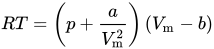
or alternatively:
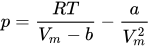
Where p is the pressure, T is the temperature, R the ideal gas constant, and Vm the molar volume. a and b are parameters that are determined empirically for each gas, but are sometimes estimated from their critical temperature (Tc) and critical pressure (pc) using these relations:

The constants at critical point can be expressed as functions of the parameters a, b:

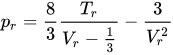
With the reduced properties , , the equation can be written in the reduced form:

Redlich–Kwong model

[edit]
Critical isotherm for Redlich-Kwong model in comparison to van-der-Waals model and ideal gas (with V0=RTc/pc)

The Redlich–Kwong equation is another two-parameter equation that is used to model real gases. It is almost always more accurate than the van der Waals equation, and often more accurate than some equations with more than two parameters. The equation is

or alternatively:

where a and b are two empirical parameters that are not the same parameters as in the van der Waals equation. These parameters can be determined:

The constants at critical point can be expressed as functions of the parameters a, b:

Using , , the equation of state can be written in the reduced form: with
Berthelot and modified Berthelot model

[edit]

The Berthelot equation (named after D. Berthelot)[1] is very rarely used,

but the modified version is somewhat more accurate

Dieterici model

[edit]

This model (named after C. Dieterici[2]) fell out of usage in recent years

with parameters a, b. These can be normalized by dividing with the critical point state[note 1]:which casts the equation into the reduced form:[3]

Clausius model

[edit]

The Clausius equation (named after Rudolf Clausius) is a very simple three-parameter equation used to model gases.

or alternatively:

where

where Vc is critical volume.

Virial model

[edit]

The Virial equation derives from a perturbative treatment of statistical mechanics.

or alternatively

where A, B, C, A′, B′, and C′ are temperature dependent constants.

Peng–Robinson model

[edit]

Peng–Robinson equation of state (named after D.-Y. Peng and D. B. Robinson[4]) has the interesting property being useful in modeling some liquids as well as real gases.

Wohl model

[edit]
Isotherm (V/V0->p_r) at critical temperature for Wohl model, van der Waals model and ideal gas model (with V0=RTc/pc)
Untersuchungen über die Zustandsgleichung, pp. 9,10, Zeitschr. f. Physikal. Chemie 87

The Wohl equation (named after A. Wohl[5]) is formulated in terms of critical values, making it useful when real gas constants are not available, but it cannot be used for high densities, as for example the critical isotherm shows a drastic decrease of pressure when the volume is contracted beyond the critical volume.

or:

or, alternatively:

where where , , are (respectively) the molar volume, the pressure and the temperature at the critical point.

And with the reduced properties , , one can write the first equation in the reduced form:

Beattie–Bridgeman model

[edit]

[6] This equation is based on five experimentally determined constants. It is expressed as

where

This equation is known to be reasonably accurate for densities up to about 0.8 ρcr, where ρcr is the density of the substance at its critical point. The constants appearing in the above equation are available in the following table when p is in kPa, Vm is in , T is in K and [7]

Gas A0 a B0 b c
Air 131.8441 0.01931 0.04611 −0.001101 4.34×10⁴
Argon, Ar 130.7802 0.02328 0.03931 0.0 5.99×10⁴
Carbon dioxide, CO2 507.2836 0.07132 0.10476 0.07235 6.60×10⁵
Ethane, C2H6 595.791 0.05861 0.09400 0.01915 90.00×10⁴
Helium, He 2.1886 0.05984 0.01400 0.0 40
Hydrogen, H2 20.0117 −0.00506 0.02096 −0.04359 504
Methane, CH4 230.7069 0.01855 0.05587 -0.01587 12.83×10⁴
Nitrogen, N2 136.2315 0.02617 0.05046 −0.00691 4.20×10⁴
Oxygen, O2 151.0857 0.02562 0.04624 0.004208 4.80×10⁴

Benedict–Webb–Rubin model

[edit]

The BWR equation,

where d is the molar density and where a, b, c, A, B, C, α, and γ are empirical constants. Note that the γ constant is a derivative of constant α and therefore almost identical to 1.

Thermodynamic expansion work

[edit]

The expansion work of the real gas is different than that of the ideal gas by the quantity .

See also

[edit]

References

[edit]

Further reading

[edit]
[edit]
Revisions and contributorsEdit on WikipediaRead on Wikipedia
from Grokipedia
A real gas is a gas composed of molecules or atoms that possess finite volume and experience intermolecular forces of attraction and repulsion, causing its behavior to deviate from the predictions of the under conditions of or low temperature. Unlike an , which is modeled as consisting of non-interacting point particles undergoing elastic collisions, a real gas exhibits measurable non-ideal properties due to these molecular interactions and the occupied by the particles themselves. The extent of deviation is quantified by the Z=PVnRTZ = \frac{PV}{nRT}, where Z=1Z = 1 for ideal behavior; for real gases, Z<1Z < 1 when attractive forces dominate (reducing effective pressure) and Z>1Z > 1 when repulsive forces or volume exclusion prevail at high densities. One of the most widely used equations of state for real gases is the , derived in 1873, which modifies the to incorporate these effects: (P+an2V2)(Vnb)=nRT\left( P + \frac{an^2}{V^2} \right) (V - nb) = nRT, where aa represents the strength of intermolecular attractions (in units of L²·atm·mol⁻²) and bb accounts for the effective volume of the molecules (in L·mol⁻¹). The parameter aa correlates with the gas's , as stronger attractions lead to higher values (e.g., 4.17 for versus 0.034 for ), while bb reflects molecular size (e.g., 0.043 for CO₂). This equation provides a more accurate description of real gas properties, such as reduced compressibility at elevated pressures, and is foundational for understanding phase transitions, critical points, and applications in and . Real gases approach ideal behavior at low pressures and high temperatures, where molecular interactions become negligible relative to , but significant deviations occur near the point or in supercritical states, influencing processes like compression and cycles. The study of real gases extends to advanced equations of state, such as the Redlich-Kwong or Peng-Robinson models, which refine predictions for industrial applications, but the van der Waals framework remains a cornerstone for illustrating the transition from ideal to non-ideal regimes.

Fundamental Concepts

Definition and Scope

A real gas is a gaseous substance in which the finite volume of the molecules and the intermolecular attractive and repulsive forces cannot be neglected, leading to behavior that deviates from the assumptions of the model, where molecules are treated as point particles with no interactions. This contrasts with the ideal gas approximation, which holds under conditions where molecular interactions are minimal. In the 19th century, early experimental work by Henri Victor Regnault in 1846 demonstrated that real gases deviate from —stating that pressure and volume are inversely proportional at constant temperature—particularly at high densities, where observed pressures exceeded predictions. , in his 1857 revival of the , recognized that real gases do not strictly obey laws due to these deviations, though his model initially limited itself to dilute conditions. James Clerk Maxwell further advanced this understanding in 1860 by developing the statistical kinetic theory, highlighting how molecular velocities and collisions contribute to non-ideal properties, including the ability of real gases to liquefy under high pressure and low temperature, as observed in experiments like those of starting in 1823. The scope of real gases encompasses virtually all gaseous substances under conditions beyond the dilute, high-temperature regime, where ideal behavior approximates reality. Real gases approach ideal behavior at low densities, such as pressures below 1 atm and temperatures above for most substances, where intermolecular forces become negligible relative to .

Comparison to Ideal Gases

The ideal gas law, expressed as PV=nRTPV = nRT, where PP is the pressure, VV is the volume, nn is the number of moles, RR is the universal gas constant, and TT is the absolute temperature, serves as the baseline for understanding gas behavior. This equation assumes that gas molecules are point particles with negligible volume and no intermolecular attractive or repulsive forces between them, leading to behavior where the product PVPV remains constant at fixed TT and nn. These assumptions hold well under certain conditions but fail for real gases, particularly when molecular effects become significant. Real gases exhibit quantitative deviations from this law, most commonly quantified using the compressibility factor Z=PVnRTZ = \frac{PV}{nRT}, where Z=1Z = 1 for an and Z1Z \neq 1 indicates non-ideality (with details on ZZ explored further in subsequent sections). At constant , plots of PVPV versus PP for an yield a straight horizontal line, as PVPV is independent of . In contrast, real gas plots show characteristic curves: at moderate pressures, PVPV often dips below the ideal line (indicating Z<1Z < 1), while at higher pressures, it rises above ( Z>1Z > 1 ), reflecting how actual gas volumes and pressures diverge from predictions. These deviations become pronounced as increases or decreases, but approach ideal behavior in the limits of low and high , where Z1Z \to 1. Experimental evidence from Boyle's law investigations, which test the inverse pressure-volume relationship at constant temperature, confirms these deviations at elevated pressures. For instance, measurements on air at 300 K show Z0.993Z \approx 0.993 at 100 bar (about 98.7 atm), a minor deviation of less than 1%, but ZZ rises to 1.033 at 200 bar and 1.067 at 250 bar, exceeding 5% deviation above approximately 250 bar (246 atm). Such data, derived from precise pressure-volume measurements, highlight the practical limits of the ideal gas approximation in high-pressure scenarios like compressed air systems.

Causes of Non-Ideal Behavior

Finite Molecular Volume

In real gases, the molecules possess a finite, non-zero , which reduces the effective available for molecular motion compared to the total container . This effect becomes prominent at high densities or pressures, where the molecular is no longer negligible relative to the overall . As a result, the observed exceeds that predicted by the , leading to PV>nRTPV > nRT. This deviation arises from the repulsive interactions due to the physical size of the molecules, which prevent them from occupying the same space. In the hard-sphere model, gas molecules are idealized as rigid, impenetrable spheres that collide elastically but cannot overlap. The excluded volume—the additional space around each molecule that other molecules cannot access—accounts for this repulsion. In the context of corrections to the ideal gas law, this excluded volume per mole is denoted by the parameter bb, representing approximately four times the actual molecular volume for a system of hard spheres. Quantitatively, at high pressures approaching close packing conditions, where molecules are nearly in contact, the finite significantly alters the pressure- relationship. For instance, in , the parameter b0.0238b \approx 0.0238 L/mol, indicating that the correction becomes relevant when the molar approaches this value, enhancing the pressure by limiting . This term establishes a minimum limit, beyond which further compression is resisted primarily by molecular repulsion. The recognition of finite molecular volume as a key factor in non-ideal behavior was first systematically proposed by in his 1873 doctoral thesis, where he introduced it as one essential modification to the to better describe real gas properties.

Intermolecular Forces

In real gases, intermolecular forces manifest primarily as van der Waals attractions, encompassing London dispersion forces present in all molecules due to temporary induced dipoles, dipole-dipole interactions between polar molecules, and hydrogen bonding in gases like where is bonded to highly electronegative atoms. These long-range forces draw molecules inward toward one another, influencing the overall behavior away from ideality. These attractive forces reduce the pressure exerted on container walls because molecules approaching the surface are pulled back by neighboring molecules, resulting in collisions with lower momentum than predicted by the , where PV < nRT at moderate pressures. This pressure-lowering effect arises from the cumulative impact of attractions slowing molecular motion near boundaries. The influence of these forces exhibits strong temperature dependence: at high temperatures, molecular kinetic energy overwhelms the attractions, rendering them negligible and allowing gas behavior to approach ideality, whereas at lower temperatures, the forces dominate, facilitating phenomena like liquefaction. For instance, carbon dioxide demonstrates this through its ability to liquefy under moderate pressure at around 273 K, where intermolecular attractions enable phase transition as kinetic energy diminishes. To quantify interaction strength, models like the are employed, which characterize the potential energy between non-bonding neutral atoms or molecules as a function of separation distance, balancing short-range repulsion with long-range attraction dominated by dispersion forces. This model, introduced by John E. Lennard-Jones in 1924, provides a foundational framework for simulating real gas deviations.

Key Thermodynamic Properties

Compressibility Factor

The compressibility factor, denoted as ZZ, is a dimensionless quantity that characterizes the extent to which a real gas deviates from ideal gas behavior. It is defined by the relation Z=PVnRT,Z = \frac{PV}{nRT}, where PP is the pressure, VV is the volume, nn is the number of moles, RR is the universal gas constant, and TT is the absolute temperature. For an ideal gas, Z=1Z = 1 at all conditions, but real gases exhibit Z1Z \neq 1 owing to finite molecular volume and intermolecular forces; specifically, Z>1Z > 1 when repulsive interactions predominate, and Z<1Z < 1 when attractive interactions are more significant. The compressibility factor can be reformulated as a function of temperature and molar density ρ=n/V\rho = n/V, expressed as Z=Z(T,ρ)Z = Z(T, \rho). This representation arises from substituting ρ=P/(ZRT)\rho = P / (Z R T) into the definition, emphasizing that deviations depend on the gas's density and thermal state rather than pressure alone. At low densities (ρ0\rho \to 0), Z1Z \to 1, reflecting ideal behavior, while higher densities amplify non-ideal effects through increased molecular interactions. This functional form facilitates comparisons across conditions and underpins thermodynamic modeling without relying on pressure explicitly. Generalized compressibility charts provide a graphical means to visualize and estimate ZZ, plotting it against reduced pressure Pr=P/PcP_r = P / P_c and reduced temperature Tr=T/TcT_r = T / T_c, with PcP_c and TcT_c as the critical pressure and temperature. These empirical charts, based on extensive PVT measurements for diverse gases, reveal isotherms where ZZ typically falls below 1 at low to moderate PrP_r for Tr>2T_r > 2, then rises above 1 at high PrP_r due to volume exclusion effects. They enable practical predictions via the principle of corresponding states, applicable to non-polar gases like with reasonable accuracy. Experimentally, ZZ is determined from precise PVT measurements, using Z=P/(ρRT)Z = P / (\rho R T) where density ρ\rho is obtained from volume assessments under controlled pressure and temperature. For nitrogen at 300 K, PVT data indicate Z initially near 1 at low pressures, remaining close to 1 up to moderate pressures (e.g., ≈0.997 at 10 atm), dipping to a minimum of approximately 0.8 around 100 atm as attractive forces dominate, before climbing above 1 at higher pressures where repulsions prevail.

Joule-Thomson Effect

The Joule-Thomson effect describes the temperature change experienced by a real gas during an isenthalpic expansion process, such as throttling through a porous plug or valve, where no heat is exchanged with the surroundings and no work is performed. This phenomenon arises because real gases deviate from ideal behavior due to intermolecular interactions, leading to either cooling or heating depending on the conditions. The effect was first systematically investigated through experiments conducted by James Prescott Joule and William Thomson (later Lord Kelvin) starting in 1852, using an apparatus that allowed high-pressure gas to flow through a constricted tube or porous barrier into a lower-pressure region, with temperature measured before and after the expansion. Their collaborative work, spanning from 1852 to 1862, produced extensive data on temperature changes for various gases, establishing foundational tables of experimental results that highlighted non-zero temperature shifts unlike those predicted for ideal gases. The Joule-Thomson coefficient, denoted as μJT\mu_{JT}, quantifies this change and is defined as μJT=(TP)H\mu_{JT} = \left( \frac{\partial T}{\partial P} \right)_H, representing the rate of variation with at constant . For most real gases at and moderate pressures, μJT\mu_{JT} is positive, resulting in cooling upon expansion; however, its sign can change based on and . The inversion temperature is the specific condition where μJT=0\mu_{JT} = 0, marking the boundary between cooling (positive μJT\mu_{JT}) and heating (negative μJT\mu_{JT}); above the upper inversion , expansion causes heating, while below it but above the lower inversion curve, cooling occurs. For , the maximum (zero-pressure) inversion temperature is 621 , allowing effective cooling at ambient conditions for applications like . Physically, the Joule-Thomson effect stems from the interplay of attractive and repulsive intermolecular forces during expansion. Attractive forces (modeled by terms like the van der Waals aa parameter) pull molecules together, performing work that reduces the gas's and thus lowers temperature, promoting cooling. Repulsive forces (related to the excluded volume bb parameter), dominant at closer molecular distances, push molecules apart, decreasing and increasing , which can lead to heating. The net effect depends on which force predominates, with the inversion point occurring when these contributions balance exactly. This effect is pivotal in practical applications, including cycles and the , where repeated throttling stages exploit cooling to reach cryogenic temperatures for like producing or oxygen. Historical and modern data tables, derived from Joule and Thomson's experiments and subsequent measurements, provide μJT\mu_{JT} values for gases such as (approximately 0.27 K/atm at 300 K and 1 atm), oxygen, and , enabling precise thermodynamic predictions in designs.

Equations of State

Van der Waals Equation

The van der Waals equation of state, proposed by Johannes Diderik van der Waals in his 1873 doctoral thesis, modifies the ideal gas law to account for the finite size of gas molecules and intermolecular attractive forces. It is expressed for one mole of gas as (P+aVm2)(Vmb)=RT,\left(P + \frac{a}{V_m^2}\right)(V_m - b) = RT, where PP is the pressure, VmV_m is the molar volume, RR is the gas constant, TT is the temperature, aa is the attraction parameter, and bb is the volume exclusion parameter. The derivation begins with the PVm=RTPV_m = RT, but introduces corrections for real gas behavior. For the pressure term, the measured PP is lower than the ideal pressure because molecules near the container walls are pulled back by attractive forces from other molecules in the bulk gas. This attractive force is proportional to the square of the molecular , leading to a correction where the effective pressure is P+aVm2P + \frac{a}{V_m^2}, with the term aVm2\frac{a}{V_m^2} representing the mean-field contribution of these attractions. The volume correction addresses the finite size of molecules, which occupy space and reduce the effective free volume available for molecular motion. In the , VmV_m assumes point particles, but for real gases, the actual volume for movement is VmbV_m - b, where bb accounts for the per mole due to molecular repulsion at close range. Combining both corrections yields the full (P+aVm2)(Vmb)=RT\left(P + \frac{a}{V_m^2}\right)(V_m - b) = RT. The parameters aa and bb are gas-specific constants determined experimentally, often from critical point data or direct measurements. The parameter aa (in units of L² mol⁻²) quantifies the strength of intermolecular attractions, increasing with molecular polarity and size, while bb (in L mol⁻¹) represents the effective volume occupied by one mole of molecules, roughly four times the actual molecular volume assuming spherical particles. For , a=3.658a = 3.658 mol⁻² and b=0.0429b = 0.0429 L mol⁻¹. At the critical point, where the distinction between liquid and gas phases vanishes, the van der Waals equation predicts an inflection point in the isotherm (PVm=0\frac{\partial P}{\partial V_m} = 0 and 2PVm2=0\frac{\partial^2 P}{\partial V_m^2} = 0). Solving these conditions gives the critical molar volume Vc=3bV_c = 3b, critical pressure Pc=a27b2P_c = \frac{a}{27b^2}, and critical temperature Tc=8a27RbT_c = \frac{8a}{27Rb}. These relations allow estimation of aa and bb from experimentally measured critical constants. A key application of the is predicting gas . Below the critical , the isotherms exhibit a non-physical loop, indicating instability; the horizontal portion of the corrected isotherm corresponds to the coexistence of and vapor phases, enabling calculation of conditions under varying pressures. This qualitative feature explained the continuity between gaseous and states, a central insight in van der Waals' work. For example, consider one mole of CO₂ at 273 K and a molar volume of 22.4 L (approximating standard conditions). Using the ideal gas law, P=RTVm=1P = \frac{RT}{V_m} = 1 atm. With the van der Waals equation and CO₂ constants (a=3.658a = 3.658 L² atm mol⁻², b=0.0429b = 0.0429 L mol⁻¹, R=0.0821R = 0.0821 L atm mol⁻¹ K⁻¹), the corrected pressure is P=RTVmbaVm20.995P = \frac{RT}{V_m - b} - \frac{a}{V_m^2} \approx 0.995 atm, showing a small deviation due to attractions dominating at low density. At higher density, such as Vm=0.05V_m = 0.05 L, the ideal law gives P448P \approx 448 atm, but the van der Waals equation yields P1620P \approx 1620 atm, highlighting the volume exclusion effect. Despite its foundational role, the has limitations, particularly at high densities where it fails to accurately capture repulsive interactions beyond simple exclusion, sometimes predicting unphysical negative pressures or volumes below bb. It performs well near the critical point for qualitative predictions but deviates significantly from experimental data at extreme pressures or low temperatures, necessitating more advanced models for precise quantitative work.

Redlich-Kwong Equation

The , proposed in 1949 by Otto Redlich and J. N. S. Kwong, improves upon the by introducing temperature dependence in the attractive parameter to enhance accuracy for real gas behavior, particularly in vapor-liquid equilibria at elevated temperatures. This empirical model retains the cubic form while addressing shortcomings in high-temperature predictions through a modified attractive term. The equation is expressed as P=RTVmbaTVm(Vm+b),P = \frac{RT}{V_m - b} - \frac{a}{\sqrt{T} \, V_m (V_m + b)},
Add your contribution
Related Hubs
User Avatar
No comments yet.
