Hubbry Logo
Oxidizing and reducing flamesOxidizing and reducing flamesMain
Open search
Oxidizing and reducing flames
Community hub
Oxidizing and reducing flames
logo
8 pages, 0 posts
0 subscribers
Be the first to start a discussion here.
Oxidizing and reducing flames
from Wikipedia
Reducing, neutral, and oxidizing oxyacetylene flames

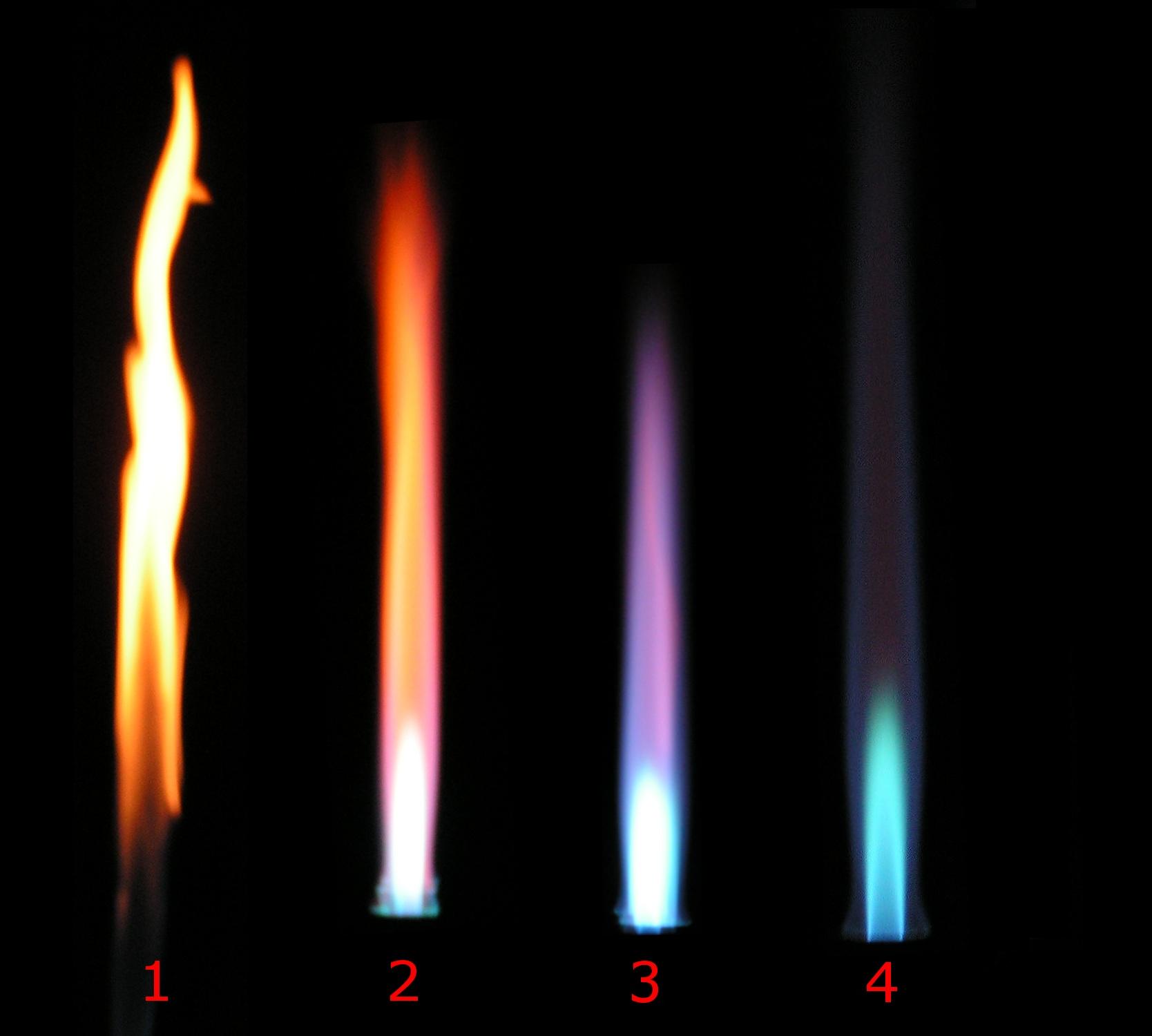
A flame is affected by the fuel introduced and the oxygen available. A flame with a balanced oxygen-fuel ratio is called a neutral flame. The color of a neutral flame is semi-transparent purple or blue. This flame is optimal for many uses because it does not oxidize or deposit soot onto surfaces.

Bunsen burner flames with different oxygen levels: 1. diffusion flame, 2. reducing flame, 3. fuel-rich neutral flame, 4. neutral flame
Oxygen rich butane torch flame
Fuel rich butane torch flame

Oxidizing flame

[edit]

If the flame has more than enough oxygen, an oxidizing flame is produced. When the amount of oxygen increases, the flame shortens due to quicker combustion, its color becomes a more transparent blue, and it hisses or roars.[1] With some exceptions (e.g., platinum soldering in jewelry), the oxidizing flame is usually undesirable for welding and soldering, since, as its name suggests, it oxidizes the metal's surface.[1] The same principle is important in firing pottery.

Reducing flame

[edit]

A reducing flame is a flame with insufficient oxygen. It has an opaque yellow or orange color due to incandescent carbon or hydrocarbons[2] which bind with (or reduce) the oxygen contained in the materials the flame processes.[1] The flame is also called carburizing flame, since it tends to introduce carbon soot into the molten metal.

The flame also produces carbon monoxide, a poisonous gas which burns on the outer envelope of flame into carbon dioxide.[3]

Reducing flames with no carbon

[edit]

Reducing flames using zero-carbon fuel, such as reducing hydrogen flames, are exceptions. They don't have an opaque yellow or orange glow, nor do they produce soot or carbon monoxide.

See also

[edit]

References

[edit]
Revisions and contributorsEdit on WikipediaRead on Wikipedia
from Grokipedia
Oxidizing and reducing flames are distinct types of flames classified based on the relative proportions of (such as ) and oxidizer (typically oxygen) in oxy- processes, influencing their chemical properties, temperature, and applications in fields like , cutting, and analytical . An oxidizing forms when excess oxygen is present, leading to a shorter, hotter with a distinct violet inner , low , and a hissing sound due to complete without formation. In contrast, a reducing (also known as a ) arises from excess , producing a longer, cooler, luminous with a feathery outer zone rich in unburnt carbon particles, which can deposit and promote reducing conditions. These flames differ fundamentally in their redox environments: oxidizing flames facilitate oxidation reactions by providing surplus oxygen, which can enhance material cutting or surface treatment, while reducing flames supply reducing agents like or , aiding in processes that prevent oxidation or add carbon to metals. In oxyacetylene , the oxidizing flame is preferred for cutting or high-conductivity metals like , as it achieves temperatures up to 3,500°C and cleans the weld area by burning impurities, though it risks oxidizing the base metal if overused. Conversely, the reducing flame is utilized for surfacing low-carbon steels or materials sensitive to oxidation, such as alloys, but its sooty nature limits its use to avoid carbon contamination in most structural welds. In , particularly flame atomic absorption spectroscopy (AAS), flame type selection optimizes element detection by managing interferences and ionization. Oxidizing flames, often air- mixtures with low content, are non-luminous and ideal for analyzing easily ionized elements like silver, , and , reducing chemical interferences such as those from sulfates on calcium signals. Reducing flames, typically nitrous oxide- with high , provide a hotter, fuel-rich environment (up to 2,900°C) suited for elements like aluminum, , and , suppressing ionization with additives like while minimizing matrix effects in complex samples. Overall, the choice between these flames depends on the desired chemical atmosphere, with neutral flames (balanced ratio) serving as a versatile intermediary for general without oxidation or reduction.

Fundamentals of Flames

Basic Principles of Combustion

is a high-temperature exothermic oxidation reaction between a fuel, such as or , and an oxidizer, typically oxygen, that releases and as products form. This process involves the rapid combination of fuel molecules with oxygen, breaking and reforming chemical bonds to produce stable compounds like and . The general form of the combustion reaction can be represented as fuel + oxidizer → products + heat. For example, the complete combustion of acetylene (C₂H₂) follows the equation: C2H2+2.5O22CO2+H2O+heat\mathrm{C_2H_2 + 2.5\, O_2 \rightarrow 2\, CO_2 + H_2O + heat} This balanced equation illustrates the stoichiometric proportions required for complete oxidation, where all reactants are fully converted to products without leftovers. Similarly, hydrogen combustion proceeds as 2H₂ + O₂ → 2H₂O + heat, emphasizing the exothermic nature across different fuels. The stoichiometric ratio defines the ideal proportion of fuel to oxidizer that ensures complete combustion, with both components fully consumed to form the desired products. For hydrocarbons like acetylene, this ratio is determined by the molecular composition, such that the fuel-to-oxygen mass or mole fraction matches the coefficients in the balanced equation for maximal energy release without excess reactants. Heat plays a critical role in sustaining the reaction through chain propagation, where initial energy input generates reactive intermediates (such as free radicals) that perpetuate the process. In propagation steps, these radicals react with or oxidizer molecules, releasing additional heat that dissociates more molecules into radicals, creating a self-sustaining cycle until or oxidizer is depleted. This mechanism underlies the continuous nature of flames in oxygen- mixtures.

Structure of Diffusion Flames

In oxygen-fuel systems like oxy-acetylene torches, flames feature a primary premixed zone, where and oxidizer are mixed within the before exiting the tip, and a secondary zone involving with ambient air. The varies based on the equivalence ratio (-to-oxidizer ratio) in the premix, which determines types: neutral (stoichiometric), oxidizing (oxygen-rich), or reducing (-rich). This mixing and ratio influence the formation of distinct zones, with rates governed by both reaction kinetics in the premix and processes in the secondary zone, leading to layers that vary in , composition, and reactivity. The overall shape and brightness are primarily influenced by the relative flow rates of and oxygen, with higher velocities producing elongated, more intense cones due to enhanced and reduced radial time. The structure of a typical flame in these systems includes several concentric zones radiating outward from the torch axis. A premixing zone exists within the torch, where the injected fuel and oxygen streams blend, initiating the combustible mixture; upon ignition, this forms the primary reaction zone. The inner cone follows, representing the primary combustion where the premixed fuel-oxidizer reacts rapidly, achieving high local temperatures (up to approximately 3,200 °C or 3,473 K) but varying in stoichiometry based on the equivalence ratio, with complete primary oxidation limited by the supplied oxygen. In reducing flames, adjacent to the inner cone is a prominent reduction zone (often visible as a white acetylene feather), a fuel-rich sheath where excess fuel undergoes incomplete reactions, fostering reducing conditions through species like carbon monoxide and hydrogen. In neutral and oxidizing flames, this zone is minimal. This transitions into the oxidation zone (secondary combustion envelope), the outermost reactive layer where additional oxygen from entrained air diffuses inward, enabling fuller combustion as the mixture approaches stoichiometric proportions with ambient air. Encasing the entire structure is the outer envelope, a non-luminous sheath of combustion products that shields the core and stabilizes the flame. The mechanism dominates the secondary zones, as unburnt species from the primary mix with air across concentration gradients, establishing a sheet at the interface; in practical torches, broadens this for more uniform energy release. Visual indicators include the sharply defined, luminous inner denoting intense primary reactions and the broader outer layers reflecting secondary diffusive processes, with generally increasing with flow rates. Stoichiometric (neutral) minimizes excess reducing or oxidizing zones for balanced burning.

Classification of Flames

Neutral Flames

A neutral flame is achieved when the oxygen-to-fuel ratio is exactly stoichiometric, enabling complete without excess oxygen or unburned fuel. In oxy- , this corresponds to an approximately 1:1 volume ratio of oxygen to acetylene, where the flame draws additional oxygen from the surrounding air to facilitate full oxidation. Formation of a neutral flame involves precise adjustment of the gas valves on the . The process begins by lighting the alone to produce a flame, followed by gradual introduction of oxygen until the flame transitions to a , well-defined structure with a sharp inner cone and no feathering or hissing. This balance ensures the inner and outer cones are of nearly equal length, indicating optimal mixing for . Key properties of the neutral flame include a semi-transparent or hue, with a light inner cone surrounded by a darker outer envelope. It reaches a of approximately 3,100–3,200°C at the tip of the inner cone, providing intense heat suitable for most applications without promoting oxidation or reduction. The absence of excess oxygen or results in a clean, efficient burn with minimal residue. Chemically, the neutral flame primarily produces (CO₂) and (H₂O) as reaction products, reflecting complete of the hydrocarbon fuel. This outcome minimizes the formation of metal oxides on the workpiece or deposition, making it ideal for processes requiring a non-reactive atmosphere.

Oxidizing Flames

An oxidizing flame is defined as a flame in which the supply of oxygen exceeds the stoichiometric requirements for complete fuel oxidation, resulting in an oxygen-rich atmosphere that promotes oxidative reactions. This excess oxygen, typically greater than 100% of the stoichiometric amount, distinguishes it from balanced and leads to the presence of free oxygen in the zone. The formation of an oxidizing flame begins from a neutral flame configuration, achieved by gradually increasing the oxygen flow rate relative to the , such as in oxy-fuel systems. This adjustment shortens the inner cone of the due to accelerated kinetics in the oxygen-enriched environment. The classification of flames, including oxidizing flames, emerged with the development of oxyacetylene in 1903 by French engineers Edmond Fouché and Charles Picard, which enabled precise control of oxygen-fuel ratios for applications in metal cutting and . These flames are particularly suited to processes that benefit from an oxidizing environment, such as metal cutting, where excess oxygen facilitates material removal through enhanced oxidation.

Reducing Flames

A reducing flame occurs when the supply of surpasses the stoichiometric requirement for oxygen, producing a fuel-rich atmosphere that promotes reduction rather than oxidation. This imbalance results in incomplete , where unburned create conditions suitable for extracting oxygen from metal oxides or preventing their formation. The formation of a reducing flame involves adjusting the -to-oxygen beyond the balanced condition of a neutral flame, typically by increasing the fuel flow while maintaining or slightly reducing oxygen delivery in oxy-fuel systems. This shift extends the length of the inner cone, where partial dominates, and introduces a feathery outer zone characterized by wisps of unburned that burn more slowly in the surrounding air. Reducing flames provide a non-oxidizing environment ideal for processing sensitive metals, such as aluminum or low-carbon steels, by shielding the material from atmospheric oxygen and minimizing unwanted reactions during heating. While often used interchangeably in some contexts, the reducing represents a broader category than the carburizing ; the latter is a specific subtype involving significant excess , like , that introduces carbon into the workpiece, whereas reducing flames emphasize overall de-oxidation without this carbon enrichment.

Characteristics of Oxidizing Flames

Formation and Conditions

An oxidizing flame is formed in oxy-fuel torches by starting from a neutral flame configuration and introducing an excess of oxygen to promote complete combustion. The process begins by opening the acetylene valve on the torch to a low flow rate, typically 3-5 psi, and igniting the gas to produce a luminous, sooty yellow flame. Oxygen is then slowly added via the torch valve at around 5-10 psi until a neutral flame is achieved, marked by a distinct, sharply pointed inner blue cone about 1/8 to 1/4 inch long and a lighter blue outer envelope. To create the oxidizing flame, the oxygen flow is increased gradually while maintaining the acetylene flow, causing the inner cone to shorten, become more defined with a bluish-white or violet tint, and produce a hissing sound, indicating excess oxygen and complete combustion without unburned hydrocarbons. Optimal conditions for sustaining an oxidizing flame in oxy- applications require an oxygen-to-fuel volume ratio of approximately 1.1:1 to 1.5:1, providing a slight excess of oxygen to foster an oxidizing atmosphere. This ratio ensures the primary zone remains oxygen-rich, contracting the zones and enhancing oxidation reactions. is adjusted higher, often 5-10 psi at the for cutting tasks, while acetylene pressure is kept at 3-5 psi for control. Key influencing factors include the choice of , with being ideal for generating a strong oxidizing environment due to its high and complete products, whereas produces a less intense oxidizing effect and is less suitable for precision applications like cutting. Flashback risks are minimized by strict sequencing—always lighting with alone first, then adding oxygen—and by installing flashback arrestors on both gas lines to interrupt reverse travel. The oxidizing character arises from complete combustion in the inner cone, exemplified by the primary reaction 2\ceC2H2+5\ceO24\ceCO2+2\ceH2O2 \ce{C2H2} + 5 \ce{O2} \rightarrow 4 \ce{CO2} + 2 \ce{H2O}, which yields carbon dioxide and water as products, along with heat. This oxygen-rich condition contrasts with reducing flames by prioritizing full oxidation over the formation of reducing species like CO and H₂.

Physical and Chemical Properties

Oxidizing flames display distinct physical characteristics due to the excess oxygen in the mixture. The flame features a shorter, sharper inner cone compared to neutral flames, with a bluish-white or violet color, a hissing sound, and an overall non-luminous appearance resulting from complete combustion. Temperatures in oxidizing flames reach approximately 3,500°C in the inner cone, higher than those of neutral flames, which contributes to their use in processes requiring intense, localized heating. A key visual indicator is the absence of feathery extensions, with the flame maintaining a clean, pointed profile signaling oxygen richness. Chemically, oxidizing flames produce an oxygen-rich environment in the inner zones where complete combustion generates oxidizing conditions with surplus oxygen available to react with materials. The primary reaction in the inner cone is 2\ceC2H2+5\ceO24\ceCO2+2\ceH2O2\ce{C2H2} + 5\ce{O2} \rightarrow 4\ce{CO2} + 2\ce{H2O}, releasing heat while providing free oxygen that can oxidize the base metal or impurities. This composition creates an environment that promotes oxidation of the base metal, potentially forming oxides during welding or heating if not controlled. In terms of , oxidizing flames provide a higher proportion of convective compared to radiant , owing to the lack of particles, making them suitable for rapid, precise cutting processes. However, the excess oxygen can lead to oxidation on the workpiece surface, potentially weakening material properties if overused. The sharp inner cone serves as a practical detection method for confirming the oxidizing condition, allowing operators to adjust the oxygen-fuel ratio accordingly.

Characteristics of Reducing Flames

Formation and Conditions

A reducing flame is formed in oxy-fuel torches by starting from a neutral flame configuration and introducing an excess of to promote incomplete . The process begins by opening the on the to a low flow rate, typically 3-5 psi, and igniting the gas to produce a luminous, . Oxygen is then slowly added via the at around 5-10 psi until a neutral is achieved, marked by a distinct, sharply pointed inner about 1/8 to 1/4 inch long and a lighter outer envelope. To create the reducing , the flow is increased gradually while maintaining or slightly reducing the oxygen flow, causing the inner to elongate, become hazy, and develop a tint, with the outer acquiring feathery, -rich extensions that indicate the presence of unburned hydrocarbons and reducing agents. Optimal conditions for sustaining a reducing flame in oxy-acetylene applications require a fuel-to-oxygen volume ratio of approximately 1.1:1 to 1.5:1, providing a slight excess of acetylene to foster a reducing atmosphere without excessive carbon deposition. This ratio ensures the primary combustion zone remains fuel-rich, expanding the flame zones and enhancing the production of reducing species. Oxygen pressure is kept relatively low, often 3-5 psi at the torch for welding tasks, to limit oxidation while acetylene pressure is adjusted to 5-7 psi for control. Key influencing factors include the choice of , with being ideal for generating a strong reducing environment due to its high and products, whereas produces a milder reducing effect and is less suitable for precision applications like . Flashback risks, which can occur if the propagates back into the , are minimized by strict sequencing—always lighting with alone first, then adding oxygen—and by installing flashback arrestors on both gas lines to interrupt reverse travel. The reducing character arises from incomplete in the inner , exemplified by the primary reaction 2\ceC2H2+2\ceO24\ceCO+2\ceH22 \ce{C2H2} + 2 \ce{O2} \rightarrow 4 \ce{CO} + 2 \ce{H2}, which yields and as key reducing agents, along with . This fuel-rich condition contrasts with oxidizing flames by prioritizing the formation of these over full oxidation to CO₂ and H₂O.

Physical and Chemical Properties

Reducing flames, also known as flames, display distinct physical characteristics due to the excess fuel gas, typically , in the mixture. The flame features a longer inner compared to neutral flames, surrounded by a yellowish or sooty outer and an overall smoky appearance resulting from incomplete . Temperatures in reducing flames range from approximately 2,800°C to 3,000°C, lower than those of neutral or oxidizing flames, which contributes to their use in processes requiring controlled heating. A key visual indicator is the presence of feathery extensions, or an acetylene feather, extending beyond the inner , signaling the degree of fuel richness. Chemically, reducing flames produce a fuel-rich environment in the inner zones where incomplete generates reducing agents such as (CO) and (). The primary reaction in the inner is 2C2H2+2O24CO+2H22\mathrm{C_2H_2} + 2\mathrm{O_2} \rightarrow 4\mathrm{CO} + 2\mathrm{H_2}, releasing while leaving unburnt and that act to scavenge free oxygen. This composition creates a protective atmosphere that minimizes oxidation of the by binding available oxygen, preventing the formation of oxides during or heating. In terms of , reducing flames provide a higher proportion of radiant compared to convective , owing to the particles that enhance , making them suitable for slower, more uniform heating processes. However, the excess carbon can lead to deposition on the workpiece surface, potentially altering material properties if not managed. The feathery extensions serve as a practical detection method for confirming the reducing condition, allowing operators to adjust the fuel-oxygen ratio accordingly.

Subtypes Based on Fuel Composition

Reducing flames can be classified into subtypes based on the composition of the used, particularly whether the contains carbon or not. This distinction arises from the chemical products of incomplete combustion in oxygen-deficient conditions, influencing the flame's interaction with materials. Carbon-containing fuels, typically hydrocarbons such as (C₂H₂), produce a carburizing subtype characterized by excess carbon in the envelope, leading to potential carbon deposition on heated surfaces. In contrast, non-carbon fuels like (H₂) generate a cleaner reducing environment without carbon byproducts. The subtype, often achieved with an oxy-acetylene mixture where the acetylene-to-oxygen ratio exceeds 1:1 (typically around 1.1:1 to 3:1), results in a with a distinct "" of unburned carbon between the inner and outer . This excess carbon creates a strongly that can infuse carbon into the , promoting carburization—for instance, during of high-carbon steels or , where it enhances but risks forming brittle iron carbides like (Fe₃C). The flame temperature in this subtype reaches approximately 3150°C at the inner tip, though the reducing conditions slightly lower the overall heat compared to neutral flames. Such flames are prone to formation due to incomplete carbon oxidation, which can contaminate the weld pool. Non-carbon reducing flames, exemplified by oxy-hydrogen mixtures (2H₂ + O₂), produce water vapor as the primary combustion product in reducing conditions, avoiding soot or carbon residues entirely. These flames maintain a transparent, non-luminous appearance and achieve temperatures around 2800°C, providing sufficient heat for precision work while preserving material purity. They are particularly suited for applications requiring contamination-free environments, such as quartz glassworking, where the flame melts and seals fused silica without introducing impurities that could cause devitrification. In comparison, carbon-based reducing flames offer higher peak temperatures and greater reducing power for carbon-sensitive metals but carry risks of embrittlement from carbon pickup and surface sooting, potentially compromising structural integrity in alloys like . Non-carbon subtypes prioritize cleanliness and minimal residue, ideal for or high-purity alloys, though their somewhat lower temperature limits use in heavy-duty . For example, an oxy-acetylene flame is selected for high-carbon components to deposit protective layers, whereas an oxy-hydrogen flame excels in soot-free reduction for delicate tube sealing in scientific apparatus.

Applications

In Welding and Metalworking

In and , oxidizing flames are primarily employed for cutting ferrous metals such as , where a cutting torch uses a preheating flame from an oxygen-acetylene mixture to heat the material to red hot (ignition ), followed by pressing a button or lever to release high-pressure pure cutting oxygen, which then provides a high-velocity oxygen jet that oxidizes and removes the molten metal, enabling precise cuts up to several inches thick. This process relies on the flame's excess oxygen to facilitate rapid oxidation, producing a clean kerf with minimal when properly controlled. Additionally, oxidizing flames are used in non-ferrous metals like and , where the oxygen-rich environment promotes fluxing action to remove oxides and suppresses vaporization during the melt, ensuring sound joints without . Reducing flames, also known as flames, find application in reactive metals such as aluminum and magnesium, providing a protective that shields the molten pool from atmospheric oxidation and prevents the formation of brittle inclusions. For high-carbon steels, this flame type minimizes at the weld interface while adding a controlled amount of carbon to enhance , particularly in operations. In processes, reducing flames create a localized inert-like environment that allows filler metals to flow without contaminating the base material, commonly used for joining dissimilar metals in structural assemblies. Torch manipulation techniques, such as directing an to oxidize impurities during cutting, aid in removal and improve edge quality by burning away adherent scale on the workpiece surface. The choice of flame type directly influences material interaction, with properties like temperature and oxygen content determining weld integrity and cut efficiency in these .

In Analytical and Scientific Processes

Oxidizing flames play a crucial role in , particularly in techniques requiring high-temperature atomization for complete volatilization of samples. In flame atomic absorption spectroscopy (FAAS), oxidizing flames, such as air- mixtures with low content, are employed for the routine determination of elements like silver, , , and , where they minimize chemical interferences and enhance sensitivity by promoting efficient atomization without excess fuel residues. These flames provide a non-luminous environment that supports precise of absorption by free atoms, making them ideal for analysis in environmental and biological samples. Similarly, in flame photometry (flame emission spectroscopy), oxidizing conditions facilitate the excitation of and alkaline metals, such as sodium and , by ensuring complete volatilization and emission of characteristic wavelengths without reductive interference. In scientific glassworking, oxidizing flames are utilized for precise cutting and of components in settings. For instance, in scientific glassblowing, an oxidizing torch flame, often oxygen-enriched, is applied to polish and seal freshly cut tubing, preventing microcracks and ensuring smooth edges for systems or spectroscopic cells. This application leverages the flame's high oxygen content to achieve clean, oxidation-free surfaces, which is essential for maintaining the integrity of glassware in analytical experiments. The advantage of oxidizing flames here lies in their ability to volatilize impurities completely, avoiding deposition that could contaminate delicate instruments. Reducing flames find specialized applications in qualitative analysis and spectrographic techniques, where controlled reduction environments are necessary. In borax bead tests for identifying metal ions, reducing flames reduce higher oxidation states of metals, such as or iron, to produce distinct colors for qualitative detection. Hydrogen-oxygen reducing flames, being carbon-free, are particularly valuable in for analyzing elements like or , as they eliminate carbon-based spectral interferences from flames while providing a hot, stable atomization zone. These flames enable selective reduction of analytes, preserving sample integrity in spectrography applications. The historical development of reducing flames in analytical processes traces back to the 20th-century adaptations of Bunsen burners, which allowed chemists to generate localized reducing atmospheres for reactions requiring protection from oxygen. In early practices, these fuel-rich flames facilitated reductions in organic compounds by minimizing oxidative side reactions, paving the way for precise control in synthetic pathways. Non-carbon reducing subtypes, such as hydrogen-oxygen mixtures, further enhance purity in modern spectrographic analyses by avoiding from fuels. Overall, oxidizing flames excel in complete volatilization for broad elemental detection, while reducing flames offer benefits, ensuring minimal in sensitive scientific processes.

Safety and Hazards

Operational Risks

Oxidizing flames, which feature an excess of oxygen relative to fuel, generate intense that can exceed 3,500°C, leading to severe thermal burns for operators if protective equipment fails or is improperly used. This excessive also promotes rapid oxidation of the and weld pool, resulting in brittle welds prone to cracking under stress due to inclusions. Furthermore, the oxygen-rich environment accelerates propagation, intensifying nearby combustibles and increasing the likelihood of uncontrolled blazes during operations. Reducing flames, characterized by excess , lead to incomplete that produces significant accumulation on equipment and workpieces, potentially obstructing nozzles and impairing control. These flames also emit elevated levels of , a colorless and odorless gas that poses a severe risk of , particularly in poorly ventilated areas where it can accumulate to toxic concentrations. Beyond type-specific issues, both oxidizing and reducing flames share general operational hazards, including explosions from gas leaks in cylinders or hoses, which can ignite upon contact with sparks or hot surfaces. Improper fuel-to-oxygen ratios in oxy-fuel torches can heighten the danger of flashback, where the flame burns back into the torch mixer, potentially causing explosions within the gas delivery system. The ultraviolet radiation emitted by these flames can cause , or "welder's flash," resulting in painful eye inflammation and temporary vision impairment. Welding operations are associated with a significant number of injuries annually in the United States, including burns, explosions, and toxic exposures, as reported by the .

Mitigation Strategies

Operators of oxidizing and reducing flames must adhere to general safety protocols to minimize risks associated with oxy-fuel systems. (PPE) is essential, including flame-resistant clothing, leather gloves, high-top boots, and protective goggles or face shields with a minimum shade 4 filter lens to shield against intense light, sparks, and molten metal splatter. Adequate ventilation is critical to remove hazardous gases such as (CO), which is produced in reducing flames; local exhaust systems with movable hoods positioned near the work area should capture fumes at the source, supplemented by general air movement in enclosed spaces. Regular equipment inspections, including checks for leaks, damaged hoses, and secure connections, must be conducted before each use to prevent failures that could lead to uncontrolled . For oxidizing flames, which result from excess oxygen and can accelerate leading to fires, operators should monitor oxygen flow to avoid over-oxygenation by adjusting valves to maintain a balanced inner without excessive hissing. Flashback arrestors must be installed on both oxygen and lines to halt reverse gas flow and extinguish any propagation back into the or regulators, a common in high-oxygen environments. In reducing flames, characterized by excess fuel and soot production, mitigation involves precise control of the fuel-to-oxygen ratio to eliminate black smoke, achieved by gradually increasing oxygen until the flame's inner cone is distinct and soot-free. Fuels such as must be stored separately from oxygen cylinders in well-ventilated, dry areas at least 20 feet apart to prevent inadvertent reactions or explosions from leaks. Comprehensive training is imperative for safe operation, emphasizing correct valve adjustment sequences—always opening fuel gas first, lighting the torch, then introducing oxygen—and immediate emergency shutdown procedures, such as closing cylinder valves and purging lines. Operators should be certified competent through hands-on instruction before handling equipment, focusing on recognizing abnormal flame behaviors and rapid response to incidents.

References

Add your contribution
Related Hubs
User Avatar
No comments yet.