Hubbry Logo
KingletKingletMain
Open search
Kinglet
Community hub
Kinglet
logo
8 pages, 0 posts
0 subscribers
Be the first to start a discussion here.
Kinglet
Kinglet
from Wikipedia

Kinglets
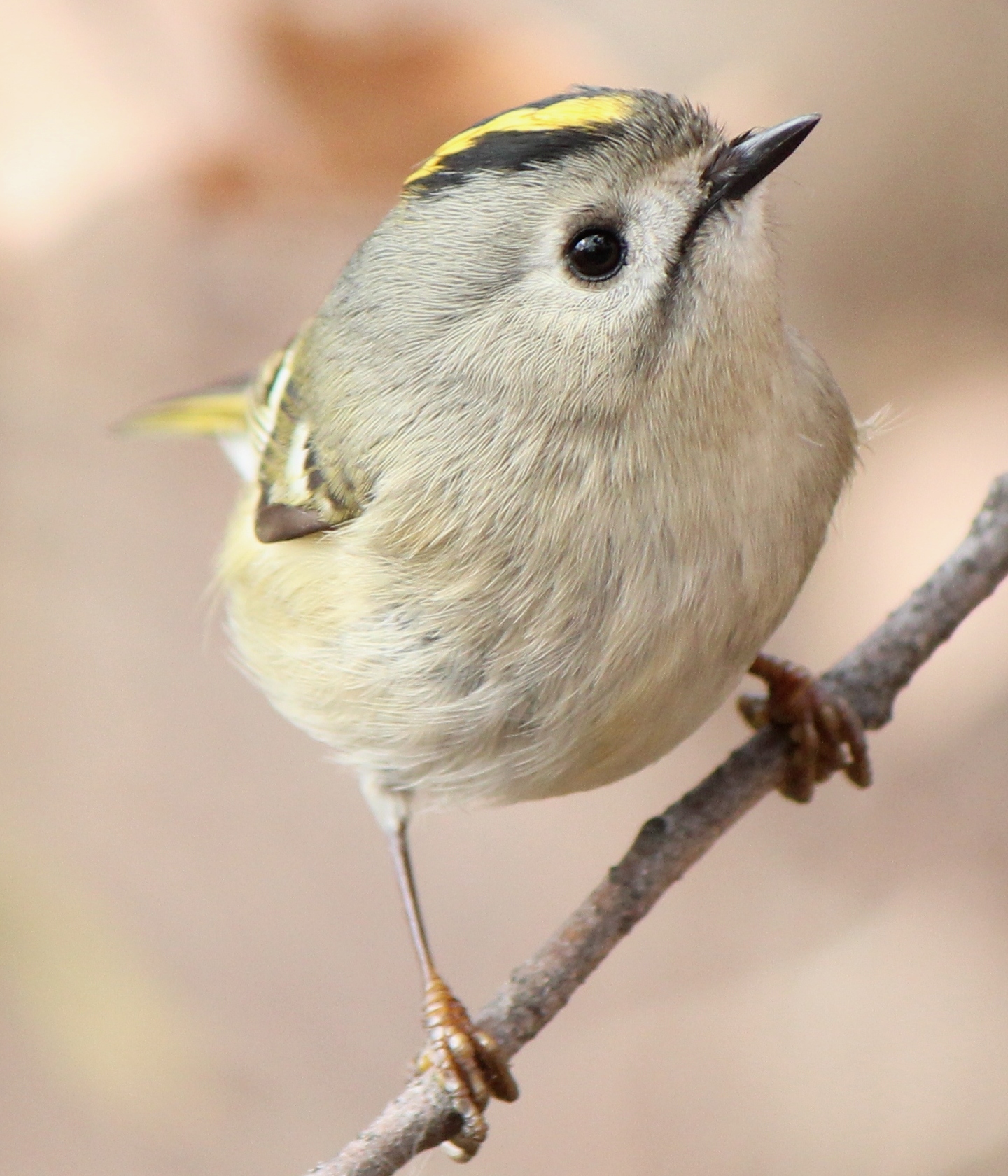
Goldcrest (Regulus regulus) in Japan
Scientific classification Edit this classification
Kingdom: Animalia
Phylum: Chordata
Class: Aves
Order: Passeriformes
Suborder: Passeri
Parvorder: Muscicapida
Family: Regulidae
Vigors, 1825
Genera

A kinglet is a small bird in the family Regulidae. Species in this family were formerly classified with the Old World warblers. "Regulidae" is derived from the Latin word regulus for "petty king" or prince, and refers to the coloured crowns of adult birds. This family has representatives in North America and Eurasia. There are six species in this family; one, the Madeira firecrest (Regulus madeirensis), was only recently split from the common firecrest as a separate species. The ruby-crowned kinglet differs sufficiently in its voice and plumage to be afforded its own genus, Corthylio.

Description

[edit]

Kinglets are among the smallest of all passerines, ranging in size from 8 to 11 cm (3 to 4.5 in) and weighing 6–8 g (0.21–0.28 oz); the sexes are the same size. They have medium-length wings and tails, and small needle-like bills. The plumage is overall grey-green, offset by pale wingbars, and the tail tip is incised. Five species have a single stiff feather covering the nostrils, but in the ruby-crowned kinglet this is replaced by several short, stiff bristles. Most kinglets have distinctive head markings, and the males possess a colourful crown patch. In the females, the crown is duller and yellower. The long feathers forming the central crown stripe can be erected; they are inconspicuous most of the time, but are used in courtship and territorial displays when the raised crest is very striking.[1]

There are two species of different genera in North America with largely overlapping distributions, and two in Eurasia that also have a considerable shared range. In each continent, one species (goldcrest in Eurasia and golden-crowned kinglet in North America) is a conifer specialist; these have deeply grooved pads on their feet for perching on conifer twigs and a long hind toe and claw for clinging vertically. The two generalists, ruby-crowned kinglet and common firecrest, hunt more in flight and have smoother soles, shorter hind claws and a longer tail.[1]

Taxonomy

[edit]

The kinglets are a small group of birds sometimes included in the Old World warblers but frequently given family status,[2] especially as recent research showed that, despite superficial similarities, the crests are phylogenetically remote from the warblers.[3][4] The name of the family derives from the Latin regulus, a diminutive of rex, "a king",[5] and refer to the characteristic orange or yellow crests of adult kinglets (aside from the red crest of Corthylio). The kinglets were allocated to the warbler genus Sylvia by English naturalist John Latham in 1790,[6] but moved to their current genus by French zoologist Georges Cuvier in 1800.[7]

Most members of the genus Regulus are similar in size and colour pattern. The exception is the ruby-crowned kinglet, the largest species, which has a strongly red crest and no black crown stripes. It has distinctive vocalisations, and is different enough from the Old World kinglets and the other American species, the golden-crowned kinglet, to be assigned to a separate genus, Corthylio.[1][8][9]

Species in taxonomic order

[edit]

Distribution and habitat

[edit]

Kinglets are birds of the Nearctic and Palearctic realms, with representatives in temperate North America, Europe and Asia, northernmost Africa, Macaronesia and the Himalayas. They are adapted to conifer forests, although there is a certain amount of adaptability and most species will use other habitats, particularly during migration. In Macaronesia, they are adapted to laurisilva and tree heaths.[1]

Behaviour

[edit]

Diet and feeding

[edit]

The tiny size and rapid metabolism of kinglets means that they must constantly forage in order to provide their energy needs. They will continue feeding even when nest building. Kinglets prevented from feeding may lose a third of their body weight in twenty minutes and may starve to death in an hour. Kinglets are insectivores, preferentially feeding on prey such as aphids and springtails that have soft cuticles. Prey is generally gleaned from the branches and leaves of trees, although in some circumstances prey may be taken on the wing or from the leaf litter on the ground.

Life cycle

[edit]

Kinglet nests are small, very neat cups, almost spherical in shape, made of moss and lichen held together with spiderwebs and hung from twigs near the end of a high branch of a conifer. They are lined with hair and feathers, and a few feathers are placed over the opening. These characteristics provide good insulation against the cold environment. The female lays 7 to 12 eggs, which are white or pale buff, some having fine dark brown spots. Because the nest is small, they are stacked in layers. The female incubates; she pushes her legs (which are well supplied with blood vessels, hence warm) down among the eggs. A unique feature of kinglets is the "size hierarchy" among eggs, with early-laid eggs being smaller than later ones.[10]

Eggs hatch asynchronously after 15 to 17 days. The young stay in the nest for 19 to 24 days. After being fed, nestlings make their way down to the bottom of the nest, pushing their still-hungry siblings up to be fed in their turn (but also to be cold).

Kinglets are the most fecund and shortest-living of all altricial birds,[11] and probably the shortest-lived apart from a few smaller galliform species. Adult mortality for the goldcrest is estimated at over 80 percent per year[12] and the maximum lifespan is only six years.[13]

References

[edit]
[edit]
Revisions and contributorsEdit on WikipediaRead on Wikipedia
from Grokipedia
Kinglets are a small family of birds (Regulidae) consisting of six species, renowned for their diminutive size and hyperactive foraging behavior in forested habitats across the . These tiny songbirds, measuring 3 to 4.3 inches (8 to 11 cm) in length and weighing 4 to 10 grams, feature large rounded heads, short pointed wings, thin bills, and often vibrant crown patches—typically yellow, orange, or red—that give the group its regal name, derived from the Latin regulus meaning "little king." The two species native to , the (Regulus satrapa) and (Corthylio calendula, formerly Regulus calendula), exemplify the family's characteristics, breeding in boreal coniferous forests and migrating southward for winter. , slightly smaller at 3.5 to 4 inches, display a bold black eyebrow stripe and a lemon-yellow to orange crown bordered in black, while are plain olive-green with a white eye-ring and wing bars, the males concealing a ruby-red crown patch that is rarely visible. Both species are non-migratory in parts of their range but undertake significant southward movements, with wintering across much of the and reaching as far south as . Kinglets inhabit dense woodlands, including spruce-fir forests, mixed stands, and suburban areas, where they forage restlessly in the lower to middle canopy, hovering or from foliage. Their diet primarily consists of small such as , spiders, and their eggs, supplemented occasionally by and , enabling them to endure harsh conditions like -40°F (-40°C) nights by huddling in groups. Males produce high-pitched, tinkling songs year-round to defend territories, and both sexes build elaborate hanging nests from , , and , with females laying up to 10-12 eggs—clutches that can exceed the mother's body weight. All regulid species are currently classified as Least Concern by the IUCN, though habitat loss poses ongoing threats to their populations.

Physical description

Size and morphology

Kinglets are among the smallest birds, typically measuring 8–11 cm in body length and weighing 4–10 g across the family, with some geographic variation in size across populations. Their compact, rounded build supports a high , aiding in cold environments despite their diminutive stature. These birds exhibit short wings with a span of 13–18 cm, enabling precise maneuvers in dense foliage, and a short, rounded or skinny tail that contributes to balance during agile perching. The bill is notably thin and pointed, measuring just a few millimeters in length, specialized for probing crevices to extract small and larvae. Their legs are sturdy and relatively strong for their size, with brown to yellowish-brown feet featuring anisodactyl toes that facilitate hopping and clinging to slender branches. Kinglets possess relatively large heads in proportion to their body, housing prominent eyes that enhance visual acuity for detecting prey in shaded understories.

Plumage and markings

Kinglets in the genus Regulus exhibit plumage characterized by predominantly olive-green or greenish-gray upperparts and paler, whitish or buffy underparts, providing effective camouflage among foliage. Distinctive markings include bold white wing bars—typically two prominent ones—and facial features such as eye rings or stripes; for instance, the ruby-crowned kinglet (Corthylio calendula) features a broken white eye-ring and contrasting blackish bar adjacent to the wing bars, while the golden-crowned kinglet (Regulus satrapa) displays black-and-white face stripes with a black eyebrow and white supercilium. A key feature across species is the colorful crown patch, which is erectile and often concealed but raised during displays; these crowns vary in hue, appearing golden-yellow in the goldcrest (Regulus regulus), ruby-red in the ruby-crowned kinglet (Corthylio calendula), and lemon-yellow to orange in the golden-crowned kinglet. Sexual dimorphism is most evident in the crown coloration and intensity, with males possessing brighter, more vivid patches used in displays, while females show duller versions. In the , males have a yellow crown with an orange central stripe, contrasting with the all- crown of females; similarly, male ruby-crowned kinglets display a scarlet crown patch absent in females, and male golden-crowned kinglets exhibit a bolder orange-centered crown compared to the solid of females. Outside the crown, the sexes are generally similar in overall tone and markings. Juvenile plumage closely resembles that of adults but is less vibrant, with reduced coloration in the crown and other features to aid in blending with surroundings during early development. Juveniles of the lack the bright crown feathers entirely, showing a duller overall appearance with a less conspicuous white eye-ring and narrow dark interior ring; ruby-crowned kinglet young have brownish upperparts, off-white wing bars, and no red crown patch, with males developing it later; likewise, golden-crowned kinglet juveniles feature a grayish-brown crown without yellow tones and looser, more filamentous feathering. These young birds undergo a post-juvenile molt to attain adult-like plumage within the first year. Seasonal variations in kinglet plumage are minimal, with most species retaining similar coloration year-round, though slight fading may occur in non-breeding plumage due to wear. All Regulus species undergo a complete post-breeding molt into fresh basic plumage in late summer or early fall, followed by a pre-winter molt in some cases, but these changes primarily refresh quality rather than alter patterns or hues significantly; for example, the shows no marked seasonal color shifts, maintaining its olive-green tones across seasons.

Taxonomy

Classification and phylogeny

Kinglets comprise the family Regulidae within the order Passeriformes, suborder Passeri, infraorder , and are classified in their own superfamily Reguloidea. Molecular phylogenies position Regulidae near the base of the , with recent genome-wide analyses (as of 2025) indicating a sister relationship to the combined clade of Certhioidea (creepers) and Muscicapoidea, based on whole-genome data across oscine birds. Earlier studies had allied them with Sylvioidea (Old World warblers and allies) or solely Certhioidea, but comprehensive phylogenomic reconstructions through 2025 have clarified their distinct early-diverging status within the largest avian radiation. The family encompasses two genera: , which includes five Eurasian and western North American species, and Corthylio, comprising a single species, the (Corthylio calendula). The separation of Corthylio from was formalized in 2019–2021 based on substantial (cytochrome b sequences showing deep splits) and vocal differences, including distinct song structures that lack phylogenetic signal shared with Regulus taxa. This reclassification reflects the ancient divergence between and lineages within Regulidae, supported by mitochondrial and nuclear DNA analyses. Evolutionary origins of Regulidae trace to an ancient lineage that diverged approximately 20–30 million years ago during the , coinciding with cooling climates that likely influenced adaptations such as the elaborate crown feathers for or intraspecific signaling. Fossil-calibrated phylogenies estimate the crown age of the family around 23–25 million years ago, placing its radiation early in diversification following the Eocene-Oligocene transition. These adaptations underscore the family's specialization for coniferous forest niches in temperate and boreal zones. Taxonomic stability has prevailed since 2021, with no major revisions to Regulidae in the IOC World Bird List (versions 11.2–15.1) or AOS North American Checklist supplements through 2025, affirming the current generic and familial boundaries amid ongoing phylogenomic refinements. The family totals six across its genera.

List of species

The family Regulidae comprises six extant , divided between two genera: five in and one in Corthylio.
Common NameScientific NameDistinguishing Traits
GoldcrestRegulus regulusOlive-green upperparts with paler underparts; bright yellow crown stripe bordered by black lines in both sexes, more vivid in males.
Regulus ignicapillaSimilar to goldcrest but with yellower overall plumage; orange-yellow crown bordered by black stripes, prominent black eyebrow, and bronze shoulder patches.
Regulus madeirensisDuller version of common firecrest with greener upperparts and less bronze on wings; crown orange-yellow with black borders, but more subdued coloration overall.
FlamecrestRegulus goodfellowiVibrant olive upperparts with white eye-ring around black eye-patch; flame-orange crown patch in males, bordered by yellow and black, giving a fiery appearance.
Regulus satrapaPale olive above and grayish below; bold black-and-white face stripes, yellow crown with orange center in males, and two white wingbars.
Corthylio calendulaDrab olive-gray upperparts with buffy-yellow underparts; prominent white eye-ring, two white wingbars, and a hidden ruby-red crown patch in males that flares during displays.

Distribution and habitat

Geographic range

Kinglets, belonging to the family Regulidae, are predominantly Holarctic in distribution, with species occupying temperate regions of the . The Eurasian (Regulus regulus) breeds across much of from the eastward through to and , extending southward to the , , and parts of . The (Regulus ignicapilla), closely related, inhabits western and , ranging from and the eastward to and the Mediterranean, with southern extensions to and . The (Regulus madeirensis), a distinct species endemic to the , is sedentary in its laurel forests. In , the (Regulus satrapa) breeds in boreal forests from across and in montane regions of the , extending south to , while wintering throughout much of the continent. The (Corthylio calendula) similarly breeds in northern coniferous forests from to Newfoundland and in the , with its range reaching into during the non-breeding season. The flamecrest (Regulus goodfellowi) is endemic to , breeding in montane coniferous and mixed forests. Migration is a key aspect of kinglet distribution for many populations, particularly those in northern latitudes. Northern breeding ruby-crowned kinglets undertake long-distance migrations, wintering across the southern United States and as far south as Central America, with some individuals reaching Guatemala and Honduras. Golden-crowned kinglets from Canadian breeding grounds move southward to the central and eastern United States, though populations in the Appalachians and western mountains often remain resident year-round. In contrast, the Madeira firecrest is sedentary in the mild climate of the Macaronesian islands. Contemporary surveys indicate dynamic shifts in some ranges amid stable overall distributions. The has shown southward expansions in eastern , with breeding records increasing in states like and through 2025, linked to warming climates. Historical ranges, as documented from early 20th-century surveys, remain largely intact, with minor poleward and elevational adjustments noted in North American Breeding Bird Survey data up to 2025, reflecting subtle responses to environmental changes without widespread contraction.

Habitat preferences

Kinglets of the family Regulidae exhibit a strong preference for coniferous and mixed forests, particularly those dominated by (Picea spp.) and (Abies spp.), which provide dense foliage for nesting and foraging. During the breeding season, such as the (Regulus satrapa) favor old-growth boreal or montane coniferous stands, often at elevations up to the treeline and reaching as high as 3,350 meters in some regions. These habitats offer protective cover and abundant resources, with the birds showing sensitivity to disturbances like that fragment dense canopies. In winter, kinglets shift toward lower elevations and incorporate woodlands alongside , utilizing mixed forests for shelter and mixed-species . For instance, the (Corthylio calendula) occupies a broader array of microhabitats, including thickets and forests, while maintaining a preference for wooded areas over exposed settings. This seasonal flexibility allows them to tolerate temperate to climates, enduring temperatures below -40°C through huddling in flocks and seeking refuge in dense vegetation. Kinglets demonstrate varying adaptability across species; while many adhere closely to forested environments, others like the goldcrest (Regulus regulus) exploit younger coniferous plantations and even gardens in human-modified landscapes. They consistently avoid open areas, such as grasslands or clearings, where predation risk from raptors and mammals is heightened due to reduced cover. Some populations engage in altitudinal migration, breeding in high-elevation conifers and descending to mid-elevation mixed woods for winter.

Behavior and ecology

Foraging and diet

Kinglets are primarily insectivorous birds, consuming a diet dominated by small arthropods such as , spiders, caterpillars, beetles, flies, leafhoppers, and their eggs. Other , including and mites, also form key components of their intake. These birds employ active foraging techniques, primarily gleaning prey from the surfaces of leaves, twigs, branches, and needles while hopping or creeping along vegetation. They frequently hover briefly to inspect or capture items from foliage undersides and may hang upside down from twigs to access hidden arthropods. Less commonly, kinglets hawk flying in mid-air. Foraging often occurs in mixed-species flocks with chickadees, , and warblers, which may enhance efficiency by flushing prey. Due to their small size and elevated metabolic rate, kinglets must feed nearly continuously during to sustain energy demands, particularly in winter when they combat cold stress. Without frequent intake, they risk rapid , losing significant body mass within hours. In non-breeding seasons, dietary shifts occur toward more plant-based items during arthropod scarcity, including small amounts of berries (such as those from dogwood, , and elderberry), seeds, and occasionally oozing tree sap. Ruby-crowned kinglets tend to hover and forage higher in trees more than golden-crowned kinglets, which glean more frequently from middle canopy levels, though both species show high overlap in techniques.

Breeding and life cycle

Kinglets typically breed during spring in their northern temperate and boreal habitats, with the season spanning to June in much of their range. Males arrive on breeding grounds ahead of females, a pattern known as protandry, allowing them to establish territories in coniferous or mixed forests before pair formation begins. In northern regions, such as , nesting activities commence in mid-May for species like the , extending through early July, while ruby-crowned kinglets may breed from May to August. Nests are elaborate, pouch-like structures suspended from branches, often high above the ground near the trunk. Constructed primarily by the female, with some male assistance in certain species, these nests incorporate , , grasses, and for binding and elasticity, lined with softer materials like feathers, , or plant down for insulation. The builds a distinctive globe-shaped nest about 4 inches wide and 5-6 inches deep, while the creates a cup-shaped pouch approximately 3 inches in diameter, both designed to protect against predators and weather. Clutches generally consist of 7-10 eggs, though the can lay up to 12—the largest relative clutch size among North American passerines of comparable body mass—with eggs being small, white to creamy, and lightly spotted. Incubation is performed solely by the female and lasts 12-15 days, during which the male provides food to the incubating partner. Upon , the altricial young are naked, blind, and helpless, fed primarily by both parents. Nestlings after 16-19 days, remaining dependent on for an additional 2-3 weeks as they develop flight and skills; pairs often raise a second brood in the same season to maximize reproductive output. This high helps offset substantial annual adult mortality rates, estimated at around 70-80% for small songbirds like kinglets, driven by predation, harsh winters, and migration hazards. Kinglets undergo a complete post-breeding moult in late summer, replacing feathers worn from the nesting period before fall migration. Average lifespan in is 1-2 years due to high first-year mortality, though maximum recorded reaches about 6 years for both golden-crowned and ruby-crowned kinglets, as documented through banding studies.

Vocalizations and social behavior

Kinglets produce a variety of high-pitched vocalizations, including and calls, that serve functions in territory defense, mate attraction, and communication. are typically thin, rapid trills delivered from concealed perches within dense foliage, reflecting the birds' preference for hidden singing positions to avoid predators. For instance, the (Regulus regulus) sings a series of high, accelerating "si-si-si" notes culminating in a twittering flourish, which males use to establish and maintain breeding territories. Similarly, the (Corthylio calendula) delivers a loud, bubbly of high-pitched "zee-zee-zee" phrases interspersed with warbles, often described as disproportionately vigorous for such a small and sung persistently during the breeding season. Calls in kinglets are sharp and functional for alarm, contact, or scolding intruders. Common calls include thin, threadlike "tsee" or "zee" notes, frequently given in series of two or three to maintain contact between mates or family members. The golden-crowned kinglet (Regulus satrapa) emits rapid "tsee-tsee-tsee" calls while foraging or during territorial chases, while the ruby-crowned kinglet produces a harsh, two-parted scold or a long chattering series when disturbed. These vocalizations are energy-efficient alternatives to physical confrontations, allowing kinglets to communicate effectively in their woodland habitats. Socially, kinglets exhibit seasonal shifts in group dynamics, being largely solitary or paired during breeding but more gregarious in winter. Breeding pairs remain together for the nesting period, with males aggressively defending territories against conspecifics and other through persistent rather than overt fights, indicating low levels of intraspecific . Outside the breeding season, they form small flocks of 10–50 individuals, often associating with mixed-species groups including chickadees, warblers, and ; these associations provide anti-predator benefits through increased vigilance and early warning calls. Displays play a key role in social interactions, particularly involving the erection of their colorful crown feathers. Males raise and flare their crowns—red in ruby-crowned kinglets and yellow in golden-crowned and goldcrests—during to attract females or when threatening rivals, often accompanying this with wing-flicking, leaning forward, and rapid calls. This visual signal, combined with vocalizations, reinforces territorial boundaries and mating intentions without escalating to physical combat.

Conservation status

Kinglets maintain substantial global populations, estimated at 100–500 million individuals across the six species in the family Regulidae. The ruby-crowned kinglet (Corthylio calendula), one of the most abundant North American species, numbers around 100 million mature individuals. Similarly, the golden-crowned kinglet (Regulus satrapa) has an estimated 130 million individuals, while the Eurasian goldcrest (Regulus regulus) supports 98–165 million mature individuals. These figures reflect the family's widespread distribution and adaptability, with data derived from comprehensive avian surveys up to 2022. Population trends for kinglets are generally stable to slightly increasing, though regional variations exist. In , ruby-crowned kinglets show an increasing trend based on long-term monitoring, with eBird and Breeding Bird Survey (BBS) data (up to 2022) indicating stability or modest growth. Golden-crowned kinglets exhibit slight declines in western regions, averaging -0.7% annually from 1966 to 2019, but populations have expanded eastward and slightly increased in eastern areas due to habitat recovery. While bird populations have declined 29% since 1970, totaling nearly 3 billion fewer birds continent-wide, kinglets demonstrate relative resilience compared to more vulnerable and species. Monitoring efforts, including the North American Breeding Bird Survey (BBS) and Audubon Christmas Bird Counts, provide key insights into these dynamics. BBS data from 1966–2022 reveal stable survey-wide trends for both ruby- and golden-crowned kinglets, with modest annual increases of around 1–2% in select eastern and northern regions for the golden-crowned species. Christmas Bird Count records, spanning over a century, corroborate these patterns, showing consistent winter abundances that fluctuate with weather but remain robust overall. These programs, involving thousands of citizen scientists, track relative abundance and highlight kinglets' persistence amid broader avian losses. As of 2025, confirmed in the October 2025 IUCN Red List update, all kinglet species are categorized as Least Concern, reflecting their large populations, extensive ranges, and lack of immediate risks. This status applies uniformly across the , supported by ongoing stable or recovering trends in core habitats.

Threats and protection

Kinglets face several primary threats that impact their populations, particularly in their preferred coniferous forest habitats. Habitat fragmentation due to logging in boreal and montane conifer forests reduces available breeding and foraging areas; for example, in the Acadian Forest of eastern Canada, the golden-crowned kinglet experienced a 38% decrease in suitable habitat from 1985 to 2020 due to forest degradation. Climate change exacerbates these pressures by altering temperature regimes and shifting suitable ranges northward, potentially causing up to 70% loss of ruby-crowned kinglet breeding habitat with a 3°C global temperature increase. During migration, window collisions pose a significant mortality risk, with large numbers of ruby-crowned and golden-crowned kinglets killed annually upon striking reflective glass surfaces, contributing to broader estimates of up to one billion bird deaths from such incidents across North America. Additionally, pesticide applications diminish insect prey availability, indirectly affecting insectivorous kinglets by reducing food resources in treated areas. Minor threats include rare instances of brood parasitism by brown-headed cowbirds, which occasionally target kinglet nests but affect only a small fraction of broods. There are no documented major impacts from invasive species on kinglet populations, as their coniferous habitats remain relatively unaffected by widespread invasives. Conservation efforts provide substantial protection for kinglets, which are covered under the Migratory Bird Treaty Act in the United States and , prohibiting their take without permits and safeguarding migratory populations. Habitat preservation occurs through national forests that maintain large tracts of coniferous woodlands essential for breeding, supporting stable populations without the need for species-specific recovery programs. Bird-friendly practices, such as sustainable forestry, further aid in mitigating fragmentation. Ongoing research into collision mitigation, including window markings and patterns spaced no more than 2 inches apart to enhance visibility, continues to evolve as of , with studies demonstrating reductions of 70–96% in strikes when implemented effectively.

References

Add your contribution
Related Hubs
User Avatar
No comments yet.