



Community hub
Recent from talks
Contribute something
Nothing was collected or created yet.
Repeating decimal
View on Wikipedia | This article has multiple issues. Please help improve it or discuss these issues on the talk page. (Learn how and when to remove these messages)
|

A repeating decimal or recurring decimal is a decimal representation of a number whose digits are eventually periodic (that is, after some place, the same sequence of digits is repeated forever); if this sequence consists only of zeros (that is if there is only a finite number of nonzero digits), the decimal is said to be terminating, and is not considered as repeating.
It can be shown that a number is rational if and only if its decimal representation is repeating or terminating. For example, the decimal representation of 1/3 becomes periodic just after the decimal point, repeating the single digit "3" forever, i.e. 0.333.... A more complicated example is 3227/555, whose decimal becomes periodic at the second digit following the decimal point and then repeats the sequence "144" forever, i.e. 5.8144144144.... Another example of this is 593/53, which becomes periodic after the decimal point, repeating the 13-digit pattern "1886792452830" forever, i.e. 11.18867924528301886792452830....
The infinitely repeated digit sequence is called the repetend or reptend. If the repetend is a zero, this decimal representation is called a terminating decimal rather than a repeating decimal, since the zeros can be omitted and the decimal terminates before these zeros.[1] Every terminating decimal representation can be written as a decimal fraction, a fraction whose denominator is a power of 10 (e.g. 1.585 = 1585/1000); it may also be written as a ratio of the form k/2n·5m (e.g. 1.585 = 317/23·52). However, every number with a terminating decimal representation also trivially has a second, alternative representation as a repeating decimal whose repetend is the digit "9". This is obtained by decreasing the final (rightmost) non-zero digit by one and appending a repetend of 9. Two examples of this are 1.000... = 0.999... and 1.585000... = 1.584999.... (This type of repeating decimal can be obtained by long division if one uses a modified form of the usual division algorithm.[2])
Any number that cannot be expressed as a ratio of two integers is said to be irrational. Their decimal representation neither terminates nor infinitely repeats, but extends forever without repetition (see § Every rational number is either a terminating or repeating decimal). Examples of such irrational numbers are √2 and π.[3]
Background
[edit]Notation
[edit] | This section needs additional citations for verification. (October 2024) |
There are several notational conventions for representing repeating decimals. None of them are accepted universally.
| Fraction | Vinculum | Dots | Parentheses | Arc | Ellipsis | |
|---|---|---|---|---|---|---|
| 1/9 | 0.1 | 0. | 0.(1) | 0.1 | 0.111... | |
| 1/3 | = 3/9 | 0.3 | 0. | 0.(3) | 0.3 | 0.333... |
| 2/3 | = 6/9 | 0.6 | 0. | 0.(6) | 0.6 | 0.666... |
| 9/11 | = 81/99 | 0.81 | 0. | 0.(81) | 0.81 | 0.8181... |
| 7/12 | = 525/900 | 0.583 | 0.58 | 0.58(3) | 0.583 | 0.58333... |
| 1/7 | = 142857/999999 | 0.142857 | 0.4285 | 0.(142857) | 0.142857 | 0.142857142857... |
| 1/81 | = 12345679/999999999 | 0.012345679 | 0.1234567 | 0.(012345679) | 0.012345679 | 0.012345679012345679... |
| 22/7 | = 3142854/999999 | 3.142857 | 3.4285 | 3.(142857) | 3.142857 | 3.142857142857... |
| 593/53 | = 111886792452819/9999999999999 | 11.1886792452830 | 11.88679245283 | 11.(1886792452830) | 11.1886792452830 | 11.18867924528301886792452830... |
- Vinculum: In the United States, Canada, India, France, Germany, Denmark, the Netherlands, Italy, Switzerland, the Czech Republic, Slovakia, Slovenia, Chile, Taiwan, and Turkey, the convention is to draw a horizontal line (a vinculum) above the repetend.[4]
- Dots: In some Islamic countries, such as Bangladesh, Malaysia, Morocco, Pakistan, Tunisia, Iran, Algeria and Egypt, as well as the United Kingdom, New Zealand, Australia, South Africa, Japan, Thailand, India, South Korea, Singapore, and the People's Republic of China, the convention is to place dots above the outermost numerals of the repetend.
- Parentheses: In parts of Europe, incl. Austria, Finland, Norway, Poland, Russia and Ukraine, as well as Vietnam and Israel, the convention is to enclose the repetend in parentheses. This can cause confusion with the notation for standard uncertainty.
- Arc: In Spain and some Latin American countries, such as Argentina, Brazil, and Mexico, the arc notation over the repetend is also used as an alternative to the vinculum and the dots notation.
- Ellipsis: Informally, repeating decimals are often represented by an ellipsis (three periods, 0.333...), especially when the previous notational conventions are first taught in school. This notation introduces uncertainty as to which digits should be repeated and even whether repetition is occurring at all, since such ellipses are also employed for irrational numbers; π, for example, can be represented as 3.14159....
In English, there are various ways to read repeating decimals aloud. For example, 1.234 may be read "one point two repeating three four", "one point two repeated three four", "one point two recurring three four", "one point two repetend three four" or "one point two into infinity three four". Likewise, 11.1886792452830 may be read "eleven point repeating one double eight six seven nine two four five two eight three zero", "eleven point repeated one double eight six seven nine two four five two eight three zero", "eleven point recurring one double eight six seven nine two four five two eight three zero" "eleven point repetend one double eight six seven nine two four five two eight three zero" or "eleven point into infinity one double eight six seven nine two four five two eight three zero".
Decimal expansion and recurrence sequence
[edit]In order to convert a rational number represented as a fraction into decimal form, one may use long division. For example, consider the rational number 5/74:
        0.0675
   74 ) 5.00000
        4.44
          560
          518
           420
           370
            500
etc. Observe that at each step we have a remainder; the successive remainders displayed above are 56, 42, 50. When we arrive at 50 as the remainder, and bring down the "0", we find ourselves dividing 500 by 74, which is the same problem we began with. Therefore, the decimal repeats: 0.0675675675....
For any integer fraction A/B, the remainder at step k, for any positive integer k, is A × 10k (modulo B).
Every rational number is either a terminating or repeating decimal
[edit]For any given divisor, only finitely many different remainders can occur. In the example above, the 74 possible remainders are 0, 1, 2, ..., 73. If at any point in the division the remainder is 0, the expansion terminates at that point. Then the length of the repetend, also called "period", is defined to be 0.
If 0 never occurs as a remainder, then the division process continues forever, and eventually, a remainder must occur that has occurred before. The next step in the division will yield the same new digit in the quotient, and the same new remainder, as the previous time the remainder was the same. Therefore, the following division will repeat the same results. The repeating sequence of digits is called "repetend" which has a certain length greater than 0, also called "period".[5]
In base 10, a fraction has a repeating decimal if and only if in lowest terms, its denominator has at least a prime factor different from 2 and 5 (a prime denominator is considered as a prime factor of itself), or in other words, the denominator cannot be expressed as 2m5n, where m and n are non-negative integers.
Every repeating or terminating decimal is a rational number
[edit]Each repeating decimal number satisfies a linear equation with integer coefficients, and its unique solution is a rational number. In the example above, α = 5.8144144144... satisfies the equation
10000α − 10α = 58144.144144... − 58.144144... 9990α = 58086 Therefore, α = 58086/9990 = 3227/555
The process of how to find these integer coefficients is described below.
Formal proof
[edit]Given a repeating decimal where , , and are groups of digits, let , the number of digits of . Multiplying by separates the repeating and terminating groups:


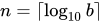


If the decimals terminate (), the proof is complete.[6] For with digits, let where is a terminating group of digits. Then,



where denotes the i-th digit, and


Since ,[7]
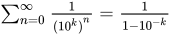
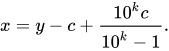
Since is the sum of an integer () and a rational number (), is also rational.[8]


Fractions with prime denominators
[edit]A fraction in lowest terms with a prime denominator other than 2 or 5 (i.e. coprime to 10) always produces a repeating decimal. The length of the repetend (period of the repeating decimal segment) of 1/p is equal to the order of 10 modulo p. If 10 is a primitive root modulo p, then the repetend length is equal to p − 1; if not, then the repetend length is a factor of p − 1. This result can be deduced from Fermat's little theorem, which states that 10p−1 ≡ 1 (mod p).
The base-10 digital root of the repetend of the reciprocal of any prime number greater than 5 is 9.[9]
If the repetend length of 1/p for prime p is equal to p − 1 then the repetend, expressed as an integer, is called a cyclic number.
Cyclic numbers
[edit]Examples of fractions belonging to this group are:
- 1/7 = 0.142857, 6 repeating digits
- 1/17 = 0.0588235294117647, 16 repeating digits
- 1/19 = 0.052631578947368421, 18 repeating digits
- 1/23 = 0.0434782608695652173913, 22 repeating digits
- 1/29 = 0.0344827586206896551724137931, 28 repeating digits
- 1/47 = 0.0212765957446808510638297872340425531914893617, 46 repeating digits
- 1/59 = 0.0169491525423728813559322033898305084745762711864406779661, 58 repeating digits
- 1/61 = 0.016393442622950819672131147540983606557377049180327868852459, 60 repeating digits
- 1/97 = 0.010309278350515463917525773195876288659793814432989690721649484536082474226804123711340206185567, 96 repeating digits
The list can go on to include the fractions 1/109, 1/113, 1/131, 1/149, 1/167, 1/179, 1/181, 1/193, 1/223, 1/229, etc. (sequence A001913 in the OEIS).
Every proper multiple of a cyclic number (that is, a multiple having the same number of digits) is a rotation:
- 1/7 = 1 × 0.142857 = 0.142857
- 2/7 = 2 × 0.142857 = 0.285714
- 3/7 = 3 × 0.142857 = 0.428571
- 4/7 = 4 × 0.142857 = 0.571428
- 5/7 = 5 × 0.142857 = 0.714285
- 6/7 = 6 × 0.142857 = 0.857142
The reason for the cyclic behavior is apparent from an arithmetic exercise of long division of 1/7: the sequential remainders are the cyclic sequence {1, 3, 2, 6, 4, 5}. See also the article 142,857 for more properties of this cyclic number.
A fraction which is cyclic thus has a recurring decimal of even length that divides into two sequences in nines' complement form. For example 1/7 starts '142' and is followed by '857' while 6/7 (by rotation) starts '857' followed by its nines' complement '142'.
The rotation of the repetend of a cyclic number always happens in such a way that each successive repetend is a bigger number than the previous one. In the succession above, for instance, we see that 0.142857... < 0.285714... < 0.428571... < 0.571428... < 0.714285... < 0.857142.... This, for cyclic fractions with long repetends, allows us to easily predict what the result of multiplying the fraction by any natural number n will be, as long as the repetend is known.
A proper prime is a prime p which ends in the digit 1 in base 10 and whose reciprocal in base 10 has a repetend with length p − 1. In such primes, each digit 0, 1,..., 9 appears in the repeating sequence the same number of times as does each other digit (namely, p − 1/10 times). They are:[10]: 166
- 61, 131, 181, 461, 491, 541, 571, 701, 811, 821, 941, 971, 1021, 1051, 1091, 1171, 1181, 1291, 1301, 1349, 1381, 1531, 1571, 1621, 1741, 1811, 1829, 1861,... (sequence A073761 in the OEIS).
A prime is a proper prime if and only if it is a full reptend prime and congruent to 1 mod 10.
If a prime p is both full reptend prime and safe prime, then 1/p will produce a stream of p − 1 pseudo-random digits. Those primes are
- 7, 23, 47, 59, 167, 179, 263, 383, 503, 863, 887, 983, 1019, 1367, 1487, 1619, 1823, 2063... (sequence A000353 in the OEIS).
Other reciprocals of primes
[edit]Some reciprocals of primes that do not generate cyclic numbers are:
- 1/3 = 0.3, which has a period (repetend length) of 1.
- 1/11 = 0.09, which has a period of two.
- 1/13 = 0.076923, which has a period of six.
- 1/31 = 0.032258064516129, which has a period of 15.
- 1/37 = 0.027, which has a period of three.
- 1/41 = 0.02439, which has a period of five.
- 1/43 = 0.023255813953488372093, which has a period of 21.
- 1/53 = 0.0188679245283, which has a period of 13.
- 1/67 = 0.014925373134328358208955223880597, which has a period of 33.
- 1/71 = 0.01408450704225352112676058338028169, which has a period of 35.
- 1/73 = 0.01369863, which has a period of eight.
- 1/79 = 0.0126582278481, which has a period of 13.
- 1/83 = 0.01204819277108433734939759036144578313253, which has a period of 41.
- 1/89 = 0.01123595505617977528089887640449438202247191, which has a period of 44.
(sequence A006559 in the OEIS)
The reason is that 3 is a divisor of 9, 11 is a divisor of 99, 41 is a divisor of 99999, etc. To find the period of 1/p, we can check whether the prime p divides some number 999...999 in which the number of digits divides p − 1. Since the period is never greater than p − 1, we can obtain this by calculating 10p−1 − 1/p. For example, for 11 we get

and then by inspection find the repetend 09 and period of 2.
Those reciprocals of primes can be associated with several sequences of repeating decimals. For example, the multiples of 1/13 can be divided into two sets, with different repetends. The first set is:
- 1/13 = 0.076923
- 10/13 = 0.769230
- 9/13 = 0.692307
- 12/13 = 0.923076
- 3/13 = 0.230769
- 4/13 = 0.307692
where the repetend of each fraction is a cyclic re-arrangement of 076923. The second set is:
- 2/13 = 0.153846
- 7/13 = 0.538461
- 5/13 = 0.384615
- 11/13 = 0.846153
- 6/13 = 0.461538
- 8/13 = 0.615384
where the repetend of each fraction is a cyclic re-arrangement of 153846.
In general, the set of proper multiples of reciprocals of a prime p consists of n subsets, each with repetend length k, where nk = p − 1.
Totient rule
[edit]For an arbitrary integer n, the length L(n) of the decimal repetend of 1/n divides φ(n), where φ is the totient function. The length is equal to φ(n) if and only if 10 is a primitive root modulo n.[11]
In particular, it follows that L(p) = p − 1 if and only if p is a prime and 10 is a primitive root modulo p. Then, the decimal expansions of n/p for n = 1, 2, ..., p − 1, all have period p − 1 and differ only by a cyclic permutation. Such numbers p are called full repetend primes.
Reciprocals of composite integers coprime to 10
[edit]If p is a prime other than 2 or 5, the decimal representation of the fraction 1/p2 repeats:
- 1/49 = 0.020408163265306122448979591836734693877551.
The period (repetend length) L(49) must be a factor of λ(49) = 42, where λ(n) is known as the Carmichael function. This follows from Carmichael's theorem which states that if n is a positive integer then λ(n) is the smallest integer m such that

for every integer a that is coprime to n.
The period of 1/p2 is usually pTp, where Tp is the period of 1/p. There are three known primes for which this is not true, and for those the period of 1/p2 is the same as the period of 1/p because p2 divides 10p−1−1. These three primes are 3, 487, and 56598313 (sequence A045616 in the OEIS).[12]
Similarly, the period of 1/pk is usually pk–1Tp
If p and q are primes other than 2 or 5, the decimal representation of the fraction 1/pq repeats. An example is 1/119:
- 119 = 7 × 17
- λ(7 × 17) = LCM(λ(7), λ(17)) = LCM(6, 16) = 48,
where LCM denotes the least common multiple.
The period T of 1/pq is a factor of λ(pq) and it happens to be 48 in this case:
- 1/119 = 0.008403361344537815126050420168067226890756302521.
The period T of 1/pq is LCM(Tp, Tq), where Tp is the period of 1/p and Tq is the period of 1/q.
If p, q, r, etc. are primes other than 2 or 5, and k, ℓ, m, etc. are positive integers, then

is a repeating decimal with a period of

where Tpk, Tqℓ, Trm,... are respectively the period of the repeating decimals 1/pk, 1/qℓ, 1/rm,... as defined above.
Reciprocals of integers not coprime to 10
[edit]An integer that is not coprime to 10 but has a prime factor other than 2 or 5 has a reciprocal that is eventually periodic, but with a non-repeating sequence of digits that precede the repeating part. The reciprocal can be expressed as:
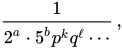
where a and b are not both zero.
This fraction can also be expressed as:
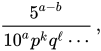
if a > b, or as
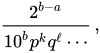
if b > a, or as
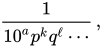
if a = b.
The decimal has:
- An initial transient of max(a, b) digits after the decimal point. Some or all of the digits in the transient can be zeros.
- A subsequent repetend which is the same as that for the fraction 1/pk qℓ ⋯.
For example 1/28 = 0.03571428:
- a = 2, b = 0, and the other factors pk qℓ ⋯ = 7
- there are 2 initial non-repeating digits, 03; and
- there are 6 repeating digits, 571428, the same amount as 1/7 has.
Converting repeating decimals to fractions
[edit]Given a repeating decimal, it is possible to calculate the fraction that produces it. For example:
(multiply each side of the above line by 10) (subtract the 1st line from the 2nd) (reduce to lowest terms)





Another example:
(move decimal to start of repetition = move by 1 place = multiply by 10) (collate 2nd repetition here with 1st above = move by 2 places = multiply by 100) (subtract to clear decimals) (reduce to lowest terms)






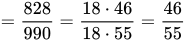
A shortcut
[edit]The procedure below can be applied in particular if the repetend has n digits, all of which are 0 except the final one which is 1. For instance for n = 7:
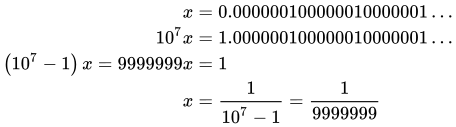
So this particular repeating decimal corresponds to the fraction 1/10n − 1, where the denominator is the number written as n 9s. Knowing just that, a general repeating decimal can be expressed as a fraction without having to solve an equation. For example, one could reason:
![{\displaystyle {\begin{aligned}7.48181818\ldots &=7.3+0.18181818\ldots \\[8pt]&={\frac {73}{10}}+{\frac {18}{99}}={\frac {73}{10}}+{\frac {9\cdot 2}{9\cdot 11}}={\frac {73}{10}}+{\frac {2}{11}}\\[12pt]&={\frac {11\cdot 73+10\cdot 2}{10\cdot 11}}={\frac {823}{110}}\end{aligned}}}](https://wikimedia.org/api/rest_v1/media/math/render/svg/e6cf612540b8255ca0ae162cc6f8ccad16a2ed93)
or
![{\displaystyle {\begin{aligned}11.18867924528301886792452830\ldots &=11+0.18867924528301886792452830\ldots \\[8pt]&=11+{\frac {10}{53}}={\frac {11\cdot 53+10}{53}}={\frac {593}{53}}\end{aligned}}}](https://wikimedia.org/api/rest_v1/media/math/render/svg/9ebeebd569c5d473703b099d8068247a0def48d7)
It is possible to get a general formula expressing a repeating decimal with an n-digit period (repetend length), beginning right after the decimal point, as a fraction:
![{\displaystyle {\begin{aligned}x&=0.{\overline {a_{1}a_{2}\cdots a_{n}}}\\10^{n}x&=a_{1}a_{2}\cdots a_{n}.{\overline {a_{1}a_{2}\cdots a_{n}}}\\[5pt]\left(10^{n}-1\right)x=99\cdots 99x&=a_{1}a_{2}\cdots a_{n}\\[5pt]x&={\frac {a_{1}a_{2}\cdots a_{n}}{10^{n}-1}}={\frac {a_{1}a_{2}\cdots a_{n}}{99\cdots 99}}\end{aligned}}}](https://wikimedia.org/api/rest_v1/media/math/render/svg/d2515e466c7582dd33e653060a6efdebcff65665)
More explicitly, one gets the following cases:
If the repeating decimal is between 0 and 1, and the repeating block is n digits long, first occurring right after the decimal point, then the fraction (not necessarily reduced) will be the integer number represented by the n-digit block divided by the one represented by n 9s. For example,
- 0.444444... = 4/9 since the repeating block is 4 (a 1-digit block),
- 0.565656... = 56/99 since the repeating block is 56 (a 2-digit block),
- 0.012012... = 12/999 since the repeating block is 012 (a 3-digit block); this further reduces to 4/333.
- 0.999999... = 9/9 = 1, since the repeating block is 9 (also a 1-digit block)
If the repeating decimal is as above, except that there are k (extra) digits 0 between the decimal point and the repeating n-digit block, then one can simply add k digits 0 after the n digits 9 of the denominator (and, as before, the fraction may subsequently be simplified). For example,
- 0.000444... = 4/9000 since the repeating block is 4 and this block is preceded by 3 zeros,
- 0.005656... = 56/9900 since the repeating block is 56 and it is preceded by 2 zeros,
- 0.00012012... = 12/99900 = 1/8325 since the repeating block is 012 and it is preceded by 2 zeros.
Any repeating decimal not of the form described above can be written as a sum of a terminating decimal and a repeating decimal of one of the two above types (actually the first type suffices, but that could require the terminating decimal to be negative). For example,
- 1.23444... = 1.23 + 0.00444... = 123/100 + 4/900 = 1107/900 + 4/900 = 1111/900
- or alternatively 1.23444... = 0.79 + 0.44444... = 79/100 + 4/9 = 711/900 + 400/900 = 1111/900
- 0.3789789... = 0.3 + 0.0789789... = 3/10 + 789/9990 = 2997/9990 + 789/9990 = 3786/9990 = 631/1665
- or alternatively 0.3789789... = −0.6 + 0.9789789... = −6/10 + 978/999 = −5994/9990 + 9780/9990 = 3786/9990 = 631/1665
An even faster method is to ignore the decimal point completely and go like this
- 1.23444... = 1234 − 123/900 = 1111/900 (denominator has one 9 and two 0s because one digit repeats and there are two non-repeating digits after the decimal point)
- 0.3789789... = 3789 − 3/9990 = 3786/9990 (denominator has three 9s and one 0 because three digits repeat and there is one non-repeating digit after the decimal point)
It follows that any repeating decimal with period n, and k digits after the decimal point that do not belong to the repeating part, can be written as a (not necessarily reduced) fraction whose denominator is (10n − 1)10k.
Conversely the period of the repeating decimal of a fraction c/d will be (at most) the smallest number n such that 10n − 1 is divisible by d.
For example, the fraction 2/7 has d = 7, and the smallest k that makes 10k − 1 divisible by 7 is k = 6, because 999999 = 7 × 142857. The period of the fraction 2/7 is therefore 6.
In compressed form
[edit]The following picture suggests kind of compression of the above shortcut. Thereby represents the digits of the integer part of the decimal number (to the left of the decimal point), makes up the string of digits of the preperiod and its length, and being the string of repeated digits (the period) with length which is nonzero.


.gif)
In the generated fraction, the digit will be repeated times, and the digit will be repeated times.


Note that in the absence of an integer part in the decimal, will be represented by zero, which being to the left of the other digits, will not affect the final result, and may be omitted in the calculation of the generating function.
Examples:
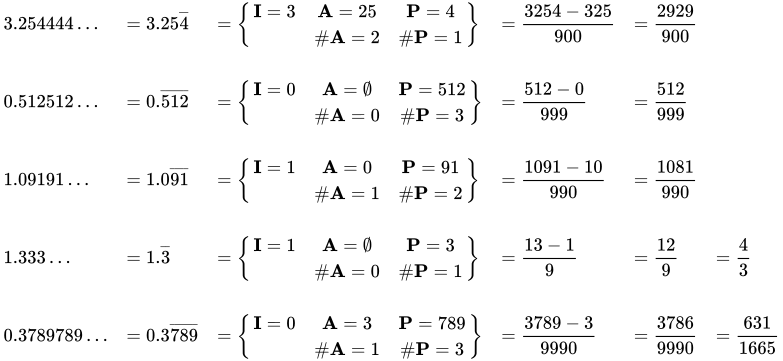
The symbol in the examples above denotes the absence of digits of part in the decimal, and therefore and a corresponding absence in the generated fraction.


Repeating decimals as infinite series
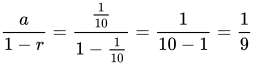
[edit]A repeating decimal can also be expressed as an infinite series. That is, a repeating decimal can be regarded as the sum of an infinite number of rational numbers. To take the simplest example,

The above series is a geometric series with the first term as 1/10 and the common factor 1/10. Because the absolute value of the common factor is less than 1, we can say that the geometric series converges and find the exact value in the form of a fraction by using the following formula where a is the first term of the series and r is the common factor.
Similarly,
![{\displaystyle {\begin{aligned}0.{\overline {142857}}&={\frac {142857}{10^{6}}}+{\frac {142857}{10^{12}}}+{\frac {142857}{10^{18}}}+\cdots =\sum _{n=1}^{\infty }{\frac {142857}{10^{6n}}}\\[6px]\implies &\quad {\frac {a}{1-r}}={\frac {\frac {142857}{10^{6}}}{1-{\frac {1}{10^{6}}}}}={\frac {142857}{10^{6}-1}}={\frac {142857}{999999}}={\frac {1}{7}}\end{aligned}}}](https://wikimedia.org/api/rest_v1/media/math/render/svg/b641179f87b6e5f31361e4a13892afeb2a0e19d5)
Multiplication and cyclic permutation
[edit]The cyclic behavior of repeating decimals in multiplication also leads to the construction of integers which are cyclically permuted when multiplied by certain numbers. For example, 102564 × 4 = 410256. 102564 is the repetend of 4/39 and 410256 the repetend of 16/39.
Other properties of repetend lengths
[edit]Various properties of repetend lengths (periods) are given by Mitchell[13] and Dickson.[14]
- The period of 1/k for integer k is always ≤ k − 1.
- If p is prime, the period of 1/p divides evenly into p − 1.
- If k is composite, the period of 1/k is strictly less than k − 1.
- The period of c/k, for c coprime to k, equals the period of 1/k.
- If k = 2a·5bn where n > 1 and n is not divisible by 2 or 5, then the length of the transient of 1/k is max(a, b), and the period equals r, where r is the multiplicative order of 10 mod n, that is the smallest integer such that 10r ≡ 1 (mod n).
- If p, p′, p″,... are distinct primes, then the period of 1/p p′ p″ ⋯ equals the lowest common multiple of the periods of 1/p, 1/p′, 1/p″,....
- If k and k′ have no common prime factors other than 2 or 5, then the period of 1/k k′ equals the least common multiple of the periods of 1/k and 1/k′.
- For prime p, if
- for some m, but
- then for c ≥ 0 we have



- If p is a proper prime ending in a 1, that is, if the repetend of 1/p is a cyclic number of length p − 1 and p = 10h + 1 for some h, then each digit 0, 1, ..., 9 appears in the repetend exactly h = p − 1/10 times.
For some other properties of repetends, see also.[15]
Extension to other bases
[edit]Various features of repeating decimals extend to the representation of numbers in all other integer bases, not just base 10:
- Every real number can be represented as an integer part followed by a radix point (the generalization of a decimal point to non-decimal systems) followed by a finite or infinite number of digits.
- If the base is an integer, a terminating sequence obviously represents a rational number.
- A rational number has a terminating sequence if all the prime factors of the denominator of the fully reduced fractional form are also factors of the base. These numbers make up a dense set in Q and R.
- If the positional numeral system is a standard one, that is it has base
- combined with a consecutive set of digits
- with r := |b|, dr := d1 + r − 1 and 0 ∈ D, then a terminating sequence is obviously equivalent to the same sequence with non-terminating repeating part consisting of the digit 0. If the base is positive, then there exists an order homomorphism from the lexicographical order of the right-sided infinite strings over the alphabet D into some closed interval of the reals, which maps the strings 0.A1A2...Andb and 0.A1A2...(An+1)d1 with Ai ∈ D and An ≠ db to the same real number – and there are no other duplicate images. In the decimal system, for example, there is 0.9 = 1.0 = 1; in the balanced ternary system there is 0.1 = 1.T = 1/2.


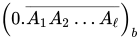
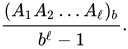
- A rational number has an indefinitely repeating sequence of finite length l, if the reduced fraction's denominator contains a prime factor that is not a factor of the base. If q is the maximal factor of the reduced denominator which is coprime to the base, l is the smallest exponent such that q divides bℓ − 1. It is the multiplicative order ordq(b) of the residue class b mod q which is a divisor of the Carmichael function λ(q) which in turn is smaller than q. The repeating sequence is preceded by a transient of finite length if the reduced fraction also shares a prime factor with the base. A repeating sequence
- represents the fraction
- An irrational number has a representation of infinite length that is not, from any point, an indefinitely repeating sequence of finite length.
For example, in duodecimal, 1/2 = 0.6, 1/3 = 0.4, 1/4 = 0.3 and 1/6 = 0.2 all terminate; 1/5 = 0.2497 repeats with period length 4, in contrast with the equivalent decimal expansion of 0.2; 1/7 = 0.186A35 has period 6 in duodecimal, just as it does in decimal.
If b is an integer base and k is an integer, then

For example 1/7 in duodecimal:

which is 0.186A35base12. 10base12 is 12base10, 102base12 is 144base10, 21base12 is 25base10, A5base12 is 125base10.
Algorithm for positive bases
[edit]For a rational 0 < p/q < 1 (and base b ∈ N>1) there is the following algorithm producing the repetend together with its length:
function b_adic(b,p,q) // b ≥ 2; 0 < p < q
  digits = "0123..."; // up to the digit with value b–1
begin
  s = "";  // the string of digits
  pos = 0; // all places are right to the radix point
  while not defined(occurs[p]) do
    occurs[p] = pos; // the position of the place with remainder p
    bp = b*p;
    z = floor(bp/q); // index z of digit within: 0 ≤ z ≤ b-1
    p = b*p − z*q;   // 0 ≤ p < q
    if p = 0 then L = 0;
      if not z = 0 then
        s = s . substring(digits, z, 1)
      end if
      return (s);
    end if
    s = s . substring(digits, z, 1); // append the character of the digit
    pos += 1;
  end while
  L = pos - occurs[p]; // the length of the repetend (being < q)
  // mark the digits of the repetend by a vinculum:
  for i from occurs[p] to pos-1 do
    substring(s, i, 1) = overline(substring(s, i, 1));
  end for
  return (s);
end function
The first highlighted line calculates the digit z.
The subsequent line calculates the new remainder p′ of the division modulo the denominator q. As a consequence of the floor function floor we have

thus

and

Because all these remainders p are non-negative integers less than q, there can be only a finite number of them with the consequence that they must recur in the while loop. Such a recurrence is detected by the associative array occurs. The new digit z is formed in the yellow line, where p is the only non-constant. The length L of the repetend equals the number of the remainders (see also section Every rational number is either a terminating or repeating decimal).
Table of values
[edit]-
fraction
decimal
expansionℓ10 binary
expansionℓ2 1/2 0.5 0 0.1 0 1/3 0.3 1 0.01 2 1/4 0.25 0 0.01 0 1/5 0.2 0 0.0011 4 1/6 0.16 1 0.001 2 1/7 0.142857 6 0.001 3 1/8 0.125 0 0.001 0 1/9 0.1 1 0.000111 6 1/10 0.1 0 0.00011 4 1/11 0.09 2 0.0001011101 10 1/12 0.083 1 0.0001 2 1/13 0.076923 6 0.000100111011 12 1/14 0.0714285 6 0.0001 3 1/15 0.06 1 0.0001 4 1/16 0.0625 0 0.0001 0 -
fraction
decimal
expansionℓ10 1/17 0.0588235294117647 16 1/18 0.05 1 1/19 0.052631578947368421 18 1/20 0.05 0 1/21 0.047619 6 1/22 0.045 2 1/23 0.0434782608695652173913 22 1/24 0.0416 1 1/25 0.04 0 1/26 0.0384615 6 1/27 0.037 3 1/28 0.03571428 6 1/29 0.0344827586206896551724137931 28 1/30 0.03 1 1/31 0.032258064516129 15 -
fraction
decimal
expansionℓ10 1/32 0.03125 0 1/33 0.03 2 1/34 0.02941176470588235 16 1/35 0.0285714 6 1/36 0.027 1 1/37 0.027 3 1/38 0.0263157894736842105 18 1/39 0.025641 6 1/40 0.025 0 1/41 0.02439 5 1/42 0.0238095 6 1/43 0.023255813953488372093 21 1/44 0.0227 2 1/45 0.02 1 1/46 0.02173913043478260869565 22 1/47 0.0212765957446808510638297872340425531914893617 46 1/48 0.02083 1 1/49 0.020408163265306122448979591836734693877551 42 1/50 0.02 0 1/51 0.0196078431372549 16 1/52 0.01923076 6 1/53 0.0188679245283 13 1/54 0.0185 3 1/55 0.018 2 1/56 0.017857142 6 1/57 0.017543859649122807 18 1/58 0.01724137931034482758620689655 28 1/59 0.0169491525423728813559322033898305084745762711864406779661 58 1/60 0.016 1
Thereby fraction is the unit fraction 1/n and ℓ10 is the length of the (decimal) repetend.
The lengths ℓ10(n) of the decimal repetends of 1/n, n = 1, 2, 3, ..., are:
- 0, 0, 1, 0, 0, 1, 6, 0, 1, 0, 2, 1, 6, 6, 1, 0, 16, 1, 18, 0, 6, 2, 22, 1, 0, 6, 3, 6, 28, 1, 15, 0, 2, 16, 6, 1, 3, 18, 6, 0, 5, 6, 21, 2, 1, 22, 46, 1, 42, 0, 16, 6, 13, 3, 2, 6, 18, 28, 58, 1, 60, 15, 6, 0, 6, 2, 33, 16, 22, 6, 35, 1, 8, 3, 1, 18, 6, 6, 13, 0, 9, 5, 41, 6, 16, 21, 28, 2, 44, 1, 6, 22, 15, 46, 18, 1, 96, 42, 2, 0... (sequence A051626 in the OEIS).
For comparison, the lengths ℓ2(n) of the binary repetends of the fractions 1/n, n = 1, 2, 3, ..., are:
- 0, 0, 2, 0, 4, 2, 3, 0, 6, 4, 10, 2, 12, 3, 4, 0, 8, 6, 18, 4, 6, 10, 11, 2, 20, 12, 18, 3, 28, 4, 5, 0, 10, 8, 12, 6, 36, 18, 12, 4, 20, 6, 14, 10, 12, 11, ... (=A007733[n], if n not a power of 2 else =0).
The decimal repetends of 1/n, n = 1, 2, 3, ..., are:
- 0, 0, 3, 0, 0, 6, 142857, 0, 1, 0, 09, 3, 076923, 714285, 6, 0, 0588235294117647, 5, 052631578947368421, 0, 047619, 45, 0434782608695652173913, 6, 0, 384615, 037, 571428, 0344827586206896551724137931, 3, 032258064516129, 0, 03, 2941176470588235, 285714... (sequence A036275 in the OEIS).
The decimal repetend lengths of 1/p, p = 2, 3, 5, ... (nth prime), are:
- 0, 1, 0, 6, 2, 6, 16, 18, 22, 28, 15, 3, 5, 21, 46, 13, 58, 60, 33, 35, 8, 13, 41, 44, 96, 4, 34, 53, 108, 112, 42, 130, 8, 46, 148, 75, 78, 81, 166, 43, 178, 180, 95, 192, 98, 99, 30, 222, 113, 228, 232, 7, 30, 50, 256, 262, 268, 5, 69, 28, 141, 146, 153, 155, 312, 79... (sequence A002371 in the OEIS).
The least primes p for which 1/p has decimal repetend length n, n = 1, 2, 3, ..., are:
- 3, 11, 37, 101, 41, 7, 239, 73, 333667, 9091, 21649, 9901, 53, 909091, 31, 17, 2071723, 19, 1111111111111111111, 3541, 43, 23, 11111111111111111111111, 99990001, 21401, 859, 757, 29, 3191, 211, 2791, 353, 67, 103, 71, 999999000001, 2028119, 909090909090909091, 900900900900990990990991, 1676321, 83, 127, 173... (sequence A007138 in the OEIS).
The least primes p for which k/p has n different cycles (1 ≤ k ≤ p−1), n = 1, 2, 3, ..., are:
See also
[edit]- Decimal representation
- Full reptend prime
- Midy's theorem
- Parasitic number
- Trailing zero
- Unique prime
- 0.999..., a repeating decimal equal to one
- Pigeonhole principle
Notes
[edit]- ^ Courant, R. and Robbins, H. What Is Mathematics?: An Elementary Approach to Ideas and Methods, 2nd ed. Oxford, England: Oxford University Press, 1996: p. 67.
- ^ Beswick, Kim (2004), "Why Does 0.999... = 1?: A Perennial Question and Number Sense", Australian Mathematics Teacher, 60 (4): 7–9
- ^ "Lambert's Original Proof that $\pi$ is irrational". Mathematics Stack Exchange. Retrieved 2023-12-19.
- ^ Conférence Intercantonale de l'Instruction Publique de la Suisse Romande et du Tessin (2011). Aide-mémoire. Mathématiques 9-10-11. LEP. pp. 20–21.
- ^ For a base b and a divisor n, in terms of group theory this length divides
- ^ Vuorinen, Aapeli. "Rational numbers have repeating decimal expansions". Aapeli Vuorinen. Retrieved 2023-12-23.
- ^ "The Sets of Repeating Decimals". www.sjsu.edu. Archived from the original on 23 December 2023. Retrieved 2023-12-23.
- ^ RoRi (2016-03-01). "Prove that every repeating decimal represents a rational number". Stumbling Robot. Archived from the original on 23 December 2023. Retrieved 2023-12-23.
- ^ Gray, Alexander J. (March 2000). "Digital roots and reciprocals of primes". Mathematical Gazette. 84 (499): 86. doi:10.2307/3621484. JSTOR 3621484. S2CID 125834304.
For primes greater than 5, all the digital roots appear to have the same value, 9. We can confirm this if...
- ^ Dickson, L. E., History of the Theory of Numbers, Volume 1, Chelsea Publishing Co., 1952.
- ^ William E. Heal. Some Properties of Repetends. Annals of Mathematics, Vol. 3, No. 4 (Aug., 1887), pp. 97–103
- ^ Albert H. Beiler, Recreations in the Theory of Numbers, p. 79
- ^ Mitchell, Douglas W., "A nonlinear random number generator with known, long cycle length", Cryptologia 17, January 1993, pp. 55–62.
- ^ Dickson, Leonard E., History of the Theory of Numbers, Vol. I, Chelsea Publ. Co., 1952 (orig. 1918), pp. 164–173.
- ^ Armstrong, N. J., and Armstrong, R. J., "Some properties of repetends", Mathematical Gazette 87, November 2003, pp. 437–443.


External links
[edit]Repeating decimal
View on GrokipediaFundamentals
Notation
A repeating decimal is a decimal representation in which a sequence of one or more digits repeats indefinitely after an optional initial non-repeating part.[5] Repeating decimals are categorized as pure repeating, where the repeating sequence begins immediately after the decimal point (such as ), or mixed repeating (also called eventually repeating), which features a finite non-repeating prefix followed by the repeating portion (such as ).[5] The conventional notation employs a vinculum, or overbar, placed above the repeating digits to indicate the repetend, the block that cycles. For instance, denotes the sequence "12" repeating from the start, while the overbar in mixed cases applies only to the cycling part.[5] Alternative conventions include dots positioned above the first and last digits of the repetend, as in for the two-digit repetend "12", or parentheses enclosing the sequence for clarity, such as .[6][7] The vinculum notation traces its origins to 16th-century European mathematicians, with Simon Stevin employing horizontal lines over or under digit groups in decimal fractions in his 1585 treatise De Thiende to signify aggregation and structure in expansions.[8] This practice evolved into the modern overbar for marking repetition in decimals by the 18th century.[8]Decimal Expansion and Recurrence
The decimal expansion of a rational number , where and are integers with , is generated by performing long division of by in base 10.[9] This process begins after any integer part by multiplying the current remainder by 10 and dividing by to produce successive decimal digits, along with a new remainder between 0 and .[10] A repeating decimal arises when, during long division, a remainder repeats a value encountered earlier in the process, causing the sequence of digits to cycle indefinitely from that point onward.[9] Since there are only finitely many possible remainders (at most ), repetition is inevitable unless the remainder reaches zero, which would terminate the expansion.[11] The repeating cycle, or repetend, corresponds to the digits produced between the repeated remainders. For instance, consider the expansion of . Dividing 1 by 3 yields an initial quotient of 0 and remainder 1. Multiplying the remainder by 10 gives 10, which divides by 3 to produce digit 3 and remainder 1 again. This loop generates , or , where the single digit 3 repeats due to the persistent remainder.[10] Repetition occurs in the decimal expansion of (in lowest terms) whenever has prime factors other than 2 and 5, as these additional factors prevent the remainders from resolving to zero and instead create a finite cycle of nonzero remainders.[9] If factors solely into powers of 2 and/or 5 after simplifying, the expansion terminates. In cases with mixed factors, a non-repeating prefix precedes the cycle, with its length equal to the maximum of the exponents of 2 and 5 in the prime factorization of .[10] For example, in , the exponent of 2 is 1 (higher than that of 5, which is 0), yielding a non-repeating digit "1" before the repeating "6".[9]Rationality and Proofs
Terminating and Repeating Decimals as Rationals
A fundamental result in number theory is that every terminating decimal and every repeating decimal represents a rational number, expressible as the ratio where and are integers with .[12] Terminating decimals, which end after a finite number of digits, can be rewritten as fractions with a denominator that is a power of 10, such as for some positive integer . Since , this denominator factors only into primes 2 and 5, allowing reduction to a simple rational form. For example, , and .[13] Repeating decimals, denoted with a bar over the repeating sequence (e.g., ), can be expressed as an infinite geometric series that sums to a rational number. Consider , a geometric series with first term and common ratio . The sum is . Similarly, .[14] In contrast, irrational numbers like have decimal expansions that are non-terminating and non-repeating, distinguishing them from rationals.[15]Rationals as Terminating or Repeating Decimals
Every rational number possesses a decimal expansion that is either terminating (finite) or eventually repeating (periodic). This fundamental property distinguishes rational numbers from irrationals, whose expansions neither terminate nor repeat.[5] Consider a rational number expressed as in lowest terms, where and are integers with and . The decimal expansion terminates if and only if the prime factors of are solely 2 and/or 5. In such cases, divides some power of 10 (since ), allowing the fraction to be rewritten with a denominator that is a power of 10, resulting in a finite number of decimal places. Otherwise, if has any prime factor other than 2 or 5, the expansion is non-terminating but eventually repeating, with the length of the repeating cycle (repetend) dividing the multiplicative order of 10 modulo the part of coprime to 10.[16] This behavior arises naturally from the long division algorithm used to compute the decimal expansion. In dividing by , each step produces a digit and a remainder satisfying . If a remainder of zero occurs, the division terminates. Otherwise, the remainders form an infinite sequence taking values in the finite set {1, 2, \dots, q-1}. By the pigeonhole principle, after at most steps, at least two remainders must coincide, say with . The digits produced between these steps then repeat indefinitely, yielding a periodic expansion starting from the -th decimal place.[17] For illustration, the fraction terminates, as 2 is a factor of 10. In contrast, repeats with period 1, since 3 is coprime to 10. A mixed case is , where the non-repeating prefix arises from the factor of 2 in 6, followed by repetition due to the factor of 3.[5] Notably, certain rational numbers admit two distinct decimal representations. Terminating decimals can be expressed either with trailing zeros or with trailing nines. For example, , where the equivalence holds because the infinite series . This non-uniqueness applies precisely to rationals that terminate in one representation.[18]Formal Proofs
To prove that every repeating decimal represents a rational number, consider a general repeating decimal , where is the integer part, the first digits after the decimal are non-repeating, and the block repeats with period .[2] Multiplying by shifts the decimal point past the non-repeating part:Multiplying by shifts past the non-repeating part and one full period:
Subtracting these equations aligns the repeating parts:
where the right side is an integer, say . Thus,
so
which is a ratio of integers, proving is rational.[2] For a pure repeating decimal with no non-repeating part (), such as , the formula simplifies. Let be the integer formed by the digits . Then
as derived by multiplying by and subtracting:
yielding . This expresses as a rational with denominator ( nines).[19] Conversely, every rational number has a decimal expansion that is either terminating or eventually repeating. Consider a rational in lowest terms, with integers and . Performing long division of by generates a sequence of remainders , each satisfying . Since there are only possible remainders (0 through ), by the pigeonhole principle, either some remainder is 0 (causing termination) or two remainders repeat, say with . In the latter case, the digits from position onward repeat with period , making the expansion eventually periodic.[20] For mixed repeating decimals, the length of the non-repeating part equals the maximum of the exponents of 2 and 5 in the prime factorization of . Write , where is coprime to 10 (i.e., has no factors of 2 or 5). The decimal terminates if (after digits); otherwise, it has a non-repeating prefix of length followed by a repeating part determined by . To see this, multiply numerator and denominator by to make the denominator , yielding a terminating part from the powers of 10 and a repeating part from dividing by (which, by the pigeonhole argument, cycles after at most steps).[21] Terminating decimals admit a dual representation: one ending in infinite 0s and an equivalent one ending in infinite 9s. For example, consider . To prove , let . Then , so , yielding and . Alternatively, as an infinite geometric series, . This duality arises because the series converges to the same limit, and in the real numbers, these representations are identical.[22]
Common Examples
Table of Values
The following table summarizes the decimal expansions of the unit fractions for to , showcasing terminating decimals, purely repeating decimals, and eventually repeating (mixed) forms. These expansions are standard representations derived from long division processes.[23]| Decimal Expansion of | |
|---|---|
| 1 | |
| 2 | |
| 3 | |
| 4 | |
| 5 | |
| 6 | |
| 7 | |
| 8 | |
| 9 | |
| 10 | |
| 11 | |
| 12 | |
| 13 | |
| 14 | |
| 15 | |
| 16 | |
| 17 | |
| 18 | |
| 19 | |
| 20 |
Reciprocals of Primes
For prime numbers , the reciprocal produces a pure repeating decimal expansion in base 10, meaning the repetition begins immediately after the decimal point with no non-repeating digits.[24] The length of this repeating block, known as the repetend or period, is given by the multiplicative order of 10 modulo , denoted , which is the smallest positive integer such that .[24] This order exists because is coprime to 10, ensuring 10 is invertible modulo .[25] By Euler's theorem, since , the order divides , where is Euler's totient function.[26] Thus, the period of is a divisor of .[24] When the order equals , the period achieves its maximum length, and is called a full reptend prime; in such cases, the repetend forms a cyclic number, an integer whose digits, when multiplied by integers from 1 to , yield cyclic permutations of the original digits.[27] A classic example is , where , so .[24] The repetend 142857 is a cyclic number: multiplying by 2 gives , by 3 gives , and so on up to , each a rotation of the same digits.[27] For primes with shorter periods, such as where (dividing 10), .[24] Similarly, for with (dividing 12), .[24] These properties highlight the connection between decimal expansions and the structure of the multiplicative group modulo .[25]Reciprocals of Composites Coprime to 10
When the denominator of the reciprocal is a composite integer coprime to 10, the length of the repeating decimal period, known as the repetend length, is the multiplicative order of 10 modulo , which is the smallest positive integer such that .[25] This order equals the least common multiple (LCM) of the orders of 10 modulo each prime power in the prime factorization of , due to the Chinese Remainder Theorem decomposing the multiplicative group modulo into a direct product of groups modulo the prime powers.[25] For odd primes , the order modulo is a multiple of the order modulo , and equals it in some cases but can be larger in others, so the period of is the LCM of the orders modulo its prime power factors.[24] Building on the periods for prime denominators, compositeness allows the overall period to be computed via LCM, which can either shorten the effective period relative to the size of (if factors share common period divisors) or extend it beyond individual prime periods (if the prime periods are coprime integers whose LCM is their product). For instance, the period of is 1, matching the period of .[28] Another example is , where the period is , combining the period of 1 (from ) and 6 (from ).[29] Similarly, for , the period is , using the periods from and .[30] In some cases, the repeating block may include leading zeros within the repetend, giving the appearance of a non-full period, though the decimal is purely periodic since . For example, , with period , but the block "03" starts with a zero after the decimal point.[31] This compositeness effect highlights how the LCM mechanism can produce periods that are multiples of prime factors' periods, often resulting in longer cycles for products of primes with distinct period lengths compared to the primes alone, while keeping the maximum possible period bounded by the Carmichael function .[32]Conversion Techniques
Repeating Decimals to Fractions
One common algebraic technique to convert a repeating decimal to its exact fractional equivalent involves setting up an equation with a variable representing the decimal and using multiplication by powers of 10 to align the repeating portions for subtraction.[33][34][35] For a purely repeating decimal of the form , where the block of length repeats indefinitely, multiply by to shift the decimal point by places. This yields . Subtract the original equation: , simplifying to , where the right side is the integer formed by the repeating block. Solving for gives , or equivalently, the repeating block as the numerator over a denominator of nines (999...9).[33][34][35] For example, consider , where and the block is 3. Then , so , yielding and . Using the shortcut, this is directly .[33][34] For a mixed repeating decimal , with non-repeating digits followed by a repeating block of length , first multiply by to shift past the non-repeating part: . Then multiply by to also shift the repeating block: . Subtract the first shifted equation from this: , which simplifies to , an integer on the right. Solving for provides the fraction, which should then be simplified.[33][34][35] As an illustration, take , with (digit 1) and (repeating 6). Then and , so , giving and .[33][34] A shortcut for pure repeats treats the entire repeating block as a single numerator unit over the corresponding string of nines; for instance, (block abc of length 3) equals , where abc is the three-digit integer. This approach leverages the fact that , scaling the numerator accordingly for longer or varied blocks.[36]Infinite Series Representation
A repeating decimal with a single-digit repetend, such as where is a digit from 1 to 9, can be expressed as the infinite geometric series .[37] This series has first term and common ratio , so its sum is .[37] For a pure repeating decimal with repetend period , denoted , let be the -digit integer formed by . This decimal equals .[38] For example, .[38] A mixed repeating decimal, such as with non-repeating digits, consists of a finite sum for the non-repeating part plus a geometric series for the repeating part shifted by places. The non-repeating portion sums to , and the repeating portion is , where is the value of the repeating block starting after the non-repeating digits.[39] For instance, .[39] In base 10, these series converge because the common ratio satisfies for any finite , ensuring the partial sums approach a finite limit.[37]Advanced Properties
Repetend Lengths and Cyclic Numbers
The repetend length, or period, of the decimal expansion of a fraction in lowest terms is the smallest positive integer such that the sequence of digits repeats every places after any initial non-repeating digits. To determine this length, first factor where is coprime to 10; the non-repeating part has length , and the repetend length is the multiplicative order of 10 modulo , defined as the minimal satisfying .[5][25] This period always divides Euler's totient function , providing an upper bound on possible lengths, though the actual value is the smallest such divisor where the congruence holds.[24][40] For prime denominators coprime to 10, the period divides , and maximal periods occur when , corresponding to primes where 10 is a primitive root modulo . These are known as full reptend primes, with examples including 7 (period 6), 17 (period 16), and 19 (period 18).[41] Cyclic numbers arise in the context of full reptend primes, where the repetend of forms an -digit integer whose multiples by 1 through yield cyclic permutations of its digits. The most famous example is the repetend 142857 from , where , , , , , and , each a rotation of the original digits.[27] Such numbers are generated solely by full reptend primes and exhibit this rotational property due to the maximal order of 10 modulo .[41]Multiplication and Cyclic Permutations
One prominent illustration of cyclic permutations in repeating decimals arises with the fraction , where the six-digit repetend cycles through permutations upon multiplication by integers from 1 to 6. Specifically, , , , , and , each representing a rotation of the original sequence.[42] In full-period fractions , where is a prime and the repetend length equals (indicating that 10 is a primitive root modulo ), multiplication by an integer with yields a decimal expansion that is a cyclic shift of the original repetend. The shift position is determined by the discrete logarithm of base 10 modulo , reflecting the multiplicative order in the cyclic group generated by 10 modulo .[43] A longer example is , featuring a 16-digit repetend that rotates under multiplication by 1 through 16. For instance, and , both preserving the digit sequence through cyclic permutation.[44] This cyclic behavior enables efficient verification of decimal expansions for such multiples, as one can confirm correctness by checking the rotation against the base repetend rather than recomputing via long division, and it aids in generating fractions' decimals for educational or computational purposes.[45]Reciprocals Not Coprime to 10
When the denominator of a reciprocal shares prime factors with 10 (i.e., ), the decimal expansion either terminates or consists of a non-repeating prefix followed by a repeating sequence, depending on whether has prime factors other than 2 and 5.[23] If is of the form with , the expansion terminates after decimal places, as the denominator divides some power of 10. For instance, (two places), and (one place).[23][46] If where is coprime to 10, the expansion has a non-repeating prefix of length , followed by a repeating part determined by the factors in . The prefix length arises because multiplying the numerator by clears the factors of 2 and 5, leaving division by to produce the repeating sequence after that point. For example, (prefix "08" of length 2), (prefix "0" of length 1), and (terminating after 2 places).[23][46][47] To compute such expansions, first factor out the powers of 2 and 5 from to isolate the coprime remainder , then determine the repeating decimal for (which is purely repeating, unlike the mixed form here) and scale it by the appropriate power of corresponding to .[23]Generalizations
Properties in Other Bases
In an integer base , the positional expansion of a rational number in lowest terms, where , is terminating if and only if every prime factor of divides , meaning divides some power .[48] Otherwise, the expansion is eventually periodic, with a non-repeating prefix whose length equals the maximum exponent of primes dividing in the factorization of , followed by a repeating cycle whose minimal period is the multiplicative order of modulo , where is the largest divisor of coprime to .[48] If , then and the expansion is purely periodic from the first fractional digit, with period equal to the order of modulo .[46] For example, in base , the fraction has , so its expansion is purely periodic with period equal to the order of 2 modulo 3, which is 2 since and ; thus, .[46] In base , the fraction also satisfies , yielding a purely periodic expansion with period equal to the order of 3 modulo 2, which is 1 since ; hence, .[46] For a mixed case, consider in base : here , , and the order of 10 modulo 3 is 1 (since ), producing a non-repeating prefix of length 1 (from the factor of 2) followed by a repeating digit: .[48] The cyclic properties observed in base-10 repeating decimals extend to other bases. For a prime denominator coprime to , the expansion of is purely periodic with period dividing , and it achieves a full reptend of length exactly if the order of modulo equals , meaning is a primitive root modulo .[49] Such full reptends generate cyclic numbers analogous to 142857 for in base 10, but now in bases coprime to .[49] A key difference from base-10 expansions arises in the criteria for terminating representations: in base , termination depends solely on whether the denominator's primes divide , without the specific asymmetry between 2 and 5 that occurs because 10 factors as .[48] For instance, in base , fractions with denominators powers of 2 or 3 terminate, while those involving other primes repeat, unifying the treatment of base factors.[48]Algorithm for Arbitrary Bases
The algorithm for computing the repeating expansion of a fraction (with and ) in an arbitrary base adapts the classical long division process to generate digits sequentially. Begin with the initial remainder . For each subsequent digit position , compute , where (the -th digit) is the unique integer satisfying and . The digit , and the new remainder is . This process continues indefinitely unless , in which case the expansion terminates.[49] To detect repeating cycles, maintain a record of all seen remainders and their corresponding starting positions. A repetition occurs when a remainder matches a previous remainder (with ); the cycle then begins at position and has length . If the denominator shares prime factors with , the expansion may have a non-repeating prefix (preperiod) followed by a repeating part. The preperiod length is the maximum exponent of the primes dividing that also divide , after which the remainders enter the coprime portion and begin cycling.[50] The following pseudocode outlines the process for the fractional expansion of in base , assuming :function repeating_expansion(b, q):
remainders = {} # map remainder to position
digits = []
remainder = 1
position = 0
while remainder != 0 and remainder not in remainders:
remainders[remainder] = position
remainder *= b
digit = remainder // q
digits.append(digit)
remainder %= q
position += 1
if remainder == 0:
return "0." + "".join(map(str, digits)) + " (terminating)"
else:
start = remainders[remainder]
non_repeating = "".join(map(str, digits[:start]))
repeating = "".join(map(str, digits[start:]))
return "0." + non_repeating + "\overline{" + repeating + "}_" + str(b)
function repeating_expansion(b, q):
    remainders = {}  # map remainder to position
    digits = []
    remainder = 1
    position = 0
    while remainder != 0 and remainder not in remainders:
        remainders[remainder] = position
        remainder *= b
        digit = remainder // q
        digits.append(digit)
        remainder %= q
        position += 1
    if remainder == 0:
        return "0." + "".join(map(str, digits)) + " (terminating)"
    else:
        start = remainders[remainder]
        non_repeating = "".join(map(str, digits[:start]))
        repeating = "".join(map(str, digits[start:]))
        return "0." + non_repeating + "\overline{" + repeating + "}_" + str(b)