Hubbry Logo
Rickey MedlockeRickey MedlockeMain
Open search
Rickey Medlocke
Community hub
Rickey Medlocke
logo
8 pages, 0 posts
0 subscribers
Be the first to start a discussion here.
Rickey Medlocke
Rickey Medlocke
from Wikipedia

Key Information

Rick Medlocke (born February 17, 1950) is an American musician, best known as the frontman/guitarist for the Southern rock band Blackfoot and a member of Lynyrd Skynyrd. During his first stint with Lynyrd Skynyrd from 1971 to 1972, he played drums and sang lead on a few songs that would initially be released on 1978's "First and... Last." Medlocke would rejoin Blackfoot in 1972 and later returned to Lynyrd Skynyrd in 1996 as a guitarist with whom he continues to tour and record today.

Medlocke was inducted into the Native American Music Hall of Fame in 2008.[1]

Early life

[edit]

Rickey Medlocke was born Rickey Lynn Green on February 17, 1950, in Jacksonville, Florida. He was raised by his maternal[2] grandparents. His grandfather, Paul "Shorty" Medlocke, was a bluegrass musician and taught his grandson to play a miniature banjo. Medlocke started performing onstage at age three, and his musical abilities increased over the years. He began teaching himself to play the guitar by age five and was playing drums in Shorty's band at age eight. Over the next several years Medlocke mastered the banjo, guitar, drums, mandolin, dobro and keyboards. He had a melodic singing voice and had taught himself to sing and play guitar at the same time. After graduating high school, Medlocke formed his first band, Fresh Garbage (inspired by the Spirit song), in which he was lead vocalist and drummer. That band soon changed its name to Hammer, then to Blackfoot.

Career

[edit]

Medlocke recorded briefly with the 1970s-era Lynyrd Skynyrd band as a session musician, occasionally playing drums or singing lead on a few songs for them in 1971: "One More Time", "Preacher's Daughter", "Lend a Helpin' Hand", "Wino", "White Dove", "Comin' Home", "The Seasons", "Ain't Too Proud to Pray", and "You Run Around". On occasion, Medlocke played alongside the band's original drummer Bob Burns but came to desire the energy of a guitarist at the front of the stage. This resulted in his 1972 decision to reform Blackfoot. The band began touring and producing hit songs that included "Train, Train", which was written by his grandfather, and "Highway Song", lyrics and title were written by Rickey and Blackfoot drummer Jackson Spires. The songs music, backing vocals and solos were arranged by "Blackfoot" and appeared along with songs written by others. He disbanded the group in the early 1990s.

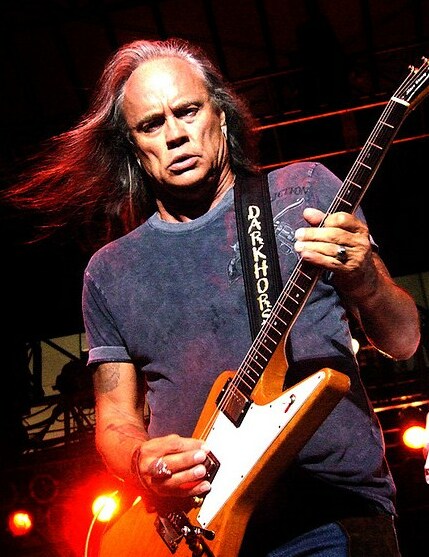
Medlocke with Lynyrd Skynyrd in 2012

For a while in the 1990s, Medlocke thought about pursuing other careers until he received a phone call in 1996 from Gary Rossington inviting him to rejoin Lynyrd Skynyrd as a lead guitarist and primary songwriter. Rossington asked Medlocke if he remembered how to play "Free Bird", "Tuesday's Gone", and "Workin' For MCA", among others.

Discography

[edit]

With Blackfoot

[edit]

With Lynyrd Skynyrd

[edit]

References

[edit]
[edit]
Revisions and contributorsEdit on WikipediaRead on Wikipedia
from Grokipedia
Rickey Medlocke (born February 17, 1950) is an American musician renowned as the frontman, guitarist, and primary songwriter for the Southern rock band Blackfoot, as well as a longtime guitarist and songwriter for . Born in , Medlocke has been a pivotal figure in the genre since the late 1960s, blending , , and influences in his performances and compositions. His spans over five decades, marked by high-energy live shows, multi-instrumental talents on guitar, drums, , and , and contributions to iconic tracks that defined the sound of . Medlocke was raised in Jacksonville by his maternal grandparents, who adopted him shortly after his birth, immersing him in music from a young age under the guidance of his grandfather , a and bluegrass musician. He attended Paxson High School amid the emerging scene and faced early health challenges from , a lifelong condition that required major at age nine during which part of one was removed. In 1969, Medlocke co-founded Blackfoot with schoolmates and Charlie Hargrett, initially as a blues-rock outfit that evolved into a powerhouse; the band achieved commercial success with their 1979 album Strikes, featuring the hit single "Train, Train," which showcased Medlocke's distinctive and vocals. Earlier, in 1971, he joined a pre-fame as their drummer, contributing to early recordings including the classic and "I Ain't the One" during sessions at , though he left in 1972 to focus on Blackfoot. Blackfoot released several acclaimed albums through the and early 1980s, touring extensively and earning a reputation for their intense live performances, before effectively disbanding in the mid-1980s after years of lineup changes; Medlocke has revived the band several times with new lineups, including in 2016 with the album Southern Native. Medlocke rejoined Lynyrd Skynyrd in 1996 as a following the band's reformation, becoming a core member alongside until his death in 2023 and contributing to songwriting on albums like (1999) and subsequent releases; he has remained with the group through extensive touring into the . Throughout his career, he has balanced commitments to both bands, occasionally performing with other projects, and continues to tour actively as of 2025, celebrating over 50 years in music while honoring his Native American heritage—specifically Lakota and —through Blackfoot's themes and recognition from the .

Early life

Family background and childhood

Rickey Medlocke was born Rickey Lynn Green on February 17, 1950, in . His biological parents separated shortly after his birth; his mother was just 16 years old at the time, and his father, of Native American descent, did not remain involved in his life. As a result, Medlocke faced the prospect of placement but was legally by his maternal grandparents, Paul "Shorty" Medlocke and his second wife, Ruby Medlocke, who raised him as their own son in a modest household on Jacksonville's west side. Upon , his name was changed to Rickey Medlocke, reflecting his grandparents' . Shorty Medlocke, originally from the and of Scots-Irish descent, emerged as the central figure in Medlocke's early years, providing stability amid limited involvement from his biological parents. The family dynamics emphasized close-knit support in a conservative, working-class environment typical of mid-20th-century Southern rural roots, where Medlocke navigated health challenges like respiratory issues requiring surgery at age nine, all while being instilled with values of perseverance. This upbringing in Jacksonville, a Navy-influenced town with deep Southern traditions, shaped his foundational sense of identity and resilience.

Initial musical training and influences

Medlocke began his musical journey at the age of three, when his grandfather, Paul "Shorty" Medlocke, a renowned , bluegrass, and musician, taught him to play a miniature five-string . Shorty, who had performed with notable acts including stints alongside Roy Acuff's band and led his own group in Jacksonville, introduced the young Medlocke to live performances by having him join on stage and on local radio shows like The Toby Dowdy Show from ages three to eight. This early immersion in Shorty's eclectic style—blending , traditional , and bluegrass—profoundly shaped Medlocke's foundational sound and performance instincts. By adolescence, Medlocke had mastered a wide array of instruments, including guitar (which he began playing at age five), drums (starting at age eight), , , , and keyboards. Much of his skill development was self-directed; he taught himself to play and sing guitar simultaneously by emulating recordings and observing musicians around him, building on the hands-on guidance from his grandfather. His influences extended beyond family roots to include early rock pioneers, particularly British acts like and , whose innovative energy and songcraft captivated him during the 1950s and 1960s. In his high school years, Medlocke began experimenting with group performances, forming informal bands that honed his abilities as a and vocalist. These early ensembles culminated in his first formal group, Fresh Garbage, around 1968–1969, where he served as and drummer—inspired by the Spirit track of the same name—and laid the groundwork for his professional trajectory.

Career

Early bands and Lynyrd Skynyrd debut (1969–1972)

After graduating from high school in 1968, Rickey Medlocke formed his first professional band, Fresh Garbage, in , alongside guitarist Charlie Hargrett and bassist , with keyboardist Ron Sciabarasi rounding out the initial lineup. The band took its name from a track by the group Spirit and focused on a mix of psychedelic and emerging influences, performing at local venues such as The Comic Book Club and Sunday "be-ins" in parks alongside acts like The One Percent, the precursor to . Medlocke handled both lead vocals and drums in the early configuration, drawing on his prior experience playing in his grandfather Shorty Medlocke's band to establish a dynamic stage presence. Fresh Garbage evolved through lineup changes and relocations, eventually laying the groundwork for what would become Blackfoot. In 1970, the group briefly renamed itself before adopting Blackfoot in homage to Medlocke's Native American heritage; they relocated to New York City's on the promise of a record deal, which ultimately fell through amid internal tensions. Keyboardist Sciabarasi departed for military service in , replaced by DeWitt Gibbs, who introduced drummer Jakson Spires, allowing Medlocke to shift toward frontman duties on vocals and emerging guitar work. By late 1972, after a period of instability, Medlocke, Walker, Hargrett, and Spires reformed in , solidifying Blackfoot's harder-edged direction. In 1971, at age 21, Medlocke joined Lynyrd Skynyrd as drummer and backing vocalist, leveraging childhood connections in the Jacksonville music scene with Ronnie Van Zant and Allen Collins. He stepped in temporarily after original drummer Bob Burns left, arriving via a call from Collins and quickly integrating into rehearsals. During sessions at Muscle Shoals Sound Studio in June and July 1971, Medlocke contributed drums and lead vocals to early demos, including the tracks "One More Time" and "White Dove," which showcased his songwriting and vocal range alongside Van Zant's leadership. These recordings captured the band's raw, formative sound before their major-label breakthrough. Medlocke departed in 1972 to prioritize his commitments with Blackfoot, where he sought to establish himself as lead guitarist and vocalist amid the group's reorganization. His exit occurred as Skynyrd's profile began to rise through relentless touring, but prior to the release of their debut album (Pronounced 'Lĕh-'nérd 'Skin-'nérd) in 1973. This brief stint provided Medlocke with valuable experience in a tightening ecosystem, though he later reflected that physical challenges from a childhood illness influenced his decision to focus on guitar over drumming.

Blackfoot formation and rise (1972–1990s)

After leaving in 1972, Rickey Medlocke reformed Blackfoot in , drawing from his earlier band experiences to create a outfit infused with Native American themes inspired by his Blackfoot heritage. The initial lineup included Medlocke on lead vocals and , drummer Jakson Spires, lead guitarist Charlie Hargrett, and bassist Lenny Stadler, with original bassist rejoining in 1973. This reformation marked Blackfoot's emergence as a southern band, emphasizing Medlocke's songwriting and the group's raw energy rooted in Jacksonville's music scene. The band's early albums established their sound on major labels. No Reservations (1975, Island Records) showcased their gritty hard rock style, followed by Flyin' High (1976, Epic Records), which highlighted Medlocke's vocal prowess and the band's touring intensity. Commercial breakthrough came with Strikes (1979, Atco Records), which achieved gold status and featured the hits "Train, Train" and "Highway Song," both written by Medlocke and drawing on bluesy southern influences. Subsequent releases like Tomcattin' (1980) and Marauder (1981) built on this momentum, with the latter including the track "Fly Away," while extensive tours alongside acts like The Who and AC/DC amplified their visibility. Medlocke served as the primary songwriter, lead vocalist, and rhythm guitarist throughout, shaping Blackfoot's identity as a fusion of hard rock aggression and southern rock grooves. By the mid-1980s, Blackfoot evolved toward a more polished sound, incorporating keyboards with the addition of former Uriah Heep member on albums like Siogo (1983) and (1984), both of which charted on the 200. However, the decade saw a decline due to falling and internal changes, including Hargrett's departure in 1984 and subsequent lineup shifts. Label pressures at exacerbated tensions, pushing the band away from their core toward a more arena-oriented style that failed to recapture earlier success. Blackfoot effectively disbanded in the early amid these challenges, though Medlocke continued performing sporadically with varying configurations before fully committing elsewhere by 1997. The era solidified the band's legacy in , with Medlocke's leadership driving their most enduring contributions.

Return to and ongoing work (1996–present)

In 1996, Rickey Medlocke rejoined as a following an invitation from , transitioning from his earlier role as a percussionist during the band's formative years to become part of the group's signature three-guitar lineup alongside Rossington and . Medlocke quickly integrated into the creative process, contributing guitar work and songwriting that helped revitalize the group's post-reformation era. Medlocke's contributions extended to several key albums during this period, including Twenty (1997), Edge of Forever (1999), Vicious Cycle (2003), and Last of a Dyin' Breed (2012), where he provided lead and rhythm guitar parts as well as co-writing credits on multiple tracks. These releases maintained Lynyrd Skynyrd's southern rock roots while incorporating Medlocke's hard-edged style, earning critical praise for their energy and authenticity. Beyond recording, Medlocke has been a mainstay in the band's relentless touring schedule, performing hundreds of shows annually across North America and Europe, often drawing tens of thousands of fans to festivals and arenas. Following Gary Rossington's death on March 5, 2023, continued touring under Medlocke's leadership alongside vocalist , honoring Rossington's wishes to keep the band's legacy alive through live performances. In 2024 interviews, Medlocke defended the decision to proceed without any surviving original members from the classic lineup, emphasizing the group's evolution and commitment to the music rather than disbanding, stating that critics labeling them a "tribute band" misunderstood their deep historical ties and ongoing creativity. maintained its momentum into 2025 with a full slate of tour dates, including high-profile stops at venues like and the , showcasing Medlocke's enduring role as a lead guitarist and vocalist. Throughout his tenure, Medlocke has occasionally incorporated elements from his Blackfoot catalog into Lynyrd Skynyrd sets, blending his dual legacies for fans.

Solo projects and collaborations

During a hiatus from Blackfoot in the mid-1980s, Medlocke released his debut solo album, Rick Medlocke and Blackfoot, in 1987 on Atlantic Records. The self-titled LP featured Medlocke on lead vocals and guitar, alongside contributions from former Blackfoot members and guests including three musicians from Mother's Finest—Glenn Burgess on bass, Joyce Kennedy on vocals, and Gary Moore on guitar—blending southern rock with hard-edged funk influences. Tracks like "Take a Train" and "Big Wheels" highlighted Medlocke's songwriting and arrangement skills, marking a period of creative experimentation outside his band commitments. In the and , Medlocke made occasional guest appearances with contemporaries, including a one-off performance where he joined onstage for an impromptu set following a backstage . Such collaborations underscored his role in the Jacksonville music scene, often sharing stages or contributing to live recordings with acts like and , though he maintained primary focus on his band affiliations. Medlocke also handled production duties on select Blackfoot projects, including co-writing and overseeing the 2016 album Southern Native, which revived the band with a new lineup while preserving its indigenous rock roots. In recent years, Medlocke has pursued solo endeavors through the Rickey Medlocke Band, releasing the single "Never Run Out of Road" in early 2024, an autobiographical rock track that amassed over 200,000 streams and reflected his career resilience. This was followed by "Rise Again" on October 16, 2024, a country-infused anthem co-written with bandmates Mark Woerpel and Brian Reidinger, featuring Medlocke on lead vocals and alongside on organ and Stacy Michelle on backing vocals. A portion of proceeds from "Rise Again," released via Rock the Cause Records, supports the National Indigenous Women's Resource Center in addressing violence against Native American women and girls. The Rickey Medlocke Band has conducted acoustic and full-band performances through 2025, including shows at venues like the , on January 24, 2025, emphasizing Medlocke's creative control in smaller-scale tributes to his heritage. These side projects, including session contributions to compilations, allow Medlocke to explore personal themes of heritage and perseverance beyond his longstanding band roles.

Personal life

Heritage and family

Rickey Medlocke has Native American ancestry, specifically Lakota Sioux and , derived from both sides of his biological parents. This heritage informed the thematic elements of Blackfoot, the band he co-founded, with its name drawn from a Native American and reflecting the group's collective indigenous roots. Medlocke demonstrates cultural pride through advocacy for Native American music, highlighted by his 2008 induction into the Native American Music Hall of Fame. Medlocke is married to Stacy Michelle, a professional who has collaborated on his recordings, including contributions to Blackfoot's music. He has referenced his in discussions of personal legacy and family support during his career. Medlocke resides in Fort Myers, Florida, where he maintains an adult family life amid extensive touring demands. Details regarding his children and grandchildren remain limited in public accounts.

Health challenges

Rickey Medlocke was diagnosed with , a progressive disease that scars tissue and causes , during his childhood in the late 1950s or early 1960s. At approximately nine and a half years old, he underwent major to remove part of one due to the condition, after which doctors predicted he would not survive past age 14. Despite this dire prognosis, Medlocke defied expectations through sheer determination and the therapeutic power of music, which he has credited with sustaining him multiple times in life. Throughout his extensive music career, Medlocke has managed the chronic effects of without undergoing additional major surgeries or retiring from performing. In 2024 interviews, he revealed ongoing battles with the disease, including breathing difficulties that persist even during tours, yet he continues to take proactive health measures to cope. At age 75 as of 2025, Medlocke attributes his longevity to a of clean living—avoiding excesses common in —and strong support, which have bolstered his resilience against the illness. Medlocke's public sharing of his health struggles in 2024, particularly in a appearance on The Monthly Social, has highlighted his survival story as a source of inspiration for fans facing their own adversities. This openness underscores the personal fortitude that has allowed him to maintain an active touring schedule with despite persistent respiratory challenges.

Legacy

Awards and recognitions

In 2008, Rickey Medlocke was inducted into the Native American Music Hall of Fame, honoring his heritage and musical contributions as a of Lakota Sioux and ancestry. Medlocke was notably excluded from Lynyrd Skynyrd's 2006 induction into the Rock and Roll Hall of Fame, despite his foundational role as a and vocalist in the band's early years from 1971 to 1972. He has publicly expressed ongoing outrage over the omission, describing it as a snub in interviews as recent as 2024. With Blackfoot, Medlocke received RIAA gold certification for the band's 1979 album Strikes, awarded on April 18, 1986, for sales exceeding 500,000 units. In 2024, Medlocke's charity single "Rise Again," released through Rock the Cause Records on , garnered recognition for directing a portion of proceeds to the movement, supporting broader Indigenous causes.

Impact on southern rock

Rickey Medlocke's contributions to southern rock are marked by his innovative fusion of blues, bluegrass, and hard rock elements, particularly through his work with Blackfoot, where he incorporated Native American-infused lyrics drawing from his Lakota Sioux and Cherokee heritage, alongside signature dual-guitar riffs that added a raw, rhythmic intensity to the genre's sound. Influenced by his grandfather Shorty Medlocke, a renowned bluegrass banjo player who taught him the instrument from a young age, Medlocke wove these acoustic roots into electric frameworks, creating a layered southern aesthetic that expanded the genre beyond its traditional boundaries. As a veteran presence in since rejoining in 1996, Medlocke has mentored younger band members, sharing his multi-instrumental expertise on guitar, drums, mandolin, and vocals to preserve the group's authentic style amid lineup changes. His versatility similarly influenced emerging acts like , as Blackfoot's hard-edged in the late paved the way for their rise, demonstrating how Medlocke's adaptability across roles shaped the genre's evolution toward more aggressive, multifaceted expressions. Medlocke's career, spanning over 50 years since his early performances in the , symbolizes the resilience of following the devastating 1977 , as he continued driving the sound forward with Blackfoot before returning to Skynyrd, ensuring its endurance through tours and recordings. In interviews, Medlocke has been hailed as "southern rock's brightest star" for his unwavering loyalty across bands, with reflections emphasizing his role in sustaining the genre's cultural vitality and inspiring cross-generational continuity.

Discography

With Blackfoot

Medlocke co-founded Blackfoot in 1969 and served as the band's and on their debut album, No Reservations, released in 1975 on . He performed lead vocals, , , , , and , contributing to the album's raw sound influenced by his early experiences in the music scene. The follow-up, Flyin' High (1976, ), continued Medlocke's central role as and , showcasing the band's evolving style with tracks emphasizing high-energy riffs and group harmonies. This early period established Blackfoot's foundation, with Medlocke handling primary songwriting duties alongside drummer Jakson Spires. Blackfoot's breakthrough came with Strikes (1979, ), which reached No. 42 on the and achieved platinum certification from the RIAA in 1986 for over one million units sold. Medlocke wrote the hit "Train, Train," adapting a tune originally composed by his grandfather , which peaked at No. 38 on the ; he also co-wrote "Highway Song" with Spires, providing lyrics inspired by a along Interstate 81. These songs highlighted Medlocke's songwriting prowess and propelled the album's commercial success. During Blackfoot's peak commercial era, Medlocke remained the frontman and key songwriter on Tomcattin' (1980, ) and Marauder (1981, ), both produced in collaboration with Al Nalli. Tomcattin' featured Medlocke's compositions like "" and supported extensive touring, while Marauder included the single "Fly Away," reinforcing the band's momentum with Medlocke's dual guitar and vocal leads. Later albums such as (1983, ) saw Medlocke continue as lead vocalist and guitarist, incorporating keyboardist for a more polished sound that charted on the 200. Medlocke led Rick Medlocke and Blackfoot (1987, Atlantic), handling vocals, guitar, and production across the album amid lineup changes. Reunions in the included the live album On the Run (2007, Deadline Music), featuring Medlocke on guitar and vocals during performances of classic material. In 2016, Medlocke guest appeared on the revived band's album Southern Native (Loud & Proud Records), contributing to tracks that honored the group's heritage. Throughout his tenure with Blackfoot, spanning over a dozen releases including studio and live efforts, Medlocke earned songwriting credits on numerous tracks and production roles on several , solidifying his foundational influence on the band's southern hard rock identity.

With Lynyrd Skynyrd

Medlocke's initial involvement with occurred from 1971 to 1972, during which he served as the band's drummer and occasional while the group was still developing its early sound in . His contributions were captured on demo recordings made at , which remained unreleased until 1978 as the album . On this collection, Medlocke performed drums and provided vocals on tracks including "One More Time," where he handled drums and backing vocals; "White Dove," where he sang lead vocals, played drums and mandolin, and received sole songwriting credit; and "Preacher's Daughter," featuring his drum work and vocal contributions. These early sessions highlighted his role in shaping the band's raw, blues-infused style before he departed to form Blackfoot. Medlocke rejoined in 1996 as a following the band's , bringing his experience from Blackfoot to bolster the lineup alongside and . His return marked a shift to rhythm and duties, contributing to the band's revitalized sound during their post-reunion era. Over the subsequent decades, he has been a core member, participating in studio recordings and extensive touring that sustained Skynyrd's legacy into the 2020s. In the studio, Medlocke's guitar work and songwriting appeared on several key albums starting with Twenty (1997), where he played rhythm guitar, slide guitar, acoustic guitar, and provided backing vocals, while co-writing tracks such as "Berneice" and "Tomorrow's Goodbye." He continued this role on Edge of Forever (1999), delivering guitar performances and co-writing songs like "Workin'" and "Rough Around the Edges." On Vicious Cycle (2003), Medlocke not only handled guitar but also co-produced select tracks and co-wrote the patriotic anthem "Red, White & Blue" alongside Rossington, Van Zant, and Hughie Thomasson, which became a staple in the band's live sets. His involvement extended to God & Guns (2009, Roadrunner Records), where he played guitars, provided backing and co-lead vocals, and co-wrote tracks including "Skynyrd Nation," and Last of a Dyin' Breed (2012), where he played guitar and co-wrote multiple songs, including the title track and "One Day at a Time." These recordings underscore his integral role in maintaining Skynyrd's signature blend of hard rock and southern grit. On the road, Medlocke has been a mainstay in Lynyrd Skynyrd's live performances since 1996, supporting tours that averaged 70 to 90 concerts annually through the 2000s and 2010s, often as headliners or alongside acts like ZZ Top and the Outlaws. This commitment has resulted in over 20 years of combined service across both stints, with Medlocke emphasizing high-energy deliveries of classics like "Sweet Home Alabama" and newer material. Following Gary Rossington's death in March 2023, Medlocke helped lead tribute performances honoring his bandmate's wishes for the group to continue, including shows in 2023–2025 that incorporated special dedications and maintained the band's rigorous touring schedule of around 80 dates per year. These efforts have kept Skynyrd active as of 2025, with Medlocke as a key architect of their enduring stage presence.

Solo and other releases

In 1987, Medlocke released the album Rick Medlocke and Blackfoot through Atlantic Records, initially conceived as a solo project but featuring a lineup including former Blackfoot members Jerry Seay on bass and Doug Bare on keyboards. The record blends hard rock with southern influences across ten tracks, including "Back on the Streets," "Saturday Night," "Closest Thing to Heaven," and "Get Up, Get On, Get Out of Here," the latter showcasing Medlocke's energetic guitar riffs and vocal delivery. Produced by Rick Medlocke and recorded in Florida, the album marked a transitional effort amid lineup changes in his band career, emphasizing radio-friendly hooks while retaining raw southern rock edges. Medlocke revisited solo endeavors with the Rickey Medlocke Band in 2024, releasing the single "Rise Again" on October 15 via Rock the Cause Records. This original track fuses country-infused rock elements with themes of resilience, featuring Medlocke's signature guitar work and the band's tight instrumentation. A portion of net proceeds supports charities aiding Indigenous women, reflecting Medlocke's heritage and commitment to social causes. The single follows the band's 2024 debut "Never Run Out of Road" and has been praised for its anthemic quality. Beyond these, Medlocke has contributed guest appearances to other projects, including session work on recordings tied to his grandfather Shorty Medlocke's legacy, such as live harmonica integrations on Blackfoot tracks like "Train, Train." His performances also appear on anthologies from the 2000s, for instance, the 2007 compilation Southern Rock Madness, which includes Blackfoot selections highlighting his vocals and guitar. These releases underscore Medlocke's versatility across genres and enduring presence in rock compilations.

References

Add your contribution
Related Hubs
User Avatar
No comments yet.