


Community hub
Recent from talks
Contribute something
Nothing was collected or created yet.
Riser (casting)
View on Wikipedia
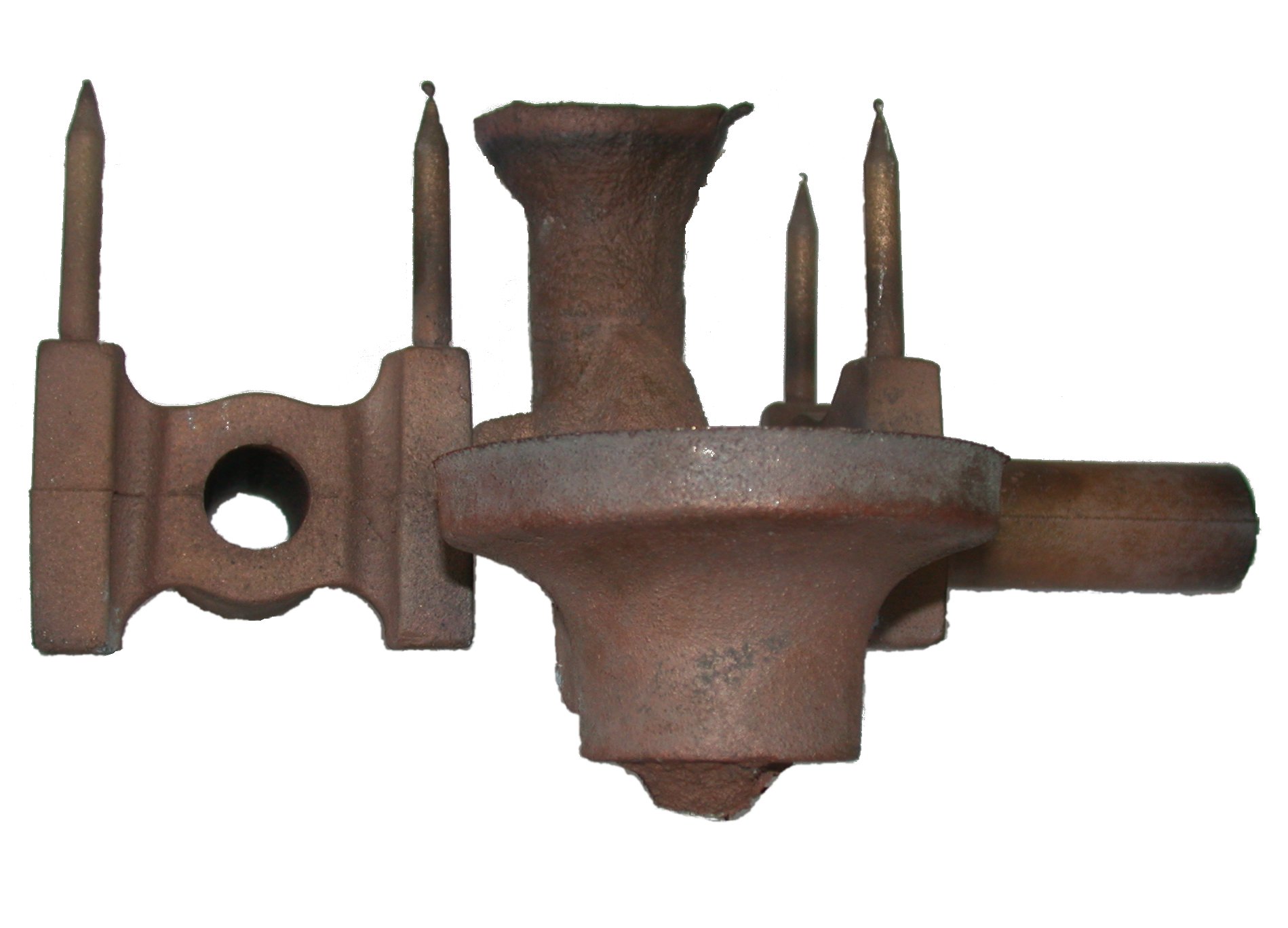
A riser, also known as a feeder,[1] is a reservoir built into a metal casting mold to prevent cavities due to shrinkage. Most metals are less dense as a liquid than as a solid so castings shrink upon cooling, which can leave a void at the last point to solidify. Risers prevent this by providing molten metal to the casting as it solidifies, so that the cavity forms in the riser and not the casting.[2] Risers are not effective on materials that have a large freezing range, because directional solidification is not possible. They are also not needed for casting processes that utilized pressure to fill the mold cavity.[3]
Theory
[edit]Risers are only effective if three conditions are met: the riser cools after the casting, the riser has enough material to compensate for the casting shrinkage, and the casting directionally solidifies towards the riser.
For the riser to cool after the casting, the riser must cool more slowly than the casting. Chvorinov's rule briefly states that the slowest cooling time is achieved with the greatest volume and the least surface area; geometrically speaking, this is a sphere. So, ideally, a riser should be a sphere, but this isn't a very practical shape to insert into a mold, so a cylinder is used instead. The height to diameter ratio of the cylinder varies depending on the material, location of the riser, size of the flask, etc.[4]
The shrinkage must be calculated for the casting to confirm that there is enough material in the riser to compensate for the shrinkage. If it appears there is not enough material then the size of the riser must be increased.
The casting must be designed to produce directional solidification, which sweeps from the extremities of the mold cavity toward the riser(s). Thus, the riser can feed molten metal continuously to part of the casting that is solidifying.[2] One method to achieve this is by placing the riser near the thickest and largest part of the casting, as that part of the casting will cool and solidify last.[4] If this type of solidification is not possible, multiple risers that feed various sections of the casting or chills may be necessary.[3]
Types
[edit]
A riser is categorized based on three criteria: where it is located, whether it is open to the atmosphere, and how it is filled. If the riser is located on the casting then it is known as a top riser, but if it is located next to the casting it is known as a side riser. Top risers are advantageous because they take up less space in the flask than a side riser, plus they have a shorter feeding distance. If the riser is open to the atmosphere it is known as an open riser, but if the riser is completely contained in the mold it is known as a blind riser. An open riser is usually bigger than a blind because the open riser loses more heat to mold through the top of the riser. Finally, if the riser receives material from the gating system and fills before the mold cavity it is known as a live riser or hot riser. If the riser fills with material that has already flowed through the mold cavity it is known as a dead riser or cold riser. Live risers are usually smaller than dead risers. Top risers are almost always dead risers and risers in the gating system are almost always live risers.[4]
The connection of the riser to the molding cavity can be an issue for side risers. On one hand the connection should be as small as possible to make separation as easy as possible, but, on the other, the connection must be big enough for it to not solidify before the riser. The connection is usually made short to take advantage of the heat of both the riser and the molding cavity, which will keep it hot throughout the process.[3]
There are risering aids that can be implemented to slow the cooling of a riser or decrease its size. One is using an insulating sleeve and top around the riser. Another is placing a heater around only the riser.[3]
Hot tops
[edit]A hot top, also known as a feeder head,[5] is a specialized riser, used to help counteract the formation of pipes when casting ingots. It is essentially a live open riser, with a hot ceramic liner instead of just the mold materials. It is inserted into the top of the ingot mould near the end of the pour, and the rest of the metal is then poured.[6] Its purpose is to maintain a reservoir of molten metal, which drains down to fill the pipe as the casting cools. The hot top was invented by Robert Forester Mushet who named it a Dozzle. With a hot top only 1 to 2% of the ingot goes to waste, prior to its use, up to 25% of the ingot was wasted.[7]
Yield
[edit]The efficiency, or yield, of a casting is defined as the weight of the casting divided by the weight of the total amount of metal poured. Risers can add a lot to the total weight being poured, so it is important to optimize their size and shape. Risers exist only to ensure the integrity of the casting, they are removed after the part has cooled, and their metal is remelted to be used again; as a result, riser size, number, and placement should be carefully planned to reduce waste while filling all the shrinkage in the casting.[4]
One way to calculate the minimum size of a riser is to use Chvorinov's rule by setting the solidification time for the riser to be longer than that of the casting. Any time can be chosen but 25% longer is usually a safe choice, which is written as follows:[4]

or
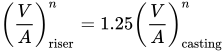
Because all of the mold and material factors are the same for n. If a cylinder is chosen for the geometry of the riser and the height to diameter ratio is locked, then the equation can be solved for a diameter, which makes this method a simple way to calculate the minimum size for a riser. Note that if a top riser is used the surface area that is shared between the riser and the casting should be subtracted from the area on the casting and the riser.[8]
References
[edit]- ^ Ravi 2005, p. 63.
- ^ a b Degarmo, Black & Kohser 2003, p. 286.
- ^ a b c d Degarmo, Black & Kohser 2003, p. 288.
- ^ a b c d e Degarmo, Black & Kohser 2003, p. 287.
- ^ Cmj Network, Inc (1959-06-25), "Riser filled by electro-slag welding", The New Scientist, 5 (136): 1383
- ^ Oberg, Erik; Jones, Franklin Day (1920), Iron and steel, Industrial Press, p. 129.
- ^ Gordon, Robert (1996), American Iron, 1607-1900, Johns Hopkins University Press, p. 178, ISBN 978-0-8018-6816-0
- ^ Degarmo, Black & Kohser 2003, pp. 287–288
Bibliography
[edit]- Degarmo, E. Paul; Black, J. T.; Kohser, Ronald A. (2003). Materials and Processes in Manufacturing (9th ed.). Wiley. ISBN 0-471-65653-4.
- Kalpakjian, Serope, et al. (2001). Manufacturing Engineering and Technology. Published by Pearson Education.
- Ravi, B. (2005), Metal Casting Computer-Aided Design And Analysis, PHI Learning Pvt. Ltd., ISBN 978-81-203-2726-9.
| International | |
|---|---|
| National | |

Riser (casting)
View on GrokipediaBasic Concepts
Definition and Purpose
A riser, also known as a feeder, is an additional reservoir of molten metal connected to the mold cavity in casting processes such as sand casting or investment casting.[7][8] It functions as part of the gating system, providing a supplementary volume of liquid metal that solidifies after the main casting to ensure structural integrity.[9] The primary purpose of a riser is to supply molten metal to the casting during solidification, compensating for volume reduction due to shrinkage and thereby preventing defects such as internal voids or porosity.[7][9] By feeding isolated hot spots—regions that solidify last—the riser promotes directional solidification from the extremities toward the reservoir, minimizing shrinkage cavities.[8] This addresses the physical phenomenon of solidification shrinkage, where metals contract upon transitioning from liquid to solid state.[9] In the basic integration of the casting process, risers are filled simultaneously with the main mold cavity during pouring and are designed to remain either open to the atmosphere or sealed, depending on the specific riser configuration.[7][8]Solidification Shrinkage
Solidification shrinkage is the volumetric contraction that occurs when molten metal solidifies, primarily due to the higher density of the solid phase compared to the liquid phase at the solidification temperature. This phenomenon affects most metals used in casting, resulting in a volume reduction of 2-7% that can create voids or defects if additional molten metal is not supplied to compensate.[10] The contraction happens in three stages: during liquid cooling before solidification, at the phase change itself, and during solid cooling afterward, with the phase change contributing the majority of the volume loss in many alloys.[11] The magnitude of solidification shrinkage varies significantly with alloy composition; for instance, aluminum alloys exhibit approximately 6.6% volumetric shrinkage, while cast iron shows much lower values around 1.5% owing to expansion from graphite formation during solidification.[10] Steel alloys typically experience 3-4% shrinkage during this phase.[10] Other influencing factors include cooling rate, which determines how quickly the metal solidifies and can exacerbate defect formation in rapidly cooled areas, and mold material, whose thermal conductivity affects the overall cooling profile and shrinkage distribution.[12][13] If unaddressed, solidification shrinkage produces defects such as pipe shrinkage and porosity. Pipe shrinkage forms as open cavities or surface depressions in the final solidification zones, commonly seen in heavy-section steel castings where the top surface sinks due to insufficient feeding.[14] Porosity manifests as internal, interconnected or isolated voids, often dispersed throughout aluminum castings in thick or isolated regions, weakening structural integrity.[14][15] The physics of solidification shrinkage stems from the density difference across the liquid-to-solid phase transition, quantified as the relative change in specific volume, combined with thermal contraction in the solid state governed by the material's linear thermal expansion coefficient. For aluminum, the liquid specific volume at 658°C is 0.4173 ml/g versus 0.3903 ml/g for the solid, yielding 6.5% shrinkage at the phase change.[11] In iron-based alloys like gray cast iron, graphite precipitation induces expansion that partially or fully offsets the density increase, minimizing net shrinkage; for steel, the liquid density is about 7.0 g/cm³ compared to a solid density of about 7.4 g/cm³ at solidification temperatures.[11][16] Non-ferrous alloys like aluminum have higher thermal expansion coefficients (∼23 × 10^{-6}/K) than ferrous ones (∼12 × 10^{-6}/K for steel), amplifying post-solidification contraction.[17]Theoretical Foundations
Feeding Mechanisms
Feeding mechanisms in risers ensure that molten metal is supplied to the casting cavity during solidification to compensate for volume contraction, primarily driven by solidification shrinkage. The core principle involves establishing directional solidification, where the metal solidifies progressively from the extremities of the casting toward the riser, which serves as the last-to-freeze zone. This is achieved by the riser's role as a heat reservoir, maintaining a temperature gradient that keeps feeding channels open and allows liquid metal to flow into shrinking regions without interruption.[9][18] A critical aspect of these mechanisms is the feeding distance, defined as the maximum distance over which molten metal can effectively flow from the riser to the casting section while maintaining soundness. This distance is typically 4-6 times the section thickness of the casting, depending on factors such as alloy type, mold material, and geometry, ensuring that shrinkage porosity is minimized within that range. Beyond this limit, the solidifying metal may impede flow, leading to defects.[19][9] Pressure differentials further facilitate feeding by driving the molten metal toward the casting. The hydrostatic pressure generated by the height of the molten metal column in the riser—proportional to the riser's height, density, and gravity—creates a positive pressure head that counteracts the vacuum-like effects from shrinkage, promoting flow through the interconnecting channels. This pressure is enhanced in top-fed systems where the riser height directly contributes to the driving force.[20][9] In complex castings, isolated sections or hot spots—regions with slower cooling rates—can disrupt uniform directional solidification, necessitating multiple risers to provide localized feeding. These areas, often identified by higher solidification modulus (volume-to-surface area ratio), require strategic riser placement to ensure all parts of the casting remain within effective feeding zones, preventing isolated shrinkage defects.[9][18]Solidification Time Principles
The solidification time of a casting and its associated riser determines the feasibility of feeding molten metal to compensate for shrinkage, with the riser required to remain liquid longer than the casting sections it supplies. Chvorinov's rule provides a foundational empirical model for predicting this time, expressed as , where is the total solidification time, is a mold-specific constant reflecting heat transfer characteristics, is the volume of the component, and is its cooling surface area.[8] This relationship, derived from experimental observations of heat extraction rates, indicates that solidification progresses slowest in regions with larger ratios due to reduced surface area for heat dissipation relative to the heat content.[21] In riser design, this principle guides the selection of geometries that maximize the riser's ratio—such as spherical or cylindrical shapes—to extend its solidification time beyond that of the casting, typically by a factor of 1.15 to 1.25.[22] Central to applying Chvorinov's rule is the module concept, where the modulus serves as a dimensionless measure of solidification behavior. This modulus allows direct comparison of solidification rates across casting sections and the riser; for effective feeding, the riser's modulus must exceed that of the thickest casting section to ensure sequential solidification.[8] For instance, a casting section with mm might require a riser with mm to provide adequate feeding distance without premature freezing.[21] The modulus simplifies preliminary design by focusing on geometry's influence on heat loss, independent of absolute size, though it assumes consistent mold conditions. Adjustments to the basic modulus account for thermal effects through the mold constant , which varies with mold material's thermal diffusivity and conductivity—for sand molds, typical values are 2–4 s/mm², reflecting slower heat extraction compared to metal molds, where may be 0.2–1 s/mm² due to enhanced conduction.[22] This leads to the concept of thermal modulus, a refined that incorporates boundary layer effects at the metal-mold interface, such as sand expansion or chill plates, to better predict local solidification times in heterogeneous environments.[21] In sand casting, the thermal modulus effectively lengthens predicted times by 10–20% over geometrical modulus alone, aiding riser sizing for alloys with varying latent heats. Chvorinov's rule and its derivatives assume isothermal mold surfaces, negligible superheat in the poured metal, and uniform one-dimensional heat flow, which limits accuracy in real castings with complex geometries or rapid cooling zones.[21] Variations from alloy superheat can extend actual times by up to 30%, while chill effects or corner geometries accelerate local solidification, potentially causing feeding inadequacies not captured by the model.[8] These constraints necessitate validation through simulation or testing for high-precision applications.Design and Sizing
Volume Calculation
The volume of a riser is determined to ensure it supplies sufficient liquid metal to compensate for the casting's solidification shrinkage while solidifying after the casting to enable directional solidification. Common design approaches include the modulus method, where the riser's modulus (volume/surface area) is set to at least 1.2 times the casting's heaviest section modulus to ensure longer solidification time per Chvorinov's rule, and then volume is calculated from chosen geometry.[9] Another approach uses feeding efficiency: , where is the volumetric shrinkage and is the efficiency (typically 0.15–0.40 for aluminum alloys).[23] The shrinkage factor typically ranges from 0.03 to 0.07 depending on the alloy.[1] Shrinkage compensation through the riser aims to provide feeding to critical sections of the casting, such as thick or isolated areas prone to porosity. For carbon steel castings, is typically 0.03–0.04.[10] For aluminum alloys, pure aluminum has , while eutectic Al-Si alloys have .[23] These values guide initial sizing, with adjustments for specific alloys and geometry. For complex geometries, iterative methods are used, incorporating simulation software such as MAGMAsoft to predict shrinkage and optimize volume, or empirical methods like Caine's diagram based on freezing ratios.[24] The total riser volume includes the neck to maintain feeding paths.[23] Design margins, such as a modulus extension factor of 1.2–1.5, account for variables like heat loss and pouring temperature to prevent defects.[9]Placement and Geometry
The placement of risers is critical to feed areas prone to shrinkage, targeting thickest sections or hot spots where solidification is last.[9] In gravity systems, top placement aids flow; side for blind risers reduces cooling exposure.[9] Maximum feeding distance varies: up to 4–5 times section thickness (T) laterally, or 6–9T with end effects for top risers, depending on width-to-thickness ratio.[9] Riser geometry maximizes volume-to-surface-area ratio for slow solidification. Cylindrical shapes (height = diameter for top risers) are common for ease of molding.[9] Spherical offers optimal efficiency but complicates patterns; tapered designs extend feeding for width-to-thickness up to 7–15.[9] The neck is sized to minimize heat loss while allowing flow, often with cross-section 70–100% of the riser's.[25] For castings where sections exceed maximum feeding distance, multiple risers (2 or more) cover zones with overlapping feeds to avoid isolated shrinkage.[9] Poor placement causes defects like porosity. These align with SFSA and AFS guidelines emphasizing simulation for validation.[9]Types of Risers
Open Risers
Open risers are reservoirs of molten metal in casting molds that remain exposed to the atmosphere at the top, facilitating the inflow of additional metal during pouring and the escape of gases such as air and steam from the mold cavity.[26] They are commonly employed in sand casting processes, where the riser is formed as a cavity in the cope portion of the mold, typically positioned at the parting plane or directly on top of the casting section requiring feeding.[27] This open configuration relies on gravity and atmospheric pressure to drive the flow of liquid metal into the solidifying casting, compensating for shrinkage voids.[28] In terms of construction, open risers are typically designed as simple vertical cylindrical shapes integrated into the mold pattern during ramming, with the top surface left uncovered to the air.[27] For optimal performance, the height of a top-mounted open riser is often equal to its diameter, while side-mounted variants may have a height 1.5 times the diameter to provide sufficient hydrostatic pressure head; hemispherical bottoms can be used in side risers to minimize premature freezing at the base.[27] These risers are sized to have a higher modulus (volume-to-surface-area ratio) than the thickest sections of the casting, ensuring they solidify last and effectively feed the mold.[26] Placement follows general principles of directing solidification toward the riser, often at the highest point to maximize feeding efficiency.[27] The primary advantages of open risers include their low cost and simplicity in fabrication, as they require no additional sealing or venting mechanisms beyond the natural exposure to air.[28] They allow for easy visual inspection of the metal level during pouring, confirming complete mold filling, and promote the ejection of trapped gases, reducing defects like porosity.[26] These features make open risers particularly suitable for non-ferrous metals with low viscosity, such as aluminum, where rapid filling and minimal oxidation concerns are key.[28] Open risers find applications in producing small to medium-sized castings, such as engine blocks, cylinder heads, and pump housings, where straightforward feeding of shrinkage-prone areas is essential without complex mold modifications.[28] However, their exposure to air limits use with highly oxidizing ferrous metals, as it can lead to surface reactions and inclusions during solidification.[26] In practice, top risers are preferred for thin sections in light alloys, while side risers may be used higher on the mold for hotter metal delivery in larger components.[28]Blind Risers
Blind risers, also known as closed or enclosed risers, are reservoirs of molten metal fully contained within the casting mold, connected to the main cavity through necks and filled via the gating system without direct exposure to the atmosphere.[29] This design ensures that the molten metal in the riser remains under higher metallostatic pressure compared to atmospheric conditions, facilitating effective feeding during solidification.[30] In construction, blind risers are typically formed using mold cores or patterns embedded in the sand mold, which create the enclosed cavity.[31] This method allows for a compact footprint, often smaller than that of open risers, as the entire volume is dedicated to feeding the casting rather than accommodating atmospheric venting.[32] The resulting structure prioritizes efficient metal flow through the connecting necks, whose geometry influences the pressure gradient and feeding capability.[33] The primary advantages of blind risers stem from their pressurized environment, which enables longer feeding distances—up to 10 times the section thickness in certain alloys—allowing metal to flow uphill or through partially solidified regions more effectively than in open systems.[34] Additionally, the absence of atmospheric contact minimizes oxidation and dross formation, promoting cleaner metal quality and higher casting yield due to the slower cooling rate from surrounding mold material.[35] Blind risers find applications in steel castings and high-integrity components, such as turbine blades, where precise feeding is critical to avoid defects in complex geometries.[36] However, their enclosed nature presents challenges in monitoring the fill level during pouring, often requiring simulation tools or indirect indicators for verification.[5]Insulated Risers
Insulated risers consist of reservoirs of molten metal enclosed or covered by insulating materials designed to minimize heat loss and extend the time the metal remains liquid, thereby enhancing feeding efficiency during solidification. These risers are typically formed by wrapping the riser cavity with sleeves or applying toppings that act as thermal barriers, such as ceramic fibers or exothermic compounds that either passively insulate or actively generate heat through chemical reactions.[37][38] A specific variant known as hot tops involves removable insulating caps placed on top of risers, commonly employed in iron foundries to promote directional solidification and reduce shrinkage defects in castings. These caps often incorporate exothermic materials that ignite upon contact with molten metal, sustaining elevated temperatures through oxidation reactions, such as those involving thermite compositions. In steel ingot casting, hot tops help maintain ingot soundness by preventing pipe formation at the top surface, allowing for more uniform cooling.[39][40] The primary advantages of insulated risers include prolonged solidification times, which can extend the effective feeding period, and the ability to use smaller riser volumes while achieving comparable performance to larger uninsulated designs. For instance, in steel castings, the use of insulating or exothermic sleeves can increase casting yield by up to 40% in chunky geometries due to an improved modulus extension factor ranging from 1.07 to 1.28, effectively reducing required riser size and metal waste.[37] These benefits are particularly evident in applications like steel ingot production, where insulation minimizes porosity and enhances overall casting quality.[41] Common materials for insulated risers include silica-based insulators like perlite for low thermal conductivity and heat retention, as well as ceramic fiber composites that provide lightweight, efficient barriers. For non-ferrous castings, graphite-based materials are often utilized due to their compatibility and minimal contamination risk. Post-2000 advancements have incorporated advanced fiber composites, such as aluminum silicate or pulp fiber variants, offering higher toughness and better performance in manual molding lines for steel and iron applications. Many insulated riser designs build upon blind riser configurations to further optimize enclosure and feeding.[42][43]Performance and Efficiency
Feeding Yield
Feeding yield quantifies the efficiency of metal utilization in the riser-casting system, defined as the ratio of the casting volume to the combined volume of the casting and riser , expressed as a percentage:This metric isolates the riser's contribution to overall metal economy, excluding gating and pouring losses, and targets 70-90% for producing sound castings without excessive scrap.[28][44][45] Riser efficiency , which influences the required riser size and thus the feeding yield, varies by design: open risers have lower efficiency due to atmospheric heat loss, while blind risers and insulated or exothermic-aided risers offer higher efficiency by prolonging solidification. Lower efficiency necessitates larger risers to ensure feeding, reducing yield, while riser metal becomes scrap upon removal, further impacting material recovery. For instance, insulated risers can achieve yields up to 85% by requiring less volume to feed the same casting section.[46][47] A practical calculation illustrates this: for a 10 kg casting requiring a 2 kg riser (adjusted for effective feeding), the feeding yield is approximately 83%, computed directly from the volume ratio. Insulation improves yield by minimizing excess riser volume, as evidenced by Steel Founders' Society of America (SFSA)-related studies showing yield gains such as 5% from optimized feeding rules and 10% from riser pressurization. Open and insulated riser types, as discussed previously, directly influence these outcomes by altering heat retention and required dimensions.[48]