


Community hub
Recent from talks
Contribute something
Nothing was collected or created yet.
Enns (river)
View on Wikipedia| Enns | |
|---|---|
 | |
.png) | |
| Etymology | Latin Anisus, Anasus |
| Location | |
| Country | Austria |
| Physical characteristics | |
| Source | |
| • location | Radstädter Tauern (mountains) |
| Mouth | |
• location | Danube at Mauthausen |
• coordinates | 48°14′13″N 14°31′08″E / 48.2369°N 14.5190°E |
| Length | 253.4 km (157.5 mi) [1] |
| Basin size | 6,084 km2 (2,349 sq mi) |
| Discharge | |
| • location | mouth |
| • average | 200 m3/s (7,100 cu ft/s) |
| Basin features | |
| Progression | Danube→ Black Sea |
The Enns (German pronunciation: [ɛns] ⓘ) is a southern tributary of the river Danube in Austria, joining northward at the city of Enns. It forms parts of the border between the states of Lower Austria and Upper Austria. The Enns spans 253 kilometres (157 mi), in a flat-J-shape.[2] It flows from its source near the village Flachau, generally eastward through Radstadt, Schladming, and Liezen, then turns north near Hieflau, to flow past Weyer and Ternberg through Steyr, and further north to the Danube at Enns (see map in References).[2]
Name
[edit]It was known in Latin as Anisus or Anasus,[3][4] of uncertain origin; Anreiter et al. tried to link it to an Indo-European *on- and the hydronymic suffix *-is-.[5] Later sources call it Ensa or Enisa.[6] Others have linked it to Upper Danubian Vasconic *an, "water."[7] Another possible link is Greek ᾰ̓νῠστός (anystos, "useful").[8] The West Slavic languages have different names for the river: in Czech it is called the Enže;[9] in Slovak, the Enža; and in Polish, the Aniza.
Geography
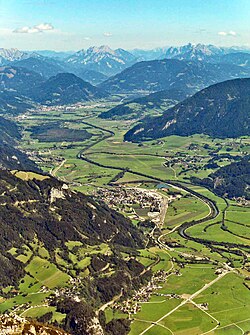
[edit]The Enns has its source in the Radstädter Tauern mountains in the Austrian state of Salzburg. In a valley which developed during the ice age, it flows at the border between the Northern Limestone Alps and the Central Eastern Alps on an eastern trajectory through Styria, where it passes the Dachstein group at its southern side. Between Admont and Hieflau, it takes a turn to the North and passes through the Gesäuse, a gorge of a length of 15 km (9.3 mi), where it penetrates the limestone of the Ennstaler Alpen. Flowing to the north from there on, it reaches the state of Upper Austria at the mouth of the Laussabach. North of Steyr, it forms the border between Upper Austria and Lower Austria (formerly also known as Austria above the Enns and Austria below the Enns). Finally, it meets the Danube at Mauthausen and the city of Enns. It is the longest river solely in Austria.
The Enns is a typical wild water river and draws its water from an area of 6,084 km2 (2,349 sq mi),[10] which makes it the fifth-largest in Austria. Its average discharge at the mouth is 200 m3/s (7,100 cu ft/s).[11]
The Anisian Age in the Triassic Period of geological time is named from Anisus, the Latin name of the river Enns.
History
[edit]During the Diocletianic Persecution of Christians, Saint Florian was drowned in the river by Roman soldiers for refusing to make a sacrifice to the Roman gods in accordance with Roman religion.[12][circular reference]
In the middle of the 19th century, canals began to be built along the 70 km (43 mi) between Weißenbach and the Gesäuse, in order to make use of the water for agriculture and forestry.
In total, ten power plants with a total generative power of 345 megawatts have been built by the Ennskraftwerke AG.
Towns along the river
[edit]Hydroelectric power stations
[edit]Currently, there are 15 hydroelectric power stations on the Enns.[13] The power stations are listed beginning at the headwaters:
| Dam | Nameplate capacity (MW) | Annual generation (Mio. kwh) |
|---|---|---|
| Gstatterboden | 2 | 6.8 |
| Hieflau | 63 | 388 |
| Landl | 25 | 135.5 |
| Krippau | 30 | 173.5 |
| Altenmarkt | 26 | 165.9 |
| Schönau | 30 | 122.8 |
| Weyer | 37 | 159.6 |
| Großraming | 72 | 270.7 |
| Losenstein | 39 | 170 |
| Ternberg | 40 | 169.7 |
| Rosenau | 34 | 145.5 |
| Garsten-St. Ulrich | 38 | 162.5 |
| Staning | 43 | 203.2 |
| Mühlrading | 25 | 111.8 |
| St. Pantaleon | 52 | 261.6 |
Tributaries
[edit]The most important inflows are the Palten, the Salza and the Steyr. Other tributaries are the Northern Taurach and the Erzbach.
Transport
[edit]A major transit route connecting Germany and Slovenia through Austria runs through the Enns valley. The so-called Eisenstraße ("iron road") runs along the river between Hieflau and Enns, along which iron ore has been transported from the Styrian Erzberg ("ore mountain") to the steel mill in Linz. The 263 km Enns Radweg cyclepath [14] follows the river starting at Flachauwinkl and finishing where the Enns enters the Danube.
References
[edit]- ^ Digitaler Atlas der Steiermark (Styria)
- ^ a b "Karte-Enns" (river map in German), RadTouren.at (Austria), May 2009, webpage: RT-map at the Wayback Machine (archive index) (236kb).
- ^ Barclay, James (September 14, 1815). "Barclay's English Dictionary. With which is incorporated a complete modern gazetteer, a beautiful atlas of maps and also a pronouncing dictionary". Alexander Cumming – via Google Books.
- ^ Bryce, James (September 14, 1862). "The family gazetteer and atlas of the world. The atlas by W. & A.K. Johnston" – via Google Books.
- ^ P. Anreiter, M. Haslinger and U. Roider, “The names of the eastern Alpine region mentioned in Ptolemy”, in Ptolemy: Towards a linguistic atlas of the earliest Celtic place-names in Europe, ed. D.N. Parsons and P. Sims-Williams, Aberystwyth, 2000, p. 129, note 53.
- ^ "Anzeige von How Old Are the River Names of Europe? A Glottochronological Approach | Linguistik Online". Linguistik Online. 70 (1). 2015. doi:10.13092/lo.70.1749.
- ^ "Basque – Iberian – Paleoeuropean » 2018 » February".
- ^ "The problematic of substrates – A case study of Iberia – Ancient DNA Era". 22 April 2019.
- ^ Solution, Horydoly cz, Next Generation. "Enže (Enns) pro vodní turisty". www.horydoly.cz.
{{cite web}}: CS1 maint: multiple names: authors list (link) - ^ "Flächenverzeichnis der Flussgebiete: Ennsgebiet" (PDF). Beiträge zur Hydrografie Österreichs Heft 61. October 2011. p. 68.
- ^ "Danube River Basin District, Part A - Roof Report" (PDF). ICPDR. April 2004. p. 12.
- ^ "Saint Florian".
- ^ "Die Enns" (in German). Verbund. Retrieved 2016-09-14.
- ^ "River Enns Cycle Trail".
| International | |
|---|---|
| National | |
| Geographic | |
| Other | |


Enns (river)
View on GrokipediaEtymology
Name Origins
The name of the Enns River traces back to the Latin form Anisus or Anasus, employed by Roman writers to denote this waterway in the province of Noricum. This nomenclature appears in classical geographical works, reflecting the river's significance as a regional feature during the Roman era. The Latin name Anisus also gave rise to the "Anisian," a stage in the Middle Triassic geological period.[7] Scholars have proposed an Indo-European origin for the name, deriving it from the root on-, which conveys concepts of "water" or "flow," augmented by the common hydronymic suffix -is-. This etymological connection suggests a pre-Roman linguistic layer, potentially Celtic or broader Indo-European, embedded in the Alpine region's ancient hydrology. The proposal, while not universally accepted, aligns with patterns observed in other European river names sharing similar formative elements.[8] The earliest known attestation of Anisus occurs in Ptolemy's Geography (2nd century AD), where it is listed among the rivers and place names of the eastern Alpine area, providing a key historical anchor for the river's nomenclature. This reference underscores the name's endurance from antiquity into later periods, though its precise pre-Latin evolution remains a subject of ongoing linguistic inquiry.[9]Linguistic Variations
The primary modern name for the river in Austria is the German "Enns," which serves as the official designation across German-speaking regions and administrative documents.[10] Reflecting West Slavic linguistic influences, the river bears distinct names in neighboring languages: Enže in Czech, used in regional travel and outdoor activity descriptions; Enža in Slovak, appearing in tourism and geographical references; and Aniza in Polish, employed in maps and guides for cross-border exploration.[11][12][13] These variations highlight Slavic adaptations and are commonly featured in bilingual contexts, such as multilingual tourist brochures, hiking maps, and navigation apps targeting visitors from Czechia, Slovakia, and Poland, where the local names facilitate accessibility for regional audiences.[14][15][16]Geography
Course
The Enns River originates in the Radstädter Tauern mountains within the Austrian state of Salzburg, near the village of Flachau, at an elevation of approximately 1,735 meters above sea level. From its headwaters, the river initially flows northward through the glacially shaped upper Ennstal valley, a scenic alpine corridor characterized by steep slopes and forested terrain developed during the last Ice Age. This initial stretch winds through mountainous landscapes before gradually turning eastward as it descends into broader valleys.[2][17] The Enns continues its predominantly eastward path through the state of Styria, traversing the central Ennstal region with its mix of alpine meadows, gorges, and forested hills. In this middle course, the river passes through geologically diverse areas, including the dramatic Gesäuse National Park, where it cuts through narrow canyons flanked by rugged limestone peaks. Near the town of Hieflau, the Enns sharply turns northward, entering Upper Austria and shifting from alpine to more rolling foothill terrain as it approaches the Danube lowlands. Along its 253-kilometer length, the river forms significant natural boundaries between Austrian federal states, including the border between Salzburg and Styria in the upper reaches, Styria and Upper Austria in the central section, and Upper Austria and Lower Austria in the lower stretches.[6][18][19] In its final course through Upper Austria, the Enns flows northward across the fertile plains of the Traun-Enns Plateau, widening into meandering channels amid agricultural landscapes. It joins the Danube as a major southern tributary at the confluence near the towns of Enns and Mauthausen, at coordinates 48°14′13″N 14°31′08″E, marking the end of its journey from high alpine source to lowland river. This overall path traces a characteristic flat-J shape, reflecting the river's adaptation to the underlying geology and topography of central Austria.[20]Hydrology
The Enns River drains a basin covering approximately 6,080 km², primarily within the Eastern Alps of Austria, making it one of the larger tributaries of the Danube.[21] This catchment area encompasses diverse terrains from high-alpine regions to lower valley plains, contributing significantly to the river's water volume. The average discharge at the river's mouth into the Danube near Enns is about 200 m³/s, reflecting the substantial inflow from its alpine sources.[22] The hydrological profile of the Enns is characterized by its origins in the steep, high-gradient Alpine headwaters in the Radstädter Tauern mountains, where rapid runoff predominates due to the mountainous terrain. As the river progresses through the Northern Limestone Alps in its middle reaches, it encounters karst features, particularly in the Kalkalpen region, which influence subsurface drainage and lead to variable surface flows through sinkholes and springs.[23] Further downstream, the gradient decreases, resulting in a transition to meandering patterns in broader valleys, where sediment deposition and slower flow dynamics become more prominent. Flow dynamics exhibit pronounced seasonal variations, with peak discharges driven by snowmelt in spring (typically May–June) and intense rainfall events throughout the year, often exceeding average levels by several times during high-water periods. These variations pose notable flooding risks, especially in the upper and middle sections, where heavy precipitation in the Eastern Alps can rapidly increase runoff from the steep slopes and karst conduits.[24] Historical flood events, such as the 2013 Upper Danube flood, underscore how these alpine influences amplify discharge peaks, with the Enns contributing substantially to downstream inundation along the Danube.[22]History
Ancient and Medieval Periods
During the Roman era, the Enns River, known in Latin as the Anisus, played a significant role in the province of Noricum as part of the Danube Limes frontier defense system.[25] The river's mouth at the Danube facilitated military routes and trade connections, with the legionary fortress of Lauriacum (modern Lorch-Enns) established around 205 AD to house up to 6,000 soldiers of Legio II Italica, protecting the empire's northern border against barbarian incursions.[26] This strategic location supported commerce in iron, salt, and other regional goods, while the surrounding vicus (civilian settlement) grew into a key administrative and economic hub by the 3rd century.[27] In the 4th century, amid the Diocletianic Persecution, the Enns became associated with early Christian martyrdom. Saint Florian, a Roman military officer and commander in Noricum, was executed for his faith around 304 AD by being scourged, flayed, and ultimately drowned in the Enns with a millstone tied to his neck near Lauriacum.[28] His relics were later enshrined in the Basilica of St. Lawrence in Lorch, marking the river as a site of religious significance in the spread of Christianity along the Danube corridor.[29] The river retained strategic importance through the early Middle Ages as the eastern boundary of the March of Austria, established around 976 AD as the Ostarrîchi (Eastern Realm) under the Babenberg dynasty to secure the Holy Roman Empire's frontier against Magyar and Slavic threats.[30] Fortifications at the Enns-Danube confluence, including early Carolingian-era strongholds from the 9th century, evolved into more robust defenses by the 12th century, such as the city walls of Enns begun in 1193–1194.[29] The town of Enns, at the river's mouth, was granted its charter on April 22, 1212, by Duke Leopold VI, making it Austria's oldest documented municipality and a vital trading post along medieval Danube routes.[29]Modern Developments
In the mid-19th century, the Enns River underwent significant regulation efforts to support agricultural expansion and forestry activities, including the construction of canals along approximately 70 km of its course between Weißenbach an der Enns and the Gesäuse region to utilize water for irrigation and timber transport. These interventions also involved straightening sections of the river to mitigate flooding and reclaim land for settlement and farming, transforming meandering stretches into more controlled channels that facilitated mechanical agriculture and reduced inundation risks in adjacent valleys. Such modifications were part of broader Habsburg-era initiatives to harness alpine waterways for economic development, particularly in Styria and Upper Austria.[31] Following World War II, the Enns saw rapid industrialization through the expansion of hydroelectric infrastructure, driven by Austria's post-war energy demands and reconstruction efforts under the Ennskraftwerke AG, established in 1947. Immediately after the war, the Enns River formed part of the demarcation line between American and Soviet occupation zones in Austria, with U.S. and Soviet forces meeting near Enns on May 8, 1945, until the Austrian State Treaty in 1955.[32][29] This period marked the construction and commissioning of multiple run-of-river power plants along the river's middle and lower reaches, contributing to a total installed capacity of around 345 MW across the system, which supports renewable energy production equivalent to powering over 500,000 households annually. Key developments included facilities like the St. Pantaleon (52 MW) and Sölk (61 MW) plants, exemplifying the shift toward large-scale hydropower to fuel industrial growth while integrating flood control measures into dam and weir designs.[33][34][35] In the 21st century, management of the Enns has aligned with European Union directives, particularly the [Water Framework Directive](/page/Water Framework Directive) (2000/60/EC) and Floods Directive (2007/60/EC), emphasizing ecological restoration alongside flood risk reduction. Projects such as the LIFE IRIS initiative have implemented minor adjustments, including the removal of hard embankments and creation of retention areas over 20 km of the river corridor, to enhance water storage capacity and natural flow dynamics while complying with EU goals for good ecological status. These updates, often led by collaborations between Verbund AG and regional authorities, represent a balanced approach to sustaining the river's role in energy production and agriculture amid climate change pressures.[36][37][38]Settlements
In Salzburg
The upper reaches of the Enns River in the state of Salzburg flow through the Pongau district, where the landscape transitions from high alpine terrain to broader valleys, supporting a cluster of small settlements centered on tourism and traditional alpine agriculture. These communities benefit from the river's proximity, which provides scenic backdrops for outdoor activities and contributes to local water management for farming, though the Enns itself remains largely undeveloped for navigation due to its mountainous course.[3] Flachau, located near the Enns's source at an elevation of about 950 meters in the Radstädter Tauern mountains, serves as a gateway to the river's headwaters and is renowned as a premier ski resort within the Ski amadé region. The village's economy revolves around year-round alpine tourism, including winter skiing on slopes accessible via cable cars and summer pursuits like hiking and cycling along the Enns Cycle Path, which begins here as kilometer zero; agriculture plays a supporting role through mountain pastures that maintain water quality and supply dairy products to local markets.[3][39] Adjacent to Flachau, Altenmarkt im Pongau lies along the young Enns in a sunny valley setting, emphasizing winter sports and as a hub for cross-country skiing events, with the river enhancing recreational trails for biking and walking. Its economy is tourism-driven, bolstered by alpine farming that utilizes Enns-fed meadows for livestock grazing, sustaining a community focused on sustainable rural livelihoods.[3] Further downstream, Radstadt marks a key settlement on the Enns, a medieval town founded in the 12th century and fortified with historic walls that encircle its well-preserved core, including Renaissance-era buildings and gates. With an economy anchored in bi-seasonal tourism—drawing visitors for skiing, cultural festivals, and Enns Valley cycling—the town also supports agriculture through valley farms producing crops and livestock, where the river aids irrigation and flood control in this transitional alpine zone.[40][41]In Styria
In Styria, the Enns River traverses the Ennstal Valley, a transitional landscape blending forested highlands with industrial and touristic developments, extending approximately 128 kilometers from the Salzburg border to the Upper Austria boundary. This mid-river section features a mix of forestry, which covers much of the surrounding terrain supporting local timber economies, light industry concentrated in valley towns, and nature-based tourism drawn to the river's dynamic flow and adjacent protected areas. The valley's economy reflects this balance, with hydroelectric facilities along the unregulated stretches contributing to regional energy needs while preserving opportunities for rafting and hiking.[42][6][43] Schladming, located shortly after crossing into Styria from Radstadt, is a prominent former mining town now established as a major winter sports resort in the Schladming-Dachstein region, having hosted the 2013 FIS Alpine World Ski Championships. The Enns runs through the town, enhancing its appeal with sections of the Enns Cycle Path for biking and walking, while the economy centers on year-round tourism including skiing, hiking, and cultural events, complemented by limited local agriculture in the valley.[44][45] Further downstream, Liezen, a central hub in the Liezen District—the largest in Styria—serves as a key industrial center along the Enns, hosting engineering firms like Maschinenfabrik Liezen und Gießerei, which specializes in heavy machinery and foundry work, alongside retail and transit infrastructure supporting the valley's role as a north-south corridor. The town's location in the widening Enns Valley facilitates both commercial activities and access to outdoor pursuits, with the river providing scenic backdrops for local recreation.[46][47][48] Further downstream, Admont emerges as a historic abbey town on the Enns's banks, anchored by the Benedictine Admont Abbey, founded in 1074 and renowned for its Baroque library, one of the world's largest monastic collections, which draws cultural tourists to the site. Nestled at the Ennstal Alps' edge, the town integrates the river's serene flow with abbey-led heritage preservation, complementing the valley's forestry traditions through managed woodlands that supply timber for regional crafts.[49][50][42] Hieflau, positioned near the Styria-Upper Austria border, acts as a gateway to Gesäuse National Park, where the Enns carves dramatic gorges through limestone formations, fostering adventure tourism via rafting on the river's wilder segments and hiking trails amid dense forests. This endpoint of Styria's Enns stretch highlights the river's role in delineating natural borders while sustaining eco-tourism that emphasizes the untouched gorges and biodiversity hotspots.[51][52][53]In Upper Austria
In Upper Austria, the lower course of the Enns river traverses a landscape transitioning from alpine foothills to industrialized plains, supporting a series of settlements that highlight urban development, manufacturing, and historical trade along its banks.[54] These communities, spanning from the Styrian border northward to the Danube confluence, reflect the river's role as a vital corridor for economic activity since medieval times.[54] Weyer, a small rural municipality in the Enns Valley, serves as an entry point to the region with its focus on natural recreation and climatic health benefits.[55] Nestled amid forests and hills, it offers hiking and cultural sites, embodying the area's quieter, agrarian heritage.[55] Further downstream, Ternberg marks a shift toward industrial activity in the Steyr-Land district, acting as a gateway to the Enns Valley with its valley basin location facilitating local mining and quarrying operations.[56][57] The community supports manufacturing tied to the broader regional economy, including resource extraction that has historically complemented river-based transport.[58] Steyr, the largest settlement along this stretch, is a major industrial hub at the confluence of the Enns and Steyr rivers, driving Upper Austria's manufacturing sector with its long-standing automotive legacy.[59] Founded over a millennium ago, the city evolved as a key trade center for iron ore transported via the Enns, later becoming home to Steyr-Daimler-Puch, which produced vehicles from 1918 onward and pioneered four-wheel-drive tractors in the mid-20th century.[54][60] Today, it remains an economic powerhouse, blending historical architecture with modern engineering firms.[59] At the northern end, the town of Enns lies at the river's mouth into the Danube, featuring a well-preserved medieval core that underscores its role as a historical trade nexus.[61] Established with town privileges in the early 13th century, it boasts Roman-era foundations and Gothic structures, serving as a cultural anchor for the lower Enns' urban fabric.[61]In Lower Austria
In Lower Austria, the Enns River marks the border with Upper Austria along its final stretch, resulting in a sparse distribution of settlements on the Lower Austrian side compared to the more densely populated Upper Austrian bank. This border configuration limits direct riverfront communities, with development concentrated near the river's mouth into the Danube at the town of Enns, where hydrological dynamics such as sediment deposition and flood risk influence local land use and infrastructure.[62] The principal settlement is Ennsdorf, situated directly on the Enns in the Amstetten district within the Mostviertel region, opposite the historic town of Enns. With a population of about 3,300 residents, Ennsdorf functions as a key economic and residential hub in the Enns-Danau-Winkel area, supporting agriculture, small-scale industry, and cross-border connectivity via the Enns Bridge.[63][64] Upstream along the border, smaller communities like Haidershofen provide additional river-adjacent habitation. Haidershofen, also in the Amstetten district, features a population of around 3,500 and integrates the Enns into local recreation, with trails and paths highlighting the river's role in cycling and hiking routes near the confluence zone. Nearby villages, such as Ramingdorf in the municipality of Behamberg, contribute to this modest settlement pattern, emphasizing rural landscapes over urban expansion.[65][66]Infrastructure
Hydroelectric Power Stations
The Enns River is equipped with 10 hydroelectric power stations, collectively generating approximately 345 MW of installed capacity. These facilities are predominantly situated in Styria and Upper Austria, reflecting the river's course through alpine and pre-alpine regions conducive to hydropower development. Most are run-of-river installations, supplemented by a few with small reservoirs to manage flow variations and enhance efficiency during peak demand periods. Key examples include the Hieflau power station in Styria, which has an installed capacity of 63 MW and produces about 370 million kWh annually, making it one of the largest on the river. Similarly, the Großraming station in Upper Austria features 72 MW of capacity, contributing significantly to regional energy supply through its Kaplan turbines optimized for variable river flows.[67][68] The majority of these stations are operated by Verbund AG through its subsidiary Ennskraftwerke AG, which manages the cascade along the middle and lower Enns. This setup plays a vital role in Austria's renewable energy mix, where hydropower accounts for over 60% of electricity production; the Enns facilities contribute to Verbund's output of more than 30 TWh annually from hydropower nationwide, aiding national goals for carbon-neutral energy by 2040.[69]Transport and Navigation
The Enns River has long served as a vital corridor for trade and mobility in central Austria, particularly in the transport of iron ore from the Styrian Erzberg mine to the Danube. For centuries, ore was floated downstream on wooden rafts, a perilous endeavor due to the river's violent torrents and large reefs that made navigation hazardous and frequently resulted in losses.[70] By the 16th century, these rafts were largely supplanted by more robust barges capable of carrying up to 10 tons of cargo, which were towed upstream by horses along specialized shore paths known as Treppelwege when returning with foodstuffs and other goods.[70] Complementing river-based efforts, the Eisenstraße—translated as the "Iron Road"—facilitated overland wagon transport of iron products alongside the Enns valley, linking Styrian mining regions to Danube markets and fostering economic ties across the provinces.[71] Today, the Enns remains unnavigable for commercial shipping along its full length owing to persistent natural barriers like rapids and reefs in the upper reaches, as well as modern obstructions that preclude large-scale vessel passage.[70] Instead, recreational and tourist activities dominate riverine mobility, with the 263-kilometer Ennsradweg (Enns Cycle Path) offering a dedicated, family-friendly route for cyclists tracing the river from its alpine source in the Niedere Tauern mountains through Salzburg, Styria, and Upper Austria to its confluence with the Danube near Enns.[72] This well-maintained path, mostly flat with asphalt and gravel surfaces, highlights scenic valleys, historic sites, and national parks while promoting sustainable tourism and connecting key settlements such as Steyr and Radstadt.[73] Parallel infrastructure enhances regional connectivity, with the Ennstalbahn (Enns Valley Railway) providing electrified rail service along much of the valley from Bischofshofen in Salzburg to Selzthal in Styria, facilitating passenger and freight movement through stations in towns like Liezen and Steyr.[74] Local roads, including the B115 federal highway running through the Enns Valley and access from the A1 motorway at the Enns-Steyr exit, support vehicular travel and integrate the river corridor into broader Austrian transport networks.[71]Tributaries
Left-Bank Tributaries
The left-bank tributaries of the Enns River primarily drain the southern Alpine slopes, featuring steeper gradients that facilitate rapid runoff from mountainous terrain and contribute significantly to the Enns' seasonal discharge variations, especially during spring snowmelt. These streams are generally shorter and more torrential compared to the longer, meandering right-bank inflows from the northern plateaus, enhancing the Enns' overall hydrological dynamism without dominating its total basin area.[75] Among the notable left-bank tributaries is the Grimmingbach, approximately 27 km long, which originates in the Dachstein Mountains and joins the Enns near Gröbming in Styria, adding waters from alpine karst regions.[6] The Steyr River stands out for its scale and integration into the urban landscape. Stretching 68 km from its source in the Totes Gebirge mountains, it meanders southward before joining the Enns at the city of Steyr in Upper Austria, where the confluence supports local water management and historical navigation routes. This tributary drains a catchment of approximately 917 km², delivering consistent flows that bolster the Enns's discharge in the central basin.[76][77] Further downstream, the Aich, around 25 km in length, flows from the Schladming Tauern and enters the Enns near Aich in Styria, contributing to the river's flow in the lower Styrian sections.[6] These tributaries, while not exhaustive, exemplify the southern inputs that shape the Enns' gradient and flood regime, with their combined catchments covering hundreds of square kilometers of steep, precipitation-rich terrain.[78]Right-Bank Tributaries
The right-bank tributaries of the Enns River, entering from the northern bank, primarily originate in the northern plateaus and the peripheral zones of the Bohemian Massif, providing essential water contributions to the mid-basin hydrology through their relatively longer and meandering courses shaped by the undulating terrain. These inflows differ from southern counterparts by drawing from less steeply sloped landscapes, which promote wider valleys and more gradual sediment transport, enhancing overall basin stability.[79] Among the notable right-bank tributaries is the Palten, a 46 km long stream originating in the Eisenerzer Alps of Styria and joining the Enns near Pürgschachen, close to Admont, where it adds sediment-rich waters from forested valleys.[80] The Salza, measuring 88 km, sources in the alpine Kalkalpen region straddling Lower Austria and Styria, flowing northward through rugged gorges before its confluence with the Enns at Großreifling in the Gesäuse area, providing a key influx of high-quality water that supports downstream ecology.[81] Further upstream, the Northern Taurach (also known as Pongauer Taurach), approximately 20 km in length, emerges from the Radstädter Tauern mountains and enters the Enns at Radstadt in Salzburg, channeling meltwater from glacial-influenced highlands that bolsters early-season flows. The Erzbach exemplifies the northern plateau origins, rising in the Eisenerz Alps near Eisenerz and flowing 22.4 km southeast to its confluence with the Enns at Hieflau in Styria. With a drainage basin of 256 km², it collects waters from iron-rich highlands, contributing mineral-laden runoff that influences the Enns's water quality and supports downstream ecological diversity in the Gesäuse region.[82][77] The Ramingbach, another key example, extends 23 km from the Kalkalpen near Großraming, entering the Enns in Upper Austria's forested uplands. Its meandering path through narrow valleys aids in recharging the Enns's mid-section flows, with its 71.4 km² basin providing vital seasonal water inputs amid the northern foreland plateaus. The Sölkbach, about 42 km long, drains the Sölk Tauern and joins near Sölk in Styria, contributing to the upper basin's flow from northern slopes.[77][6]| Tributary | Length (km) | Confluence Location | Catchment Area (km²) | Key Characteristics |
|---|---|---|---|---|
| Erzbach | 22.4 | Hieflau, Styria | 256 | Mineral-rich from alpine edges; supports gorge ecology |
| Ramingbach | 23 | Near Großraming, Upper Austria | 71.4 | Forested plateau drainage; seasonal flow stabilizer |
| Salza | 88 | Großreifling, Styria | 868 | Rugged gorges; high-quality water influx |
Ecology and Environment
River Modifications
The regulation of the Enns River commenced in the mid-19th century, driven by the need to expand agricultural land use and settlement areas along its course. This initial phase involved systematic straightening of the river, which shortened its overall length by approximately 18% through the cutoff of 37 meander bends, alongside drainage efforts that dried surrounding valley swamps.[31] These efforts continued and intensified in the early 20th century with a broader flood protection program, entailing further channelization, stabilization of riverbanks using riprap, and backfilling of most side arms to contain flows and prevent erosion. Such modifications transformed the Enns from a dynamic, meandering system into a more controlled and uniform channel, with riprap fortifications applied extensively along its banks to support agriculture and infrastructure development.[83] The alterations had significant ecological consequences, including the loss of meanders, gravel banks, and interconnected side channels that once supported diverse riparian habitats. This homogenization reduced habitat variability for aquatic and terrestrial species, while the straightened profile accelerated flow velocities in regulated sections, diminishing natural retention capacity and heightening downstream flood propagation.[83][31] Major flood events in 1954 and 2002 underscored the limitations of these modifications and spurred additional engineering responses. The 1954 flood, part of a widespread deluge in the Austrian Danube basin, swelled the Enns alongside tributaries like the Inn and Traun, causing extensive inundation and damage in valley settlements. Similarly, the severe August 2002 floods prompted targeted interventions, such as the construction of an 800-meter flood protection dam and widening of the riverbed in vulnerable sections like Aich to enhance retention and mitigate future risks.[84][31]Conservation Projects
The Enns River has been the focus of several EU-funded LIFE projects aimed at reversing historical channelization and restoring its natural dynamics. These initiatives emphasize renaturalization to enhance ecological connectivity, biodiversity, and flood resilience while complying with the EU Water Framework Directive.[85] A key effort is the LIFE IP IRIS project, which includes the Enns-Salzburg and Enns-Styria sub-projects, targeting a combined 151 km of the river. In Salzburg, the 23 km section from the Grießbach confluence in Flachau to the Styria border underwent meander restoration near Mandlinger Moor between 2022 and 2023, reviving pre-regulation river morphology to improve hydromorphological conditions from moderate to good ecological status.[39] This involved reconnecting the river to its floodplain, creating dynamic habitats such as gravel banks and side arms that support fish species like the grayling (Thymallus thymallus) and birds including the kingfisher (Alcedo atthis).[2] Outcomes include reduced flood peaks for 100-year events (protecting against discharges up to 200 m³/s) and enhanced biodiversity in Natura 2000 sites, with monitoring continuing until 2027.[39] The Enns-Styria component of IRIS addresses 128 km from the Salzburg border to the Gesäuse gorge entrance, with planning from 2019 to 2021 and pilot measures implemented through 2026. Measures focus on river widening, gravel bed restoration, and habitat creation through floodplain reconnection and deadwood introduction, aiming to elevate the river's ecological status while integrating flood risk management for settlements like Liezen.[6] These actions have preserved alluvial forests and wetlands, benefiting species such as the European otter (Lutra lutra) and bullhead (Cottus gobio), and reduced flood risks by retaining bedload and lowering peak flows from 100-year to more manageable 30-year events in vulnerable areas.[86] By mid-2026, the project is expected to yield measurable biodiversity gains and improved connectivity for migratory fish.[87] As of 2025, initial construction measures under the IRIS project are underway and scheduled for completion by the end of the year.[88] Building on IRIS findings, the LIFE WeNatureEnns project, initiated in 2024 (with a public launch in April 2025) by Verbund and partners, targets a 20 km stretch in Styria between the Sölk River mouth and Stainach over seven years until 2031. It prioritizes valley widening by removing bank protections, creating 35 hectares of new floodplain habitats including amphibian ponds, riparian forests, hedges, and reptile refuges, alongside ecological sediment management and tributary reconnection.[89] Goals include fostering near-natural river dynamics to boost habitat diversity for protected species in Natura 2000 areas and mitigate flood risks through increased retention capacity.[89] Expected outcomes encompass enhanced biodiversity via gravel restoration and deadwood structures, supporting fish and bird populations, alongside sustainable flood protection and agricultural integration through farmer engagement events.[37] In October 2025, the citizens' initiative 'Wilde Wasser – Enns und Talbachklamm' received the FishLife AWARD 2025 from ÖKF FishLife (Austria) for its contributions to the river's ecological protection.[90]References
- https://en.wikivoyage.org/wiki/Schladming