Hubbry Logo
Rock burstRock burstMain
Open search
Rock burst
Community hub
Rock burst
logo
8 pages, 0 posts
0 subscribers
Be the first to start a discussion here.
Rock burst
Rock burst
from Wikipedia
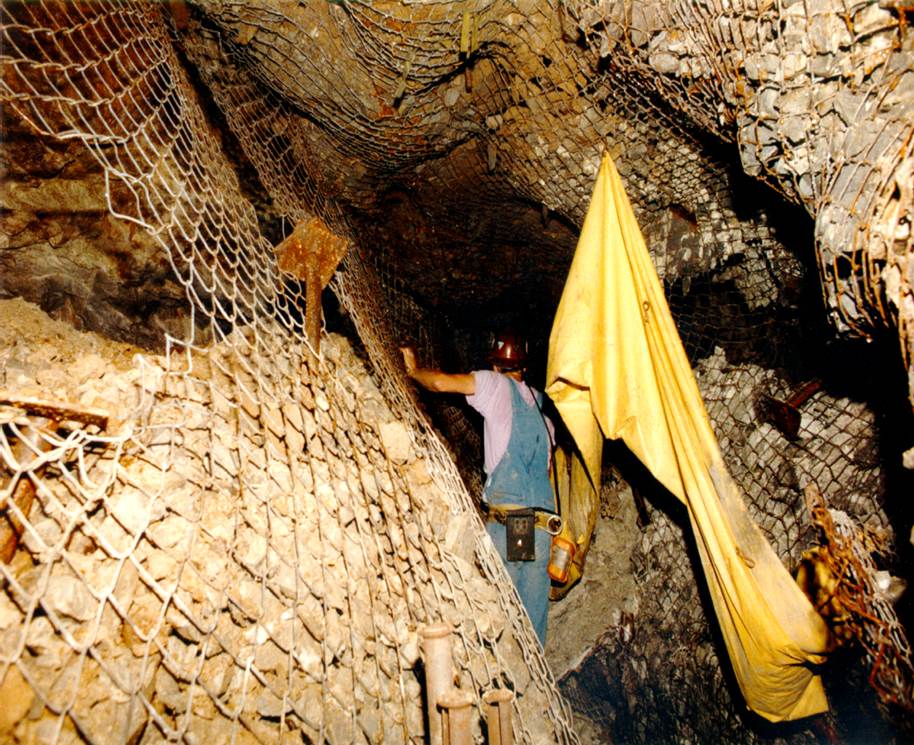
Rock burst damage at a deep US mine

A rock burst is a spontaneous, violent failure of rock that can occur in high-stress mines. Although mines may experience many mining-related seismic events, only the tremors associated with damage to accessible mine workings are classified as rock bursts.[1] The opening of mine workings relieves neighboring rocks of tremendous pressure, which can cause the rock to fail explosively or trigger abrupt movement in nearby geological structures. Rock bursts are a serious hazard;[2][3]

Always a problem in South Africa,[4] they kill a large number of miners each year.[5][6]

Details

[edit]

Rock bursts result from brittle fracturing of rock, causing it to collapse rapidly with violent spalling of rock that is approximately 100 to 200 tonnes, or more. This release of energy reduces the potential energy of the rock around the excavation. Another explanation is that the changes brought about by the mine's redistribution of stress trigger latent seismic events, deriving from the strain energy produced by its geological aspects.[2][3][7]

The likelihood of rock bursts occurring increases as the depth of the mine increases.[8] Rock bursts are also affected by the size of the excavation (the larger the more risky), becoming more likely if the excavation size is around 180 m and above. Induced seismicity such as faulty methods of mining can trigger rock bursts. Other causes of rock bursts are the presence of faults, dykes, or joints.[2][3][7]

Mitigation

[edit]

Approaches for dealing with rock bursts can be divided into two categories: tactical measures, which can be taken locally and at short notice in response to a heightened level of rock burst hazard, and strategic measures, which must be integrated into the mine design process and long-term planning.[2]

Tactical measures

[edit]

A number of tactical measures have been used successfully to reduce rockburst hazards. They include:[2]

  1. Using support systems that absorb energy and deform without breaking. Even where these systems suffer damage, they are often able to limit falls of ground and permit access where other systems fail completely.
  2. Using destress blasting can reduce rock burst hazards, particularly highly stressed brittle rock. Destress holes can be efficiently integrated into conventional rounds. Destress blasting of large volumes, however, can be more problematic.
  3. Slowing the rate of extraction will often reduce the amount of seismicity in relation to tonnage mined and may actually prevent bursting under some conditions.

Strategic measures

[edit]

Strategic measures that have been used successfully include:[2]

  1. A properly planned sequence of stoping for the whole ore body should be adopted and followed as closely as possible.
  2. The merging of large excavations at depth should be avoided.
  3. Pillars, or volumes of rock in between excavations, should be eliminated or reduced to a minimum.
  4. Parallel veins should be stoped singly, the hanging wall vein first (footwall vein first if underhand mining).
  5. Where veins branch, stoping should begin at the intersection and then progress away from the intersection one branch at a time.
  6. Where possible, stoping should proceed away from a fault or other plane of weakness.
  7. Mined-out areas should be filled, and filling should proceed concurrently with extraction and be kept as close to the face as possible.

See also

[edit]

References

[edit]

Further reading

[edit]
Revisions and contributorsEdit on WikipediaRead on Wikipedia
from Grokipedia
A rock burst is a sudden, violent of hard and brittle rock masses in underground excavations, such as mines or tunnels, characterized by the rapid release of accumulated elastic , resulting in the ejection of rock fragments and potential seismic activity. This phenomenon typically occurs in high-stress environments where excavation disturbs the equilibrium of stresses, leading to dynamic instability and damage to surrounding structures. The primary mechanisms of rock bursts involve the storage and abrupt dissipation of within the rock mass, often triggered by stress concentrations around excavations that exceed the rock's . Key causes include high stresses from deep (commonly beyond 1000 meters), the inherent brittleness of rocks like or , and geological discontinuities such as faults or joints that facilitate energy propagation. Additional factors encompass dynamic disturbances from blasting or mining-induced , which can propagate shock waves and exacerbate stress redistribution in the rock mass. Rock bursts are classified into several types based on their source mechanisms and confinement conditions, including strain bursts (self-induced failures in low-confinement zones near excavation faces), pillar bursts (in moderately confined pillar structures), and fault-slip bursts (high-confinement events triggered by remote seismic activity along geological weaknesses). Other variants involve , ejection, or implosive failures, distinguished by the mode of energy release—such as tensile cracking or shear rupture—and the from the excavation site. These classifications aid in prediction and mitigation, with strain bursts being the most common in civil tunneling and fault-slip types posing greater risks in deep due to their higher energy magnitudes. Historically, rock bursts have been documented since at least the , with early records in German tin mines in the 1640s and further reports in British tin mines in the , but systematic study emerged in the early amid deep in South Africa's region, where they caused significant fatalities and operational disruptions. Notable modern incidents include the 2009 rock burst at China's Jinping II hydropower station, which resulted in seven deaths and highlighted the hazards in large-scale tunneling projects. Prevention strategies have evolved to include destress blasting to relieve accumulated energy, yielding support systems like dynamic rock bolts, and advanced monitoring via microseismic networks and signals, substantially reducing risks in high-geostress environments. Recent advancements as of include AI-based short-term prediction models and fractal analysis of microseismic energy for improved early warnings.

Definition and Overview

Definition

A rock burst is a spontaneous and violent failure of intact rock surrounding underground excavations in high-stress environments, driven by the rapid release of accumulated elastic when induced stresses exceed the rock's strength. This phenomenon typically results in the ejection of brittle rock fragments, often amounting to 5–100 tonnes in typical cases and up to several hundred tonnes in severe events, at high velocities reaching up to 50 m/s for smaller particles. Rock bursts differ from related phenomena such as coal bumps, which involve similar dynamic failures but are confined to seams and overlying sedimentary strata due to their specific material properties, and mine earthquakes, which are broader seismic disturbances in the rock mass that generate vibrations without necessarily causing significant ejection of material into the excavation. The occurrence of rock bursts is predicated on the accumulation of within the rock mass under in-situ stresses— the pre-existing compressive forces in the that act on the rock prior to any human-induced disturbances like . These stresses cause elastic deformation, storing that can be suddenly liberated during excavation, leading to unstable failure if the rock cannot dissipate the energy gradually. The elastic strain energy density stored in the rock per unit volume is quantified by the formula U=12σ2EU = \frac{1}{2} \frac{\sigma^2}{E} where σ\sigma represents the deviatoric stress and EE is the rock's modulus of elasticity; this equation illustrates how higher stresses or lower stiffness amplify the energy available for violent release.

Characteristics

Rock bursts are typically preceded by audible precursors, including cracking sounds and minor rockfalls, which can occur in the minutes leading up to the event, providing potential early indicators for miners. These sounds result from initial crack propagation and minor instability in the surrounding rock mass. During a rock burst, ejection patterns manifest as violent failure involving radial fractures, spalling, or slabbing of the rock, where fragments are propelled outward from the excavation boundary. Rock pieces, often in the form of slabs or blocks, can be ejected at velocities ranging from 0 to 6 m/s for larger fragments, with smaller particles reaching 8–50 m/s, enabling them to travel distances of several meters into the mine opening. Seismically, rock bursts register as events with magnitudes typically ranging from -0.5 to 2.9 on the , though severe cases can reach up to 5.0, characterized by distinct P- and S-wave arrivals detectable through microseismic monitoring networks. These signatures reflect the rapid release of stored , often following the accumulation of microseismic activity. Environmental indicators accompanying rock bursts include the generation of dust clouds from pulverized material, air blasts due to sudden pressure changes, and ground vibrations with peak accelerations of 0.05–0.1 g near the source. These effects can propagate through the mine, impacting ventilation and stability further afield. Temporal patterns of rock bursts frequently exhibit clustering, with multiple events occurring in sequences over hours to days, often triggered in rapid succession following an initial burst that redistributes stress. This non-random temporal distribution underscores the importance of continuous monitoring during high-risk periods.

Causes and Mechanisms

Geological Factors

Rock bursts are predominantly influenced by inherent geological conditions that create preconditions for sudden energy release in the rock mass. High in-situ stress regimes, particularly in tectonically active regions, play a critical role, where horizontal stresses often exceed vertical stresses by factors of 1.5 to 3 times, leading to elevated strain energy storage. These stress anomalies arise from regional tectonic forces, amplifying the potential for brittle failure independent of excavation activities. Certain rock types exhibit low , making them particularly susceptible to rock bursts due to their nature. quartzites, granites, and hard sedimentary rocks, characterized by a low , typically below 0.3, store elastic with minimal plastic deformation, facilitating violent fracturing under stress. For instance, granites in high-stress environments demonstrate pronounced . Structural features within the rock mass further exacerbate vulnerability by localizing stresses. Faults, dykes, and folds act as stress concentrators, which can trigger instability through shear or tensile mechanisms. Dykes, for example, create stiff barriers that redirect stress fields, intensifying concentrations near excavation boundaries. The depth of the rock mass correlates strongly with burst propensity, as lithostatic increases at approximately 27 MPa per kilometer, building cumulative stress. Rock bursts are rare above 500 meters due to insufficient , but they peak between 1,000 and 3,000 meters where vertical stresses dominate and horizontal components amplify. This gradient underscores the role of in preconditioning deeper formations for energy accumulation. Prevalence of rock bursts is notable in Precambrian shields, where ancient tectonic histories have locked in high residual stresses. In South Africa's Witwatersrand Basin, deep gold mines encounter frequent bursts in quartzite-hosted reefs due to these regional stress fields. Similarly, Canada's Sudbury Basin, with its complex igneous and metamorphic rocks, experiences bursts linked to the structure's tectonic legacy, as documented in ongoing mine seismicity studies.

Mining-Induced Factors

Mining operations disrupt the equilibrium of stresses through excavation, leading to significant redistribution in the surrounding rock mass. This process creates stress concentrations near the excavation boundaries, where tangential stresses can reach 2-4 times the stress, while stress shadows form in adjacent areas with reduced loading. Such alterations exacerbate the accumulation of , promoting brittle failure and rock bursts when local stresses exceed the rock's strength. The extent of stress concentration is quantified by the factor K=σmaxσ0K = \frac{\sigma_{\max}}{\sigma_0}, where KK represents the concentration factor (typically ranging from 2 to 5 near openings), σmax\sigma_{\max} is the local maximum stress, and σ0\sigma_0 is the far-field stress. This equation, derived from elastic theory for underground openings, highlights how excavation geometry amplifies virgin stresses, with higher values observed in deep environments prone to bursts. Blasting and mining-induced seismicity further contribute to rock burst initiation by generating dynamic vibrations that propagate through the rock mass. Explosive charges or mechanical operations induce micro-fractures, which lower the rock's effective strength and trigger the sudden release of stored energy, often in high-stress zones adjacent to active workings. The scale of excavation plays a critical role, as larger spans exceeding 20 m or rapid advance rates greater than 1 m/day intensify stress gradients and limit time for natural , elevating burst risk compared to controlled operations. Inadequate support interactions compound this vulnerability; insufficient rock bolting or installations fail to dissipate from failing rock, resulting in uncontrolled pillar collapse and amplified burst violence.

Types of Rock Bursts

Classification by Severity

Rock bursts are classified by severity primarily based on the extent of damage to the surrounding rock mass and excavation . This provides a standardized framework for assessing levels and implementing appropriate strategies in underground mining and tunneling operations. Severity categories—typically mild, moderate, and severe—help engineers evaluate the potential impact on personnel safety and structural integrity, drawing from empirical observations and quantitative metrics such as seismic activity. Mild rock bursts result in localized spalling or slabbing of the rock surface with minimal ejection of fragments. The damage is confined to a small zone near the excavation face, causing superficial cracking and negligible disruption to support systems. These events pose limited to personnel and typically require only minor repairs without evacuation. Seismic signatures of mild bursts correspond to low-intensity activity, with moment magnitudes between -0.2 and 0. Moderate rock bursts lead to more pronounced ejection of rock fragments and deformation of nearby supports such as bolts or . The affected area extends further, with fracturing and displacement impacting operational continuity and necessitating temporary evacuation and . Seismic moment magnitudes for these events range from 0 to 1.5, and throw distances of ejected material serve as proxies for assessing the dynamic involved. Severe rock bursts cause widespread fracturing, violent ejection, and potential total collapse of unsupported roof sections. These high-impact events can destroy heavy machinery and supports, leading to extensive roadway damage and significant downtime. Classification relies on seismic moment magnitudes greater than 2.0, highlighting the event's capacity for far-reaching seismic propagation, while throw distances exceeding 10 meters underscore the nature. Damage indices such as seismic moment magnitude and throw distance of ejected rock offer complementary metrics for severity assessment. Seismic moment magnitude quantifies the total radiated, with values scaling from low (mild) to high (severe), while throw measures the propulsion of fragments, correlating directly with impact velocity and potential for secondary . These indices enable real-time monitoring and predictive modeling in prone environments. The severity of rock bursts has evolved with increasing mining depths, where higher in-situ stresses amplify accumulation and release intensity. Deep mines (beyond 1,000 meters) have reported a notable rise in severe events compared to shallower operations, driven by intensified extraction in geologically complex regions. This trend underscores the need for depth-specific risk frameworks.

Classification by Trigger

Rock bursts are classified by their triggers, which represent the initiating events or conditions leading to the sudden release of stored in the rock mass. This classification helps in understanding the dynamic failure mechanisms and tailoring prevention strategies accordingly. The primary categories include fault-slip bursts, strain bursts, pillar bursts, and shock bumps, with emerging recognition of hybrid and hydraulic-influenced triggers in recent research. Fault-slip bursts, also known as fault-activated bursts, occur when activities reactivate pre-existing geological faults, leading to violent shear failure and energy release along the fault plane. These events are characterized by sudden slippage under high confinement, often propagating seismic waves that cause rock ejection over significant distances. They are particularly prevalent in tectonically active regions or deep mines where excavation alters shear stresses on discontinuities. Strain bursts, or strain-type bursts, result from the direct fracturing of intact rock due to elevated tangential stresses concentrated around underground openings, such as tunnels or stopes. This trigger is common in hard, brittle rock masses where the deviatoric stress exceeds the rock's strength, causing spalling or slabbing without reliance on pre-existing weaknesses. The mechanism involves the rapid unloading of radial stress during excavation, which amplifies stored elastic strain energy near the excavation boundary. These bursts are self-initiated and frequently observed in massive rock formations under high in-situ stresses. Pillar bursts occur in moderately confined pillar structures, where the failure of artificial or natural pillars leads to sudden energy release due to stress redistribution in room-and-pillar layouts. These events are typically associated with strain accumulation in the pillars exceeding their load-bearing capacity, resulting in progressive or violent . Shock bumps represent bursts induced by dynamic external disturbances, such as remote seismic waves from distant activities, blasting operations, or roof falls, which impose sudden loading on the surrounding rock or . These events produce audible impacts and rock projections, often in seams under high static pre-stresses, where the dynamic impulse triggers . Unlike static triggers, shock bumps can exhibit a response lag due to wave , making them challenging to predict in real-time. They are documented in both and hard rock environments, emphasizing the role of transient energy inputs. Hybrid triggers involve the interaction of multiple mechanisms, such as fault-slip amplified by excavation-induced stress changes or combined with , leading to compounded energy release. These complex events are noted in scenarios where initial fault reactivation is exacerbated by nearby mining perturbations, resulting in more severe bursts than single-trigger cases. For instance, combined fault systems in deep excavations can synchronize slips, intensifying the overall failure. Such hybrids highlight the need for integrated models in multifaceted geological settings. Post-2020 has expanded classifications to include hydraulic triggers in water-influenced bursts, where or infiltration alters rock strength and stress distribution, promoting instability in saturated environments. These bursts arise when weakens the rock matrix or induces pore changes that facilitate sudden fracturing, particularly in deep or projects. Studies emphasize how hydraulic factors couple with static stresses to elevate burst propensity, calling for updated monitoring of in prone areas.

Occurrence and Risk Assessment

Prone Locations and Conditions

Rock bursts are most prevalent in deep hard-rock mining operations, particularly in regions characterized by high in-situ stresses and brittle rock masses. In , gold mines operating at depths exceeding 2,500 meters, such as those in the Basin, experience frequent rock bursts due to the combination of vertical stress and horizontal tectonic influences. Similarly, deep metalliferous mines in , including those in targeting nickel and gold, face elevated risks from similar geomechanical conditions. In , coal fields like those in the Qinshui Basin are highly susceptible to coal bursts—a variant of rock bursts—in underground extraction at depths over 800 meters, where coal seams are under high deviatoric stress. Critical conditions that predispose sites to rock bursts include significant stress anisotropy, relatively low rock strength, and substantial excavation-induced deformation. Stress anisotropy, defined as the ratio of the major to minor principal stress (σ₁/σ₃), exceeding 1.5 promotes uneven stress distribution around excavations, facilitating brittle and energy accumulation. Rock masses with high uniaxial (UCS >100 MPa), typical of brittle hard rocks like , exhibit heightened proneness to bursts due to their ability to store . Excavation convergence greater than 1% of the tunnel signals excessive plastic deformation and stress redistribution, often preceding violent . Risk assessment commonly employs indices like the Stress Reduction Factor (SRF) in the Q-system, which incorporates the ratio of uniaxial compressive strength (UCS) to major principal stress (σ₁); heavy rock burst potential when UCS / σ₁ < 2.5 (SRF = 10–20), indicating high risk as in-situ stress nears rock strength limits. This approach helps quantify burst likelihood by comparing in-situ stress to material capacity. Predictive modeling for site-specific hazards often integrates probabilistic assessments using microseismic monitoring and GPS data to track precursors like seismic energy release and surface deformation. Microseismic networks detect event clustering and energy trends, enabling probability-based forecasts of burst timing and location, while GPS provides precise timing synchronization for data integration across sensors. As of 2025, emerging risks are noted in deep geothermal projects, such as hot dry rock exploitation beyond 3 km depths, where thermal stresses exacerbate burst potential in crystalline formations; similar concerns arise in carbon capture and storage (CCS) initiatives involving deep injection, potentially inducing stress perturbations in reservoir rocks.

Historical Incidents

One of the earliest documented deep-level rock bursts occurred in the of India in 1925, where a severe event struck the Nundydroog Mine at approximately 1,200 meters depth, highlighting the hazards of mining in high-stress environments as operations deepened. Although the first recorded rock burst in the Kolar fields dates to 1898 at shallower levels, the 1925 incident underscored the increasing frequency and intensity of such events in progressively deeper excavations, contributing to multiple fatalities and injuries over the mine's history. In the United States, the Coeur d'Alene mining district in northern Idaho experienced a series of rock bursts during the 1960s and beyond, particularly in silver-lead mines where pillar failures under high stress led to over 10 fatalities as part of a broader toll of 22 rock burst-related deaths across five mines from the mid-20th century through the 1990s. These events, often triggered by fault slips and mining-induced stress concentrations, prompted early research into burst prediction and control measures in the district, with incidents continuing into the late 20th century despite mitigation efforts. South African gold mines in the 1990s faced a high incidence of rock bursts due to the ultra-deep nature of operations, with studies documenting over 100 such events annually during peak periods and significant casualties, including a notable 1994 seismic disturbance at the Vaal Reefs mine that injured around 50 workers. This era saw rock bursts as a leading cause of underground fatalities in the industry, with comprehensive accident databases recording hundreds of rock burst and rockfall incidents from 1990 onward, emphasizing the need for improved seismic monitoring in faulted ore bodies. More recent incidents include a moderate rock burst at a Canadian hard rock mine in 2014, which damaged infrastructure but resulted in no fatalities, illustrating ongoing risks in deep metal mines despite advanced support systems. In China, a severe rock burst occurred in November 2023 at the Shuangyang coal mine in Heilongjiang province, killing 11 miners and trapping others in a high-stress coal seam environment. More recent incidents include a July 2025 rock burst at Chile's El Teniente copper mine, leading to a collapse that killed 6 miners—the first fatalities there in 35 years—and an April 2025 event at Australia's Appin colliery involving a continuous miner with no injuries but infrastructure damage. These underscore persistent challenges in deep mining as of November 2025. Globally, rock burst fatalities have shown a marked decline, dropping from an average of around 50 per year before 2000—largely in deep coal and metal mines—to fewer than 10 annually after 2010, attributed to enhanced awareness, better risk assessment, and technological interventions in prone regions like South Africa and North America. This trend reflects lessons from historical events, where early bursts often involved strain-type triggers from geological faults, leading to improved protocols without eliminating the hazard entirely.

Effects and Consequences

Impacts on Personnel and Infrastructure

Rock bursts pose severe risks to personnel through direct physical trauma, primarily from the sudden ejection of rock fragments, spalling, and slabbing of tunnel walls or roofs. These events can cause ejection injuries where high-velocity rock pieces strike workers, leading to lacerations, fractures, and concussions from impact forces. Crush injuries and asphyxia may occur when workers are buried under collapsed material, restricting breathing or causing compressive trauma to the body. In the United States, from 1936 to 1993, 172 recorded rock burst events resulted in 78 fatalities and 158 injuries, highlighting the potential for multiple casualties per incident. Infrastructure damage from rock bursts often manifests as roof falls and tunnel collapses, with ejected rock volumes ranging from small fragments (<10 cm in light events) to large slabs (>150 cm in severe cases), compromising structural integrity over areas up to several meters. Support systems, including linings, rock bolts, and , frequently fail under the , leading to fragmentation and partial or full obstruction. Equipment such as rigs, loaders, and ventilation systems can be destroyed or rendered inoperable, with repair costs escalating due to the need for specialized recovery operations in hazardous environments. For instance, in deep coal mines like the Mine in at 450 m depth, a roof rock burst caused large-area flaking and anchor failure, blocking access and damaging nearby machinery. In October 2025, a rock burst at Chile's El Teniente copper mine resulted in significant infrastructure damage and production suspension. Secondary hazards exacerbate the immediate dangers, including the release of toxic gases such as or through burst-induced fractures, which can lead to asphyxiation or explosions in confined spaces. Flooding may also occur from water ingress via cracks in overlying aquifers, as seen in cases where rock bursts propagate roof watering and seam destabilization. These effects can extend the danger zone beyond the initial burst site, complicating evacuation and rescue efforts. Survivors of rock bursts may experience long-term health effects, including from the intense air blasts and shock waves accompanying the event, which can damage the similar to blast trauma. Psychological impacts, such as (PTSD), arise from the sudden violence and near-death experiences, contributing to ongoing challenges among miners. In severe incidents, the injury radius can reach up to 30 m due to flying debris, with a significant portion of fatalities—often over 70% in ground failure cases—attributed to impacts from ejected rock. For example, at the Jinping Secondary Station in (1500–2000 m depth), rock bursts induced flaking and tensional damage in cavern arches, affecting personnel within a broad radius and underscoring the debris-driven nature of casualties. At El Teniente in October 2025, the event claimed 6 lives, illustrating continued risks to personnel.

Economic and Operational Impacts

Rock bursts impose substantial direct costs on mining operations, primarily through repair, cleanup, and replacement following severe events. For instance, a 2018 underground rock collapse in resulted in a $5 million claim, while a 2015 incident in exceeded $100 million, highlighting the range of $1-10 million or more per severe rock burst depending on scale and location. These costs encompass damaged , such as roadways and support systems, and immediate evacuation protocols that halt activities. As of 2019, insurance premiums in the sector were under $1 billion annually globally, with premiums in high-risk areas prone to rock bursts rising significantly, including rate increases of 20-400% reported for loss-free accounts amid market hardening, and even steeper hikes for underground exposures due to recent claims. arise from production halts, often lasting weeks, which disrupt workflows and lead to significant economic losses; for example, the October 2025 rock burst at El Teniente mine caused an estimated $500 million in lost earnings. In South African gold mines, rock bursts have historically caused up to 11.5% loss in total production over multi-year periods, as seen at Western Deep Levels, due to rehabilitation and restricted access. Regulatory repercussions amplify operational delays, with agencies like MSHA mandating 24-hour reporting of rock bursts and requiring comprehensive control plans that include monitoring and support procedures, often triggering stricter inspections post-incident. These measures can postpone project timelines by 6-12 months, as enhanced oversight and compliance audits interrupt normal sequences. Long-term effects include partial or full mine closures, such as the permanent shutdown of Falconbridge Mine in Sudbury, , in 1984 due to recurrent severe rock bursts, which curtailed resource extraction and operational viability. In South African operations, partial shutdowns from rock burst risks have reduced output by approximately 15%, limiting access to reserves and necessitating costly redesigns. By 2025, escalating costs from deeper —where rock burst frequency intensifies—have prompted investments in AI-driven monitoring, with over 60% of operations expected to adopt predictive systems that can offset 10-20% of losses through early hazard detection and reduced . These technologies, including sensor-based for rock bursts, are projected to yield up to 18% savings in maintenance and 25% fewer safety incidents, enhancing overall productivity.

Detection and Monitoring

Traditional Methods

Traditional methods for detecting rock bursts rely on manual observations and basic instrumentation to identify precursors such as cracking, deformation, and seismic activity in underground mining environments. Visual inspections involve daily manual monitoring of tunnel walls for signs of instability, including the development of cracks, roof convergence, or water seepage, which can indicate impending rock bursts. These approaches, practiced since the mid-20th century, allow miners to assess surface changes directly but are inherently subjective and limited to observable features. Acoustic emission monitoring represents an early instrumental technique, dating back to the , where workers use stethoscopes or basic geophones to listen for micro-cracks and popping sounds emanating from stressed rock masses. Since the 1970s, geophones have been deployed to capture these audible signals, providing an initial warning of fracture propagation within the rock. However, this method's effectiveness is constrained by its reliance on human interpretation and low sensitivity to distant or subtle emissions. Stress gauges, such as borehole extensometers, are installed in drill holes to measure localized strain changes in the rock mass, detecting displacements that signal building stress. These devices typically monitor deformations on the order of millimeters, offering insights into convergence or expansion near excavation faces. Simple seismic networks complement this by using arrays of 4-10 sensors to track microseismic events, locating potential burst sources with accuracies around 30-100 meters. Such setups have been integral to burst-prone mines since the 1960s, enabling basic event mapping. Despite their foundational role, these traditional methods are largely reactive, providing detection windows of only seconds to minutes before a burst, which limits proactive evacuation or . Their low technological sophistication results in challenges like poor spatial coverage, delayed alerts, and vulnerability to , often necessitating supplementation with more advanced systems in high-risk operations.

Advanced Technologies

Advanced technologies for rock burst detection leverage automated, data-intensive systems to enable proactive monitoring and early warning, surpassing traditional methods by providing real-time insights into subsurface dynamics. These innovations, developed primarily since the , integrate sensors, algorithms, and computational models to detect like microseismic activity and changes with high spatial and . Key advancements focus on in deep environments, where rock bursts pose escalating risks due to increasing excavation depths. Microseismic monitoring employs real-time sensor arrays to capture acoustic emissions from rock failure, facilitating the localization of potential burst sources. Systems typically deploy dozens of geophones or accelerometers—such as configurations with at least 6 uniaxial for determination—in underground networks to cover extensive mine volumes. location algorithms, based on travel-time inversion and least-squares optimization, solve nonlinear equations from multipoint data to achieve positioning precision of 10-20 meters, enabling the identification of high-risk zones before bursts occur. Fiber-optic strain sensing utilizes distributed sensors embedded along tunnels to measure deformation continuously over kilometers, offering unparalleled coverage for detecting stress gradients in rock masses. These systems, often based on Brillouin Optical Time Domain Analysis (BOTDA), achieve strain resolutions down to 1 microstrain (με), capturing subtle compressive or tensile changes that signal fracture propagation and overburden movement. In mining applications, such as longwall faces, they delineate caved zones (e.g., 13-16 m height) and water-conducting fractures by correlating strain profiles with lithological variations, providing early indicators of rock burst proneness. Electromagnetic radiation (EMR) monitoring detects pulses emitted by micro-cracks and stress changes in rock masses, serving as a non-contact method for early warning of rock bursts. Sensors capture EMR signals in the low-frequency range (e.g., 1-100 kHz), which intensify prior to failures due to piezoelectric effects in quartz-bearing rocks or charge separation during fracturing. Commonly integrated with microseismic or systems in and mines, EMR provides precursors hours to days in advance, with algorithms identifying sharp increases in signal or for hazard . Field applications in Chinese deep mines have demonstrated EMR's sensitivity to fault , achieving early warning accuracies up to 85% when fused with multi-parameter . Artificial intelligence and machine learning enhance prediction by analyzing seismic datasets for pattern recognition, forecasting rock bursts 1-24 hours in advance through feature extraction from microseismic signals like energy release and event frequency. Integrated models, such as SSA-CNN-MoLSTM with attention mechanisms, process noise-reduced data via wavelet transforms to classify hazard levels with accuracies exceeding 90%, as demonstrated in coal mine validations where predictions aligned with observed energy spikes up to 8,100 J. Extremely randomized forest algorithms, optimized for imbalanced datasets, further achieve 90.91% accuracy and 0.914 macro F1-score in short-term evaluations across diverse underground projects. In rockburst prediction models, particularly those employing empirical criteria and machine learning approaches, indicators such as the stress ratio (SR) and the maximum tangential stress (σ_θ) often exhibit high correlation. The stress ratio is defined as SR = σ_θ / σ_c, where σ_c is the uniaxial compressive strength of the rock. This mathematical coupling arises because SR is directly derived from σ_θ divided by σ_c, leading to inherent interdependence between these parameters in predictive models. Ground-penetrating radar (GPR), when integrated with drones, enables remote imaging of subsurface fractures up to 50 meters deep, mapping discontinuities that contribute to rock burst instability without invasive drilling. (UAV)-mounted systems, equipped with 120 MHz antennas, combine radar profiles with to delineate fractured zones in quarries and tunnels, identifying water-filled features at 25-30 m depths for targeted . This approach supports rapid surveys over large areas, enhancing safety assessments in environments. By 2025, advancements in (IoT) integration with cloud platforms have streamlined rock burst monitoring in Chinese deep mines, enabling automated alerts through fusion from microseismic and strain sensors. These B/S systems, applied in deep-buried railway tunnels in Southwest , incorporate for waveform recognition and event localization, achieving 87.56% early warning accuracy over extended monitoring periods while reducing localization errors compared to manual processing. Such deployments facilitate multi-user access and 3D visualization, minimizing false positives via optimized Gaussian mixture models and particle swarm algorithms.

Mitigation and Prevention

Tactical Measures

Tactical measures for managing rock bursts focus on immediate interventions at the mining face to mitigate risks during active operations. These reactive strategies aim to dissipate concentrated stresses, reinforce unstable areas, and ensure personnel safety through rapid response actions. By targeting high-risk zones directly, such measures help prevent escalation of dynamic failures while allowing to continue under controlled conditions. Destress blasting serves as a primary tactical intervention, involving controlled explosions in highly stressed rock to induce localized failure and redistribute energy. This technique preconditions the rock mass ahead of the advancing face, reducing its effective elastic modulus and releasing a significant portion of accumulated strain energy—often exceeding the input explosive energy by factors of 33 to 52 times in simulated stages. Blasts are typically designed with borehole spacings of 1.8 to 2.6 meters between rings to achieve fragmentation and stress relief across targeted panels, effectively lowering burst proneness in ore pillars from 15% to under 8% in case studies. Over 2,000 applications in coal basins have demonstrated its reliability in mitigating seismic risks without halting production. Support reinforcement employs dynamic bolting systems combined with energy-absorbing meshes to contain ejected rock during bursts. These bolts, such as D-bolts, elongate under impact to dissipate , with capacities reaching up to 39 kJ per 850 mm section, while meshes absorb 25% of incoming dynamic loads in rigid rock conditions. Installed immediately in burst-prone areas, this setup enhances surface containment and prevents roof collapse, allowing the rock mass to deform without . Field tests confirm that such systems improve overall stability by distributing impact forces across the support network. Evacuation protocols emphasize staged retreats triggered by precursor indicators like microseismic activity, providing 5 to for miners to reach safe zones based on predicted event severity. These procedures integrate clear routes, communication systems, and head counts to minimize exposure, as seen in deep operations where timely warnings prevent injuries during imminent bursts. To curb stress accumulation, advance rates are controlled in high-risk zones, allowing time for strata stabilization and reducing buildup. This control measure, applied in fractured areas, maintains structural integrity and lowers burst potential by slowing the rate of mining-induced perturbations. Post-event responses prioritize rapid scaling of loose material and enhanced ventilation to clear and gases, stabilizing the site against aftershocks and facilitating safe re-entry. These actions ensure environmental control and structural assessment before resuming operations.

Strategic Measures

Strategic measures for mitigating rock bursts focus on proactive planning and design to distribute stresses evenly across the rock mass and avoid high-risk geological features at the layout level. These approaches integrate geotechnical assessments into the overall mine development , ensuring that extraction sequences and structural elements are optimized to prevent stress concentrations that could lead to violent failures. By incorporating numerical modeling and risk zoning early in the phase, mines can achieve long-term stability while maintaining production . Stope sequencing plays a critical role in controlling stress redistribution during extraction, with sequential patterns designed to evenly distribute loads and minimize localized high-stress zones. For instance, retreating sequences away from faults or shears can reduce seismic energy release by up to 25% compared to advancing methods, as demonstrated in models from Canadian hard rock mines. Chevron-style center-out and bottom-up sequencing, implemented at INCO's Sudbury operations since the 1960s, sequences stopes to manage vertical and horizontal stresses in burst-prone environments. Top-down approaches, such as those used at LaRonde Mine, further avoid advancing into high-stress areas by extracting from lower elevations first, thereby limiting spans to under 20 meters in vulnerable sections to prevent excessive energy accumulation. Sequential grid mining in dipping orebodies employs dip-stabilizing pillars and strict extraction orders to address erratic geology, ensuring progressive stress relief without cascading failures. Pillar and barrier design optimizes dimensions through numerical modeling to enhance stability in high-stress conditions, acting as load-bearing elements that prevent sudden collapses. In room-and-pillar layouts, extraction ratios are typically limited to less than 60% to avoid pillar bursting and progressive failures, with models simulating stress concentrations in pillar cores to guide sizing. Numerical approaches, including finite element , evaluate pillar strength against induced stresses, emphasizing width-to-height ratios for maintaining stability. Barrier pillars, similarly modeled, isolate active areas from abutments, reducing energy transfer that could trigger bursts in adjacent stopes. These designs prioritize stability over maximum recovery, often incorporating heterogeneous rock properties to predict failure modes accurately. Fault avoidance in mine layouts involves rerouting tunnels and drifts to maintain safe distances from major geological discontinuities, minimizing activation. Numerical modeling identifies high-risk zones near faults, guiding adjustments to prevent intersection-induced bursts. Where avoidance is impractical, pre-split techniques create controlled planes along fault traces to dissipate energy ahead of , reducing the violence of potential events. These strategies are integrated into initial alignments, using geophysical surveys to map faults and adjust plans accordingly. Holistic embeds burst-prone into mine-wide planning, designating high-risk areas based on integrated geological and geotechnical data to inform layout adjustments. Rock Burst Hazard Assessments (RHA) classify zones using criteria like stress magnitude and rock , leading to modifications in development plans, such as altered routes or delayed extractions in vulnerable sectors. This multiple-line defense approach combines with monitoring to dynamically refine designs, ensuring compliance with thresholds throughout the mine life. Quantitative models delineate impact-prone areas, enabling targeted reinforcements and extraction halts to mitigate cumulative risks. Recent practices as of 2025 emphasize sustainable destressing through hydraulic fracturing in green initiatives, promoting environmentally conscious stress relief without extensive explosives use. Hydraulic fracturing creates controlled fractures to release stored in block caving and drift development, as tested in Canadian deep mines, reducing burst propensity by inducing permeability and fluid pathways for energy dissipation. A 2025 at the Mengcun mine demonstrated its efficacy in mitigating strong bursts at longwall faces. In ultra-thick seams, this method optimizes pillar sizes by pre-relieving pressures, allowing narrower designs while enhancing stability and minimizing surface . Integrated into green frameworks, these techniques lower carbon footprints by replacing traditional destress blasting, with field verifications showing up to 30% stress reduction in treated zones.

References

Add your contribution
Related Hubs
User Avatar
No comments yet.