Hubbry Logo
Rowan OakRowan OakMain
Open search
Rowan Oak
Community hub
Rowan Oak
logo
8 pages, 0 posts
0 subscribers
Be the first to start a discussion here.
Rowan Oak
Rowan Oak
from Wikipedia

Rowan Oak
Rowan Oak
Rowan Oak is located in Mississippi
Rowan Oak
Rowan Oak is located in the United States
Rowan Oak
Map
Interactive map showing the location of Rowan Oak
LocationOld Taylor Road, Oxford, Mississippi
Coordinates34°21′35″N 89°31′29″W / 34.3598°N 89.5247°W / 34.3598; -89.5247
Built1844
ArchitectCol. Robert Sheegog
Architectural styleGreek Revival
NRHP reference No.68000028
USMS No.071-OXF-0502-NHL-ML
Significant dates
Added to NRHPMay 23, 1968[3]
Designated NHLMay 23, 1968[2]
Designated USMSJanuary 15, 1986[1]

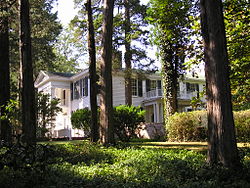
Rowan Oak was the home of author William Faulkner in Oxford, Mississippi. It is a primitive Greek Revival house originally built in 1844 for Robert B Sheegog, an Irish immigrant farmer from Tennessee. Faulkner purchased the house when it was in disrepair in 1930, and resided there until his death in 1962. The home has been owned and operated by the University of Mississippi since 1972, and is open to the public year-round.

History

[edit]

The house was originally built in 1844 and sits on four landscaped acres, surrounded by 29 acres of woods known as Bailey Woods. The original owners, The Sheegogs, lived in the home from 1844 to 1872. The home originally was designed with an L-shaped layout with a 450 square foot center hall connecting a parlor and dining room on one side with a library on the other. A quarter-turn stair led to the second floor and its three bedrooms.[4] Several features from the antebellum era remain on the property including the alley of Eastern Red Cedar trees that line the driveway and front entrance. During that time, it was believed that cedar trees purified the air of the yellow fever virus. There also remains a concentric circle garden, post oak barn, and slave dwelling on the property.[5]

In 1872, the Bailey family purchased the home and resided there until 1923. Around the turn of the century, Julia Bailey added an indoor kitchen and pantry, a front porch, and a bathroom; she also enclosed a dogtrot hallway in the servants' area.[4]

The property had been unoccupied for seven years before William Faulkner purchased it in 1930. In 1931, he renamed it "Rowan Oak" after two trees: the rowan tree of Scotland for peace and security, and the live oak for strength and solitude. Neither of those trees can be found on the property, and there is no such tree species known as a "rowan oak". Soon thereafter, he settled with his wife, Estelle, and her two children from a previous marriage, Malcolm and Victoria. Within a few years their daughter Jill was born. Rowan Oak served as the Faulkner family home until William Faulkner's death in 1962.

Rowan Oak was William Faulkner's private world, in reality and imagination, and he was fascinated with its history. During his time at Rowan Oak, Faulkner kept horses on the property for riding, jumping, and, occasionally, fox hunting, and he would often attend athletics events at nearby Ole Miss.[6]

Faulkner made several renovations and additions to the home and property. In the 1930s, he installed plumbing and electricity, added brick terraces with balustrades framing the front portico, added a porch off the dining room, a porte-cochère on the home's west side, a fourth bedroom, a butler's pantry and kitchen, as well as other structural changes.[4] In the 1950s, he oversaw other updates, including the enclosing of the second floor sleeper porch and the ground floor porch. In 1951, Faulkner added a private closet, bathroom, and office on the ground floor. He would spend the last decade of his career writing in the office, and wrote the outline of his Pulitzer Prize-winning novel A Fable on the office walls.[7]

Faulkner's years spent at Rowan Oak were productive, resulting in him ultimately winning the Nobel Prize for Literature in 1949, and the Pulitzer Prize and National Book Award for A Fable in 1954.

Preservation

[edit]
Faulkner wrote the plot outline of his 1954 novel A Fable on the walls of his office at Rowan Oak.

In 1972, the University of Mississippi purchased Rowan Oak. The home is preserved as it was at the time of Faulkner's death in 1962 and contains 90% of all the original furnishings. The university maintains the home in order to promote Faulkner's literary legacy, and it is open to visitors year-round. The home has been visited by such writers as John Updike, Czesław Miłosz, Charles Simic, Richard Ford, James Lee Burke, Bei Dao, Charles Wright, Charles Frazier, Alice Walker, the Coen brothers, Bobbie Ann Mason, Salman Rushdie, and others. Writer Mark Richard once repaired a faulty doorknob on the French door to Faulkner's study.

Rowan Oak was declared a National Historic Landmark in 1977.

The current curators of Rowan Oak are William Griffith and Rachel Hudson. Past curators include the novelists Howard Bahr and Cynthia Shearer. The original curator was Bev Smith, an Ole Miss alumna, who was responsible for finding a large number of Faulkner's original manuscripts hidden within the closet under the stairs in the home.

See also

[edit]

References

[edit]
[edit]
Revisions and contributorsEdit on WikipediaRead on Wikipedia
from Grokipedia
Rowan Oak is a primitive Greek Revival residence constructed in 1844 on 33 acres in , best known as the home of Nobel Prize-winning author from 1930 until his death in 1962. Originally built for early settler Robert Sheegog, the house passed to subsequent owners including the Bailey family before standing vacant in the late , after which Faulkner purchased it for $6,000 and renamed it Rowan Oak in 1931, evoking the protective symbolism of Scotland's rowan tree and the enduring strength of America's . Faulkner resided there with his wife Estelle, her children, and their daughter Jill, using the secluded property as a creative retreat where he composed significant works such as Absalom, Absalom! and , the latter earning him the in 1955. Upon Faulkner's death, the family maintained the home until Jill sold it to the in 1972, which has since preserved it as a reflecting the author's life and era, attracting visitors interested in his literary legacy.

Architectural Features

Design and Construction

Rowan Oak was constructed in 1844 by Colonel Robert Sheegog, an Irish immigrant who purchased the 40-acre property that December. Sheegog oversaw the building of the main house, a barn, and a detached , following plans attributed to local architect William Turner of . The house exemplifies primitive , featuring a two-story structure with an L-shaped plan and four Doric columns supporting a pedimented . utilized siding for the exterior, with employed for the east wall and chimneys, reflecting typical antebellum building practices in the region. The design emphasized symmetry and classical proportions, common in Greek Revival homes of the mid-19th century South. Original outbuildings included a log barn hewn by hand and a cook's , integral to the site's early functional layout. These elements supported the household's operations, underscoring the property's evolution from frontier to established residence.

Interior and Modifications

The interior of Rowan Oak reflects its origins as a primitive Greek Revival structure built in 1844, with modest rooms finished by William Faulkner after his 1930 purchase. The layout includes a central hall flanked by a parlor and dining room on the ground floor, with bedrooms and additional spaces upstairs, many personalized by Faulkner through DIY modifications and furnishings. Faulkner extensively modified the house to accommodate his writing and family life. In the 1930s, he added a pantry and kitchen, which were modernized in 1954; he often wrote there during winters, and family phone numbers remain inscribed on the pantry wall. Around 1934, he constructed an addition for his wife Estelle's bedroom, featuring windows suited for her painting and birdwatching hobbies. By circa 1954, Faulkner reconfigured the front staircase to allow access left or right, transformed a screened back porch into a hallway with added bathroom, closet, and private office—where he outlined the plot of A Fable on the walls using graphite and red grease pencil—and converted the second-floor sleeping porch into a hallway providing private entrances to bedrooms. Key interior features include the , where Faulkner whitewashed original wildlife murals, built locking bookshelves (with compartments for shells), and displayed his mother Maud's s and sculptures. The parlor, used for family events like weddings and funerals, houses Estelle's Chickering and a of Faulkner. The features French doors added by Faulkner leading to a typing area, and Maud's large mantel . Faulkner's office contains a fold-top he built with his brother-in-law and a table from his mother, while his bedroom holds books, cameras, and riding boots marked with "64" from horse shows. Upstairs, Jill's and guest bedrooms retain family s and artifacts from ghost-story sessions. These elements, preserved largely as Faulkner left them, emphasize functionality over ornamentation, with simple woodwork and hand-built evident throughout.

Historical Development

Pre-Faulkner Ownership

Rowan Oak was constructed in 1844 as a primitive Greek Revival-style house by Colonel Robert Sheegog, an Irish immigrant from Tennessee who had settled in Oxford, Mississippi, shortly after the town's founding in 1837. Sheegog, a planter and militia colonel, developed the property amid the surrounding hardwood forests and cedar groves, initially encompassing about 40 acres. The Sheegog family retained ownership through the antebellum and immediate post-Civil periods, during which enslaved people resided and worked on the estate, as confirmed by archaeological evidence of structures associated with their living quarters and labor activities. By , the property transferred to its second owners, the Bailey family, who lent their name to the estate, thereafter known as the Bailey Place. Under Bailey ownership, the house served domestic purposes, including lessons conducted by Ms. Ellen Bailey in the room that later became the library. The Bailey family held the property until roughly 1923, after which it remained vacant and deteriorated for seven years, its manicured grounds overgrown and the structure in advanced states of neglect due to lack of maintenance. This period of abandonment preceded the estate's acquisition by in 1930, marking the end of its pre-Faulkner era under private antebellum and Reconstruction-era ownership patterns typical of the region.

Faulkner's Acquisition and Use

In 1930, shortly after marrying Estelle Oldham Franklin on June 20, William Faulkner purchased the dilapidated property then known as the Bailey Place, a Greek Revival house built in 1844 that had stood vacant for seven years. The acquisition provided Faulkner with a secluded retreat on approximately four acres of hardwood and cedar land northwest of Oxford, Mississippi, amid financial strains from his early writing career despite publications like The Sound and the Fury (1929). In 1931, he renamed it Rowan Oak, drawing from the rowan tree in Scottish folklore believed to ward off evil. Faulkner resided at Rowan Oak continuously from 1930 until his death on July 6, 1962, transforming it into a primary family home and creative sanctuary where he produced much of his oeuvre, including novels such as (1932) and short stories that solidified his Nobel Prize-winning legacy. He undertook extensive renovations, installing , , and in the 1930s; converting a side into a hallway, closet, bathroom, and dedicated around 1954; and constructing a in 1957 to accommodate his horses, reflecting his integration of equestrian pursuits into daily life at the estate. The surrounding grounds served practical and inspirational purposes, with Faulkner engaging in horseback riding, gardening, nut-gathering, and hunting, activities that informed the rural settings recurring in his fiction. Despite periodic travels and postal work to support the household, Rowan Oak remained Faulkner's anchor, housing his wife, daughter Jill, and extended family amid the property's expansion to 31 acres through subsequent land acquisitions.

Faulkner's Life and Productivity

Daily Routines and Writing Process

William lacked a fixed daily routine at Rowan Oak, adapting his schedule to external obligations while prioritizing morning for writing. In , after purchasing the property, he typically rose early for before retreating to a in the , where he removed the doorknob to ensure and composed steadily through the morning. Afternoons involved manual tasks like home repairs, extended walks, or horseback rides across the grounds and nearby areas, fostering reflective time away from the page. Evenings often passed on the porch with relaxation, including whiskey, though he abstained from alcohol during active writing to maintain clarity. His output reflected bursts of intensity rather than steady quotas, averaging 3,000 words daily but reaching 10,000 during prolific stretches that could extend from 10:00 a.m. to . Faulkner worked sober, drawing from internal resources without notebooks or preliminary sketches carried beyond the home; instead, he relied on accumulated memory and direct observation of life in and Lafayette County. Solitary outings, such as squirrel hunting at least a mile from the house or silent treks to distant hills like Thacker's Mountain, served as incubators for plot and character development amid natural quietude, undisturbed by telephone, radio, or urban noise. The writing process at Rowan Oak emphasized immersion in dedicated spaces: initially the or upstairs using and ink during "silent" phases, or a portable Underwood during more active periods. By the , following construction of a small ground-floor office, he planned complex works like (1954) by diagramming chapter sequences and themes on the walls with and grease pencils—a method adopted after wind from an electric fan scattered his initial taped outlines. He revised these markings post-repainting by his , then shellacked them for permanence, underscoring a tactile, iterative approach to structuring intricate narratives. Completion of drafts often triggered extended "binges" of absence, driving circuits through rural to decompress.

Personal and Family Associations

William Faulkner acquired Rowan Oak in October 1930 and, following his marriage to Estelle Oldham Franklin on June 20, 1931, relocated there with his new wife and her two children from her prior marriage to Cornell Franklin: son Malcolm Argyle Franklin (born 1922) and daughter Victoria "Cho-Cho" Franklin (born 1926). The couple's first child together, daughter Alabama, was born prematurely on January 11, 1931, but died nine days later on January 20; their surviving daughter, Jill Sommers Faulkner, was born on June 24, 1933, and grew up primarily at Rowan Oak. Rowan Oak functioned as the central family residence for over three decades, housing Faulkner, Estelle, Jill, and periodically Estelle's adult children until Faulkner's death on , 1962, after which Estelle remained until her passing in 1968. In 1934, Faulkner expanded the house to include a dedicated for Estelle, equipped with large windows that facilitated her amateur pursuits. Family dynamics at the property reflected Faulkner's prioritization of writing seclusion alongside domestic responsibilities, with Estelle managing household affairs amid Faulkner's frequent absences for equestrian activities and travel, though the home hosted key milestones such as Jill's 1954 wedding reception to Paul D. Summers Jr. Jill Faulkner Summers inherited Rowan Oak and, in 1972, deeded it to the to preserve it as a public memorial to her father, ensuring its role in commemorating the family's literary legacy. Malcolm Franklin, who pursued a writing career influenced by his , maintained connections to the property but resided elsewhere in adulthood, while Cho-Cho Franklin pursued independent ventures away from . The site's family associations underscore its function as a private retreat amid Faulkner's public acclaim, with interiors retaining artifacts like family furnishings that evoke the domestic environment supporting his creative output.

Preservation Efforts

Transfer to Public Ownership

Following William Faulkner's death on July 6, 1962, Rowan Oak remained under private family ownership, with his daughter Jill Faulkner Summers inheriting primary control of the property. In 1972, Summers sold the house and its 33 acres to the , motivated by the desire to preserve the site indefinitely as a house museum where visitors worldwide could study her father's life, writings, and creative environment. The transfer ensured public access and institutional stewardship, with the university committing to maintain the home in a condition reflective of Faulkner's occupancy, including retaining approximately 90% of the original furnishings and artifacts from 1962. The Foundation facilitated the acquisition, transitioning Rowan Oak from private residence to a publicly operated under the university's system.

Restoration Projects and Challenges

In the early 1990s, the Post Oak Barn at Rowan Oak was fully dismantled and restored by the , reusing 97 percent of its original timbers from the 1840s construction to maintain structural authenticity. In 2015, the Mississippi Department of Archives and History undertook a comprehensive exterior restoration project, including cleaning and repair, roof repairs, and repainting to address weathering and deterioration typical of Greek Revival structures in the humid climate. The sunken garden, abandoned during Reconstruction and later overgrown with volunteer trees that shaded out original hedges, has undergone periodic restoration to revive its formal brick beds while respecting Faulkner's preference for a semi-wild Gothic aesthetic over full antebellum revival. In September 2025, Faulkner's personal piano was refurbished through a collaborative effort involving local and conservators, aiming to restore its playability and acoustic integrity after decades of neglect, thereby enhancing interpretive programs for visitors. The establishment of the Bruce Levingston Rowan Oak Endowed Fund in October 2025 provides dedicated resources for artifact conservation, restoration of existing furnishings, and acquisition of Faulkner-associated items, addressing long-term curatorial needs amid rising operational costs. Preservation challenges stem primarily from chronic underfunding prior to institutional endowments, as the property fell into disrepair after Faulkner's death in until its 1972 transfer to oversight, requiring substantial initial interventions to stabilize aging , , and outbuildings against and . Balancing historical fidelity with modern accessibility—such as installing without altering original features—further complicates efforts, as does the site's exposure to events that accelerate material degradation in the region's subtropical environment.

Recent Developments and Funding

In October 2025, internationally acclaimed concert pianist Bruce Levingston established the Bruce Levingston Rowan Oak Endowed Fund through a significant financial gift to the , which manages the site. The endowment specifically supports the restoration of existing artifacts at Rowan Oak, the acquisition of historically significant items linked to William Faulkner's life and work, and broader preservation initiatives to maintain the property's integrity as a . This funding builds on prior renovations at the site, some of which Levingston previously supported as a part-time resident, addressing ongoing needs for artifact conservation and structural upkeep in the Revival home and its grounds. University officials emphasized the endowment's role in sustaining long-term curatorial efforts, including potential purchases of Faulkner-related manuscripts or furnishings to enhance interpretive displays for visitors. No specific endowment amount was publicly disclosed, but it represents a targeted philanthropic commitment amid reliance on university resources and public donations for operational funding. Preservation funding for Rowan Oak remains multifaceted, drawing from the Museum's budget, admission fees, and occasional grants, though recent efforts highlight private endowments as critical for specialized projects like artifact restoration without detailed federal or state grant allocations reported in this period. These developments ensure continued public access, with the site operating through from 10:00 a.m. to 4:00 p.m. and Sundays from 1:00 p.m. to 4:00 p.m., closed Mondays.

Cultural Significance and Legacy

Literary Inspirations and Influence

Rowan Oak afforded the isolation essential to his writing process, enabling the composition of major works during his residency from 1930 to 1962. He produced novels including Absalom, Absalom! in 1936 and outlined the plot of his 1954 Pulitzer Prize-winning on the walls of his office using graphite pencil. The property's dedicated writing room, added after 1950, further supported this productivity. The landscape of Rowan Oak, encompassing manicured grounds and adjacent woods with eastern red cedars, dogwoods, magnolias, and , permeated Faulkner's prose. In Sartoris, he depicted a "cinder-packed drive rose in a grave curve between cedars," echoing the estate's gravel entrance lined with mid-19th-century red cedars. Similarly, Absalom, Absalom! references -laden twilight and lilac rains, drawing from the property's floral abundance that intensified in summer with scents. These elements contributed to the vivid Southern settings in his saga, rooted in Lafayette County's and . Local lore around Rowan Oak shaped character archetypes and narratives, incorporating tales of Native Americans, runaway slaves, Civil War colonels, and eccentric spinsters, interwoven with Faulkner's observations of a amid and modernization. The home's name, derived from rowan and trees symbolizing protection in Scottish legend, aligned with themes of and resilience in his literature. Faulkner's personal library at Rowan Oak, exceeding 1,200 volumes from classics like Don Quixote to science fiction, provided intellectual fodder for his stylistic innovations and thematic depth.

Public Access and Interpretive Debates

Rowan Oak has been open to the public since its donation to the in 1972, operating as a managed by the university's museum department. Visitors can access the grounds free of charge at any time, while entry to the house requires a $5 admission fee, payable in only, for self-guided tours lasting approximately one hour. The site maintains regular operating hours of 10:00 a.m. to 4:00 p.m. through and 1:00 p.m. to 4:00 p.m. on Sundays, with closures on Mondays and extensions to 5:00 p.m. during summer months from June 1 to July 31. Interpretive programming emphasizes Faulkner's domestic life and creative process, featuring preserved rooms with original furnishings, handwritten manuscripts, and audio tours narrated by students that cover specific spaces such as the parlor, office, bedrooms, stable, and a former slave dwelling. These tours highlight the home's role in Faulkner's productivity while noting its pre-Faulkner history under original owner Robert Sheegog, who constructed the Greek Revival structure in the 1840s using enslaved labor. The inclusion of the slave dwelling in interpretive materials reflects efforts to contextualize the site's antebellum origins amid broader initiatives, including campus-wide slavery research and tours documenting enslaved individuals' roles in early institutional operations. Debates over interpretation at Rowan Oak center on reconciling Faulkner's literary legacy with his personal conservatism and the house's ties to slavery, avoiding both uncritical romanticization and anachronistic condemnation. Faulkner's works, such as Absalom, Absalom!, grapple with slavery's moral corruption of Southern society, portraying it as a systemic evil that degraded whites as much as it oppressed blacks, yet his public stances—opposing rapid desegregation in the 1950s while critiquing racial violence—reflected a paternalistic gradualism rooted in Southern traditions rather than modern egalitarian ideals. Academic events, including the 2018 Faulkner and Yoknapatawpha Conference themed "Faulkner and Slavery" with sessions at Rowan Oak, have explored these tensions, urging presentations that honor the author's complex portrayal of race without sanitizing historical realities like the enslaved labor that built the home. Critics argue that overemphasizing Faulkner's flaws risks eclipsing his unflinching realism about human causality and Southern decay, while underemphasizing them ignores verifiable evidence of his era's entrenched hierarchies; site curators thus prioritize primary artifacts and balanced narratives to sustain the house as a lens for undiluted examination of Faulkner's world.

References

Add your contribution
Related Hubs
User Avatar
No comments yet.