Hubbry Logo
Royal ClipperRoyal ClipperMain
Open search
Royal Clipper
Community hub
Royal Clipper
logo
8 pages, 0 posts
0 subscribers
Be the first to start a discussion here.
Royal Clipper
Royal Clipper
from Wikipedia

Royal Clipper
History
Malta[1]
NameRoyal Clipper
OwnerStar Clippers
Port of registryValletta
Identification
StatusActive
General characteristics
TypeCruise ship
Tonnage4,425 GT
Length439 ft (134.8 m)
Beam54 ft (16.5 m)
Draft18.5 ft (5.6 m)
Propulsion
  • Masts: 5
  • Sails: 42
  • Sail Area: 56,000 ft2 (5,202.6 m2)
  • Engines: 2 Caterpillar 3516 diesels
Capacity227 passengers (Max)
Crew106

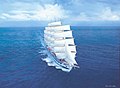
Royal Clipper is a steel-hulled five-masted fully rigged tall ship used as a cruise ship. She was redesigned by Robert McFarlane of McFarlane ShipDesign, for Star Clippers Ltd. of Sweden, the same designer behind the cruise company's first two vessels Star Clipper and Star Flyer.

This third one was built using an existing steel hull designed by Zygmunt Choreń that was modified by the Gdańsk Shipyard, where 24 metres (79 ft) was added to its length. Originally built by Polish communist authorities as "Gwarek" she was intended as a floating vacation home for miners[citation needed] . This hull was sold because of financial problems[citation needed]. The Merwede shipyard completed the ship's interior in July 2000, whilst visiting the Pool of London, for its pre-launch to the travel industry. The renovations included frescography murals by Rainer Maria Latzke completing the ship's Mediterranean interior.[2] Her design was based on Preussen, a famous German five-mast Flying P-Liner windjammer built in 1902.

Star Clippers claims that she is the largest "true sailing ship" built since Preussen. She is listed in Guinness World Records as the largest square-rigged ship in service, with 5,202 square metres (55,990 sq ft) of sail. Her sails can be handled with a crew as small as twenty using powered controls.[3]

Royal Clipper cruises the Mediterranean during the summer. During the winter she offers Caribbean trips through the southern parts of the Lesser Antilles area. Because of her size, she can visit smaller ports that larger (motor) cruise ships can't reach. Transatlantic crossings are available between seasons.[4]

[edit]

See also

[edit]

References

[edit]
[edit]
Revisions and contributorsEdit on WikipediaRead on Wikipedia
from Grokipedia
The Royal Clipper is a steel-hulled, five-masted fully rigged launched in 2000, serving as the of the Star Clippers fleet and recognized by as the world's largest square-rigged vessel in service. Measuring 134 meters (439 feet) in length with a beam of 16 meters and a of 4,425, it features 42 sails spanning 5,000 square meters, enabling speeds of 7 to 18 knots under alone. Designed for luxury cruising, the ship accommodates up to 227 passengers and 106 crew members, blending traditional heritage with contemporary amenities. Inspired by the early 20th-century German barque Preussen, the Royal Clipper was commissioned by Swedish entrepreneur Mikael Krafft as the third vessel in Star Clippers' lineup, following the Star Flyer and Star Clipper. Its construction emphasized authentic maritime engineering, including manually hoisted sails, while incorporating modern navigation systems for safety. Registered in Malta and classified by DNV, the ship sails itineraries across the Caribbean, Mediterranean, and transatlantic routes, often under full sail for an immersive experience. Key onboard features include 1,760 square meters of open deck space, three swimming pools, a platform for watersports like and , and elegant public areas such as a three-deck atrium, the Lounge with underwater viewing portholes, and a . The vessel prioritizes a relaxed, adult-oriented atmosphere with no or large-scale entertainment, focusing instead on sail-setting ceremonies, educational talks on , and dining using fresh, locally sourced ingredients. With hidden balconies on select suites and passenger access to mast lookouts, the Royal Clipper offers a unique blend of adventure and sophistication for enthusiasts.

History

Origins and design inspiration

The Royal Clipper's design draws direct inspiration from the Preussen, a German steel-hulled five-masted ship-rigged launched in 1902 by the F. Laeisz shipping company, which remains the only previous vessel of its kind ever constructed. This historical precedent influenced the Royal Clipper's creators to pursue the ambition of building the largest square-rigged in active service, surpassing the Preussen's scale while honoring its elegant lines and full-rigged configuration to evoke the era of grand ocean sailers. The vessel's origins trace back to 1991, when Polish naval architect Zygmunt Choreń initially designed the hull under the name Gwarek, intended as a floating vacation home for Polish miners amid the economic transitions following the fall of communism. The project, started at the Gdańsk Shipyard, was abandoned due to severe financial constraints in post-communist Poland, leaving the incomplete steel hull in limbo until its acquisition in the mid-1990s. In the , Swedish entrepreneur Mikael Krafft, founder of Star Clippers Ltd., acquired the Gwarek hull and spearheaded its transformation into a luxury sailing , enlisting naval architect Robert McFarlane of McFarlane ShipDesign to adapt and extend the structure for modern cruising needs. This redesign aligned with Krafft's vision to revive cruising by creating the world's largest square-rigged vessel in operation, blending historical aesthetics with contemporary passenger amenities to offer an authentic sailing experience.

Construction process

The construction of the Royal Clipper began with the acquisition and modification of an existing steel hull originally built in the , , in 1990–1991 as the Gwarek, a planned floating vacation home for Polish miners that was left unfinished due to financial constraints under the communist regime. In the mid-1990s, Star Clippers purchased the hull and initiated modifications at the same to adapt it for use as a full-rigged sailing vessel, including the addition of approximately 24 meters to its length and structural reinforcements to support the extensive mast and system. These adaptations presented significant challenges, as the original non-sailing design required extensive reengineering to accommodate the five masts and sails while ensuring stability and seaworthiness. Following the hull modifications in Poland, the incomplete vessel was transferred to the Merwede Shipyard in , , for final assembly, installation of the , and interior outfitting, a process completed in July 2000 at a total construction cost of approximately USD 70 million. As part of the interior work, artist Rainer Maria Latzke incorporated frescography murals—large-scale digital frescoes printed on canvas and integrated into the walls—to create Mediterranean-inspired decorations in the public spaces, marking one of the first major applications of this technique in maritime design. The Royal Clipper received classification from Det Norske Veritas (DNV) as "1A1 +", the highest rating for a sailing vessel, confirming compliance with stringent safety and construction standards. This certification underscored the successful transformation of the hull, drawing conceptual inspiration from the historic Preussen but executed through modern engineering to meet contemporary cruise requirements.

Launch and early voyages

Construction of the Royal Clipper was completed in 2000 at the Merwede shipyard in , , marking the completion of construction for the first five-masted full-rigged built since 1902. The vessel, inspired by the historic German Preussen, measured 439 feet in length and featured 42 sails totaling over 54,000 square feet. The ship was then sailed to , where it arrived in harbor and was christened on 28 2000 by in a ceremonial event attended by maritime enthusiasts and dignitaries. Following the christening, the Royal Clipper undertook its maiden voyage later in 2000, embarking on a from to the to establish its winter base in , . This inaugural commercial sailing showcased the ship's hybrid propulsion system, combining traditional with auxiliary diesel engines for reliability across the Atlantic. Early operations focused on Mediterranean itineraries during the summer season, allowing the vessel to demonstrate its capabilities in calmer waters before the longer ocean passage. The transatlantic leg highlighted the ship's design for extended voyages, with passengers experiencing the thrill of sail-assisted travel under optimal conditions. In 2001, the Royal Clipper received official recognition from as the largest square-rigged in active service, a distinction based on its sail area and overall size surpassing all contemporaries. Initial voyages revealed the need for operational refinements, particularly in sail handling, where a specialized of 20 crew members among the total complement of 106 underwent intensive training to manage the complex efficiently. This preparation ensured safe and seamless deployment of the sails, blending modern safety protocols with traditional techniques during the ship's early deployments in both European and waters.

Design and features

Hull and structural elements

The Royal Clipper features a steel-hulled construction designed for enhanced durability and seaworthiness in modern sailing operations. The hull measures 439 feet (134 meters) in length, with a beam of 16 meters and a draft of 5.98 meters, providing a stable platform that balances hydrodynamic efficiency with the demands of square-rigged propulsion. This all-steel fabrication adheres to yacht-quality standards, ensuring resistance to marine corrosion and structural integrity under varying sea conditions. The ship's five-mast configuration is a key structural element, with masts constructed from to withstand the rigors of tall-ship and reaching a height of 54 meters (177 feet) above the deck. These masts support the fully rigged square sails while incorporating engineering features for load distribution and stability. The vessel's classification by as "1A1 +" certifies its structural reinforcements, including provisions for handling wind loads typical of square-rigged vessels, thereby enhancing overall seaworthiness. Open deck spaces span 1,760 square meters, fostering an expansive outdoor environment that contributes to the ship's balanced design for passenger comfort and operational functionality. This includes three swimming pools integrated into the deck layout for recreational use and a platform that lowers from the , enabling direct access for watersports while maintaining hull integrity. Additionally, the structure incorporates unique underwater glass portholes in the Captain Nemo Lounge, allowing views of marine life without compromising the hull's watertight envelope.

Rigging and sails

The Royal Clipper is equipped with a five-masted full-rigged configuration, featuring 42 sails that provide a total sail area of 5,000 square meters (approximately 53,800 square feet). This setup draws inspiration from historic ships, enabling efficient wind-powered propulsion across open seas. The employs a square-rigged on all masts, with 26 square sails as the primary propulsors, supplemented by fore-and-aft sails including 11 staysails, 4 jibs, and 1 gaff-rigged spanker to enhance maneuverability, particularly during tacking and in variable winds. The masts, supported by the ship's hull structure, reach heights of up to 54 meters, allowing the sails to capture optimal wind flow. Sail handling is facilitated by a hydraulic roller furling for the square sails, powered by hydraulic motors that set and furl them without requiring crew to climb , supplemented by electric winches for braces, sheets, and halyards. This modernized allows a deck crew of about 12 to manage the sails efficiently, a significant reduction from the dozens needed on traditional square-riggers. Under full , the Royal Clipper achieves a maximum speed of 18 knots, with typical cruising speeds ranging from 7 to 12 knots depending on wind conditions. The sails are constructed from high-quality Dacron, a durable fabric chosen for its strength, UV resistance, and longevity in marine environments. Regular maintenance involves inspections for wear, repairs to tears or stitching, and periodic cleaning to ensure optimal performance and safety.

Interior layout and amenities

The Royal Clipper features a striking three-deck atrium that serves as the ship's central hub, allowing natural sunlight to cascade down into the surrounding public spaces and creating an open, airy atmosphere enhanced by nautical and tropical decor elements in the Tropical Bar area. Adjacent to this is the elegant Clipper Dining Room, a three-level venue seating all 227 passengers at once under a single-seating, open-seating policy with no formal required. The dining room offers international cuisine for , , and , prepared by the onboard culinary team using fresh ingredients. Further amenities include the Captain Nemo Lounge, which doubles as a and with underwater glass portholes providing views of the sea below, offering and beauty treatments in a serene setting. The ship also houses an Edwardian-style library stocked with books for quiet reading, an observation lounge for panoramic views, and a within the Tropical Bar for evening entertainment. These spaces emphasize comfort and relaxation, blending classic maritime elegance with modern conveniences. Accommodations consist of 114 cabins across eight categories, all equipped with air-conditioning, flatscreen TV/DVD players, private bathrooms with showers (whirlpool tubs in suites), hairdryers, safes, and telephones. The Owner's Suite spans 40 m² with two double beds, a separate sitting area, and premium furnishings but no private veranda. Deluxe Outside Suites measure 26 m², featuring private verandas, twin or double beds, mini-bars, and whirlpool bathrooms with 24-hour room service available. Standard cabins range from 10 m² inside staterooms to 14.5 m² deluxe outside options, all non-smoking and designed for efficient use of space. Unique interior features include hidden bow balconies accessible from select forward cabins, offering private sea views, and passenger lookouts at the crow's nests on the masts, where guests can climb with safety harnesses for elevated vistas. These elements integrate the ship's heritage with luxurious passenger access, ensuring an immersive experience without compromising .

Technical specifications

Dimensions and capacity

The Royal Clipper measures 134 meters (439 feet) in , with a beam of 16 meters (54 feet) and a draft of 5.98 meters (19.6 feet). The vessel has a gross of 4,425 GT. In terms of accommodation capacity, the ship features 114 cabins distributed across multiple decks, designed to house up to 227 passengers at double occupancy. It is supported by a of 106, comprising international officers and deckhands specialized in traditional sailing operations. The Royal Clipper is registered in , , operating under the Maltese flag. These specifications enable an intimate cruising experience, with the layout supporting varied passenger arrangements as detailed in the interior amenities.

Propulsion and performance

The Royal Clipper utilizes a hybrid propulsion system that combines from its 42 sails with auxiliary diesel engines for optimal performance and efficiency. The ship is powered by two 3516B diesel engines, each rated at 2,500 brake horsepower (1,865 kW), providing a combined output of 5,000 brake horsepower (3,730 kW) delivered through a single controllable-pitch propeller. This configuration enables reliable motive power while prioritizing sail usage to reduce fuel dependency. Under engine power alone, the Royal Clipper achieves a maximum speed of 17 knots, with combined sail and engine operation capable of reaching up to 18 knots in favorable conditions. Purely under , speeds of 17 knots have been recorded, highlighting the rig's contribution to —though detailed sail mechanics are covered elsewhere. The vessel operates on low-sulfur gas oil, and its allows for to account for up to 70% of needs, substantially lowering fuel consumption compared to engine-only cruising. Navigation is supported by state-of-the-art systems, including , GPS, and an integrated that coordinates with sail controls for enhanced maneuverability and safety. These technologies ensure precise tracking and automated adjustments, complementing the captain's traditional expertise during voyages. The overall setup supports extended transatlantic crossings, with fuel-efficient hybrid operation enabling ranges suitable for such routes.

Operations

Ownership and management

The Royal Clipper is owned by Star Clippers Ltd., a company founded in 1989 by Swedish entrepreneur Mikael Krafft, who serves as its president and has maintained ownership without changes since the ship's launch in 2000. The company, headquartered in at Clipper Palace, 4 Rue de , operates a small fleet of tall ships, including the Royal Clipper, , and , all dedicated to luxury sailing cruises. Operational management is overseen by a dedicated led by Krafft, incorporating master mariners with extensive experience in square-rigged tall ships to ensure safe and authentic sailing operations. The vessel flies the Maltese flag, registered in , and complies with international regulations through classification by , which certifies its structural integrity and safety standards, including insurance requirements for passenger vessels. Crew recruitment emphasizes maritime expertise, with positions filled through targeted applications for roles requiring proficiency in both traditional and modern systems; programs focus on square-rigger handling and protocols to maintain high operational standards across the fleet.

Itineraries and routes

The Royal Clipper operates seasonal itineraries primarily focused on the Mediterranean during the summer months and the during the winter, with repositioning voyages across the Atlantic in spring and fall. In the summer season, typically from April to October, the ship offers 7- to 14-night cruises in the Mediterranean, departing from ports such as , , and (). These voyages explore the , Italian coast, and islands like and , with representative stops including , , Bonifacio, and on ; extended itineraries may extend to , , and occasionally Greek destinations such as the or islands. During the winter season, from late November to early April, the Royal Clipper sails 7- to 10-night itineraries in the , often roundtrip from , , or one-way from St. John's, , and Philipsburg, St. Maarten. These routes emphasize the Islands, visiting lesser-known ports such as Terre-de-Haut in the , Cabrits in , Bequia in the , and St. George's in , with opportunities for beach stops in and sailing through scenic passages like the Pitons in St. Lucia. Seasonal transatlantic crossings reposition the vessel between these regions, lasting 14 to 28 days in spring (eastbound from to or ) and fall (westbound from or to ). These voyages include brief stops in the or , leveraging the ship's sailing capabilities for efficient ocean passages under favorable winds. The ship's relatively shallow draft of approximately 6.0 (19.7 feet) and compact size enable access to smaller, more intimate ports and harbors that larger cruise vessels cannot reach, such as secluded coves in or remote islands, enhancing the exploratory nature of its routes. Itineraries may be adjusted for weather conditions, port availability, or operational issues, such as shifts in docking locations due to environmental regulations or disputes; for instance, in 2019, implemented restrictions on certain cruise ships for pollution reasons, prompting alternative embarkation points like for some sailings.

Safety record and notable events

The Royal Clipper has maintained an exemplary safety record since entering service in 2000, with no reported major accidents, fires, or groundings. This track record underscores the vessel's robust operational standards under Star Clippers management. Star Clippers, the operator of the Royal Clipper, has been recognized with multiple World Travel Awards for excellence in cruises, including World's Leading Specialist in 2023 and 2018, World's Leading Luxury Sailing Cruise Company in 2020, and World's Best Boutique in 2024. These accolades highlight the line's consistent commitment to high-quality, safe passenger experiences across several years post-2000. Notable events for the Royal Clipper include its participation in international parades, showcasing its capabilities as a modern square-rigger. The vessel also earned recognition as the largest square-rigged ship in service, featuring 5,202 square meters of sail across five masts. The Royal Clipper complies fully with the International Convention for the Safety of Life at Sea (SOLAS) standards, holding the highest possible 1A1 classification from , which ensures rigorous safety protocols for hull integrity, , and . Regular dry-dock inspections are performed in accordance with SOLAS requirements, typically twice within every five-year period, to verify structural condition and maintenance. Crew members receive specialized safety training for sail handling operations and conduct mandatory emergency drills, including abandon ship and scenarios, at least monthly to align with SOLAS mandates and enhance response readiness. This training emphasizes safe rigging maneuvers and passenger evacuation procedures unique to a environment.

References

Add your contribution
Related Hubs
User Avatar
No comments yet.