Hubbry Logo
search
logo
1703742

Russian cursive

logo
Community Hub0 Subscribers
Read side by side
from Wikipedia
Text written by a foreign student in Russian cursive. The text is called Встреча в Бразилии (meeting in Brazil).

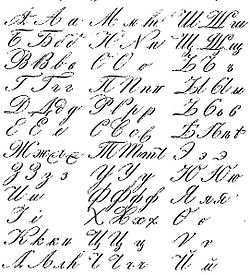
Russian cursive is a variant of the Russian alphabet used for writing by hand. It is typically referred to as (ру́сский) рукопи́сный шрифт (rússky) rukopísny shrift, "(Russian) handwritten font". It is the handwritten form of the modern Russian Cyrillic script, used instead of the block letters seen in printed material. In addition, Russian italics for lowercase letters are often based on Russian cursive (such as lowercase т, which resembles Latin m). Most handwritten Russian, especially in personal letters and schoolwork, uses the cursive alphabet. In Russian schools most children are taught from first grade how to write in this script.

History

[edit]
A ukase written in the 17th-century Russian chancery cursive

The Russian (and Cyrillic in general) cursive was developed during the 18th century on the base of the earlier Cyrillic tachygraphic writing (ско́ропись, skoropis, "rapid or running script"), which in turn was the 14th–17th-century chancery hand of the earlier Cyrillic bookhand scripts (called ustav and poluustav). It became the handwritten counterpart of so-called "civil" (or Petrine) printed script of books. In order,[clarification needed] modern Cyrillic italic typefaces are based (in their lowercase part) mostly on the cursive shape of the letters.[citation needed]

18th-century Russian italic font, note unusual "square" minuscule в

The resulting cursive bears many similarities with the Latin cursive.[1] For example, the modern Russian cursive letter "п" may coincide with Latin cursive "n" (𝓃) (despite having completely different sound values); both upright and italic printed typefaces demonstrate less similarity.[citation needed]

One must not confuse the historical Russian chancery hand (ско́ропись, skóropis' ), the contemporary Russian cursive (рукопи́сное письмо́, rukopísnoe pis'mó) and the contemporary Russian stenography. The latter is completely different from the other two, though it is sometimes called ско́ропись, skóropis' , like the former.[citation needed]

Features

[edit]

Russian cursive is much like contemporary English and other Latin cursives. But unlike Latin handwriting, which can range from fully cursive to heavily resembling the printed typefaces and where idiosyncratic mixed systems are most common, it is standard practice to write in Russian cursive almost exclusively.

Ambiguities

[edit]

There exists some ambiguity from the fact that several lowercase cursive letters consist (entirely or in part) of the element that is identical to the dotless Latin cursive letter ı, the cursive Greek letter ι or a half of the cursive letter u, namely и, л, м, ш, щ, ы. Therefore, certain combinations of these Russian letters cannot be unambiguously deciphered without knowing the language or without a broader context. For example, in the words волшебник, "magician" and домик, "little house" the combinations лш and ми are written identically. The word лишишь, "you will deprive" written in cursive consists almost exclusively of these elements. There are examples of different words that become absolutely identical in their cursive form, e.g. мщу "I avenge" and лицу (dative of лицо "face"). The most radical form of this, though not well known, is the Tajik word миллии meaning 'national'. It consists only of these elements.

Some words in Russian may pose a challenge due to the similarities between the letters Ш, Щ, И, Л, М in cursive.

Variants, use of diacritics

[edit]
A signature of Fyodor Dostoevsky showing a stylized macron above the ⟨т⟩ in "Достоевскій"

In some forms of cursive, the distinction between т and ш may become elusive because both are written in the shapes of either 𝑚 or ɯ. To alleviate this case of ambiguity, a horizontal bar can be written above the character (like or rarely ɯ̅) if it is т, or below (like ɯ̲ or rarely ) if it is ш. Also, writing т in its printed form (the T shape) rather than its usual 𝑚 shape is common.

The letter д may also be written in the shape of or . The letter х is sometimes written identical to block lowercase Latin x.

Differences to Serbian and Macedonian cursives

[edit]
Serbian cyrillic alphabet written in cursive. Note how the outlines г̄, ū, ɯ̅, Ձ contrast to respective Russian г, 𝓃, 𝑚, Д.

Several letters in Russian cursive are different from the cursive used in the Serbian and Macedonian languages. Thus, Serbian/Macedonian cursive lowercase г looks the same as in Russian with additional macron, п is written like the cursive Latin u with macron (ū), and the letter т is written in the shape of ɯ̅.[2][3] Serbian uppercase Д resembles the shape of Ձ. The letters б, д, з, Б, Н can also be written differently from their Russian counterparts.[4]

Charts

[edit]

See also

[edit]

References

[edit]
Revisions and contributorsEdit on WikipediaRead on Wikipedia
from Grokipedia
Russian cursive is the handwritten variant of the Cyrillic alphabet used for the Russian language, characterized by fluidly connected letters that often deviate significantly from printed block forms to enable faster writing.[1] It employs 33 letters, with many lowercase forms featuring hooks, bows, and tails for smooth connections, such as the letter т resembling a lowercase "m" or г appearing as a backwards "r."[2] This style introduces ambiguities, where letters like б and д or и and п can resemble each other depending on the scribe's variation, requiring contextual reading for clarity.[2] The history of Russian cursive traces back to medieval precursors, evolving from the solemn, block-like ustav script of the 11th century—used primarily for religious texts like the Ostromir Gospels—to the more flexible poluustav (semi-ustav) in the following centuries, which allowed for slanted and abbreviated forms suitable for broader literary use.[3] By the 16th century, skoropis' (fast writing) emerged as an early cursive style, prioritizing speed with connected letters, ligatures, and improvisational flourishes for administrative and legal documents.[3][4] This tachygraphic form influenced the modern cursive, which was formalized in the 18th century under Peter the Great's reforms introducing the Civil Script, blending Cyrillic with Latin-inspired humanist and Roundhand elements for printing and handwriting.[5] Further refinements occurred in the 19th century through calligrapher N. Gradoboyev's adaptations of Western methods, and in the Soviet era, a monolinear version with reduced slope was promoted in schools during the 1960s.[5] In contemporary Russia, cursive remains a standard in education, taught from primary school to foster efficient handwriting, though digital tools have reduced its everyday use among adults.[5] Recent proposals, such as those by Irina Smirnova and Julia Baranova, advocate italic-based models to simplify learning while preserving decorative flow.[5] Ornate variants like vyaz', with intricate ligatures and colored inks, persist in artistic calligraphy for headlines or illuminated manuscripts.[3] Overall, Russian cursive embodies a balance of practicality and aesthetic tradition, distinguishing it from the more uniform printed alphabet.

History

Origins in Cyrillic Script

The Cyrillic alphabet, the foundation of Russian cursive, emerged in the 9th and 10th centuries as a script tailored for Slavic languages, particularly Old Church Slavonic, which served as the liturgical and literary medium for early Slavic Christian communities.[6] While Saints Cyril and Methodius are credited with inventing the precursor Glagolitic script around 863 CE to translate religious texts into the Slavic vernacular, the Cyrillic system was developed shortly thereafter by their disciples in the First Bulgarian Empire, blending practical phonetics with established writing traditions to facilitate broader dissemination of Slavic literacy.[7] This innovation addressed the phonetic needs of Slavic sounds absent in Greek or Latin, enabling the transcription of biblical and liturgical works that would underpin Russian manuscript culture.[8] The script's initial forms drew heavily from Greek uncial writing, a rounded, majuscule style used in Byzantine manuscripts, which provided the visual basis for Cyrillic letter shapes, while Glagolitic contributed specific phonetic elements and ligature-like constructions for complex sounds.[7] These influences fostered early tendencies toward fluidity in handwriting, as Greek uncials already incorporated cursive elements for efficiency in copying sacred texts, and Glagolitic's intricate, interconnected letter designs hinted at connected forms to represent Slavic affricates and diphthongs.[8] In medieval Russian contexts from the 11th to 17th centuries, this evolved through stages: the solemn ustav (uncial) script, characterized by large, geometric letters with minimal connections, gradually transitioned to poluustav (semi-uncial), introducing smaller, slanted forms and initial ligatures for faster production of non-liturgical texts amid growing demand for administrative and educational manuscripts.[4] Key artifacts from Old Church Slavonic texts illustrate these nascent cursive elements, such as the Ostromir Gospels (1056–1057), an early Cyrillic manuscript in ustav that displays rigid yet proportionally balanced letters occasionally linked through subtle superscript abbreviations, reflecting the shift toward practicality.[4] Similarly, the Svyatoslav Izbornik (1073) exemplifies ustav's ornamental restraint but includes isolated ligatures for numerals and common phrases, influenced by Glagolitic prototypes like the Codex Zographensis (late 10th–early 11th century), where letters such as Ⰱ (a ligature of Greek μπ for "mp") demonstrate connected forms that carried over into Cyrillic adaptations.[9] These manuscripts, primarily from Kievan Rus' scriptoria, highlight how early ligatures and partial connections served to economize space and enhance readability in parchment-bound volumes, laying groundwork for more fluid handwriting styles.[7]

Development and Reforms

The development of Russian cursive handwriting accelerated in the 18th century, building on the skoropis' script that emerged in the 16th century as an early cursive style prioritizing speed. Skoropis', used primarily for administrative and legal documents, featured connected letters, ligatures, and improvisational flourishes, allowing for quicker writing than previous scripts like poluustav while introducing more fluid connections that influenced subsequent handwriting practices.[3] Peter the Great's civil script reform of 1708–1710 simplified the Cyrillic alphabet for secular use, reducing the number of letters from 43 to 38 and adopting rounder, more legible forms inspired by Latin typography, which facilitated the emergence of new cursive models derived from Latin calligraphic styles.[5][10] During the 18th and 19th centuries, Russian cursive evolved through handwriting manuals and integration into school curricula, emphasizing connected letter forms for efficiency and speed. Mikhail Lomonosov's Russian Grammar (1755) contributed to this standardization by establishing orthographic principles that supported consistent secular writing practices, influencing the adoption of cursive in educational settings.[5][11] Manuals such as N. Gradoboyev's works from 1858 and 1884 promoted a slanted, pointed-pen style influenced by English Roundhand, establishing connected forms as the norm for personal and official correspondence.[5] In the Soviet era, cursive underwent further standardization amid 20th-century literacy drives and orthographic changes. The 1918 orthographic reform simplified spelling rules to boost literacy, indirectly supporting the persistence of civil script-based cursive in education despite typeface shifts.[12] Post-1917 likbez campaigns, aimed at eradicating illiteracy, embedded cursive handwriting in mass education programs, teaching millions to write in connected forms using standardized copybooks.[5] By the 1920s–1930s, attempts at Latinization were abandoned, preserving Cyrillic cursive with a reduced slope; a monolinear variant emerged in the 1960s for school use.[5]

Characteristics

Letter Forms and Shapes

Russian cursive handwriting employs stylized letter forms that markedly differ from the block Cyrillic used in print, especially in lowercase variants, to facilitate fluid pen movement and rapid writing. These shapes evolved from 18th-century adaptations of earlier Cyrillic scripts, incorporating curves and loops that simplify strokes while maintaining legibility in connected text.[2] Lowercase letters dominate in Russian handwriting, as they are designed for seamless integration within words, whereas uppercase letters generally retain closer resemblance to printed forms but often include elongated or slanted elements for aesthetic flow. This distinction emphasizes the practical focus on lowercase for everyday use, with uppercase reserved for sentence beginnings or emphasis. The prevalence of lowercase cursive stems from its efficiency in prolonged writing sessions, such as note-taking or personal correspondence.[13] Writing speed and continuous flow profoundly shape these forms, leading to rounded, simplified strokes that reduce pen lifts and enhance rhythm. Letters like д typically feature a looped descender or ascender for quick execution, while г incorporates a curve that mirrors the hand's natural motion, allowing scribes to maintain momentum without pausing. Such adaptations prioritize legibility under haste, though rapid writing can occasionally blur distinctions between similar shapes.[2] Key transformations in individual letters highlight these deviations. The following table illustrates selected examples, comparing printed and cursive lowercase forms (uppercase cursive largely mirrors print unless noted):
Printed LowercaseCursive Lowercase DescriptionKey Difference from Print
аA small loop with a curved tail, resembling Latin "a".More enclosed and rounded, less angular than the printed triangle.[2]
бBow between baseline and midline, with an ascending stroke from baseline to headline curving right.Curves rightward along headline, unlike д's leftward curve.[2]
вTwo stacked bows, similar to printed but with fluid curves.Slightly more open loops for easier connection.[13]
гRising stroke from near midline to midline, dropping to baseline in a minim, curving up into next.More rounded with no hook, simpler than print's hooked form.[2]
дA looped descender resembling Latin "g" or an ascender curving left.Adds loops for flow, absent in print's straight lines.[2]
еLoop between baseline and midline, starting left and dropping right, like Latin "e".Formed as a simple loop rather than barred structure.[2]
жA curved line with a tail, akin to printed but elongated.Extended for connection, more serpentine.[2]
зSemi-bow right from midline to baseline, descender loops right-to-left, rising above baseline.More compact loop than print's extended form.[2]
иTwo connected minims at the baseline, like Latin "u".Dots omitted, forming a continuous wave unlike dotted print.[2]
кUpward stroke curving under to a leg, fluid version of print.More arched for handwriting rhythm.[2]
лA minim with a looped tail, resembling Latin "n".Adds loop below baseline, simplifying print's angles.[13]
мTwo minims with a hook, rounded like connected "n"s.Softer curves, less peaked than print.[2]
пA descender with an open bow, like Latin "n".Inverted from print, for baseline flow.[13]
тThree connected minims at midline, resembling Latin "m".Horizontal flow replaces print's vertical stem.[2]
уA descender with a curve, like Latin "y".More hooked tail for speed.[13]
шThree minims connected at baseline, like Latin "w".Triple curves simplify print's complex hooks.[2]

Writing Rules and Connections

In Russian cursive, the baseline serves as the primary connection point for most letters, where the stroke of one letter typically joins the next from the bottom, ensuring a fluid, continuous flow across words. Letters with ascenders, such as б, г, and д, extend upward above the midline while maintaining their baseline linkage, whereas descenders like у and р dip below the baseline without disrupting the overall connection. This principle allows for efficient handwriting while preserving legibility, as the baseline alignment helps maintain horizontal consistency in text.[2] Ligature rules in Russian cursive emphasize seamless transitions between letters, with mandatory connections applying to most consonant-vowel and consonant-consonant pairs to avoid breaks in the script's rhythm. Specific pairings can introduce ambiguities, such as the у-в combination, where the descender of у may blend indistinguishably with в's loop in rapid writing, potentially altering word interpretation if not spaced carefully. Other ligatures, like those involving и and ш, require distinct stroke separations to prevent confusion in multi-letter clusters.[14][2] The script follows a left-to-right directionality with a typical rightward slant, promoting a natural forward lean that aids speed and aesthetics; modern forms have reduced steepness as promoted in the 1960s. Even spacing between letters is achieved through proportional sizing, where lowercase letters occupy roughly the space from baseline to midline (about two-thirds of uppercase height), preventing overcrowding or gaps that could hinder readability.[5][2] Historically, 19th-century rules were rigid, as outlined in N. Gradoboyev's Russian Scripts (1884), which prescribed strict slants, uniform connections, and precise proportions influenced by European calligraphic traditions like English Roundhand to standardize education and official documents. In contrast, modern Russian cursive has evolved toward flexibility, particularly post-Soviet era, with reduced slant steepness by the 1960s and emphasis on personal variations in connections and spacing through movement-based teaching methods, allowing for individualized styles while retaining core baseline principles.[5]

Challenges

Ambiguities in Letter Recognition

In Russian cursive, several lowercase letters exhibit similarities in form, leading to potential misidentification. For instance, the letters т and ш can be confused due to both featuring three minims; т is connected at the midline (resembling a Latin m), while ш connects at the baseline (like a w), but variations in connection or added lines may blur distinctions.[2] Similarly, м and и are often similar, with м having two minims at the baseline plus an initial hook, while и lacks the hook, but hasty writing can make them hard to differentiate.[2] The letter ч may be mistaken for г, as both are similar in size and shape, though ч includes a distinct curve.[2] Recognition of these letters heavily depends on their position within a word, where forms can alter significantly. Such positional shifts require contextual cues from surrounding letters to resolve ambiguities accurately.[14] These issues have persisted historically, with Latin-influenced cursive models from the 19th century contributing to the evolution of Cyrillic handwriting styles. Non-native speakers commonly face difficulties in reading cursive due to these shape changes, such as т resembling м.[14] These letter-level ambiguities are further compounded by the ligatures and connecting strokes inherent to cursive flow.[2]

Reading and Interpretation Issues

Russian cursive handwriting often leads to word-level ambiguities due to the fluid connections between letters, where combinations can blend in ways that obscure boundaries between individual characters and words. For instance, sequences involving letters like и, л, м, ш, ц, щ, and ы can appear similar because they share structural elements resembling upright strokes in cursive, making it challenging to distinguish them without context, such as лш resembling ми. This blending can result in misinterpretation of entire words, requiring readers to rely on linguistic context or prior knowledge to resolve the ambiguity.[14] A key trade-off in Russian cursive arises between writing speed and legibility, as faster production typically involves greater slant and compression of letter forms, reducing readability. In practice, this means quick notes or informal writing may require multiple readings or contextual cues to interpret accurately, highlighting the balance writers must strike for effective communication. Modern technological challenges further complicate the reading of Russian cursive, especially with optical character recognition (OCR) software, which struggles with the variability and connectivity of handwritten forms. Research on handwritten Russian text recognition reports accuracies as low as 66.5% on certain datasets when using standard models without extensive augmentation, underscoring the need for specialized training data to improve performance. This low accuracy stems from the script's cursive nature, where letter ligatures and stylistic variations hinder automated parsing, often resulting in higher error rates compared to printed text.[15]

Variants

Stylistic Differences

Russian cursive exhibits a range of stylistic variations shaped by historical, regional, and individual factors, reflecting adaptations in form, slant, and connectivity over time.[5] In the 19th century, Russian cursive often featured ornate, decorative elements influenced by Western European calligraphic traditions, such as the slanted English Roundhand style, with elaborate loops and pronounced stroke contrasts for aesthetic appeal in personal and official correspondence.[5] This pre-1918 approach emphasized fluidity and embellishment, as documented in period copybooks like those by N. Gradoboyev.[5] By contrast, 20th-century styles post-1918 shifted toward simplification under Soviet educational reforms, reducing the steep slant and introducing more uniform, monolinear forms by the 1960s to facilitate faster writing and legibility in mass literacy programs.[5] These changes are evident in school primers, such as the 1947 copybook by A.I. Voskresenskaya and N.I. Tkachenko, which promoted a less ornate, practical script.[5] For instance, 19th-century southern Russian primers, such as Taras Shevchenko's 1861 work, drew from Ronde models with rounded, robust forms distinct from central Russian norms.[5] Personal idiosyncrasies further diversify cursive, with writers varying slant angles for comfort, adjusting loop sizes to suit hand size, and adapting speed through abbreviated connections, leading to highly individualized yet recognizable scripts.[5] Contemporary calligraphers like Irina Smirnova and Julia Baranova encourage such expressions, emphasizing movement and personal rhythm over rigid uniformity.[5] The evolution of printed cursive fonts mirrors these handwriting shifts, transitioning from 19th-century engraved models to simplified forms in early 20th-century typewriters, which approximated cursive connectivity for official documents.[7] In the digital era, fonts like PT Serif incorporate cursive-inspired italics with slanted, flowing letterforms to evoke traditional handwriting while ensuring readability across Cyrillic scripts.[16] Diacritics integrate fluidly into these styles, preserving overall connectivity without disrupting stylistic flow.[5]

Role of Diacritics

In Russian cursive writing, the primary diacritical marks include the two dots (known as a diaeresis or umlaut) placed above the letter ё to denote the sound /jo/, distinguishing it from the similar-looking е, which represents /je/ or /e/. Acute accents (´) are another key diacritic, applied to vowels such as е and ё to indicate stress, though their use is confined to pedagogical texts, dictionaries, and language learning materials rather than standard handwriting. These marks help clarify pronunciation in a script where connections between letters can obscure individual forms.[17] The letter ё and its diacritics trace their origins to a proposal by Princess Ekaterina Dashkova in 1783 at a meeting of the Russian Academy, where she advocated for a dedicated symbol to replace the digraph "io" or "e" with iotation. It first appeared in print in a 1795 poem by Ivan Dmitriev and gained widespread adoption through Nikolai Karamzin's 1797 work Aonidy, marking a pivotal moment in Russian orthography. By the 19th century, cursive adaptations of ё emerged in printed handwriting exemplars and educational manuals, where the dots were integrated into the flowing letter connections, though early forms sometimes rendered them as small strokes to fit the script's rhythm.[18] Placement of these diacritics in cursive presents notable challenges, particularly with the dots on ё, which are frequently merged with adjacent connecting lines or entirely omitted during rapid writing, heightening the risk of confusion between ё and е—for instance, distinguishing "всё" (everything) from "все" (all). This omission stems from the cursive emphasis on speed and fluidity, where precise positioning above a slanted or looped е becomes impractical without slowing the hand.[18] Functionally, the dots on ё serve to prevent homographic ambiguities in words where the /jo/ sound is essential for meaning, but they are considered optional in most contexts unless clarification is needed, leading to their absence in the vast majority of everyday cursive handwriting. In contrast, acute accents fulfill a prosodic role by marking the stressed syllable to guide correct intonation and vowel reduction, a necessity in dictionaries and learner resources but virtually absent from personal or informal cursive notes, where native speakers rely on contextual knowledge. Stylistic variations in cursive can influence diacritic visibility, with more formal styles preserving clearer dots compared to informal ones.[18][19]

Comparisons

With Serbian Cursive

Russian and Serbian cursive scripts, both derived from the medieval Cyrillic alphabet developed in the 9th century by Saints Cyril and Methodius, exhibit notable structural and visual differences despite their shared origins. The Serbian alphabet comprises 30 letters and omits several characters unique to Russian, such as ё, щ, and ъ (the hard sign), while incorporating Serbian-specific letters like џ, ћ, and ђ to represent distinct phonetic sounds. In cursive forms, these shared letters often display variations in shape; Serbian italic and cursive forms of certain lowercase letters, such as б, г, д, п, and т, differ significantly from their Russian counterparts. These divergences in letter forms contribute to differences in connection styles and overall legibility. Russian cursive emphasizes fluid ligatures and interconnected strokes, resulting in a more ornate and continuous flow that can sometimes obscure individual letters, reflecting its evolution from 18th-century civil script reforms. In contrast, Serbian cursive incorporates more rounded and fluid elements with occasional disconnected components, influenced by Latin script conventions due to Serbia's bilingual tradition, which enhances clarity and simplifies reading compared to the denser Russian style. Handwriting styles can vary regionally or by individual scribe. This Serbian approach stems from 19th-century reforms led by Vuk Stefanović Karadžić, who prioritized phonetic accuracy and folk speech in his orthographic overhaul, standardizing the script under the principle of "write as you speak" and reducing archaic complexities from Church Slavonic influences.[20] Karadžić's reforms, formalized through works like his 1818 Serbian Dictionary and the 1850 Vienna Literary Agreement, marked a historical divergence from Russian traditions, which retained more elaborate and etymologically driven forms tied to broader Slavic literary norms. By simplifying letter shapes and eliminating redundant signs (such as the yer ъ and ь in certain contexts), Serbian cursive achieved greater accessibility and legibility, often perceived as clearer for everyday use than the intricate Russian variant. These changes not only aligned the script with spoken Serbian phonetics but also fostered a distinct national identity in handwriting practices.[20]

With Macedonian Cursive

Macedonian cursive script, standardized alongside the language's orthography in the 1940s, incorporates unique letters such as Ќ (for /c/), Ѓ (for /ɟ/), and Џ (for /d͡z/), whose cursive forms feature distinctive hooks and loops to denote palatalized consonants not present in Russian Cyrillic.[21] These elements contrast with Russian approximations, where such sounds are typically rendered through digraphs or modified standard letters without dedicated hooks, leading to orthographic divergences in handwriting.[22] In terms of flow, Macedonian cursive tends to be more rounded and phonetically direct, reducing ambiguities in letter recognition compared to Russian cursive's intricate ligatures and tailed forms.[23] Cursive forms vary across Slavic scripts, with Macedonian emphasizing clarity. For instance, shared letters like к show variations that facilitate smoother connections in everyday writing.[21] The post-World War II standardization of Macedonian cursive occurred in 1945, with the modern alphabet and orthographic rules formalized by linguists including Krum Toshev, Krume Kepeski, and Blaže Koneski, drawing on Bulgarian Cyrillic traditions for its base but diverging through the addition of dialect-specific letters to better represent phonetic nuances.[23] This development marked a departure from Russian's civil script legacy, which evolved from 18th-century reforms emphasizing aesthetic ligatures over strict phonemics. Practically, Macedonian cursive prioritizes clarity to accommodate regional dialects, resulting in a more vertical orientation and less pronounced slant than the typical rightward incline in Russian handwriting, which aids in distinguishing similar forms across phonetic variations.[22] This emphasis on legibility aligns with broader South Slavic trends toward simplified cursive for educational and dialectical accessibility. Handwriting styles can vary regionally or by individual scribe.[23]

Modern Usage

Educational Role

Russian cursive holds a prominent place in the primary education system of Russia, where it is taught as a mandatory component of the language arts curriculum starting from the first grade. Instruction typically spans the early years of elementary school, integrating handwriting practice into Russian language lessons to build foundational writing skills alongside reading and grammar. This approach ensures that students master the connected forms of Cyrillic letters essential for fluid expression.[24][5] Teaching methods emphasize progressive skill-building, beginning with isolated letter elements and basic strokes, such as circular movements, before advancing to letter connections, words, and paragraphs. Copybooks, known as прописи, serve as key tools, featuring slanted guidelines to promote consistent letter slant, size, and alignment; students trace and replicate examples to internalize proper form. Modern pedagogical techniques may incorporate interactive elements like air writing or games to engage learners and reduce reliance on rote copying, fostering adaptability in handwriting. These methods draw from historical standardization of the cursive script, providing a stable basis for contemporary instruction.[24][5] The primary pedagogical goals of cursive education extend beyond mechanics to holistic development, including the enhancement of fine motor skills through precise hand movements and the strengthening of visual-motor coordination. It also cultivates cognitive benefits, such as improved attention, memory, and analytical thinking, while promoting cultural literacy by immersing students in the aesthetic and historical traditions of Cyrillic handwriting. Even amid increasing digitalization, these objectives underscore cursive's role in building discipline, creativity, and a personal writing style that facilitates reading varied handwritten texts.[24] In international settings, Russian cursive is incorporated into curricula of diaspora schools and heritage language programs, supporting cultural preservation for Russian-speaking communities abroad. Since the 2010s, supplementary resources like structured online tutorials have emerged to aid self-paced learning, adapting traditional methods for global audiences.[5]

Current Practices and Decline

In contemporary Russia, cursive handwriting remains a staple for personal and informal applications, such as jotting down notes, creating shopping lists, signing documents, and engaging in artistic calligraphy.[25] Adults frequently employ a semi-connected form of cursive that prioritizes speed over perfect linkage, reflecting its practical role in daily communication like birthday cards or informal correspondence.[26] This usage underscores cursive's enduring functionality despite evolving writing habits, where it is often preferred for its fluidity in longer handwritten texts.[25] The proliferation of digital devices since the 1990s has significantly diminished the necessity of cursive in routine activities, as keyboards and smartphones facilitate typing over handwriting for most professional and social interactions.[26] In educational settings, while cursive instruction persists as a foundational skill, there is a growing emphasis on digital literacy, with typing exercises increasingly integrated into curricula to align with technological demands.[26] This shift has led to reduced handwriting practice among younger generations, contributing to a broader decline in its proficiency and frequency.[26] Cursive maintains cultural persistence in literary and media contexts, appearing in book dedications, historical document reproductions, and artistic representations that evoke traditional Russian aesthetics.[3] For instance, it is commonly featured in reproductions of classic literature or personal inscriptions, preserving its role as a marker of authenticity and heritage.[3] Looking ahead, debates surrounding cursive's future highlight tensions between technological obsolescence and cultural preservation, with some educators questioning its relevance in a digital era while others advocate for its retention to foster cognitive and motor skills.[26] Efforts to maintain its teaching in schools serve as a counterbalance, ensuring its survival amid ongoing digital transformation.[26]

References

User Avatar
No comments yet.