Hubbry Logo
Dwarf novaDwarf novaMain
Open search
Dwarf nova
Community hub
Dwarf nova
logo
8 pages, 0 posts
0 subscribers
Be the first to start a discussion here.
Dwarf nova
Dwarf nova
from Wikipedia
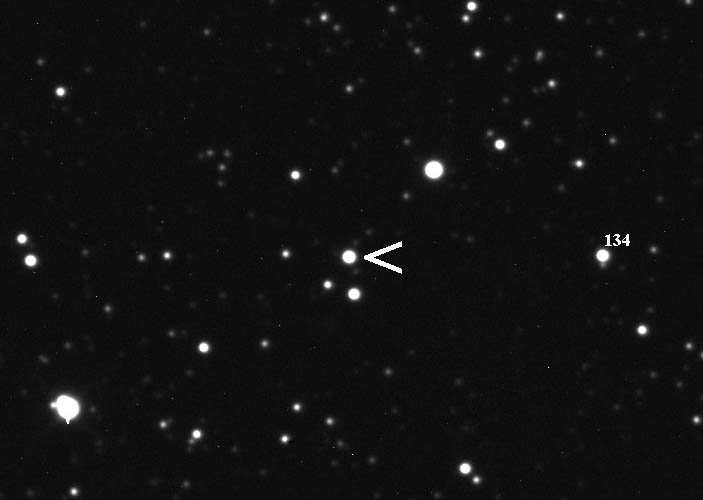
Dwarf nova HT Cas seen in outburst (mag ~13.4) on November 2, 2010

A dwarf nova (pl. novae), or U Geminorum variable, is one of several types of cataclysmic variable star, consisting of a close binary star system in which one of the components is a white dwarf that accretes matter from its companion. Dwarf novae are dimmer and repeat more often than "classical" novae.[1]

Overview

[edit]

The first one to be observed was U Geminorum in 1855; however, the mechanism was not known until 1974, when Brian Warner showed that the nova is due to the increase of the luminosity of the accretion disk.[2] They are similar to classical novae in that the white dwarf is involved in periodic outbursts, but the mechanisms are different. Classical novae result from the fusion and detonation of accreted hydrogen on the primary's surface. Current theory suggests that dwarf novae result from instability in the accretion disk, when gas in the disk reaches a critical temperature that causes a change in viscosity, resulting in a temporary increase in mass flow through the disc, which heats the whole disc and hence increases its luminosity. The mass transfer from the donor star is less than this increased flow through the disc, so the disc will eventually drop back below the critical temperature and revert to a cooler, duller mode.[3][4]

Dwarf novae are distinct from classical novae in other ways; their luminosity is lower, and they are typically recurrent on a scale from days to decades.[3] The luminosity of the outburst increases with the recurrence interval as well as the orbital period; recent research with the Hubble Space Telescope suggests that the latter relationship could make dwarf novae useful standard candles for measuring cosmic distances.[3][4]

There are three subtypes of U Geminorum star (UG):[5]

  • SS Cygni stars (UGSS), which increase in brightness by 2–6 mag in V in 1–2 days, and return to their original brightnesses in several subsequent days.
  • SU Ursae Majoris stars (UGSU), which have brighter and longer "supermaxima" outbursts, or "super-outbursts," in addition to normal outbursts. Varieties of SU Ursae Majoris star include ER Ursae Majoris stars and WZ Sagittae stars (UGWZ).[6]
  • Z Camelopardalis stars (UGZ), which temporarily "halt" at a particular brightness below their peak; a behavior termed a "standstill".[7] They are interpreted as occupying the border between the classes of dwarf nova and the more stable nova-like variables.[8]

In addition to the large outbursts, some dwarf novae show periodic brightening known as “superhumps”. They are caused by deformations of the accretion disk when its rotation is in resonance with the orbital period of the binary.

References

[edit]
[edit]
Revisions and contributorsEdit on WikipediaRead on Wikipedia
from Grokipedia
A dwarf nova is a subtype of cataclysmic variable, comprising a close binary system in which a white dwarf accretes hydrogen-rich material from a low-mass main-sequence companion star through Roche-lobe overflow, forming a circumstellar accretion disk that undergoes recurrent thermal instabilities leading to optical outbursts of 2–5 magnitudes in amplitude lasting days to weeks. These outbursts recur on timescales ranging from days to decades, driven by the disk instability model where ionization fronts propagate through the disk, temporarily boosting the mass accretion rate onto the white dwarf surface. Unlike classical novae, which involve explosive thermonuclear fusion on the white dwarf, dwarf novae exhibit non-destructive variability confined to the accretion disk and boundary layer, preserving the binary system's long-term evolution. Dwarf novae are observationally distinguished by their light curves, which typically feature a rapid rise to maximum brightness (hours to a day) followed by an over 1–20 days, often showing bimodal patterns with short (~2–3 day) and long (~10–15 day) outbursts in certain subtypes. During quiescence between outbursts, the system's drops, and spectra reveal emission lines from a cool, optically , while outbursts produce absorption-line spectra from a hot, optically thick disk, with the continuum shifting to bluer colors due to from ~5000 K to ~20,000 K. Multi-wavelength observations detect hard emission (from in the ) in quiescence and soft / flux during outbursts, providing probes of the accretion physics. The three primary subtypes—U Gem-type, Z Cam-type, and SU UMa-type—reflect variations in mass-transfer rates and disk behavior, with U Gem systems showing standard outbursts above the ~2–3 hour gap, Z Cam systems exhibiting intermittent "standstills" at intermediate brightness, and SU UMa systems below the gap displaying rarer superoutbursts (up to 3–5 magnitudes brighter, lasting 10–20 days) accompanied by superhumps, which are photometric modulations ~1–3% longer than the due to in a tilted, eccentric disk. These phenomena, first systematically studied in the mid-20th century through variables like U Geminorum (discovered 1855), have advanced models of viscous accretion and binary evolution, highlighting dwarf novae as key laboratories for understanding in binaries.

Definition and Characteristics

Definition

Dwarf novae constitute a subclass of cataclysmic variables, characterized as systems in which a primary accretes hydrogen-rich material from a low-mass main-sequence or companion via Roche-lobe overflow. This steady mass transfer forms an around the white dwarf, where gravitational energy release powers the system's , punctuated by recurrent outbursts that increase brightness by 2–5 magnitudes every few weeks to months. In contrast to classical novae, which undergo infrequent, explosive thermonuclear runaways on the white dwarf's surface ejecting substantial envelope material, dwarf novae experience more regular variability driven by thermal instabilities within the , without significant mass loss or nuclear ignition. These outbursts typically endure 2–20 days, elevating the visual magnitude from quiescent values of approximately V = 12–18 to peaks around V = 7–15, followed by quiescence intervals of 10–100 days during which accretion proceeds at a diminished rate.

Physical Properties

Dwarf novae systems consist of a primary with typical masses in the range of 0.6 to 1.2 solar masses (M⊙), derived from analyses of eclipsing systems and measurements. These white dwarfs exhibit surface effective temperatures typically between 20,000 and 50,000 K in quiescence, as inferred from . During outbursts, increased accretion causes significant heating, raising surface temperatures by several thousand . The companion star is a low-mass main-sequence or slightly evolved donor, with masses typically between 0.1 and 0.8 M⊙, corresponding to spectral types from late G to M, and occasionally cooler L or T dwarfs in short-period systems. This mass range aligns with the empirical relation M₂ ≈ 0.1 × P_orb (where P_orb is the orbital period in hours), which holds for periods of 1–5 hours common in dwarf novae. The donor's spectral type influences the system's infrared emission, with M-type stars showing strong molecular absorption features. Orbital periods in dwarf novae predominantly span 1.5 to 6 hours, reflecting the close binary nature required for sustained . A notable period gap occurs around 2–3 hours, where fewer systems are observed, attributed to a temporary halt in driven by loss mechanisms such as magnetic braking above the gap and gravitational radiation below it. The shortest periods approach a minimum of about 77 minutes, near the theoretical limit for stable from low-mass donors. Accretion rates vary significantly between quiescence and outburst. In quiescence, the rate onto the is typically 10^{13}–10^{16} g s⁻¹, corresponding to time-averaged values of ~10⁻¹¹ to 10⁻¹⁰ M⊙ yr⁻¹, as determined from far-ultraviolet flux measurements and disk instability models. During outbursts, this rate increases dramatically to up to 10¹⁹ g s⁻¹, enhancing disk and by factors of 10–100. System inclinations are often high, with approximately 30% of dwarf novae exhibiting eclipses due to the secondary occulting the or , providing direct constraints on component sizes and masses. These eclipsing systems, such as IP Pegasi, typically have inclinations exceeding 80°, enabling precise geometric modeling.

Binary System and Formation

Companion Stars and Orbital Dynamics

Dwarf novae are close binary systems consisting of a white dwarf primary and a low-mass main-sequence companion star, typically of spectral type G8 to M6, which fills its Roche lobe and transfers matter to the white dwarf via gravitational interactions. The companion, often referred to as the secondary, has a mass generally less than 1 solar mass and provides the hydrogen-rich material that forms the accretion disk around the white dwarf. This mass transfer is the fundamental process enabling the recurrent outbursts characteristic of dwarf novae. The primary mechanism for in these systems is Roche lobe overflow, where the secondary star expands to contact its due to angular momentum losses in the binary orbit. These losses are driven predominantly by magnetic braking for orbital periods longer than about 3 hours, which removes angular momentum from the secondary's , and by gravitational radiation for shorter periods below 2 hours, causing the orbit to shrink and the secondary to overfill its . As a result, the rate typically ranges from 10^{-11} to 10^{-8} solar masses per year, sustaining the accretion process. Orbital velocities in dwarf novae binaries reflect the compact nature of these systems, with the typically orbiting at speeds of approximately 100–500 km/s, while the companion moves more quickly due to the mass disparity. The mass ratio = M_companion / M_white_dwarf is usually in the range 0.1–0.5, which influences the of the formation and stability, as lower values lead to more eccentric disks prone to tidal resonances. Tidal interactions between the components promote spin-orbit synchronization in most systems, where the secondary's rotation period aligns with the , facilitating efficient transfer and affecting the accretion flow through spin-orbit . Evidence for these dynamics comes from radial velocity measurements, which reveal orbital semi-amplitudes K of 50–300 km/s, often derived from absorption or emission lines tracing the motion of the companion or disk. For instance, in the well-studied dwarf nova SS Cygni, spectroscopic observations yield K ≈ 159 km/s for the secondary, confirming the binary parameters and geometry. Such measurements, combined with photometric data, provide constraints on the inclination and component masses, underscoring the role of in dwarf nova behavior.

Evolutionary Pathways

Dwarf novae originate from post-common envelope binaries formed when the more massive star in a primordial main-sequence pair evolves into a red giant or asymptotic giant branch star, initiating a common envelope phase that shrinks the orbit to separations of approximately 1–3 R_⊙. These progenitor systems typically consist of a white dwarf primary and a low-mass main-sequence secondary, with the envelope ejection leaving a compact binary primed for Roche lobe overflow and the onset of cataclysmic variable behavior. The long-term evolution of these systems is driven primarily by angular momentum loss mechanisms that shrink the orbit and facilitate . Magnetic braking, arising from the interaction of the secondary's magnetized with the , dominates at longer orbital periods above the period gap, providing the necessary to sustain accretion. At shorter periods below the gap, emission takes over as the primary driver, accelerating through quadrupole radiation from the compact binary. A notable feature in this evolution is the period gap, spanning approximately 2–3 hours, where few systems are observed due to a temporary halt in . As the secondary loses mass and becomes fully convective around 3 hours, magnetic braking efficiency drops sharply—by about 90%—causing the donor to detach from its and interrupting accretion, rendering the system optically faint. Evolution resumes below 2 hours as gravitational radiation dominates, driving the secondary back into contact and restarting the cataclysmic phase. The dwarf nova phase persists for timescales on the order of 10^9 years, during which repeated disk instabilities lead to outbursts, though the may experience classical nova eruptions if sufficient accumulates. Ultimately, continued evolution could drive the system toward a if the accretes enough mass to approach the , though many models indicate net mass loss via novae prevents this outcome for most systems. Population synthesis models estimate around 10^7 dwarf novae in the , reflecting the intrinsic Galactic population after accounting for evolutionary selection effects and the period gap.

Outburst Mechanism

Accretion Disk Instability

The disk instability model (DIM) attributes dwarf nova outbursts to a thermal-viscous in the , where the disk cycles between stable cool and hot states separated by an unstable intermediate branch on the surface density-temperature (Σ-T) curve. This arises in regions of partial , causing a sharp increase in opacity and that drives rapid state transitions. In the cool quiescent state, the disk has low due to neutral , while in the hot outburst state, full enables higher and enhanced accretion. The is described by the Shakura-Sunyaev α , typically in the range α ≈ 0.01–0.1, which jumps from lower values (∼0.02–0.04) in quiescence to higher values (∼0.1–0.2) during outburst, amplifying the mass accretion rate by orders of magnitude. The critical transition occurs when the midplane enters the partial zone for , around 6000–8000 at the lower turning point, where recombination and balance leads to . This ignites a heating front that propagates outward through the disk at speeds of approximately 10–30 km/s, ionizing and heating successive annuli until the entire disk reaches the hot state. During quiescence, transferred mass accumulates in the outer disk because the low impedes inward flow, building surface density until it surpasses the critical threshold for instability, equivalent to roughly 0.1–1% of the mass. This threshold, when reached, destabilizes the outer disk, initiating the heating front and outburst as excess mass drains inward on a viscous timescale. The characteristic viscous time governing disk is given by tviscR2ν,t_\mathrm{visc} \approx \frac{R^2}{\nu}, where RR is the disk radius, and the kinematic viscosity ν=αcsH\nu = \alpha c_\mathrm{s} H, with csc_\mathrm{s} the isothermal sound speed and HH the disk scale height; this timescale sets the outburst recurrence interval to days or weeks for typical parameters. As the heating front advances, the local disk temperature rises, and the emerging flux follows the blackbody approximation FT4F \propto T^4, causing a rapid brightening that dominates the early outburst rise. This propagation continues until a cooling front reverses the process at outburst peak, returning the disk to quiescence.

Classification and Types

U Geminorum Subtype

The U Geminorum subtype represents the classical and most common form of dwarf novae, comprising approximately 70% of all known systems in this class. These stars exhibit simple, regular outbursts driven by thermal instabilities in the , without the standstills seen in other subtypes or extended superoutbursts. The light curves are characterized by a rapid, symmetric rise to maximum brightness lasting 1–2 days, followed by a slower over several days to weeks. Outburst cycles in U Geminorum stars typically recur every 10–300 days, with visual increases of 3–5 magnitudes from quiescence to maximum. This periodicity arises from the accumulation of transferred material in the disk until the instability threshold is reached, leading to a heating front that ionizes the disk and causes the brightness surge. The steady rate from the secondary star, on the order of 10^{16} g/s during quiescence, provides sufficient material to sustain these frequent instabilities without significant variations that could alter the system's behavior. Prominent examples include the prototype U Geminorum itself, which has an of 4.25 hours and displays typical outburst properties, and SS Cygni, a well-monitored system with similar cycle lengths around 50 days. These systems maintain evolutionary stability in the U Geminorum class as long as the rate remains relatively constant; significant increases could potentially shift them toward nova-like behavior, while decreases might suppress outbursts altogether.

Z Camelopardalis Subtype

The Z Camelopardalis (Z Cam) subtype represents approximately 10–20% of known dwarf novae, characterized by recurrent outbursts that are periodically interrupted by standstills—plateaus of relatively constant brightness at an intermediate level, typically 1–2 magnitudes fainter than outburst maximum or about 2 magnitudes brighter than quiescence. These standstills distinguish Z Cam stars from other dwarf nova subtypes, as the system remains in a semi-stable state without fully decaying to quiescence or escalating to a full outburst. The prototype for this class is Z Camelopardalis itself, discovered in but recognized for its unique standstill behavior in the through early photometric observations. The underlying mechanism for standstills in Z Cam stars involves rates from the donor star that hover near the critical threshold for thermal stability in the , typically around 3 × 10^{16} g/s, placing these systems at the boundary between unstable dwarf nova behavior and stable nova-like states. When the mass transfer rate temporarily increases—possibly due to enhanced activity on the secondary, such as star spots or irradiation effects—the outer disk regions remain ionized and hot, preventing the propagation of a cooling front that would otherwise trigger quiescence; alternatively, disk truncation by magnetic or other effects can sustain this hot state. This results in a stable, low-viscosity hot disk configuration during standstills, with accretion proceeding steadily at a rate sufficient to maintain the plateau without the of a full outburst. Standstill durations are highly irregular, lasting from weeks to several months (up to ~1000 days in extreme cases), with transitions to and from these phases occurring unpredictably, often without clear precursors in the light curve. Outburst cycles between standstills typically span 10–40 days, but the overall behavior is erratic, reflecting fluctuations in the rate around the stability boundary. Z Camelopardalis, with an of approximately 7.0 hours (0.289 days), exemplifies this irregularity, having been monitored extensively since its early recognition and showing multiple prolonged standstills over decades of observation.

SU Ursae Majoris Subtype

The SU Ursae Majoris (SU UMa) subtype consists of short-period dwarf novae with orbital periods Porb<4.5P_{\rm orb} < 4.5 hours that exhibit both frequent normal outbursts and rarer superoutbursts, the latter characterized by amplitudes of 5–6 magnitudes and durations of 10–20 days occurring every 5–10 normal outbursts. These systems represent approximately 5–10% of all dwarf novae and occur in systems with short s below the ~2-3 hour period gap, where the can expand to the 3:1 radius with the companion star, enabling the tidal excitation of eccentricity and superoutbursts. The prototype, SU Ursae Majoris itself, has an orbital period of 1.8 hours and was first identified as a in 1908, with its superoutburst behavior recognized in . Superoutbursts in SU UMa stars arise from tidal interactions in the , where the grows through accumulated until it reaches the 3:1 radius with the companion star. This resonance excites the disk's eccentricity via parametric instability, causing the outer disk to expand and contact the outer , triggering enhanced viscous heating and a prolonged outburst phase. The tidal-thermal instability model, developed through hydrodynamic simulations, explains how this process amplifies the thermal instability inherent to dwarf novae, leading to superoutbursts that are both brighter and longer-lasting than normal ones. A hallmark of superoutbursts is the emergence of superhumps, which manifest as photometric modulations with a period Psh=Porb(1+0.010.03)P_{\rm sh} = P_{\rm orb} (1 + 0.01 - 0.03), resulting from the of the eccentric disk. This beat frequency produces brightness variations of 0.1–0.3 magnitudes, peaking after the outburst maximum and providing a measurable proxy for the in these systems. Observations confirm that superhumps are absent during normal outbursts but reliably appear in every superoutburst, underscoring their tidal origin.

Observational Features

Light Curve Variations

Dwarf novae spend most of their time in a quiescent state characterized by low accretion rates onto the , resulting in a faint optical brightness dominated by a blue continuum spectrum from the surface, overlaid with emission lines from the . Typical quiescent magnitudes vary by system but often range from 12 to 18 in V-band, with small fluctuations due to variable from the companion star. Outbursts begin with a rapid rise in brightness, typically exponential in nature and lasting from hours to a few days, as a heating front propagates through the . The rise time reflects the speed of this thermal instability and can differ between outburst types, with very rapid rises (under 1 day) common in systems like SS Cygni. Following maximum , the decay phase is generally slower and more linear when plotted in magnitude versus time, with durations scaling inversely with the prevailing accretion rate; short decays last 2–5 days, while longer ones extend to 10–20 days or more. Overall outburst amplitudes reach 2–5 magnitudes, with recurrence intervals of 10–100 days depending on the mass transfer rate. Light curve shapes vary distinctly by subtype, providing diagnostic signatures for . U Geminorum systems exhibit classic fast-rise, slow-decay profiles with high amplitudes and no plateaus, reflecting inside-out of the heating front. Z Camelopardalis stars show alternating normal outbursts and extended plateaus at intermediate brightness levels lasting weeks to years, where the disk hovers near a . SU Ursae Majoris systems display both short normal outbursts and rarer, longer superoutbursts with superimposed superhumps—periodic wiggles of ~0.1–0.3 mag amplitude and periods 1–4% longer than the —arising from disk . Superimposed on these longer-term variations is flickering, a short-term photometric instability on timescales of seconds to minutes with amplitudes of 0.1–0.5 magnitudes, attributed to and inhomogeneities in the inner . Flickering is most prominent in the blue/UV bands during quiescence and early outburst stages but diminishes at maximum light as the disk expands. These rapid variations, strongest near the disk's bright spots, offer probes into the disk's dynamical structure.

Spectroscopic Signatures

In the quiescent phase, dwarf novae exhibit spectra dominated by strong emission lines from the , particularly the such as Hα and Hβ, which arise from optically thin regions of the disk. These lines have typical (FWHM) values ranging from approximately 1000 to 3000 km/s, reflecting the broad velocity dispersion due to Keplerian motion across the disk's radial extent. During the outburst phase, the spectra transition dramatically: early in the rise, broad absorption lines in the become prominent, originating from the of the heating . As the outburst progresses, these evolve into emission lines, often displaying P Cygni profiles characterized by blue-shifted absorption troughs superimposed on broader emission components, indicative of outflowing disk winds with velocities up to several thousand km/s. The emission lines in both phases frequently show double-peaked profiles due to the rotational kinematics of the , where the peak separation Δv approximates 2 v sin i, with v representing the azimuthal at the line-forming region and i the ; this structure is most evident in high-resolution spectra of non-eclipsing systems. lines provide key diagnostics of the plasma conditions: He I emissions are common in quiescence from cooler disk regions, while He II lines, such as λ4686, appear strongly during outburst, signaling and temperatures exceeding 10,000 K in the irradiated inner disk. Radial velocity curves derived from these spectroscopic lines enable precise measurements of orbital periods and binary component masses; for instance, the semi-amplitudes K1 (from absorption lines) and (from donor star features) yield mass ratios and total masses via Kepler's laws, as demonstrated in time-resolved observations of prototypes like SS Cygni.

Notable Examples and Studies

Key Prototypes

U Geminorum, the archetypal dwarf nova, was discovered in December 1855 by the English astronomer John Russell Hind while searching for asteroids; he initially mistook it for a nova due to its sudden appearance at magnitude 9 before it faded rapidly. As the first recognized recurrent variable of its class, it established the pattern of semi-periodic outbursts characteristic of dwarf novae, with observations confirming its binary nature consisting of a accreting material from a low-mass companion. The system's is 4.25 hours, determined through extensive spectroscopic and photometric studies that reveal eclipses and variations. Regular outbursts, rising from magnitude 14-15 to 9-10 over a few days and lasting about a week, recur approximately every 100 days on average, providing a benchmark for understanding dynamics in cataclysmic variables. SS Cygni, the second discovered dwarf nova, was identified in 1896 by Louisa D. Wells at Harvard College Observatory through photographic plates showing its variability. Located at a distance of 114 parsecs, it is one of the nearest and brightest examples, facilitating detailed multi-wavelength observations across optical, , , and radio spectra since its discovery. During outbursts, it brightens dramatically to visual magnitude 8 from a quiescent level of 12, with events recurring every 49 days on average and lasting 1-2 weeks; these have been monitored extensively, revealing correlated emissions from the and . Z Camelopardalis, the prototype of its subtype, was discovered photographically in 1904 by Henry Park Hollis as part of the Astrographic Catalogue project at the Royal Observatory, Greenwich. Its distinctive behavior, including occasional standstills where brightness plateaus at an intermediate level between outburst and quiescence, was first observed in the 1920s, marking the initial recognition of this phenomenon that interrupts the usual outburst cycle. With an of 7 hours, the system exhibits normal outbursts rising 4-5 magnitudes every few weeks, but the standstills—lasting weeks to years—highlight enhanced episodes, as evidenced by stable emission line profiles during these phases. SU Ursae Majoris, discovered in 1908 by Lidiya Ceraski at the Moscow Observatory during a routine patrol, became pivotal in defining the SU UMa subclass through observations of its superoutbursts. These longer, brighter events—reaching magnitude 10 from 14 and lasting 10-20 days—were confirmed in the via high-precision photometry that detected associated superhumps, periodic brightness modulations due to in the eccentric . Occurring roughly every 1-2 years amid shorter normal outbursts, SU UMa's data have been instrumental in validating tidal-thermal instability models, where 3:1 orbital resonances expand the disk to trigger these extended brightenings. VW Hydri serves as the premier prototype for SU UMa-type dwarf novae, with its variability first noted in photographic surveys in the mid-20th century and outbursts extensively documented since the . As an eclipsing binary with a 1.78-hour , its deep eclipses—up to 2 magnitudes in quiescence—enable precise measurements of the white dwarf's radius, temperature, and where the accretion stream impacts the disk, offering unique insights into component masses and geometries. Superoutbursts every 2-3 months, interspersed with normal ones, have been studied in detail, revealing rapid oscillations and superhumps that align with disk instability predictions.

Recent Observations

The mission has provided precise trigonometric parallaxes for over 1,500 cataclysmic variables, including hundreds of dwarf novae, enabling refined estimates of their distances and intrinsic luminosities that better align with predictions from the disc instability model (DIM). For instance, the distance to the prototype SS Cygni is measured at 117 ± 6 pc, resolving prior discrepancies and supporting mass-transfer rates consistent with observed outburst properties. High-cadence photometric surveys such as the (ZTF) and the All-Sky Automated Survey for Supernovae (ASAS-SN) have detected precursors to dwarf nova outbursts in multiple systems, offering insights into the early stages of thermal-viscous instabilities. These observations, spanning timescales of hours to days before peak brightness, help constrain key DIM parameters like the viscosity parameter α and the critical mass-transfer rate threshold for instability onset. Observations in and wavelengths from missions like and have illuminated the evolution of the —the interface between the accretion disc and the surface—during outbursts. Multi-wavelength campaigns on GK Persei, an intermediate polar exhibiting hybrid dwarf nova behaviors, from 2022 to 2024 revealed variable accretion rates and spin-modulated emission, with the 2023 outburst showing enhanced soft flux indicative of boundary layer heating and cooling cycles. These data highlight transitions between disc-dominated and magnetically channeled accretion regimes. Population studies leveraging parallaxes and all-sky surveys estimate the Galactic dwarf nova population at approximately 10^6 to 10^7 systems, with a space density of about 10^{-5} pc^{-3}, predominantly in the thin disc. Extragalactic detections remain challenging due to distance and faintness, but has identified candidate dwarf nova-like transients in M31, including recurrent low-amplitude outbursts consistent with thermal instabilities in resolved systems. Theoretical advancements have refined α-viscosity prescriptions in the DIM by incorporating magnetorotational instability (MRI)-driven , with 2024 magnetohydrodynamic simulations demonstrating that numerical in global disc models yields effective α values of 0.01–0.1, aligning with outburst recurrence times and quiescence luminosities observed in dwarf novae. These models validate MRI as the primary mechanism for anomalous transport in ionized accretion discs.

References

Add your contribution
Related Hubs
User Avatar
No comments yet.