Hubbry Logo
Sack AS-6Sack AS-6Main
Open search
Sack AS-6
Community hub
Sack AS-6
logo
8 pages, 0 posts
0 subscribers
Be the first to start a discussion here.
Sack AS-6
Sack AS-6
from Wikipedia
Sack AS-6
Role Experimental
National origin Germany
Manufacturer Mitteldeutsche Motorwerke/Flugplatz-Werkstatt
Designer Arthur Sack
Status Abandoned
Produced 1944
Number built 1

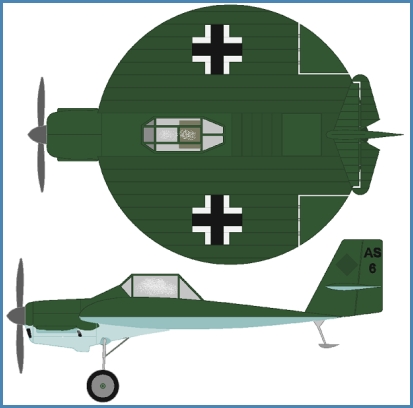
The Sack AS-6 was a German prototype circular-winged aircraft built privately during the Second World War.[1]

Design and development

[edit]

In July 1938, local farmer Arthur Sack entered his AS-1 circular-winged model in the first Reich-Wide Contest for Motorized Flying Models, which was held at Leipzig.[2] The model had poor flight characteristics and had to be hand launched. However, Ernst Udet showed interest in Sack's design, and encouraged him to continue his research into circular wing aircraft for possible use as an observation or attack aircraft.[2]

Sack went on to build four additional models based on the AS-1, with each increasing in size, before building the full-sized prototype as the AS-6 V1. The AS-6 V1 was built in January 1944 by Mitteldeutsche Motorwerke, with final assembly at the Flugplatz-Werkstatt workshop located at the air base in Brandis, Germany.[3] The aircraft was built with the landing gear, cockpit, and pilot seat from a Messerschmitt Bf 109B, and was powered by an Argus As 10C-3 engine from a Messerschmitt Bf 108 Taifun. The wing structure was made of plywood.

Operational history

[edit]

Testing of the AS-6 V1 began in February 1944, with test pilot Rolf Baltabol in the cockpit. During taxi tests, it was found that the tail needed extensive modifications in order to handle the 240 hp of the As 10C-3 engine.[4] Five flight attempts were conducted on the Brandis air base's 1,250 m (4,100 ft) runway, but the aircraft failed to achieve flight. Defects were found in the aircraft's control surfaces. On its fifth attempt, both brakes failed, resulting in structural damage to the aircraft.[4]

The prototype was subsequently repaired and two more flight attempts were made, but once again it would not lift off.[4] Sack blamed the problem of insufficient angle of attack, but Baltabol believed it to be lack of power, and suggested that the AS-6 be fitted with a 2,000 hp Daimler-Benz DB 605 engine from a Bf 109. Sack, convinced it was the angle of attack that was the problem, relocated the landing gear eight inches aft.[4] This, too, was insufficient, and some sources claim that the landing gear was relocated a further 16 inches aft, but this is unlikely.[4] The aircraft was reported to have been fitted with better brakes from a Junkers Ju 88 and have had further modifications to the tail. An additional 70 kg (154 lb) of metal ballast was added.[4]

On April 16, 1944, the modified AS-6 V1 attempted another flight. The aircraft made a brief hop, but yet again it was unable to achieve flight.[4] Another attempt was made with similar results, but during the short hop it was found that the torque from the As 10C-3 caused stability problems. One more attempt was made, but stability problems resulted in one of the landing gear legs collapsing. After this, Baltabol lost interest in the project, telling Sack that his AS-6 was dangerous and to stop flight testing until after wind tunnel testing and necessary modifications could be made.[4] Sack subsequently went back to the drawing board and made further modifications to the aircraft.

In the summer of 1944, Jagdgeschwader 400 relocated to Brandis, flying the new Messerschmitt Me 163B Komet.[3] Confident that the new Me 163 pilots were more experienced than the pilots previously available to him, Sack asked for a new test pilot for his modified AS-6. The aircraft, nicknamed Bussard (Buzzard) by the JG 400 pilots, made one final flight attempt, this time with Oberleutnant Franz Roszle at the controls. Once again, the aircraft made only a short hop, resulting in a collapsed landing gear leg.[3] Roszle suggested that Sack send his design to Messerschmitt for proper development, but Sack refused. Nevertheless, Messerschmitt got word of Sack's aircraft and proposed to build an improved version, the AS-7, as the Me 600.[3]

The AS-6 was damaged in a strafing run before Sack had a chance to make further improvements, and the aircraft was likely scrapped soon afterward. By the time US troops arrived at Brandis in April 1945, no traces of the AS-6 were left.[3]

The Sack AS-6 is commonly associated with the Nazi UFOs conspiracy theory.[2]

Variants

[edit]
The AS-5 which Arthur Sack flew as a model
AS-1 through AS-5
Development models, each increasing in size.
AS-6 V1
Full-sized prototype, one built.
AS-7
Proposed enlarged version to be powered by a 2,000 hp DB 605 engine and armed with six MK 108 cannons mounted in the wings. None built.
Me 600
Proposed Messerschmitt production of the AS-7. Not built.

Specifications (AS-6 V1)

[edit]
Sack AS-6

Data from [3]

General characteristics

  • Crew: 1
  • Length: 6.4 m (21 ft 0 in)
  • Wingspan: 5 m (16 ft 5 in)
  • Height: 2.56 m (8 ft 5 in)
  • Wing area: 19.62 m2 (211.2 sq ft)
  • Max takeoff weight: 900 kg (1,984 lb)
  • Powerplant: 1 × Argus As 10C-3 inverted V8 engine, 180 kW (240 hp)
  • Propellers: 2-bladed, 2.5 m (8 ft 2 in) diameter

Performance

  • Wing loading: 45.87 kg/m2 (9.39 lb/sq ft)

See also

[edit]

References

[edit]
Revisions and contributorsEdit on WikipediaRead on Wikipedia
from Grokipedia
The Sack AS-6 was a highly unconventional German experimental aircraft developed during , featuring a circular-wing that resembled a flying saucer, built as a single-seater prototype primarily from wood and canvas by engineer Arthur Sack. Sack, a self-taught aviation enthusiast and farmer, conceived the AS-6 as an evolution of his earlier AS-1 model from 1939, aiming to create a high-speed fighter with low drag through its disc-shaped wing and lack of a traditional fuselage; the incorporated a single large circular wing surrounding a short central body, a conventional tail assembly with vertical and horizontal stabilizers, and salvaged components such as the cockpit and landing gear from a wrecked Messerschmitt Bf 109B. Development received limited funding from the Reich Air Ministry (RLM) in 1944, with construction handled by the Mitteldeutsche Metallwerke firm using readily available parts to expedite the project amid wartime shortages. The prototype, completed in early 1944, was powered by an underpowered 240 horsepower Argus As 10C-3 inverted V-8 air-cooled engine, which proved insufficient for the aircraft's ambitious goals; during ground tests and brief taxiing attempts at Brandis Airbase, it exhibited severe control difficulties due to its unstable aerodynamics and the engine's limited thrust, preventing any sustained flights despite efforts by experienced pilots, including one from the Me 163 rocket fighter unit JG 400. With a wingspan of 5 meters (16 feet 5 inches), length of 6.4 meters (21 feet), and maximum takeoff weight of 900 kilograms (1,984 pounds), the AS-6 had no armament and was envisioned for potential interceptor roles, though its 19.62 square meter (211 square foot) wing area resulted in a low wing loading of approximately 45.87 kg/m² (9.4 lbs/ft²), contributing to its handling issues. Following initial failures, the damaged was stored at Brandis, where it was ultimately destroyed during an Allied bombing raid in , ending the without operational ; Sack proposed an improved AS-7 with power and controls, but it remained unbuilt due to the war's conclusion. The AS-6's brief highlighted the experimental risks of radical aerodynamic in late-war German .

Development

Conception and Design Principles

Arthur Sack (1900–1964), a self-taught engineer and farmer from Germany, first conceived the idea for a circular-wing aircraft in the late 1930s, driven by his personal enthusiasm for aviation and a desire to explore unconventional designs. As an amateur without formal training or institutional support, Sack's motivations centered on achieving superior low-speed stability and short takeoff and landing (STOL) capabilities, which he believed could enhance the performance of fighter aircraft in combat scenarios. At the core of Sack's design principles was the hypothesis that a disc-shaped wing planform could fundamentally improve aerodynamic behavior compared to traditional elliptical or rectangular wings. He theorized that the circular configuration would distribute lift more evenly across the span, thereby reducing the risk of at low speeds and enabling tighter maneuverability without the abrupt loss of control associated with conventional designs. This approach aimed to prioritize inherent stability during slow flight, potentially allowing for operations from unprepared fields, aligning with Sack's vision for a versatile, agile combat machine. Sack's independent initiative drew loose inspiration from pre-war German experimental trends, including into annular and forms in gliders and early powered prototypes. While his early work remained private without official sponsorship, he benefited from informal advice, such as design insights from renowned aerodynamicist Dr. , but emphasized a self-reliant methodology unburdened by military oversight. Following the success of his AS-5 model in , the received from the (RLM). Sack began documenting his concepts through initial sketches and rudimentary theoretical calculations in the late 1930s, starting with small-scale models like the AS-1, which he demonstrated at the 1939 Leipzig-Mockau model aircraft competition. These early efforts included basic estimates of lift-to-drag ratios for circular planforms, suggesting potential efficiency gains in low-speed regimes over standard wing shapes, though detailed documentation remains sparse. By the early 1940s, these ideas evolved into more advanced models such as the AS-5, laying the groundwork for the full-scale AS-6 prototype.

Construction and Prototyping

The Sack AS-6 prototype was constructed by the Mitteldeutsche Metallwerke firm near Brandis, Germany (close to Leipzig), starting in late 1943 under the severe resource limitations imposed by World War II. With limited funding from the RLM, the project drew from the theoretical advantages of circular-wing designs explored in Sack's pre-war model experiments. The airframe featured a primarily wooden structure for the distinctive disc-shaped wing, measuring approximately 5 meters in diameter, with fabric covering for aerodynamic surfacing and simple metal fittings for assembly. Due to acute wartime shortages of new components, key elements including the cockpit canopy, pilot seat, and main landing gear were scavenged from a wrecked Messerschmitt Bf 109B, while the inverted V-8 engine was sourced from a salvaged Messerschmitt Bf 108. These improvisations highlighted the logistical hurdles of aviation development during the conflict, where access to specialized materials and tools was severely restricted. Construction faced significant engineering obstacles, particularly in fabricating the rigid circular wing form without elaborate internal supports, balancing the overall weight distribution to maintain stability, and compensating for the lack of precision tooling. The first prototype, designated V1, was completed by early 1944, after which Sack made iterative modifications based on preliminary ground handling trials to address issues like uneven weight loading and structural flexing observed during taxiing.

Technical Description

Airframe and Wing Configuration

The Sack AS-6 featured an innovative annular , consisting of a ring-shaped with an outer of approximately 5 and employing the NACA 23012 airfoil section throughout its profile. This design incorporated a central cutout to provide clearance for the pusher , a compact "flying disc" layout without compromising structural integrity. The wing area measured 19.62 m², contributing to the aircraft's overall low aspect ratio and emphasis on stability across various attitudes. The airframe integrated a minimal fuselage directly into the wing's central hub, positioning the pilot in an enclosed cockpit at the disc's core for optimal visibility and balance. Overall dimensions included a length of 6.4 meters and a height of 2.56 meters, with an empty weight of around 800 kg, reflecting the lightweight wooden construction augmented by fabric covering. Landing gear comprised a tricycle arrangement adapted from components of the Messerschmitt Bf 109, featuring retractable nose gear to reduce drag while maintaining ground handling suitability for the unconventional profile. Control authority was provided by a conventional tail assembly consisting of one vertical stabilizer and two horizontal stabilizers, with elevators mounted at the rear for pitch and yaw control via a rudder. This configuration, along with potential wing-mounted surfaces, managed roll and overall stability, prioritizing the theoretical advantages of uniform lift distribution inherent to the circular planform.

Powerplant and Performance Characteristics

The Sack AS-6 utilized an Argus As 10C-3 inverted V-8 air-cooled engine rated at 240 hp at 2,200 rpm, mounted in a pusher configuration behind the pilot to facilitate the unique circular wing layout. This engine, salvaged from a Messerschmitt Bf 108, was housed in a metal frame and provided the motive power for the experimental design. The incorporated a two-bladed wooden pusher with a diameter of approximately 2 , integrated through a cutout in the trailing edge of the to avoid interference with the . The circular configuration was intended to contribute to high-speed performance and favorable low-speed handling characteristics. No armament was fitted to the prototype, though the design theoretically allowed for the integration of 20 mm cannons within the disc-shaped wing rim to leverage the structure for defensive or offensive roles.

Testing and Fate

Ground Trials and Flight Attempts

Ground trials of the Sack AS-6 prototype commenced at Flugplatz Brandis in February 1944, focusing on taxi runs and engine tests to assess basic stability and systems integration. Initial taxiing revealed significant issues with rudder authority and landing gear durability, resulting in structural damage during the first run, which highlighted the aircraft's marginal control responsiveness and sensitivity to center of gravity shifts caused by uneven weight distribution. Engine trials with the installed 240 hp Argus As 10C-3 inverted V-8 confirmed inadequate power output for overcoming the design's high drag profile, exacerbating stability problems during high-speed ground rolls. Subsequent ground testing in April 1944 involved five taxi and short takeoff runs on the 1,200-meter Brandis runway, conducted by ATG Leipzig test pilot Rolf Baltabol. These efforts exposed persistent stability challenges, including lateral oscillations and sluggish response from the small control surfaces, further complicated by center of gravity variations as fuel and ballast were adjusted. The aircraft demonstrated the intended short takeoff capability in brief ground-effect hovers but failed to transition to free flight. Further tests in summer 1944 were attempted by Oblt. Franz Rösle, Staffelkapitän of 3./JG 400, an experienced pilot with Me 163 rocket fighter background. These efforts resulted in short hops at low altitudes but were unable to achieve sustained flight, underscoring unresolved issues with lift generation and pitch control due to the underpowered engine and unstable aerodynamics. Eyewitness reports from Brandis airfield personnel described the AS-6's unusual hovering behavior near the ground, akin to a low-speed ground effect vehicle, but consistently noted the absence of sustained lift or controllable flight paths. These observations aligned with the prototype's experimental circular wing configuration, which provided marginal stability at low speeds but proved inadequate for dynamic maneuvers. All testing proceeded under strict as a privately funded initiative by designer Sack, without formal endorsement or support, amid escalating threats from raids on the area that disrupted operations and heightened measures at the airfield.

Destruction and Post-War Assessment

The fate of the Sack AS-6 V1 prototype remains uncertain; reports indicate it was either destroyed in an Allied bombing raid or dismantled and broken up for firewood at Brandis airfield in early 1945 to prevent capture by advancing Allied forces. No second prototype (V2) was constructed. The project's limited success stemmed from the inherent instability of its circular wing design, which generated significant pitching moments and control challenges at low speeds, compounded by inadequate control surfaces like the elevators. Additionally, the absence of wind tunnel testing meant aerodynamic refinements were impossible, while wartime resource shortages forced reliance on salvaged parts from wrecked aircraft, such as a Messerschmitt Bf 109, hindering structural integrity and performance. These factors, alongside failed ground trials that exposed torque and directional issues, ensured the AS-6 never progressed to sustained flight. Post-war evaluations in 1950s aviation histories portrayed the Sack AS-6 as a curious private venture rather than a viable military innovation, often highlighting its unconventional form amid myths of advanced German technology. No verified flight records exist, and contemporary analyses question whether true flights occurred, attributing reported "hops" to brief, uncontrolled lifts during taxi tests rather than powered flight. The AS-6's legacy was marginal, contributing to postwar interest in disc-wing designs but yielding no practical advancements.

Variants

AS-6 V1

The AS-6 V1 represented the initial prototype of the experimental circular-wing aircraft designed by Sack, completed in early after construction began in the autumn of 1943. This version served as the primary testbed for validating the overall circular-wing concept, incorporating a 5 m disc diameter, full wooden with fabric , a salvaged Argus As 10C-3 inverted V-8 producing 240 hp, and landing gear adapted from a Messerschmitt Bf 109B. Distinctive features of the V1 included rudimentary elevon controls integrated into the wing's trailing edge for combined pitch and roll , along with a central cutout in the disc to allow clearance for the two-bladed pusher . The aircraft's loaded reached approximately kg, reflecting its build using scavenged components such as the canopy from a Bf 109. As the only completed example, the AS-6 V1 was involved in both documented flight attempts conducted at Brandis airfield in 1944, consisting of taxi runs and brief low hops by test pilots, including one from KG 400; it suffered landing gear damage during these efforts and further harm from an Allied air raid, rendering it unfit for additional use. Documentation of the V1 remains sparse, but rare photographs from Brandis airfield illustrate its compact disc-shaped planform, elevated pusher propeller arrangement, and overall unconventional profile.

AS-7 (proposed)

Following the AS-6 V1's testing failures, Arthur Sack proposed an improved AS-7 variant in early 1945, which was passed to for and redesignated as the Me 600. This unbuilt design aimed to address stability and power issues with a more powerful engine (around 2,000 hp from the Bf 109K-4), an enlarged for better , and provision for up to six 30 MK 108 cannons in the wings for interceptor use. The was abandoned due to the end of in May 1945, with no construction or testing undertaken.
Add your contribution
Related Hubs
User Avatar
No comments yet.