Hubbry Logo
Sally BSally BMain
Open search
Sally B
Community hub
Sally B
logo
8 pages, 0 posts
0 subscribers
Be the first to start a discussion here.
Sally B
Sally B
from Wikipedia

Elly Sallingboe awarded the Transport Trust Lifetime Achievement Award in 2008

Key Information

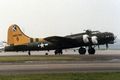
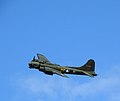
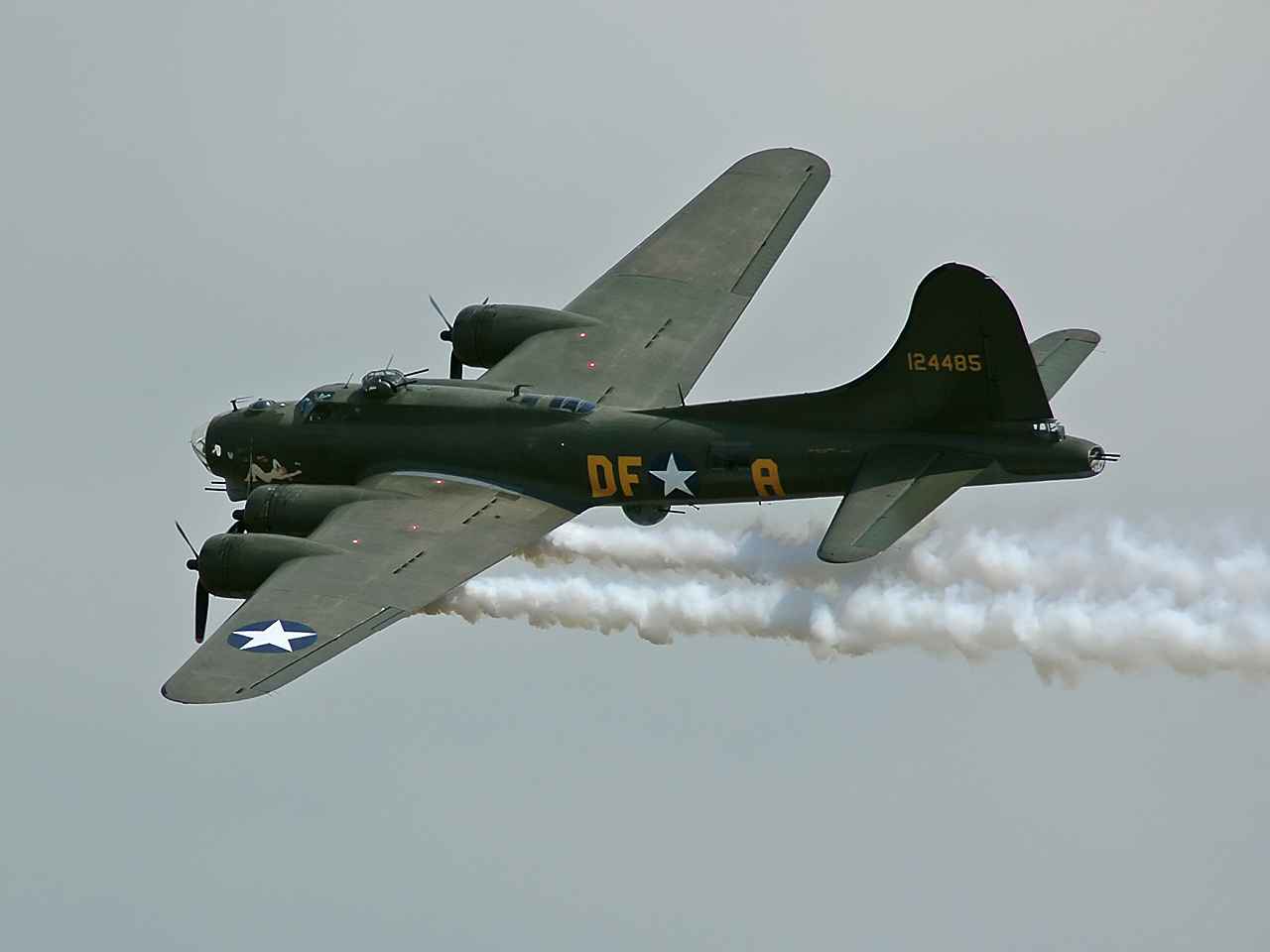
Sally B is the name of an airworthy 1945-built Boeing B-17G Flying Fortress. At 79 years old, she is the only airworthy B-17 based in Europe, as well as one of three B-17s preserved in the United Kingdom. The aircraft is presently based at the Imperial War Museum Duxford, in eastern England.[1] Sally B flies at airshows in the UK and across Europe as well as serving as an airborne memorial to the United States Army Air Forces airmen who lost their lives in the European theatre during World War II.

History

[edit]

The aircraft was delivered to the United States Army Air Forces (USAAF) on 19 June 1945 as 44-85784, too late to see active service in the war. After being converted to both a TB-17G training variant and then an EB-17G, she was struck off charge in 1954. In 1954, the Institut Géographique National in France bought the plane for use as a survey aircraft.[1] In 1975, she moved to England and was registered with the CAA as G-BEDF[2] to be restored to wartime condition.

The Sally B was first fitted with accurate gun turrets and other much needed additions for her role as Ginger Rogers, a B-17 bomber of the fictitious bomber unit featured in the 1981 LWT series We'll Meet Again.[3]

During the winter of 1983–84, Sally B was painted in an olive drab and neutral grey colour scheme, in place of the bare metal scheme she had worn since construction, in order to protect the airframe from the damp UK weather. At the same time, she received the markings of the 447th Bomb Group.[3]

The Sally B was used in the 1990 film Memphis Belle as one of five flying B-17s needed for various film scenes, and it was used to replicate the real Memphis Belle in one scene. Half of the aircraft is still in the Memphis Belle livery,[1] following restoration of the Sally B nose art and the black and yellow checkerboard pattern on the cowling of the starboard inner (no 3) engine, carried as a tribute to Elly Sallingboe's companion Ted White, whose Harvard aircraft had the same pattern on its cowling. Sally B was reworked to B-17F configuration for filming.[3]

Since 1985, Sally B has been operated by Elly Sallingboe's B-17 Preservation Ltd and maintained by Chief Engineer Peter Brown and a team of volunteers. The aircraft is flown by volunteer experienced professional pilots. The B17 Charitable Trust exists to raise funds to keep the plane flying.[4] In 2008, Elly Sallingboe was awarded the Transport Trust 'Lifetime Achievement Award' in recognition of over thirty years of dedication to the preservation and operation of Britain's only airworthy Boeing B-17 Flying Fortress as a flying memorial to the tens of thousands of American aircrew who lost their lives in her sister aircraft during the Second World War.[1]

One of the key events in the flying calendar for Sally B is an annual tribute flypast following the Memorial Day service at the American Military Cemetery at Madingley, Cambridge. This takes place over the May Bank Holiday weekend. Flypasts over former Eighth Air Force bases are also carried out whenever possible during the summer months.[1]

[edit]

References

[edit]
[edit]
Revisions and contributorsEdit on WikipediaRead on Wikipedia
from Grokipedia
Sally B is a Boeing B-17G Flying Fortress heavy bomber, registration G-BEDF and U.S. serial number 44-85784, that is the only airworthy example of its type remaining in Europe. Built in 1945 by Lockheed-Vega in Burbank, California, it never saw combat during World War II but has since been preserved as a flying memorial to the 79,000 USAAF airmen who lost their lives during the conflict. Operated by the UK-based charity B-17 Preservation Ltd since 1982, Sally B is permanently based at the Imperial War Museum Duxford and participates in air shows, commemorative flypasts, educational programs, and film productions to honor its historical legacy. Constructed as one of the final B-17s produced, with constructor's number 8693, Sally B was accepted by the USAAF on June 19, 1945, too late for wartime operations. It was initially converted to a TB-17G configuration for pilot training at Wright Field, , before serving as an EB-17G for electronic projects from 1949 to 1954, including trials with wingtip pods and infrared tracking systems. Surplus after the war, it was sold to France's Institut Géographique National in 1954, where it operated as F-BGSR for and mapping missions until the early 1970s. In March 1975, American aviator Ted White ferried the to the , where it was registered as N17TE and renamed Sally B in honor of its sponsor, Elly Sallingboe; it made its UK debut at the Air Fair later that year. Initially maintained by the volunteer Aviation Society, preservation efforts intensified with the formation of the Sally B Supporters Club in 1980 and the establishment of B-17 Preservation Ltd as a registered charity in 2000 to ensure long-term funding and operations. The gained international recognition for its starring role as the Memphis Belle in the 1990 film of the same name, as well as appearances in the 1981 series and the 2006 film Black Book. Today, Sally B is flown by a team of volunteer pilots and maintained by chief engineer Daryl Taplin and a dedicated crew, relying on public donations, membership fees from its Supporters Club, and event revenues to cover high operational costs. In 2025, it marked the 50th anniversary of its arrival in the UK with special commemorative flights, continuing to educate visitors on the B-17's role in WWII through displays at airshows and static exhibitions across Europe. As a rare surviving example of the iconic "Flying Fortress"—over 12,700 of which were built—Sally B symbolizes the engineering prowess and sacrifices of the Allied air campaign.

Construction and U.S. Service

Construction

Sally B, originally designated as a B-17G-105-VE with manufacturer's 8693, was constructed at the Lockheed-Vega plant in , as part of the final production batch of B-17 Flying Fortresses. This facility, operated under license from , assembled the during the spring of 1945, making it one of the last examples produced before the end of the B-17 manufacturing program. The B-17 line, which began with the prototype in 1935, totaled over 12,700 units across all variants, but wartime demands had shifted focus away from heavy bombers by mid-1945 as Allied victories mounted. Upon completion, the aircraft was accepted by the (USAAF) on June 19, 1945, and assigned the serial number 44-85784. This acceptance occurred after the unconditional surrender of on May 8, 1945, and mere months before Japan's capitulation on September 2, 1945, rendering the bomber too late for combat deployment in . At the time of delivery, it embodied the standard factory configuration of the B-17G model, featuring four air-cooled Wright R-1820-97 Cyclone radial engines, each rated at 1,200 horsepower with turbo-superchargers for high-altitude performance. The defensive armament setup included thirteen .50-caliber positioned in powered turrets and flexible mounts: a chin turret with twin guns, dorsal and ventral ball turrets, a tail gunner's position with a twin mount, and single guns in the nose, radio compartment, and waist positions. This configuration prioritized long-range bombing capability with robust self-defense, though the aircraft's overall design emphasized crew survivability through armor plating and self-sealing fuel tanks. The B-17G represented the culmination of iterative improvements to the Flying Fortress series, with production streamlining at plants like Lockheed-Vega enabling rapid assembly—typically around 300 man-hours per major component—despite the complexity of integrating engines, hydraulics, and armament systems. Sally B's construction thus marked a symbolic close to an era of dominance in strategic air campaigns.

U.S. Military Service

Following its acceptance by the on June 19, 1945, the B-17G Flying Fortress serial number 44-85784 was too late for combat deployment in and instead underwent modifications at Nashville Army Air Base for training purposes, being redesignated as a TB-17G trainer configuration in November 1945. It was then assigned to Wright Field in under the 2750th Group, where it served for pilot and crew training from late 1945 through 1949, accumulating experience in non-combat roles during the immediate postwar period. In 1949, the aircraft was redesignated as an EB-17G to support electronic research and testing, a role it fulfilled until 1954 while based primarily at Wright Field. During this phase, it received unique modifications, including a man-carrying pod mounted on the starboard wingtip for and testing, as well as an infrared tracking device installed in place of the original Perspex nose section to facilitate experimental trials. From September 1950 to 1954, it was leased to the General Electric Test Flight Center in , where it was further adapted into EB-17G and ETB-17G configurations for advanced testing of electronic systems, contributing to postwar aviation research without any operational combat history due to its late-war delivery. After nine years of stateside service, the aircraft was struck off the U.S. inventory in 1954 and placed in storage. Prior to its surplus disposal, it was returned to a standard B-17G configuration—minus armament—at in , preparing it for civilian transfer.

French Survey Operations

Acquisition by France

In November 1954, the Boeing B-17G Flying Fortress, serial number 44-85784, was acquired from U.S. military surplus by France's Institut Géographique National (IGN) for use in aerial mapping and photographic survey missions. Upon purchase, the aircraft was registered in France as F-BGSR and ferried across the Atlantic to its new base at Creil, arriving in November 1954 to begin preparations for civilian operations. In , F-BGSR underwent conversion from its military configuration to a civilian survey platform, including adaptations for photographic equipment installation, enabling its integration into IGN's mapping programs. The operated primarily from French bases throughout the 1950s and 1960s, supporting IGN's extensive photographic surveys over and its overseas territories and colonies as part of a fleet that covered significant global terrain. By the early 1970s, advancing technology, high operating costs, and parts shortages rendered B-17 operations uneconomical for , leading to F-BGSR's decommissioning from active survey service and subsequent storage.

Survey Modifications and Use

Upon acquisition by the in 1954, the Boeing B-17G Flying Fortress 44-85784 underwent modifications to suit peacetime duties, including the installation of specialized cameras for high-altitude photography, onboard facilities for film processing, and enhanced aids to support precise mapping operations. Some of its original armament was removed to accommodate this equipment, transforming the into a dedicated cartographic platform while retaining its robust airframe. From 1954 until its decommissioning in the early 1970s, the aircraft performed extensive mapping missions over , , and other overseas territories on behalf of the French and international partners, logging thousands of flight hours in civilian service. These operations capitalized on the B-17's exceptional range—up to 2,000 miles—and inherent stability at altitudes exceeding 20,000 feet, making it well-suited for systematic photographic coverage of vast territories in support of topographic and mapping. The IGN's B-17 fleet, including 44-85784, demonstrated remarkable longevity in the survey role, contributing to the mapping of over 12 million square kilometers worldwide by the early , though operational costs and parts availability began to mount by the late . As more efficient jet-powered survey aircraft like the Hurel-Dubois HD.34 entered service and satellite remote sensing technologies emerged, the IGN phased out its piston-engine B-17s, with 44-85784 stored after active service ended in the early 1970s and sold in 1975.

Import to the United Kingdom

Purchase and Arrival

In early 1975, aviation enthusiast and businessman Ted White acquired the B-17G Flying Fortress (serial number 44-85784), previously known as F-BGSR, from the surplus inventory of 's Institut Géographique National. He registered the as N17TE under his newly formed , Euroworld Ltd., to facilitate its transfer. On March 15, 1975, White, accompanied by pilots Don Bullock and Mark Campbell, ferried the B-17 from to Airport in the , marking the start of its new chapter in British aviation preservation. The was subsequently based at RAF , home of the Imperial War Museum's aviation collection. To meet regulations, the B-17 was re-registered as G-BEDF in August 1975. Initial post-arrival inspections confirmed the was in sound condition, attributable to the thorough maintenance standards upheld during its French survey operations, which expedited preparations for its return to flight.

Early UK Operations and Naming

Upon its arrival in the in March 1975, Sally B, registered as G-BEDF (formerly F-BGSR), was based at the and initially operated under the banner of the USAAF World War Two Memorial Flight. The aircraft's early activities emphasized maintenance and operational checkouts to ensure airworthiness after the transatlantic ferry flight, with volunteer support from the Duxford Aviation Society facilitating routine flights and ground handling. These initial sorties were primarily conducted at airfields for promotional purposes, building awareness of the rare airworthy B-17 as a living tribute to Second World War aviation heritage. Sally B made its public debut at the 1975 Biggin Hill Air Fair, marking the first airshow appearance of a B-17 in post-war and drawing significant crowds eager to see the iconic in flight. To enhance its historical authenticity, the aircraft was repainted in the wartime livery of the 457th Bomb Group, USAAF 8th Air Force, complete with the retained 485784, which evoked the fortress's role in Allied bombing campaigns and amplified public interest in its preserved condition. The name "Sally B" was bestowed by owner Ted White as a tribute to his partner, Elly Sallingboe, an avid enthusiast whose support was instrumental in the aircraft's acquisition and ; the "B" specifically referenced her surname in the tradition of bold American . Through the late , operations continued with a focus on airshow displays and memorial flights, culminating in the unveiling of a at in October 1979 by Colonel John Vanden Heuvel DSC, honoring the airmen it represented. This period laid the groundwork for broader public engagement, leading to the formation of a supporters club in 1980 to sustain its flying career.

Ownership and Film Career

Supporters Club and Ownership Changes

In October 1979, a commemorative plaque was unveiled at the by John Vanden Heuvel DSC, dedicated to the 79,000 fallen US airmen of and installed in Sally B's radio room, marking the aircraft's emerging status as a key element of aviation heritage. To address growing operational costs and public enthusiasm, Ted White and Elly Sallingboe established the Sally B Supporters Club in 1980, which quickly became essential for funding maintenance and flights through membership dues and donations from enthusiasts. Following White's death in a T-6 Harvard crash in in 1982, Sallingboe assumed full operational leadership, supported by a dedicated volunteer network that sustained the aircraft's activities amid financial challenges. In 1985, the organization transitioned to B-17 Preservation Ltd under Sallingboe's direction, providing a more structured framework for long-term management, fundraising, and preservation to ensure Sally B's viability as a flying memorial.

Film Appearances

Sally B first gained significant cinematic exposure in the 1982 British television series We'll Meet Again, where it served as a stand-in for U.S. Army Air Forces (USAAF) bombers during World War II operations. Painted with the fictional nose art "Ginger Rogers" for the production, the aircraft was filmed at West Malling airfield in Kent and surrounding locations to depict wartime aviation scenes. The aircraft's most prominent film role came in the 1990 Warner Bros. production Memphis Belle, directed by Michael Caton-Jones, which dramatized the historic final mission of the real B-17F Memphis Belle. Sally B portrayed the lead aircraft in several sequences, including the climactic return flight, as one of five airworthy B-17s assembled for the project; its stable ownership under the B-17 Preservation Limited enabled this involvement. Chief engineer Peter Brown served as the film's aeronautical consultant, overseeing technical accuracy and aircraft readiness. For authenticity, the B-17 underwent modifications such as the installation of smoke canisters to simulate battle damage and provisions for firing guns from the rear and ball turrets, alongside period-accurate nose art replicating the original Memphis Belle's pin-up girl on one side. Principal filming occurred at UK sites including the Imperial War Museum Duxford in Cambridgeshire and RAF Binbrook in Lincolnshire, where hangar and airfield scenes were captured. Sally B also appeared in the 2006 Dutch World War II film Black Book, directed by Paul Verhoeven, providing aerial footage for scenes depicting Allied bombing operations in Nazi-occupied Netherlands. Following production of Memphis Belle, Sally B retained select cosmetic elements from its portrayal, including the replicated nose art on the starboard side, to bolster its recognition as a World War II icon during public displays. This dual-scheme livery—original "Sally B" markings on the port side and Memphis Belle on the starboard—has since become a signature feature.

Preservation Efforts

Restorations and Maintenance

During the winter of 1983–1984, Sally B was repainted at in an olive drab and neutral gray scheme to enhance historical accuracy and protect against the damp climate, replacing its previous bare metal finish. In September 1998, Sally B experienced a critical engine failure during an air display at , stranding the aircraft on the island for nine months until repairs were completed in 1999. The restoration involved overhauling and replacing multiple engines, supported by local community efforts, volunteer assistance, and donations totaling over £12,000 from supporters including the Friends group. Sally B returned to flight and on April 22, 1999, following collaboration with organizations such as KLM UK and Aircraft Service Guernsey. Since establishing its permanent base at the , Sally B has undergone continuous volunteer-led maintenance to address airframe fatigue accumulated over more than 50 years of service since its 1945 construction. A dedicated team of engineers, headed by Daryl Taplin, performs annual inspections, component overhauls, and structural reinforcements to ensure airworthiness, often utilizing facilities provided by the . In recognition of her pivotal role in these preservation efforts, Elly Sallingboe received the Transport Trust's Lifetime Achievement Award in June 2008 for over 30 years of dedication to maintaining and operating Sally B.

Charitable Trust Establishment

In March 2000, following eight months of consultation and research, the B-17 (Registered Charity No. 1079007) was formally established to secure long-term funding for the preservation, operation, and educational outreach related to the B-17 Flying Fortress known as Sally B. The Trust's primary objectives include maintaining the aircraft's airworthiness for public education on its history and the sacrifices of its crews, while facilitating fundraising through memberships, donations, and grants, such as an initial £20,000 contribution from the in May 2000. Ownership of Sally B was transferred from B-17 Preservation Ltd to the , enabling tax-exempt status for donations and broadening access to charitable sources essential for the aircraft's sustainability. This shift ensured that all operational and maintenance costs could be supported through charitable contributions without reliance on or commercial , positioning the Trust as the dedicated steward of the aircraft's future. The Trust plays a central role in commemorating key milestones, including the 50th anniversary of Sally B's arrival in the in 2025, which highlighted its enduring legacy as a flying memorial. Under the continued leadership of trustee Elly Sallingboe, who has been involved since the aircraft's early UK operations, the organization emphasizes Sally B's function as a to the losses suffered by the (USAAF) during the war, promoting educational programs that honor those sacrifices.

Modern Operations

Airshow Participation

Sally B has been a prominent fixture at major airshows since her debut at the 1975 Air Fair, where she performed as part of the USAAF Two Memorial Flight. Over the subsequent decades, she has made regular appearances at events such as the Flying Day and the Farnborough International Airshow, contributing to her status as one of Europe's most recognized warbirds on the display circuit. In 2025, Sally B marked 50 years of continuous airshow flying, highlighted by formation flights with other historic warbirds to commemorate her enduring legacy. When flight conditions or maintenance schedules prevent aerial displays, the aircraft participates in taxying demonstrations and serves as a static exhibit, often featuring engine runs that attract large crowds for close-up views and interactions with the crew. Beyond the , Sally B has expanded her visibility through international participation, notably at the Sanicole Airshow in , where she performed in both daytime and evening displays as part of events commemorating historical milestones.

Memorial Flights

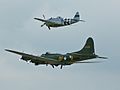
Sally B serves as a flying to the approximately 26,000 airmen of the ' who lost their lives over during . Maintained by the B-17 Preservation Ltd and the B-17 Charitable Trust, the aircraft participates in commemorative flights that honor these sacrifices, emphasizing the role of the B-17 in campaigns. These efforts underscore Sally B's status as the last airworthy B-17 in , dedicated to preserving the memory of the crews who flew perilous missions against Axis targets. A key annual event is the Memorial Day flypast at the Madingley American Cemetery and Memorial near Cambridge, held on the May Bank Holiday weekend. Typically occurring in the afternoon following the service, this tribute involves low passes over the cemetery, where over 3,800 American servicemen are buried, to remember the broader losses of the USAAF in the European Theater. The flypast often coordinates with other historic aircraft, including formations with the RAF Battle of Britain Memorial Flight, to evoke the Allied cooperation during the war. Special commemorative events further highlight Sally B's memorial role, such as the September 2023 joint formation flight with the RAF's at the . This pairing symbolically marked the end-of-war timelines, as both aircraft were delivered to their respective forces in early , just before the conclusion of hostilities in on May 8, 1945. Such flights provide poignant reminders of the conflict's close and the shared Allied victory. In addition to aerial tributes, Sally B contributes to WWII education through onboard tours offered at its base, where visitors explore the aircraft's interior and learn about B-17 operations, crew positions, and the challenges faced by aircrews. These guided experiences, available during select weekends, detail the bomber's instrumentation, defensive armament, and mission profiles, fostering a deeper understanding of the USAAF's contributions to the air war. The B-17 emphasizes this educational mission to ensure future generations appreciate the historical significance of these aircraft.

Specifications and Modifications

General Characteristics

Sally B, a B-17G Flying Fortress, operates with a typical of 4–5 members for display and flights, including pilots and a . The aircraft's dimensions include a of 103 ft 9 in (31.62 m), a length of 74 ft 4 in (22.66 m), and a of 19 ft 1 in (5.82 m). It has an empty weight of 36,135 lb (16,391 kg) and a of 65,500 lb (29,710 kg). Performance includes a maximum speed of 287 mph (462 km/h) at 25,000 ft (7,620 m), a cruising speed of 150 mph (241 km/h) at 5,000 ft (1,524 m), a climb rate to 20,000 ft (6,096 m) in 37 minutes, a service ceiling of 35,600 ft (10,850 m), and a range of 2,000 mi (3,219 km) with 6,000 lb (2,722 kg) of bombs (adapted for non-combat configurations). Sally B is powered by four R-1820-97 radial engines, each delivering 1,200 hp (895 kW), with ongoing modern maintenance programs ensuring operational reliability for contemporary flights.

Armament and Unique Features

Sally B, as a preserved B-17G Flying Fortress, retains the standard defensive armament configuration of her wartime design, featuring positions for 13 × .50 in (12.7 mm) machine guns distributed across the nose, dorsal, ventral ball, and tail turrets, as well as waist and cheek mounts. However, following post-war modifications in 1954 at Hill AFB, , all operational armament was removed to convert the aircraft for non-combat roles, and it has not been reinstated for firing capability in her current airworthy configuration. For display purposes during airshows and memorial flights, dummy gun barrels are fitted in select positions, such as the dorsal turret, but these are non-functional and serve solely as visual representations of the original defensive setup. A notable exception occurred during the production of the 1990 film Memphis Belle, where Sally B was temporarily equipped with .50-caliber machine guns in the rear and ball turrets, modified to fire blank rounds for cinematic battle sequences; these were subsequently removed after filming concluded. This adaptation highlighted her versatility for historical reenactments while adhering to modern safety standards that prohibit live or even pyrotechnic firing in civilian operations. In her standard setup today, no or firing mechanisms are present, emphasizing her role in educational flights and demonstrations rather than simulated combat. Unique to Sally B's airframe are her evolving nose artworks, drawn from film roles that have shaped her public identity. Painted with "Sally B" pin-up art in 1975, honoring her namesake Elly Sallingboe, the aircraft has periodically adopted WWII-era designs, such as the Memphis Belle markings—including a stylized blonde figure and mission tally—retained since the 1990 film to evoke her starring portrayal of that iconic B-17F. Earlier appearances in productions like the 1981 series We'll Meet Again featured temporary schemes, including a "Ginger Rogers" motif, but her current prioritizes the Memphis Belle tribute for airshow authenticity. These artistic elements, combined with her bare-metal finish reminiscent of late-war B-17Gs, distinguish her from static museum examples. To ensure compliance with civilian airspace regulations, Sally B incorporates modern safety modifications, including the installation of an ADS-B Out transponder in 2021, enhancing her visibility to and other aircraft during flights across . Additional updates to , such as improved navigation and communication systems, have been integrated over the years to meet UK Civil Aviation Authority requirements, though specifics remain aligned with her historical instrument panel where possible. While the original B-17G lacked dedicated engine suppression, Sally B benefits from routine protocols, including anti-corrosion treatments like Corrosion-X applications during overhauls, to mitigate risks in her radial engines. No bomb racks or ordnance are carried, with the repurposed for passenger seating or equipment during her focus on commemorative and joyride operations.

References

Add your contribution
Related Hubs
User Avatar
No comments yet.