


Community hub
Recent from talks
Contribute something to knowledge base
Content stats: 0 posts, 0 articles, 1 media, 0 notes
Members stats: 0 subscribers, 0 contributors, 0 moderators, 0 supporters
Subscribers
Supporters
Contributors
Moderators
Hub AI
Saul Alinsky AI simulator
(@Saul Alinsky_simulator)
Hub AI
Saul Alinsky AI simulator
(@Saul Alinsky_simulator)
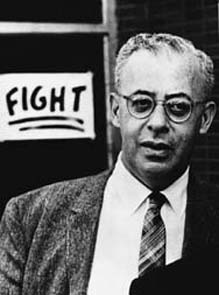
Saul Alinsky
Saul David Alinsky (January 30, 1909 – June 12, 1972) was an American community activist and political theorist. His work through the Chicago-based Industrial Areas Foundation helping poor communities organize to press demands upon landlords, politicians, bankers and business leaders won him national recognition and notoriety. Responding to the impatience of a New Left generation of activists in the 1960s, Alinsky – in his widely cited Rules for Radicals: A Pragmatic Primer (1971) – defended the arts both of confrontation and of compromise involved in community organizing as keys to the struggle for social justice.
Beginning in the 1990s, Alinsky's reputation was revived by commentators on the political right as a source of tactical inspiration for the Republican Tea Party movement and subsequently, by virtue of indirect associations with both Hillary Clinton and Barack Obama, as the alleged source of a radical Democratic political agenda. While criticized on the political left for an aversion to broad ideological goals, Alinsky has also been identified as an inspiration for the Occupy movement and campaigns for climate action.
Saul Alinsky was born in 1909 in Chicago, Illinois, to Lithuanian Jewish emigrant parents from Vilnius, Russian Empire. He was the only surviving son of Benjamin Alinsky and his second wife, Sarah Tannenbaum Alinsky, from what was then Vilna, (now Vilnius ,the capital of Lithuania). His father started out as a tailor, then ran a delicatessen and a cleaning shop.
Both parents were strict and observant Orthodox. Alinsky describes himself as being devout until the age of 12, the point at which he began to fear his parents would force him to become a rabbi. Although he had "not personally" encountered "much antisemitism as a child", Alinsky recalled that "it was so pervasive ... you just accepted it as a fact of life." Called up for retaliating against some Polish boys, Alinsky acknowledged one rabbinical lesson that "sank home." "It's the American way . . . Old Testament . . . They beat us up, so we beat the hell out of them. That's what everybody does." The rabbi looked at him for a moment and said quietly, "You think you're a man because you do what everybody does. But I want to tell you something great: 'where there are no men, be thou a man'". Alinsky considered himself an agnostic, but when asked about his religion would "always say Jewish."
In 1926, Alinsky entered the University of Chicago. He studied in America's first sociology department under Ernest Burgess and Robert E. Park. Overturning the propositions of a still ascendant eugenics movement, Burgess and Park argued that social disorganization, not heredity, was the cause of disease, crime, and other characteristics of slum life. As the passage of successive waves of immigrants through such districts had demonstrated, it is the slum area itself, and not the particular group living there, with which social pathologies were associated. Yet Alinsky claimed to be "astounded by all the horse manure [sociologists] were handing out about poverty and slums, playing down the suffering and deprivation, glossing over the misery and despair. I mean, Christ, I’d lived in a slum, I could see through all their complacent academic jargon to the realities."
The Great Depression put an end to an interest in archaeology: after the stock-market crash "all the guys who funded the field trips were being scraped off Wall Street sidewalks." A chance graduate fellowship moved Alinsky on to criminology. For two years, as a "nonparticipant observer", he claims to have hung out with Chicago's Al Capone mob (he explains that, as they "owned the city", they felt they had little to hide from a "college kid"). Among other things about the exercise of power, he says they taught him was "the terrific importance of personal relationships". Alinsky took a job in the Illinois, Division of the State Criminologist, working with juvenile delinquents and at the Joliet Correctional Center. He recalls it as a dispiriting experience: if he dwelt on the contributing causes of crime, such as poor housing, racial discrimination, or unemployment, he was labelled a "red."
In 1938, Alinsky gave up his last employment at the Institute for Juvenile Research, University of Illinois at Chicago, to devote himself full-time as a political activist. In his free time he had been raising funds for the International Brigade (organized by the Communist International) in the Spanish Civil War and for southern sharecroppers, organizing for the Newspaper Guild and other fledgling unions, fighting evictions, and agitating for public housing. He also began to work alongside the CIO (Congress of Industrial Organizations) and its president John L. Lewis. (In an "un-authorized biography" of the labor leader Alinsky wrote that he later mediated between Lewis and President Franklin D. Roosevelt in the White House).
Alinsky's idea was to apply the organizing skills he believed he had mastered "to the worst slums and ghettos, so that the most oppressed and exploited elements could take control of their own communities and their own destinies. Up until then, specific factories and industries had been organized for social change, but never whole communities."
Saul Alinsky
Saul David Alinsky (January 30, 1909 – June 12, 1972) was an American community activist and political theorist. His work through the Chicago-based Industrial Areas Foundation helping poor communities organize to press demands upon landlords, politicians, bankers and business leaders won him national recognition and notoriety. Responding to the impatience of a New Left generation of activists in the 1960s, Alinsky – in his widely cited Rules for Radicals: A Pragmatic Primer (1971) – defended the arts both of confrontation and of compromise involved in community organizing as keys to the struggle for social justice.
Beginning in the 1990s, Alinsky's reputation was revived by commentators on the political right as a source of tactical inspiration for the Republican Tea Party movement and subsequently, by virtue of indirect associations with both Hillary Clinton and Barack Obama, as the alleged source of a radical Democratic political agenda. While criticized on the political left for an aversion to broad ideological goals, Alinsky has also been identified as an inspiration for the Occupy movement and campaigns for climate action.
Saul Alinsky was born in 1909 in Chicago, Illinois, to Lithuanian Jewish emigrant parents from Vilnius, Russian Empire. He was the only surviving son of Benjamin Alinsky and his second wife, Sarah Tannenbaum Alinsky, from what was then Vilna, (now Vilnius ,the capital of Lithuania). His father started out as a tailor, then ran a delicatessen and a cleaning shop.
Both parents were strict and observant Orthodox. Alinsky describes himself as being devout until the age of 12, the point at which he began to fear his parents would force him to become a rabbi. Although he had "not personally" encountered "much antisemitism as a child", Alinsky recalled that "it was so pervasive ... you just accepted it as a fact of life." Called up for retaliating against some Polish boys, Alinsky acknowledged one rabbinical lesson that "sank home." "It's the American way . . . Old Testament . . . They beat us up, so we beat the hell out of them. That's what everybody does." The rabbi looked at him for a moment and said quietly, "You think you're a man because you do what everybody does. But I want to tell you something great: 'where there are no men, be thou a man'". Alinsky considered himself an agnostic, but when asked about his religion would "always say Jewish."
In 1926, Alinsky entered the University of Chicago. He studied in America's first sociology department under Ernest Burgess and Robert E. Park. Overturning the propositions of a still ascendant eugenics movement, Burgess and Park argued that social disorganization, not heredity, was the cause of disease, crime, and other characteristics of slum life. As the passage of successive waves of immigrants through such districts had demonstrated, it is the slum area itself, and not the particular group living there, with which social pathologies were associated. Yet Alinsky claimed to be "astounded by all the horse manure [sociologists] were handing out about poverty and slums, playing down the suffering and deprivation, glossing over the misery and despair. I mean, Christ, I’d lived in a slum, I could see through all their complacent academic jargon to the realities."
The Great Depression put an end to an interest in archaeology: after the stock-market crash "all the guys who funded the field trips were being scraped off Wall Street sidewalks." A chance graduate fellowship moved Alinsky on to criminology. For two years, as a "nonparticipant observer", he claims to have hung out with Chicago's Al Capone mob (he explains that, as they "owned the city", they felt they had little to hide from a "college kid"). Among other things about the exercise of power, he says they taught him was "the terrific importance of personal relationships". Alinsky took a job in the Illinois, Division of the State Criminologist, working with juvenile delinquents and at the Joliet Correctional Center. He recalls it as a dispiriting experience: if he dwelt on the contributing causes of crime, such as poor housing, racial discrimination, or unemployment, he was labelled a "red."
In 1938, Alinsky gave up his last employment at the Institute for Juvenile Research, University of Illinois at Chicago, to devote himself full-time as a political activist. In his free time he had been raising funds for the International Brigade (organized by the Communist International) in the Spanish Civil War and for southern sharecroppers, organizing for the Newspaper Guild and other fledgling unions, fighting evictions, and agitating for public housing. He also began to work alongside the CIO (Congress of Industrial Organizations) and its president John L. Lewis. (In an "un-authorized biography" of the labor leader Alinsky wrote that he later mediated between Lewis and President Franklin D. Roosevelt in the White House).
Alinsky's idea was to apply the organizing skills he believed he had mastered "to the worst slums and ghettos, so that the most oppressed and exploited elements could take control of their own communities and their own destinies. Up until then, specific factories and industries had been organized for social change, but never whole communities."
Recent media
Recent media