Hubbry Logo
search
logo
2203097

Scaphoid bone

logo
Community Hub0 Subscribers
Read side by side
from Wikipedia
Scaphoid bone
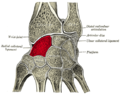
Left hand anterior view (palmar view). Scaphoid bone shown in red.
The left scaphoid bone
Details
Pronunciation/ˈskæfɔɪd/
ArticulationsArticulates with five bones
radius proximally
trapezoid bone and trapezium bone distally
capitate and lunate medially
Identifiers
Latinos scaphoideum,
os naviculare manus
MeSHD021361
TA98A02.4.08.003
TA21250
FMA23709
Anatomical terms of bone

The scaphoid bone is one of the carpal bones of the wrist. It is situated between the hand and forearm on the thumb side of the wrist (also called the lateral or radial side). It forms the radial border of the carpal tunnel. The scaphoid bone is the largest bone of the proximal row of wrist bones, its long axis being from above downward, lateralward, and forward. It is approximately the size and shape of a medium cashew nut.

Structure

[edit]

The scaphoid is situated between the proximal and distal rows of carpal bones. It is located on the radial side of the wrist,[1]: 176  adjacent to the styloid process of the radius.[2] It articulates with the radius, lunate, trapezoid, trapezium, and capitate.[1]: 176  Over 80% of the bone is covered in articular cartilage.[3]

Bone

[edit]

The palmar surface of the scaphoid is concave, and forming a distal tubercle, giving attachment to the transverse carpal ligament. The proximal surface is triangular, smooth and convex.[3] The lateral surface is narrow and gives attachment to the radial collateral ligament. The medial surface has two facets, a flattened semi-lunar facet articulating with the lunate bone, and an inferior concave facet, articulating alongside the lunate with the head of the capitate bone.[4]

The dorsal surface of the bone is narrow, with a groove running the length of the bone and allowing ligaments to attach, and the surface facing the fingers (anatomically inferior) is smooth and convex, also triangular, and divided into two parts by a slight ridge.[4]

Blood supply

[edit]

It receives its blood supply primarily from lateral and distal branches of the radial artery, via palmar and dorsal branches. These provide an "abundant" supply to middle and distal portions of the bone, but neglect the proximal portion, which relies on retrograde flow.[1]: 189  The dorsal branch supplies the majority of the middle and distal portions, with the palmar branch supplying only the distal third of the bone.[3]

Variation

[edit]

The dorsal blood supply, particularly of the proximal portion, is highly variable.[1]: 189  Sometimes the fibers of the abductor pollicis brevis emerge from the tubercle.[4]

In animals

[edit]

In reptiles, birds, and amphibians, the scaphoid is instead commonly referred to as the radiale because of its articulation with the radius.

Function

[edit]

The carpal bones function as a unit to provide a bony superstructure for the hand.[5]: 708  The scaphoid is also involved in movement of the wrist.[1]: 6  It, along with the lunate bone, articulates with the radius and ulna to form the major bones involved in movement of the wrist.[5] The scaphoid serves as a link between the two rows of carpal bones. With wrist movement, the scaphoid may flex from its position in the same plane as the forearm to perpendicular.[1]: 176–177 

Clinical significance

[edit]

Fracture

[edit]
Scaphoid fracture before and after operation

Fractures of the scaphoid are the most common of the carpal bone injuries, because of its connections with the two rows of carpal bones.[1]: 177 

The scaphoid can be slow to heal because of the limited circulation to the bone. Fractures of the scaphoid must be recognized and treated quickly, as prompt treatment by immobilization or surgical fixation increases the likelihood of the bone healing in anatomic alignment, thus avoiding mal-union or non-union.[6] Delays may compromise healing. Failure of the fracture to heal ("non-union") will lead to post-traumatic osteoarthritis of the carpus.[1]: 189  One reason for this is because of the "tenuous" blood supply to the proximal segment.[3] Even rapidly immobilized fractures may require surgical treatment, including use of a headless compression screw such as the Herbert screw to bind the two halves together.

Healing of the fracture with a non-anatomic deformity (frequently, a volar flexed "humpback") can also lead to post-traumatic arthritis. Non-unions can result in loss of blood supply to the proximal pole, which can result in avascular necrosis of the proximal segment.

Scaphoid fractures may be difficult to diagnose via plain x-ray. A repeat x-ray may be required at a later date, as might cross-sectional imaging via MRI or CT scan.[6]

Other diseases

[edit]

A condition called scapholunate instability can occur when the scapholunate ligament (connecting the scaphoid to the lunate bone) and other surrounding ligaments are disrupted. In this state, the distance between the scaphoid and lunate bones is increased.[1]: 180 

One rare disease of the scaphoid is called Preiser's Disease.

Palpation

[edit]

The scaphoid can be palpated at the base of the anatomical snuff box. It can also be palpated in the volar (palmar) hand/wrist. Its position is the intersections of the long axes of the four fingers while in a fist, or the base of the thenar eminence. When palpated in this position, the bone will be felt to slide forward during radial deviation (wrist abduction) and flexion.

Clicking of the scaphoid or no anterior translation can indicate scapholunate instability.

Etymology

[edit]

The word scaphoid (Greek: σκαφοειδές) is derived from the Greek skaphos, which means "a boat", and the Greek eidos, which means "kind".[7] The name refers to the shape of the bone, supposedly reminiscent of a boat. In older literature about human anatomy,[4] the scaphoid is referred to as the navicular bone of the hand (this time from the Latin navis for boat); there is also a bone in a similar position in the foot, which is called the navicular. The modern term for the bone in the hand is scaphoid; in human anatomy the term navicular is reserved for the bone in the foot.

Additional images

[edit]

References

[edit]
Revisions and contributorsEdit on WikipediaRead on Wikipedia
from Grokipedia
The scaphoid bone, also known as the navicular bone, is the largest of the eight carpal bones in the human wrist and is classified as a short bone with a distinctive boat-like shape.[1] It is positioned in the proximal row of carpal bones on the radial (thumb) side, articulating proximally with the distal radius to form part of the radiocarpal joint and distally with the trapezium bone, while also connecting with the lunate, capitate, and trapezoid bones.[2] This strategic location enables the scaphoid to bridge the proximal and distal carpal rows, facilitating essential wrist movements such as flexion, extension, radial deviation, and ulnar deviation, thereby contributing significantly to overall hand mobility and stability.[3] Structurally, the scaphoid features a concave proximal surface, a convex distal surface, and a prominent tubercle on its palmar aspect that forms part of the carpal tunnel floor and serves as an attachment site for the flexor retinaculum and abductor pollicis brevis muscle.[2] Its blood supply is uniquely retrograde, primarily derived from branches of the radial artery entering at the distal end and flowing toward the proximal pole, which makes the bone particularly vulnerable to avascular necrosis in cases of injury.[4] Clinically, the scaphoid is the most frequently fractured carpal bone, often resulting from falls on an outstretched hand, with tenderness in the anatomical snuffbox—a triangular depression on the radial wrist—serving as a key diagnostic indicator.[1] Such fractures can disrupt the bone's precarious vascularity, leading to delayed healing or nonunion, and may necessitate immobilization, surgical intervention, or advanced imaging for proper management.[3]

Anatomy

Gross anatomy

The scaphoid bone is the largest of the four bones in the proximal row of the carpal bones, positioned on the radial (thumb) side of the wrist, where it lies between the distal radius proximally and the bases of the first and second metacarpal bones distally, adjacent to the lunate medially.[5] It exhibits a distinctive boat-shaped morphology, reflecting its Greek-derived name "scaphoid" meaning boat, with a twisted, peanut-like structure that spans the proximal and distal carpal rows.[6] The bone is divided into three primary regions: a smaller, rounded proximal pole; a narrow, constricted waist in the central portion; and a broader distal pole that includes a prominent palmar tubercle serving as an attachment site for ligaments such as the transverse carpal ligament.[7] The scaphoid is oriented obliquely within the wrist, with its long axis aligned at approximately 45 degrees to the longitudinal axis of the forearm in both the coronal and sagittal planes, facilitating its role as a bridging element between the forearm and hand.[8] Average dimensions vary by sex, with males typically exhibiting a length of 31.3 mm (standard deviation ±2.1 mm) and females 27.3 mm (±1.7 mm) along the long axis from the proximal pole to the distal articular surface; width measurements narrow at the waist to about 13.6 mm in males (±2.6 mm) and 11.1 mm in females (±1.2 mm), while the proximal pole measures around 4.5 mm in males (±1.4 mm) and 3.7 mm in females (±0.5 mm).[9] Key surfaces of the scaphoid include a smooth, convex proximal articular surface that interfaces with the scaphoid fossa of the distal radius, forming part of the radiocarpal joint.[5] The distal surface is convex and subdivided by a central ridge into two facets for articulation with neighboring carpals, while the medial surface is concave for contact with the lunate.[5] Additionally, a dorsoradial ridge on the dorsal aspect provides attachment points for ligaments, including the dorsal intercarpal ligament.[10] Over 75% of the bone's surface is covered by articular cartilage, emphasizing its extensive joint interfaces.[10]

Articulations

The scaphoid bone, the largest in the proximal carpal row, articulates with five adjacent structures, facilitating its central role in wrist stability and motion. Proximally, its convex surface forms the radiocarpal joint with the scaphoid fossa of the distal radius. Distally, a bony ridge divides the surface into radial and ulnar facets: the radial facet articulates with the trapezium and trapezoid bones at the midcarpal joint, while the ulnar facet connects to the capitate. Medially, a smooth concave surface joins the lunate, also at the midcarpal joint.[5][10] These articulations exhibit varied morphologies to accommodate multiplanar wrist movements. The proximal radiocarpal interface is a synovial joint with the convex scaphoid articulating against the concave radial fossa. The medial scapholunate and scaphocapitate contacts are concave-convex, with the scaphoid's concave ulnar border enhancing interlocking stability. Distally, the scaphotrapezial joint features saddle-like contours for rotational capacity, while the scaphotrapezoid articulation is relatively planar. Approximately 75% of the scaphoid's surface is covered by articular cartilage, underscoring its extensive joint involvement.[10][11] Ligamentous attachments reinforce these joints, with the scaphoid serving as a key anchor point. Volarly, the radioscaphocapitate ligament spans from the radius to the scaphoid and capitate, stabilizing the proximal articulation; the scapholunate interosseous ligament, a C-shaped intrinsic structure with dorsal, volar, and membranous components, binds the scaphoid to the lunate, linking the proximal and distal carpal rows. Additional volar supports include the scaphocapitate, scaphotrapezial, and scaphotrapezoid ligaments, attaching to the distal pole and tubercle. Dorsally, the dorsal radiocarpal and dorsal intercarpal ligaments secure the proximal and waist regions, preventing excessive extension. The only direct musculotendinous attachment on the scaphoid is the origin of the abductor pollicis brevis muscle on its tubercle.[10][12][5][13] The scaphoid's unique morphology, including volar (palmar) concavity and dorsal convexity along its oblique axis, optimizes these articular interfaces for load distribution and motion facilitation without compromising stability. This curvature, combined with the scapholunate ligament, positions the scaphoid as a pivotal connector between carpal rows.[10][7]

Blood supply

The blood supply of the scaphoid bone is primarily derived from branches of the radial artery, which enter through nutrient foramina located along the non-articular dorsal ridge, particularly at the distal pole. These dorsal branches, originating from the dorsal carpal branch of the radial artery, provide the major vascular input, accounting for approximately 70-80% of the intraosseous blood supply. The blood flow within the scaphoid is predominantly retrograde, traveling from the distal pole proximally through the bone's medullary cavity to nourish the waist and proximal pole regions.[14] A secondary source of vascularization comes from the superficial palmar branch of the radial artery (or occasionally the anterior interosseous artery), which supplies the distal tubercle on the palmar aspect via smaller foramina. This volar supply contributes the remaining 20-30% of the blood flow and primarily perfuses the distal third of the bone, with limited contribution to more proximal segments due to the bone's predominantly articular surfaces that restrict extraosseous vessel penetration. The distal pole is well-vascularized by both dorsal and volar inputs, the waist receives moderate retrograde flow from the primary dorsal branches, and the proximal pole depends almost entirely on these distal-derived vessels, making it particularly vulnerable to disruption.[14] The retrograde nature of the scaphoid's blood supply has significant clinical implications, as fractures—especially those in the proximal pole—can interrupt this flow, leading to avascular necrosis in 13-50% of cases, with higher rates in proximal fragments. This vulnerability arises because the proximal pole lacks direct extraosseous supply, relying solely on intraosseous retrograde perfusion that is easily compromised by displacement or hematoma formation at the fracture site.

Anatomical variations

The scaphoid bone displays several normal anatomical variants that deviate from the typical morphology, influencing its shape, size, and ligamentous attachments. One common variant involves the os centrale carpi, an accessory ossicle derived from an independent ossification center that often fuses to the distal scaphoid, with a prevalence of 0.3-1.6% in the general population; this fusion can appear as a transverse lucency on radiographs, mimicking an acute fracture.[15][16] Variations in the transscaphoid arc, which refers to the curvature and orientation across the bone's waist, include differences in overall length and angulation that affect carpal kinematics. For instance, scaphoid length may vary between approximately 18-20 mm depending on morphological type, with type 1 scaphoids (40-58% prevalence) exhibiting longer dimensions and greater angulation of ligament attachments (e.g., dorsal intercarpal ligament at 31.6° ± 6.32°) compared to type 2 (41.8-60% prevalence) at 18.4 mm and 14.7° ± 2.11°; the flexion arc of the scaphoid typically spans 120-150 degrees in normal motion, though individual variations influence this range.[17][18] The size of the scaphoid tubercle also varies, with prominent forms occurring in 10-15% of cases, often associated with type 1 morphology where the tubercle is more pronounced, impacting the attachment sites of volar ligaments such as the radioscaphocapitate.[17] Rare fusions, such as congenital scaphoid-lunate coalition, have an incidence of less than 1% and represent about 2% of all carpal coalitions, typically presenting as osseous or fibrous bridging without clinical symptoms unless associated with instability.[19][20]

Function

Kinematics

The scaphoid bone primarily participates in wrist flexion-extension, contributing approximately 45-60 degrees of motion, which is coupled with radial-ulnar deviation of 20-30 degrees overall in the wrist complex.[21] During wrist flexion, the scaphoid flexes significantly, often reaching up to 70% of the capitate's flexion, while in extension, it extends to about 74% of the capitate's range, facilitating smooth proximal-distal carpal row coordination.[22] This coupled motion underscores the scaphoid's role in enabling multiplanar wrist mobility without isolated axial rotation. A key kinematic feature is the scaphoid shift, where during radial deviation, the scaphoid flexes and pronates as the trapezium approximates the radius, promoting palmar flexion; conversely, in ulnar deviation, it extends and supinates as the hamate rotates, aligning with dorsal extension.[21] This dynamic shifting maintains carpal stability and influences adjacent bones like the lunate through ligamentous connections.[23] As a keystone of the carpus, the scaphoid links the proximal row (scaphoid, lunate, triquetrum) to the distal row via the midcarpal joint, ensuring synchronized intercarpal motion during wrist excursions.[22] In the neutral position, the scaphoid adopts a flexion-pronation posture, angled at approximately 45 degrees (range 30-60 degrees) relative to the lunate and capitate, due to inherent ligament tensions that balance compressive loads.[21] The scaphoid contributes to the dart-thrower's motion, an oblique plane combining radial extension and ulnar flexion, where it undergoes balanced flexion-extension with minimal proximal row translation, divided equally between radiocarpal and midcarpal contributions for functional stability.[24][21]

Load transmission

The scaphoid bone plays a critical role in load sharing across the wrist, transmitting approximately 50-70% of axial compressive forces from the radius to the distal carpal row during wrist compression in neutral or extended positions.[25] This distribution ensures efficient force transfer while minimizing stress on adjacent structures like the lunate, which bears about 35% of the load.[25] In dynamic scenarios, such as gripping or weight-bearing, this mechanism supports overall wrist function by balancing loads between the proximal and distal carpal rows. Stress distribution within the scaphoid is uneven, with the waist region—its narrowest portion—experiencing the highest shear forces.[26] These forces arise from the bone's oblique orientation and the wrist's hyperextension, concentrating shear at the waist and predisposing it to mechanical vulnerability under high-impact conditions.[26] The scaphoid's stabilizing role further enhances load transmission by resisting carpal collapse through tension in the scaphoid-lunate ligament, which maintains alignment between the proximal carpal bones under compressive loads.[27] Biomechanically, the scaphoid exhibits compressive strength (approximately 60 MPa) to withstand these axial loads, yet its narrow waist confers low torsional resistance, making it susceptible to twisting stresses.[28] This configuration influences wrist stability by preserving neutral alignment of the proximal carpal row, thereby preventing dorsal intercalated segment instability (DISI) during normal loading.[29]

Clinical aspects

Fractures

Scaphoid fractures represent the most common type of carpal bone injury, accounting for approximately 60-70% of all carpal fractures and 2-7% of all fractures.[30][31] These injuries predominantly affect young adults, with a mean age of around 29 years, often occurring in males due to high-energy trauma.[32][33] The typical mechanism involves a fall on an outstretched hand (FOOSH) with the wrist in hyperextension and radial deviation, leading to axial compression of the scaphoid against the dorsal rim of the radius, particularly fracturing the waist region.[30][11][34] Fractures are classified either anatomically by location or using the Herbert classification system, which assesses stability and guides management. Anatomic classification divides fractures into proximal pole (about 20%), waist (70%), and distal (10%), with waist fractures being the most frequent due to the bone's vulnerability to compressive forces in that region.[11][32] The Herbert system categorizes them as follows: Type A (stable acute fractures, including A1 tuberosity and A2 incomplete waist); Type B (unstable acute fractures, including B1 distal oblique, B2 complete waist, B3 proximal pole, and B4 trans-scaphoid dislocation); Type C (delayed union); and Type D (established nonunion, with D1 fibrous and D2 sclerotic subtypes).[35][11][36] Unstable fractures, such as those in the proximal pole or with displacement greater than 1 mm, carry higher risks due to potential disruption of the retrograde blood supply entering distally.[30][11] Healing of scaphoid fractures is often prolonged, typically requiring 4-6 months for union, particularly for proximal pole injuries, owing to the bone's tenuous vascularity where up to 80% of the intraosseous supply is retrograde from distal branches.[30][37] Nonunion rates range from 10-15% overall, rising to 30-50% for proximal pole fractures if untreated or managed conservatively, as avascular necrosis can occur in the proximal fragment.[38][39][40] Treatment depends on fracture stability and location. Stable, nondisplaced waist fractures (Herbert Type A or B2 without displacement) are initially managed conservatively with thumb spica casting for 8-12 weeks, achieving union rates of approximately 90% in compliant patients.[11][32][41] Unstable fractures (Herbert Type B with displacement, proximal pole, or comminuted), especially those at risk of nonunion, require surgical intervention, typically percutaneous or open reduction and internal fixation using a headless compression screw such as the Herbert screw, which yields union rates exceeding 90% and allows earlier mobilization.[11][42][39] For proximal pole fractures, vascularized bone grafting may be necessary in addition to fixation to promote healing.[11][40]

Associated disorders

Avascular necrosis of the scaphoid, often referred to as Preiser's disease when idiopathic, arises from disruption of the bone's retrograde blood supply, predominantly affecting the proximal pole and leading to fragmentation and collapse. In the context of fractures, avascular necrosis complicates 13% to 30% of cases, with higher rates in proximal pole injuries due to limited vascularity entering from the distal end. Symptoms include progressive radial-sided wrist pain and reduced motion, diagnosed via MRI showing bone marrow edema or sclerosis without initial fracture evidence on radiographs. Treatment ranges from immobilization and NSAIDs for early stages to revascularization or salvage procedures like proximal row carpectomy in advanced collapse.[43][44] Scaphoid non-union occurs in 5% to 25% of fractures, with rates of 5-10% after conservative management and up to 25% after surgery, and manifests as hypertrophic (fibrous, stable) or atrophic (osteoporotic, unstable) variants that predispose to carpal instability. Risk factors encompass displacement exceeding 1 mm, older age, and smoking, with untreated non-union promoting progressive deformity and arthritis. Diagnosis relies on serial radiographs demonstrating lack of bridging callus, supplemented by CT for fragment assessment or MRI to detect concurrent avascular necrosis. Management involves bone grafting and internal fixation to restore alignment and vascularity, preventing long-term complications like instability.[38] Scapholunate dissociation stems from rupture of the scapholunate interosseous ligament, resulting in abnormal scaphoid palmar flexion and lunate dorsal extension, termed dorsal intercalated segment instability (DISI) deformity, which alters carpal kinematics and load distribution. This injury, common in 10-30% of intra-articular distal radius fractures, presents with dorsoradial pain, clicking, and weakness exacerbated by grip or loading activities. Radiographic signs include a scapholunate gap greater than 3 mm on posteroanterior views (Terry Thomas sign) and a scapholunate angle exceeding 70° on lateral views; arthroscopy confirms ligament integrity. Chronic cases evolve into scapholunate advanced collapse (SLAC), a degenerative arthritis pattern initiating at the radial styloid and progressing to the midcarpal joint, often managed with ligament reconstruction or four-corner arthrodesis for pain relief and stability.[29][45] Scaphoid shift syndrome describes dynamic instability arising from partial scapholunate ligament tears, where the scaphoid subluxates dorsally under radial deviation stress, eliciting pain and a palpable clunk on the scaphoid shift test (Watson's maneuver). This condition reflects early, motion-dependent carpal malalignment without static deformity, commonly following hyperextension trauma, and risks progression to static dissociation if untreated. Diagnosis involves provocative testing and dynamic fluoroscopy to visualize subluxation, with treatment favoring ligament repair or dorsal capsulodesis to restore stability and avert osteoarthritis.[29] Post-traumatic osteoarthritis involving the scaphoid typically develops as scaphoid non-union advanced collapse (SNAC), a sequential degenerative process starting at the radioscaphoid joint due to chronic non-union and hinging of the proximal fragment. In SNAC, arthritis advances to the scaphotrapezial joint in later stages, causing stiffness, weakness, and pain with radial deviation, confirmed by radiographs showing joint space narrowing and subchondral sclerosis. Salvage options include radial styloidectomy for early involvement or four-corner fusion with scaphoid excision for advanced disease to preserve motion while eliminating painful articulations.[46]

Diagnosis

Diagnosis of scaphoid bone issues typically begins with a clinical examination focused on eliciting tenderness and assessing stability. Tenderness in the anatomical snuffbox is a key indicator of scaphoid fracture, demonstrating high sensitivity of up to 100% but low specificity of around 9-74%, which can lead to overdiagnosis of non-fracture injuries.[47][48] The scaphoid shift test, also known as the Watson test, evaluates for scapholunate ligament instability by applying dorsal pressure to the scaphoid tubercle with the wrist in radial deviation; a positive test, indicated by a clunk or pain upon ulnar deviation, has a sensitivity of 50-67% and specificity of 67%, performing better for more severe ligament disruptions.[49][50] The anatomical snuffbox, a palpable triangular depression on the radial aspect of the wrist, serves as a primary landmark for palpation and is bounded medially by the tendon of the extensor pollicis longus, laterally by the tendons of the extensor pollicis brevis and abductor pollicis longus, and proximally by Lister's tubercle of the radius.[51] Additional sites include the scaphoid tubercle on the palmar aspect, palpated with the wrist in ulnar deviation.[52] Initial imaging relies on plain radiographs, including anteroposterior (AP), lateral, and dedicated scaphoid views with the wrist in ulnar deviation and 20-30° extension, though approximately 20-22% of fractures remain occult on these initial films due to the bone's orientation and subtle displacement.[53][54] For suspected occult fractures or avascular necrosis, magnetic resonance imaging (MRI) is the gold standard, offering sensitivity of 88-100% and specificity up to 100% for detecting both fractures and early vascular compromise without radiation exposure.[55][56] Computed tomography (CT) excels in assessing fracture union, displacement, and fragment alignment with high resolution, particularly useful in preoperative planning.[11] Advanced diagnostic tools include bone scintigraphy, which evaluates bone viability and detects occult fractures with high sensitivity by showing focal tracer uptake, though it is less specific and involves radiation.[53][34] Wrist arthroscopy provides direct visualization of ligament integrity and cartilage damage, confirming scapholunate dissociation or other intra-articular pathology when non-invasive imaging is inconclusive.[57] Diagnostic challenges arise from the scaphoid's intra-articular position and limited blood supply, with 15-22% of fractures missed on initial X-rays, necessitating clinical follow-up and repeat imaging at 10-14 days to reveal resorption lines or progression.[53][31] This delay underscores the importance of immobilization for suspected cases pending confirmatory tests to prevent complications like nonunion.[54]

Etymology and comparative anatomy

Etymology

The term "scaphoid" for the carpal bone derives from the Ancient Greek σκάφος (skáp̄hos), meaning "boat" or "skiff," reflecting its characteristic boat-like shape when viewed from the dorsal side.[58][5] This etymology emphasizes the bone's concave, elongated form, akin to a small vessel, a descriptor rooted in classical observations of its morphology.[59] Historically, the bone was referred to in Latin as "os naviculare" or simply "naviculare," from "navicula," diminutive of "navis" meaning "ship" or "little boat," highlighting a similar nautical theme in Roman anatomical terminology.[5] This alternative name persisted into early modern anatomy but was phased out to avoid confusion with the tarsal navicular bone in the foot. The scaphoid was first systematically described among the eight carpal bones in the 2nd century AD by the physician Galen in his anatomical treatises, where he detailed the wrist's skeletal structure.[60] In the 19th and early 20th centuries, standardized nomenclature solidified the use of "scaphoid" (Latinized as "os scaphoideum") through efforts like the Basle Nomina Anatomica (1895) and subsequent revisions, such as the Paris Nomina Anatomica (1955), which reserved "navicular" exclusively for the pedal bone.[5] The etymology remains confined to anatomical contexts, with no notable cultural or symbolic extensions beyond this descriptive origin.[61]

In animals

In mammals, the scaphoid bone is homologous to the radial carpal bone, serving as the medialmost element in the proximal row of the carpus and often displaying a boat-shaped form in primates and carnivores to support comparable wrist mobility across these groups.[62][63] This central positioning allows it to articulate proximally with the radius and distally with elements of the distal carpal row, contributing to the overall stability and range of motion in the forelimb.[64] Structural variations in the scaphoid homologue are evident across species, reflecting adaptations to diverse locomotor demands; in ungulates such as horses, the radial carpal bone incorporates a fusion of the scaphoid and lunate, while the adjacent intermediate carpal bone derives from the os centrale, resulting in a more streamlined carpus suited to high-speed gait.[65] In contrast, arboreal primates like monkeys exhibit a more elongated scaphoid to facilitate grasping and suspension, enhancing proximal-distal mobility during climbing.[66][67] These differences underscore the bone's evolutionary plasticity in response to positional behaviors. Functionally, the scaphoid homologue acts as a primary load-bearing structure in quadrupeds, such as dogs, where it transmits forelimb weight through the carpus during weight-bearing phases of locomotion.[65][64] In primates, it supports enhanced flexion and extension, paralleling human wrist dynamics to accommodate varied arboreal and terrestrial activities.[63] Evolutionarily, the scaphoid traces its origins to the distal radial elements in the pectoral fins of Devonian fishes, which underwent transformation into discrete carpal ossifications in early tetrapods to enable weight support on land.[68][69] In veterinary medicine, fractures of the radial carpal bone are prevalent in racing horses due to repetitive stress, commonly managed through immobilization with splints or bandages to promote healing and prevent further displacement.[70][71][72]

References

User Avatar
No comments yet.