Hubbry Logo
TypexTypexMain
Open search
Typex
Community hub
Typex
logo
8 pages, 0 posts
0 subscribers
Be the first to start a discussion here.
Typex
Typex
from Wikipedia

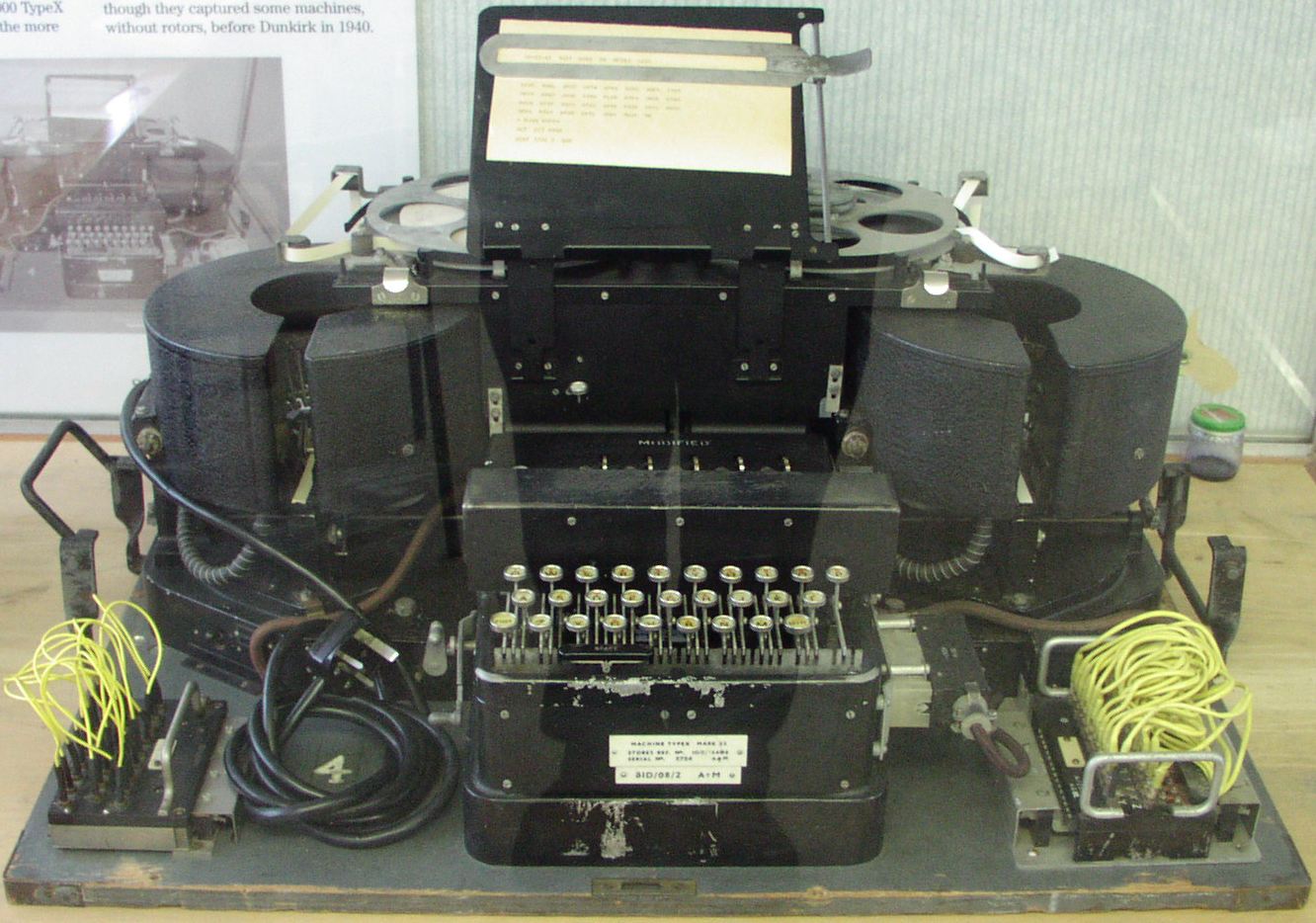
Typex was based on the commercial Enigma machine, but incorporated a number of additional features to improve the security. This model, a Typex 22, was a late variant, incorporating two plugboards.

Typex (also spelled Type X or TypeX) was the primary cipher machine used by the British military during World War II by and into the early Cold War. Based on the commercial Enigma, it was significantly enhanced to increase its security, providing robust encrypted military and government communications from 1937 throughout the late 1950s. New Zealand and other Commonwealth countries continued to use Typex well until early 1970s.

Description

[edit]

Like Enigma, Typex was a rotor machine.[1] Typex came in a number of variations, but all contained five rotors, as opposed to three or four in the Enigma. Like the Enigma, the signal was sent through the rotors twice, using a "reflector" at the end of the rotor stack. On a Typex rotor, each electrical contact was doubled to improve reliability.

Of the five rotors, typically the first two were stationary. These provided additional enciphering without adding complexity to the rotor turning mechanisms. Their purpose was similar to the plugboard in the Enigmas, offering additional randomization that could be easily changed. Unlike Enigma's plugboard, however, the wiring of those two rotors could not be easily changed day-to-day. Plugboards were added to later versions of Typex.

The major improvement the Typex had over the standard Enigma was that the rotors in the machine contained multiple notches that would turn the neighbouring rotor. This eliminated an entire class of attacks on the system, whereas Enigma's fixed notches resulted in certain patterns appearing in the cyphertext that could be seen under certain circumstances.

The Typex 23, pictured, was similar to the Mark 22, but modified for use with the Combined Cypher Machine (CCM).

Some Typex rotors came in two parts, where a slug containing the wiring was inserted into a metal casing. Different casings contained different numbers of notches around the rim, such as 5, 7 or 9 notches. Each slug could be inserted into a casing in two different ways by turning it over. In use, all the rotors of the machine would use casings with the same number of notches. Normally five slugs were chosen from a set of ten.

On some models, operators could achieve a speed of 20 words a minute, and the output ciphertext or plaintext was printed on paper tape. For some portable versions, such as the Mark III, a message was typed with the left hand while the right hand turned a handle.[2]

Several Internet Typex articles say that only Vaseline was used to lubricate Typex machines and that no other lubricant was used. Vaseline was used to lubricate the rotor disc contacts. Without this there was a risk of arcing which would burn the insulation between the contacts. For the rest of the machine two grades of oil (Spindle Oils 1 and 2) were used. Regular cleaning and maintenance was essential. In particular, the letters/figures cam-cluster balata discs had to be kept lubricated.[citation needed]

History and development

[edit]

By the 1920s, the British Government was seeking a replacement for its book cipher systems, which had been shown to be insecure and which proved to be slow and awkward to use. In 1926, an inter-departmental committee was formed to consider whether they could be replaced with cipher machines. Over a period of several years and at large expense, the committee investigated a number of options but no proposal was decided upon. One suggestion was put forward by Wing Commander Oswyn G. W. G. Lywood to adapt the commercial Enigma by adding a printing unit but the committee decided against pursuing Lywood's proposal.

Typex Mk III was a portable version powered by a handle.

In August 1934, Lywood began work on a machine authorised by the RAF. Lywood worked with J. C. Coulson, Albert P. Lemmon, and Ernest W. Smith at Kidbrooke in Greenwich, with the printing unit provided by Creed & Company. The first prototype was delivered to the Air Ministry on 30 April 1935. In early 1937, around 30 Typex Mark I machines were supplied to the RAF. The machine was initially termed the "RAF Enigma with Type X attachments".

The Typex Mark II and the more compact Mark III and VI are the most widely described but several distinct Typex models were developed over its operational lifespan.[3]

The development of Typex Mark II, the successor to the original Typex cipher machine, began in February 1937. By June 1938, the Typex Mark II was demonstrated to the cipher-machine committee, who approved an order for 350 units. The Mark II was significantly larger than the Enigma, weighing approximately 120 lb (54 kg) and measuring 30 in (760 mm) × 22 in (560 mm) × 14 in (360 mm) due to the incorporation of two printers: one for plaintext and one for ciphertext. Following successful trials, After trials, the machine was adopted by the RAF, Army and other government departments. During World War II, a large number of Typex machines were manufactured by the tabulating machine manufacturer Powers-Samas.[4]

Typex Mark III was a more portable variant, using the same drums as the Mark II machines powered by turning a handle (it was also possible to attach a motor drive). The maximum operating speed is around 60 letters a minute, significantly slower than the 300 achievable with the Mark II.

Typex Mark VI was another handle-operated variant, measuring 20 in (510 mm) × 12 in (300 mm) × 9 in (230 mm), weighing 30 lb (14 kg) and consisting of over 700 components.

Plugboards for the reflector were added to the machine from November 1941.

For inter-Allied communications during World War II, the Combined Cipher Machine (CCM) was developed, used in the Royal Navy from November 1943. The CCM was implemented by making modifications to Typex and the United States ECM Mark II machine so that they would be compatible.

Typex Mark VIII was a Mark II fitted with a morse perforator.

Typex 22 (BID/08/2) and Typex 23 (BID/08/3) were late models, that incorporated plugboards for improved security. Mark 23 was a Mark 22 modified for use with the CCM. In New Zealand, Typex Mark II and Mark III were superseded by Mark 22 and Mark 23 on 1 January 1950. The Royal Air Force used a combination of the Creed Teleprinter and Typex until 1960. This amalgamation allowed a single operator to use punch tape and printouts for both sending and receiving encrypted material.

Typex machines were modified to have the same inner wirings as the Enigma machine to routinely decipher Enigma messages at Bletchey Park.[5]

Erskine estimates that around 12,000 Typex machines were built by the end of World War II.[6]

Security and use

[edit]

Less than a year into the war, the Germans could read all British military encryption other than Typex,[7] which was used by the British armed forces and by Commonwealth countries including Australia, Canada and New Zealand. The Royal Navy decided to adopt the RAF Type X Mark II in 1940 after trials; eight stations already had Type X machines. Eventually over 600 machines were required. New Zealand initially got two machines at a cost of £115 (GBP) each for Auckland and Wellington.[8]

From 1943 the Americans and the British agreed upon a Combined Cipher Machine (CCM). The British Typex and American ECM Mark II could be adapted to become interoperable. While the British showed Typex to the Americans, the Americans never permitted the British to see the ECM, which was a more complex design. Instead, attachments were built for both that allowed them to read messages created on the other.

In 1944 the Admiralty decided to supply 2 CCM Mark III machines (the Typex Mark II with adaptors for the American CCM) for each "major" war vessel down to and including corvettes but not submarines; RNZN vessels were the Achilles, Arabis (then out of action), Arbutus, Gambia and Matua.[9]

Although a British test cryptanalytic attack made considerable progress, the results were not as significant as against the Enigma, due to the increased complexity of the system and the low levels of traffic.

A Typex machine without rotors was captured by German forces at Dunkirk during the Battle of France and more than one German cryptanalytic section proposed attempting to crack Typex;[10] however, the B-Dienst codebreaking organisation gave up on it after six weeks, when further time and personnel for such attempts were refused.[11][12]

One German cryptanalyst stated that the Typex was more secure than the Enigma since it had seven rotors, therefore no major effort was made to crack Typex messages as they believed that even the Enigma's messages were unbreakable.[13]

Although the Typex has been attributed as having good security, the historic record is much less clear.[14] There was an ongoing investigation into Typex security that arose out of German POWs in North Africa claiming that Typex traffic was decipherable.

A brief excerpt from the report

TOP SECRET U [ZIP/SAC/G.34]

THE POSSIBLE EXPLOITATION OF TYPEX BY THE GERMAN SIGINT SERVICES

The following is a summary of information so far received on German attempts to break into the British Typex machine, based on P/W interrogations carried out during and subsequent to the war. It is divided into (a) the North African interrogations, (b) information gathered after the end of the war, and (c) an attempt to sum up the evidence for and against the possibility of German successes.

Apart from an unconfirmed report from an agent in France on 19 July 1942 to the effect that the GAF were using two British machines captured at DUNKIRK for passing their own traffic between BERLIN and GOLDAP, our evidence during the war was based on reports that OKH was exploiting Typex material left behind in TOBRUK in 1942.

Typex machines continued in use long after World War II. The New Zealand military used TypeX machines until the early 1970s, disposing of its last machine in about 1973.[15]

Advantages over Enigma

[edit]

All the versions of the Typex had advantages over the German military versions of the Enigma machine. The German equivalent teleprinter machines in World War II (used by higher-level but not field units) were the Lorenz SZ 40/42 and Siemens and Halske T52 using Fish cyphers.

  • Most versions of the Enigma required two operators to operate effectively—one operator to input text into the Enigma and the other to copy down the enciphered or deciphered characters—Typex required just one operator.
  • Typex avoided operator copying errors, as the enciphered or deciphered text was automatically printed on paper tape.
  • Unlike Enigma, Typex I machines were linked to teleprinters while Typex II machines could be if required.
  • Enigma messages had to be written, enciphered, transmitted (by Morse), received, deciphered, and written again, while Typex messages were typed and automatically enciphered and transmitted all in one step, with the reverse also true.[16]

See also

[edit]

Citations

[edit]
  1. ^ Chang, Kelly; Low, Richard M.; Stamp, Mark (3 April 2014). "Cryptanalysis of Typex" (PDF). Cryptologia. 38 (2): 116–132. doi:10.1080/01611194.2013.797051. ISSN 0161-1194.
  2. ^ Deavours & Kruh 1985.
  3. ^ Cheetham, Thomas (2025). "Practical and Organisational Factors in the Development History of the Typex Cipher Machine and its Use at Bletchley Park". Proceedings of the 8th International Conference on Historical Cryptology (HistoCrypt 2025). hdl:10062/109742. ISSN 1736-6305.
  4. ^ Campbell-Kelly 1990.
  5. ^ Lendl, Christian (December 2022). Bletchley Park - British Cryptanalysis during World War II (PDF). p. 29. ISBN 978-3-200-02924-8.
  6. ^ Erskine 2002.
  7. ^ Comer, Tony (2021). "Commentary: Poland's Decisive Role in Cracking Enigma and Transforming the UK's SIGINT Operations". Royal United Services Institute. Retrieved 5 July 2025.
  8. ^ "RN circulars M 0707/40, 1 May 1940 and M 013030/40, 26 July 1940" (Document). Archives NZ RNZN file R21466809: Archives New Zealand.{{cite document}}: CS1 maint: location (link)
  9. ^ "RN circular AFO S 7/44" (Document). Archives NZ RNZN Naval file R21466810: Archives New Zealand.{{cite document}}: CS1 maint: location (link)
  10. ^ Richards, Lee (3 March 2018). "Summary of Work Done on Typex Traffic by OKH/In 7/VI, 1939-1941 - German Army High Command Attempts to Break TypeX Cypher". www.arcre.com. Retrieved 10 July 2025.
  11. ^ Ferris 2005, p. 165.
  12. ^ Abrutat, David. "The Story of TypeX". commsmuseum.co.uk. RN communications branch museum/library. Retrieved 5 July 2025.
  13. ^ Ratcliff 2006, p. 165.
  14. ^ Turing, Dermot (12 June 2019). "The Typex Scare of 1943: How Well Did the British React to a Cypher-Security Scare?" (PDF). Proceedings of the 2nd International Conference on Historical Cryptology, HistoCrypt 2019, June 23-26, 2019, Mons, Belgium.
  15. ^ Mogon, Eric. "Chapter 8-A History of Communications Security in New Zealand/ Codes & Cyphers in World War 2" (PDF). Unofficial RNZN Communications History. RNZN Communicators Association. Archived (PDF) from the original on 18 January 2011. Retrieved 28 December 2014.
  16. ^ Ferris 2005, p. 153.

General and cited references

[edit]
[edit]
Revisions and contributorsEdit on WikipediaRead on Wikipedia
from Grokipedia
Typex was a rotor-based electromechanical cipher machine developed in the United Kingdom during the 1930s for encrypting military communications, serving as the primary encryption device for British and Commonwealth forces throughout World War II and into the early Cold War period. Based on the commercial version of the German Enigma machine, which the British government had acquired in 1928, Typex incorporated five rotors—three moving and two static—along with a plugboard in later models to enhance security, and it featured built-in printing mechanisms for simultaneous output of plaintext and ciphertext on paper tape. Unlike the lamp-display Enigma, Typex models like the Mark III were often hand-cranked for field use, achieving speeds of up to 20 words per minute, and required no external power source in portable variants. The machine's development began in 1934 under the leadership of (later ) O.G.W. Lywood at the Royal Air Force's research station in Farnborough, with contributions from engineers at Creed & Company, who produced the first prototypes by 1937. Initially designated as the "RAF Enigma with Type X attachments," it evolved into the standalone Typex Mark I, with the first 29 units delivered to the RAF in early 1937, followed by the more robust Mark II later that year, which weighed over 120 pounds and operated on 230V for stationary use. Production ramped up significantly during the war, reaching 3,232 Mark II machines by September 1941 and totaling around 12,000 units across variants by 1945, including the portable Mark III for field operations and the Mark VI for naval applications. Typex saw extensive deployment by the , , , and allies such as , , and , encrypting high-level messages until the early 1970s in some cases. In 1943, it was adapted into the Combined Cipher Machine (CCM) for interoperability with the American ECM Mark II (), using converter units to bridge the two systems despite initial U.S. secrecy concerns. Security-wise, Typex proved more resilient than Enigma due to its additional rotors, multiple turnover notches, and optional plugboards in postwar Mark 22 and 23 models, which allowed for greater key variability; German cryptanalysts deemed it unbreakable, and no major breaches were reported, though a captured unit at in 1942 allowed brief exploitation of some traffic until keys were changed and destruction protocols were enforced. Postwar, it influenced communications and was gradually replaced by transistorized systems in the 1950s and 1960s.

Overview

Description

Typex is a British electromechanical rotor-based machine designed for secure and governmental communications, primarily to encipher and decipher messages for high-security transmission. It resembles a in form, featuring a keyboard for plaintext input and a mechanism that outputs on paper tape, allowing operators to produce encrypted text for radio or other transmission methods. The machine was employed by Allied forces from through the , providing a robust system for protecting sensitive information during and after . At its core, Typex incorporates five rotors— the first two fixed as stators, with the remaining three capable of stepping—along with a static reflector to facilitate the by substituting letters through electrical pathways. It is powered by hand-cranking in portable configurations or (typically 230V AC) in stationary models, and includes a system for generating output. These components enable the machine to handle message and decryption reliably in operational environments. The Mark II model, a primary production variant, weighs approximately 120 pounds (54 kg) and measures about 30 × 22 × 14 inches (760 × 560 × 360 ), making it suitable for fixed installations such as command centers. Portable variants, like the Mark III, are lighter and hand-crank operated, achieving speeds of around 60 characters per minute while typing with one hand and cranking with the other, facilitating field use without external power sources. The Mark VI, another portable option, weighs 30 pounds (14 kg) and measures 20 × 12 × 9 inches (510 × 300 × 230 ).

Basic Principles of Operation

The operation of the Typex machine relied on a daily key setting process to configure its components for secure encryption. Operators selected five rotors from a set of ten available (with later variants expanding to fourteen for naval use), arranging them in a specific order within the machine. Each rotor's ring setting was adjusted using a thumbwheel or spring-loaded pin to offset the internal wiring relative to the external letter ring, providing 26 possible positions per rotor. Initial starting positions for all rotors were set manually via indicators, typically to letters specified in the daily key list. The reflector, positioned at the end of the rotor stack, used fixed wiring in early models but could be rewired via a plugboard in later versions like Mark 22 to further vary the permutation. Encryption began with the operator typing the message on the integrated keyboard, which closed an electrical circuit corresponding to the input letter. The current passed through an entry disc that mapped the 26 letters to rotor contacts, then traversed the five rotors in from right to left, where each rotor substituted the signal based on its current orientation and internal wiring. Upon reaching the reflector, the signal was redirected back through the rotors in reverse order, undergoing further substitutions, before exiting to illuminate a lamp or activate a printer for the corresponding letter. This output was printed simultaneously on a tape via the right-hand printer, while the plaintext appeared on the left-hand printer for verification, enabling a throughput of approximately 50-60 characters per minute. For messages exceeding 150 groups, the rotor stack was manually advanced between sections to enhance . The stepping mechanism ensured non-periodic encryption by advancing the rotors irregularly after each key press. The three leftmost rotors stepped like those in contemporary rotor machines: the rightmost advanced one position per letter, carrying over to the middle rotor upon reaching a turnover point, and similarly for the middle to the leftmost. However, all rotors featured multiple notches (typically five, seven, or nine per rotor, positioned at letters such as A, C, E, I, N, Q, T, V, Y) on their casings, which triggered additional irregular turnovers when aligned, preventing predictable patterns and increasing the period before repetition. The two rightmost rotors remained static once set, contributing to the overall without further movement. Decryption followed the identical process and settings: the operator typed the into the keyboard, and the machine output the recovered on the printer, relying on the reciprocal nature of the rotor-reflector path to invert the substitutions. In later models such as Mark II and beyond, Typex integrated with teleprinters for automated transmission, allowing encrypted output to be punched onto paper tape in or sent directly over lines at speeds up to 300 characters per minute, with special keys for figures (Z), letters (V), and spacing (X).

Development

Invention and Early Prototypes

The development of the Typex cipher machine began in 1934 at the RAF Wireless Establishment in , Greenwich, under the leadership of Oswyn G. W. G. Lywood, alongside J. C. Coulson, Albert P. Lemmon, and Ernest W. Smith. These engineers and officers focused on constructing a rotor-based system using available commercial components, adapting principles from existing technology while prioritizing British manufacturing independence. The initiative was driven by the British military's need for a secure, homegrown alternative to commercial rotor machines like the Enigma, which had demonstrated vulnerabilities in intercepted communications. Although influenced by German rotor designs observed through , the Typex project proceeded independently to avoid reliance on foreign technology and to integrate seamlessly with RAF signaling protocols. This effort addressed growing concerns over the security of transmissions in an era of rising geopolitical tensions. The first operational prototype was delivered to the on 30 April 1935, marking a significant milestone after initial assembly and basic testing at . Subsequent evaluations revealed areas for improvement, leading to iterative refinements in design and construction over the following two years. By early 1937, these enhancements culminated in the RAF's initial adoption of the machine, with limited units deployed for trial use in secure communications. Among the primary challenges during this prototype phase were achieving mechanical reliability—particularly in the stepping mechanisms and electrical contacts—to withstand field conditions, and upholding strict secrecy protocols under oversight from the Government Code and Cypher School (GC&CS). Initial models notably omitted a plugboard, relying instead on wirings and settings for variability, which simplified construction but limited key space expansion until later iterations.

Production Models and Variants

The Typex Mark I, introduced in 1937, served as the basic production model primarily for the Royal Air Force (RAF), featuring an online configuration connected to teleprinters without a plugboard for key variation. Approximately 29 to 30 units were manufactured by Creed & Company and delivered to RAF headquarters by mid-1937. The Mark II, entering production in 1938, became the standard wartime variant with enhanced durability, weighing around 120 pounds (55 kg) and capable of handling 300 characters per minute through dual printers for and . It addressed limitations of the Mark I by incorporating offline printing and options, with an initial order of 350 units followed by larger wartime production totaling approximately 8,200 machines by the end of . Overall, around 12,000 Typex machines across models were produced by the war's conclusion, manufactured primarily by Creed & Company at their facilities, including the Treforest factory. Portable variants emerged to meet field requirements during the war. The Mark III, a hand-cranked model operating at 60 letters per minute, provided a compact alternative to the stationary Mark II while using similar components, allowing optional motor attachment for faster use. The Mark VI, designed for mobile operations, weighed 30 pounds and measured 20 by 12 by 9 inches, featuring an electromotor drive and output to a narrow paper strip; an estimated 3,000 units were built by August 1945. The Mark VIII, based on the Mark II chassis, included a Morse perforator for tape-based input and output, enabling online integration with other systems; 398 units were ordered by 1945. Post-war enhancements focused on interoperability and security. The Typex Mark 22 (also known as BID/08/2), introduced around 1948, added plugboards and a pluggable reflector to the Mark II design, increasing key variability for diplomatic and use. The Mark 23 (BID/08/3) modified select Mark 22 units for compatibility with the American Combined Machine (CCM), incorporating four mounting posts for secure attachment. These later models superseded earlier variants in nations, such as , where Mark II and III machines were replaced by Mark 22 and 23 starting in January 1950. Typex production and exports extended to Allied forces in , Australia, and other countries, supporting secure communications into the early 1970s.

Technical Design

Rotor and Stepping Mechanism

The Typex cipher machine employs five rotors as its core electromechanical components for permutation, with the first two rotors functioning as stationary entry and output stators that do not move during encipherment, while the remaining three rotors are movable and advance stepwise with each key press. These movable rotors are positioned to the left of the stators in the machine's configuration, with the rightmost rotor advancing once per letter, the middle rotor advancing based on the position of the right rotor, and the leftmost rotor advancing similarly based on the middle rotor's movement. Operators select three movable rotors from a set of 10 available rotors, each featuring unique internal wirings that define distinct permutation paths through 26 electrical contacts, providing variability in the encryption process. The stepping mechanism of the movable rotors is designed to produce irregular advances, enhancing security by avoiding the predictable single-step progression seen in earlier rotor machines. Each rotor casing includes multiple notches—typically 5, 7, or 9, though configurations allow up to 10—positioned around its circumference to trigger the advance of the adjacent rotor not only once per full revolution but multiple times, resulting in double-stepping or other non-periodic movements that complicate cryptanalytic recovery of patterns. This multi-notch system ensures that the rotors' positions change in an unpredictable manner relative to the input, with the exact stepping dependent on the selected rotors' notch placements and initial settings. Electrical current, supplied by an external 230V AC source in stationary models or generated mechanically by a hand-crank in portable variants, initiates the encryption path upon depressing a key on the Typex keyboard, flowing through the stationary entry into the three movable in a forward direction before reversing course back through the movable and the stationary output to complete the circuit and activate the corresponding printing pins on the output mechanism. This bidirectional traversal through the rotors permutes the signal multiple times, with each rotor substituting the electrical pathway according to its fixed internal wiring. To further expand the cryptographic key space, Typex rotors incorporate adjustable ring settings, which allow operators to rotate the external letter ring relative to the internal wiring core using a spring-loaded pin mechanism, effectively shifting the mappings without altering the rotor's physical position. Each rotor offers 26 possible ring settings, multiplying the available configurations and making it more difficult for adversaries to exhaustively test possible alignments during . This feature, combined with rotor selection and initial positioning, contributes significantly to the machine's overall security depth.

Reflector, Plugboard, and Output Systems

The reflector in the Typex cipher machine consisted of fixed wiring that redirected electrical current back through the rotors after the initial forward pass, functioning similarly to the reflector (Umkehrwalze) in the but integrated within Typex's unique five-rotor configuration of three moving rotors and two static rotors (stators). This setup created non-reciprocal encryption paths, as the stators lacked the reciprocal wiring found in Enigma's plugboard, ensuring that the substitution for a given letter on the forward path differed from the return path, thereby enhancing cryptographic depth without relying on reversible mappings. Early models featured a non-rewirable reflector, but from November 1941, later variants allowed reflector wiring alterations via a plugboard interface, further increasing key variability. The plugboard, absent in initial Typex models, was introduced in later production variants such as the Mark 22 and Mark 23 to provide additional permutation layers beyond the rotor system. These plugboards employed a single-ended design using a 33-pin Jones socket, enabling up to 26 independent cross-connections where each letter could be mapped to any other without mandatory pairing, unlike Enigma's reciprocal steckerbrett that swapped letters in fixed pairs. This non-reciprocal flexibility allowed for greater key space expansion, with the Mark 22 specifically modifying the Mark II scrambler unit to incorporate both an entry plugboard and a pluggable reflector, significantly bolstering against known-plaintext attacks. The addition of the plugboard in these models addressed earlier vulnerabilities in rotor-only configurations, though it introduced maintenance challenges due to the fragility of the wiring. Typex output systems primarily utilized solenoid-driven printers to produce on narrow paper tape, distinguishing the machine from Enigma's lampboard and enabling automated, readable decryption without manual transcription. Standard models like the Mark II printed both and simultaneously at speeds up to 300 characters per minute on 9.6 mm tape strips, while portable variants such as the Mark III employed a slower hand-crank mechanism (60 characters per minute) for field use, integrating the crank both for stepping and printer operation. -linked models, including the Mark IV built around the Creed Model 7 , output text directly onto message form rolls for efficient clerical processing, whereas the Mark VIII incorporated a perforator to interface with radio transmissions, automatically converting incoming Morse to printed and enabling online encipherment/decipherment between compatible machines. Power for these systems derived from a 230-volt in stationary models or hand-cranking in portables, with no native battery operation; however, mechanical reliability required periodic lubrication of contacts with to prevent arcing and ensure consistent electrical contact during extended use.

Usage

Adoption by Allied Forces

The Royal Air Force was the first British service to adopt the Typex cipher machine, receiving an initial batch of 29 Mark I units in early 1937 for securing air communications. By September 1939, Typex had been integrated across all RAF headquarters, enabling encrypted messaging for operational coordination. This early adoption marked Typex as a key tool for aerial command and control, with production scaling to support broader military needs. Adoption expanded to the and by 1940, following an order of 350 Mark II machines in June 1938 shared among the services and government departments. The specifically procured 630 units by October 1939, equipping ships and shore stations for secure naval signaling. Typex's single-operator design, which allowed one person to both encode and record messages via integrated printing, simplified training and field deployment compared to multi-person systems like Enigma, facilitating rapid distribution amid wartime pressures. Typex machines were also supplied to nations, including , , and , with adoption by their service departments occurring by April 1941. For instance, received ten units from the British government, with initial setups established in to support regional secure communications. In , Typex was used by military and diplomatic services until the . During the war, Typex became integral to Allied secure command channels, processing encrypted traffic for strategic and tactical coordination across theaters. To enhance Anglo-American interoperability, Typex was linked to the Combined Cipher Machine (CCM) starting in November 1943, adapting Mark II and later models to interface with the U.S. ECM Mark II for joint operations. This integration enabled seamless encrypted exchanges between British and U.S. forces, bolstering combined military efforts without compromising individual system security.

Post-War Applications and Retirement

Following the end of , Typex machines persisted in service during the early , particularly within British and forces. The Royal Air Force continued employing Typex until the mid-1950s. In , the military retained Typex models such as the Mark 22 and Mark 23, which had been introduced in 1943, with usage extending until around 1973 before final disposal. Typex was maintained across networks post-war, supporting interoperability among allied nations. It was briefly integrated into NATO-compatible systems through adaptations like the Combined Cipher Machine (CCM), which paired Typex with the U.S. for secure exchanges, loaned to allies until its replacement in 1958. Retirement of Typex was driven by the advent of more advanced electronic cipher machines, which offered greater speed, security, and ease of use compared to rotor-based systems. Machines like the TSEC/KW-26 (codenamed Romulus), an online stream cipher developed by the NSA, gradually superseded rotor machines such as Typex and the 5UCO in the mid-1960s onward. Overall, Typex's service spanned from 1937 to the early 1970s, a period of over three decades. The legacy of Typex influenced subsequent British cryptographic developments, emphasizing rotor mechanics and plugboard enhancements in transitional designs. Surviving units are preserved in institutions such as the and .

Security and Cryptanalysis

Cryptographic Strengths

The Typex cipher machine's cryptographic strength derived primarily from its expanded key space, achieved through the use of five rotors—three dynamically stepping and two fixed stators—contrasting with the three or four rotors typical in Enigma variants. This configuration, combined with selectable wirings from up to 14 available rotor sets (using 10 in practice), reversible rotor orientations, and initial positions for each rotor, yielded a practical key space of approximately 247.72^{47.7} possibilities for rotor-related settings, which, when combined with the plugboard in later models, resulted in a total exceeding Enigma's effective key space of around 2772^{77} bits including its plugboard. Later models incorporated a plugboard, further multiplying the combinations by up to 26!26! (roughly 288.42^{88.4} bits) for additional permutations, resulting in a total key space of approximately 21362^{136} bits. These elements collectively rendered exhaustive brute-force attacks infeasible with World War II-era computational resources. A key design advantage was the irregular stepping mechanism, enabled by multiple turnover notches on each rotor rim—ranging from four to nine notches per rotor—compared to Enigma's single notch per rotor. This produced non-periodic motion, preventing the emergence of fixed cycles that could facilitate in . Such irregularity disrupted assumptions in known-plaintext attacks, as the rotor advancement lacked the predictable periodicity exploited in Enigma , thereby increasing the complexity of deriving internal states from observed outputs. The non-reciprocal nature of Typex's plugboard (termed stators in some configurations) addressed a inherent in Enigma's reciprocal plugboard and self-inverse reflector, where mappings were (if A maps to B, then B maps to A). In Typex, the plugboard allowed independent permutations before and after rotor passage, eliminating this and requiring attackers to solve twice as many unknowns without the aid of reciprocal constraints. This demanded substantially greater computational effort for partial key recovery, as methods relying on , such as those developed for Enigma, became inapplicable. Overall, these features ensured Typex's resistance to cryptanalytic efforts during its operational peak; no documented successful Axis breaks of the machine in service have been recorded, attributing its security to design innovations that outpaced contemporary attack capabilities.

Known Compromises and Analysis Efforts

In 1940, during the , German forces captured a rotor-less Typex Mark II machine, prompting initial cryptanalytic efforts by the OKW/Chi and Luftwaffe's Chi-Stelle, but these were abandoned after approximately six weeks due to the machine's complexity and lack of essential components like rotors and wirings. In , a "Typex Scare" emerged within British intelligence, fueled by suspicions of German penetration following the 1942 Tobruk capture of machines, rotors, and keys, as well as reports from POW interrogations. This led to evaluations at , where recommended limiting message lengths to counter crib-based attacks, and assessed that German progress posed no immediate threat. Post-war TICOM interrogations of German cryptanalysts, including those from NFAK 621 captured in , revealed claims of partial readability of Typex traffic, such as assertions by Bode and Haunhorst, but these remain debated with no evidence of widespread breaches in declassified records. Post-war studies, such as the 2014 analysis by Chang, Low, and Stamp, implemented simulated attacks like a modified Turing crib method combined with hill-climbing, demonstrating that Typex could be vulnerable to recovery of rotor settings with sufficient ciphertext (around 9-10 cycle pairs) and computational effort on the order of 2^28 operations, yet confirmed its historical resilience absent major wartime compromises. Conflicting historical reports suggest potential vulnerabilities from inadequate lubrication of rotor contacts, which required regular application of to prevent wear and ensure reliable stepping, though no documented exploits arose from this issue. Operator errors, such as reusing rotor start positions derived from previous messages rather than true randomness, were noted in post-war interrogations as facilitating German traffic analysis, but did not lead to confirmed breaks. The integration of Typex into the Combined Cipher Machine (CCM) for Anglo-American interoperability from 1943 introduced synchronization risks due to shared keying protocols, contributing to a 1951-1952 U.S. crisis over potential weaknesses, though no specific exploits against CCM-configured Typex were recorded.

Comparison to Enigma

Architectural Differences

Typex and the , while both rotor-based devices, exhibited fundamental architectural variances in their core mechanical components, which influenced the signal path and key space . Typex employed five rotors in total, with the two rightmost rotors serving as fixed stators that did not rotate during encipherment, in contrast to Enigma's configuration of three to four fully movable rotors that all stepped during operation. This fixed positioning in Typex increased the effective path through stationary wiring permutations without the need for continuous motion in those positions, altering the overall of the substitution process compared to Enigma's dynamic, all-rotating assembly. Additionally, Typex's fixed stators featured non-reciprocal wiring, allowing asymmetric permutations that further expanded the key space beyond Enigma's reciprocal rotor designs. The stepping mechanisms further diverged, with Typex rotors featuring multiple turnover notches—typically five, seven, or nine per rotor—enabling irregular and more frequent advancements of adjacent rotors, unlike Enigma's standard single-notch design that produced a more predictable, chain-driven stepping pattern. In Typex, this multi-notch system allowed for variable step increments, such as advancing one to three rotors per key press depending on notch alignment, which introduced greater irregularity in the sequence than Enigma's uniform single-step progression. Reflector designs also differed: Typex used a stationary reflector with reciprocal wiring, akin to Enigma's fixed umkehrwalze. Unlike Enigma's rotors, which had ring settings for offset adjustment, the reflectors in both machines remained fixed during encipherment. Unlike the standard Enigma, which featured a reciprocal plugboard from early models, initial Typex variants lacked one; the Mark 22 and 23 introduced a non-reciprocal 33-pin plugboard allowing non-reciprocal letter-to-letter mappings, which provided a broader range of permutations than Enigma's reciprocal 26-pair plugboard. Additionally, early Typex models featured a fixed battery entry wheel for direct signal input to the rotors, bypassing the variable pre-plugboard stage present in Enigma, which relied on the plugboard for initial substitutions before rotor entry.

Operational and Security Advantages

Typex offered significant operational advantages over the , particularly in terms of efficiency and usability for military personnel. Unlike Enigma, which typically required two operators—one to input the message and another to record the output from the lamp panel—Typex could be managed by a single operator due to its integrated printing mechanism. This design streamlined workflows in high-pressure environments, allowing for faster message handling without the coordination challenges of team-based operation. The machine further minimized through its automatic printing on a narrow paper tape, which produced both and at speeds up to 300 characters per minute, eliminating the need for manual transcription from visual indicators. Additionally, models such as the Mark I and II integrated directly with teleprinters, enabling encrypted messages to be transmitted in over communication lines without intermediate manual steps, which reduced transcription mistakes and supported seamless integration into existing telegraph networks. These features contrasted with Enigma's reliance on and lamp-based output, which were more prone to fatigue-induced errors during extended use. From a security perspective, Typex's design provided a robust edge over Enigma through a vastly larger key space and more complex dynamics. Its five- configuration—three moving and two stationary—combined with a non-reciprocal plugboard allowing arbitrary letter mappings, generated far more permutations than Enigma's three- or four- setup with paired swaps. The irregular stepping mechanism, where rotors advanced 4 to 9 times per full revolution via multiple turnover notches, introduced unpredictable motion that resisted the patterned advances exploited in Enigma . Despite some German interest following captures (e.g., 1940), including a 1943 British scare, no successful of Typex traffic occurred during , as Germans underestimated it as an Enigma copy. Typex's field adaptability enhanced its practical security in mobile operations, with portable variants like the Mark VI—measuring 20 by 12 by 9 inches and weighing about 30 pounds—designed for easier transport and use in forward areas compared to bulkier Enigma models. This portability, coupled with battery or hand-crank options in some marks, allowed reliable deployment in dynamic warfare without compromising the machine's cryptographic integrity.
Add your contribution
Related Hubs
User Avatar
No comments yet.