


Community hub
Second-order cone programming
View on Wikipedia | This article may be too technical for most readers to understand. (October 2011) |
A second-order cone program (SOCP) is a convex optimization problem of the form
- minimize
- subject to


where the problem parameters are , and . is the optimization variable. is the Euclidean norm and indicates transpose.[1]



The name "second-order cone programming" comes from the nature of the individual constraints, which are each of the form:

These each define a subspace that is bounded by an inequality based on a second-order polynomial function defined on the optimization variable ; this can be shown to define a convex cone, hence the name "second-order cone".[2] By the definition of convex cones, their intersection can also be shown to be a convex cone, although not necessarily one that can be defined by a single second-order inequality. See below for a more detailed treatment.

SOCPs can be solved by interior point methods[3] and in general, can be solved more efficiently than semidefinite programming (SDP) problems.[4] Some engineering applications of SOCP include filter design, antenna array weight design, truss design, and grasping force optimization in robotics.[5] Applications in quantitative finance include portfolio optimization; some market impact constraints, because they are not linear, cannot be solved by quadratic programming but can be formulated as SOCP problems.[6][7][8]
Second-order cones
[edit]The standard or unit second-order cone of dimension is defined as

- .

The second-order cone is also known by the names quadratic cone or ice-cream cone or Lorentz cone. For example, the standard second-order cone in is

- .
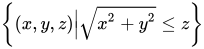
The set of points satisfying a second-order cone constraint is the inverse image of the unit second-order cone under an affine mapping:

and hence is convex.
The second-order cone can be embedded in the cone of the positive semidefinite matrices since
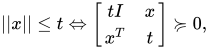
i.e., a second-order cone constraint is equivalent to a linear matrix inequality. The nomenclature here can be confusing; here means is a semidefinite matrix: that is to say


which is not a linear inequality in the conventional sense.
Similarly, we also have,
- .

Relation with other optimization problems
[edit]
When for , the SOCP reduces to a linear program. When for , the SOCP is equivalent to a convex quadratically constrained linear program.


Convex quadratically constrained quadratic programs can also be formulated as SOCPs by reformulating the objective function as a constraint.[5] Semidefinite programming subsumes SOCPs as the SOCP constraints can be written as linear matrix inequalities (LMI) and can be reformulated as an instance of semidefinite program.[5] The converse, however, is not valid: there are positive semidefinite cones that do not admit any second-order cone representation.[4]
Any closed convex semialgebraic set in the plane can be written as a feasible region of a SOCP,.[9] However, it is known that there exist convex semialgebraic sets of higher dimension that are not representable by SDPs; that is, there exist convex semialgebraic sets that can not be written as the feasible region of a SDP (nor, a fortiori, as the feasible region of a SOCP).[10]
Examples
[edit]Quadratic constraint
[edit]Consider a convex quadratic constraint of the form

This is equivalent to the SOCP constraint

Stochastic linear programming
[edit]Consider a stochastic linear program in inequality form
- minimize
- subject to


where the parameters are independent Gaussian random vectors with mean and covariance and . This problem can be expressed as the SOCP


- minimize
- subject to

where is the inverse normal cumulative distribution function.[1]

Stochastic second-order cone programming
[edit]We refer to second-order cone programs as deterministic second-order cone programs since data defining them are deterministic. Stochastic second-order cone programs are a class of optimization problems that are defined to handle uncertainty in data defining deterministic second-order cone programs.[11]
Other examples
[edit]Other modeling examples are available at the MOSEK modeling cookbook.[12]
Solvers and scripting (programming) languages
[edit]| Name | License | Brief info |
|---|---|---|
| ALGLIB | free/commercial | A dual-licensed C++/C#/Java/Python numerical analysis library with parallel SOCP solver. |
| AMPL | commercial | An algebraic modeling language with SOCP support |
| Artelys Knitro | commercial | |
| CPLEX | commercial | |
| FICO Xpress | commercial | |
| Gurobi Optimizer | commercial | |
| MATLAB | commercial | The coneprog function solves SOCP problems[13] using an interior-point algorithm[14]
|
| MOSEK | commercial | parallel interior-point algorithm |
| NAG Numerical Library | commercial | General purpose numerical library with SOCP solver |
See also
[edit]- Power cones are generalizations of quadratic cones to powers other than 2.[15]
References
[edit]- ^ a b Boyd, Stephen; Vandenberghe, Lieven (2004). Convex Optimization (PDF). Cambridge University Press. ISBN 978-0-521-83378-3. Retrieved July 15, 2019.
- ^ Jibrin, Shafiu; Swift, James W. (2024). "On Second-Order Cone Functions". Journal of Optimization. 2024 (1) 7090058. doi:10.1155/2024/7090058. ISSN 2314-6486.
- ^ Potra, lorian A.; Wright, Stephen J. (1 December 2000). "Interior-point methods". Journal of Computational and Applied Mathematics. 124 (1–2): 281–302. Bibcode:2000JCoAM.124..281P. doi:10.1016/S0377-0427(00)00433-7.
- ^ a b Fawzi, Hamza (2019). "On representing the positive semidefinite cone using the second-order cone". Mathematical Programming. 175 (1–2): 109–118. arXiv:1610.04901. doi:10.1007/s10107-018-1233-0. ISSN 0025-5610. S2CID 119324071.
- ^ a b c Lobo, Miguel Sousa; Vandenberghe, Lieven; Boyd, Stephen; Lebret, Hervé (1998). "Applications of second-order cone programming". Linear Algebra and Its Applications. 284 (1–3): 193–228. doi:10.1016/S0024-3795(98)10032-0.
- ^ "Solving SOCP" (PDF).
- ^ "portfolio optimization" (PDF).
- ^ Li, Haksun (16 January 2022). Numerical Methods Using Java: For Data Science, Analysis, and Engineering. APress. pp. Chapter 10. ISBN 978-1-4842-6796-7.
- ^ Scheiderer, Claus (2020-04-08). "Second-order cone representation for convex subsets of the plane". arXiv:2004.04196 [math.OC].
- ^ Scheiderer, Claus (2018). "Spectrahedral Shadows". SIAM Journal on Applied Algebra and Geometry. 2 (1): 26–44. doi:10.1137/17M1118981. ISSN 2470-6566.
- ^ Alzalg, Baha M. (2012-10-01). "Stochastic second-order cone programming: Applications models". Applied Mathematical Modelling. 36 (10): 5122–5134. doi:10.1016/j.apm.2011.12.053. ISSN 0307-904X.
- ^ "MOSEK Modeling Cookbook - Conic Quadratic Optimization".
- ^ "Second-order cone programming solver - MATLAB coneprog". MathWorks. 2021-03-01. Retrieved 2021-07-15.
- ^ "Second-Order Cone Programming Algorithm - MATLAB & Simulink". MathWorks. 2021-03-01. Retrieved 2021-07-15.
- ^ "MOSEK Modeling Cookbook - the Power Cones".
Second-order cone programming
View on GrokipediaProblem Formulation
Standard Form
Second-order cone programming (SOCP) is a class of convex optimization problems that involves minimizing a linear objective function subject to linear equality constraints and second-order cone inequalities.[4] The problem assumes familiarity with basic linear algebra and the Euclidean vector norm , defined as for a vector .00115-8) In its canonical form, an SOCP is formulated asSecond-Order Cones
The second-order cone, also known as the Lorentz cone, quadratic cone, or ice-cream cone, is a fundamental convex set in optimization defined for dimension asTheoretical Foundations
Convexity and Duality
Second-order cone programming (SOCP) problems are convex optimization problems, as their objective functions are linear and thus convex, while the feasible sets are defined by affine equality constraints and second-order cone inequalities, both of which describe convex sets. The linearity of the objective ensures convexity, since linear functions satisfy the convexity inequality for . Affine equality constraints define affine subspaces, which are convex, and their intersections preserve convexity. Second-order cone constraints of the form , or equivalently where , represent membership in the second-order (Lorentz) cone, a closed, convex, pointed, and self-dual cone. The intersection of these convex sets yields a convex feasible region, confirming that SOCP is a convex program.[7][8] To derive the Lagrangian dual, consider the standard SOCP primal in the formComputational Complexity
Second-order cone programming (SOCP) belongs to the class P of problems solvable in polynomial time, primarily through interior-point methods that achieve an iteration complexity of where is the total barrier parameter (typically for cones of dimensions ) to achieve -accuracy, and each iteration involves solving a linear system scaling with problem size.[11] This complexity arises from the structure of the second-order cone, which allows for efficient path-following algorithms that maintain feasibility and reduce the duality gap progressively. Seminal work by Alizadeh and Goldfarb in 2001 established these bounds by extending primal-dual interior-point techniques from linear and semidefinite programming to the conic setting of SOCP.[12] Central to these methods is the use of a self-concordant barrier function for the second-order cone, specifically for the cone , which has a parameter and enables Newton's method to converge quadratically near the central path while ensuring global polynomial-time performance.[13] This barrier facilitates the construction of a self-concordant function for the overall feasible set, leading to short-step or long-step path-following algorithms that require at most iterations, independent of problem-specific constants beyond the barrier parameter.[14] While convex SOCP remains tractable in polynomial time, nonconvex extensions—such as those involving quadratic objectives or constraints over nonconvex second-order cones—are NP-hard in general, as they encompass difficult problems like nonconvex quadratic optimization.[15] In contrast to semidefinite programming (SDP), where each interior-point iteration requires arithmetic operations due to matrix factorizations, SOCP iterations scale as by exploiting the vector-based structure of the cones, rendering SOCP significantly faster for large-scale instances with many variables.[1]Connections to Other Optimization Problems
Linear and Quadratic Programming
Second-order cone programming (SOCP) generalizes linear programming (LP) by incorporating second-order cone constraints, where LP emerges as a special case when the cones degenerate into linear inequalities. Specifically, an LP constraint of the form , which bounds the maximum absolute value of the components of by , can be reformulated as an SOCP using multiple two-dimensional second-order cones, each representing for individual components . This degeneration occurs because a second-order cone in two dimensions reduces to the linear inequalities . Thus, standard LPs with only linear constraints and objectives fit seamlessly within the SOCP framework without requiring quadratic elements.[4][16] SOCP also extends quadratic programming (QP), particularly convex QP and quadratically constrained QP (QCQP), through representable quadratic forms. A convex QCQP with a single quadratic constraint , assuming for convexity, is SOCP-representable by rewriting it as , which directly matches a second-order cone constraint. More generally, any convex QP of the form subject to linear constraints, where , can be reformulated as an SOCP by introducing auxiliary variables. This involves lifting the quadratic objective into the epigraph form , which is equivalent to after a change of variables, representable using a rotated second-order cone with and linear mappings . The Schur complement plays a key role in verifying such equivalences, ensuring the quadratic structure aligns with cone constraints.[4][16] These reformulations highlight SOCP's advantages over pure LP or QP solvers, as it unifies the handling of norms, hyperbolic inequalities, and quadratic terms under a single convex framework solvable by efficient interior-point methods. Unlike LP, which is limited to polyhedral sets, or QP, which struggles with multiple quadratic constraints, SOCP enables broader modeling of norms and second-order structures while maintaining polynomial-time solvability. Historically, SOCP emerged in the 1990s as a bridge between LP solvers and quadratic extensions, with foundational interior-point algorithms developed by Nesterov and Nemirovski in 1994, followed by practical applications surveyed by Lobo et al. in 1998 and theoretical developments by Alizadeh and Goldfarb in 2003.[4][16]Semidefinite Programming
Second-order cone programming (SOCP) can be embedded into semidefinite programming (SDP) through a straightforward reformulation of its constraints as linear matrix inequalities (LMIs). Specifically, the second-order cone constraint , where and , is equivalent to the positive semidefiniteness condition on the matrixSolution Methods
Interior-Point Algorithms
Interior-point algorithms for second-order cone programming (SOCP) primarily rely on primal-dual path-following methods, which trace the central path defined by scaling the logarithmic barrier function associated with the second-order cones by a barrier parameter μ > 0. The central path consists of points (x(μ), y(μ), z(μ)) that satisfy the primal and dual constraints while achieving approximate complementarity through x_i ∘ z_i = μ e for each cone component, where ∘ denotes the Jordan algebra product for Lorentz cones. These methods solve a sequence of Newton systems to compute affine-scaling directions that move toward the central path, leveraging the self-concordance of the barrier function to ensure theoretical guarantees.[20][5] The barrier parameter μ is updated iteratively using a damping scheme, such as μ_k = σ θ μ_{k-1} + (1 - σ) ν_k, where ν_k approximates the current duality gap, σ ∈ (0,1) controls centering, and θ ≈ 1 promotes long steps in predictor-corrector variants to accelerate convergence. Newton directions are obtained by solving the Karush-Kuhn-Tucker (KKT) system in the form:First-Order and Other Methods
First-order methods for second-order cone programming (SOCP) primarily rely on projected gradient or subgradient descent, which iteratively update variables by taking steps along the negative gradient direction and projecting onto the feasible cone constraints. These methods are particularly suited for large-scale problems where computing exact projections is feasible due to the structure of second-order cones. The projection of a point onto the second-order cone admits a closed-form expression: , where if , and otherwise; this can be computed efficiently without singular value decomposition for standard cones, though SVD may be used for more general quadratic cones. For nonsmooth objectives, subgradient methods extend this approach by using subgradients in place of gradients, maintaining the projection step to enforce feasibility.[26][27] Splitting techniques decompose SOCP into simpler subproblems, enabling parallel computation and scalability. The alternating direction method of multipliers (ADMM) is widely used in consensus formulations, where the problem is reformulated with auxiliary variables to enforce agreement across subproblems; updates follow the form , followed by analogous updates for dual and auxiliary variables, with as the penalty parameter. This approach converges linearly under suitable conditions and is effective for distributed SOCP arising in power systems or machine learning. Dual decomposition complements ADMM by relaxing coupling constraints via Lagrangian multipliers, particularly for distributed settings where each agent solves local SOCP subproblems and coordinates through dual updates; this leverages Lagrangian relaxation across cone constraints to obtain global optimality bounds.[28][29][30] For SOCP with nonsmooth objectives, such as those involving -regularization or max-type penalties, Nesterov smoothing approximates the nonsmooth part with a smooth surrogate, enabling accelerated first-order methods with optimal complexity iterations to achieve -accuracy in function value. The smoothing parameter is adaptively decreased to balance approximation error and optimization speed, making it suitable for composite SOCP where the smooth component is differentiable. Recent hybrid approaches integrate machine learning to tune parameters like step sizes or penalty in first-order iterations; for instance, neural networks trained on parametric convex problems, including SOCP instances, learn acceleration sequences that reduce iteration counts by up to 50% while certifying robustness to perturbations.[31][32] Despite their scalability, first-order and splitting methods exhibit slower convergence to high-precision solutions compared to interior-point algorithms, often requiring iterations versus polylogarithmic dependence, though they excel on very large instances with millions of variables due to low per-iteration cost and easy parallelization.[33]Applications and Examples
Engineering and Control Systems
Beamforming in signal processing leverages SOCP for optimal array design, particularly in robust downlink scenarios for MIMO wireless systems. The problem minimizes transmit power subject to signal-to-interference-plus-noise ratio (SINR) constraints for desired directions and for power limits, where is the beamforming vector and is the steering vector; uncertainties in channel estimates are incorporated via ellipsoidal sets, reformulated as SOC constraints like . This yields efficient solutions that maintain quality-of-service with high probability (e.g., 95% in simulations), converging in 5-10 iterations.[34] Structural design applications, such as truss optimization, employ SOCP to minimize material cost under stress constraints modeled as second-order cones. For instance, compliance minimization subject to volume bounds and stress limits for cross-sectional areas and lengths is cast as with SOC representable elastic energy terms, enabling handling of multiple loads and worst-case scenarios via duality-based heuristics. Numerical examples demonstrate improved stiffness in ground structures with added members, solved efficiently using solvers like MOSEK.[35] Quadratic constraints in sensor network localization are directly addressed by SOCP, using range measurements between nodes as for positions and distances . The non-convex problem is relaxed to a convex SOCP by minimizing a bi-criterion objective approximating error variance via Jensen's inequality, with constraints like for auxiliary variables; this achieves higher accuracy (e.g., relative entropy of 0.2089 bits) and lower computational complexity than semidefinite programming (SDP) alternatives, using tools like SDPT3.[36] Early applications in the 1990s, such as minimax FIR filter design via SOCP, minimized maximum deviation subject to cone constraints on frequency responses like , as explored in seminal works establishing SOCP's practicality for engineering. These foundations extended to modern robotics path planning, where SOCP coordinates large-scale teams in polygonal environments by minimizing total distance subject to linear inequalities for obstacle avoidance, using two-phase methods for convex and non-convex spaces with complexity scaling as practically.[2][37] SOCP offers advantages over SDP in real-time engineering systems due to lower computational complexity, with feasibility checks linear in dimension versus cubic for SDP, and per-iteration costs compared to , enabling faster solutions for large-scale problems like dynamic control without embedding into higher-dimensional SDPs.[2] More recently, as of 2025, SOCP has been applied to co-optimization in integrated transmission-distribution optimal power flow (TD-OPF), facilitating efficient grid management under uncertainty.[38]Finance and Stochastic Programming
Second-order cone programming (SOCP) plays a prominent role in portfolio optimization, where it facilitates the minimization of risk subject to return and budget constraints. A classic formulation minimizes the standard deviation of portfolio returns, expressed as subject to , , and , with as the covariance matrix, the expected returns vector, the weights, the minimum return, and the -norm capturing quadratic risk measures efficiently via SOCP solvers.[2] This approach extends mean-variance optimization by handling additional conic constraints like cardinality limits or robust adjustments, enabling scalable solutions for large asset universes. In stochastic programming, SOCP approximates chance-constrained linear programs under Gaussian uncertainty, transforming probabilistic guarantees into deterministic conic inequalities. For problems requiring with Gaussian noise, the constraint simplifies to for each row , where is the inverse cumulative distribution function of the standard normal and the standard deviation, yielding a conservative SOCP reformulation that ensures feasibility with high probability.[39] This approximation is particularly useful in finance for robust decision-making under parameter uncertainty, such as in asset allocation with noisy estimates.[40] Stochastic SOCP extends these ideas to two-stage models with recourse, minimizing where the recourse function incorporates second-order cone constraints under random , often Gaussian-distributed. In financial applications like multi-period portfolio selection, this captures uncertainty in returns or losses, with second-stage variables adjusting positions to meet risk limits, such as probability constraints on portfolio drawdowns reformulated as SOCP.[41] Such models balance first-stage commitments against expected recourse costs, providing tractable solutions for dynamic risk management.[42] SOCP also aids in option pricing, particularly for discretizations of the Black-Scholes partial differential equation or pricing American-style barrier options in incomplete markets. For instance, lower hedging prices for American contingent claims, including barriers with early exercise features, are computed via mixed-integer SOCP formulations that maximize superhedging values under risk measures like Sharpe ratio constraints.[43] These approaches leverage conic duality to bound prices without full distributional assumptions, enhancing computational efficiency over traditional finite-difference methods.[44] Value-at-risk (VaR) models in finance employ SOCP to impose second-order constraints on tail risks, approximating worst-case scenarios in portfolio losses. Robust VaR optimization minimizes over uncertainty sets, subject to return thresholds, directly as an SOCP to control conditional tail expectations.[45] This formulation integrates quantile-based deviation measures, ensuring portfolios withstand extreme events while maintaining convexity.[46] Recent developments in the 2010s incorporate mixed-integer SOCP for portfolio rebalancing with transaction costs, especially in high-frequency trading contexts where fixed and linear costs necessitate discrete decisions. Models minimize risk plus cost penalties via MISOCP, with binary variables enforcing trade limits, as in multi-period optimizations balancing turnover against performance.[47]Software Tools
Dedicated Solvers
Dedicated solvers for second-order cone programming (SOCP) are specialized software packages designed to efficiently solve SOCP problems, often supporting extensions like rotated quadratic cones and mixed-integer formulations. These tools vary in licensing, algorithmic approaches, and scalability, catering to different use cases from embedded systems to large-scale industrial applications.Open-Source Solvers
SeDuMi is a free MATLAB toolbox for optimization over symmetric cones, including SOCP and rotated quadratic cones, employing an interior-point method based on self-dual embedding. It serves as a de facto standard for academic research due to its reliability on small to medium-sized problems but may exhibit numerical issues on ill-conditioned instances.[48] ECOS, an embedded conic solver, is an open-source interior-point method tailored for SOCP in resource-constrained environments like embedded systems.[49] It excels on small problems, solving them faster than many general-purpose solvers, and remains competitive for medium-sized instances up to about 20,000 variables, though it struggles with larger scales due to memory limits.[50] SCS (Splitting Conic Solver) is an open-source first-order primal-dual method using operator splitting (ADMM) for large-scale convex cone programs, including SOCP.[51] It supports scalable solving of problems with millions of variables by leveraging sparse linear algebra, providing approximate solutions quickly at the cost of lower precision compared to interior-point methods.[52]Commercial Solvers
MOSEK is a high-performance commercial optimizer supporting SOCP, mixed-integer SOCP, and extensions like rotated quadratic and exponential cones (introduced in version 9 around 2018).[53] It uses advanced interior-point algorithms and is licensed for industrial use, with interfaces in multiple languages.[54] Gurobi is a commercial solver that integrates SOCP with mixed-integer programming, featuring a dedicated barrier method for second-order cones and rotated variants since version 5.0 (2012), with ongoing enhancements for multi-threaded parallelism in releases through the 2020s.[55] It handles quadratically constrained problems efficiently, combining SOCP capabilities with broad MIP support.[56]| Solver | Type | Key Features | Scalability |
|---|---|---|---|
| SeDuMi | Open-source | Interior-point, MATLAB interface, rotated cones | Small-medium |
| ECOS | Open-source | Interior-point, embedded focus | Small-medium |
| SCS | Open-source | First-order ADMM, large-scale | Large (millions of vars) |
| MOSEK | Commercial | Interior-point, MI-SOCP, exponential cones | Medium-large |
| Gurobi | Commercial | Barrier method, MIP integration, parallelism | Medium-large |
Performance Benchmarks
In benchmarks on DIMACS and CBLIB test sets, MOSEK demonstrates superior performance, solving medium-scale SOCP instances (e.g., up to 50,000 constraints) in seconds with a geometric mean time of about 1.35 seconds across 18 problems.[57] Comparisons show ECOS handling similar sizes but slower (e.g., 128 seconds mean time), while SCS trades speed for scalability on very large problems without timeouts.[57] SeDuMi and Gurobi perform reliably on NETLIB-derived SOCP sets, though Gurobi's parallelism accelerates mixed-integer variants in the 2020s releases.[58] Modern versions of these solvers, post-2015, handle extensions such as rotated quadratic cones in SeDuMi and ECOS, and exponential cones in MOSEK and SCS, enabling broader applications like power cone approximations.[59] In the 2020s, cloud-based options have emerged, such as the NEOS Server providing remote access to MOSEK and Gurobi for SOCP without local installation. Despite advances, dedicated SOCP solvers face scalability challenges for problems with millions of variables, often requiring decomposition techniques like ADMM in SCS to manage memory and computation without failure.[51]Integration with Programming Languages
Second-order cone programming (SOCP) problems can be modeled and solved efficiently using high-level libraries in various programming languages, which abstract the underlying mathematical constraints into intuitive syntax. In Python, the CVXPY library provides a domain-specific language for convex optimization, allowing users to specify SOCP constraints via thecp.SOC function. For instance, a basic SOCP minimizing $ c^\top x $ subject to $ |z| \leq t $ can be formulated as follows:
import cvxpy as cp
x = cp.Variable(n)
z = cp.Variable(m)
t = cp.Variable()
objective = cp.Minimize(c @ x)
constraints = [cp.SOC(t, z), A @ x == b]
prob = cp.Problem(objective, constraints)
prob.solve(solver=cp.MOSEK)  # or ECOS for open-source
soc or rot_cone functions, which link to backend solvers such as SeDuMi for interior-point methods. Alternatively, the CVX toolbox provides a concise syntax for SOCP specification, where constraints like $ |Ax + b|_2 \leq c^\top x + d $ are written as norm(A*x + b) <= c'*x + d, automatically dispatching to compatible solvers like SeDuMi or SDPT3. These tools facilitate rapid prototyping in engineering and scientific computing environments.
Julia's optimization ecosystem supports SOCP through the Convex.jl package, which builds on JuMP for declarative modeling and natively handles cone constraints via SOCConstraint. This allows formulations like minimizing a linear objective subject to rotated quadratic cones, with solvers such as Mosek.jl or ECOS.jl invoked transparently. Convex.jl's integration with Julia's just-in-time compilation makes it suitable for large-scale problems in scientific simulations.
For lower-level control, languages like C++ and Fortran access SOCP capabilities through the MOSEK Optimization API, which exposes functions for defining conic constraints directly in code, such as MSK_rescone for second-order cones. This is ideal for embedding SOCP in performance-critical applications like real-time systems. In R, the CVXR package provides a domain-specific language for convex optimization, supporting SOCP via interfaces to solvers like MOSEK and ECOS, though it is less feature-rich for complex cones compared to Python or Julia counterparts.[60]
Best practices for SOCP modeling in these languages emphasize exploiting problem structure to avoid unnecessary reformulations, such as lifting SOCP to semidefinite programming (SDP) only when required, as SDP solvers may scale less favorably. Users should leverage dual information from solvers to debug infeasible problems—for example, examining dual multipliers to identify violating constraints—and prefer disciplined convex programming rules to ensure solver compatibility.
As of 2025, a notable trend is the integration of auto-differentiation for differentiable SOCP in machine learning pipelines, particularly via extensions in PyTorch that enable end-to-end optimization of hyperparameters in robust control or portfolio models, with libraries like cvxpylayers providing differentiation through convex optimization solves including SOCP.[61]
Accessibility varies by tool: open-source options like CVXPY with ECOS or YALMIP with SeDuMi support academic and small-scale research at no cost, while commercial solvers like MOSEK offer free academic licenses but require paid subscriptions for industrial deployment, handling problems up to millions of variables.