



Community hub
Recent from talks
Contribute something
Nothing was collected or created yet.
Section formula
View on Wikipedia
In coordinate geometry, the Section formula is a formula used to find the ratio in which a line segment is divided by a point internally or externally.[1] It is used to find out the centroid, incenter and excenters of a triangle. In physics, it is used to find the center of mass of systems, equilibrium points, etc.[2][3][4][5]
Internal divisions
[edit]
If point P (lying on AB) divides the line segment AB joining the points and in the ratio m:n, then



The ratio m:n can also be written as , or , where . So, the coordinates of point dividing the line segment joining the points and are:


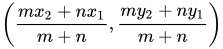
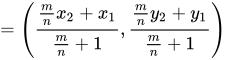
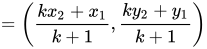
Similarly, the ratio can also be written as , and the coordinates of P are .[1]


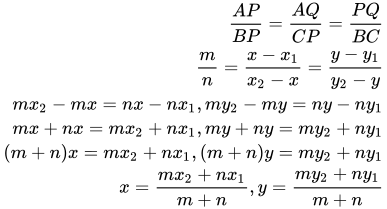
Proof
[edit]Triangles .

External divisions
[edit]
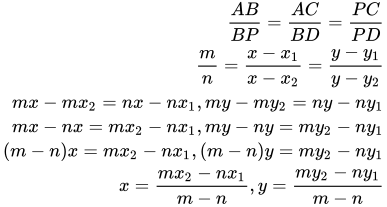
If a point P (lying on the extension of AB) divides AB in the ratio m:n then

Proof
[edit]Triangles (Let C and D be two points where A & P and B & P intersect respectively). Therefore ∠ACP = ∠BDP

Midpoint formula
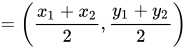
[edit]The midpoint of a line segment divides it internally in the ratio . Applying the Section formula for internal division:[4][5]

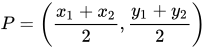
Derivation
[edit]


Centroid
[edit]
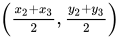
The centroid of a triangle is the intersection of the medians and divides each median in the ratio . Let the vertices of the triangle be , and . So, a median from point A will intersect BC at . Using the section formula, the centroid becomes:



In three dimensions
[edit]Let A and B be two points with Cartesian coordinates (x1, y1, z1) and (x2, y2, z2) and P be a point on the line through A and B. If . Then the section formula gives the coordinates of P as


If, instead, P is a point on the line such that , its coordinates are .[1]


In vectors
[edit]The position vector of a point P dividing the line segment joining the points A and B whose position vectors are and


See also
[edit]References
[edit]- ^ a b c d e Clapham, Christopher; Nicholson, James (2014-09-18), "section formulae", The Concise Oxford Dictionary of Mathematics, Oxford University Press, doi:10.1093/acref/9780199679591.001.0001, ISBN 978-0-19-967959-1, retrieved 2020-10-30
{{citation}}: CS1 maint: work parameter with ISBN (link) - ^ "Section Formula | Brilliant Math & Science Wiki". brilliant.org. Retrieved 2020-10-16.
- ^ "Coordinate Geometry" (PDF). Archived (PDF) from the original on 2016-06-26. Retrieved 2020-10-16.
- ^ a b c Aggarwal, R.S. Secondary School Mathematics for Class 10. Bharti Bhawan Publishers & Distributors (1 January 2020). ISBN 978-9388704519.
- ^ a b c Sharma, R.D. Mathematics for Class 10. Dhanpat Rai Publication (1 January 2020). ISBN 978-8194192640.
- ^ a b Loney, S L. The Elements of Coordinate Geometry (Part-1).
- ^ a b "Vector Algebra" (PDF). Archived (PDF) from the original on 2016-12-13. Retrieved 2020-10-30.
External links
[edit]Section formula
View on Grokipedia[3] In contrast, for external division, where the point lies outside the segment, the coordinates are
assuming .[1] A special case is the midpoint formula, derived when , yielding .[2] The section formula finds extensive applications in analytic geometry, such as computing centroids of triangles, verifying collinearity of points, and solving problems in vector geometry and computer graphics for interpolation between coordinates.[3] It also aids in determining the ratio in which a given point divides a line segment, enhancing problem-solving in fields like physics for position vectors and engineering for spatial calculations.[1]