

Setun
View on Wikipedia A photo of a Setun computer in 1959. | |
| Developer | Sergei Sobolev and Nikolay Brusentsov at Moscow State University |
|---|---|
| Manufacturer | Kazan Mathematical plant |
| Release date | 1959 |
| Lifespan | 1959–1965 |
| Units sold | 50 |
| Successor | Setun-70 |
Setun (Russian: Сетунь) was a computer developed in 1958 at Moscow State University. It was built under the leadership of Sergei Sobolev and Nikolay Brusentsov. It was the first modern ternary computer, using the balanced ternary numeral system and three-valued ternary logic instead of the two-valued binary logic prevalent in other computers.[1][2][3]
Overview
[edit]The computer was built to fulfill the needs of Moscow State University. It was manufactured at the Kazan Mathematical plant. Fifty computers were built from 1959 until 1965, when production was halted. The characteristic operating memory consisted of 81 words of memory, each word composed of 18 trits (ternary digits) with additional 1944 words on magnetic drum (total of about 7 KB).[4] Between 1965 and 1970, a regular binary computer was used at Moscow State University to replace it. Although this replacement binary computer performed equally well, it was 2.5 times the cost of the Setun.[5]
In 1970, a new ternary computer architecture, the Setun-70, was developed. Edsger W. Dijkstra's ideas of structured programming were implemented in the hardware of this computer. The short instructions set was developed and implemented by Nikolay Brusentsov independently from RISC architecture principles.[5]
The Setun-70 hardware architecture was transformed into the Dialogue System of Structured Programming (DSSP). DSSP emulates the "Setun 70" architecture on binary computers, thus it fulfills the advantages of structured programming. DSSP programming language has similar syntax to the Forth programming language but has a different sequence of base instructions, especially conditional jump instructions. DSSP was developed by Nikolay Brusentsov and doctoral students in the 1980s at Moscow State University. A 32-bit version was implemented in 1989.
History
[edit]Initiation of the project
[edit]The Setun project was initiated by Sergei Sobolev, in order to develop a small computer for use at the Moscow State University, after the planned transfer of the M-2 computer to the university got canceled in 1953. In 1956, he organized a series of seminars analyzing the disadvantages of existing computers and various plans for technical implementation. These meetings included participants from the Moscow State University, the Institute of Atomic Energy, and other institutes of the Academy of Sciences. Notable attendees include Shura-Bura, Konstantin Adolfovich Semendaev, and Zhogolev. On one of these seminars on April 23, 1956, Nikolay Petrovich Brusentsov was appointed as the executive designer and supervisor of the project.[6][7]
At the time, Brusentsov was a graduate (equivalent to a master degree, see Education in Russia, traditional model) at Moscow State University, who was graduated from the Moscow Energy Institute. Before appointing Brusentsov as the executive designer of Setun computer, Sobolev transferred Brusentsov to the Mechanics-Mathematics department and sent him to Gutenmakher's laboratory at the Institute for Precision Mechanics to gain relevant experience. To Brusentsov, this was an invaluable experience. In the lab, he had access to the lab's computers and their supporting documentation, which Brusentsov found being "technically weak". Brusentsov then decided to use a ternary number system.
Setun computer
[edit]Sobolev continued to support the project both by finding assistants and participating in the discussions. In 1956, Brusentsov started the design with four engineers and five technicians plus himself. The whole team worked in a 60-square-meter room with laboratory tables, where they designed and assembled the machine by hand. Zhogolev worked as the main programmer, and together with him, Brusentsov developed the computer architecture of Setun. In 1958, the team grew to 20 people, and the first model of the Setun computer was assembled. The name Setun comes from a river near the University.[5][6]
After the first model of Setun was built, the Kazan Mathematical Machines Factory was decreed by the Soviet Cabinet of Ministers to mass-produce the Setun computers. However, the leadership at the Kazan plant was not interested in large-scale computer production. The second model built in the factory was sent back because the plant managers and officials maintained that the computer was not yet reliable. The team was forced to manually adjust the second model. On November 30, 1961, the director of the Kazan factory was forced to sign an act which ended the attempts to cease the production of the Setun computer. The computers were then produced at the rate of 15-20 machines annually until 1965, when the plant refused to continue the production as the sale price of the computer was too low.
While Setun attracted significant interest from abroad, the Ministry of Foreign Trade never filled the orders received. Only 50 Setun computers have been manufactured, 30 of which were used in the higher education institutions inside the Soviet Union.[5][6]
Setun-70 computer
[edit]Between 1961 and 1968, Brusentsov and Zhogolev developed Setun-70, the next generation of Setun computer with a new architecture. It was designed for effective software development, in which the ternary system played a key role. Both addresses and operations are in syllables, where each syllable's length equals to 6 trits (about 9.5 bits). Algebraic expressions of operands by syllables replace the instructions as words in the traditional design, as the instruction set is updated to allow more variance of operand length.[5] The algebra is supplemented by testing, control, and input-output operations. The user can add operations on their own without reducing the computer's performance, thus providing the ideal conditions for structured programming. Brusentsov claimed that the programming time on Setun-70 is reduced by five to tenfold with unprecedented reliability, clarity, compactness and speed.
The functioning algorithm of Setun-70 was comprehensively described in expanded Algol-60.
End of the Setun project
[edit]The new university rector considered Brusentsov's research and computer design a pseudo-science. After the Setun-70 project, Brusentsov's lab was relocated from the computer center at Moscow State University to an attic in a student dormitory, and the original prototype of the Setun computer was destroyed. The Setun-70 model was taken to the new attic laboratory and was used as a basis for developing the educational computer system Master Work Station.
Adoption and application
[edit]Thanks to the simplicity and naturalness of its architecture, as well as a well-designed programming system that included the following interpreters—IP-2 (floating-point, 8 decimal digits), IP-3 (floating-point, 6 decimal digits), IP-4 (complex numbers, 8 decimal digits), IP-5 (floating-point, 12 decimal digits)—plus the POLIZ autocode with its operating system and standard subroutine library (floating-point, 6 decimal digits), the Setun computers were quickly mastered by users in universities, industrial plants, and research institutes. They proved to be an effective tool for solving practically important problems across a wide range of fields, from scientific modeling and engineering calculations to weather forecasting and enterprise management optimization.[8]
At user seminars on the Setun computers—held at Moscow State University (1965), the Lyudinovo Diesel-Locomotive Plant (1968), and Irkutsk Polytechnic Institute (1969)—dozens of reports were presented on successful real-world applications for the national economy. Owing to its balanced ternary code, Setun turned out to be a truly universal, easily programmable, and highly efficient computing instrument. It earned a strong reputation, notably as an educational tool for teaching computational mathematics in more than thirty universities. At the Zhukovsky Air Force Engineering Academy, Setun even became the platform for the first automated computer-based learning system.[9]
Critics
[edit]Brian Hayes argues in his article Third Base that Brusentsov did not realize the theoretical advantage of the base 3 system:[10]
Unfortunately, Setun did not realize the potential of base 3 to reduce component counts. Each trit was stored in a pair of magnetic cores, wired in tandem so that they had three stable states. A pair of cores could have held two binary bits, which amounts to more information than a single trit, and so the ternary advantage was squandered.
Ternary compared to binary
[edit]Balanced ternary systems and ternary computers are not unprecedented in history. Thomas Fowler built a mechanical computer in 1840 using balanced ternary system.[11] The balanced ternary representation of numbers and its related arithmetics was applied in number theory back to Leonhard Euler[12] and was briefly discussed by Claude Shannon in his paper a symmetric notation of numbers published in 1950.[13]
Despite the ternary design never becoming massively produced, there have been discussions on the advantages of the ternary system over the binary system, and great interest was present on the ternary and more generally on the multi-valued logic systems in the academy.[14]
Advantages
[edit]Brusentsov found the ternary number system superior to the binary number system: it allowed him to create very simple and reliable elements, and he needed seven times fewer elements than the Gutenmakher's computers. The power source requirements were also significantly reduced because a smaller amount of magnetic rods and diodes was used. He also found the natural number-coding system used in the ternary system superior over the direct, reciprocal and supplementary number coding used in the binary system. He maintained that the ternary system is superior to binary in most aspects and published several papers advocating the ternary system from 1985 to 2014.
The symmetric nature of balanced ternary logic allows for natural representation of negative numbers.
The ternary system is also more efficient from an information theory perspective. Donald Knuth wrote in his book The art of Computer Programming that "Perhaps the symmetric properties and simple arithmetic of this number system will prove to be quite important some day,"[15] noting that,
The complexity of arithmetic circuitry for balanced ternary arithmetic is not much greater than it is for the binary system, and a given number requires only as many digit positions for its representation."[15]
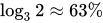
In the paper The Prospects for Multivalued Logic: A Technology and Applications View, Kenneth C. Smith argued that multi-valued logic is a solution to the interconnection problem in digital systems.[16] In particular, Douglas W. Jones suggests that the ternary system will reduce the number of interconnection wires by 36%[17]
Disadvantages
[edit]Douglas W. Jones made a series of computations and designs algorithms of ternary system on his homepage under the name The Ternary Manifesto, including fast ternary addition, multiplication, and division. It turns out that much of the improved efficiency in the interconnection and digit representation is balanced out by requiring more gates in the computations. For example, the ternary addition, while achieving the same computational speed as binary addition, requires 62% more logic.[17]
Meanwhile, many have suggested that ternary circuits are hard to develop, especially when most modern digital flows are binary.[18][19]
In the paper Comparison of Binary and Multivalued ICs According to VLSI Criteria written by Daniel Etiemble & Michel Israël, the authors compared binary and multivalued integrated circuits by examining their performance in detail, and discovered that while the design of multivalued circuits are valid and useful, they have not surpassed the binary circuits. They wrote in the conclusion that [18]
Multi-valued circuits and two-valued circuits must not be seen as competitors. If they are seen as such, then two-valued circuits have already won.
See also
[edit]References
[edit]- ^ Weatherby, Leif. "Hegel 2.0 | Leif Weatherby". cabinetmagazine.org.
- ^ "Глава 2. Киберразнообразие". DataArt IT Museum.
- ^ "The Setun Computer". December 29, 2014.
- ^ "ЭВМ Сетунь" [Setun computer]. Russian Virtual Computer Museum (in Russian). Retrieved September 20, 2016.
- ^ a b c d e Brousentsov, N. P.; Maslov, S. P.; Ramil Alvarez, J.; Zhogolev, E. A. "Development of ternary computers at Moscow State University". Russian Virtual Computer Museum. Retrieved January 19, 2015.
- ^ a b c "Pioneers of Soviet Computing | SIGCIS". www.sigcis.org. Retrieved 2025-05-26.
- ^ Prokhorov, Sergei (June 2020). "Sergei Sobolev - the eminent mathematician, founder of Russian computer science". 2020 International Conference Engineering Technologies and Computer Science (EnT). IEEE. pp. 104–108. doi:10.1109/EnT48576.2020.00026. ISBN 978-1-7281-8090-8.
- ^ Брусенцов, Н.П. (1972). "Электромагнитные цифровые устройства с однопроводной передачей трехзначных сигналов". Наука: 242–244.
- ^ "Троичные ЭВМ "Сетунь" и "Сетунь 70"". www.computer-museum.ru. Retrieved 2025-05-27.
- ^ Hayes, Brian (2001). "Computing Science: Third Base". American Scientist. 89 (6): 490–494. doi:10.1511/2001.40.490. ISSN 0003-0996. JSTOR 27857554.
- ^ McKay, John; Vass, Pamela. "Thomas Fowler". Archived from the original on 31 May 2007.
- ^ Andrews, George E. (2007). "Euler's "De Partitio numerorum"". Bulletin of the American Mathematical Society. New Series. 44 (4): 561–573. doi:10.1090/S0273-0979-07-01180-9. MR 2338365.
- ^ Shannon, C. E. (February 1950). "A Symmetrical Notation for Numbers". The American Mathematical Monthly. 57 (2): 90–93. doi:10.1080/00029890.1950.11999490. ISSN 0002-9890.
- ^ Dubrova, Elena. Multiple-Valued Logic in VLSI: Challenges and Opportunities. S2CID 17070721. Retrieved 2025-05-27.
- ^ a b Knuth, Donald (1997). The art of Computer Programming. Vol. 2. Addison-Wesley. pp. 195–213. ISBN 0-201-89684-2.
- ^ Smith (September 1981). "The Prospects for Multivalued Logic: A Technology and Applications View". IEEE Transactions on Computers. C-30 (9): 619–634. Bibcode:1981ITCmp.100..619S. doi:10.1109/tc.1981.1675860. ISSN 0018-9340.
- ^ a b Jones, Douglas (April 1, 2012). "Douglas W. Jones on Ternary Computing". homepage.cs.uiowa.edu. Retrieved 2025-05-27.
- ^ a b Etiemble, D.; Israel, M. (April 1988). "Comparison of binary and multivalued ICs according to VLSI criteria". Computer. 21 (4): 28–42. Bibcode:1988Compr..21d..28E. doi:10.1109/2.49. ISSN 0018-9162.
- ^ Nair, Ravi; Smith, Scott; Di, Jia (2015-09-11). "Delay Insensitive Ternary CMOS Logic for Secure Hardware". Journal of Low Power Electronics and Applications. 5 (3): 183–215. doi:10.3390/jlpea5030183. ISSN 2079-9268.
Setun
View on GrokipediaOverview
Development Context
Following World War II, the Soviet Union faced significant technological isolation due to Cold War tensions, trade embargoes, and ideological policies under Stalin that prioritized self-reliance and rejected Western aid, such as a 1944 U.S. offer for technical assistance.[5] This isolation, compounded by resource constraints like limited access to advanced components and a ban on cybernetics as a "bourgeois pseudoscience" in the late 1940s and early 1950s, compelled Soviet scientists to innovate independently in computing, often relying on vacuum tubes and theoretical advancements rather than imported hardware.[5] These factors drove exploration of alternative paradigms to maximize efficiency amid scarcity, fostering unique designs tailored to national needs in science, industry, and education.[5] In this context, Nikolay P. Brusentsov, a Ukrainian-born engineer and mathematician, emerged as the lead designer of the Setun project at Moscow State University (MSU), where he began conceptual work in 1956 under the guidance of Sergei L. Sobolev, who had established an electronics department at MSU that year to address growing demands for practical digital machines.[1] Brusentsov's efforts were supported by a small team of graduate students and technicians, reflecting the resource-limited environment of Soviet academia.[1] Early Soviet computing efforts, such as the MESM (Small Electronic Calculating Machine) completed in 1950 under Sergei Lebedev and the BESM (Large Electronic Calculating Machine) operational by 1953, were binary systems that advanced national capabilities but underscored the need for more accessible, efficient machines suitable for university research and education, where large-scale binary computers proved cumbersome and expensive.[6][1] These machines influenced Brusentsov's vision by highlighting limitations in affordability and scalability for non-military applications, prompting a shift toward innovative logic systems to meet educational demands.[1] The primary goal of the Setun project was to develop a low-cost, small-scale computer for university and laboratory use, leveraging balanced ternary logic—where digits represent -1, 0, and +1—for its potential to achieve greater informational density and hardware simplicity compared to binary systems, thereby reducing material and production expenses in a constrained economy.[7][1] This approach aligned with broader Soviet motivations to democratize computing for teaching and research while optimizing limited resources.[7]Key Innovations
The Setun computer pioneered the use of balanced ternary logic, employing digits -1 (often symbolized as N or ñ), 0, and +1 to represent values. This system enabled direct encoding of both positive and negative numbers without requiring additional sign bits or two's complement conversions, simplifying arithmetic operations and reducing hardware complexity compared to binary systems.[1] The balanced ternary approach provided optimal density for numerical representation, as each trit conveyed approximately 1.585 bits of information, outperforming binary in terms of information efficiency for signed integers.[7] A major hardware innovation was the implementation of magnetic logic elements known as jeoters, which served as the core building blocks for both memory and logic functions. These jeoters, constructed from ferrite cores and diodes, integrated storage and computation in a compact form, eliminating the need for vacuum tubes in core logic while the overall machine used a limited number of vacuum tubes and transistors for peripheral functions, offering high noise immunity and low power consumption.[1][2] Each jeoter cost about 3.50 rubles, allowing the entire machine to be built economically with around 2,000 such elements, making Setun suitable for resource-constrained environments.[1] Setun featured an 18-trit word length for its accumulator and multiplier registers, delivering a numerical range equivalent to approximately 29 binary bits and supporting fixed-point arithmetic with high precision relative to its era's binary counterparts.[1] The architecture included 24 basic single-address instructions optimized for ternary arithmetic, such as addition, multiplication, and shifts, which leveraged the system's inherent symmetry for efficient execution.[1] Furthermore, Setun operated in an asynchronous mode, avoiding a global clock to minimize synchronization overhead and enhance performance flexibility, particularly when paired with its magnetic drum memory.[1] The single-address instruction format, augmented by a 5-trit index register for address modification, streamlined control unit design by reducing the need for complex multi-address decoding, contributing to the machine's overall simplicity and reliability.[1]Historical Development
Project Initiation
The Setun project was formally initiated in 1956 at the Faculty of Mechanics and Mathematics of Moscow State University (MSU), following the establishment of an electronics department at the university's computer center under the initiative of Sergei L. Sobolev.[1] The core team was formed by assembling eight graduate students from MSU and the Moscow Power Engineering Institute (MEI), along with twelve technicians and laboratory assistants, with key leadership provided by Nikolay P. Brusentsov and José Ramil Alvarez.[1] This group, supplemented by seminars involving faculty such as K. A. Semendyaev, M. R. Shura-Bura, and I. S. Berezin, focused on creating a simple and reliable computing machine tailored to the era's technological constraints.[7] Early efforts centered on feasibility studies and theoretical designs to validate balanced ternary logic as an alternative to binary systems. The team conducted a year-long analysis of contemporary computers, which revealed inefficiencies in binary arithmetic—particularly in multiplication and division operations that required additional complement codes and rounding steps—prompting the decision to adopt ternary encoding with digits {-1, 0, 1} for its uniform representation of positive and negative numbers.[1] Initial prototypes and simulations were developed to test this approach, including paper-based designs for arithmetic units utilizing ternary threshold logic with ferrite cores and diodes, emphasizing simplicity and reduced hardware complexity.[7] Funding for the project came from Moscow State University, which supported it as part of broader efforts to develop affordable computing tools for educational institutions, research laboratories, design offices, and industrial applications.[1] This backing aligned with the need for an inexpensive, low-power machine suitable for university teaching and middle-level computational tasks, distinguishing Setun's inception from larger-scale Soviet computing initiatives.[7]Original Setun Construction
The original Setun computer was assembled by the end of 1958 at Moscow State University under the direction of Nikolay Brusentsov, marking the first practical implementation of a balanced ternary digital computer.[1] The construction relied on approximately 2,000 magnetic digital elements, each serving as a basic logic and memory component, produced at specialized plants in Astrakhan at a low cost of 3 rubles 50 kopecks per unit.[1] These elements were based on ferrite cores with multiple windings to enable ternary state representation, allowing the system to operate without traditional binary gates.[4] The assembly process was entirely manual, carried out by a small team of eight graduate students and twelve technicians who hand-wired the logic circuits in a university laboratory with limited resources.[1] Following assembly, the Setun began initial use by the university's electronics department collaborators in late 1958, though full debugging and interdepartmental testing extended until April 1960.[1] During this period, only three defective elements required replacement in the first year of operation, demonstrating the reliability of the hand-built components with no further repairs needed thereafter.[1] The system's operating memory consisted of 162 nine-trit cells organized across three pages of 54 cells each, supplemented by a magnetic drum storage unit capable of holding 36 or 72 pages for extended data retention.[1] Challenges during construction included the team's inexperience as beginners in computer building, constrained testing facilities, and the labor-intensive wiring of complex ternary logic without standardized tools or mass-production support.[1] Key milestones in the early operation of the original Setun included the development of a complete programming system and application software by the end of 1959, enabling practical computations.[1] Successful demonstrations of arithmetic operations, such as fixed-point and floating-point calculations using an index register, were achieved through direct programming in ternary machine code, validating the efficiency of the balanced ternary architecture for basic numerical tasks.[1] These achievements highlighted the machine's potential despite its modest scale, as it performed reliably in university research settings without the need for extensive hardware modifications.[4]Setun-70 Evolution
The Setun-70 represented an iterative advancement over the original Setun, evolving its balanced ternary architecture into a more sophisticated two-stack system while retaining core principles of ternary logic. Development of the Setun-70 commenced in the mid-1960s following the cessation of original Setun production, with the prototype constructed between 1967 and 1969 under the leadership of Nikolai Brusentsov at Moscow State University. The first operational unit became functional in April 1970, marking a significant step in applying ternary computing to structured programming environments.[7][1] Key hardware innovations in the Setun-70 included the use of ferrite cores and diodes to realize ternary threshold logic, which improved reliability and processing efficiency compared to the original. Memory capacity was expanded to 9 pages of 81 trytes each in the operating memory, where a tryte comprised 6 trits (yielding roughly 9.5 binary bits per unit), enabling handling of larger datasets and more complex computations. Processing speed was enhanced through the two-stack design—an operand stack evolved from the original's accumulator and a return stack for control flow—allowing for faster execution of operations.[7][1] Programming support advanced with the introduction of the "Poliz" interpretive system, a Fortran-like environment based on reverse Polish notation that facilitated postfix expression evaluation and structured programming paradigms, making software development more intuitive for users. Input/output capabilities were refined with a simple yet effective terminal interface featuring a digital keyboard and calculating indicator, supplemented by potential compatibility with tape and teletype peripherals for data exchange in research settings. The modular two-stack architecture further supported easier maintenance by allowing flexible expansion of memory and instructions without overhauling the core design.[1] Production remained limited to small-scale experimental output, with a handful of units deployed to Soviet research institutes for testing and application in computational tasks, underscoring the Setun-70's role as a prototype rather than a mass-produced machine. This constrained rollout highlighted the challenges of scaling ternary hardware amid prevailing binary standards, yet it demonstrated practical enhancements in modularity and usability for academic and scientific use.[1][7]Project Termination
In 1972, the Soviet State Planning Committee (Gosplan), through its Deputy Chairman M. E. Rakovskiy, played a key role in formalizing the standardization of Soviet computing on binary systems as part of the Ryad (ES EVM) series, which was designed for compatibility with IBM System/360 architecture.[8] This decision prioritized mass production and interoperability with Western standards to accelerate technological catch-up, effectively sidelining non-binary projects like Setun despite their proven efficiency in resource use.[9] Political pressures during the Cold War exacerbated the project's challenges, including U.S. export embargoes that restricted access to advanced Western hardware and software, fostering concerns over espionage and the need for self-reliant yet compatible systems.[9] Soviet leadership, influenced by Comecon (CEMA) dynamics, aligned with binary paradigms to facilitate bloc-wide standardization and economic integration, viewing ternary innovations as incompatible with emerging global norms dominated by IBM.[8] These factors led to the reallocation of resources and personnel toward the Ryad series, which emphasized cloning IBM designs for reliability and scalability, even as Setun-70 prototypes demonstrated superior cost-effectiveness in limited production runs.[9] By the mid-1970s, the Setun project was fully decommissioned, with operational units phased out in favor of the expanding Ryad infrastructure across Soviet institutions.[9] Surviving machines, including examples from the original series, were preserved in educational settings and museums, such as the Polytechnic Museum in Moscow, where a Setun unit is designated a "relic of science and technology" for its historical significance.[10]Technical Design
Balanced Ternary Principles
Balanced ternary is a ternary numeral system (base-3) that employs the digits −1, 0, and 1, typically denoted as N (or T or ¯), 0, and 1, respectively, to represent integers in a signed-digit format.[11] This system provides a symmetric range around zero, where positive and negative values are encoded naturally without requiring a dedicated sign bit, unlike binary two's complement representations.[2] Each ternary digit, or trit, encodes approximately log₂(3) ≈ 1.584 bits of information, offering greater density than binary digits.[11] In the Setun computer, balanced ternary served as the foundational encoding for all numerical data, enabling efficient handling of signed arithmetic across its 18-trit word length.[2] Numbers in balanced ternary are expressed as a sum of powers of 3 weighted by the digits:where the representation is unique and non-redundant for every integer, eliminating ambiguities found in standard ternary (which uses digits 0, 1, 2).[12] For example, the decimal number 2 is represented as 1 N (or +− in some notations), computed as .[11] Similarly, −1 is N (), and 4 is 1 1 (). The sign of a number is determined by its most significant non-zero digit.[11] Arithmetic operations in balanced ternary follow rules adapted from base-3, but account for the signed digits, resulting in carry propagation that differs from binary due to the three possible values per position. Addition is performed digit-by-digit with a full adder that handles inputs from two trits plus a carry-in, producing a sum trit and carry-out; for instance, −1 + 1 yields 0 with no carry, while 1 + 1 = N with a carry of 1 to the next position (since , equivalent to −1 + carry 1 in balanced form).[13] The complete addition truth table includes 27 input combinations (3×3×3 for two digits and carry), simplifying to 18 minterms for the sum and 10 for the carry, with propagation using multi-valued signals in advanced implementations.[13] Multiplication employs a digit-by-digit approach akin to long multiplication, where each trit of the multiplicand shifts and adds (or subtracts for negative trits) the multiplier; for example, multiplying by a trit of 1 copies the multiplier, by −1 negates it, and by 0 yields zero, followed by summation with appropriate shifts by powers of 3.[14] Carry propagation in both operations can ripple (linear time) or use lookahead logic with 7-valued propagate/generate signals for logarithmic time complexity.[13] Conversion between balanced ternary and decimal leverages the positional weighting for decoding and a modified division algorithm for encoding. To convert from balanced ternary to decimal, compute the weighted sum as in the representation formula; for 1 N (decimal 2), it is .[12] For decimal to balanced ternary, first convert to standard ternary (digits 0–2) via repeated division by 3, then adjust: retain 0 and 1, replace 2 with −1 (N or Z) and add 1 to the next higher digit (carrying over if necessary, e.g., 3 becomes 0 with carry 1); this ensures the unique balanced form.[12] For example, decimal 7 in standard ternary is 21 (); adjusting the 2 to N adds 1 to the next digit, yielding 1 N 1 ().[12] This algorithm guarantees no redundant representations and handles negatives by processing the absolute value and inverting digits (replacing 1 with N, N with 1, leaving 0) while negating the leading digit if needed.[12]