Hubbry Logo
Shogi variantShogi variantMain
Open search
Shogi variant
Community hub
Shogi variant
logo
8 pages, 0 posts
0 subscribers
Be the first to start a discussion here.
Shogi variant
Shogi variant
from Wikipedia

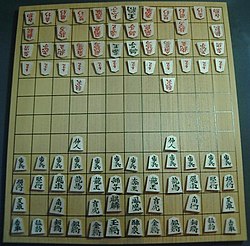
A shogi variant is a game related to or derived from shogi (Japanese chess). Many shogi variants have been developed over the centuries, ranging from some of the largest chess-type games ever played to some of the smallest. A few of these variants are still regularly played, though none are as popular as shogi itself.

The drop rule, often considered the most notable feature of shogi, is absent from most shogi variants, which therefore play more like other forms of chess, with the board becoming less crowded as pieces are exchanged. This is especially true for variants larger than shogi itself. In fact, the largest well-known variant that features the drop rule is the 11×11 game wa shogi.

Predecessors of modern shogi

[edit]

Some form of chess had almost certainly reached Japan by the 9th century, if not earlier, but the earliest surviving Japanese description of the rules of chess dates from the early 12th century, during the Heian period. Unfortunately, this description does not give enough information to play the game, but this has not stopped people from trying to reconstruct this early form of shogi, which is usually referred to as Heian shogi (平安将棋). Piece movements were as in modern shogi, but there was no rook or bishop. The board appears to have been either 9×8 or 8×8. The setup is unknown, but can reasonably be assumed to have been the same as in modern shogi (minus the rook and bishop, and minus a gold general in the 8×8 case), but possibly the pawns started on the second rank rather than the third. It can safely be assumed that the game was played without drops, since the weak pieces promote strictly to gold, instead of just moving like gold.

By the 16th century the game had taken a form closer to the modern game: it was played on a 9×9 board with the same setup as in modern shogi except that an extra piece (an elephant) stood in front of the king. This form of the game is known as sho shogi (小将棋), which means "small shogi". (While 9×9 may not seem small, despite the name, it was smaller than the other shogi variants prevalent at the time.) The elephant was eliminated by the Emperor Go-Nara (reign 1526–1557), and it is assumed that the drop rule was introduced at about the same time, giving rise to shogi as we know it today.

Historical variants

[edit]

There are a number of shogi variants played on boards larger than 9×9. These variants are all quite old, and were possibly all played without drops. Michael C. Vanier says, "It is thought that the really huge games (dai dai and up) were never really played to any significant extent [...] and were devised merely so that the creators could have the fun of inventing enormous games, amazing their friends and confounding their enemies. However, the games up to tenjiku shogi at least appear to be quite playable, assuming one has the time."[1]

The same 12th-century document which describes the Heian form of shogi also describes a variant played on a 13×13 board, which is now called Heian dai shogi (平安大将棋). As with the smaller Heian shogi, the rules for this game have not been completely preserved.

The most popular large-board variant is chu shogi (中将棋), played on a 12×12 board. The name means medium shogi, and the game is sometimes so called (or called middle shogi) in English. Chu shogi has existed since at least the 14th century; there are earlier references, but it is not clear that they refer to the game as we now know it. Chu shogi is best known for a piece called the lion, which moves like a king but up to twice per turn. The game was still commonly played in Japan in the early 20th century, but has now largely died out. It has, however, gained some adherents in the West. The main reference work in English is the Middle Shogi Manual by George Hodges.

Other large medieval shogi variants were wa shogi (11×11, sometimes played with drops), dai shogi (大将棋, "great shogi", 15×15), tenjiku shogi (天竺将棋, literally "Indian shogi", but meant "exotic shogi", 16×16), dai dai shogi (大大将棋, "great great shogi", 17×17), maka dai dai shogi (摩訶大大将棋, "ultra great great shogi", 19×19) and tai shogi (泰将棋, "grand shogi", 25×25). These variants date back at least to the 17th century. Tai shogi was thought to be the world's largest chess variant, but recently records of an even larger variant, taikyoku shogi (大局将棋, "ultimate shogi", 36×36), was discovered. However, there is no evidence that any of them were commonly played apart from dai shogi. While a few sets for dai dai shogi, maka dai dai shogi, and tai shogi are known to have been made, they appear to have been intended as display pieces and not for actual playing. Furthermore, the sources for the rules of almost all the larger variants tend to disagree with each other on many particular issues, even including the very moves of the pieces, such that only for chu shogi and dai shogi is it well-known what the historical rules were, and some small lacunae still arise in the latter with rare situations.

Name Board size Pieces each Piece types Different moves When invented First mentioned Notes
Sho shogi 9×9 21 10 10 Kamakura period Ancestor of modern shogi.
Shogi 9×9 20 9 9 16th century Introduced piece drops
Heian shogi 8×8 or 9×8 or 9x9 16 or 18 6 6 ~1120 or before;
Heian period
An early form of shogi.
Wa shogi 11×11 27 17 22 17th century; Edo period 1694
Shōgi Zushiki
All pieces are named after animals. Occasionally played.
Chu shogi 12×12 46 21 28 Early 14th century?; Muromachi period 1350
Yūgaku ōrai
Smaller version of dai shogi with fewer pieces (eliminating the least powerful ones) and different start setup. The most popular of the large variants.
Heian dai shogi 13×13 34 13 14 Heian period 1230
Nichūreki
Dai shogi 15×15 65 29 36 ~1230; Kamakura period 1300
Futsū Shōdōshū
Tenjiku shogi 16×16 76 36 43 15th or 16th century; Muromachi period 1694
Shōgi Zushiki
Enlarged version of chu shogi with more pieces (adding even more powerful ones) and different start setup. One of the relatively more popular large variants.
Dai dai shogi 17×17 96 64 68 15th century; Muromachi period 1443
Shōgi Rokushu no Zushiki
Maka dai dai shogi 19×19 96 50 76 15th century; Muromachi period 1443
Shōgi Rokushu no Zushiki
Occasionally played, though with altered rules.
Tai shogi 25×25 177 93 101 15th century; Muromachi period 1443
Shōgi Rokushu no Zushiki
Taikyoku shogi 36×36 402 208 300 Edo period 1694
Shōgi Zushiki

Of the historical large-board variants, only wa (11×11), chu (12×12), tenjiku (16×16), and maka dai dai shogi (19×19) have gained a limited following today. There is a society for chu shogi in Japan, as well as some efforts to revive maka dai dai shogi, though both efforts have changed the rules slightly from the historical ones – more significantly for maka dai dai shogi, unlike for chu shogi whose former popularity still lies within living memory. Tenjiku shogi gained some Western following around the turn of the millennium, although not with the historical rules.

Development of Shogi Variants
Heian shogi
平安将棋
Heian dai shogi
平安大将棋
Dai Shogi
大将棋
Chu Shogi
中将棋
Dai dai shogi
大大将棋
Tenjiku shogi
天竺大将棋
Wa Shogi
和将棋
Sho shogi
小将棋
Maka dai dai shogi
摩訶大大将棋
Shogi
将棋
Tai Shogi
泰将棋
Taikyoku Shogi
大局将棋

Modern variants

[edit]

These are some of the new and old shogi variants which have been invented. Time will show which if any of the many recently invented variants stand the test of usage and competition from other games, and stay in use.

Small variants

[edit]
Name Board size Pieces each When invented Invented by Notes
9 grid shogi[2] 3×3 Various 2016 Teruichi Aono Uses 40 different piece combinations and start positions. The first and last rank are the promotion zones. All other rules are the same as the traditional shogi. Designed to teach shogi. Its name in Japanese is 9マス将棋 kyu-masu shogi.
Dobutsu shogi 3×4 4 Madoka Kitao Children's game.[3] Also sold as "Let's Catch the Lion!"
Micro shogi 4×5 5 Modern, but before 1982 Ōyama Yasuharu? Pieces alternate between promoted and demoted state after each capturing move.
Mini shogi 5×5 6 ~1970 Shigenobu Kusumoto He may have rediscovered it instead of inventing it. Comparatively popular.
Kyoto shogi 5×5 5 ~1976 Tamiya Katsuya Pieces alternate between promoted and demoted state after each time they are moved.
Goro goro shogi 5×6 8 Each player's promotion zone consists of the two farthest ranks from the player. There are also no long-range pieces such as rooks and bishops, although there is a variant where each player has a knight and a lance.[4]
Judkins shogi 6×6 7 Before April 1998 Paul Judkins of Norwich, England
Whale shogi 6×6 12 1981 R. Wayne Schmittberger of USA All pieces named after cetaceans.
Tori shogi 7×7 16 Late 18th century Toyota Genryu All pieces named after birds. Uses the drop rule. One of the more popular shogi variants.
Yari shogi 7×9 14 1981 Christian Freeling, Netherlands Except for the general (king) and the pawn, all pieces have a strong emphasis on their vertical movement, like that of the shogi lance.
EuroShogi 8×8 16 After 2000 Vladimír Pribylinec Pieces are two colored cubes with chess symbols. A rotation of the man promotes the unit or changes its colour.
Ogi 8×8 18 After 2000 Cyril Veltin This version introduces the princess piece.[5]

Standard-size variants

[edit]
Name Board Size Pieces each When invented Invented by Notes
Eight-directional knight shogi [ja] 9×9 20 Early 20th century Unknown Shogi with knight that can jump in all eight directions (八方桂). When it promotes, it gains additional power of gold general.
Cannon shogi 9×9 20 February 1998 Peter Michaelsen Shogi plus xiangqi-type and Janggi-type cannons.
Hasami shogi 9×9 9 or 18 Like ludus latrunculorum. Not much like shogi.
Hand shogi 9×9 19 pieces Early 1997 John William Brown, Lewisville, Arizona Starts with 10 pieces each side in hand.[6]
Annan shogi 9×9 20 A Korean variation of standard shogi where pieces gain the powers of the pieces behind them. Popular in Japan.
Unashogi 9×9 20 1994 Edward Jackman Starts with all pieces in hand.
Masonic shogi 9×9 20 1987 George R. Dekle, Sr. Ranks indented like brickwork, adapted moves; otherwise like shogi.
Hexshogi 85 cells 20 1986 George R. Dekle, Sr. Hexagonal cells, adapted moves; otherwise like shogi.
Trishogi 9×10 20 1987 George R. Dekle, Sr. Triangular cells, adapted moves; otherwise same as shogi.

Large variants

[edit]
Name Board size Pieces each Piece types Different moves When invented Invented by
Okisaki shogi 10×10 22 9 11 ~1996 Masayuki Nakayachi
Great whale shogi 11×11 28 17[a] 28 1981 R. Wayne Schmittberger
Ko shogi 19×19 90 34 53 Late 17th century; Edo period Ogyū Sorai (attributed) Based partly on xiangqi and projectile weapons.

The most recent traditional large board variant is ko shogi (廣将棋 or 廣象棋 "wide shogi", 19×19), which is played on a go board and incorporates elements of Chinese chess. Ko shogi is unusual for the interdependence of its pieces and the complex rules of promotion, but likewise there is no evidence that it was ever played.

Multiplayer variants

[edit]
Name Board size Pieces each When invented Invented by Notes
Sannin shogi 7×7×7 hexagonal 18 ~1930 Tanigasaki Jisuke For three players
Yonin shogi 9×9 9 1993 Ota Mitsuyasu For four players

One-dimensional variants

[edit]
Name Board size Pieces each When invented Invented by Notes
Ito shogi 1×31 7 2007, updated 2022 Jonathan Rutherford Two-dimensional moves translated to a one-dimensional board[7]

Three-dimensional variants

[edit]
Name Board size Pieces each When invented Invented by Notes
Space shogi 9×9×9 20 1987 George R. Dekle, Sr. Orthodox shogi in a 3D gamespace

References

[edit]

Notes

[edit]
[edit]
Revisions and contributorsEdit on WikipediaRead on Wikipedia
from Grokipedia
Shogi variants are games derived from or closely related to , the traditional Japanese form of chess, featuring modifications to elements such as board size, piece types, promotion rules, and capture mechanics. These variants encompass a wide spectrum of complexity and scale, from compact modern inventions designed for quick play to expansive historical that predate the standardized 9×9 shogi board and lack the signature drop rule allowing captured pieces to be reused. Over centuries, enthusiasts in and the West have created dozens of such variants, with historical ones often drawing from medieval texts and emphasizing powerful, multi-move pieces like the , while modern ones prioritize accessibility and balance on smaller grids. Historical shogi variants emerged primarily between the 15th and 16th centuries in , during a period when larger boards and diverse piece sets were experimented with before the evolution of modern around the 17th century. Notable examples include Chu Shogi, played on a 12×12 board with 46 pieces per side of 21 types, recognized as the most popular historical variant due to its balance of complexity and playability without drops. Larger variants push the boundaries of chess-like , such as Tenjiku Shogi on a 16×16 board with 78 pieces of 36 types per side, featuring uniquely powerful pieces like the Soaring Eagle and Fire Demon that can capture multiple enemies in a single turn. The grandest is Taikyoku Shogi, utilizing a massive 36×36 board with 402 pieces of 93 types per player, though its rules remain partially reconstructed from ancient manuscripts. These often involve intricate promotions and no repetition rules to prevent stalemates, reflecting the strategic depth of their era. However, rules for some larger historical variants remain partially ambiguous due to incomplete or terse ancient sources, leading to variations in modern reconstructions. In contrast, modern shogi variants, largely developed since the outside , tend to simplify rules for broader appeal and shorter games, frequently retaining the drop mechanic. Mini Shogi, on a 5×5 board with just 12 pieces per side, exemplifies this approach, offering a distilled version of suitable for beginners or travel. Judkins Shogi expands slightly to a 6×6 board, incorporating standard pieces like the rook and alongside golds and silvers for tactical variety. Some contemporary variants, such as Dai Dai Shogi (17×17 board with 96 pieces of 64 types), bridge historical and modern styles by adapting medieval rules for computer play and tournaments, though ambiguities in piece movements persist due to archaic sources. Efforts by enthusiast organizations and associations have promoted select variants through online platforms and rule clarifications.

Introduction

Definition and Scope

A Shogi variant refers to any board game derived from traditional Japanese chess, known as , that retains the strategic essence of two players maneuvering armies to the opponent's , along with characteristic movement patterns for pieces like the , rook, and , while introducing modifications to elements such as board dimensions, piece assortments, or specific rules like the drop mechanic or promotions. These variants adapt Shogi's core gameplay for varying complexities or themes, with historical forms often omitting the drop rule of captured pieces—allowing reintroduction onto the board—unlike modern . The scope of Shogi variants in this entry includes historical predecessors dating from the 10th to 16th centuries, which represent early evolutionary forms of the game and typically lack the drop rule, as well as modern inventions emerging from the to the present, often created by enthusiasts or scholars to explore new dynamics and frequently retaining drops. Unrelated chess-like from other traditions, such as Chinese Xiangqi or international chess without ties to Shogi's lineage, are excluded to focus exclusively on derivations within the Shogi family. This coverage highlights the game's adaptability while emphasizing documented forms rather than speculative or unverified creations. Historical emerged primarily in medieval before the standardization of modern around the , with about a dozen major forms identified. Shogi itself traces its roots to the ancient Indian game of , which emerged between the 3rd and 6th centuries CE as a four-player war simulation using dice, and later evolved into two-player forms that spread across through trade and cultural exchanges, possibly via , Korea, or southern routes like Burma and . By the , these influences coalesced in , where the game underwent significant localization, including the introduction of promotions and, eventually, the drop mechanic in the 15th–16th centuries, solidifying Shogi's distinct identity. Numerous variants are documented in historical texts and modern compilations, with at least a dozen major historical forms identified from the medieval period alone, and additional contemporary ones expanding the total to dozens actively discussed or implemented in software and play communities.

Key Differences from Standard Shogi

Shogi variants commonly deviate from the standard 9×9 board by employing smaller or larger grids, such as the 5×5 board in Minishogi or the 36×36 board in Taikyoku Shogi. Piece counts per side adjust accordingly, ranging from 6 pieces in Minishogi to 402 pieces of 209 types in Taikyoku Shogi. Movement rules frequently introduce specialized pieces, including ranged attackers like cannons that capture by hopping over an adjacent enemy piece and powerful leapers like the lion, which can perform two king-like moves in a single turn, potentially capturing twice. The drop rule, a hallmark of standard allowing captured pieces to be reintroduced, is retained in many modern variants like Minishogi but omitted or restricted in others, particularly historical large-board games such as and Maka Dai Dai Shogi, where captured pieces are permanently removed to manage complexity. In variants without drops, gameplay resembles international chess more closely, emphasizing positional maneuvering over recycling captured material. Promotion mechanics vary significantly; while standard limits promotion to the final three ranks with specific upgrades, some variants expand the zone to four ranks or make it optional, and promoted forms can differ, such as pawns becoming tokin (gold generals) or unique pieces gaining lion powers. Certain games introduce "contagious" promotion, where capturing a promoted piece forces the capturer to promote as well. Win conditions generally follow or of the king, as in standard , but variants may require capturing all opposing royal pieces, including princes or emperors, or incorporate special captures enabled by pieces like the 's double move. Piece nomenclature employs traditional Japanese alongside English translations, with shared elements like the king (王, ōshō) and rook (飛車, hisha) appearing across variants, while unique additions include the (獅子, raion) in large historical games and the stone general (石将, isshō) in others.

Historical Development

Ancient Influences and Pre-Shogi Games

The origins of Shogi trace back to the ancient Indian game of , which emerged in the Northern during the period, approximately 319–543 CE, representing the four divisions of an ancient army: infantry, cavalry, elephantry, and chariotry. This proto-chess game spread along , first reaching Sassanid Persia around 600 CE, where it evolved into Chatrang (later ), as documented in a Persian manuscript describing its introduction as a gift from an Indian ambassador to King . From Persia, the game transmitted eastward to , adapting into Xiangqi by the 8th century, featuring a 9×10 board with pieces placed at intersections and for notation. The transmission to occurred around 1000 CE, facilitated by trade routes and Buddhist monks who carried cultural elements from through and Korea, mirroring the spread of itself. Early Japanese adaptations during the (794–1185 CE) lacked the modern drop rule, resembling Makruk-like variants with simplified movements and no captured piece repatriation; pieces were often represented by characters inscribed on wooden plaques or cards placed on boards. Fragmentary evidence from 10th–11th century manuscripts, such as the Kirinsho (early ) by no Yukinari, details piece and promotion rules, while the Shinsarugakuki (1058–65) provides the earliest diary references to gameplay. Key pre-Shogi games included Heian shogi, played on an 8×8, 9×8, or 8×9 board (exact size uncertain) with six piece types (King, Gold General, Silver General, Knight, Lance, and Pawn) and a large promotion zone on the third rank, where pieces advanced to Gold General equivalents, but without Rook or Bishop. An early large form, Heian dai shogi, mentioned in the Nichureki chronicle (1126–1130), used a 13×13 board with 34 pieces per side of 13 types, including unique pieces like the Side Mover and Flying Dragon, reflecting 13th-century expansions though possibly a recent invention at the time (rules partially reconstructed). These proto-games, influenced by Buddhist terminology in later variants (e.g., divine guardians), underscore the priestly role in cultural exchange and game evolution.

Predecessors to Modern Shogi

The predecessors to modern emerged during Japan's Heian and periods, evolving from earlier strategic board games influenced by , the ancient Indian precursor to chess and variants that arrived in Japan by the . These early forms featured simpler piece sets and rules compared to later developments, gradually incorporating elements like promotion while lacking the drop rule that defines contemporary play (drop rule introduced in the 15th-16th centuries). Heian Shogi, dating to the 11th century during the (794–1185), is the earliest recorded variant and is reconstructed on an 8×8, 9×8, or 8×9 board (size uncertain) with 16 or 18 pieces per side, consisting of 1 , 1 or 2 gold generals, 2 silver generals, 2 knights, 2 lances, and 8 or 9 pawns. Unlike modern , it had no drop rule for captured pieces, and pawns promoted to gold generals upon reaching the enemy camp, emphasizing linear advancement and capture without reuse (rules reconstructed from fragmentary sources). By the 13th century in the (1185–1333), variants like Heian dai shogi continued without drops, on larger boards with expanded piece sets, marking gradual increases in complexity on boards similar to Heian Shogi. This period saw experimentation with rules but no evidence of drops, which would accelerate games later. Dai Shogi, from the 13th to 14th centuries, expanded to a 15×15 board with 65 pieces per side of 36 types, including unique hook movers like the (long-range orthogonal with a hook) and drops not permitted (unlike later forms; rules partially reconstructed). This larger format increased strategic complexity, but its scale contributed to slower play. Sho Shogi began emerging in the as a streamlined alternative on a 9×9 board with 20 pieces per side, incorporating rooks and bishops from larger variants while standardizing the full drop rule for all pieces by , as documented in the manual by Inja Ryūho. This reduction in size and pieces, alongside universal drops, facilitated quicker matches and led to its dominance. The decline of larger predecessors like Dai Shogi stemmed from their inherent complexity and prolonged games, which contrasted with the preference for faster, more accessible play in the 1600s, ultimately solidifying modern Shogi's form.

Modern Variants by Board Size

Small Board Variants

Small board variants of Shogi are modern adaptations played on boards smaller than the standard 9x9 grid, typically ranging from 4x5 to 7x7, to facilitate quicker games and greater portability. These variants retain core elements of Shogi, such as piece movement and capture mechanics, but adjust piece counts, promotion rules, and sometimes the drop rule to suit the compact space. They are popular among beginners and for casual play due to shorter game lengths, often lasting under 30 minutes. Minishogi, developed around 1970 by Shigenobu Kusumoto of , , is played on a 5x5 board with 12 pieces per side, including one each of the king, rook, , gold general, and silver general, plus eight pawns. Unlike standard , it omits the drop rule, focusing instead on pawn promotion as a key strategic element, where pawns advance to the final rank to become powerful tokin pieces. Victory is achieved by or capturing the opponent's last piece. Microshogi, emerging in the 1980s, utilizes a 4x5 board and just six pieces per player: a king, lance, incense chariot (a forward-only rook variant), silver general, gold general, and pawn. It features unique movement for the incense chariot, which slides any number of squares forward but cannot retreat, and lacks a traditional promotion zone, with pieces instead transforming upon capture. The game has no drops and is known for its participation in informal tournaments due to its rapid pace and tactical depth. Kyoto Shogi, a modern 5x5 variant, allows the standard drop rule for captured pieces and incorporates a "ghost-move" rule to resolve stalemates, permitting a player to move a piece to a square from which it cannot legally move on the next turn, effectively passing without repetition. This rule, combined with familiar piece types like kings, golds, silvers, and pawns, makes it accessible and popular in Japan, particularly for teaching beginners the fundamentals of drops and positioning. Judkins Shogi, created in the 1990s by Michael Judkins, expands to a 6x6 board with 18 pieces per side, drawing from standard Shogi's arsenal including the king, rook, bishop, golds, silvers, knights, and pawns, while supporting full drops. A distinctive feature is the potential for bishop and rook exchanges early in play, mirroring common openings in larger variants but adapted for the smaller board to create dynamic midgames. Dobutsu Shogi, a modern 3×4 board variant invented by Madoka Kitao, uses animal-themed pieces (lion as king, giraffe, elephant, chick) and includes the drop rule, designed for children and beginners to introduce shogi concepts in a simplified, quick-play format. Tori Shogi, a variant from the late invented in 1799 by Toyota Genryu, is played on a 7x7 board and has seen modern revival for its unique flying pieces, such as the crane (moving like a but with additional leaps) and (diagonal slider). Employing the drop rule, it emphasizes aerial maneuvers among avian pieces like the phoenix (royal piece) and , blending ancient aesthetics with contemporary play.

Standard-Size Board Variants

Standard-size board variants of retain the familiar 9×9 grid, allowing players accustomed to the traditional game to explore altered dynamics through modified pieces, captures, or restrictions while preserving overall accessibility and balance. These variants often introduce elements from other chess-like games or simplify rules to emphasize specific tactics, such as jumping captures or linear assaults, without expanding the playing field. Unlike larger variants, they prioritize tactical depth over grand-scale maneuvering, making them suitable for focused study or casual play. Cannon Shogi, invented by Peter Michaelsen in 1998, incorporates cannon pieces drawn from (Chinese chess) to add ranged jumping mechanics on the standard 9×9 board. Each player deploys 20 pieces, including the four new cannons— (orthogonal mover), copper (diagonal mover), (orthogonal), and iron (diagonal)—positioned between the and rook on the second rank. These cannons move like their base pieces (rook or ) but capture only by hopping over exactly one intervening piece of either color, without capturing the jumped piece itself; promoted "flying" versions gain additional short-range diagonal or orthogonal steps. Pawns gain sideways movement and capture, promote to tokin ( general), and face no drop restrictions, such as multiple per file or via drop. Standard rules apply otherwise, including drops for all pieces except the modified pawns' freedoms enhance aggressive play. Hasami Shogi, developed in the 1930s, drastically simplifies the game to just kings and pawns on a 9×9 board, promoting a pure of entrapment over piece diversity. Each side starts with one and either 8 or 9 pawns filling the back rank; all pieces move any distance horizontally or vertically like rooks but cannot move diagonally. Captures occur via "hasami" (sandwiching), where a player removes any number of consecutive opponent pieces (including the king) trapped between two of their own in a straight line—short-range (adjacent) or long-range (with empty spaces). There are no promotions, drops, or other piece types, and the game ends by capturing the king or reducing the opponent to a single piece. This variant emphasizes positioning and inevitability, often leading to shorter games than standard . Yari Shogi, invented in 1981 by Christian Freeling of the , is played on a 7×9 board by replacing the and rook with (spear) pieces to highlight forward assaults. Each player has 16 pieces: the standard , golds, silvers, knights, lances, and 9 pawns, plus two on the second rank. The moves and captures any number of unoccupied squares straight forward only, like a limited rook, promoting to a forward dragon (adding backward rook movement). Other pieces follow standard movements, but without drops, the game relies on initial placement and linear threats to control files. This setup fosters aggressive, pawn-heavy advances and defensive fortifications. Annan Shogi, a modern 9×9 variant, uses identical pieces to standard Shogi but imposes movement restrictions based on adjacent friendly pieces, altering tactical flow. The key rule prohibits any piece from moving if directly backed by another friendly piece in its primary direction (e.g., a rook blocked rearward by its own pawn cannot slide forward fully). Drops and promotions remain standard, but this "color-binding" mechanic—treating friendly alignments as obstructive—forces careful stacking and unblocking, reducing stalemates and emphasizing fluid positioning over static blocks. No special drop bans apply beyond standard pawn rules.

Large Board Variants

No rewrite necessary — no critical errors detected.

Specialized Modern Variants

Multiplayer Variants

Multiplayer variants of adapt the game for three or more players by reconfiguring the board, turn sequences, and interaction rules to handle multiple opponents, often introducing elements of and prolonged play beyond simple . These variants emphasize strategic depth through and multi-front warfare, diverging from the binary confrontation of standard . Sannin Shogi, also known as Kokusai Sannin Shogi, is a modern three-player variant invented around 1930 by Tanigasaki Jisuke. The game uses a hexagonal board with 127 cells arranged in a grid of border length 7, where players occupy positions at 120-degree intervals around the perimeter. Each player starts with a reduced army of 18 pieces, including a , rook, , two gold generals, two silver generals, two knights, two lances, and five pawns, using standard pieces. Turns rotate clockwise among the three players, with shared board edges enabling pieces to maneuver across territories. A key multiplayer adaptation allows temporary alliances: if two players coordinate an attack on the third, they enter a binding partnership, sharing captured pieces but unable to target each other until the alliance dissolves. Victory occurs when a player eliminates an opponent's , but the game continues until only one player remains, adapting standard win conditions to a survival format. Drops are permitted, but alliance partners may drop pieces into shared zones with restrictions to prevent exploitation. Yonin Shogi, a four-player variant, was invented in 1993 by Ota Mitsuyasu, former mayor of Hirata (now Izumo) in Shimane Prefecture, Japan, and formalized for publication in 1995. It employs two standard Shogi sets, with each player receiving a subset: one king, two gold generals, two silver generals, three pawns, one lance, and one knight, totaling nine pieces on board with additional in hand. The game is typically played on a 9x9 board, with players seated at the four sides or corners, though variants on 12x12 boards exist for expanded space. Turns proceed clockwise in free-for-all mode or paired teams (north-south vs. east-west), allowing pieces to traverse corners and interact across adjacent sectors. Alliance rules are optional, permitting temporary pacts similar to Sannin Shogi, where partnered players cannot attack each other but coordinate captures. Captured pieces go to the captor's hand for drops, but team drops require mutual agreement. The objective extends standard checkmate: the game ends when all opposing kings are captured, with the last player or surviving team victorious, often leading to dynamic shifts as early eliminations reshape alliances. Historical multiplayer variants are exceedingly rare, with most documented from the and earlier focusing on two players despite the era's proliferation of large-board experiments by Buddhist . Experimental six-player variants, such as those on radial hexagonal boards with spoke-based movements and restricted drops to personal pieces only, remain largely undocumented and unstandardized, appearing primarily in niche theoretical discussions. These adaptations highlight persistent challenges in multiplayer Shogi, including power imbalances that favor aggressive early play and the need for diplomatic elements to mitigate rapid eliminations, shifting emphasis from pure tactics to .

One-Dimensional and Three-Dimensional Variants

One-dimensional variants adapt the game's mechanics to a linear board, restricting movement to a single file and eliminating diagonal or lateral options, which emphasizes adjacency-based captures and forward-backward positioning. A prominent example is Ito Shogi, invented by Jonathan Rutherford in 2007 and finalized with Andrew Sheedy in 2022. Played on a 1x31 uncheckered board with notched corners for visual distinction, each player starts with seven pieces: a king, flying swallow (bishop-like), goose (phoenix-like), heavenly horse (cavalryman-like), silver cannon (reverse chariot-like), tile general (silver general-like), and pawn (go-between-like). Pieces move along the line via steps or jumps— for instance, the pawn advances one square forward, the silver cannon leaps over exactly one piece any distance forward or backward, and the king steps one square forward, jumps to the second square forward, or steps one backward— with captures occurring by landing on or jumping over an adjacent enemy piece. Promotion in Ito Shogi occurs uniquely upon capturing an enemy piece, where the capturer flips to its promoted form (e.g., pawn to go-between, which moves one square forward or backward), except for the king; demotion reverses this upon recapture. Captured pieces may be dropped on any vacant square as an unpromoted piece, following 's drop rule but adapted to the linear space, with no restrictions on pawn drops except avoiding immediate checkmate. The game ends in , with illegal, fostering aggressive play and tactical depth in a constrained environment. This variant highlights how one-dimensional constraints create novel strategies focused on blocking, leaping, and precise sequencing rather than spatial maneuvering. Three-dimensional Shogi variants expand the board into volumetric space, introducing vertical movement layers that enable complex tactics such as elevation changes, inter-layer captures, and multi-plane positioning. Space Shogi, invented by George Dekle Sr. in , uses a 9x9x9 cubic board comprising nine stacked 9x9 layers, with each player controlling a standard set of 20 pieces (one , rook, bishop, two gold and silver generals each, two knights, two lances, and nine pawns). The initial setup places one player's pieces on layers 1-3 (ranks 1-3 on layers 1 and 2 for major pieces, pawns on layer 3 rank 3), and the opponent's on layers 7-9 symmetrically; pieces move according to standard rules extended to three dimensions, allowing the rook to traverse orthogonally across layers (becoming unicorn-like in vertical paths), the bishop diagonally in planes or triagonally between layers, and the one step in any of 26 possible directions including up/down. All conventional rules apply, including drops and promotions in the opponent's three layers, resulting in heightened strategic complexity from tunneling through layers and orbital-like maneuvers around central volumes. Another innovative three-dimensional variant is Cubic Shogi, developed by Vladimír Pribylinec starting in 2000, which employs cubic pieces on a flat 7x8 or 8x8 board to simulate dimensionality through rotation and multi-face symbolism. Each player has 14 cubic pieces marked with chess/ symbols on various faces (, rook, , queen, pawn, ), arranged initially with knights, , queen, , , on the back rank, rooks or bishops on the second, and pawns on the third; movements combine and orthodox chess elements—kings, rooks, , and pawns follow paths, knights leap in L-shapes, and the queen moves 1-2 squares orthogonally or diagonally— with pieces rotating upon landing to reveal new movement options from exposed faces. Captures allow drops as in , but pawns cannot drop on occupied files, and promotion occurs in the last two ranks to stronger forms like gold generals. This design introduces stacking-like tactics via piece orientation and gravity-inspired drops, where rotated faces alter future mobility, promoting conceptual depth in piece versatility without a physical 3D board. Software implementations, such as downloadable versions for Windows, facilitate play and exploration of these variants' unique spatial innovations.

Other Unique Variants

Insect Shogi represents a contemporary thematic innovation, developed in the 2010s by the Shogi Club and commercialized by around 2020, using insect figures on a compact 4×5 board to introduce children to principles through simplified rules and fast-paced captures. Pieces like the (analogous to a pawn) and the (with jumping capabilities) emphasize strategic positioning over complex promotions, making it an accessible entry point while retaining core elements like capturing and . It promotes educational play with a focus on insect ecology subtly integrated into piece designs. Annan Shogi introduces an unconventional movement mechanic where a player's pieces can optionally mimic the movement of the friendly piece directly behind them on the same file, allowing for adaptive tactics and chained maneuvers that evolve mid-game. This rule adds layers of prediction and positioning, distinguishing it from standard while maintaining the 9×9 board and drop system; it originated in the but gained renewed interest through online platforms as of the . Shinjuu Shogi, created in 2021 by Eric Silverman, blends historical influences with modern design on an 11×11 board, featuring 27 pieces per side themed around mythological creatures like the (unicorn-like leaper) and Dog (short-range jumper with unique blocking). It incorporates drops and promotions while aiming for balanced complexity, making it a fresh take for experienced players seeking thematic depth without overwhelming rules. Platforms like Lishogi.org, launched in , have facilitated the digital proliferation of these and other unique variants post-2000, enabling global access and community-driven refinements without altering core heritage. As of November 2025, Lishogi supports over 20 variants, including recent additions like custom multiplayer modes.

References

Add your contribution
Related Hubs
User Avatar
No comments yet.