Hubbry Logo
Shopian districtShopian districtMain
Open search
Shopian district
Community hub
Shopian district
logo
8 pages, 0 posts
0 subscribers
Be the first to start a discussion here.
Shopian district
Shopian district
from Wikipedia

Shopian district (Urdu pronunciation: [ʃoːpɪjɑ̃ː]), known as Shupyan[4] (Kashmiri pronunciation: [ʃupʲjan]) in Kashmiri, is an administrative district of Indian-administered Jammu and Kashmir in the disputed Kashmir region.[1] It is a hill district with its administrative headquarters in Shopian town.[5] As it is situated on the historical road commonly known as Mughal Road, most of its area is occupied by forests. Shopian district comes under the Pir Panjal Range which makes it very cold in winter.[6] After partition of India, it was a tehsil of Pulwama district. In March, 2007, the district status was granted by the Government of India.[7][8] The economy of the district depends on agriculture, particularly apple growing.[9]

Key Information

Shopian district is called "the apple bowl of Kashmir".[10]

Demographics

[edit]

According to the 2011 census, the Shopian district has a population of 266,215.[11] This gives the Shopian district a ranking of 577th in India (out of a total of 640).[11] The district has a population density of 852 inhabitants per square kilometre (2,210/sq mi) .[11] Its population growth rate over the 2001–2011 decade was 25.85%.[11] Shopian has a sex ratio of 951 females for every 1,000 males[11] (this varies with religion), and a literacy rate of 62.49%. 6.15% of the population lives in urban areas. Scheduled Castes and Scheduled Tribes make up 0.02% and 8.20% of the population respectively.[11]

Religion in Shopian district (2011)[12]
Religion Percent
Islam
98.52%
Hinduism
1.17%
Other or not stated
0.31%
Sex Ratio in Shopian District in 2011 Census.[12]
(no. females per 1,000 males)
Religion (and population) Sex Ratio
Muslim (pop 262,263)
968
Hindu (pop 3,116)
122
Other (pop 836)
779
Total (pop 266,215)
951
Shopian (Shupiyan) district: religion, gender ratio, and % urban of population, according to the 2011 Census.[12]
Hindu Muslim Christian Sikh Buddhist Jain Other Not stated Total
Total 3,116 262,263 429 178 6 1 6 216 266,215
1.17% 98.52% 0.16% 0.07% 0.00% 0.00% 0.00% 0.08% 100.00%
Male 2,777 133,233 229 100 2 1 3 135 136,480
Female 339 129,030 200 78 4 0 3 81 129,735
Gender ratio (% female) 10.9% 49.2% 46.6% 43.8% 66.7% 0.0% 50.0% 37.5% 48.7%
Sex ratio
(no. of females per 1,000 males)
122 968 951
Urban 2,146 14,060 67 56 2 0 0 29 16,360
Rural 970 248,203 362 122 4 1 6 187 249,855
% Urban 68.9% 5.4% 15.6% 31.5% 33.3% 0.0% 0.0% 13.4% 6.1%
Languages of Shopian district (2011)[13]
  1. Kashmiri (88.0%)
  2. Gojri (8.80%)
  3. Pahari (1.78%)
  4. Others (1.43%)

At the time of the 2011 census, 87.99% of the population spoke Kashmiri, 8.80% Gojri and 1.78% Pahari as their first language.[13]

Education

[edit]

In 1988, The Government of Jammu and Kashmir established a college namely Government Degree College, Shopian which provides higher education infrastructure to the people of Shopian district. The Government Polytechnic college was established recently in the Shopian town, which provides technical engineering diploma level education.

Some of the other notable educational institutions are:

Economy

[edit]

The local economy depends on agriculture. Apple growing "provides employment to about 60% of the population and is the main source of livelihood of many households."[9] Apple growing is more profitable than other crops, partly because the hilly nature of the land makes it harder to cultivate other crops than apples.[9] The apple orchards in District Shopian cover an extensive area of 26,231 hectares, establishing it as the second-largest apple producer in the region after district Anantnag, which holds the distinction of being the top apple producer with its vast apple orchards spanning 33,768 hectares. [14] District Shopian produces around 3 to 3.5 lakh metric tonnes of apple annually.[15]

Apple Cluster

[edit]

To enhance apple production in Shopian district, the Union government has granted approval for an "Apple Cluster" under the Cluster Development Programme. The project aims to boost Shopian apple's competitiveness globally by focusing on three key areas: pre-production-production, post-harvest management and value addition, and logistics, marketing, and branding. The estimated cost of the project is Rs 135.23 crore, with the Ministry providing around Rs 37.05 crore as grant-in-aid.[16]

Healthcare

[edit]

The district has a number of hospitals and healthcare facilities, some of which include its adjoining areas they are:[17]

Places of interest

[edit]

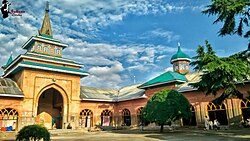
Shopian district has many places with tourism potential: Arshi Pora Lahanthour, Sedow, Hirpora Wildlife Sanctuary, Dubijan - 6 km (3.7 mi) from Heerpora Village; Peer Marg/Peer Gali - 20 km (12 mi) away from Heerpora on the historical Mughal Road; Lake Nandansar - 2 km (1.2 mi) away from the Peer Ki Gali; Hash Wang Bagam Pather, Sok Saray, and Mughal Saray at Jajinar. The Jamia Masjid in Shopian is one of the famous historical monuments built during the Mughal reign resembling that of jamia Masjid Srinagar. The Aasar-i-Sharief Dargah at Pinjura, attracts thousands of devotees on the occasion of Eid-i-Milad-un- Nabi and Shab-i-Mehraj. Darul Uloom Islamia Pinjura where large people gather to seek (spiritual and moral) knowledge and propagate to others.Another famous muslim seminary called Jamia Sirajul Uloom is situated at Imamsahib.

On the outskirts of Shopian town near Nagbal area, there is a Siva temple called Kapalmochan Mandir with three natural springs and a unique Shivling with small Rudraksh shaped knots spread all over it.

Transport

[edit]

The major roads connecting Shopian with neighbouring districts are:

  • Shopian-Pulwama-Srinagar Road
  • Shopian-Anantnag Via Chitragam
  • shopian to Aglar via heff turkuwangam
  • Shopian -Anantnag via Kaider
  • Shopian Anantnag Via Kulgam khudwani Wanpoh khanabal
  • shopian to sangam via Aglar
  • Shopian-Rajouri-Poonch via Mughal Road
  • Shopian-Zawoora-Keller
  • Shopian-Ganawpora-Berthipora-Kralcheck
  • Shopian-Sedow-Aharbal
  • Shopian-Hirpora
  • Shopian-Bijbehara via Malik Gund Imamsahib,
  • Shopian-Pinjoor
  • Shopian-Zainapora( Babapora)- Frisal- khudwani
  • Shopian-Zainapora( Babapora)- wachi - Sangam
  • Shopian to Kulgam Kachdoora, Sehpora Mohan Pora or Okay
  • Shopian to Reshnagri via Narwaw, Saidpora
  • Shopian to Nehama via Vehil Nowgam, Kanjiullar
  • Shopian to Ramnagri via Narwaw, Saidpora, Amshipora.
  • Shopian to Kangiullar via Ramnagri and Gadiporahir
  • Shopian to Kheer Bhawani at Mamzam via Ramnagri, Kanjiuller Nihama
  • Shopian to Aharbal via Ramnagri, Gadipora and Nihama
  • Shopian to Zawoora via Rambiara.
  • Shopian to Shadab Karewa Via Zowoora.
  • Shopian to Narapora, keller via Zawoora
  • Shopain to Aharbal via Saidow
  • Shopian Arshi pora road to link Via Herman Kadder Road
  • Shopian to Manzimpara via Kundalan.
  • Shopian to Anantnag via Manihall and Yaripora
  • Shopian to Toolihalan
  • Shopian to Aharbal via Ramnagri, Reshnagri, Bridge Completed in Last year.

.

References

[edit]
[edit]
Revisions and contributorsEdit on WikipediaRead on Wikipedia
from Grokipedia
Shopian District, known locally as Shupiyan, is an administrative district in the Kashmir Division of the Indian union territory of Jammu and Kashmir. Located approximately 51 km south of Srinagar, it encompasses a geographical area of 612.87 square kilometers and features a predominantly rural landscape with significant forest cover of about 300 square kilometers. As per the 2011 census, the district's population stood at 266,215, with a rural majority of around 250,000 and urban population of 16,000, reflecting a density of approximately 434 persons per square kilometer and a literacy rate of 60.76%. The local economy relies heavily on agriculture, particularly horticulture, where apple cultivation dominates, supporting over 60% of the workforce and positioning Shopian as a key contributor to Jammu and Kashmir's fruit production, often termed the "Apple Bowl of Kashmir." The district also hosts natural attractions such as the Hirpora Wildlife Sanctuary and historical remnants along the Mughal Road, underscoring its blend of ecological and cultural significance amid the Pir Panjal range.

Geography and Environment

Location and Topography

Shopian District occupies the southern portion of the in Jammu and Kashmir, , approximately 51 kilometers south of , the union territory's . It is positioned at an elevation of about 2,146 meters (7,041 feet) above at its district headquarters. The district lies along the historic , which connects the to regions in the . The district is bounded by to the north, and Districts to the east, and to the west, separated by the via the Peer Ki Gali pass. This positioning places Shopian at the interface between the relatively flat and the rugged Pir Panjal mountains, influencing its accessibility and economic activities such as . Topographically, Shopian features predominantly hilly terrain in the foothills of the , with undulating landscapes, deep valleys, and significant forested areas covering much of the district. Elevations vary from around 1,500 meters in lower valleys to over 3,000 meters in higher mountain slopes, supporting diverse ecosystems including the Hirpora Wildlife Sanctuary. The Vishav River, originating from springs and glaciers in the surrounding mountains approximately 34 kilometers from Shopian town, flows northward through the district, draining into the system and shaping local agriculture and .

Climate and Natural Resources

Shopian district exhibits a typical of the , with distinct seasonal variations influenced by its ranging from 1,580 to 4,000 meters above . Winters from December to March are severe, with temperatures frequently falling below freezing and heavy snowfall accumulating up to several feet, contributing to the region's through . Summers from to August are mild, with daytime highs generally between 20°C and 27°C, while autumn and spring periods experience moderate temperatures around 10–20°C. Annual averages approximately 700–800 mm, predominantly as winter snow, though recent variability has shown fluctuations in rainfall and snowfall patterns, with some years recording reduced snow cover impacting . Natural resources in Shopian are dominated by forests and agricultural land, with over half the district's area covered by temperate coniferous forests featuring species such as Cedrus deodara (deodar) and other western mixed conifers, which support biodiversity including insects, ferns, and wildlife in areas like the Hirpora Wildlife Sanctuary. Horticulture represents a key resource, particularly apple orchards that form the backbone of the local economy, supplemented by crops like maize, pulses, vegetables, and paddy; the district's apple production benefits from the cool climate and fertile alluvial soils along rivers such as the Rambiara. Water resources include rivers and groundwater, though illegal sand mining in riverbeds poses risks to aquatic ecosystems and farmland stability. Mineral resources are limited, with no significant metallic or non-metallic deposits reported, though riverine sand extraction occurs but is unregulated in parts, leading to environmental degradation. Forest fragmentation due to land-use changes has reduced contiguous woodland from 1995 to 2015, threatening ecological viability.

History

Pre-20th Century Administration


Shopian, historically referred to as Sheen-e-van meaning "forest of snow," derived administrative importance from its position on the ancient route linking the to Punjab, which became known as the under Mughal governance of from 1586 to 1753. This strategic location supported oversight of trade, military logistics, and regional control within the Mughal suba of , governed by appointed subahdars.
Following Mughal decline, Shopian fell under Afghan Durrani control from 1753 to 1819, administered by governors who imposed stringent revenue systems on the Kashmir Valley. The Sikh Empire's conquest on July 3, 1819, at the Battle of Shopian—where forces under Misr Diwan Chand defeated Afghan governor Jabbar Khan—integrated the area into Sikh provincial administration until 1846, with governors managing local affairs amid continued emphasis on the transit route. In 1846, the Treaty of Amritsar transferred Kashmir to Dogra ruler , forming the of Jammu and Kashmir. Under Dogra rule, the was reorganized into wazarats, each headed by a wazir; Shopian functioned as the headquarters of one such wazarat from 1872 to 1892, encompassing multiple tehsils and parganas for collection and local . This period marked elevated status for Shopian within the state's hierarchical structure, which prioritized fiscal extraction through jagirdari and farming systems across the valley.

Post-Independence Developments and Insurgency Onset

The region encompassing present-day Shopian experienced agrarian transformation through Jammu and Kashmir's post-independence land reforms, initiated with the Big Landed Estates Abolition Act of September 1950, which abolished the jagirdari system and redistributed surplus land exceeding 22.75 acres to tillers without compensation to proprietors. These measures, extending to subsequent legislation like the 1976 Agrarian Reforms Act, empowered smallholders in the by granting ownership rights and debt relief, enabling expanded cultivation of cash crops such as apples in Shopian's fertile tracts, which benefited from the area's alluvial soils and . thus emerged as the economic mainstay, with orchards proliferating under state-supported extension services, though constrained by limited and until later decades. Administratively, the Shopian tehsil operated under from the state's reorganization in the 1970s until March 2007, when the carved it out as an independent —spanning 312.8 square kilometers—to decentralize governance, improve service delivery, and address the area's remoteness from district headquarters. This bifurcation aimed to facilitate targeted development amid growing pressures, from approximately 211,000 residents in 2001 to over 265,000 by 2011, though implementation faced challenges from uneven funding and bureaucratic inertia. The insurgency's onset in Jammu and Kashmir, erupting in July 1988 with the formation of groups like the (JKLF) and escalating after the disputed November 1987 assembly elections—widely viewed as rigged by the National Conference-Indian National Congress alliance—reached by the early 1990s, as Pakistan-based networks infiltrated via the Pir Panjal passes to recruit locals disillusioned by political suppression and economic stagnation. Militants exploited the district's forested slopes and proximity to the for training camps and ambushes, shifting from initial pro-independence aims to Islamist separatism under outfits like , which dominated south operations. By 1990, security forces reported encounters in peripheral villages, though remained relatively peripheral until the mid-1990s, when cross-border arms smuggling intensified, disrupting horticultural supply chains and prompting cordon-and-search operations that alienated segments of the Muslim-majority populace. The conflict's causal roots trace to unresolved accession grievances amplified by external patronage, rather than indigenous economic drivers alone, with over 40,000 deaths statewide by 2000, including civilian casualties from militant targeting of perceived collaborators.

Administration and Governance

Administrative Structure

Shopian district is headed by a , who serves concurrently as the District Development Commissioner and , overseeing revenue administration, law and order, and developmental activities. The district is subdivided into seven s for revenue and land management purposes: Shopian, Barbugh, Chitragam, Hermain, Keegam, Keller, and Zainapora. Each is administered by a responsible for maintaining land records, collecting revenue, and performing limited magisterial functions. Rural development in the district is facilitated through nine blocks, each led by a Block Development Officer: Chitragam, Herman, Imamasaheb, Kanjiullar, Kaprin, Keller, Ramnagri, Shopian, and Zainapora. These blocks coordinate implementation of government schemes, infrastructure projects, and welfare programs at the level. The district encompasses 231 inhabited villages and features one for the town of Shopian, which covers 13 wards and handles urban civic services such as sanitation, , and street lighting. Additionally, there are 43 Patwar Halqas, the smallest units managed by Patwaris for village-level record-keeping.

Local Governance and Elections

Shopian district's local governance framework is embedded within Jammu and Kashmir's three-tier Panchayati Raj Institutions (PRIs), comprising Halqa Panchayats at the village level, Block Development Councils (BDCs) at the block level, and the District Development Council (DDC) at the district level. These bodies handle decentralized planning, resource allocation, and implementation of development schemes, with the Deputy Commissioner serving as the ex-officio Chief Executive Officer of the DDC. The district encompasses nine tehsils—Shopian, Chitragam, Ramnagri, Heerpora, Wachi, Imam Sahib, Keller, Kanjular, and Kapran—and eight community development blocks, including Chitragam, Shopian, Imam Sahib, Keller, Wachi, Harman, Kanjular, and Kapran, plus a portion of Keller block, enabling block-level coordination of rural development activities. Halqa Panchayats form the foundational tier, managing local issues such as , , and minor projects across numerous villages. As of recent records, multiple Halqa Panchayats are registered in , with sarpanches and panches elected to represent village clusters; for instance, panchayats like Chitragam A and Children operate under the Chitragam block. Electoral processes include periodic revisions of voter rolls, with designated Electoral Registration Officers (EROs) and Assistant Electoral Registration Officers (AEROs) overseeing updates for the 2024-25 panchayat elections, ensuring compliance with the Jammu and Kashmir Panchayati Raj Act. Panchayat elections were last comprehensively held in 2018, establishing these grassroots bodies for five-year terms focused on community welfare. At the intermediate level, BDCs facilitate block-wide development, integrating inputs from Halqa Panchayats for schemes under programs like MGNREGA. Elections for BDC chairpersons occurred in 2019, with results listing elected representatives across Jammu and Kashmir districts, including Shopian blocks, to oversee local resource distribution and infrastructure. These councils bridge village and district governance, with chairpersons elected from among panchayat members. The apex DDC Shopian, established post-2019 reorganization, conducts district-level planning, including annual budget allocations via District Capex Plans, as demonstrated in meetings held in July 2025. Direct elections for DDC members took place in December 2020 and January 2021, yielding a with elected chairperson and members, including Vice Chairman Manhas, who engaged with higher authorities in October 2025. These polls, amid regional security challenges, marked a key step in local empowerment, with five-year terms set to conclude around 2025-2026, prompting preparations for subsequent cycles.

Demographics

Population Statistics

As per the 2011 Census of India, Shopian district recorded a total population of 266,215, comprising 136,480 males and 129,735 females. This marked a decadal growth rate of 25.95% from the 2001 census figure of 211,332. The district's sex ratio stood at 951 females per 1,000 males, reflecting a slight improvement over the state average. Literacy rate was 60.76%, with male literacy at 70.27% and female literacy at 50.90%, indicating gender disparities in educational access typical of rural-dominated districts in Jammu and Kashmir. Of the total population, approximately 93.8% resided in rural areas (249,855 persons), while the urban population was concentrated in Shopian Municipal Committee at 16,360.
Demographic Indicator (2011 Census)Value
Total 266,215
Rate (2001–2011)25.95%
Sex Ratio (females per 1,000 males)951
Overall Literacy Rate60.76%
Male Literacy Rate70.27%
Female Literacy Rate50.90%
Rural 249,855 (93.8%)
Urban 16,360 (6.2%)
No official census has been conducted since 2011, and subsequent estimates from district administration approximate the population at around 268,000 as of recent years, though these lack the granularity of census data.

Ethnic and Religious Composition

According to the 2011 Census of India, Shopian district had a total population of 266,215, with Muslims comprising 98.52% (262,263 individuals), Hindus 1.17% (3,116), Christians 0.16% (429), and Sikhs 0.07% (178), alongside smaller numbers of other groups totaling 836. This distribution reflects the broader demographic pattern in the Kashmir Valley, where Muslim-majority populations dominate rural and urban areas alike, with minority communities often concentrated in administrative or security-related settlements.
ReligionPopulationPercentage
Muslim262,26398.52%
Hindu3,1161.17%
Christian4290.16%
Sikh1780.07%
Other8360.31%
Ethnically, the district is predominantly composed of Kashmiri people, an Indo-Aryan ethnic group native to the Kashmir Valley, who form the core of the Muslim majority and speak Kashmiri as their primary language. Smaller ethnic subgroups include Muslim Gujjars (estimated at around 17,000), a pastoral community classified as Scheduled Tribe, and negligible populations of other groups such as Rajput Muslims. The Hindu minority, historically including Kashmiri Pandits, has been significantly reduced due to migration amid regional instability since the 1990s, leaving primarily non-native or transient Hindu residents. No comprehensive post-2011 ethnic census data exists, but the homogeneity persists, with linguistic surveys indicating over 95% Kashmiri speakers district-wide.

Economy

Horticulture and Apple Industry

Shopian district, located in the of Jammu and Kashmir, , derives its primary economic sustenance from , with apples (Malus domestica) serving as the dominant crop and earning the region the moniker "Apple Bowl of ." The district's , characterized by cold winters and moderate summers at elevations between 1,600 and 3,000 meters, provides ideal conditions for apple cultivation, which occupies the majority of the and supports the livelihoods of the rural populace. accounts for the bulk of agricultural output, with apples forming the cornerstone due to their high and potential. The apple industry employs approximately 60% of Shopian's , either directly through farming or indirectly via related activities such as packing, transportation, and trading, making it the pivotal sector for income generation and alleviation in this agrarian . According to economic analyses, apple cultivation contributes substantially to household revenues, with smallholder farmers relying on it as the main source of earning, though productivity gains have been limited without widespread adoption of modern techniques. In Jammu and Kashmir as a whole, apples constitute 60-65% of total horticultural production from over 50% of the horticultural acreage, underscoring the crop's dominance; Shopian, alongside districts like and , plays a central role in this output. The sector's value to the regional exceeds ₹10,000 annually, driven largely by apple sales. Production in has shown growth, with district-level output increasing by 20% in 2023 compared to the prior year, attributed to expanded cultivation and improved , as per economic survey data. While precise district-specific figures for area under cultivation remain around 10,000-12,000 s (part of the broader 's 1.6 hectares), yields average 10-13 tonnes per hectare under traditional low-density planting, with emerging high-density models promising higher returns of up to 2.5 times. In 2024-25, apple production reached 20.56 metric tonnes, representing over 73% of India's total, highlighting the region's national significance despite climatic vulnerabilities. Efforts to enhance farmer knowledge, with mean indices around 51.75% in , focus on practices like for yield estimation and energy-efficient inputs, where chemical fertilizers dominate energy use at 71.46% of total inputs.

Challenges from Militancy and Diversification Efforts

Militancy in district has severely disrupted the local economy, particularly the dominant apple sector, by targeting transportation and trade networks during peak harvest seasons. In 2019, militants killed at least 12 non-local civilians, including apple traders and truck drivers in and adjacent areas, resulting in a 44% decline in apple exports from Jammu and Kashmir by month's end as transporters halted operations due to fear. Such attacks aimed to undermine economic lifelines, with militants forcing orchard owners to unload consignments destined for markets, marking an initial bid to the . By June 2020, , once primarily known for its orchards, had emerged as a militancy hotspot, with ongoing deterring labor migration and in . These disruptions extend beyond immediate casualties to broader , as insecurity during apple seasons—typically to —leads to rotting produce and reduced . Militant groups exploit the sector's visibility, rearing violence specifically to target India's economic interests in the region, exacerbating farmer indebtedness from loans taken for seasonal inputs. Persistent threats have compounded vulnerabilities, with non-local traders avoiding the district, limiting outlets for produce and contributing to price volatility; for instance, apple prices crashed by 70% in by October 2025 amid ongoing risks, though direct militant incidents had waned, the legacy of fear lingers. In response, diversification efforts have focused on expanding beyond apples to crops like pears, walnuts, cherries, and stone fruits, leveraging Shopian's and over 80% land under fruit cultivation. The Jammu and Kashmir Horticulture Department promotes such shifts through schemes emphasizing high-yield varieties, soil health improvements, and bringing uncultivable land into production, aiming for better returns and risk mitigation. Local initiatives include skill development programs and in Shopian, as outlined in the district's 2023 vision document, to foster alternative fruit-based livelihoods. Individual farmers have piloted diversification, such as integrating climate-resilient crops to counter both weather and security-related losses, with cost-benefit analyses indicating positive socio-economic impacts from varied horticultural activities. However, militancy poses ongoing barriers to these efforts, as insecurity raises costs for new planting, infrastructure, and market linkages required for non-apple crops, which demand longer maturation periods and higher initial investments. in southern districts like has historically shifted resistance patterns, limiting labor-intensive diversification and deterring external funding or expertise. schemes, while providing subsidies for anti-hail nets and premium-based insurance like the Rupee Weather-Based Crop Insurance Scheme, face uptake challenges in high-risk areas where militants target economic normalization. Overall, while diversification holds potential for resilience—evidenced by increasing pear production in Jammu and Kashmir—sustained militancy undermines adoption, perpetuating over-reliance on vulnerable apple .

Infrastructure and Public Services

Education System

The education system in Shopian district reflects limited progress, with a literacy rate of 62.49% recorded in the 2011 , marked by a pronounced gender gap: 71.86% for males and 52.77% for females. This rate lags behind the Jammu and Kashmir Union Territory average of 67.16% as of 2021-22, underscoring rural isolation and socioeconomic factors in the predominantly agrarian, conflict-affected area. Administrative oversight falls under four educational zones—Imamsahib, Keegam, , and Vehil—managing 657 schools in total, including 508 government and 149 private institutions. Breakdown includes 343 primary schools, 215 middle (upper primary) schools, 85 high schools, and 14 higher secondary schools, supported by 2,225 teaching staff (including 10 principals) and limited non-teaching personnel. Infrastructure deficiencies persist, with only 378 schools providing and facilities, and 102 government schools connected to , hampering consistent operations. Higher education access centers on the Government Degree College Shopian, established in March 1988 and affiliated with the , which offers undergraduate programs across arts, science, and commerce streams to a intake capacity of 3,614, served by 36 faculty members. Enrollment drives, such as the mega campaign launched on March 7, 2025, aim to boost participation at the school level amid low baseline attendance. Persistent militancy severely disrupts the system, causing recurrent school shutdowns, cordons, and reduced attendance, as seen in prolonged closures following security incidents. Studies indicate heightened strains among students, with significant numbers in primary grades exhibiting trauma symptoms linked to exposure. Additionally, certain religious schools have drawn scrutiny for involvement in terrorist groups, raising concerns over pathways within educational settings. These factors compound disparities, particularly in female enrollment and retention, despite government initiatives for universal elementary .

Healthcare Facilities

The healthcare system in Shopian district operates under the Jammu and Kashmir Health Department, divided into two medical blocks—Shopian and Keller—encompassing 86 institutions as of September 2025. These include one District Hospital, three Sub-District Hospitals/ Centres (CHCs), nine Primary Health Centres (PHCs), 55 sub-centres, five Urban Primary Health Centres (UPHCs), 12 Nutrition Rehabilitation Centres, and one . The District Hospital in Shopian town functions as the principal referral facility, handling secondary and tertiary care needs for the district's population of approximately 265,000, though it has historically operated with limited capacity, such as only 30 beds reported in 2016 against a recommended minimum of 100. Primary and centres provide basic outpatient services, maternal and child , and , with PHCs located in areas including Herman, Sedow, and others to cover rural tehsils. Two PHCs—Herman and Sedow—achieved National Standards (NQAS) certification in December 2023, indicating improved infrastructure and service delivery standards among select facilities. In 2022, Shopian Hospital (referring to Hospital) was ranked first in facilities within its category by regional assessments, reflecting relative performance in accessibility and care quality compared to peers. Despite these elements, the district faces significant staffing shortages, with 93 medical and paramedical positions vacant across institutions as of March 2025, contributing to overburdened facilities and delays in service provision. Militancy-related incidents have occasionally disrupted operations, such as security forces entering hospitals during encounters, as occurred in April 2018 when clashes spilled into the District Hospital, prompting appeals from medical staff to avoid targeting healthcare premises. Broader inter-district analyses highlight Shopian's healthcare infrastructure disparities, including uneven distribution of beds, doctors, and nurses relative to population needs, exacerbated by geographic isolation and security constraints in this district. Private healthcare options remain limited, with public institutions dominating service delivery.

Transportation Networks

Shopian district depends primarily on road networks for transportation, with no operational rail lines or airports within its boundaries. The district maintains road connectivity to adjacent areas including , , and , facilitating access to via National Highway 444 (NH-444). This highway supports the movement of horticultural produce, such as apples, to markets in the and beyond. A 8.925 km bypass on NH-444 in received funding of 224.44 from the Union Ministry of Road Transport and Highways in March 2024, aimed at easing in the town center and enhancing efficiency without widening existing urban roads. Other key road projects include the Shopian-Bijbehara link, with substantial construction nearing completion as of 2022, and the Shopian-Aglar road, slated for resumption post-winter in 2025. The serves as a strategic alternative route, linking to Bafliaz in Poonch district over 84 km through mountainous terrain, historically used by Mughal emperors for valley access and reducing travel distance to regions from over 500 km via the main highway. It traverses areas like Behramgala and the Hirpora Wildlife Sanctuary but remains closed during winter due to snow, prompting infrastructure upgrades such as the Peer Ki Gali Tunnel on NH-701A, approved in 2025 for all-weather connectivity. Public transportation in Shopian relies on buses and shared mini-vans operating along major roads, though organized networks remain underdeveloped, as highlighted in studies proposing bus route designs to address intra-district mobility gaps. The absence of rail infrastructure underscores road dependency, with ongoing projects like the Zaznar-Shopian section contributing to broader .

Security and Militancy

Historical Context of Insurgency

The , which encompasses district, originated in the late 1980s amid widespread allegations of in the 1987 state assembly elections, prompting a shift from political agitation to armed separatism influenced by Islamist groups seeking alignment with or independence. Militant outfits like the (JKLF) initiated attacks in 1988-1989, followed by the in 1990, which established dominance through targeted killings and infrastructure sabotage, with Pakistani providing training and arms to sustain operations. By the early 1990s, the conflict had caused over 1,000 fatalities annually across the region, though southern districts like those incorporating modern (then part of ) experienced lower intensity compared to urban and northern areas. Shopian, carved out as a separate district in 2007 from , remained relatively insulated from peak militancy during the 1990s and early 2000s, when violence peaked with foreign militants dominating and mass exoduses like the Kashmiri Pandit migration in 1990. Incidents in the area were sporadic, often involving overground workers aiding infiltration routes through forested terrains like Hirpora, but lacked the sustained presence seen in adjacent , where commanders operated bases. Data from security records indicate fewer than a dozen major encounters or attacks in pre-2010 Shopian terrains, contrasting with valley-wide totals exceeding 20,000 militant-related deaths by 2004. Militancy intensified in from the mid-2010s, evolving into a hub for homegrown recruits amid propaganda and the death of Hizbul commander on July 8, 2016, which sparked protests and over 50 local enlistments by 2018. This phase marked a tactical shift to "hybrid" militants blending covers with ambushes, resulting in 44 local militants neutralized in 2018 alone, driven by localized grievances over security crackdowns but sustained by cross-border networks. The district's orchards and remote villages facilitated hideouts, transforming its economy-disrupted landscape into a focal point for counter-insurgency operations by the mid-2020s.

Terrorist Activities and Encounters

Shopian district has served as a significant base for terrorist groups, including (HM) and (LeT), with activities centered on recruitment, arms smuggling, and attacks on and civilians. These operations have involved overground workers (OGWs) providing logistical support, such as shelter and weaponry, often linked to cross-border handlers in . Encounters between —comprising the , (CRPF), and —and terrorists have intensified in forested and rural areas like Keller and upper reaches, leading to the neutralization of militants and recovery of arms including AK rifles and grenades. Key encounters include the February 2, 2022, operation in where commander Umar Ishfaq Malik, alias Musa, was killed along with the recovery of incriminating materials linking him to multiple attacks. In May 2025, eliminated three LeT terrorists in the Keller area during a cordon-and-search operation triggered by specific intelligence, with the militants identified as foreign operatives involved in prior ambushes. Shortly after, on May 19, 2025, two terrorist associates were arrested in a joint operation by the Army's 34 , Special Operations Group Shopian, and CRPF's 178 Battalion, yielding arms and ammunition used for sustaining militant networks. HM-linked disruptions persisted into late 2025, with the (NIA) attaching properties of operative Tariq Ahmad Mir on September 27, who facilitated arms supply to active militants, underscoring ongoing terror financing through local assets like orchards and residences. On August 23, 2025, the State Investigation Agency arrested HM OGW Altaf Hussain Wagay in , connected to a cross-border sleeper cell coordinating for HM attacks. These incidents reflect a pattern where terrorists exploit the district's terrain for hideouts, though security operations have disrupted command structures and reduced large-scale attacks compared to pre-2019 levels.

Counter-Insurgency Measures and Controversies

Counter-insurgency efforts in Shopian district primarily involve joint operations by the Indian Army's Rashtriya Rifles units, Central Reserve Police Force (CRPF), and Jammu and Kashmir Police, focusing on intelligence-led cordon-and-search missions and encounters with militants in forested and rural areas. These operations target groups like Lashkar-e-Taiba (LeT) and Hizbul Mujahideen, often in response to specific inputs about terrorist presence. For instance, on May 13, 2025, security forces killed three terrorists in an encounter in Shopian following intelligence intercepts, with the operation involving Army, CRPF, and local police. Similarly, Operation Keller in the Keller Forest of Shopian, launched on May 14, 2025, based on intelligence about hidden militants, resulted in ongoing searches and neutralization efforts. In May 2025 alone, additional actions included the arrest of two LeT associates in Baskuchan with AK rifles and grenades recovered during Operation Sindoor, and the apprehension of two more hybrid terrorists by 34 Rashtriya Rifles, Special Operations Group, and CRPF 178 Battalion. These measures have contributed to a decline in militant violence post the 2019 abrogation of Article 370, with Shopian seeing fewer high-profile attacks but persistent low-level threats from overground workers and infiltrators. units, specialized in counter-insurgency, emphasize area domination through patrols, village coordination, and community engagement, such as informal sports events to build rapport, though critics argue such tactics mask underlying coercion. The Armed Forces (Special Powers) Act (AFSPA), applicable in Jammu and Kashmir, grants security forces broad powers for operations, including shoot-to-kill authority, which has been credited with enabling rapid responses but also linked to accountability gaps. Controversies surrounding these efforts center on allegations of human rights violations, including extrajudicial killings and staging of encounters. A prominent case occurred on July 18, 2020, in Amshipora village, , where three civilian laborers—Imtiyaz Ahmad Kullay, Ali Mohammad Bhat, and Mohammad Ibrar—were killed by personnel of the Indian Army's 10 ; the army initially claimed they were LeT militants in an encounter but later admitted the killings were staged, leading to the of five soldiers, including a commandant, for and evidence tampering. The incident drew scrutiny from human rights groups, who highlighted it as emblematic of broader patterns under AFSPA's Section 7, which offers near-impunity for violations unless sanctioned by central government approval, though the army's internal probe and charges marked rare accountability. Reports from organizations like have documented similar claims of abuses in operations, including torture and disappearances, but these are often contested by Indian authorities as exaggerated or propagandistic, with limited independent verification due to restricted access in conflict zones. In , local resentment over such incidents has fueled recruitment for militancy, complicating counter-insurgency gains.

Culture and Attractions

Places of Interest

Shopian district offers a range of natural and historical sites, including sanctuaries, waterfalls, passes, and Mughal-era structures, drawing visitors for trekking, photography, and cultural exploration. The area's lush forests and alpine meadows, particularly in regions like Hirpora and Sedow, enhance its appeal despite security challenges in the Pir Panjal region. Hirpora Wildlife Sanctuary covers approximately 341 square kilometers in the Shopian district, located about 70 kilometers south of , and supports diverse flora such as pine and fir forests alongside fauna including the endangered and . Established to conserve in the , the sanctuary features alpine meadows and serves as a catchment for rivers like the Rambiara, though it has faced threats from militancy and . Aharbal Waterfall, situated in the southern part of Shopian, cascades from a height amid and forests, providing opportunities for trekking, , and expeditions in its surrounding meadows. Known for its serene environment, the site attracts nature enthusiasts seeking respite from urban areas. Peer Ki Gali, a in the at an elevation of about 3,400 meters, connects Shopian to via the historic and offers panoramic views of snow-capped peaks and valleys. Historically used as a , it now serves as a trekking destination, though access may be seasonal due to heavy snowfall. The Jamia Masjid in town, constructed during the Mughal period, represents a key historical religious site with architectural similarities to Srinagar's Jamia Masjid, featuring wooden elements and a central . Recognized as a heritage place in under a city beauty competition, it remains a focal point for local worship and cultural visits. The , an ancient route traversing Shopian from to , includes remnants like Aliabad Sarai, a 17th-century built for travelers under Emperor , highlighting the district's role in historical connectivity between the and Punjab plains. Restored sections now facilitate scenic drives and treks, underscoring Shopian's strategic past.

Cultural and Religious Sites

The Jamia Masjid in Shopian town serves as the district's primary , functioning as a central hub for prayers and community religious activities. Constructed by local efforts without patronage from rulers, the mosque holds historical importance as a symbol of communal initiative and architectural adaptation in the region. Its location amid bustling markets underscores its role in daily religious and social life for the predominantly Muslim . Kapal Mochan Temple, situated in Nagbal near Shopian town along the Rambiara Nallah, is an ancient Hindu shrine dedicated to Lord , featuring a unique Shivling and three natural freshwater springs. Associated with the mythological site of Shiva's redemption from the sin of , the temple attracts Kashmiri devotees for annual rituals, including shradh ceremonies for unmarried souls and deceased children. Local Muslim residents have maintained the site in instances of Hindu exodus, preserving its sanctity amid demographic shifts. Historical Mughal-era sarais along the , such as Aliabad Sarai and Heerpora Sarai, represent significant cultural landmarks built in the as resting inns for travelers and emperors traversing the . Aliabad Sarai, positioned on the banks of the Panchal River approximately 30 km from Shopian, exemplifies with its stone construction, though it currently requires restoration to prevent further deterioration. These structures highlight the district's strategic role in historical trade and imperial routes connecting to . In November 2024, an ancient worship site dating potentially to the 9th century was unearthed in the forests of Hirpora village, adding to the district's religious heritage with evidence of pre-Islamic Shaivite practices. Efforts by the are underway to restore the Mughal sarais, aiming to safeguard these sites for cultural preservation.

References

Add your contribution
Related Hubs
User Avatar
No comments yet.