Hubbry Logo
The ShowboxThe ShowboxMain
Open search
The Showbox
Community hub
The Showbox
logo
8 pages, 0 posts
0 subscribers
Be the first to start a discussion here.
The Showbox
The Showbox
from Wikipedia

The Showbox[2] (originally known as the Showbox Theater) is a music venue in Seattle, Washington, United States. It has been owned by AEG Live since 2007.[3]

Key Information

History and usage

[edit]

Founded in 1939,[4] the Showbox has hosted a diverse offering of music over the decades. From the Jazz Age to the Grunge Era, the ballroom has featured shows by Duke Ellington, Muddy Waters, and the Ramones — as well as local artists such as burlesque performer Gypsy Rose Lee, and grunge bands Soundgarden, Pearl Jam, Mudhoney, TAD and Screaming Trees.[5]

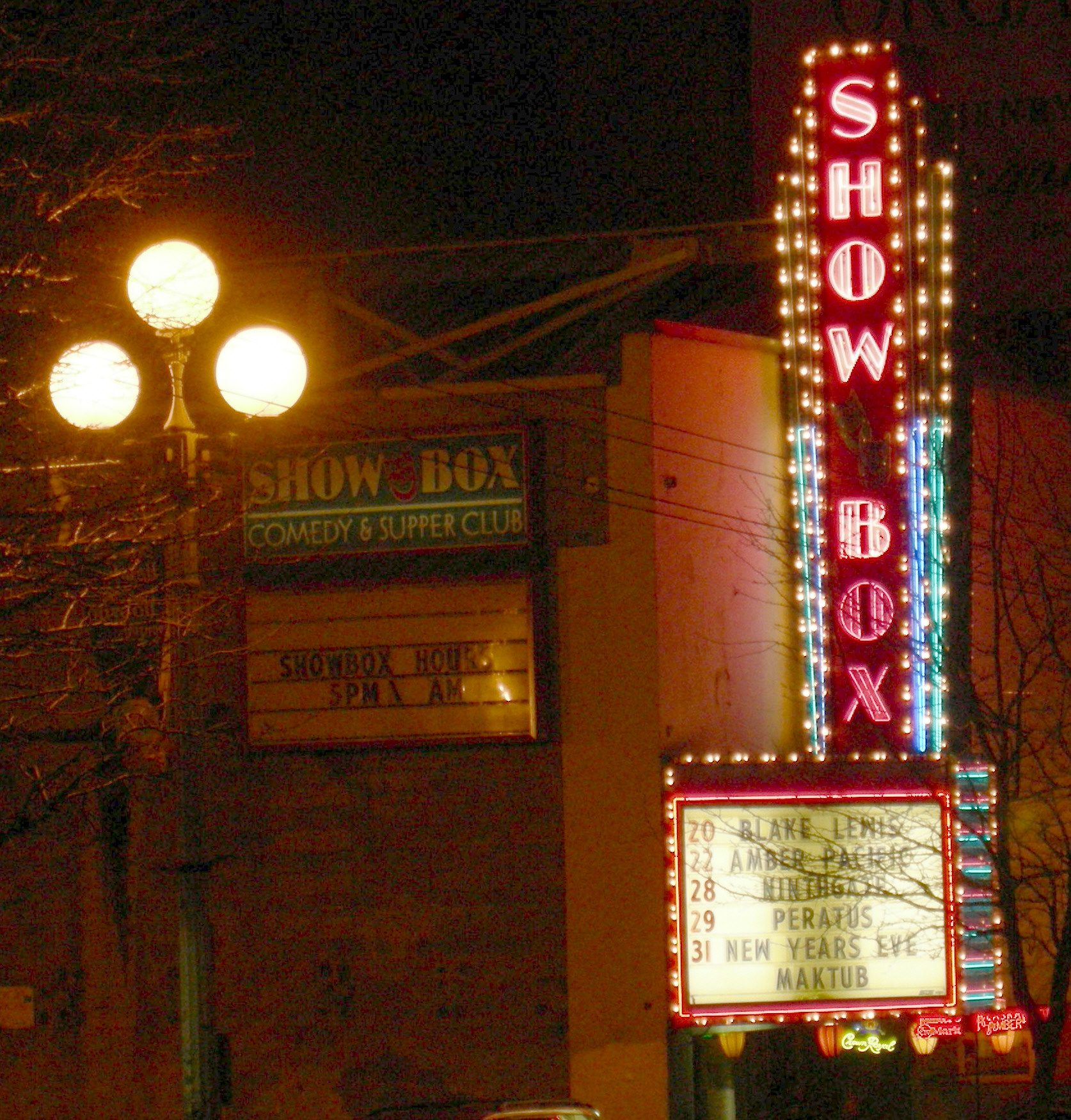
After many years of operating as the Improv Comedy Club, restaurateur Tony Riviera and Barry Bloch purchased The Improv with the intent of continuing operating the venue as The Improv. Riviera and Bloch discovered old photos, historical information and articles about the Showbox and decided to recreate the venue as its original look and reopened New Year's Eve, 1995 as The Showbox Comedy and Supper Club which they operated for several years before deciding to sell the venue. Riviera went on to open numerous restaurants up and down the West Coast.[5][6]

In July 2018, Vancouver-based developer Onni Group announced plans to redevelop the property into a 42-floor apartment tower.[7] Seattle musicians such as Pearl Jam, Duff McKagan,[8] Alice in Chains,[9] Death Cab for Cutie,[10] and Macklemore voiced their support for preserving the Showbox.[10] A petition on Change.org to name the Showbox an official City of Seattle landmark garnered over 110,000 signatures.[8]

Local preservation advocates, including Historic Seattle, Friends of Historic Belltown, and Vanishing Seattle, submitted a landmark nomination for review by the City of Seattle's Landmarks Preservation Board in June 2019.[11] The board unanimously decided to grant the Showbox landmark designation on July 17, 2019, preventing the theater from being demolished.[12] The property owner filed a lawsuit against the city of Seattle. Claims of damages were dismissed by the court, but a trial was scheduled for August 2019 regarding other claims.[13]

On November 19, 2019, the Historic Seattle group announced a partnership with the Seattle Theatre Group and submitted a formal offer to purchase the property. The partnership would retain AEG as the operating tenant through at least 2024.[11]

Showbox SoDo

[edit]
Showbox SoDo
Map
Interactive map of Showbox SoDo
Former namesFenix Underground (2006–07)
Premier (2004–05)
Address1700 1st Avenue South
Seattle, WA 98134
LocationSoDo
Coordinates47°35′17″N 122°20′02″W / 47.588°N 122.3338°W / 47.588; -122.3338
OwnerWSA Properties VI LLC
AEG Live (operator)
Capacity1,800
Construction
Opened1992 (1992)

Showbox SoDo opened in 2007 and belongs to the "Showbox Presents" family. It is located at 1700 1st Avenue South, Seattle, Washington, a few blocks south of T-Mobile Park and Lumen Field. It takes its name from the SoDo district, an area south of downtown Seattle and Pioneer Square.

A converted-warehouse-turned-concert-venue, the Premier nightclub opened in the building in early 2004[14] but closed in 2005. In Fall 2006, the Fenix Underground, a club that spent 15 years in two locations in Pioneer Square, took over the space but just as quickly folded when it filed for bankruptcy in May 2007.[15] The Showbox stepped in and added the venue to its family, opening as the Showbox SoDo in September 2007.[15]

The space has wood-beam and brick architecture. With a capacity of 1,800, it is larger than its elder sibling, which was renamed The Showbox at the Market to distinguish the two.

The venue has hosted events featuring My Bloody Valentine, Heart, The Pogues, M.I.A, The Hives, Dropkick Murphys, Josh Ritter, Counting Crows, Panic! at the Disco, Adam Lambert, Odd Future, Jillian Banks, The WhiteTrash Whiplash, Trivium and others.[16]

Ownership and potential replacement by an arena

[edit]

The Showbox SoDo was originally built as a truck warehouse in 1935 for John Eddy Franklin, who was also responsible for the Columbarium at Evergreen Washelli Funeral Home. The main part of the warehouse had a dirt floor and a gas pump.[citation needed]

The building and the land parcel are currently owned by WSA Properties VI LLC,[17] a holding company founded by hedge fund manager Chris Hansen and Steve Ballmer, the former Microsoft chief executive officer and current owner of the Los Angeles Clippers basketball team.

Purchased in August 2012,[17] Hansen and Ballmer intended to use the land as part of a proposal for a new sports arena to lure an NBA team back to Seattle following the relocation of the SuperSonics to Oklahoma City in 2008.[18] After a failed effort to purchase and relocate the Sacramento Kings in 2013, a five-year exclusive agreement with the city on the arena development ended in 2017. The city subsequently negotiated a deal with Oak View Group to build a new arena on the site of the former KeyArena across town at Seattle Center, preserving that building's historic roof.

While Hansen holds onto the property as a potential back-up arena plan, should Climate Pledge Arena fail to secure an NBA team, the Showbox SoDo continues to operate at its location.

References

[edit]
[edit]
Revisions and contributorsEdit on WikipediaRead on Wikipedia
from Grokipedia
The Showbox is a historic at 1426 First Avenue in , Washington, originally opened on July 24, 1939, as a dine-and-dance ballroom featuring a spring-action dance floor in an building constructed in 1917. Over eight decades, it has hosted diverse performers including icons and , punk bands like the , acts such as and , and contemporary artists like Prince, , and , establishing it as a pivotal hub in 's evolving music landscape from the through the era and beyond. The venue's significance stems from its role in showcasing both touring legends and local talents, contributing to Seattle's reputation as a breeding ground for influential genres, though it underwent periods of varied use, including as a furniture showroom during the 1962 World's Fair and a club in the late . Owned by AEG Presents since 2007, The Showbox features a storied interior that has drawn crowds for its intimate atmosphere amid the Pike Place Market district. In 2018, The faced demolition threats from a proposed high-rise apartment development, sparking widespread preservation campaigns supported by musicians like and community groups, leading to legal battles and a city council ordinance that ultimately preserved the site, underscoring its cultural landmark status. A sister venue, SoDo, opened in to accommodate larger crowds, expanding the brand's footprint in Seattle's live entertainment scene.

Building and Architectural History

Origins as Central Public Market

The Central Public Market building at 1426 1st Avenue in was constructed beginning in 1916 and completed in mid-1917, opening to the public on October 26, 1917. Designed by architect Theobald Buchinger for Charles H. Frye of Frye & Co.—a prominent meatpacking firm whose owners later founded the Frye Art Museum—the structure was intended to serve as a multi-tenant commercial space focused on food retail. Positioned directly across from the established Pike Place Public Market, the Central Public Market functioned as a direct competitor, offering stalls for vendors selling fresh produce, meats, and other groceries in an effort to capture a share of Seattle's growing urban food trade. This rivalry emerged amid the rapid expansion of Seattle's downtown markets in the early 20th century, with Pike Place having opened a decade earlier in 1907 and already drawing significant crowds for direct-from-producer sales. The Central Public Market emphasized enclosed, organized retail spaces suitable for wholesalers and retailers, contrasting somewhat with Pike Place's open-air farmer stalls, though both catered to similar working-class and immigrant populations seeking affordable foodstuffs. Initial operations featured a variety of tenants, including the Central Meat Co. and Washington Fruit & Vegetable Co. shortly after opening in 1917, followed by the Bay City Meat Co. and General Baking Co. by October of that year. These businesses occupied leased stalls for processing, storage, and sales of perishable goods, reflecting the era's emphasis on centralized markets to handle Seattle's booming population and port-driven economy. By the mid-1920s, however, advertisements for vacant stalls indicated underutilization, likely due to Pike Place's dominance and the challenges of competing in a saturated market environment. Despite this, the building remained a functional commercial hub until the late 1930s, underscoring its role in the neighborhood's early 20th-century economic fabric.

Architectural Features and Modifications

The Showbox building, located at 1426 First Avenue in , exemplifies architecture following its 1939 remodel, characterized by smooth stucco-clad facades, horizontal banding, and curved elements emphasizing horizontal lines and aerodynamic forms. The exterior features a masonry foundation with unreinforced walls 12 to 16 inches thick, a flat roof covered in composition material, and a prominent marquee above the curved theater entrance. A horizontal band of windows with anodized aluminum frames runs along the upper facade, contributing to the streamlined aesthetic. Interior highlights include a domed supported by vase-like columns, tiered seating areas, and a sprung dance floor over subflooring, with textured plaster walls and a arch featuring rounded corners. The space retains a fly loft and vaulted elements from the performance-oriented design, originally accommodating terraced dining and a central performance volume. Originally constructed in 1917 as the Central Public Market with heavy timber mill construction by architect H. Buchinger, the building underwent foundational upgrades in 1938 by Bjarne Moe to prepare for conversion into a performance venue. The pivotal 1939 remodel, also by Moe, transformed the structure by adding an entrance foyer, the distinctive columns, dance floor, and tiered seating, establishing the core layout for its use as the Showbox. Further alterations in 1940 included a coat check, bar modifications, and heating system updates, all under Moe's oversight. In 1959, following the demolition of the adjacent Regent Hotel, the north wall was rebuilt using to maintain structural integrity. The 1986 renovations, designed by EHA Architects, incorporated seismic upgrades, re-stuccoing of the facade, and reconfiguration of ground-level commercial storefronts to their current form. Subsequent changes in the 1990s and 2000s involved additional facade re-stuccoing, window updates, and installation of corrugated metal panels on secondary elevations, preserving the primary character while addressing maintenance and safety needs.

Evolution as a Music Venue

Establishment in 1939 and Early Entertainment

The Showbox was established on July 24, 1939, when local tavern and theater owner Michael Lyons (1891–1965) opened the venue at 1426 First Avenue in Seattle, transforming a portion of the 1917 Central Public Market building into a streamlined entertainment space. Lyons commissioned Northwest architect Bjarne H. Moe (1904–1980) to remodel the interior in the Art Moderne style, incorporating a spring-action dance floor, balcony seating, and facilities for both live performances and motion pictures. The grand opening featured promotional fanfare positioning it as Seattle's premier "dine and dance rendezvous," with continuous dancing from noon onward amid the economic recovery from the Great Depression. Early programming emphasized vaudeville-style variety acts, including skits, musical numbers, and novelty performances, which drew crowds seeking escapist on the cusp of U.S. entry into . Complementing these were screenings of motion pictures and live dance bands providing accompaniment for ballroom-style social dancing, fostering a multifaceted atmosphere that blended theatrical revues with cinematic exhibits and casual nightlife. The venue's initial success stemmed from its accessible pricing—admission often under $1—and central location near , which facilitated patronage from diverse local audiences despite wartime looming on the horizon.

Post-War Developments and Genre Shifts

Following , the Showbox maintained its role as a live entertainment venue, hosting , swing, and acts amid Seattle's post-war economic recovery. Performers included the Orchestra, , , and stars such as and around 1946, alongside local acts like Melody Jones in 1948. These bookings reflected the venue's adaptation to diverse audiences, including racially integrated shows despite prevailing segregation norms. Financial difficulties led to a closure in 1949, after which the venue reopened in 1951 under new management by George Baum, William Lemereaux, and Pat Patton. The 1950s programming shifted toward popular jazz and emerging pop acts, featuring , , accordionist , the Lancers, , and . However, rising operational costs prompted another closure in 1955, followed by vacancy through the early 1960s and a brief repurposing as the Show Box Furniture store in 1961. A significant genre shift occurred in 1967 with the reopening as the Happening Teenage Nite Club, emphasizing and teen-oriented dance music to align with trends. Initial acts included & the Turnabouts on March 3, 1967, alongside local bands like and touring groups such as . This marked a departure from the venue's prior and variety focus, though the club closed by amid fluctuating attendance. The period underscored the Showbox's vulnerability to broader entertainment industry changes, including competition from television and suburban venues.

1980s–2000s Rock and Grunge Era

During the 1980s, The Showbox emerged as a key hub for punk, new wave, and rock performances in Seattle's evolving music landscape. It hosted early shows by influential acts such as and on January 1, 1980, followed by on February 29, 1980, drawing crowds to its interior for the city's burgeoning indie-rock circuit. Local punk bands like the and the Debbies performed regularly, alongside national rock draws including and the Blackhearts, establishing the venue's reputation for reliable weekend programming amid the surge. This period aligned with broader developments, including KZAM radio broadcasts of Showbox sets and the launch of The Rocket publication, which amplified Seattle's underground scene from 1980 to 1981. By the late 1980s, The Showbox transitioned into a cornerstone of the movement, hosting formative gigs by Seattle's raw, guitar-driven acts before their mainstream breakthroughs. Bands such as , Mudhoney, TAD, and the played multiple nights there, with the venue's 1,100-capacity space fostering intimate connections between performers and fans in Pioneer Square. , , and Nirvana also graced its stage repeatedly, contributing to the organic growth of —a genre rooted in local and peaking from the mid-1980s to mid-1990s—without the gloss of larger arenas. These performances underscored the Showbox's role in nurturing talent, as evidenced by its consistent booking of homegrown groups amid the scene's DIY ethos and rejection of commercial hype. Into the 1990s and 2000s, the venue sustained its rock focus , adapting to alt-rock and indie evolutions while maintaining ties to Seattle's legacy. It continued booking established acts and emerging bands, preserving its status as a mid-sized stage for guitar-based music even as the city's scene diversified beyond flannel-clad origins. The Showbox's endurance through these decades highlighted its cultural significance in hosting over eight decades of performances, from punk's edge to grunge's raw intensity and subsequent rock iterations.

Musical Legacy and Cultural Impact

Notable Performers and Performances

In its early years as a theater, the Showbox hosted prominent jazz ensembles, including Duke Ellington's on April 1, 1940, which drew crowds with its 25-person lineup and affordable admission for schoolchildren. Other jazz luminaries such as , and His Orchestra, and performed there, establishing the venue's reputation for big-band entertainment during the late 1930s and 1940s. During the 1960s, under names like the Happening Teenage Nite Club, the venue featured emerging rock acts, including & the Turnabouts on March 3, 1967, alongside , , and Country Joe & the Fish. The late 1970s and 1980s marked a shift to punk and new wave, with opening on September 8, 1979, followed by , the (scheduled for April 19, 1980, though the show was canceled due to illness, a meet-and-greet proceeded), on November 26, 1979, and on November 16, 1980. The era solidified the Showbox's role in Seattle's rock scene, hosting local bands like (including a September 14, 1996, performance and a December 6, 2002, show later released as Live at the Showbox), , , TAD, and . Punk influences persisted with acts like , while icons such as appeared. In later decades, the venue showcased rising stars in its intimate setting, including Coldplay's first U.S. show, early performances by , , and , as well as Seattle natives and . These appearances underscored the Showbox's function as a launchpad for diverse genres, from alternative rock like on November 21, 2003, to indie acts such as on May 7, 2015.

Contributions to Seattle's Music Ecosystem

The Showbox has served as a pivotal platform for diverse musical genres, fostering Seattle's vibrant by hosting performances across , , blues, rock 'n' roll, punk, new wave, , and hip hop since its establishment as a . This breadth enabled the venue to support the city's evolution from early 20th-century dance halls to a global hub for , providing consistent exposure for both touring acts and local talent. By maintaining operations through economic shifts, it contributed to the continuity of Seattle's live music infrastructure, which relied on mid-sized venues like the Showbox—capable of accommodating 1,000 patrons—to bridge intimate clubs and larger arenas. In the and , the Showbox emerged as a central hub for and new wave bands, solidifying its role as Seattle's premier rock venue and incubating the raw energy that preceded the grunge explosion. It hosted early performances by regional acts that shaped the local scene, offering a professional stage for experimentation amid a DIY , which helped cultivate audiences receptive to underground sounds. During the grunge era, the venue amplified Seattle's breakthrough by featuring multiple shows from foundational bands such as Nirvana, , , and , thereby validating and disseminating the genre's gritty aesthetic to wider audiences. This programming not only boosted ticket sales and media attention but also reinforced Seattle's reputation as a breeding ground for innovative rock, influencing subsequent waves of indie and alternative music. Beyond genre-specific impacts, the Showbox advanced inclusivity in Seattle's music by integrating Black performers like during eras of venue segregation, predating broader civil rights gains in entertainment. Its enduring status as an influential club has sustained local artist development, with ongoing bookings of neo-folk and hip-hop acts that reflect Seattle's current sonic diversity. Preservation efforts in underscored its ecosystem value, as community backlash against demolition proposals highlighted the venue's irreplaceable role in nurturing talent pipelines and cultural identity.

Influence on Broader Music History

The Showbox played a pivotal role in the incubation of music, a genre that reshaped global rock in the early by emphasizing raw, unpolished aesthetics drawn from punk, metal, and influences. As one of Seattle's premier mid-sized venues with a capacity of about 1,100, it hosted formative performances by foundational grunge acts including Nirvana, (then performing as ), , and during the late 1980s and early , allowing these bands to build regional followings and hone their live dynamics before major-label breakthroughs. This environment fostered a DIY ethos amid Seattle's affordable rehearsal spaces and interconnected club circuit, contributing to grunge's organic ascent without initial heavy industry intervention. Grunge's explosion, amplified by performances at venues like the Showbox, precipitated a seismic shift in , supplanting 1980s with alternative rock's introspective aggression and anti-commercial stance. Seattle-originated acts from the scene achieved unprecedented commercial success—Nirvana's Nevermind (1991) sold over 30 million copies worldwide, while Pearl Jam's debut album topped the for five weeks—propelling independent labels like to prominence and inspiring a wave of and nu-metal derivatives. The genre's cultural ripple effects extended to fashion, media, and youth rebellion, with (1991) becoming a generational anthem that influenced subsequent artists from to . Beyond , the Showbox's decades-long programming across genres—from hosting punk pioneers like the in the 1970s to emerging alternative acts like and in the 1990s—reinforced live music's role in artist development, providing a professional stage for career-launching shows that bridged underground scenes to mainstream viability. This continuity helped sustain Seattle's status as a music hub, indirectly influencing touring routes and label scouting practices that democratized access for non-coastal talent in the pre-streaming era.

Associated Venues

Showbox SoDo: Development and Operations

Showbox SoDo, located at 1700 1st Avenue South in Seattle's SoDo district, originated as a converted warehouse previously operated as the Fenix Underground nightclub. The Fenix closed in August 2007, prompting its operators—associated with the original Showbox—to acquire and rebrand the 22,000-square-foot space as Showbox SoDo, which reopened in September 2007 for concerts and private events accommodating all-ages and 21-and-over audiences. With a main room capacity of 1,500, the venue features an adjacent 300-capacity lounge equipped with independent stage, sound, lighting, full bar, and seating facilities. In December 2007, AEG Live (now AEG Presents) purchased both and the original , integrating them under unified management while retaining local talent buyer Chad Queirolo for booking and operations. This acquisition positioned as a complementary larger-capacity venue to the downtown , enabling it to host mid-tier national and international acts that exceeded the original's 1,100-person limit, thereby expanding Seattle's mid-sized concert infrastructure. Under AEG's oversight, operations emphasize professional production with in-house sound and lighting systems, supporting a diverse range of genres from rock to electronic music, though specific programming details vary seasonally via the Showbox Presents ticketing platform.

Comparisons and Complementary Roles

The original Showbox at the Market holds a standing capacity of up to 1,100 patrons, emphasizing an intimate, historic setting in near , whereas Showbox SoDo offers a larger main room accommodating 1,800 attendees in a converted in the district adjacent to and . The downtown venue retains architectural elements from its 1939 transformation, fostering a preserved cultural ambiance suited to mid-sized acts, while SoDo's exposed brick walls, wood-beam ceilings, and open floor plan provide a modern industrial space with enhanced production capabilities, including a separate 300-capacity lounge for smaller or private events. Acoustically, attendee reports often favor the original for superior in its balconied layout, though SoDo's scale supports higher-energy, visually dynamic performances with updated lighting and staging. These differences enable complementary operations within the Showbox Presents portfolio, managed by AEG Presents since 2007, by diversifying venue options to match artist draw and logistical needs—directing larger touring acts or stadium-adjacent events to SoDo's proximity to parking and transit hubs, while reserving the original for heritage-focused bookings that leverage its landmark status and central location. This dual structure expands total capacity to over 2,900 across sites, allowing efficient scheduling to avoid oversubscription at a single location and supporting Seattle's ecosystem by accommodating varied genres from rock to electronic without displacing established mid-tier performers. The addition of SoDo in September 2007 specifically addressed demand for bigger spaces, preventing strain on the original and sustaining year-round programming, as evidenced by coordinated calendars featuring sequential bookings for acts like national tours. In economic terms, SoDo's location facilitates tie-ins with sports district events, drawing crowds less reliant on downtown foot traffic, while the original bolsters Pike Place's tourism synergy; together, they mitigate risks from seasonal fluctuations or preservation debates at the historic site, ensuring operational resilience. This pairing has historically enabled Showbox Presents to book over 200 annual events across both, contributing to the city's reputation for scalable live music infrastructure without homogenizing venue experiences.

Ownership and Commercial Aspects

Key Ownership Changes

The Showbox venue was founded on July 24, 1939, by local entrepreneur , who leased the 1917-era building at 1426 First Avenue from owner William K. Greene and converted it into a and performance space with an initial investment covering remodeling and a ten-year valued at approximately $75,000. Lyons operated it amid intermittent closures and shifts in format, including a 1951 reopening under a partnership led by attorney George Baum, financier William Lemereaux, and operator Pat Patton following a period of vacancy. By the late , the venue had evolved into a key music club under successive operators, but a pivotal commercial shift occurred on December 11, 2007, when longtime owner Jeff Steichen sold the Showbox at the Market and its sister venue Showbox SoDo to AEG Live, a Los Angeles-based entertainment conglomerate. Steichen, who had managed the clubs since the and focused on rock and alternative bookings, retained his role as post-sale to ensure operational continuity. This acquisition integrated the Showbox into AEG's national portfolio of venues, emphasizing expanded touring and event programming without immediate alterations to its historic character. The underlying property has remained distinct from venue operations, with current building owner Roger Forbes holding title and leasing space to AEG Presents (AEG Live's successor entity) as of the , amid later disputes over potential redevelopment that did not alter operational ownership. No further transfers of venue control have been recorded since 2007, preserving AEG's management amid preservation efforts.

Management Under AEG Live

In December 2007, AEG Live acquired the Showbox at the Market and its sister venue, Showbox SoDo, from longtime owner Jeff Steichen, who continued in the role of to ensure operational continuity. The transaction, announced on December 11, provided AEG Live with enhanced market presence in Seattle's live entertainment sector, enabling integrated booking and promotion across its portfolio, including nearby venues such as the Paramount Theatre and WaMu Theater (now ). Under AEG Live's oversight, management emphasized expanded programming diversity, leveraging the company's national artist relationships to attract mid-tier national and international acts while preserving the venues' focus on rock, indie, and emerging talent. Steichen's retention facilitated seamless transition, with the Showbox at the Market maintaining its 1,100-capacity format for concerts and the SoDo location operating as a 1,147-capacity warehouse-style space for larger events. This period saw operational enhancements, such as improved ticketing through AEG's infrastructure and cross-promotional campaigns, which boosted attendance without altering the historic venues' grassroots character. By 2014, AEG Live—rebranded as AEG Presents—supported commemorative events for the Showbox at the Market's 75th anniversary, including restoration of original marquee elements and themed programming to highlight its legacy. Management under AEG prioritized lease stability and revenue optimization, hosting over 200 events annually across both sites by the mid-2010s, though building ownership disputes later emerged independently of operational control.

Economic Role in Seattle's Entertainment Industry

The Showbox venues, operated by AEG Presents, serve as mid-sized live music spaces in , with The Showbox at the Market holding a capacity of 1,100 and Showbox SoDo accommodating up to 1,800 patrons. These facilities host hundreds of concerts annually, drawing national and international touring acts that bolster the city's position within the broader music circuit. By providing platforms for performances ranging from emerging s to established headliners, the venues facilitate revenue generation through ticket sales, concessions, and merchandise, while integrating into AEG's global network of over 350 properties to support tours and logistical efficiencies. Attendance at The Showbox at the Market alone exceeds 200,000 visitors per year, contributing to localized economic spillover as patrons frequent nearby businesses in the Pike Place Market district, including restaurants, bars, and retail outlets. This activity aligns with Seattle's music sector, which in generated $4.3 billion in economic output and sustained 30,000 jobs across production, promotion, and roles, with venues like the Showbox enabling the direct of approximately 200 staff members, many in part-time or event-based capacities. Showbox , located near sports stadiums, further amplifies by attracting event-goers to the SoDo neighborhood, enhancing synergies with adjacent entertainment infrastructure such as . In the context of Seattle's entertainment industry—dominated by tech-driven growth yet rooted in its grunge-era legacy—the Showbox exemplifies the role of independent-feeling venues in retaining cultural vibrancy amid commercialization pressures. These spaces prevent over-reliance on larger arenas like , preserving a diverse that supports smaller-scale acts and fosters long-term industry resilience through sustained local spending and artist development.

Preservation Controversies and Debates

2018 Demolition Proposal and Public Backlash

In 2018, preliminary plans surfaced indicating that the theater at 1426 First Avenue in 's Pioneer Square would be demolished to accommodate a 44-story residential tower developed by the , featuring 442 apartment units, ground-level retail space, and underground parking. The proposal followed the property's sale by owner Roger Forbes to Onni, with the venue operated under lease by AEG Presents; no building permits had been issued at the time, but the notification aligned with Seattle's booming real estate market prioritizing high-density housing. The announcement, reported on July 25, 2018—just one day after the venue's 79th anniversary—ignited swift and widespread public opposition, particularly from Seattle's music community valuing the Showbox's legacy as a performance space for artists including Nirvana, , and since its 1939 opening as a and film house. A petition launched the same day amassed over 80,000 signatures within a week, urging preservation and highlighting the venue's irreplaceable role in the city's cultural history. Local musicians, fans, and preservation groups mobilized rapidly, organizing rallies and campaigns that emphasized the Showbox's status as one of Seattle's few remaining mid-sized halls amid ongoing venue closures driven by development pressures. Critics of the backlash, including some urban policy commentators, argued that prioritizing a single non-landmarked two-story building over exemplified misplaced in a city facing acute shortages, though such views were overshadowed by the dominant preservation sentiment. The outcry underscored tensions between economic and , with supporters framing the Showbox as essential to Seattle's identity as a hub rather than a disposable structure. In response to the proposed demolition of the Showbox in July 2018, members, including , introduced and passed Ordinance 126047 on August 13, 2018, which temporarily rezoned the property from 75 feet to 30 feet in height, effectively halting redevelopment plans for high-rise apartments while allowing time for landmark designation review. This action followed rapid mobilization by the local music , including petitions and campaigns under "Save the Showbox," which garnered widespread public support and prompted elected officials to intervene amid concerns over losing a historic venue tied to Seattle's era. The property owner, 1426 First Avenue LLC (associated with Roger Forbes), challenged the ordinance legally, filing a lawsuit in King County Superior Court on September 5, 2018, alleging violations of substantive due process, equal protection, and the prohibition on regulatory takings under both Washington state law and the U.S. Constitution, while seeking $40 million in damages for diminished property value. On June 21, 2019, Judge Patrick Onishi ruled the ordinance invalid, determining it constituted an illegal spot zone, lacked rational basis, and arbitrarily targeted the property without adequate justification, thereby voiding the height restriction and restoring the site's development potential. The city settled the lawsuit on October 8, 2019, agreeing to pay the owner $915,000 in legal fees; in exchange, the owner committed to a temporary hold on redevelopment and offered a third-party purchase option for the property and Showbox name at $41.4 million, preserving operational continuity during ongoing landmark proceedings. Advocacy groups like Historic Seattle continued pushing for permanent landmark status post-ruling, arguing the settlement did not override the city's landmarks ordinance, though no final designation has been granted as of the latest reviews. The episode highlighted tensions between cultural preservation and property rights, with critics of the council's actions citing it as an example of ad hoc zoning that undermines development incentives in a housing-constrained market.

Arguments For and Against Preservation

Advocates for preserving the Showbox emphasize its cultural significance as a cornerstone of 's live music history, having hosted pivotal performances by artists such as Nirvana, , and since its opening in 1939, which contributed to the city's and rock legacy. Preservation supporters, including Historic Seattle and local musicians, argue that demolishing the venue would erase a irreplaceable site fostering community experiences and the regional music ecosystem, with ongoing operations generating economic value through concerts and . They contend that designation, granted by the Seattle Landmarks Preservation Board on July 17, 2019, provides legal protections to maintain its facade and interior while allowing , countering claims of economic infeasibility by citing studies showing often costs less than new construction and boosts property values in urban cores. Opponents, primarily the property owner and development advocates, assert that preservation overrides rights through regulatory overreach, as evidenced by a 2019 King County Superior Court ruling invalidating the city's emergency rezoning to include the Showbox in the Pike Place Public Market Historic District, deeming it an unconstitutional spot zone that violated . They highlight the building's low architectural merit, scoring a 4 out of 4 (indicating minimal historical integrity) in a 2018 Seattle city survey of commercial properties, arguing it lacks the physical or design qualities warranting landmark status compared to nearby structures already protected. Critics further maintain that blocking high-rise development on land zoned for density since the hampers Seattle's housing and commercial growth amid population pressures, potentially setting a for subjective cultural claims to halt urban progress without compensating owners, who faced a $41.4 million valuation in 2019 settlement discussions. The debate underscores tensions between and , with preservationists viewing the Showbox as integral to Pike Place Market's aesthetic and experiential continuity—opponents counter that sentimental attachment does not equate to verifiable historic value, as the venue was omitted from prior district expansions despite eligibility reviews. Local analyses, such as those from property rights advocates, warn that ad-hoc interventions like the 2018 council ordinance risk legal liabilities and inefficient , while supporters cite petitions exceeding 100,000 signatures as evidence of broad community demand for safeguarding irreplaceable venues against speculative .

Current Status and Prospects

Ongoing Operations and Recent Events

The Showbox continues to function as an active live music venue in , presenting concerts across genres including rock, electronic, and alternative acts. Operated by AEG Presents under the Showbox Presents banner since 2007, the venue handles bookings, ticketing through AXS, and event logistics at its location near . Capacity supports standing-room crowds for performances, maintaining its historic format established in 1939. In 2025, operations have proceeded without reported disruptions, with the venue hosting multiple shows monthly. Recent events include a performance by on October 16, followed by concerts on October 26 featuring Stephen Wilson Jr. and 6arelyhuman with DEV. The schedule extends into late October and beyond, with bookings such as on October 29 and with supporting acts on a subsequent date, underscoring consistent programming. Sister venue Showbox SoDo, also under AEG management, complements operations by hosting parallel events in the SODO district, such as Ho99o9 on October 25, contributing to the broader Presents ecosystem proximate to sports stadiums. No significant operational changes or closures have been documented in 2025 sources, affirming the venue's role in Seattle's live entertainment scene despite historic development pressures.

Unresolved Development Pressures

Despite its designation as a City of Landmark on July 17, 2019, which prohibits demolition and requires review for significant alterations, the Showbox faces persistent threats from its private property owner's development ambitions. The owner has repeatedly sought extensions from the city to negotiate preservation incentives and controls, including a second extension noted in recent efforts, signaling ongoing reluctance to commit to long-term cultural use amid lucrative redevelopment potential in downtown 's high-demand market. Zoning for the site permits high-rise construction, heightening pressures as grapples with housing shortages and urban densification goals; this conflicts with preservation mandates, leaving the venue vulnerable if the owner pursues legal challenges or relocates operations elsewhere. In October 2024, joint bids from nonprofits Historic Seattle and the Washington Trust for Historic Preservation to acquire the property for continued venue operations were reportedly well below the asking price, likely leading to rejection and prolonging uncertainty. As of March 2025, advocacy groups continue to highlight the Showbox's exposure to demolition risks, underscoring the inadequacy of landmark status alone without ownership transfer or binding agreements to enforce its role as a . These unresolved tensions reflect broader development dynamics, where property rights and economic incentives for residential towers often outweigh claims, absent stronger public intervention or market disincentives for teardown.

References

Add your contribution
Related Hubs
User Avatar
No comments yet.