Hubbry Logo
search
logo
2163106

Siphuncle

logo
Community Hub0 Subscribers
Read side by side
from Wikipedia
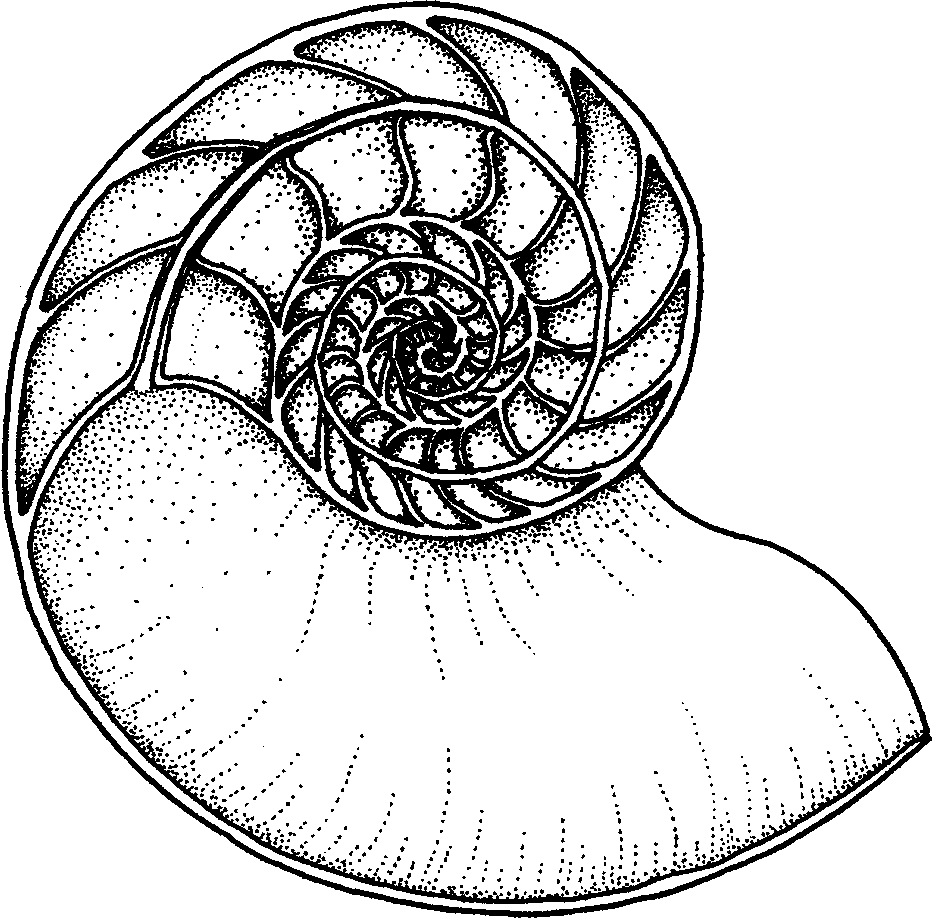
A cross-section through a Nautilus shell, showing a narrow siphuncle connecting the chambers of the shell

The siphuncle is a strand of tissue passing longitudinally through the shell of a cephalopod mollusc. Only cephalopods with chambered shells have siphuncles, such as the extinct ammonites and belemnites, and the living nautiluses, cuttlefish, and Spirula. In the case of the cuttlefish, the siphuncle is indistinct and connects all the small chambers of that animal's highly modified shell; in the other cephalopods it is thread-like and passes through small openings in the septa (walls) dividing the camerae (chambers). Some older studies have used the term siphon for the siphuncle, though this naming convention is uncommon in modern studies to prevent confusion with a mollusc organ of the same name.[1]

Function

[edit]
Simplified structure and mechanism of cephalopodic siphuncle.

The siphuncle is used primarily in emptying water from new chambers as the shell grows.[2] To perform this task, the cephalopod increases the saltiness of the blood in the siphuncle, and the water moves from the more dilute chamber into the blood through osmosis. At the same time gasses, mostly nitrogen, oxygen, and carbon dioxide, diffuse from the blood in the siphuncle into the emptying chamber. This is not a form of active pumping: the gas moving into the chamber is a passive process. Most energy is expended through the absorption of water from the chamber.

Removing water from the chambers of the shell reduces the overall density of the shell, and thus the shell behaves as a flotation device comparable to the swim bladder in bony fish. Typically, cephalopods maintain a density close to that of sea water, allowing them to keep a stable buoyancy with minimal effort. In the geologic past, many cephalopods grew to an enormous size (perhaps approaching ten meters in length) thanks to this.

Generally, the siphuncle is unable to provide a way to change the density of shell rapidly and thus cause the animal to rise or sink at will; rather, the animal must swim up or down as required.

Cephalopods with a wider siphuncle have a higher rate of metabolic activity.[3]

Morphology

[edit]
A shell of Nautilus pompilius in cross section. Septal necks are preserved, but the thin connecting rings have been degraded and lost.

The siphuncle of fossilised cephalopods is assumed to have worked in the same general way as in living nautiluses. The siphuncle itself is only rarely preserved, but its shape can be inferred from hardened structures which lie around it. Many fossils show the holes where the siphuncle passes through each septum. Around these holes, the rim of the septum is bent into a stout aragonitic tube known as a septal neck (or siphuncle notch).[1][4]

These polished orthocerid nautiloid cephalopod fossils from Morocco have fully preserved septal necks and connecting rings outlining the shape of the siphuncle.

In each chamber of the shell, the siphuncle is encased by a tubular structure known as a connecting ring. In living nautiluses, the connecting ring is a simple, thin-walled cylinder, with organic or thinly calcitic layers secreted from the tissues of the siphuncle. This fragile and poorly-mineralized form is known as a nautilosiphonate morphology. Many extinct cephalopods have a much more prominent connecting ring, with a very thick and porous inner calcitic layer. This more strongly-mineralized form is known as a calciosiphonate connecting ring. Connecting rings are strongly variable in morphology, from narrow homogenous tubes to bulbous, segmented cavities. Some are infolded, sending lobes or blades of calcite into the siphuncle. Connecting rings are typically continuous with the septal necks, and are difficult to distinguish without close examination. However, their developmental origin is wholly separate from the shell and septa, and they utilize calcite rather than aragonite as a biomineralized reinforcement.[1][4]

Biomineralized structures which develop within the siphuncle are known as endosiphuncular deposits (or simply siphonal deposits). These may include horizontal partitions (diaphragms), stacked conical structures (endocones), longitudinal rods, and various other concretions. Endosiphuncular deposits are typically thin structures which may be homologous to parts of the septae or connecting rings.[1][4]

In most fossil nautiluses, the siphuncle runs more or less through the center of each chamber, but in ammonites and belemnites it usually runs along the ventral edge of the shell. In some fossil straight shelled nautiloids, cylindrical calcareous growths ("siphuncular deposits") around the siphuncle can be seen towards the apex of the shell. These were apparently counterweights for the soft body at the other end of the shell, and allowed the nautilus to swim in a horizontal position. Without these deposits, the apex of the buoyant shell would have pointed upwards and the heavier body downwards, making horizontal swimming difficult. The siphuncle of the Endocerida also contained much of the organisms' body organs.[5]

See also

[edit]

References

[edit]
Revisions and contributorsEdit on WikipediaRead on Wikipedia
from Grokipedia
The siphuncle is a slender, membranous tubular structure that extends from the mantle of shelled cephalopods, running longitudinally through the septa that divide the internal chambers of their phragmocone.[1] This organ, containing a cord of vascularized tissue known as the siphuncular cord, perforates each septum via a small opening called the foramen, connecting the living chamber to the apex of the shell.[2] Siphuncles are found in shelled cephalopods across subclasses, including ectocochleates such as nautiloids and ammonoids, and some endocochleates such as the deep-sea cephalopod Spirula spirula. In living cephalopods like the nautilus (Nautilus pompilius), the siphuncle regulates buoyancy by actively transporting ions across its epithelium to create osmotic gradients, drawing water out of or into the chambers to adjust the balance of gas and liquid volumes.[3] To increase buoyancy and ascend, the siphuncle removes water from empty chambers, allowing dissolved gases such as nitrogen, oxygen, and carbon dioxide to diffuse inward from the blood and form bubbles that reduce overall density.[4] Conversely, to descend, it pumps ions into the chambers, prompting water influx via osmosis, which compresses gases and increases density for sinking.[4] This mechanism enables precise hydrostatic control, maintaining near-neutral buoyancy across varying depths without significant energy expenditure on locomotion.[3] The siphuncle's efficiency is enhanced by the shell's internal architecture, particularly in extinct ammonoids, where complex septa increase the surface area-to-volume ratio of the siphuncle relative to chambers, accelerating diffusion rates and supporting rapid growth and high reproductive output.[3] In modern forms like the chambered nautilus and Spirula spirula, the siphuncle remains a key adaptation for vertical migration in the water column.[3] Fossil evidence indicates that early cephalopods, such as Plectronoceras from the Late Cambrian, possessed siphuncles that enabled buoyancy regulation, highlighting their fundamental importance to the group's ecological success.[3]

Introduction

Definition and Role

The siphuncle is a tubular, vascularized strand of tissue that extends longitudinally through the phragmocone, connecting all chambers in the chambered shells of ectocochleate cephalopods such as nautiloids and ammonoids.[5] Composed of a central vascularized connective tissue core lined by epithelial cells, it passes through perforations in the septa that divide the phragmocone into discrete compartments.[5] This structure is unique to cephalopods possessing chambered shells and is absent in those with internalized or reduced shells, such as most modern coleoids.[6] The primary role of the siphuncle is to regulate buoyancy by facilitating the removal of liquid from newly formed posterior chambers and its replacement with gas, thereby adjusting the overall density of the shell relative to the surrounding seawater.[6] As the cephalopod grows and secretes a new septum to isolate a chamber, the siphuncle acts as an osmotic pump, drawing out cameral liquid through epithelial transport and allowing gas diffusion to maintain equilibrium.[6] This process enables precise control over the animal's vertical positioning in the water column. The term "siphuncle" originates from the New Latin siphunculus, a diminutive form of the Latin sipho (from Greek siphōn), meaning "tube" or "pipe," which aptly describes its elongated, conduit-like form.[1] Essential for achieving neutral buoyancy without reliance on continuous active swimming, the siphuncle allows shelled cephalopods to hover efficiently and conserve energy in their marine habitats.[6]

Occurrence in Cephalopods

The siphuncle is a characteristic feature present in all ectocochleate shelled cephalopods, specifically within the subclasses Nautiloidea, which includes both extant and extinct forms, and the extinct Ammonoidea.[7] In Nautiloidea, the siphuncle traverses the chambers of the phragmocone, facilitating connections between the shell's internal compartments and the living animal.[8] Similarly, in the extinct Ammonoidea, known for their coiled shells, the siphuncle served an analogous role in chambered structures throughout their Mesozoic dominance.[9] However, the modern deep-sea squid Spirula spirula (order Spirulida, subclass Coleoidea) retains a chambered internal shell with a functional siphuncle for buoyancy regulation. In most other modern coleoids, such as squid, octopuses, and cuttlefish, the siphuncle is absent, as these groups evolved the loss of a chambered external shell.[10] This evolutionary shift occurred as Coleoidea diverged from shelled ancestors, prioritizing soft-bodied agility over buoyant chambered structures, with internal modifications like the cuttlebone in cuttlefish representing a derived, non-siphuncular form.[10] Modern Coleoidea comprise over 800 extant species (as of 2024), most without a chambered shell and siphuncle (except for Spirula spirula).[11] The fossil record reveals the siphuncle's prominence in over 10,000 extinct cephalopod species, predominantly from Nautiloidea and Ammonoidea, highlighting its role as a defining feature since the Late Cambrian period approximately 500 million years ago.[12] In comparison, only five extant nautiloid species retain the siphuncle today, all within the genera Nautilus and Allonautilus, emphasizing the drastic reduction in ectocochleate cephalopod diversity.[13] This evolutionary persistence in a few lineages traces back to early nautiloids like the plectronocerids, which first exhibited the siphuncle for chamber management.[14]

Morphology

General Structure

The siphuncle is a thin-walled tubular structure composed primarily of epithelial tissue, lined internally with a chitinous layer, and containing an intricate network of blood vessels and nerves that run parallel to the shell axis. This tube passes through the septal necks, the perforations in the septa that divide the shell's internal chambers. The epithelial lining consists of columnar cells resting on a vascularized connective tissue sheath, which surrounds a central canal filled with extracellular matrix and additional vascular elements, providing structural integrity and support for physiological processes. The siphuncle consists of a living inner core (endosiphuncle) and surrounding non-living structural elements (ectosiphuncle), including septal necks and connecting rings.[15] The siphuncle is connected to the animal's mantle at the protoconch end—the initial embryonic chamber of the shell—ensuring stable positioning as the shell grows. From this attachment point, it extends continuously through all camerae (the gas-filled chambers) of the phragmocone, the portion of the shell behind the living body chamber. This longitudinal extension allows the siphuncle to traverse the entire chambered region without interruption, maintaining connectivity between the living tissues and the older shell parts.[16] Key components of the siphuncle include the siphuncular cord, which forms the inner core of living tissue comprising connective elements and vascular structures; an outer peritoneal layer that envelops the assembly. The siphuncle's diameter typically ranges from 1% to 5% of the shell width across cephalopod species, reflecting its compact design relative to the overall shell dimensions, and it derives its vascular supply directly from the animal's circulatory system via integrated blood vessels.[17][15][9]

Variations in Position and Size

The position of the siphuncle exhibits significant variation across cephalopod evolution and species, influencing its structural integration within the shell. In early cephalopod forms, such as those from the Late Cambrian and Early Ordovician, the siphuncle is typically marginal, positioned along the shell edge, often on the concave side of curved conchs.[18] In later nautiloids, it shifts to a central or subcentral location within the chambers, as seen in modern Nautilus species where it runs through the median of the phragmocone.[19] For ammonoids, the siphuncle generally occupies a ventral position near the outer margin of the coiled shell, though some groups like clymeniids show a dorsal shift.[8][20] Size variations are quantified using metrics such as the relative siphuncle diameter (ratio to shell diameter) or the siphuncle index (si; surface area to volume ratio), which reflect relative proportions and have ranged from less than 1% (diameter ratio) in primitive coiled forms to over 20% in advanced ammonoids and early straight-shelled taxa.[9] For instance, in Early Ordovician ellesmerocerids, the siphuncle diameter approximates one-fifth (20%) of the conch cross-section, indicating a relatively broad structure.[18] In contrast, modern nautiloids like Nautilus pompilius exhibit narrower siphuncles, with si values around 2-5%, adapted to more stable shell geometries.[9] Larger siphuncles correlate with faster rates of chamber emptying due to increased surface area for fluid exchange, as demonstrated in experimental studies on chambered cephalopods.[21] Representative examples include the broad siphuncles in orthoconic nautiloids, such as those in early Paleozoic endocerids with si up to 0.312 (equivalent to ~20-30% diameter ratio in cross-section), which facilitate rapid buoyancy adjustments compared to the narrower siphuncles in coiled forms like later nautiloids (si ~0.03 or <5%).[9][21] Structural adaptations in the siphuncle include thickened walls and reinforced connecting rings in species inferred to inhabit deeper waters, enhancing resistance to hydrostatic pressure.[9] These features, such as strong decoupling spaces between the siphuncular epithelium and shell wall, are prominent in taxa with high si values, like Ordovician actinocerids, allowing structural integrity under elevated pressures without compromising the epithelial layer's general composition.[9]

Physiology and Function

Buoyancy Regulation

The siphuncle plays a central role in buoyancy regulation for chambered cephalopods by managing the liquid and gas content within the shell's internal chambers. Following the formation of a new septum, which partitions off a fresh chamber filled with seawater-like cameral liquid, the siphuncle initiates the removal of this liquid. This process replaces the liquid with gas derived primarily from diffusion through the siphuncular epithelium, thereby reducing the overall density of the animal to achieve neutral buoyancy.[22] The efficiency of this adjustment is critical, as it allows the cephalopod to counteract the increasing weight of the growing shell and soft body tissues. The primary mechanism involves active transport across the siphuncular epithelium, where specialized cells pump ions such as sodium and chloride from the cameral liquid into the bloodstream, establishing an osmotic gradient. This gradient draws water out of the chamber osmotically, facilitating the emptying process without requiring mechanical pumping. Studies on living Nautilus specimens demonstrate that this ion-driven osmosis can operate against pressure differentials, enabling controlled buoyancy changes even under varying hydrostatic conditions.[23] This regulatory system provides precise control, permitting nautiluses to maintain neutral buoyancy and hover at depths up to 700 meters, limited primarily by shell implosion thresholds. The siphuncle's tubular structure bridges the fluid-filled living chamber at the shell's aperture with the gas-filled phragmocone, the series of emptied posterior chambers that store the buoyant gas volume. By modulating liquid removal rates across multiple chambers, cephalopods can fine-tune their vertical positioning in the water column for foraging, predator avoidance, and energy conservation.[24][22]

Fluid and Gas Dynamics

The removal of cameral liquid from the shell chambers occurs through a combination of diffusion and active pumping across the siphuncular epithelium, facilitated by ion transporters such as Na⁺/K⁺-ATPase embedded in the epithelial cells lining the siphuncle pores.[25] This enzyme hydrolyzes ATP to actively transport sodium ions out of the epithelial cells and potassium ions inward, establishing an electrochemical gradient that drives the osmotic withdrawal of water from the chamber liquid into the siphuncular blood vessels.[26] The process creates a hypo-osmotic environment in the chamber relative to the surrounding seawater, pulling fluid through the porous structure of the siphuncle at rates influenced by the epithelial surface area and ion pump density.[21] As cameral liquid is evacuated, gases diffuse from the blood vessels in the siphuncle into the chambers to replace the volume and maintain pressure, primarily through the passive diffusion of nitrogen, oxygen, and carbon dioxide across the thin epithelial membrane.[27] This diffusion is driven by partial pressure gradients, with these gases entering from the hemolymph to equalize concentrations and counteract the vacuum formed by liquid removal, ultimately generating the gas pressure necessary for buoyancy.[22] The osmotic pressure differential (π) that sustains this fluid-gas exchange follows the van't Hoff equation:
π=iMRT \pi = iMRT
where ii is the van't Hoff factor accounting for ion dissociation, MM is the molarity of the solute (primarily salts in the cameral liquid), RR is the gas constant, and TT is the absolute temperature.[28] This equation quantifies the pressure required to prevent net water flow back into the chamber, ensuring efficient gas filling once liquid levels drop sufficiently. The resulting gas composition in the chambers consists primarily of an argon-nitrogen mixture, with traces of other gases derived from blood and environmental equilibration.[29] The rate of chamber emptying and gas filling is modulated by siphuncle size, which determines the effective surface area for ion transport and diffusion, as well as the animal's activity level, with full processing of a single chamber typically requiring approximately 4–5 months in observed cycles.[30] Larger siphuncles in mature cephalopods increase emptying rates relative to smaller juvenile siphuncles, with rates potentially up to several times higher under stressed conditions.[21]

Evolutionary History

Origin in Early Cephalopods

The earliest undisputed evidence of the siphuncle in cephalopods dates to the Late Cambrian, approximately 488 million years ago, where it is observed in protoconchs exhibiting siphuncular pores. More recent analyses (as of 2021) suggest possible earlier origins around 522 million years ago with fossils tentatively identified as cephalopods, such as Tannuella, though this remains controversial.[31] This structure was first described in the genus Plectronoceras, an orthoconic nautiloid from the Upper Cambrian of Asia, characterized by a short, slightly curved shell and a ventral siphuncle attached to the shell wall that penetrated the embryonic shell portion.[32] In these primitive forms, the siphuncle functioned to facilitate the exchange of cameral liquid with gases in the phragmocone chambers, enabling basic buoyancy regulation even in near-bottom habitats.[32][33] The initial form of the siphuncle was a simple, marginal tube positioned ventrally in straight-shelled (orthoconic) ancestors, consisting of short, straight septal necks and a connecting ring derived from modified septal tissue. This tube likely evolved from soft molluscan mantle tissue associated with larval pedal retractor attachments, which persisted apically and became surrounded by septa as the chambered shell developed.[32] The siphuncular wall featured two calcified layers—an outer spherulitic-prismatic layer and an inner compact layer with pore canals—allowing efficient fluid transport despite the primitive design.[33] The siphuncle co-evolved with septa to form the chambered shells essential for hydrostatic function in early cephalopods, with connecting rings structurally adapted from septal necks to enhance gas exchange surfaces. By the Ordovician period (approximately 485–443 million years ago), the siphuncle was present in all early nautiloids, including ellesmerocerid-like forms, marking its establishment as a defining feature amid rapid cephalopod diversification.[33][34] In terms of developmental biology, the siphuncle forms during embryogenesis as an outpocketing of mantle epithelium, extending through the initial chamber as a rounded caecum before integrating with subsequent septa. This process, observed in embryonic shells of early nautiloids, underscores its origin as a specialized epithelial strand connecting body tissues to the phragmocone.[32][8]

Adaptations and Diversity Over Time

During the Paleozoic era, particularly from the Silurian through the Devonian, the siphuncle in coiled cephalopods underwent notable adaptations toward a more central or medial position, reducing variability in placement and enhancing structural stability for buoyancy regulation. This trend, evident after the Late Devonian, is interpreted as a response to increasing predatory pressures and fluctuating sea levels, which favored cephalopods capable of efficient depth adjustments in marine environments.[35] In Devonian nautiloids, siphuncle sizes also increased relative to shell dimensions, allowing for faster fluid and gas exchange that supported habitation in deeper waters, where hydrostatic pressures demanded more robust buoyancy mechanisms.[36] Fossil evidence from these periods shows a correlation between larger siphuncle indices (si, defined as the ratio of siphuncle diameter to shell diameter) and tighter shell coiling, which optimized weight distribution and maneuverability against environmental shifts like oxygenation variations in benthic habitats.[37] In the Mesozoic, siphuncle diversity expanded dramatically among ammonoids, with Jurassic species displaying notably high si values, surpassing those in Paleozoic forms and enabling rapid ontogenetic growth through enhanced osmotic control of chamber fluids.[9] These adaptations likely arose as a recovery mechanism following mass extinctions, such as the end-Triassic event, where lineages with efficient siphuncles—suited to variable oxygenation levels and predation from early marine reptiles—proliferated in diverse habitats from shallow shelves to deeper basins.[36] Quantitative analyses of fossil metrics reveal that higher si values correlated strongly with increased shell coiling complexity, providing adaptive advantages in predator evasion and habitat depth transitions during periods of ecological upheaval.[38] Following the Cretaceous-Paleogene extinction, siphuncle-bearing cephalopods experienced a profound decline, with ammonoids vanishing entirely due to their higher metabolic demands amid global disruptions like surface-water acidification and plankton collapse, while nautiloids persisted with lower-energy buoyancy systems.[39] Today, only nautiloids and the coleoid Spirula spirula retain a functional siphuncle, but their diversity has remained markedly reduced compared to Mesozoic peaks, reflecting ongoing selective pressures from predation and limited habitat niches in deeper, oxygen-poor waters. This evolutionary bottleneck underscores how siphuncle efficiency, honed over geological time, ultimately favored survival in resilient but specialized lineages.

Siphuncle in Cephalopod Groups

In Nautiloids

In extant nautiloids, such as Nautilus pompilius and Allonautilus, the siphuncle occupies a subcentral position within the phragmocone chambers, running parallel to the shell's coiling axis but offset toward the dorsum. It forms a slender tubular strand composed of septal necks and connecting rings, with the latter being thin-walled cylinders featuring organic or lightly calcitic layers secreted by the siphuncular tissues. The inner lining consists of a reticulate, net-like epithelium of columnar epithelial cells supported by vascularized connective tissue, which provides the structural basis for fluid exchange between the siphuncle and chambers. This structure connects posteriorly to vascularized tissue that facilitates ammonia diffusion into the chambers, aiding in the composition of cameral gases alongside other components like nitrogen and carbon dioxide.[40][41][21] The siphuncle's primary function in nautiloids is to regulate buoyancy for a slow, energy-efficient lifestyle in deep-water habitats, where vertical movements occur over extended periods. By actively transporting ions across the epithelial lining and employing osmosis, the siphuncle removes cameral liquid from newly formed chambers, allowing gases to diffuse inward from the siphuncle's blood vessels; this process typically empties chambers over 1-2 days in controlled conditions, balancing the animal's weight against seawater density. In the living chamber, the siphuncle terminates anteriorly in a bulbous gland that produces gas, a feature documented in dissections of Allonautilus and Nautilus pompilius, enhancing fine-tuned adjustments without disrupting the animal's position. This mechanism supports the nautiloids' preference for depths of 100-600 meters, where rapid buoyancy shifts are unnecessary.[4][21] The siphuncle's morphology and role in nautiloids have exhibited remarkable conservation since the Paleozoic, with fossil specimens from orders like the Nautilida displaying septal necks, connecting rings, and positional traits nearly identical to those in living forms. This minimal evolutionary change, evident in Paleozoic to Cenozoic nautiloid fossils, underscores the siphuncle's reliability in buoyancy control, likely contributing to the group's endurance through mass extinctions that decimated other cephalopod lineages. Such stability highlights the adaptive sufficiency of this system for stable, deep-sea niches over hundreds of millions of years.[40]

In Ammonoids

The siphuncle in ammonoids, an extinct group of cephalopods, exhibited considerable structural diversity that distinguished it from that of living nautiloids. Predominantly retrochoanitic in configuration, representing the primitive condition, the septal necks extended aborally and connected the siphuncle to the previous chamber, facilitating fluid exchange across septa. Variations included modified retrochoanitic, prochoanitic, and amphichoanitic forms, with the latter featuring necks that curved both adorally and aborally for enhanced structural support. This diversity in septal neck morphology contributed to the siphuncle's adaptability in coiled shells, where it typically occupied a ventral or marginal position along the outer whorl margin, aiding in the animal's orientation and buoyancy control during locomotion.[42][43][9] Functionally, the siphuncle enabled rapid adjustments to buoyancy in these active nektonic swimmers, allowing ammonoids to maintain neutral buoyancy despite their complex, tightly coiled shells. The siphuncle was relatively narrow compared to the shell diameter, supporting efficient gas and fluid dynamics, though its ventral position in coiled forms permitted quicker emptying of cameral liquid from lower chambers compared to centrally located siphuncles. This configuration, inferred from the increasing complexity of septa over evolutionary time, likely facilitated faster shell growth rates by minimizing hydrostatic stress on the phragmocone during vertical migrations and predatory escapes. Septal complexity, which escalated iteratively in ammonoid lineages, further reinforced the siphuncle's role by distributing mechanical loads, enabling sustained activity in open marine environments.[44][9][45] Ammonoids, encompassing over 10,000 described species, thrived from the Devonian Period approximately 400 million years ago to the end of the Cretaceous around 66 million years ago, with the siphuncle's position serving as a key taxonomic feature across orders. For instance, in the Lytoceratida, the siphuncle migrated to a marginal position early in ontogeny, typically prochoanitic, which helped differentiate this group from more centrally siphunculate ancestors and influenced their evolute shell coiling. This positional variation, combined with septal neck types, provided paleontologists with diagnostic traits for classifying diverse morphologies, from planispiral to heteromorph forms. The siphuncle's design, while innovative for rapid adaptation, may have contributed to vulnerabilities in gas retention under extreme environmental stress, potentially factoring into the group's total extinction at the Cretaceous-Paleogene boundary, in contrast to the more robust nautiloid siphuncle.[46][47][48]

References

User Avatar
No comments yet.