


Community hub
Recent from talks
Contribute something
Nothing was collected or created yet.
Nautilida
View on Wikipedia
| Nautilida Temporal range:
| |
|---|---|

| |
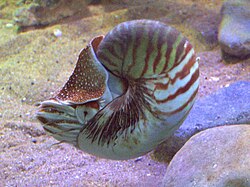
| Nautilus pompilius | |
Scientific classification 
| |
| Kingdom: | Animalia |
| Phylum: | Mollusca |
| Class: | Cephalopoda |
| Subclass: | Nautiloidea |
| Order: | Nautilida Agassiz, 1847 |
| Type species | |
| N. pompilius | |
| Superfamilies | |
The Nautilida constitute a large and diverse order of generally coiled nautiloid cephalopods that began in the mid Paleozoic and continues to the present with a single family, the Nautilidae which includes two genera, Nautilus and Allonautilus, with six species. All told, between 22 and 34 families and 165 to 184 genera have been recognised, making this the largest order of the subclass Nautiloidea.
Classification and phylogeny
[edit]Current classification
[edit]The current classification of the Nautilida, in prevalent use,[1] is that of Bernhard Kummel (Kummel 1964) in the Treatise which divides the Nautilida into five superfamilies, the Aipocerataceae, Clydonautilaceae, Tainocerataceae, and Trigonocerataceae, mostly of the Paleozoic, and the later Nautilaceae. These include 22 families and some 165 or so genera (Teichert and Moore 1964)
Other concepts
[edit]Shimansky 1962 (in Kummel 1964) divided the Nautilida into five suborders, the mostly Paleozoic Centroceratina, Liroceratina, Rutoceratina, and Tainoceratina, and the Mesozoic to recent Nautilina. These include superfamilies which are different from those of Kummel (1964) and of less extent. The Centroceratina are comparable to the Trigonocerataceae, the Liroceratina to the Clydonautilaceae, and the Nautilina to the Nautilaceae. The main difference is that the Rutoceratidae are included with the Aipocerataceae of Kummel (1964) in the Rutoceratina. The remaining Tainocerataceae are the Tainoceratina.
Rousseau Flower (1950) distinguished the Solenochilida, Rutoceratida, and Centroceratida, as separate orders, from the Nautilida, derived from the Barrandeocerida, which are now abandoned. Within the Nautilida, he placed 10 families, included in the Nautilaceae and the no longer considered ancestral Clydonautilaceae. Teichert's 1988 classification is an abridged version of Shimansky's and Flower's early schemes.
Derivation and evolution
[edit]Both Shimansky and Kummel derive the Nautilida from the Oncocerida with either the Acleistoceratidae or Brevicoceratidae (Teichert 1988) which share some similarities with the Rutoceratidae as the source. The Rutoceratidae are the ancestral family of the Tainocerataceae and of the Nautilida (Kummel 1964) and of Shimansky's and Teichert's Rutoceratina.
The Tainocerataceae gave rise, probably through the ancestral Rutoceratidae, to the Trigonocerataceae and Clydonautiliaceae in the Devonian and to the Aipocerataceae early in the Carboniferous. The Trigonocerataceae, in turn, gave rise late in the Triassic through the Syringonautilidae to the Nautilaceae, which include the Nautilidae, with Nautilus. (Kummel 1964)
Diversity and evolutionary history
[edit]
The Nautilida are thought to be derived from either of the oncocerid families, Acleistoceratidae or Brevicoceratidae (Kummel 1964; Teichert 1988), both of which have the same sort of shells and internal structure as found in the Devonian Rutocerina of Shimanskiy, the earliest true nautilids. Flower (1950) suggested the Nautilida evolved from the Barrandeocerida, an idea he came later to reject in favor of derivation from the Oncocerida. The idea that the Nautilida evolved from straight-shelled ("Orthoceras") nautiloids, as proposed by Otto Schindewolf in 1942, through transitional forms such as the Ordovician Lituites can be rejected out of hand as evolutionarily unlikely. Lituites and the Lituitidae are derived tarphycerids and belong to a separate evolutionary branch of nautilioids.
The number of nautilid genera increased from the Early Devonian to about 22 in the Middle Devonian. During this time, their shells were more varied than those found in species of living Nautilus, ranging from curved (cyrtoconic), through loosely coiled (gyroconic), to tightly coiled forms, represented by the Rutoceratidae, Tetragonoceratidae, and Centroceratidae.
Nautilids declined in the Late Devonian, but again diversified in the Carboniferous, when some 75 genera and subgenera in some 16 families are known to have lived. Although there was considerable diversity in form, curved and loosely coiled shells are rare or absent, except in the superfamily Aipocerataceae. For the rest, nautilids adapted the standard planispiral shell form, although not all were as tightly coiled as the modern nautilids (Teichert 1988). There was, however, a great diversity in surface ornamentation, cross section, and so on, with some genera, such as the Permian Cooperoceras and Acanthonautilus, developing large lateral spikes (Fenton and Fenton 1958).
Despite again decreasing in diversity in the Permian, nautilids were less affected by the Permian-Triassic extinction than their distant relatives the Ammonoidea. During the Late Triassic there was a tendency in the Clydonautilaceae to develop sutures similar to those of some Late Devonian goniatites. Only a single genus, Cenoceras, with a shell similar to that of the modern nautilus, survived the less severe Triassic extinction, at which time the entire Nautiloidea almost became extinct.
For the remainder of the Mesozoic, nautilids once again flourished, although never at the level of their Paleozoic glory, and 24 genera are known from the Cretaceous. Again, the nautilids were not as affected by the end Cretaceous mass extinction as the Ammonoids that became entirely extinct, possibly because their larger eggs were better suited to survive the conditions of that environment-changing event.
Three families and at least five genera of nautilids are known to have survived this crisis in the history of life. There was a further resurgence during the Paleocene and Eocene, with several new genera, the majority of which had a worldwide distribution. During the Late Cretaceous and Early Tertiary, the Hercoglossidae and Aturiidae again developed sutures like those of Devonian goniatites. (Teichert 1988, pp. 43–44)
Miocene nautilids were still fairly widespread, but today the order includes only two genera, Nautilus and Allonautilus, limited to the southwest Pacific.
The recent decrease in the once worldwide distribution of nautilids is now believed to have been caused by the spread of pinnipeds.[2] From the Oligocene onward, the appearance of pinnipeds in the geological record of a region coincides with the disappearance of nautilids from that region.[3] As a result, nautilids are now limited to their current distribution in the tropical Indo-Pacific ocean, where pinnipeds are absent.[2] The genus Aturia seem to have temporarily survive regions where pinnipeds were present through adaptations to fast and agile swimming, but eventually went extinct as well.[3] Predation by short-snouted whales and the development of OMZs, preventing nautilids from retreating into deeper water, are also cited as other potential causes of extinction.[3]
References
[edit]- ^ "Paleobiology Database". Archived from the original on 2007-10-01. Retrieved 2024-11-18.
- ^ a b "How seals made Nautilus a 'Living Fossil'". Journal of Biogeography. 2022-10-15. Archived from the original on 2022-10-23. Retrieved 2023-03-29.
- ^ a b c Kiel, Steffen; Goedert, James L.; Tsai, Cheng‐Hsiu (2022-09-22). "Seals, whales and the Cenozoic decline of nautiloid cephalopods". Journal of Biogeography. 49 (11): 1903–1910. doi:10.1111/jbi.14488. ISSN 0305-0270. Archived from the original on 2022-10-25.
- Fenton and Fenton (1958), The Fossil Book (Doubleday & Co., Garden City, New York).
- Kümmel, B. (1964) "Nautilida" in Treatise on Invertebrate Paleontology, Part K. Mollusca 3. (Geological Society of America, and University of Kansas Press).
- Moore, Lalicker and Fischer, (1952) Invertebrate Fossils, McGraw-Hill Book Company, Inc., New York, Toronto, London.
- Teichert, T. (1988) "Main Features of Cephalopod Evolution", in The Mollusca vol. 12, Paleontology and Neontology of Cephalopods, ed. by M.R. Clarke & E.R. Trueman, Academic Press, Harcourt Brace Jovanovich.
External links
[edit]Notable fossil cephalopods (listed by first occurrence) | |||||||||
|---|---|---|---|---|---|---|---|---|---|
| Cenozoic |
| ||||||||
| Mesozoic |
| ||||||||
| Palaeozoic |
| ||||||||


Nautilida
View on GrokipediaTaxonomy and phylogeny
Current classification
Nautilida is classified as an order within the subclass Nautilia (revised from the traditional Nautiloidea) of the class Cephalopoda, phylum Mollusca, kingdom Animalia.[1][7] This placement reflects its position as the sole surviving order of nautiloid cephalopods, distinguished from the coleoid cephalopods by features such as a chambered external shell and numerous tentacles without suckers.[8] Among extant taxa, Nautilida is represented solely by the family Nautilidae, which includes two genera: Nautilus and Allonautilus, encompassing approximately 9 recognized species as of 2023.[3] These include Nautilus pompilius, N. macromphalus, N. stenomphalus, N. belauensis, N. vitiensis, N. samoaensis, and N. vanuatuensis in the genus Nautilus, and Allonautilus perforatus and A. deepwater (also known as A. scrobiculatus) in Allonautilus.[3] Classification of these species relies on shell morphology, including coiling patterns, umbilicus width, and coloration, as well as soft tissue differences observed in live specimens. Historically, Bernard Kummel proposed a comprehensive classification in 1964, dividing Nautilida into five superfamilies—Aipocerataceae, Clydonautilaceae, Tainocerataceae, Trigonocerataceae, and Nautilaceae—encompassing 22 families and 165 genera, primarily based on fossil records from the Paleozoic to Cenozoic.[2] This scheme emphasized shell coiling (typically nautiliconic or planospiral), siphuncle position (dorsal to ventral marginal), and septal complexity (with simple, straight sutures).[8] Earlier, V. N. Shimansky in 1962 outlined five suborders—Centroceratina, Liroceratina, Rutoceratina, Tainoceratina, and Nautilina—focusing on conch shape, whorl profiles, and endosiphuncular deposits to differentiate Paleozoic forms.[9] Recent revisions, such as the 2025 classification for Carboniferous and Permian Nautilida, recognize seven suborders—Temnocheilina, Domatoceratina (new), Tainoceratina, Liroceratina, Solenochilina, Rutoceratina, and Nautilina—incorporating five superfamilies like Trigonoceratoidea, Grypoceratoidea, Tainoceratoidea, Liroceratoidea, and Aipoceratoidea, with new families such as Dasbergoceratidae and Epistroboceratidae.[2] This update refines earlier schemes by integrating stratigraphic data, conch ontogeny, sculpture, and suture line morphology, while maintaining the core criteria of siphuncle positioning and septal features for higher-level groupings.[10]Phylogenetic relationships
Nautilida occupies a basal position within the Cephalopoda, serving as the sister group to Coleoidea, which encompasses all modern cephalopods except nautilids, such as squids and octopuses.[11] This relationship is supported by phylogenetic analyses of fossil morphology, placing the divergence between Nautilida and Coleoidea in the Late Cambrian or Early Ordovician, around 489 million years ago, based on the oldest known cephalopod fossils like Plectronoceras cambria.[11] The crown-group Cephalopoda, defined by Nautilida and Coleoidea, emerged during this period, with Nautilida retaining plesiomorphic traits that highlight its primitive status among extant cephalopods.[12] The order Nautilida is derived from earlier nautiloid groups, specifically tracing its origins to the Oncocerida through transitional families such as Acleistoceratidae or Brevicoceratidae, with further evolution via Rutoceratidae during the Devonian.[13] This lineage is evidenced by morphological transitions in shell and siphuncle structures, where early Devonian forms like Ptenoceras alatum exhibit cyrtocochantic siphuncles as relict features from oncocerid ancestors, leading to the more coiled and stabilized morphologies characteristic of later Nautilida.[14] Key synapomorphies defining Nautilida include the retention of an external chambered shell, orthostrophic coiling (where the coiling direction aligns with the embryonic shell), and complex septal structures that form simple but robust sutures, distinguishing them from more derived cephalopod groups.[15] Molecular evidence from mitochondrial DNA reinforces the close phylogenetic ties within Nautilida, particularly between the genera Nautilus and Allonautilus, with analyses of COI and 16S genes showing minimal divergence and shared haplotypes indicative of recent common ancestry.[16] Studies reveal limited genetic diversity across populations, characterized by high F_ST values (0.888–0.975) and negative Tajima’s D scores suggesting population expansions, which point to a recent evolutionary radiation rather than ancient divergence.[16] This low variability contrasts with the broader cephalopod tree, underscoring Nautilida's isolated evolutionary trajectory. Nautilida is phylogenetically distinct from extinct Ammonitida, which features highly complex septal sutures adapted for enhanced buoyancy control, and from Belemnoidea, a coleoid subgroup with internalized phragmocones and reduced external shells.[17] These differences highlight Nautilida's retention of ancestral external shell architecture, setting it apart from the more specialized internalizations seen in ammonoids and belemnoids.[17]Evolutionary history
The Nautilida originated in the mid-Devonian period, approximately 380 million years ago, evolving from rutoceratid ancestors such as those in the Rutoceratidae family, which exhibited transitional coiled shell morphologies from earlier oncocerid nautiloids.[13] This emergence marked the beginning of a lineage characterized by increasingly planispiral shells and improved septal complexity. Early diversification in the Devonian involved key families like Trigonocerataceae and Clydonautiliaceae, leading to around 22 genera that adapted to a range of marine environments through variations in shell coiling and ornamentation.[13] The Carboniferous period represented the zenith of Nautilida diversity, with roughly 75 genera distributed across 16 families, predominantly featuring tightly coiled planispiral shells that enhanced hydrodynamic efficiency.[18] This radiation included suborders such as Tainoceratina and Domatoceratina, reflecting adaptive expansions in shell sculpture and siphuncle positioning for better buoyancy regulation. The group demonstrated exceptional resilience, surviving four major mass extinctions—including the Late Devonian, Devonian-Carboniferous boundary, Permian-Triassic, and Cretaceous-Paleogene events—owing to their generalist ecology, which allowed exploitation of varied niches with low metabolic demands compared to more specialized cephalopods like ammonoids.[13][19] A critical adaptation was the siphuncle, a tubular structure enabling precise control of buoyancy by regulating gas and fluid in shell chambers via osmotic processes.[20] Post-Permian-Triassic recovery favored Nautilida over ammonoids, which suffered greater losses but later rebounded, as nautiloids maintained stable populations through their broad habitat tolerance.[13] The Mesozoic saw a gradual decline, with diversity dropping to about 24 genera by the Cretaceous, amid increasing competition from advanced coleoid cephalopods that outcompeted them in speed and predation efficiency.[18] In the Cenozoic, further reduction occurred, potentially triggered by Oligocene predation from expanding pinniped populations, prompting a shift to deeper-water refugia in the Indo-West Pacific and limiting their global distribution.[21] These habitat changes, combined with ongoing ecological pressures, confined modern Nautilida to a fraction of their former range.Morphology
Shell structure
The shell of Nautilida is characterized by a planispiral, tightly coiled external structure that provides protection and buoyancy, with adult diameters typically ranging from 10 to 25 cm depending on the species.[22] This coiled form, known as nautilicone, evolved from earlier nautiloid stocks and is composed primarily of aragonite, a polymorph of calcium carbonate, organized into distinct layers including an outer porcelaneous zone, an inner stratified aragonite region, and a nacreous inner lining that imparts the characteristic iridescent sheen.[23] The nacreous layers, formed by thin sheets of aragonite crystals separated by organic matrices, contribute to the shell's mechanical strength and aesthetic appearance.[24] Unlike some other nautiloid groups, Nautilida shells lack internal cameral deposits, contributing to their simple chamber architecture.[23] Internally, the shell is divided into approximately 30 to 40 chambers by thin, gently curved septa, creating a phragmocone that serves as the buoyant core.[25][23] The outermost chamber, known as the living chamber, is located at the aperture and houses the animal's soft body, while the earlier, more posterior chambers are gas-filled—primarily with nitrogen—to provide neutral buoyancy and enable depth regulation in the water column.[22] These septa attach to the shell wall along sutures that are simple and lobed in extant forms, forming a straightforward junction without complex folding seen in other cephalopods.[23] A key feature is the siphuncle, a tubular strand of vascularized tissue that extends through the center of each septum, connecting all chambers and facilitating buoyancy control.[26] The siphuncle regulates the gas-to-fluid ratio within the chambers through osmotic pumping, where epithelial cells actively transport ions to create osmotic gradients that draw water out of the chambers, allowing gases to diffuse in and adjust overall density.[27] This mechanism enables the animal to maintain hydrostatic equilibrium at varying depths, with the siphuncle's thin connecting rings and septal necks providing structural support.[23] While extant Nautilida exhibit highly involute, tightly coiled shells for streamlined hydrodynamics, fossil representatives from Paleozoic and Mesozoic deposits display greater morphological variation, including evolute (loosely coiled) and orthoconic (straight) forms that reflect adaptations to diverse ancient environments.[23] In these fossils, such as Permian Stenopoceras, the shell often shows secondary calcite replacement, altering the original aragonitic composition, though the fundamental chambered and siphuncular architecture remains conserved across the order.[23]Soft anatomy
The soft body of Nautilida exhibits a bilaterally symmetrical head-foot complex integrated with the shell. The head features 60 to 90 retractile tentacles arranged in a peripheral fringe around the mouth; these lack suckers but bear longitudinal ridges and grooved sheaths that enable firm adhesion to surfaces or prey.[28] Positioned between the tentacles are simple pinhole eyes, which lack corneas or lenses and provide low-resolution, motion-sensitive vision through a fluid-filled chamber.[29] At the center, a chitinous, parrot-like beak with sharply curved mandibles facilitates biting and initial food fragmentation, supported by a radula for rasping.[30] The mantle forms a thin, extensible epithelial layer that secretes the shell and lines the pallial cavity, creating a spacious chamber for vital functions. This cavity contains two pairs of ctenidial gills attached to the mantle wall, where gas exchange occurs; blood is circulated through the gills by paired branchial hearts before reaching the systemic heart.[31] A muscular funnel, or hyponome, extends from the ventral pallial cavity floor and enables locomotion via jet propulsion, drawing in and expelling water rhythmically.[30] Key internal organs support digestion, reproduction, and equilibrium. The digestive tract comprises a crop for initial food storage, followed by a muscular stomach for grinding and enzymatic breakdown.[30] In females, paired nidamental glands produce gelatinous egg capsules. Statocysts, fluid-filled sacs posterior to the eyes, detect orientation and angular acceleration via an epithelium lined with 130,000 to 150,000 sensory hair cells embedded in a statolith matrix.[32] Sexual dimorphism manifests prominently in reproductive structures. Males possess a specialized left pre-ocular tentacle modified as a hectocotylus, a slender, elongate organ that transfers spermatophores directly into the female's mantle cavity during copulation.[30] This modification correlates with a broader shell aperture in males, facilitating deployment of the hectocotylus.[33] The nervous system forms an ortho- or sub-orthogon around the esophagus, comprising a brain of interconnected ganglia (cerebral, pedal, visceral, and optic) with nerve cords extending to peripheral organs. This decentralized configuration is structurally simpler and less centralized than the fused, lobe-dominated brains of coleoid cephalopods.[28]Biology and ecology
Reproduction and life cycle
Nautilida species are dioecious, with separate male and female individuals, and reproduction involves internal fertilization achieved when males use a specialized arm called the hectocotylus to insert spermatophores into the female's mantle cavity.[34][35] The male's reproductive anatomy includes the hectocotylus and spermatophoric glands for spermatophore production, while females possess the organ of Valenciennes for sperm storage.[36] Females lay eggs singly or in small groups of a few leathery, opaque capsules, each measuring 25–35 mm in length, which are attached to hard substrates such as coral or rock at depths of 80–100 m, with females producing 10–20 eggs annually.[34] Incubation lasts 8–14 months, depending on environmental conditions, with no parental care provided after deposition.[35] Hatchlings emerge as fully formed miniature adults with a shell diameter of 20–25 mm and 4–5 chambers, exhibiting direct development without a distinct planktonic larval stage, though they may disperse briefly before settling into benthic habitats.[34][35] Growth in Nautilida is indeterminate and slow, with individuals reaching sexual maturity at 10–15 cm shell diameter after 12–15 years, as determined by annual growth rings visible in the septa.[35] Lifespan exceeds 20 years, with no post-reproductive senescence observed.[34][35] Fecundity is low, with females producing only 10–20 eggs per year and an estimated lifetime total of 100–200, reflecting a strategy without seasonal breeding patterns.[34]Behavior and feeding
Nautilida employ jet propulsion for locomotion, drawing water into the mantle cavity and expelling it forcefully through the hyponome, a muscular siphon that directs the flow for controlled movement.[25] This mechanism enables backward swimming as the primary mode, with the animal orienting its shell aperture forward while the head and tentacles trail behind, supplemented by occasional anterior-first orientation for maneuvering.[37] Maximum sustained speeds reach approximately 0.33 m/s, though burst propulsion yields lower thrust—about one-eighth that of comparably sized squids—reflecting an adaptation for efficient, low-energy travel rather than rapid evasion.[38] The numerous tentacles, numbering over 90 and lacking suckers but featuring adhesive ridges, assist in substrate manipulation and prey handling during movement.[39] Activity patterns in Nautilida are predominantly nocturnal, characterized by diel vertical migrations that align foraging with reduced predation risk. During daylight hours, individuals remain largely stationary at depths of 489–700 m, exhibiting minimal movement consistent with resting or ambush positioning.[40] At dusk, they ascend to shallower waters, typically 130–350 m, with continuous activity persisting through the night to depths as shallow as 100 m, before descending again at dawn to exceed 350 m en route to daytime haunts.[40][25] Olfactory cues, detected via sensory anatomy, likely guide these migrations toward prey concentrations in the water column.[25] Feeding in Nautilida combines carnivory and scavenging, targeting live crustaceans such as shrimp and crabs, as well as fishes and carrion, with occasional conspecific predation observed.[39][25] Prey is captured using the array of grooved tentacles, which adhere via mucus secretion to grasp and transport items to the mouth without suction.[39] A powerful, parrot-like beak then crushes or tears the food into fragments, while the radula—a chitinous, toothed ribbon—further scrapes and shreds material for ingestion, facilitating efficient processing of tough-shelled items like crustaceans.[39][25] Nautilida exhibit a solitary lifestyle, with individuals showing no evidence of group formation, cooperative foraging, or complex social interactions in either wild or captive settings.[41] Communication remains rudimentary, lacking visual signals, acoustic cues, or chemical messaging beyond basic olfactory prey detection, consistent with their isolated deep-sea existence.[41] Predation avoidance relies on physical and behavioral defenses rather than chemical deterrents, as Nautilida lack an ink sac and cannot release obscuring clouds.[42] The robust, chambered shell provides primary protection, resisting crushing pressures up to implosion depths of around 800 m, while daytime stasis at profound levels (489–700 m) minimizes encounters with visual predators active in shallower zones.[40] Vertical migrations further enhance survival by timing surfacing to nocturnal low-light conditions, reducing detectability.[40]Habitat and distribution
Nautilida, the order encompassing modern nautiluses, exhibit a restricted geographic distribution confined to the tropical Indo-Pacific region. Their range spans from the Philippines and Indonesia eastward to Fiji and American Samoa, northward to southern Japan, and southward to northern and northeastern Australia, including areas around New Guinea and Palau.[43][44] This distribution is patchy, resulting from limited larval dispersal capabilities that prevent widespread colonization across ocean basins.[45] These cephalopods inhabit warm tropical waters with temperatures typically ranging from 20 to 25°C, though they can tolerate up to 30°C in some locales, and salinities between 30 and 35 ppt.[46][47] They prefer steep fore-reef slopes and drop-offs at depths of 100 to 700 meters, where low light levels prevail, with juveniles often occurring in shallower waters closer to 100 meters.[48][40] Nautilida demonstrate tolerance for oxygen minimum zones at these depths, allowing exploitation of hypoxic refuges without short-term physiological constraint.[49] Within these environments, nautilids favor microhabitats featuring rocky substrates, to which gravid females attach eggs using a cement-like secretion, while avoiding soft sediments that offer unsuitable anchorage.[47][45] Key adaptations include the siphuncle, which regulates buoyancy by adjusting gas and fluid volumes in shell chambers to facilitate vertical migrations and depth changes, alongside shell structures capable of withstanding hydrostatic pressures exceeding 800 meters before implosion.[6][26][50] Nautilida undertake diel vertical migrations, ascending to shallower foraging depths at night and descending to deeper resting depths by day.[51]Diversity
Extant species
The order Nautilida is currently represented by eight extant species belonging to two genera, Nautilus and Allonautilus, all confined to the Indo-Pacific region. The taxonomy remains unsettled, with some authorities recognizing up to nine species depending on whether certain forms (e.g., N. belauensis) are treated as distinct or synonymous.[52] These species are characterized by their coiled, chambered shells and are the sole surviving members of the subclass Nautiloidea, highlighting their status as living fossils.[53] The genus Nautilus comprises six recognized species, each adapted to specific locales within the southwestern Pacific. Nautilus pompilius, the most widespread species, inhabits depths of 100–700 m across the Philippines, Indonesia, and northern Australia, with a shell diameter reaching up to 16–20 cm and featuring a closed umbilicus covered by a calcareous plug, along with variable iridescent color patterns of brown stripes on a white background.[52][54] Nautilus macromphalus is endemic to deeper waters (300–500 m) around Papua New Guinea, distinguished by a wide, open umbilicus resembling a "bellybutton" and similar striped pigmentation to N. pompilius, with shells averaging 15–18 cm in diameter.[53] Nautilus stenomphalus, found off the Solomon Islands, has a narrower umbilicus and aperture compared to its congeners, with a shell size of about 14–16 cm and subdued ribbing on the outer shell surface.[52] The three recently described species include Nautilus vitiensis from Fiji's Suva Harbour (shell 13.7–16.5 cm, 15–30% pigmentation with simple unbranched stripes, umbilical plug present), Nautilus vanuatuensis from Vanuatu's Mele Bay (shell 15–16.3 cm, 40–50% pigmentation with full-length stripes from venter to umbilicus), and Nautilus samoaensis from American Samoa's Taema Bank (shell 16.2–17.7 cm, 32–36% pigmentation with branching stripes curving toward the aperture).[52] The genus Allonautilus includes two species, both occurring in deeper habitats (400–700 m) off Papua New Guinea and Indonesia. Allonautilus perforatus, known from Indonesian waters including Bali, features a shell up to 18 cm in diameter with prominent undulating radial ribs on the flanks and a relatively open umbilicus, lacking the smooth hood ornament of Nautilus. Allonautilus scrobiculatus, restricted to the Bismarck Sea, inhabits even deeper slopes and is identifiable by its "crusty" shell surface with deep pits and scrobiculae (grooves), a wide umbilicus, and raised papillae on the hood, with shells reaching 20 cm.[53] Identification of Nautilida species primarily relies on shell morphology, including umbilicus width (wide in N. macromphalus and Allonautilus spp., narrow or plugged in others), color patterns (e.g., branching vs. unbranched stripes), and surface ribbing (subdued in Nautilus, pronounced in A. perforatus). Genetic analyses reveal minimal distinctions among Nautilus species, with low divergence supporting close relatedness, though soft anatomy like hood structure aids differentiation.[52][53] Population densities for extant Nautilida are generally low, ranging from 0.03 to 77 individuals per km² across surveyed sites, with higher values (13–77/km²) at unfished reefs like Osprey Reef, Australia, and lower (0.03–0.34/km²) in heavily exploited areas such as the Philippines and Fiji.[54] Total abundance estimates suggest around 2–3 million individuals for N. pompilius alone in key regions like western Australia and the Philippines, implying a global total across all species on the order of several million, though fragmented distributions and ongoing declines complicate precise figures.[54][55] Recent discoveries have expanded the known diversity of Nautilus, with three new species—N. vitiensis, N. vanuatuensis, and N. samoaensis—formally described in 2023 based on shell morphometrics, pigmentation, and genetic data from specimens collected in the Coral Sea and South Pacific. These additions, from Fiji, Vanuatu, and American Samoa, represent the easternmost extent of the genus and underscore the need for targeted surveys in understudied habitats.[52]| Genus | Species | Key Shell Features | Distribution |
|---|---|---|---|
| Nautilus | N. pompilius | 16–20 cm diameter; closed umbilicus with plug; variable stripes | Philippines to northern Australia |
| Nautilus | N. macromphalus | 15–18 cm; wide open umbilicus; striped pattern | Papua New Guinea |
| Nautilus | N. stenomphalus | 14–16 cm; narrow umbilicus and aperture; subdued ribbing | Solomon Islands |
| Nautilus | N. vitiensis | 13.7–16.5 cm; unbranched stripes; umbilical plug | Fiji |
| Nautilus | N. vanuatuensis | 15–16.3 cm; high pigmentation, full stripes | Vanuatu |
| Nautilus | N. samoaensis | 16.2–17.7 cm; branching stripes | American Samoa |
| Allonautilus | A. perforatus | 18 cm; radial ribs; open umbilicus | Indonesia (Bali) |
| Allonautilus | A. scrobiculatus | 20 cm; pitted surface, wide umbilicus | Papua New Guinea (Bismarck Sea) |